
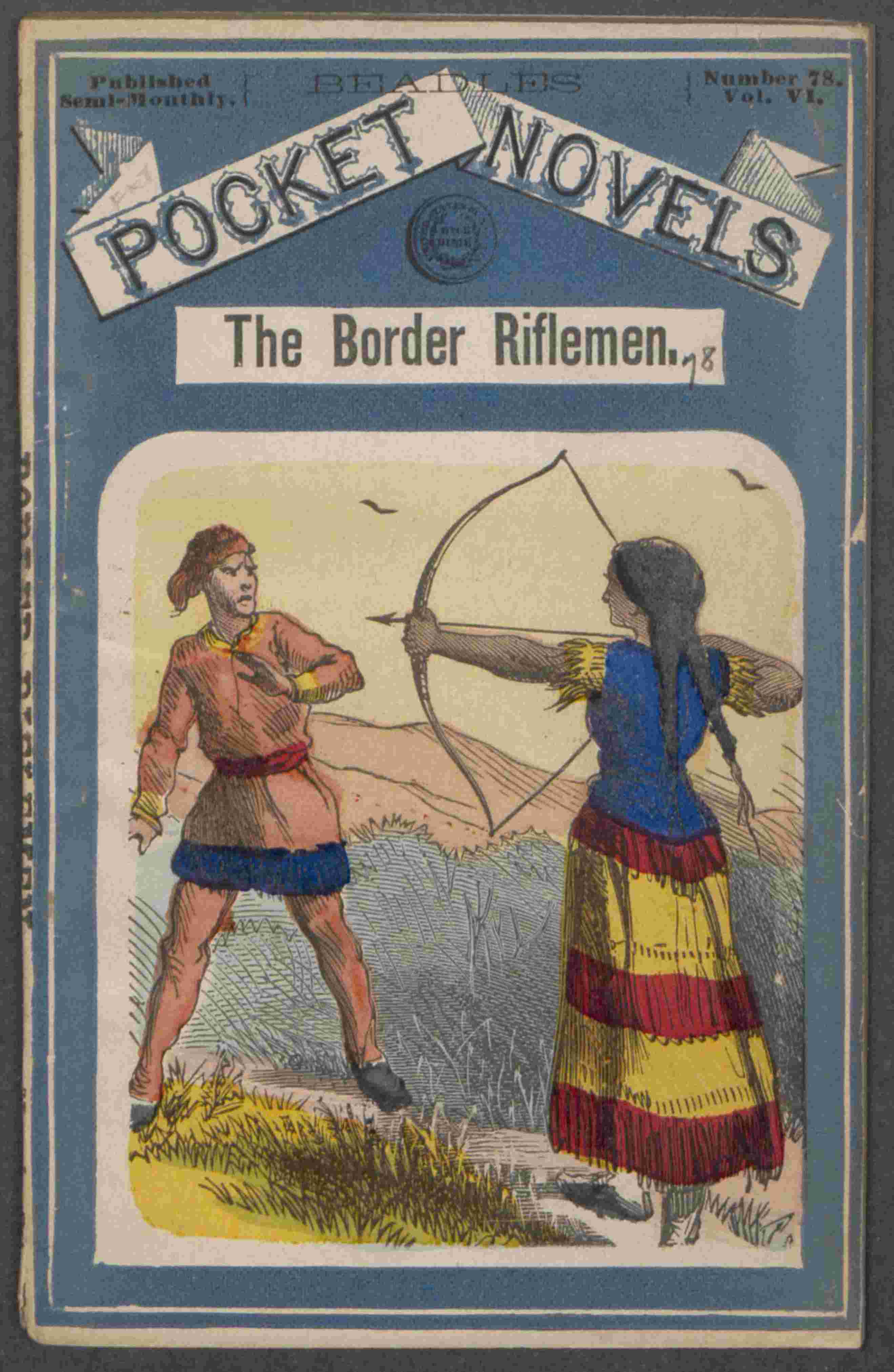
The Project Gutenberg eBook of The Border Riflemen; or, The Forest Fiend. A Romance of the Black-Hawk Uprising
Title: The Border Riflemen; or, The Forest Fiend. A Romance of the Black-Hawk Uprising
Author: Albert W. Aiken
Release date: August 15, 2021 [eBook #66064]
Most recently updated: October 18, 2024
Language: English
Original publication: United States: Beadle and Adams, 1876
Credits: David Edwards, Stephen Hutcheson, and the Online Distributed Proofreading Team at https://www.pgdp.net (Northern Illinois University Digital Library)
THE BORDER RIFLEMEN;
OR,
THE FOREST FIEND.
A ROMANCE OF THE BLACK-HAWK UPRISING.
BY LIEUT. LEWIS W. CARSON.
NEW YORK.
BEADLE AND ADAMS, PUBLISHERS,
98 WILLIAM STREET.
Entered according to Act of Congress, in the year 1872, by
FRANK STARR & CO.,
In the office of the Librarian of Congress at Washington.
CONTENTS
- I. The Border Suitor—Cooney Joe 9
- II. Minneoba’s warning 15
- III. Black-Hawk Insulted 22
- IV. Little Fox—Na-She-Eschuck 29
- V. The Price of Treachery 35
- VI. The First Blow 42
- VII. Overboard 49
- VIII. Melton’s Scout—A Bush Fight 54
- IX. The Defense of the Island 61
- X. The Forest Fiend 68
- XI. Black-Hawk Keeps His Word 75
- XII. Sadie’s Sacrifice 82
- XIII. Guests Not Invited 88
THE BORDER RIFLEMEN;
OR,
THE FOREST FIEND.
CHAPTER I.
THE BORDER SUITOR—COONEY JOE.
The sun was going down behind the western hills in a flood of yellow light, and a river dimpled on under the slanting rays, great fish leaping now and then from the placid surface, and the trees along the bank casting fantastic shadows into its depths. In a sheltered nook, near a spot where a little creek joined the river, a settler had built a cabin, which the hand of woman had beautified and adorned as only the hand of woman can. Bright flowers bloomed on each side of the rustic doorway and an English ivy vine clung to the walls and was rapidly spreading its delicate tendrils over the whole front. The cabin faced the stream, and behind it the hand of industry had cleared many acres which now showed heavy growths of cereals and roots, carefully cultivated. It was a silvan spot, and one upon which the eye of the artist would linger long and pleasantly.
The door opened suddenly, and a young girl holding a water-pail in her hand came out with a free, careless step, singing a merry song. She was plainly dressed, and yet there was an air of native grace about her every movement which plainly showed that she had not always lived amid such wild surroundings. She was beautiful—not the vapid beauty of cities, but that of perfect health, and a free life. Her form was untrammeled by the fashions which cramp and deform the beautiful women of our day, and her face, a little browned by exposure to the to sun, glowed—
“With sunny beauty and rustic health.”
Maud Müller—Whittier’s Maud—was not more beautiful than this frontier damsel. Not only was her face cut in a perfect mold, but her eyes sparkled with life and vivacity, and her sunny hair, unconfined, hung about her shoulders in beautiful profusion.
She left the river, turned down the creek, entered a little grove half a mile from the house, passed through it, and looked across the open field beyond.
“Father,” she cried, “are you there?”
No answer was returned, save the echo of her musical voice, and she looked about her in evident surprise.
“Where can he have gone?” she murmured. “Father!”
As the words left her lips there was a slight rustle in the bushes by her side, and a man came out and stood beside her. He was still young, but his strikingly handsome face bore the marks of a life of dissipation and riot. He was quite tall, nearly six feet in his moccasins, with a face which showed unmistakable signs of Indian blood, though somewhat remote, and a wandering black eye, full of passion. He was dressed in hunting costume, and held in one hand a long rifle, and two small protuberances in the breast of his hunting-coat showed where his pistols lay concealed.
“I thought I should meet you here, Sadie,” he said, quietly. “You don’t look very glad to see me.”
“You know what I think of you, William Jackwood,” she replied, turning quickly away. “How dare you to come here, after what has happened?”
He laughed a low, bitter, chilling laugh, which did not indicate enjoyment, and his black eyes seemed to emit sparks of fire.
“I would not refer to our last meeting, if I were you, Sadie,” he said, evidently controlling himself by a violent effort. “I was half crazy with liquor that night or I would not have said what I did. See here; give me a chance to make this right with you and I’ll do it. I want to be a friend to you—I do, upon my soul. I’ll ask your pardon on my knees, if you’ll forgive, and promise not to lay it up against me.”
“I forgive you,” she said, with a cold, passionless glance, “but you must not come here any more, for all that. My father has told me not to have any more to say to you, and I shall obey him.”
The man stood grinding the butt of his rifle into the soft earth, and fighting a powerful battle to keep down his heart. The girl no longer looked at him but took up the pail and was moving on.
“Wait a moment,” he said, hoarsely. “I can’t part from you like this, Sadie. You don’t know what you are doing or what will happen if you don’t use me more kindly. By—I beg your pardon, but I am half mad—I can’t stand it. Do you know that I worship the ground you tread for your sake, and would give my life at any moment if it would be of service to you?”
“You must not speak to me in that way, Mr. Jackwood,” she said, in a more gentle tone. “I am truly sorry for you if you speak the truth, but I can not listen to you. Aside from the fact that my father does not like you, I have my own inclinations to consult, and I do not and never can love you.”
“Then you love some one else,” he cried savagely. “All right; marry him if you dare, but of this be assured—the moment you stand up before the minister with any man, if it were my own brother, I will kill you both where you stand. Do you hear me?—I will kill you both.”
“Do you dare to threaten me in that way, Will Jackwood? Oh, if my father were here, he would teach you to insult his daughter in that way. Do you think to frighten me by idle threats? Since you force me to say it, know that the sight of your dark face is and always has been odious to me, and that I will never speak to you again except upon compulsion under any circumstances.”
He caught her by the wrist with his disengaged hand and held her firmly, when she dropped the pail and struck him full in the face with her open hand. He uttered a cry like that of an angry tiger, and letting go his hold upon the gun caught her about the waist with his strong right arm. Powerless in his grasp, she struggled with all her strength and screamed for help. The call was not made in vain, for a quick step was heard, and a heavy body crashed through the bushes, and Sadie screamed again.
“Comin’, by the mortal, comin’!” roared a hoarse voice. “Oh, yes.”
Will Jackwood released her instantly and caught up his gun, just as a short, thick-set, powerfully-built man darted from the bushes and stood beside them. He wore the fringed hunting-shirt and beaded moccasins of the scout and hunter, and his long, flax-colored hair was crowned by a greasy coon-skin cap in the last stages of dissolution. The face was a marvel of native ugliness, but in spite of that he was greeted with a cry of joy from Sadie.
“Cooney Joe is hyar,” he yelled. “What is the matter now?”
“I have been insulted, Joe,” cried Sadie, panting for breath.
“By that yer p’ison critter, I’ll bet. Now look out, Black Will, acause I’m a-goin’ to give yer the durndest lickin’ you ever got sence yer mammy took ye over her knee. Hyar’s fur ye.”
Before Black Will could bring his rifle to a level the stout hunter dashed in and his heart was beating against the broad breast of the man known as Jackwood. In a moment more they were locked in a fierce grapple, fighting in true western style, without the slightest idea of the rules of the ring. In a stand-off fight, the long arms and powerful build of Black Will would have given him a decided advantage, but in the close grapple Cooney Joe was more than his equal, and loosening one hand by a violent effort he struck his antagonist such a blow in the face that his teeth seemed to rattle in his jaws, and he staggered. Throwing himself forward with a victorious war-whoop, Cooney Joe brought him to the ground, and the next moment was kneeling on his breast with his long, brown fingers fastened on his throat in a decidedly uncomfortable way.
“Yah-h-h—hip! Got ye that time, my sweet infant! The old coon kin climb a tree yit. Say the word, Miss Wescott, an’ by the big meat pie I’ll choke the life clean out of his pesky karkidge.”
“Let him go for the present, Joe,” she said. “He has been punished sufficiently, and it will teach him that I am not friendless.”
“Oh, pshaw! don’t let him git off that way. Take off his belt and let me larrup him with it till he howls.”
“No, no; don’t strike him again. Take away his weapons and let him go.”
“Hold on,” said Black Will hoarsely. “Don’t touch the pistols and I promise to go away at once, and not make a move for revenge to-day.”
“That’s fair,” said Joe, rising. “I never knowed the critter to break a fair promise, Miss Sadie, and you kin trust him.”
Cooney Joe stood up and Black Will slowly arose, with an expression of fearful malice upon his dark face, slowly brushing the dust from his clothing without speaking a word. Cooney Joe had taken up his rifle and stood leaning upon it, a grin of enjoyment stretching his naturally wide mouth.
“Curi’s how things come ’round, ain’t it? I’ve wanted a lick at you fur nigh onto five year an’ never got a chance till now; does me good, this does.”
“Of course you know I’ll have your life for it, Joe Bent,” said Black Will, in a quiet tone.
“Sartin, sartin, if ye kin git it,” replied Cooney Joe. “But don’t forgit that ef I see yer hand go anigh a pistil in a strange company I’ll try to shoot first. ’Member that, don’t ye.”
“I’ll try to remember, Joe,” was the reply. “Now, Miss Wescott, I will say to you what I intended to say when this meddling fool broke in upon us. You shall never live to be the wife of another man. If I can not have you, no one else shall, I swear by every thing I hold true.”
“P’isen critter, ain’t you, Will?” said Cooney Joe, regarding him with a look of benign interest, as a great natural curiosity. “I’ll be individually an’ collectively cussed ef you ain’t a nice picter to go a-talkin’ about marryin’ a gal like Miss Sadie. Why, bu’st my buttons, ef I don’t think she’d ruther have me!”
“I would indeed,” replied Sadie.
“Who asked you to speak, Joe Bent?” said Black Will, savagely. “Keep your distance and live in safety for twenty-four hours, but after that I will take your life, no matter where I meet you.”
“You rare ’round the awfulest kind, don’t ye,” replied Joe, with a merry look. “Dash my bacon ef you ain’t a study fur a painter. I’ve see’d chaps in the theater at St. Louis that rared ’round the stage jest as you do now, but somehow they allus got special hail kolumbia in the end. Now git; I don’t want to say any thing more but git.”
Black Will quietly tightened his belt, brought his rifle to a “right shoulder shift,” and was off at a long, slinging pace which carried him rapidly across the field.
“Thar goes a pizen critter, Miss Sadie,” muttered Cooney Joe. “Now I reckon he meant jest what he said when he told me that he’d hev my life, but I’ve took a good many chances, though he’ll hev my ha’r sartin ef I don’t shoot first when we meet.”
“I am sorry to have brought you into danger, Joe,” said the girl.
“Sorry—danger—git out! D’ye think I keer fur that, little gal? Why, make it the wust ye kin, the chances ar’ I git a shot afore he does, an’ ef I miss, then it’s my own fault. Whar’s yer daddy?”
“I came out to find him and bring him some drink. I thought he was at work in this field.”
“He orter be keerful,” said Joe Bent, uneasily, “’cause the Injins are gitting r’iled up awful, and thar’s no tellin’ when they may break out. Let’s try an’ find him.”
“There he is now,” cried Sadie.
As she spoke, a middle-aged man, with a hoe across his shoulder, appeared at the other side of the woods and came rapidly toward them. As he came near he shouted cheerily to Joe Bent, who seemed very glad to see him, and they shook hands heartily. Mr. Wescott had the same air of gentility which showed itself in his daughter, but, like her, had adapted himself to his present surroundings, and looked the picture of a genuine western farmer. In stature he was almost a giant.
Sadie rapidly recounted her meeting with Black Will, and all that had passed between them, and the face of Mr. Wescott darkened, while his hand closed convulsively upon the handle of his hoe.
“It is a lucky thing for the black-hearted scoundrel that I was not by, Sadie,” he said, “or it would have gone hard with him. What brings you up this way, Joe?”
“I sort o’ got a hint to git off the hunting grounds from that pernicious red devil, Napope, who is sp’ilin’ fur mischief. Ar’ ye good friends with the Injins, ’square?”
“Certainly; I never wronged one of them in my life.”
“Not that it matters much ef they once rise,” continued Joe, “because then they won’t hev any friends in the white race. I’ve my doubts of that Black Will, anyhow. Two weeks ago I saw him in the Injin village, an’ him an’ that cussid Napope was ez thick ez flies in sp’iled bacon.”
“What is the trouble with the Indians?” said Wescott, uneasily.
“Them cussid agents rob them like thieves,” replied Joe Bent. “Ef Black-Hawk would only ketch an’ burn them, I don’t believe our fellers would kick much, they act so fearful mean. Do you know that I think the village the best place fur Miss Sadie, ’bout this time in the year?”
“I’ll talk to you by-and-by,” said Wescott, with a quick glance at his daughter’s observant face. “Come to the house and get something to eat.”
They quickened their steps and reached the cabin, and while Sadie set about preparing a meal, they sat outside and smoked their pipes, talking in low, eager tones. Sadie could see that their conversation was very important, and, woman-like, felt piqued that they kept it secret from her, and hurried her preparations. In a few moments the homely meal was smoking on the board, and they sat down, enjoying their food with keen relish; but the two men dropped their conversation, or rather, changed it to indifferent subjects, much to the disgust of Sadie. Just as they were about to rise from the table, she gave utterance to a cry of surprise and ran to the door, and a moment after appeared, leading an Indian girl by the hand.
CHAPTER II.
MINNEOBA’S WARNING.
It was a woman of the Sac nation, but bearing unmistakable signs of white blood. Her form might almost have vied with that of Sadie, and her dark skin glowed with perfect health. Her hair was unlike that of any pure Indian girl, slightly waving, and with a luster upon it never seen in the pure Indian. Her dress was of the richest description that was worn by the women of the tribe, and her head was crowned by a coronet of eagle-feathers, which bespoke the daughter of a chief. Dainty feet, small hands and delicate features distinguished the maid from the majority of her race, and all together, two more noble specimens of native grace rarely trod the same floor.
“By the piper that played while the king danced, if it ain’t Minneoba, the pride of the Sac nation,” cried Cooney Joe. “Say, gal, what ye doin’ ’round yer?”
“Minneoba has traveled a long path, and she is weary,” replied the Indian girl, faintly. “Let the Wild Rose give her food and drink.”
Sadie, who was much taken by the rare beauty of the forest maid, seated her at once at the table and placed food before her. She passed over the few dainties which the table afforded, and ate the most simple food, and her appetite was soon gratified. Joe whispered aside with Mr. Wescott.
“I tell you that the gal is the favorite daughter of Black-Hawk,” he whispered, “an’ she’s got some good reason fur bein’ hyar. But don’t hurry her, for I know the breed and she’s obstinit, durned obstinit, when she hez a mind to, though she’s a good gal, too.”
In the mean time the Indian girl was chatting merrily with her new friend, and her musical laugh rung through the cabin.
“Whisper to Sadie to git her confidence, Mr. Wescott,” muttered the hunter. “She kin do it. The gal is open-hearted as the day, and ef she means friendship she means it.”
Wescott called Sadie aside and spoke to her in a low, hurried tone, and nodding intelligently, the white girl returned to the side of the Indian girl, and soon after the two rose and went out of the cabin, strolling down by the river side. Minneoba had her fan in her hand, more from habit than any thing else, and they walked along the green banks, talking earnestly.
“Minneoba is the daughter of Black-Hawk,” said the maiden, in answer to a question, “and she loves her father well. The heart of the old man is very sad, for he sees the white men forcing the Indian step by step out of the land their fathers gave them. Look down and tell me what you see.”
Close to the bank of the stream not far away a succession of low mounds of different sizes showed where the ancient grave-yard of a tribe had been. Not far from this a white village was seen, the farms of the settlers encroaching upon the graves.
“When we bury the bodies of those we love, daughter of the white man, it is not pleasant to think that the feet of the strangers tread upon the graves. The Indians are rough and rude, but they too love the graves of their fathers, and it makes them sad to think that the plow of the white man will disturb the loved remains.”
“It is very sad, but I have heard that Keokuk sold this land to our people.”
“Keokuk has done wickedly,” cried the girl, excitedly. “It is a false Indian who treads upon his father’s grave, or allows the white man to do it. A Sac despises the man who is so base.”
“What will the Indians do?”
“What they will do is not for an Indian girl to say; their hearts are very sore, but they would be friends with the white men, if the white men will let them. But fire-water and bad men will make trouble in the land. Tell the people of the village that it would be better for them to give up the Sac town and build for themselves upon another place.”
In order to understand the words of Minneoba fully, it will be necessary to set down the history of the events which finally drove Black-Hawk to desperation.
By the treaty entered into by the United States upon one side and the Sacs and Foxes, Siouxs, Omahas, Iowas and Ottoes upon the other, headed by Keokuk, or the Watchful Fox, the land of these tribes was sold to the United States. In this bargain and sale Black-Hawk took no part, but in spite of that the Indian agents insisted that he should leave his village, which without his consent had been sold to the whites, and build another upon the west bank of the Mississippi.
No race love their native land better than the Indian, and Black-Hawk was of the pure blood. He cursed the traitors who had sold their country, but vowed that he would not leave his village until compelled to do so by force. Every little disturbance between wandering white men and the tribes, every slight affair of whatever kind was magnified and turned against the Sac chief. Yet he only sought to do what was right, and prevailed upon Keokuk, who had made the treaty, to go to the white agents, with whom it had been made, and offer them in the name of the Sacs the lead mines, the most valuable property of the Indians, if they might be permitted to retain their village. The Watchful Fox, satisfied that he had sold that which was not his own, agreed to go, and ask for Black-Hawk the little land on which the village stood, including the grave-yard of the tribe. It was refused.
It was the custom of the western tribes at this date to go out in winter in a body and have a great hunt. Black-Hawk went away at the head of his tribe with secret misgivings, and the village was left unguarded. This was the winter of 1830, and when the Indians came back from their hunt they found their village in the possession of the whites, who had taken advantage of their absence to take possession. The river was yet full of floating ice, and it was impossible for the Indians to move, but they sent word to the invaders that before corn-planting they would drive them out of the village, no matter at what cost to themselves.
The whites were alarmed, for they felt their inability to oppose the tribe with their present number. A deputation was sent to the chiefs, proposing that they should occupy and plant the land together. The Indians, always generous in the disposal of land, agreed to the proposal, but upon arriving they found that the whites had seized and planted the best of the land.
The peaceful village became one of the most disorderly upon the frontier. With the whites came in their vices, and the Indians, naturally weak, began to feel their effects. The sale of liquor was commenced, and by its aid the whites gradually robbed the Indians of all that they could call their own.
The chief saw with alarm what must be the result, when they received orders to cross no more to the east bank of the river. The result of such an order may be readily understood, rousing all the fierce passions of the Indians, and in this state matters stood at the time when Minneoba visited the cabin of Mr. Wescott.
The Indians were now nearly all upon the west bank of the river, the chiefs preferring this to longer intercourse with the white men. These simple men were no match for their wily antagonists, and had too rapidly imbibed their vices. Black-Hawk was an Indian, but he had a heart to feel for the woes of his people, and he saw that only by force of arms could he hope to succeed in wresting his country from the hand of the invader.
“Is it possible that my father’s land belongs to the Indians?” said Sadie. “He paid for it honestly, and would not willingly wrong any man.”
“The Wild Rose speaks truly. Her father has a great heart, but he holds the land which belongs to Black-Hawk.”
“Then he will pay for it again, sooner than wrong a chief of the Sacs.”
“Black-Hawk will not sell his lands to a white man. Let the words of Minneoba sound in the ears of Wild Rose. This is no place for her to dwell. Let her get a swift horse and fly away until the tempest has passed, for a dark cloud hangs over her father’s house and threatens her.”
“I have done no wrong; why should I flee?”
“My sister, the evil will come to the just and the unjust, for Black-Hawk will have his land again. Do not ask me to tell you more, for a Sac maiden can not betray her father, but take those you love and fly.”
While yet speaking, the rapid beat of hoofs could be heard, and two men rounded a point of woods and approached them. At a glance Sadie recognized Black Will and a desperate ruffian who was more than suspected of selling arms to the Indians, a great offense upon the frontier. This man’s name was Richard Garrett, and he was hated and feared all along the border.
“Ha, look!” cried Minneoba. “Yonder comes a bad white man, who has spoken evil words in the ears of Black-Hawk. What does he here?”
“Let us hurry away,” whispered Sadie. “He is my enemy, and I fear to meet him now.”
The two girls darted into the bushes, but not quickly enough to evade the eyes of the two men, who at once urged their horses and overtook the flying girls.
“Ha, my dear,” said Black Will, placing himself in front of Sadie, and effectually barring her further flight. “I did not expect to meet you so soon.”
“Do not stop me, Will Jackwood,” cried Sadie. “You have been punished once to-day for your insolence. Joe Bent is not far away.”
“He is safe from me for this day, for he has my word,” replied Black Will. “But, when we meet again, one or the other goes down.”
“Threats do not hurt the absent,” was the quiet reply. “Let me pass at once.”
“Not so fast. I shall not have a better opportunity than this, and must entreat you to come with me.”
Unconsciously, in their walk, the girls had come some distance from the house, and at that quiet hour few persons were abroad. Sadie understood the object of Black Will. It was to seize and carry her away for the purpose of forcing her to become his wife. He sprung out of the saddle, and menacing her with instant death if she cried out, hurried toward her, when a new and unexpected obstacle stood in his path. Minneoba had been almost unnoticed by the two scoundrels, and seeing that Dick Garrett was employed in holding the horses, the brave girl suddenly strung her bow, and fitting an arrow hastily, sprung in between Black Will and his intended victim, and he recoiled with a cry of rage, as the bright point of the arrow glittered in the light.
“Minneoba, by all the devils! Out of my path, girl, or a worse thing may come to you.”
But Minneoba did not move, her bright eyes fixed upon the form of the would-be abductor in a way which he did not like.
“Sadie is the friend of the Sac girl,” she said, quietly. “You shall not touch her while I live.”
“You don’t know what you are doing, mad girl. What will your father say when he knows that you have aimed an arrow at my breast—mine, of all white men in the territory!”
“It would be better for Black-Hawk if you had never seen him,” replied the girl. “Take your horse and go, for I will spare your life if you do not touch the Wild Rose; touch her, and you are dead.”
Black Will was a brave man, but he knew well the deadly skill of the Indian girl, and had seen it proved a hundred times in sportive encounters in the Indian village. Though full of rage, he dared not advance.
“But listen to me, Minneoba,” he said. “This girl is to be my wife; I love her, and would take her into my lodge.”
“Let me hear her say that she loves you, and the Sac girl will not come between you. Stand back, or the arrow flies from the string.”
“You shall suffer for this, girl. Black-Hawk shall know how his daughter claims for a friend the daughter of the man who holds his land. We shall see how he likes that.”
“Minneoba can talk to Black-Hawk; she does not need the white hunter to tell her what to say.”
“She’s a bu’ster, Will,” said Dave Garrett, laughing. “I reckon you had better give it up. Come, little girl, don’t be foolish. Get out of the way, for my sake.”
Minneoba did not move, and the arrow was still ready to fly.
“Hark, Will! There come horses. Let’s get out of this as quick as we can.”
Black Will, shaking his clenched hand at the immovable figure of the Indian girl, sprung into the saddle, and the two men rode away at the top of their speed. They were scarcely out of sight when a party of mounted riflemen came up at a trot, but, seeing the two girls, they halted, and the leader dismounted and came toward them. He was a young, handsome fellow, in a fringed hunting-coat, booted and spurred, and wearing the insignia of Melton’s mounted rifles, to show that he was captain of scouts. He lifted the cap gracefully from his head, and bowed low as he approached.
“Captain Melton of the mounted rifles, by way of introduction. May I ask if you have seen any thing of a man known in this region as Dick Garrett?”
“He rode away five minutes since in company with William Jackwood.”
“The deuce he did! Excuse me, Miss, which way did he go?”
Sadie pointed out the road, and with a hasty adieu the young officer bounded into the saddle and the command went off at full speed, with Melton at their head. Sadie had noted that his dark eyes had rested admiringly upon her, and she was herself struck by his noble appearance, and Minneoba laughed softly. She could see that the two had met before.
“The young white chief is very brave. Sadie could love him!”
“Nonsense, you foolish girl,” said Sadie, blushing. “I have only seen him twice before, and probably shall never see him again. Let us return to the house.”
CHAPTER III.
BLACK-HAWK INSULTED.
They had scarcely reached the house when the sound of voices could be distinctly heard upon the river and Joe sprung to the door, from which the stream was plainly visible. A dozen canoes were upon the water full of Indians, crossing from the other shore.
“You’d better git out of sight, Minneoba,” said Cooney Joe. “It won’t be well for them to see you here unless you are forced to come out.”
The Indian girl hurried into the cabin, and went into Sadie’s room. A moment later a tumultuous band of Sacs, shouting out furious threats against the whites, landed near the cabin and came hastily toward it.
“Drunk as lords, every man jack of them,” said Joe. “We’ve got to talk sweet to them or thar will be some ha’r raised right about yer. Thar; that’s old Black-Hawk himself, by George. I wonder what he wants.”
An Indian somewhat advanced in life, and wearing the usual insignia of a chief of the Sacs, headed the party, and a word from him stilled the clamorous tongues of the warriors. Mr. Wescott and Joe stepped out to meet them, and the chief received them by a lofty gesture.
“We come for corn,” he said, “and my young men are so angry that they need the hand of a chief. It is hard that the Sacs must come like thieves in the night to take corn from their old fields.”
“It is hard indeed, Black-Hawk,” replied Mr. Wescott. “I am as much grieved as you can be that this thing has happened, and upon my word, I hope that you may settle this trouble peaceably.”
“Why do you stay on the Sac fields then?” replied the Indian, morosely. “The words of my brother are wise, but they do not agree with his actions. I stand upon Sac ground, which is not sold and can not be sold unless Black-Hawk puts his totem on the paper and gives a belt. Why is the white man here then?”
“I bought of a man who claimed the right to sell,” said Wescott, “but I am willing to give you a fair price for the fields, even now.”
“Black-Hawk will not sell his fathers’ graves,” replied the chief, fiercely. “Look; your white men are making my warriors like themselves, good at talking but no workers. They drink the accursed fire-water and become hogs. In a few years, the name of Sac will be forgotten and they will be but beasts to carry the loads the white man puts upon their backs.”
“It’s no use talkin’ now, Black-Hawk,” said Cooney Joe. “I don’t say it’s right—because it ain’t—for Keokuk had no right to sell your land. But, the thing’s done and our fellers have possession, and I’m afraid they won’t give it up.”
“They must.”
“Oh, pshaw; you ought to know that they are darned good at takin’ things but they don’t give back wuth a cent. You may as well build a village over yender.”
“That they may come and take it again,” replied Black-Hawk, with a bitter laugh. “Let us speak no more, for my tongue grows bitter in my mouth. Sons of the Sac, let us go for corn.”
The Indian stalked away, followed by a shouting crowd of his adherents, and Cooney Joe looked uneasily at Wescott.
“I don’t like this, ’square. You see our fellers ar’ mighty rough on the Injins, and I heard some on ’em say that ef the Sacs came over to steal corn they’d give ’em an all-fired lickin’. Now if they do that it means war.”
“I hope our men will not be so impudent,” said Wescott. “They ought to give the poor fellows a chance to carry away corn for their suffering families, since they have dispossessed them of their land.”
Half an hour passed, when suddenly there came a great tumult from the direction in which the Indians had gone. The shouts of men, the loud and continuous barking of dogs, and the occasional crack of fire-arms, could be heard.
Cooney Joe caught up his weapons, and followed by Mr. Wescott, hurried away in the direction from which the sound came. They had not gone half a mile when they came upon a great rabble of whites surrounding the party which had come over for corn, abusing them in every possible way. Showers of stone were hurled upon them, clods of earth and filth of every description was cast upon them, and they were fighting their way slowly back toward the stream, apparently unconscious of the insults heaped upon them. Foremost among them, walking with a firm step, but with a dark cloud gathering upon his brow, strode Black-Hawk. A stone had struck him on the forehead, and the blood was trickling slowly down his face, but he did not seem to be aware of the fact. Once or twice he turned his head when some unusually vile epithet was heaped upon him, with a haughty glance at the offender, which they remembered in the after times, for two men who struck him, and whom he marked for destruction, were the first to fall when the struggle commenced in earnest.
“White men,” cried the chief, halting, at length. “Do not dare to stand in the track of Black-Hawk, upon his own land.”
“Your land, you old thief,” roared a man named Churchill. “You lie! It is ours—fairly bought—and we will keep it.”
“Black-Hawk does not waste words with a man with a double tongue, who is only fit to sit with the women when the warriors are on the battle-field,” replied the chief.
Churchill caught up a handful of sand and flung it into the face of the old chief. Black-Hawk trembled in every limb but not with fear, and he clenched his hands until the blood started from beneath his nails.
“Fool!” he hissed. “In the days to come, remember Black-Hawk!”
That the man had good cause to remember this insult, the history of that time will show.
The Indians went on their way, but all around them the confusion became greater, and it was with the utmost difficulty that they kept their ranks, and kept down their passions enough to prevent the use of the tomahawks, which every man carried. Had Black-Hawk but given the word, they would have rushed like tigers upon their prey, and torn the rabble asunder like cobweb. But the policy of the chief had been opposed to bloodshed, and he hoped to be able to get to the river without being forced to draw a weapon.
“Look at the black thieves,” roared Churchill. “Down with them, boys; shower the mud on them; stone them out of the country.”
He was but too well seconded by those who followed him, and many of the Indians were badly hurt by the missiles which were thrown at them. Directed by Churchill, three or four strong men rushed suddenly forward and laid hold upon the chief, with the intention of beating him.
“Dogs!” cried the Sac, casting them aside like feathers. “Take your clubs, sons of the brave.”
Up to this moment the Indians had not lifted a hand, but at the order of their chief they lifted their clubs, and sprung forward with furious yells. The chief singled out Churchill, and leaped upon him like a tiger, but the man ran backward, and the chief, never thinking of support, followed him with uplifted club. Before he was aware of his danger he was in the midst of a circle of infuriated whites, who commenced an indiscriminate assault upon him, striking and kicking him with merciless force. It is impossible to say whether he would have escaped with life, but at this moment the rabble parted before the rush of strong men, and Cooney Joe and Mr. Wescott darted into the circle, and placed themselves beside the chief.
“Back, if you are men,” cried Wescott. “What, thirty against one poor old man!”
“Keep cl’ar, keep cl’ar,” cried Joe, flourishing his rifle in a threatening manner. “He’s an Injin, but fair play’s a jewel, you know. You won’t strike him ag’in while I stand hyar.”
“Get out of the way, Joe Bent,” screamed Churchill. “What business have you to interfere?”
“Because I’m called on by a magistrate,” replied Joe. “Keep cl’ar, I tell ye, or I’ll make my rifle-butt acquainted with the softness of yer head. Back a little.”
“Disperse, every one of you, and let the Indians return to the river, and I will see to it that you are punished for what you have already done,” said Wescott, as they hesitated. There was some grumbling, but after a little they began to step away, and the little knot of Indians were left alone upon the field.
“I am sorry that this has happened, Black-Hawk,” said Wescott. “You want corn, you say; go to my crib and take out what you want.”
The chief did not reply, but he stood looking after the retreating forms of the white men, with a moody brow. Many a man who was in his grave before that season closed, might have been alive and happy but for that vile attack.
“Black-Hawk owes much to the white man,” he said, slowly. “They have stolen his village, trampled upon his father’s grave, plowed up the earth above the dead, and scored the earth with their axes. Now they have insulted Black-Hawk and he will remember.”
“I would not take it too much to heart, Black-Hawk,” said Wescott.
“Black-Hawk will remember,” was the reply. “But look my brother. By this blood which drops upon the earth I promise friendship to you and yours. You are two just white men; and all the tribes shall honor you for what you have done this night. Let my good brother go toward the rising sun and stay until the tempest has passed by.”
Wescott shook his head, and walked beside the chief to the river. He refused to take any corn, and as the canoes pulled off the two foresters looked at each other.
“This is bad, Joe,” said Wescott, “but we must get to work. Do you know where the General is now?”
“He’s at Jefferson Barracks—that’s whar he is,” replied Joe.
“Then he must be spoken to and at once. In the mean time I will take a horse and see other officers and concert measures for the public safety. The whole North-west is in danger, for many will follow Black-Hawk.”
They hurried back to the cabin, and to his delight the settler found Captain Melton there, who had returned unsuccessful from the pursuit of Black Will and Dick Garrett.
The young officer was well known to both Mr. Wescott and Cooney Joe, and was cordially greeted by both.
“What was this disturbance I heard just now, Mr. Wescott?” said Melton, as they shook hands. “It sounded almost like a battle.”
“It was very near one as it was,” said Wescott. “Our people surrounded a party of Indians who came over for corn, insulted them in every conceivable way, beat and threw stones at them and injured Black-Hawk quite severely.”
“You don’t tell me that they have hurt Black-Hawk?”
“Yes, and if I know any thing of the Indian he will resent it.”
“This is too bad, just when we hoped to settle the matter peaceably. Let the people on the frontier look to it now, for there is trouble ahead as sure as we live. Hi, there, Stanley,” he cried, addressing one of his men. “Ride to the Post and see the General. Tell him exactly what has happened, word for word, and when you have done that, go back by way of the island and tell the rest of the boys to come up.”
“Do you think they will fight, captain?”
“Of course they will, and we have a lot of dunderheads who will do their best to force it on. With your permission, Mr. Wescott, I will stay here to-night, if you will let the men sleep in your barn.”
“Certainly; if the house were large enough they should be welcome to that.”
The command of Melton was an independent one, composed principally of bordermen and scouts, selected for their known valor and knowledge of the country. As usual in such cases they were despised by the dandy regiments until two or three rough bouts between the men had taught them a lesson. They were very popular with the masses, however, and in a bush fight, were capable of doing more work than any body of men in the service.
Two or three couriers were dispatched in various directions, and then the party camped outside, while the captain entered the house, where he was received by Mrs. Wescott and the daughter. The elder lady had just returned from a visit down the river.
“This is Charley Melton, my prince of borderers, the best scout captain in the territories,” said Wescott. “Captain, my daughter Sadie.”
“I met Miss Wescott early in the evening when in chase of a desperate gambler who had shot a man over a card-table. And indeed we met twice in the village.”
“I hope you caught him, captain,” said Wescott.
“Sorry to say I did not. How the fellow managed to slip away I don’t know, but when we got to the bend, all trace of them was lost. He had a man in his company whom I want to see, for I believe he is stirring up the Indians against us.”
“You mean Black Will Jackwood, I’ll bet,” said Joe Bent.
“Yes; what made you think that?”
“’Cause I see the bloody cuss at Rock Island, whisperin’ round old Black-Hawk, and it looked bad to me, somehow. It will be a ’markably good thing when he is hung up out of harm’s way.”
“That good thing will be very likely to happen if we have the good luck to catch them. Ha! What Indian girl is that?”
“Minneoba, the daughter of Black-Hawk,” replied the girl, coming forward. “Let not Loud Tempest fear that she will speak the words she hears in the lodge of her white father in the ear of the Sacs. Minneoba is not a creeping serpent, and will not betray her friends.”
“Loud Tempest, eh? Poetical name the Sacs have given me, though for what cause I do not know. What have you there, Dix?”
An orderly had appeared at the door and saluted.
“Caught a Pottawatomie, just now, who claims that he has something to say.”
“Who is he?”
“Little Fox.”
“Pah! I don’t think much can be made out of him. However, bring him in, and let us hear what he has to say.”
The orderly turned and beckoned, and an Indian, greasy and smoke-begrimed, with a face which bore evident signs of hard potations, appeared in the doorway. This “lord of the forest” was very drunk. His eyes rolled in their sockets, and he found it easiest to stand by the aid of the door-post.
CHAPTER IV.
LITTLE FOX—NA-SHE-ESCHUCK.
The Indian was one of the worst specimens of his race—a creature naturally brutal, who had been rendered more debased by an excessive use of fire-water. As he clung to the door-post and looked at them out of bleared and watery eyes, he was as disgusting a specimen of the genus homo as could be found between the two oceans.
“Let me talk to this critter,” said Cooney Joe. “I calculate I understand the natur’ of the unadulterated, unb’iled, unwashed and unclean drunken red, as well as any man in the great Nor’-west. I do, by the livin’ hokies. Hyar, you ’possum, speak up, and speak quick; what ar’ ye looking fur now?”
“Fire-water; poor Injun very dry,” replied this noble red-man. “Tire—much tire; walk durn good ways; mus’ hab fire-water.”
“You got to airn it fust, my noble red,” replied Joe. “Come, agitate yer jaw; tell us what ye want.”