
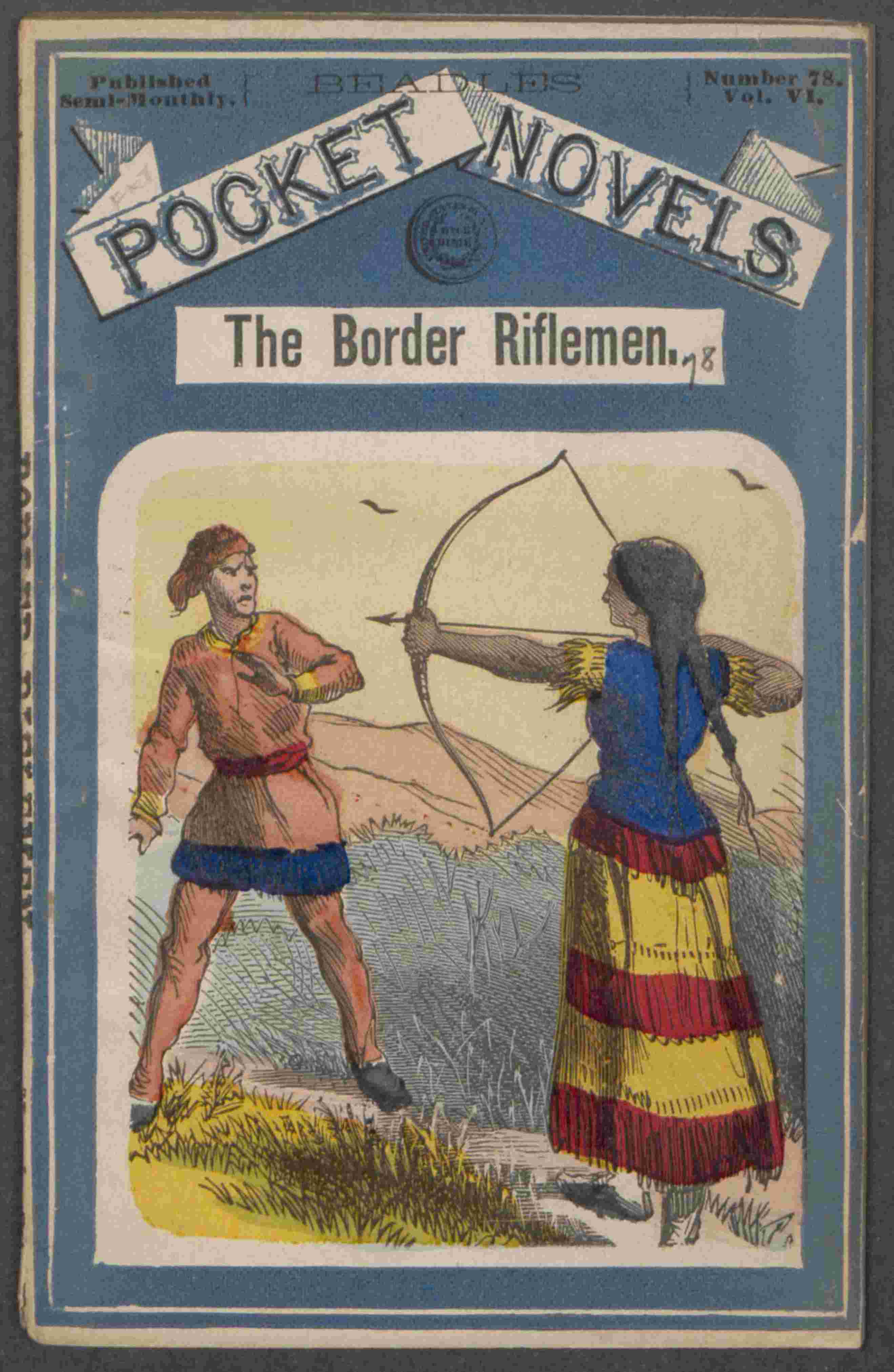
“S’pose you give Little Fox fire-water, den talk. How can talk when no hab drink? Ugh!”
“That’s the heathen philosophy, gents all,” said Joe, with a look of supreme disgust. “No whisky, no news. Got sech a thing as a drain of sperrits handy, ’square?”
Mr. Wescott left the room, and returned shortly with a small flask of rum, from which he poured out a glass for the Indian, who drank it with avidity, smacked his lips, and held out the glass for more.
“Hold on,” said Joe, pushing back the extended hand. “Not ef I know it, Injin. That tongue of yours begins to double, anyhow, and I reckon you’ll hev to do some talking afore you git any more rum.”
“Pottawatomie big warrior, much brave,” replied the Indian, loftily, striking his clenched hand upon his broad breast. “Give Injun rum.”
“I’ll give you a bat ’long side your old head ef ye ask fur more afore you’ve done the work,” said Joe, angrily. “Come now, speak up. What d’ye want?”
“Want rifle—want blanket—want heap fire-water!” replied Little Fox. “Got heap story to tell.”
“Lies, probably. Come, out with it, and ef it is any use to us, then we’ll pay han’sum. That’s the time of day.”
“Want him now,” replied the Indian, with a surly glance at the speaker. “No tell news widout you put him down here.”
“That won’t do, Injin,” said Joe. “You heard what the fellers done with Black-Hawk, just now. I’ve only got to say the word, and you go away the sorest Injin in the Nor’-west. Tell us any really important news, and we’ll give you a rifle, two blankets and a keg of rum, and you kin drink you’self to death in a week.”
“Much promise—little do. Dat white man’s way,” replied the Indian. “Little Fox no speak.”
“Will you speak if I promise to give you what you ask?” said Captain Melton, advancing.
“Loud Tempest will do what he says,” replied the Indian, with a drunken leer. “Little Fox will believe him.”
“Very well, then; I promise to give you the rifle, blankets and rum, if you tell us all you came to tell.”
“Give Injun stool; sit down like white man. Floor much dizzy; whirl round fast. Ugh!”
By the not very mild assistance of Cooney Joe the Indian was seated on a stool, with his back to the wall, and sat with drunken gravity waiting to be questioned.
“Go on with yer story, you red nigger,” cried Joe. “And see yer, the minnit you begin to lie—and oh, Lord, how he kin lie when he lays his tongue to it!—that minnit I jump on you and yer ha’r comes off.”
“Little Fox will speak with a straight tongue,” replied the savage, drawing himself up. “Give injun more rum, and he talk heap fast.”
Cooney Joe poured out a very mild dose of rum and gave it to the savage, who gulped it down at once, and would have asked for more but that the expression of Joe’s face taught him that such a measure would bring down upon his head the wrath of the hunter, and he prudently refrained.
“Black-Hawk much mad,” he said. “See—white man take his village and plant corn among the graves. That no right in white man.”
“No moril reflections, bummer,” said Joe. “Git on with yer yarn, or off goes yer sculp.”
“Black-Hawk has a great army,” said the Indian. “His braves are coming in from the plains and their faces are painted for war. The white men must not sleep or they will all die.”
It is needless to follow word by word the disjointed narrative of the drunken savage, interrupted as it was by appeals for rum, which was doled out to him in very small quantities by Cooney Joe, who feared that he would get too drunk to articulate. He sat swaying unsteadily to and fro, and told a tale which confirmed their fears. Messengers had been sent out to the various tribes, and all had agreed to follow the standard of Black-Hawk and assist him in driving out the invaders of their land. Nearly all the principal chiefs except Keokuk had given in their adhesion, and bands of warriors were already on their way to the place of rendezvous, not far from Rock Island, where there was a Sac village and a fort. Doubtless the Indian misrepresented the plans of Black-Hawk, but he told enough truth to make his story tally with the preconceived ideas of the whites, and they looked at one another in silent dismay.
“This is very serious,” said the captain of scouts. “This Indian has earned his reward, and if he will come into the village to-morrow he shall have the liquor; the rifle and blankets I can give him now.”
He went out and brought in a very good rifle and two blankets, which he had obtained from the men. A flask of powder was added, and a mold to run bullets, and Little Fox staggered away, happy as a lord, little knowing that the possession of these articles would prove his death-warrant. With the weapon in his hands he staggered toward the village, where he was met by a young warrior of the Sac nation, whom, in his drunken blindness, he did not recognize as the youngest son of Black-Hawk, who was lurking about for information.
“My brother has a fine gun,” he said in the Indian tongue, endeavoring to lay his hand upon the weapon. But Little Fox tore it away from him in drunken wrath.
“Wagh! It is the gun of the white man, and the Sacs will fall before it as the leaves when they are yellow,” he said.
“My brother is very rich. He must have taken much fur to buy so fine a gun,” said the young Indian, who already showed the qualities which afterward gave him a leading place in the tribe.
“Little Fox is the friend of the white man, and he can get a gun for nothing,” was the reply. “When Black-Hawk comes with his warriors he will find the white men ready.”
“Has my brother told the white men what Black-Hawk is doing?” said the young Sac, vailing his rage.
“Little Fox can speak or Little Fox can be silent,” replied the Pottawatomie. “Look: to-morrow he is to have enough rum to last him a whole moon, because he is the friend of the white man.”
“Fire-water is good,” said the Sac. “Has my brother a canoe to carry it across the river?”
The Indian shook his head, and a sort of hazy idea passed through his clouded brain that he had already said as much as he ought concerning the affair.
“I have a fine canoe,” continued the son of Black-Hawk. “Let my brother bring the rum to the Point, and I will help him carry it away.”
The Pottawatomie nodded gravely, and went on his sinuous way, while the young chief darted into the forest, and taking a circuitous course, reached his father’s village at early morning. The old chief was in his lodge, in an attitude of the deepest dejection, for he had not sought a quarrel with the whites. Near him, seated upon a pile of skins, and with a look of deep malice on his face, sat Black Will, holding his rifle in his brown right hand.
“Ha! here comes Na-she-eschuck,” he said. “Now, Black-Hawk, let your great heart awake and listen to the words of your son. Speak, Na-she-eschuck; what are the white men doing?”
“They go about among the lodges they have built above our fathers’ graves and laugh because they have insulted Black-Hawk,” replied the young Sac, fiercely. “Their ears are stopped to all thoughts of peace, and they long for war. Let them get what they seek, since they will have it so.”
“What did I tell you, Black-Hawk?” said Black Will. “The scoundrels do not care for your great name, and they throw mud at you as if you were a common Pottawatomie, and not the head chief of a great nation. Will you bear this tamely?”
“Black-Hawk is an Indian,” replied the proud old man, drawing up his stalwart form to its full hight. “But he does not seek for war. If the white men will let us rest where we now are, I will send the warriors back, and we will be friends.”
“Friends! Friends with the men who threw mud in your face and beat you like a dog?” cried Black Will. “Come, I have been mistaken in you. I thought you were a man ready to revenge your injuries, but the white men have cowed you until you dare not lift a hand against them.”
Black-Hawk bounded to his feet with a terrible cry, and laid his hand upon a weapon. But that Na-she-eschuck sprung between him and the object of his wrath, it is doubtful whether the career of Black Will would not have ended upon the spot.
“Hold your hand, great chief,” cried his son, forcing him back. “He sits under the shadow of your lodge, and you have smoked the pipe with him. Do not make yourself a dog since you have taken his hand.”
“He has insulted a great chief,” replied the old warrior, fiercely. “But, he is right; Black-Hawk is a dog to listen to the words of the white men, and to refuse to dig up the hatchet when so many warriors are ready to follow him to the fight.”
“We must fight,” said Na-she-eschuck. “Little Fox has been among the white men, and has told them that the braves are gathering at the call of Black-Hawk. He is a dead dog, and has taken a rifle and blankets, and is to have much fire-water, because he has betrayed us.”
Black Will began to look uneasy.
“Has the scoundrel told them that I am here?” he asked.
“I can not tell. He is to come to the point above the island with the price of his guilt, to-morrow, and I will be there to help him over the river.”
A grim look crossed the face of Black-Hawk, as his son spoke.
“It is good,” he said. “One traitor shall die, because he has sold himself for the fire-water of the white men. As for us, we will not strike the first blow, but if they take up the hatchet against us, then we will fight. But I will not remove.”
“It is better for us to strike the first blow,” said Black Will. “That is the main thing in war—to strike such a terrible blow, that their hearts will turn water in their bosoms. Look at me; I am of the blood of the white men, but I am not all white. A chief of the Sacs was my father, and he is dead. He died in chains, because he dug up the hatchet against the cowardly Chippewas. You have known and loved him, for you fought by his side. Black-Hawk, Red-Bird was the father of the man who speaks.”
“Ha!” cried the chief. “Red-Bird was a man, but he could not bear the chains of the white man, and he died. Is my son the child whom he lost, who was born of the French squaw, who followed him from Detroit?”
Black Will inclined his head slowly, and Black-Hawk took his hand in his own and pressed it again and again to his bosom.
“Black-Hawk can understand how the son of Red-Bird should hate the white man,” he said. “We will fight side by side in this war, and if we die, let us die bravely. Are the warriors coming in, Na-she-eschuck?”
“They are gathering from every side. They have heard of the insult to Black-Hawk, and their hearts are hot in their bosoms. They will behave like men.”
“It is good,” said the chief. “Now we will go forth, and you shall see how Black-Hawk shall give a traitor his dues.”
They left the lodge, and followed by the brother of Black-Hawk, and Napope, a celebrated chief, moved down toward the river, where the rest of the party concealed themselves while Na-she-eschuck brought out his canoe and crossed to the other shore.
CHAPTER V.
THE PRICE OF TREACHERY.
Little Fox had remained all night in the white village, and as it was noised about that he had betrayed the plans of Black-Hawk, he had no lack of his favorite beverage, and morning found him as drunk as ever. Captain Melton sent a man with a canoe to carry the price of the information to the point above the island, and as the son of Black-Hawk was crossing the river, Little Fox was sitting in drunken state upon his keg, dreaming of the glorious times he would have when he broached it in the seclusion of his lodge. He remembered indistinctly that some one had promised to help him across the river with his prize, but for his life could not remember who it was, and it almost sobered him when he saw Na-she-eschuck crossing from the other shore, and he fumbled with the lock of his rifle, and was half inclined to warn the Sac to keep off. But the fumes of the liquor were still in his brain, and the young chief landed and came toward him.
“The Pottawatomie did not lie to Na-she-eschuck,” said he. “Let us put the fire-water into the canoe.”
“You put him in,” said the owner. “Me watch.”
He looked on while Na-she-eschuck placed the keg in the canoe and then followed, and, drunk as he was, managed to seat himself safely in the light craft. The Sac followed, and obeying the orders he had received, headed up the river, rounded the point of the island, and made toward the other shore. There was something in the stern, steadfast look of Na-she-eschuck which struck a chill into the heart of the traitor Pottawatomie, and almost sobered him, and twice he laid his hand upon his rifle, as if tempted to use it upon his companion. But, as often as he did so, the countenance of the Sac took on a pleasant air of good fellowship, which made it impossible to be angry with him.
“Why does not Na-she-eschuck go to the bank?” said Little Fox. “We will make a hole in the fire-water tub and drink.”
The canoe was now headed directly for the point of the woodland which came down to the water’s edge, and after drawing the light bark up the bank, they took the keg between them and carried it up to the first opening, where it was placed upon its end, while Little Fox, by the aid of his knife, succeeded in drawing out the bung.
“Wagh!” he cried. “Smell good, don’t he, Na-she-eschuck? Now s’pose you get straws, we drink much, good deal.”
The Sac went down to the water’s edge and quickly cut two long, slender reeds, one of which he gave to Little Fox, and the two sat down over the keg, inserted the reeds, and began to imbibe after the manner of boys over a barrel of cider. But, although Na-she-eschuck went through all the motions of drinking rapidly, it is doubtful if he took as much as Little Fox, whose fiery eyes began to light up as he took in the burning fluid, and in five minutes he was more drunk than before he crossed the stream.
“E-yah! Little Fox is the friend of the white man. Who would not serve them when he can earn such drink?”
“Tell Na-she-eschuck what to do and he will get fire-water from the white man.”
Drunk as he was, Little Fox looked at the speaker in astonishment. That the Sac youth would betray his father seemed impossible to him, and yet knowing how strong his own love of liquor was, and that he would betray a nation to obtain it, his surprise faded away.
“Will Na-she-eschuck do this? He can get more fire-water than Little Fox, for he knows more.”
“What must I do?”
“Go to the white men and tell them all that Black-Hawk is doing, and my brother will be very rich.”
“Has Little Fox done this?”
“He has done what he could, but he did not know much,” replied the traitor. “Na-she-eschuck has been in the lodge of his father and heard his words.”
“Na-she-eschuck will do any thing for fire-water,” said the young chief, seeming to reel as he sat. “Did the white men give all this for the message which was brought them by Little Fox?”
The Pottawattomie nodded, and again applied his mouth to the reed. But, at this moment the expression of drunken gravity passed away from the face of Na-she-eschuck. He bounded to his feet, with a look of wild rage upon his dark face and his hand upon his hatchet, and drunk as Little Fox was, he could see that he was deceived and that Na-she-eschuck was perfectly sober. He would have seized his rifle, but the foot of the young Sac was firmly planted upon it and he found it impossible to raise it, and the threatening action of Na-she-eschuck caused him to draw back in alarm.
“Dog—traitor!” hissed the chief. “You have betrayed our people into the hands of the enemy and you shall die. Black-Hawk, Napope and Wa-be-ke-zhick, appear.”
As he spoke, the three chiefs, accompanied by Will Jackwood, appeared from the bushes upon the right. Every face was black with fury, and the traitorous savage knew that his doom was fast approaching. He would have fled, but the strong hands of Na-she-eschuck and Napope were upon him, and in the twinkling of an eye his hands were bound behind him and Black-Hawk stood regarding him with a steadfast look, which had no pity in it.
“The ears of Black-Hawk have heard the words which have been spoken by the mouth of a traitor. Away with him to the sacred wood and then call the warriors to witness his fate.”
Napope and Na-she-eschuck dragged him away, and Black-Hawk uttered a signal whoop which quickly brought four stalwart Indians to the spot, who, at the command of Black-Hawk, fastened up the keg, and making a sort of cradle of strong boughs, carried the liquor away toward the sacred forest, being solemnly warned not to touch it on their lives. After them marched the remaining chiefs and Black-Hawk, taking a sequestered path through the wood. Half an hour’s walk brought them to a deep glen in the midst of the solemn woods, where a sort of rude altar was erected, and where the mystic ceremonies of their strange religion were nearly always observed. A solitary tree of small size, with a blackened trunk, the scene of many a sacrifice, was standing in the center of the glade, and there, tightly bound with green withes, stood Little Fox awaiting his fate.
The Indian was sober enough now, for nothing brings a man to his senses so quickly, no matter how much stupefied by drink, as the presence of danger. His eyes roved from face to face for some sign of relenting or pity, but he found none.
“Why has Black-Hawk brought a Pottawattomie here?” he said. “He dare not shed the blood of the son of Na-bo-lish.”
“Na-bo-lish was a great chief but his son is a dog,” he said. “Black-Hawk will not shed his blood, and a coward’s death he shall die.”
“Little Fox knows how to die, if die he must,” replied the Indian, proudly. “He will speak no more and he dares Black-Hawk to do his worst.”
The summons had gone forth, and one by one the chiefs and warriors began to enter the sacred wood. Every face was clouded, for they knew that they would not have been called to this place but to witness some great sacrifice. A single glance at the prisoner was all they gave, and then, man by man, they seated themselves in a great circle and waited for the coming of others. In less than an hour from the time when Little Fox was taken, five hundred grim warriors were seated within the glade, and then Black-Hawk arose.
“Chiefs and warriors,” he cried—“children of the same great Father, although our tribes are many—listen to Black-Hawk. He is getting old, his hair is gray, but he weeps for the sorrows of the poor Indian. Once, all these great hunting-grounds, in which the white man plants his corn, were the property of the Indian. There he lived—there he died, and there he lies buried. The steel of the white man’s plow is among the bones, and he builds his lodge in the villages which once were ours.
“This should make an Indian very sad, and he should do all he can to help his people. But there are some who are so base that for the fire-water of the white man they would sell their fathers’ bones. It grieves the heart of Black-Hawk that this should be so, for he loves the Indian. Now, when we have risen for our rights, and to protect our once happy homes, Indians of the pure blood stand ready to give us up a prey to the white man, that they may drink the strong water which makes men mad.
“Look upon this man. He is a son of the great Na-bo-lish, the Pottawattomie. Once, he was a man and a mighty warrior. His foot was quick upon the war-path, and his hand ready to shed the blood of his enemies. The white men came and brought the strong water to the villages. Little Fox was no longer a man when he had taken it into his mouth. Let Na-she-eschuck speak, and tell the warriors what Little Fox has done, and then let them speak. I have done.”
He sat down amid a strange murmuring, and Na-she-eschuck arose. The young chief was well known for his strict honesty, and they were assured that he would not lie to save his life.
“My father has spoken good words. Little Fox has sold us to the white men for a rifle, two blankets and this fire-water,” striking the keg with his foot. “Out of his own mouth condemn him. Let him die.”
Napope arose.
“I heard the words which came from the lips of Little Fox, and the Sac has spoken the truth. Let Little Fox die like a dog.”
“And I heard it,” cried the Prophet. “I—Wa-be-ke-zhick, the Prophet. He sold us to the white men and he deserves to die. Now let the chiefs and warriors speak.”
There was a sudden movement among the listening warriors. They arose as one man, and every voice pealed out the solemn sentence: “He is a traitor; let him die!”
“You are women,” shrieked the Pottawottamie, fiercely. “Do your worst; Little Fox will show you how to die.”
“It is well,” said Black-Hawk, slightly inclining his head. “We will not deny that Little Fox has been a great brave, but he is now a dog. Let the chiefs come about me, and we will have a talk.”
They were not long in consultation, and then separated, the chiefs going about among the men and giving their orders. Then a long-sounding whoop from Black-Hawk called them into line, and they began to circle about the tree, pointing their fingers scornfully at the prisoner. Then Black-Hawk advanced and bared the breast of the prisoner, exposing the totem of his tribe.
“Look,” he said, “he bears upon his bosom the sign of a great tribe. This is not well, and it must be removed. Wa-be-ke-zhick, advance, and cut the totem from his flesh.”
“Cut away the totem of the great tribe,” cried the warriors. “He has no right to wear it, who is a dog. Cut it away!”
The countenance of Little Fox was distorted with rage more than fear. Drunken and worthless as he had become, he was a true Indian, and felt keenly the disgrace about to be put upon him.
“Do not dare to make a chief a dog,” he hissed. “Give me the torture, or give me death. Have I no friend among this people who will strike a sharp knife into my breast?”
“Has he a friend among the warriors who will do this?” said Black-Hawk. “Let him speak.”
No voice replied, and the countenance of Little Fox changed from hope to fear.
“He has no friend,” cried Black-Hawk. “Advance, Wa-be-ke-zhick; cut away the totem.”
It was done, and Little Fox, if he lived, was ostracised for ever from his tribe and death would be to him a happy release. In the mean time, a great caldron had been placed upon a fire, and in this the keg of rum was poured, and a great quantity of gourds piled up beside it. The spirits had now begun to bubble, and taking up a little in a gourd, Black-Hawk advanced and offered it to the condemned man.
“For this you sold us to the white men, Little Fox. Drink, now that I give it to you. It is warm—it is good—it will make you strong.”
As he spoke, he dashed the contents of the gourd against the breast of the doomed man, and Little Fox uttered an appalling shriek which rung with startling distinctness through the forest. Now ensued a horrible scene, as Indian after Indian caught up a gourd and dashed a portion of the boiling spirits upon the naked body of the traitor. Black Will stopped his ears and turned away his head to shut out the agonizing sights and sounds which the sacrifice presented. He was a cruel man by nature, but he found that the Indians could go beyond him in refinement of torture. At last the caldron was empty, and the victim stood literally parboiled at the stake, gnawing his lips to keep down the shrieks which arose in spite of himself. The faces of his stern executioners did not change, and they were about to commence some new species of torture, when Black Will sprung between.
“Stop, Black-Hawk; stand back there, Napope. This fellow deserves death. But you shall not torture him any longer. Kill him, and put him out of pain.”
“Stand aside, white man!” cried Napope. “Why do you come between the warriors and a traitor?”
“White man! I am the son of Red-Bird, the Sac, who died in the white man’s prison; and I say that this shall not go on. Will you kill him?”
“No; let the torture go on.”
Black Will wheeled in his tracks, drew a pistol, and shot Little Fox through the heart. Bloody as the deed was, it was mercy, compared with the torture in store for the traitor. He started as the bullet pierced him, a look of ferocious joy passed over his face, and his head dropped upon his bosom. There came a wild rush at the immovable figure of Black Will, but the sonorous voice of Black-Hawk was heard, ordering them to stand back.
“Touch not the son of Red-Bird, lest you make an enemy of Black-Hawk,” he cried. “Take down the body and cast it out in the open woods, that the wolves may eat all that is left of a traitor.”
The work was done, and although there was some grumbling at being robbed of their victim so early, the bravest among the warriors were inclined to commend the bold action of Black Will, although, under the circumstances, none of them would have dared to do the same. The body was thrown upon the earth to rot, and the warriors on their march back to the village, when a runner, hot with haste, dashed into the forest and met Black-Hawk.
“Let the braves take their hatchets,” he cried. “The white men are upon the march.”
“Ha,” cried Black-Hawk. “Do they come with arms?”
“Major Stillman comes, with many warriors,” replied the runner.
“Let us see if they are friends,” said Black-Hawk. “If they come in peace it is well. If they harm a hair of one of my young men they shall all die.”
He sent out five young warriors with a white flag, who did not return. Later in the day three more went out and reconnoitered in the vicinity of the advance of the white men. They were pursued and two of them killed, the first blood shed in the war. The third escaped and brought the news to Black-Hawk, and they dug up the hatchet and prepared for war.
CHAPTER VI.
THE FIRST BLOW.
It must be admitted by unprejudiced men and thinkers of all lands, that the “Black-Hawk” war was precipitated by the rapacity of the whites. Not satisfied with driving the Indians from the better portion of their lands, they persisted still further in forcing them from their villages about Rock Island. They would have been less than men if they had not resisted, but to the last, Black-Hawk insisted that he would not be the first to shed blood, and, as we have seen, the first man killed was one of Black-Hawk’s band, by Stillman’s party.
This man seemed to have little knowledge of the Indian character, and lacked the power of leading men. He had been sent out by General Atkinson in advance, with orders to scour the country, find out the position of the Indian force, and to act as his discretion seemed to dictate. Captain Melton was with him, and had occasion twice to remonstrate with him upon his manner of advancing through a country favorable to an ambuscade. The troop consisted of two hundred and seventy mounted men, marching without order, straggling where they liked, and firing at any stray Indian of whatever tribe, whom they chanced to meet.
When the flag of Black-Hawk appeared, Stillman ordered the bearers to be taken prisoners.
“Excuse me, Major Stillman,” said Melton, as he heard the order. “Surely you do not propose to make these men prisoners?”
“Certainly I do, sir; take your place and let me hear no more.”
“Your words will require an explanation at another time and place, my good sir,” said Melton. “Be so good as to remember that I had no orders to join you, and that if you insist upon such conduct, I will leave you at once. These men came to you under the shadow of a white flag, and you have no right to take them prisoners.”
“Will you take your place, Captain Melton?” roared Stillman, “or must I put you under arrest?”
Melton said no more, but fell back to the head of his troop, fully determined to leave the irate major if he persisted in his conduct.
The three bearers of the flag were sent to the rear, under guard, and the troop proceeded in the same disorderly manner. Some time after the stragglers in advance caught sight of the warriors who had been sent out to see what had been done with the bearers of the flag, and were pursued, and two of them shot down without mercy, the rest escaping, by taking to the woods in front. No sooner had he beheld this cruel and uncalled for butchery, than the young captain of scouts called to his men and they wheeled out of the line, faced about, and marched back toward the river.
Stillman, boiling with rage, called his men to a halt, and rode back.
“What is the meaning of this conduct, Captain Melton?” he hissed, fairly foaming at the mouth. “How dare you detach your command without orders?”
“If you think you have men enough in your rag-tag and bob-tail command to stop us, you had better try it on, Major Stillman,” said Melton, coolly. “I for one will not give countenance to murder, as you are doing.”
“Murder, sir?”
“Murder is the word. Those Sacs were doing no harm who were just killed by your men, and did not even use their weapons when your scoundrels took after them. Go on your way, sir; I will not march a foot further with you.”
“I will have you court-martialed, upon my return, sir,” cried Stillman.
“Very well; I shall take an opportunity to tell the court some things not to your credit. Good-day, sir. But, for the safety of your men I tell you to call in your stragglers, march in a more orderly manner and beat the bushes thoroughly before you enter. Attention, scouts; forward.”
And the compact little body rode away at a killing pace, leaving Major Stillman to his own devices.
Stillman hesitated for some time before advancing, for he knew that the desertion of Captain Melton was a great loss to him. While he stood in doubt, the men who had killed two Indians came back at a gallop and announced that the Indians were just across Sycamore creek and in some force. All was now confusion in the white camp. Some who had dismounted sprung into the saddle, and with wild shouts the disorderly band rushed on, headed by the men who had just come in. Black-Hawk had not supposed that Stillman intended to attack him, and the greater portion of his force were on the other side of the village; in all, the great chief had only forty men under his command when Stillman’s men came up at the gallop, strung out across the plain, man, by man, according to the speed of their horses, and in this manner crossed the creek. Black-Hawk had not hoped that they would thus give themselves a prey to him, and his ambuscade was quickly formed.
When half the party had crossed the creek and were massed in disorder upon the bank and the rest were struggling up, some crossing the creek, and others yet upon the plain beyond, the war-whoop of the Sacs announced the onset, and from every side the warriors poured in upon the foe. One withering volley was poured in, which strewed the earth with dead and dying forms, and at the same moment the charge was made and the knife and hatchet was doing its silent but deadly work before the doomed men had time to lift a hand. To show the utter foolishness with which the advance was made, it is enough to say that the warlike major was never in the fight at all, so quickly was the force which had crossed the creek disposed of by the furious attack of Black-Hawk.
The cry was, “Satan take the hindmost.” Hardly waiting for Stillman’s order to retreat, they broke and fled in every direction, each man for himself, lashing their horses to get out of the fearful imbroglio into which their own foolhardy conduct had forced them.
Thus, in one desperate charge forty Indians had put two hundred and seventy white men to flight! It is no discredit to the West, for the men of Stillman’s force, under a different leader, would have laughed at the efforts of the Sac force. They came into Dixon’s Ferry as they had left Sycamore creek, one at a time, and the loss gradually dwindled from seventy to about one-fourth of the number.
The alarm went forth through the land, and the little force of Sac warriors were magnified into an army. The work had been done, however, and a scene of blood and death was about to be enacted upon the border.
Captain Melton rode back to the settlement, after leaving Stillman, but had not gone far when the flying men from the band of heroes began to come up with him. Seeing that the war was begun in earnest he faced about and prepared to meet them as best he might, knowing nothing of the small force of Black-Hawk. After waiting all night for some sign of Indian pursuit, as none was made he drew off his men and reached the settlement some hours after the arrival of Stillman, who had been filling the ears of the inhabitants with stories of the cowardly conduct of the captain.
The captain quickly set matters right, and only that he had more important business upon his hands, would have followed Stillman to the camp of Atkinson, to which he had directed his steps. Taking ten of his men, he rode up the river, to the residence of Mr. Wescott, but as he drew near, he found evidences upon every hand of the presence of the destroyer, and as he crossed the hill, saw, to his horror, that during the last night the cabin had been attacked. Wild with fear, he rushed in at the broken door and found every thing in confusion, and scattered here and there, various bits of Indian finery, beads and the like, which told him beyond a doubt who had done the work.
“Indians,” said one of the men. “Good heaven, captain, they are killed!”
They explored the house everywhere, but not a trace of the family could be seen. Upon the floor near the entrance was a little pool of fresh blood, which looked as if it had been shed the night before, and Melton looked at it with a shudder.
“Where are they?” he groaned. “Who has done this ruin?”
“It is always so in an Indian war,” said his lieutenant. “Some band of Indians coming up to join Black-Hawk, have rushed in on them, before they had time to fire a shot.”
“Somebody has been hurt,” said Melton. “Ha! what have you got there, Chris?”
One of the men came forward, holding in his hand a heavy knife, with about three inches broken from the point. Upon the hilt of the weapon, rudely engraved, was the name, “R. Garrett.”
“Dick Garrett has been here, then,” said Melton, turning pale; “and if he has taken Sadie Wescott, it is done for Black Will. Oh! heaven, what shall we do?”
“Hold on,” said a feeble voice from beneath their feet. “Help me out of this and I’ll let ye know.”
“Some one is in the cellar,” said Melton. “Up with the trap and let him out.”
The trap-door was opened, and Cooney Joe, bleeding and ghastly, appeared at the foot of the ladder. A dozen hands were extended to help him up, and he was seated upon one of the stools, gasping for breath.
“What is this, Joe?” said Melton. “Speak, man; don’t you see that I am in torture until I know the worst?”
“The worst is, that a party of red niggers, headed by Dick Garrett, made a rush at us last night, and took Mr. Wescott and the gal prisoners. I had a tussle with Dick Garrett, and one of them cussid reds hit me over the head with a hatchet, and I fell into the cellar. I do’no’ what drove ’em off, but they did not come down to raise my wool, and I’ve been too weak to git out without help.”
“You don’t know which way they went?”
“Don’t I tell ye they knocked the life clean out of me, the fust crack? I didn’t fairly git my senses back till I heerd ye talking. ’Tain’t above two hours sence they left.”
“How many had Dick Garrett under him?”
“Mebbe twenty, the ugliest-lookin’ lot of whites painted red you ever sot yer livin’ eyes on. I’ll be bu’sted ef they wouldn’t spile a lookin’-glass by jest peekin’ into it; darned lot of ruffi’ns!”
“We must follow them,” hissed Melton, through his set teeth. “I’ll have the girl out of their hands, if I have to follow them into Black-Hawk’s village.”
“See here; Black-Hawk do’no’ nothin’ ’bout it. The pizen cusses took his darter with ’em, but she sp’iled one chap, sure as you live. He got an arrer clean through him.”
“She is a brave girl, Joe. Oh, how sorry I am that you are hurt.”
“Hold hard; you ain’t goin’ without me, you know. One of your chaps wash out this cut, and put some plaster on it, and we’ll make it do. I’m goin’, you bet.”
“I fear you are not strong enough.”
“You be grannied! You see I’ve got a sort of snickering notion after that there Injin gal, and I’ll be blowed if I don’t help her.”
In his border life Melton had picked up a slight knowledge of surgery, and he washed and dressed the wound as well as the limited conveniences at his disposal would admit. Having done so, Cooney Joe rose up, though somewhat “weak and staggering,” to use his own expression, and was ready to “fight or run,” as circumstances might require.
“Now see here, cripples,” he said. “That carroty-headed son of a gun, Dick Garrett, is a whole boss-team, you bet ye. He’ll fight—he will—till the teeth meet in the flesh. Oh, you bet he is on it, now. He kin shoot, and when we foller him, we ain’t tracking Sacs, so look out for thunder.”
“And he is in league with Black Will, and that scoundrel has a hundred ruffians at his beck and call,” said Melton. “We never should have had any trouble with the Indians but for men of his kidney.”
“Now fur trailing,” said Cooney Joe. “Stand one side, you critters, and let the old man work! I’ve got a mark that can’t be beat, fur Dick wears the biggest moccasin of any man in the Nor’-west. Look around mighty spry, and when you find a track like a young canoe, that’s Dick Garrett’s hoof.”
The trail was quickly found, and led to the northward. They followed it swiftly, Cooney Joe bending slightly in the saddle, and keeping his eyes on the trail, while the rest followed, keeping far enough behind not to disturb the trail. After a march of nearly two miles, the track suddenly ended upon the bank of the Father of Waters, and they knew that the scoundrels had taken to the stream.
“Now ain’t this cussid mean; ain’t it enuff to make a man raise his hand against his venerable ancestor?” roared Joe. “They’ve took water, they hev. Here; send back two men with the hosses, fur we’ve got to hoof it.”
This plan was adopted, and two of the men returned with the horses, while the rest searched about among the reeds, and after some trouble found two rude dug-outs concealed, in which, by making two trips, they crossed the great stream. Here they scattered and searched up and down for the trail which they had lost, still guided by the ponderous hoof of Dick Garrett.
“Oh, ain’t he pizen, that Dick!” growled Cooney Joe. “Its just his nat’ral cussedness, you know. He’s aweer that I like to ride, and he jest done this to be mean. Comes nat’ral to him, meanness does. Here you are; come on, boys!”
He had taken up the recovered trail as if no interruption had occurred, and the party moved on across the plain. They were tried men, who had followed Captain Melton in many an hour of danger, but even their hearts gave a great leap as they plunged into the Indian country, perhaps never to return.
CHAPTER VII.
OVERBOARD.
The surprise of the occupants of the log-cabin by the river was sudden and complete, when at a late hour the house was surrounded by a motley group headed by a man who, in spite of his paint and feathers, could not hide from so acute a scout as Samuel Wescott that he was a white man in disguise. The rush was so sudden that they had been overthrown before they had fairly time to reach their weapons, and the captured men were at once hurried to their horses, and the band made off at a rapid rate up the stream. Mr. Wescott was wounded, but in spite of that the savage white leader urged him on, threatening him with the point of his knife if he faltered or turned aside. They reached the river, when, to the surprise of all, a flat-boat shot out from the western bank and made toward the eastern shore. The men who held the poles were either white men or showed a marvelous aptitude for flat-boating, an accomplishment rarely to be looked for in an Indian who is not in love with manual labor. The bow of the flat grated on the low beach, when the party went on board, horses and all, and they pushed out into the stream.
“This boat belonged to Captain Hughes’ father,” whispered Sadie. “Is it possible that these wretches have murdered him and his crew?”
“He ought to have come down some days ago,” said Mr. Wescott, in an uneasy tone. “I am afraid that the good old man has indeed fallen. Be careful what you say, for these scoundrels understand every word you speak.”
At this moment the chief approached and caught Mr. Wescott by his wounded arm, causing him to utter a low cry of pain, while the blood gushed from under his hand.
“No whispering,” he hissed, dropping all at once his assumed Indian habits. “I’m no baby, Sam Wescott, but a bird of the woods, a Mississippi roarer, and I can lick the universal earth a-flying.”
“Dick Garrett!” cried Wescott, in a tone of surprise. “I thought so.”
“You know me, do ye?” said Dick, with an air of bravado. “All right, ’square, it’s all the wuss for you, for Dick Garrett don’t let no man live that knows he wears an Injin rig. Git ropes hyar and take a couple of hitches on this chap, some of you fellers.”
“What do you intend to do?” cried Wescott, struggling. “Hands off, you scoundrels!”
“Tie him tight, boys,” replied Dick Garrett, in fiendish glee. “Teach the cuss to be so sharp, I will, before I git done with him. Now, then, Sam Wescott, if you’ve got any prayers to say, say ’em quick, for overboard you go when we get to that snag in the river.”
“You cannot mean it,” said Wescott. “Such a cold blooded and unprovoked murder—”
“Oh, give us a rest or I’ll gag you,” replied Dick Garrett. “The matter of a man more or less in the world ain’t going to shake it to its center, you bet, and when I say you’ve got to go under, then you go.”
“Have your way, then, murderous wretch,” cried the brave man, drawing himself up proudly. “I will not beg for my life from such as you, and am ready to die, if my time has come, as bravely as another. Do your worst.”
Sadie by this time began to comprehend the danger in which her father stood, and would have come to him, but she was forced back by one of the rough men who wore the Indian garb, but who could not conceal a certain flat-boat swagger which betrayed him.
“He crows loud, boys, don’t he?” said Garrett; “mighty loud for a bird of his feather that’s only got three minnits to live. Keep the gal away; she ain’t got leave to die yet.”