
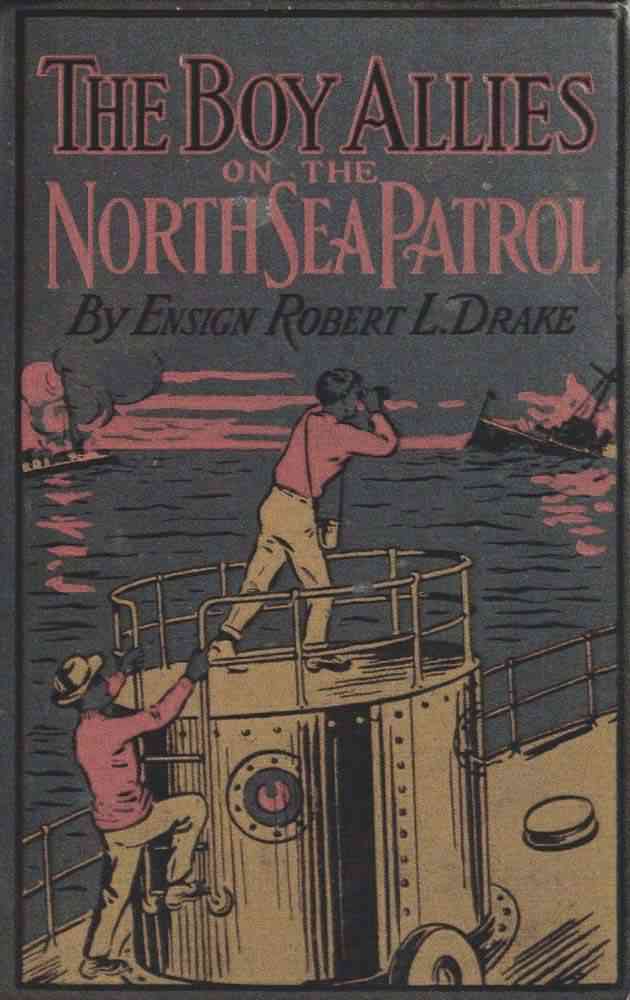
CHAPTER XI.
OFF TO THE WAR.
“So you want to go to war, eh?”
It was Lord Hastings who spoke. Frank and Jack had lost no time in putting their plans before him when he returned home the evening on which the two lads had talked over their future.
“Yes!” replied both lads, in the same breath.
Lord Hastings stroked his mustache.
“Well,” he said, “if you have set your minds on going, I know there is no use of my trying to stop you. Now, I have a plan that I believe will meet with your approval.”
The boys listened eagerly as Lord Hastings continued:
“As you know, the British home fleet is in the North Sea, bottling the Germans up in Kiel and Helgoland. There is likely to be a battle there almost any time. My yacht, the Sylph, has been converted into a scout cruiser, and has been heavily armed.
“Although the Sylph is listed as being able to make a speed of only twenty knots, nevertheless it is swifter than any of our war vessels. This unknown speed has been useful more than once. My naval rank is that of captain, and I have been ordered to the North Sea with the Sylph!”
“What!” exclaimed the two lads, and Frank continued:
“Why cannot you take us with you?”
“Just what I was about to propose,” declared Lord Hastings. “Would you like to go with me, or would you prefer to join the army?”
“The sea for me!” exclaimed Jack.
“For me, too!” declared Frank.
“Good!” replied Lord Hastings. “Then that part is settled.”
“But what will be our duties?” asked Jack.
“Well, while you will be only unofficial members of the crew, in view of the service you have done for England, I believe my influence is great enough to have you rated as midshipmen.”
“But we know nothing of naval warfare,” declared Frank.
“The chances are that we won’t have to do a great deal of fighting,” explained Lord Hastings. “But I guess you will both be able to give a good account of yourselves if we do.”
“We shall do the best we can,” declared Frank.
“You won’t find us shirking our duties,” Jack agreed.
“I’m sure of that,” replied Lord Hastings, rising. “I must go now, and I shall try and get your appointments to-night. I shall let you know what success I have in the morning. Good-night.”
Lord Hastings left the room, and Frank and Jack immediately fell into a discussion of the times that were to come. So interested did they become in their talk that it was well after midnight when they finally went to bed.
They were up bright and early the next morning, however, so eager were they to learn the result of Lord Hastings’ mission, and were already there when that gentleman entered the breakfast room with a smile on his face.
“Well,” demanded Frank, so anxious that he was unable to wait for Lord Hastings to speak, “is it all right?”
“Did you fix it?” asked Jack.
Lord Hastings nodded.
“Yes; it’s all right,” he replied. He drew from his pocket two official and important looking papers. “Here are your appointments as midshipmen in his majesty’s navy. You have been assigned to the Sylph, under my command.”
“Hurrah!” cried Frank.
“Hurrah!” shouted Jack.
Lord Hastings smiled quietly at their enthusiasm.
“I am glad you are pleased,” he said.
“You bet we are pleased,” said Jack. “We can never thank you enough.”
“We certainly can’t,” declared Frank. “But when do we go?”
“Now, don’t get excited,” laughed Lord Hastings. “There is plenty of time. We shall go on board the Sylph to-night and sail about midnight. Now come with me, and we’ll see about getting your uniforms.”
Their uniforms obtained and their other needs having been supplied, the boys spent the rest of the day strolling about the city. So great was their impatience to be off that the hours dragged by slowly and time hung heavily on their hands as they wandered about, waiting for six o’clock, when they were to meet Lord Hastings at his home.
As with everything, however, the time came and passed, and Frank and Jack at last stood again upon the deck of the Sylph. It was almost midnight when the little scout cruiser finally slipped her cable and steamed proudly down the Thames.
“Well,” said Jack, “we are off at last. I wonder where we shall be next month at this time?”
Frank shrugged his shoulders.
“Who knows?” he replied.
For several hours the two lads stood upon the deck, gazing over the rail into the dark waters of the river; but at length they turned in.
The Sylph was manned with a crew of 100 men, besides her officers. A small cruiser, she nevertheless had been an extremely large-sized yacht. All told she mounted ten eight-inch guns and several smaller pieces.
Used frequently as she had been by Lord Hastings on diplomatic and political missions, the Sylph had always been prepared to resist an attack, so that her present armament was only twice what it had been.
While the Sylph would stand little chance against one of the great German dreadnoughts or battle cruisers, Lord Hastings had little doubt that she could give a good account of herself in an encounter with some of the enemy’s smaller vessels. If he encountered one of the enemy’s bigger vessels, it was Lord Hastings’ plan to run, and he was positive that he could not be overhauled; for the Sylph had the heels of practically anything afloat.
Officers and crew were trained to the minute. Picked from among the flower of Britain’s sailors, drilled so that they went about their work like well-oiled cogs in a great machine, they were all eager to get into action.
Although rated as midshipmen, Frank and Jack were not assigned to fixed stations. They had been given a cabin just off the one occupied by Lord Hastings. The Sylph, ostensibly a pleasure yacht, had been fitted up with roomy and beautiful cabins, and this space, although the yacht now was a war cruiser, necessarily had to be utilized.
Under Lord Hastings, Lieutenant Edwards was the second in command. The next two ranking officers were Second Lieutenant Taylor and Third Lieutenant Harvey.
Bright sunlight streamed into the cabin occupied by the two boys when they awoke the morning following their departure from London. They jumped up, dressed hurriedly, and went on deck. There was no land in sight, nor was there even a sail in the distance; nothing but water as far as the eye could see.
The little cruiser steamed swiftly along, rising and falling gently with the swell of the sea. For a long time the boys stood gazing out over the water, and they were still there when Lord Hastings approached.
“Good morning,” he greeted them. “How do you think you will like life on the ocean wave?”
“It’s glorious,” replied both lads in a single voice. “Where are we?”
“We are headed straight for the North Sea,” was the reply.
“Is there any danger of our meeting a German warship?”
“Very little. Of course, there may be a cruiser prowling about, but I doubt it. I did hear, however, that there was a German cruiser in these waters several days ago. Nothing has been heard of her since, in spite of a keen search. She has probably put into some neutral port. In that event she must either leave in twenty-four hours or disarm until the end of the war.”
“Are we to join the fleet immediately?”
“No, not immediately. We shall do some scouting for several days off the Scandinavian coast, trying to pick up some of the Germans who, under neutral colors, have been laying mines in the North Sea.”
“But isn’t there some danger of our striking a mine?”
“Not around here. Farther along, of course, we shall have to be extremely careful.”
For two days the Sylph continued on her way without incident.
Frank and Jack quickly fell into the routine life aboard the cruiser, and performed such duties as were from time to time assigned to them in such manner as to draw forth the praise of Lord Hastings and his officers.
It was on the third evening after leaving London that Frank and Jack, who were standing on deck, were startled by a cry from the lookout:
“Cruiser off the port bow, sir!”
The word was passed and Lord Hastings quickly appeared on deck.
“A German, as sure as I am a foot high!” he declared, after a long and careful scrutiny through his glass.
“She’s a German, sir,” agreed Lieutenant Edwards, “and she is headed directly for us.”
“We’ll go a little closer, and try to make out her identity,” was Lord Hastings’ order. “Slow down to fifteen knots!”
Soon the ship, at first but a speck in the distance, was close enough for Lord Hastings to make out her colors.
“American!” he said; then turning to Lieutenant Edwards, added:
“Try her on the wireless!”
“No reply,” came the answer from the wireless room a few moments later.
Still the ships continued to draw nearer to each other.
Suddenly the American flag at the masthead of the stranger fluttered down, and a moment later the German colors were run up in its stead.
At the same moment a loud boom sounded from across the water, and there was a great splash in the water behind the Sylph.
The wireless operator approached Lord Hastings:
“A message from the German, sir!” he said.
Lord Hastings took the slip of paper extended to him, and read aloud:
“Surrender, or we shall blow you out of the water!”