
CHAPTER XXIV.
THE BATTLE AT SEA.
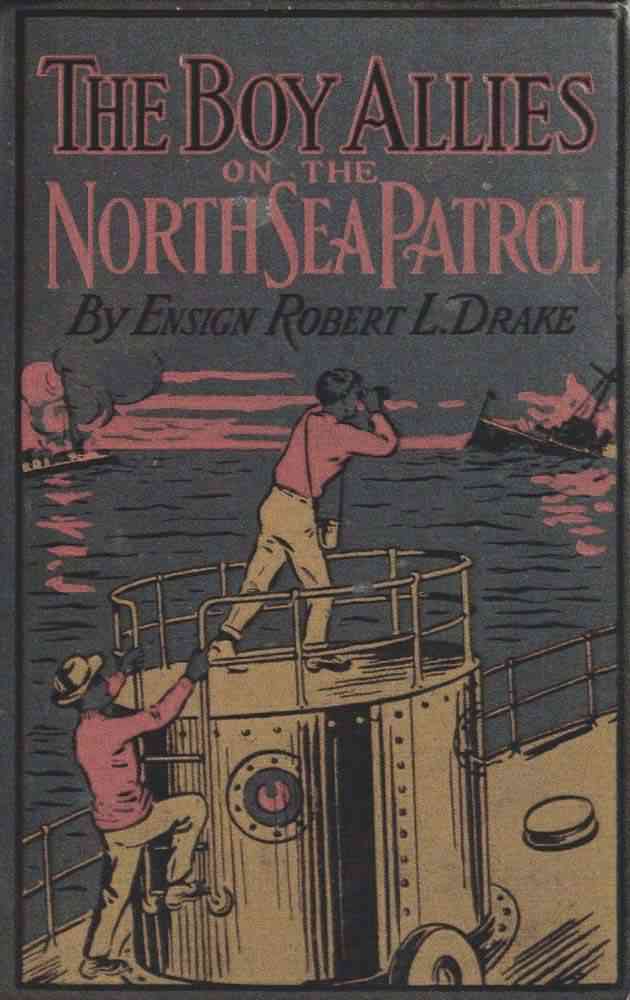
It was shortly before dawn the following morning—August 28th, to be exact—that two British submarines, taking care to keep clear of the mines which had been planted outside the harbor of Helgoland, crept in close to the island. A little farther out, screened by the darkness which is always greatest just before dawn, the light cruiser, Fearless, took her position to await results.
Alongside the Fearless, but hidden from view by the larger vessel, lay the Sylph—to which our two boys had returned late that night—ready at an instant’s notice to act as scout or carry dispatches. All aboard were on the alert, and, as Frank and Jack leaned over the rail, awaiting anxiously the first glimmer of daylight, their excitement was intense.
Slowly the gray dawn approached and the first light disclosed the two submarines well inland, but apparently in distress. One of them seemed to have been disabled, and the other was standing by as though to give aid.
Both boys watched eagerly for the development of the strategy, details of which were known to every officer on the Sylph. They had not long to wait, for the German lookouts had been quick to note the seemingly crippled condition of the submarine.
It was also evident from the movement of the German torpedo craft that they, too, had discovered the Fearless, for these swift destroyers were speedily put in motion, some heading for the submarines, while others started toward the Fearless.
Perceiving that the ruse was working, the Fearless put on full speed and turned to the northwest. The Sylph followed her example, and the two boats sped away with the Germans in full chase.
Meanwhile, the Germans were getting their first surprise. Having filled their tanks, the submarines quickly disappeared beneath the waves.
Looking backward, the boys could see what had happened.
“I hope they don’t suspect what we are doing,” said Frank.
“I should think they would,” replied Jack. “I should think anybody could see it was a ruse.”
“That is because you know all about it,” laughed his companion. “If you did not, you would do just exactly what the Germans are doing.”
The words had scarcely left his lips when there was a flash from the pursuing torpedo boats, quickly followed by others, and the shells began to fly over and about the Fearless.
Then it was that the Fearless replied, and that her fire was effective was quickly discovered. But, while it could be seen that the pursuers were repeatedly hit, they were not disabled, and seemed determined to capture the little cruiser.
And now came a surprise. Out of the gray mist of morning there appeared a flotilla of British destroyers—nearly two dozen in all—accompanied by the new light armored cruiser Arethusa.
From the portholes of each vessel were flashes thick and fast, and the shells and solid shot began to scream through the air. Almost before they knew it, and certainly before they had time to realize how matters stood, the German torpedo flotilla was hotly engaged by the fresh arrivals.
It was very evident that the British reinforcements were greatly superior in every way, and the Germans were getting the worst of it when, from out the harbor, came swiftly several light German cruisers, rushing to the support of their small craft.
Almost sooner than it can be told the two fleets were close enough together to use every available gun; and for the next few minutes pandemonium reigned.
The gun-laying of all the British ships was splendid, and soon the Germans began to show by their rent funnels, splintered upper works and damaged hulls the punishment they were receiving. Almost together, two shells from 10-inch guns struck the Arethusa. One plowed its way through the upper decks, doing great damage, while the other found its way into the engine-room. There was a terrific explosion, and the steam poured from the portholes and mingled with the smoke of battle.
But the Arethusa never deviated from her course nor ceased her terrible fire.
A minute later a solid shot entered the bow of the Sylph, tore its way diagonally across the gun deck, and put one of the 6-inch rifles out of commission. Another struck the bridge, smashed the funnel, and killed the man at the wheel.
Unmindful of the shot and shell flying about, Jack sprang from his station in the wheel house and grabbed the wheel in time to prevent the Sylph from colliding with the Laertes, one of the swiftest of the torpedo boats, which had also been severely damaged, but was making a fierce running fight.
After some ten minutes of running and fighting, the Fearless, which was leading the flotilla, turned sharply to the west, followed by the remainder of the smaller craft. As the flotilla came around, two of the enemy’s cruisers could be seen in a half-sinking condition, and two of the destroyers were missing, having been sunk.
Up to this instant the battle had been fought at very close range, and the dozen or more German cruisers seemed to be rapidly overhauling the mosquito fleet; but, with the sudden turning of the little squadron to the west, there came the single boom of a great gun from out the northwest, heralding the approach of the British battleships—magnificent vessels of the First Battle Squadron.
As the great British guns opened upon the enemy, the Germans turned to flee; but it was too late. They had been lured too far into the open. British strategy had proved too much for the Teutonic mind. Badly battered by the terrific and accurate fire of the British, the Germans turned, and, as fast as their numerous wounds would allow, ran for Helgoland.
Above the sharp banging of the smaller guns, came the great booms from the giant British battleships.
Suddenly one of the enemy’s cruisers, the Köln, burst into a brilliant sheet of flame. A shell had exploded in her boiler-room. There was a terrible explosion, and the vessel seemed to leap into the air like a live thing of fire, only to disappear beneath the water with a great hiss a moment later.
A great British cheer rang out across the water; and the Germans, if possible, fled faster than before. Evidently the Germans had expected assistance from the remainder of the fleet, which had been so long bottled up in Helgoland; but no help came.
In spite of the fact that the German vessels under the protection of the great guns of the fort were undoubtedly ready for instant action, the order for them to sally forth to the assistance of their comrades came not.
Gradually the German ships drew off, pursued for a great distance by the victorious British fleet, leaving four vessels at the bottom of the North Sea, two others burning, and, with practically every vessel that had been engaged in the action suffering serious damage. British marksmanship had been too much for them, and they retired to the protection of the great guns of Helgoland, till they presently should once more summon sufficient courage to face the British.
The loss of the Germans was enormous—that of the English comparatively light, only thirty-two lives lost, and less than sixty men wounded.
Several of the British ships had been struck by German shells, but all were able to steam away, although for a short time the Arethusa received some aid from the Sylph. The Liberty also had been seriously damaged.
While the smaller guns of the Sylph had prevented her from working any great damage on the heavily armored German vessels, the little scout cruiser had, nevertheless, been right in the hottest of the fight. One of her men was killed and three were wounded.
“A gallant fight!” declared Lord Hastings to his officers, as the Sylph drew off after the battle. “England may well be proud of her sailors!”
“It was glorious!” replied Frank. “But I am sorry we did not have a more important part to play.”
“And so am I,” declared Jack.
“Don’t let that worry you,” replied Lord Hastings. “You will see all the fighting you want, and more too before the war is over, or I miss my guess.”
“Well,” said Jack, “to-day’s action has proved one thing, at least.”
“And that?” questioned Lord Hastings.
“That” repeated Jack, “is that Britannia, as ever, rules the wave!”