
CHAPTER IX
CHESTER TO THE RESCUE
Despite himself, Hal was forced to smile.
“‘Gats?’” he repeated.
“Well, that’s what we call ’em on the East Side in good old New York,” replied Bowers, also smiling. “But you can call ’em anything you want to. We ought to be good for a couple of Huns apiece before we go down.”
“They’ll know we’re here, at all events,” declared Hal grimly.
As the Germans bore down on them from the east, Hal glanced quickly over his shoulder and uttered a cry of joy.
“Here come the Yanks!” he shouted.
It was true. Half a mile behind them a long line of the boys in khaki advanced at the double, spread out in the battle formation which had its origination in the great war. Behind the first line came a second and then a third.
Hal estimated the distance with a practiced eye.
“Half a mile,” he said.
“Right,” said Bowers, “and the Germans are a quarter of a mile closer—but still not close enough for my little gun here. But if there is going to be a race for us, I’ll lay long odds on Fritz.”
“Looks like you’d win,” replied Hal. “There is the first messenger,” he added quietly, as a German bullet struck the wall behind which the two had taken refuge.
Bowers peered over the top of the wall, raised his automatic and would have fired had Hal not stayed his hand.
“Don’t waste your bullets,” said the lad. “Remember the watchword of the battle of Bunker Hill: ‘Wait until you see the whites of their eyes.’”
“Right,” said Bowers briefly.
Came a volley of bullets from the foremost Germans as Hal and the marine crouched down behind their refuge. The bullets flattened themselves against the stout wall, but did no other damage.
“Pure waste of ammunition,” was Hal’s cool comment.
“What do the fools want to shoot for?” demanded Bowers. “All they have to do is rush us. We’ll probably get a couple of them, but they are bound to get us in the end.”
It appeared that the German officers had reached the same conclusion, for the rifle fire of the advancing infantry ceased and the Germans came on with fixed bayonets.
“Here’s where the Marine Corps loses a private of the first class,” said Bowers, with something like a grin, as he made sure that his automatic was ready for business.
“Looks like a certain lieutenant was going along with you,” replied Hal, again glancing over his shoulder and calculating the distance to the approaching American forces. “Well, they’ve seen us anyhow,” he added.
There came a shout of encouragement from the Yankee line and the troops appeared to redouble their speed.
“Help on the way, sir,” said Bowers.
“And the Germans are here,” rejoined Hal. “Don’t waste a shot, Bowers.”
“I wear a marksman’s medal, sir,” replied Bowers simply.
The Germans still came forward with a rush. Hal and Bowers stood to the wall, their revolvers poked slightly above and beyond it.
In this position, both were exposed to rifle fire from the enemy, but if they intended to fight back and not be caught like rats in a trap there was no help for it.
“Crack!”
Hal’s revolver spoke first and a German toppled in his tracks.
Bowers’ automatic belched forth a stream of fire as he swept the German line. At this distance, a miss was practically impossible. Thus ten shots were hurled among the advancing foes and every bullet found its mark.
“Some shooting, Bowers,” said Hal quietly, as he emptied his revolver into the very faces of the enemy.
There was no time to reload.
Hal clubbed his revolver in his right hand and waited. Bowers did likewise. Neither thought of surrender. In fact, so inhuman and barbarous had been the action of the Germans in the past that it was doubtful whether they would be spared should they raise their hands high in the air.
“Here they come!” cried Bowers.
The first German to poke his head around the wall from the left tumbled back again as the butt of Bowers’ revolver crashed down on his skull.
Fortunately for the two, the granite wall, at the extreme right, touched a steep hill, thus preventing a surrounding movement by the enemy. Nevertheless, it was possible that the enemy might climb the hill and pick Hal and Bowers off with revolver or rifle at will. On the other hand, there was little likelihood that they would have time for such a maneuver before the American troops reached the spot. Besides the left flank, therefore, the only way the foe could reach the defenders was over the wall itself.
One German tried this. Climbing to the top of the wall, he leaped down. As he struck the ground Hal’s revolver crashed down on his head and he lay still.
A moment later two Germans leaped down together. The first Hal met with a blow to the head with his revolver, but before he could turn, the second man seized him in a powerful embrace. Hal kicked out with his left foot, which found the German’s shin. At the same time the lad sent his left fist into the man’s face. Down went the German.
Bowers, meanwhile, was equally hard pressed. Two men he disposed of with his revolver butt and his fists; then the enemy surrounded him. Hal, thinking to join forces with the marine, had moved backward as other enemies came over the wall and just before Bowers was hemmed in, the two managed to get back to back.
American arms flew about like flails and wherever a fist or a revolver butt landed, a German crashed to earth. Right and left Hal and Bowers struck out until their arms grew weary.
In the press of conflict, it seemed impossible that the two could remain on their feet. The struggle would have ended almost as soon as it began had one of the enemy been able to bring a revolver or rifle to bear, but so close were the struggling figures that the Germans could not fire without imminent risk of killing one of their own number.
So the struggle went on.
But an unequal combat such as this could have but one ending. Under the overwhelming numbers that closed in on them, Hal suddenly went down.
With a bellow like that of an enraged bull, Bowers moved back a trifle and stood squarely over the lad, one foot on each side of his prostrate form.
Two Germans jumped him from in front and two from behind. The first he sent staggering with a powerful blow from his right fist. The second he hurled from him with a kick; then turned on his heel to face the men behind. One of these threw his arms around Bowers’ neck. Without a moment’s hesitation, the marine buried his teeth in the man’s hand and the strangle hold relaxed.
Whirling about, Bowers caught the fourth man in his arms, picked him up as though he had been a child and tossed him squarely in the faces of his comrades. Then, single-handed, he charged his foes.
Rifles were raised by the German soldiers and brought down sharply. Bowers reeled back, made an effort to retain his feet, and then sank to the ground unconscious.
Almost at the same moment, and as a German infantryman raised his bayonet to finish his work, a hail of rifle fire swept the Boche troops. Followed a loud Yankee cheer and the first American troops entered the conflict.
So intent had the enemy been on finishing Hal and Bowers, that they seem to have paid little attention to the advancing American columns. It is probable that they had been ordered to finish the work in hand before worrying about the others and this had taken so long that they were caught in their own trap.
With cries of terror, the Germans gave ground.
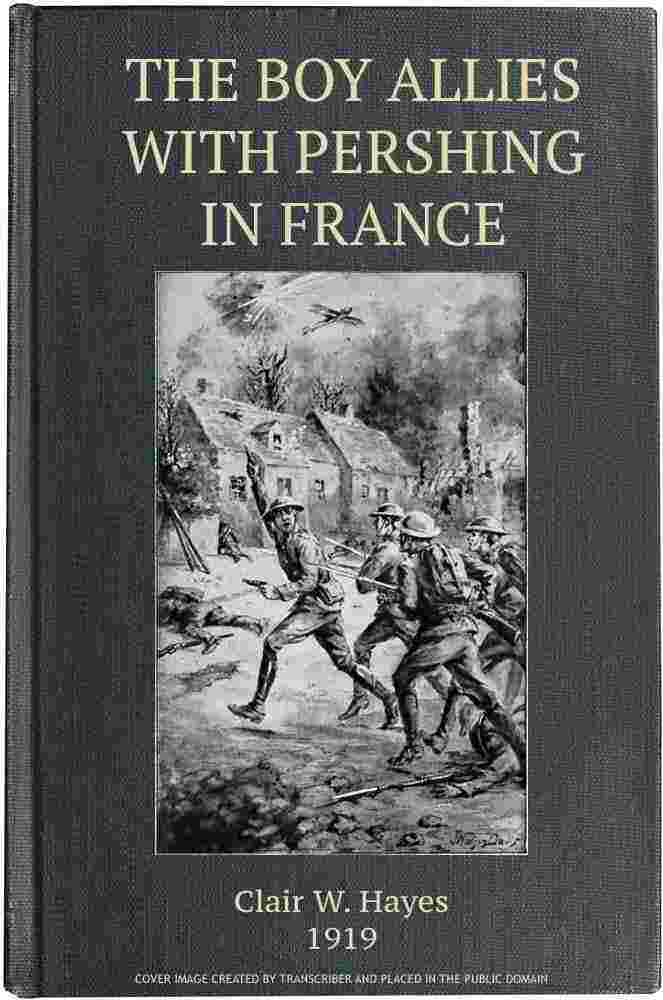
But even as they turned to flee, the Americans were upon them with swords and bayonets. Foremost in the advancing columns, their swords throwing circles of steel about their heads and revolvers clasped in their left hands, belching fire, three officers dashed forward. Two were marines. The other wore the garb of the regular army. The first two were Lieutenants Smith and Jenkins; the third, Chester Crawford.
“Get ’em, Smith!” shouted Jenkins. “You may not get another chance.”
Smith apparently needed no urging. He led his men on with wild cries. In the face of these charging demons the Germans, who at first had attempted to retire with some semblance of order, broke and fled in utter rout. With loud cheers, the boys from Yankeeland followed close on their heels.
Suddenly Lieutenant Smith, who was slightly ahead of Jenkins and Chester, halted. He had come upon the prostrate forms of Hal and Bowers.
“Hello!” he ejaculated, paying no heed to the confusion of battle. “A marine, and he is down. Fritz will have to pay for that.”
He sprang forward again.
A moment later Chester came upon his fallen chum. There was fear in his heart as he bent over Hal, but this quickly fled as Hal drew a long breath.
Chester lifted Hal to his feet.
“Still alive, eh?” he said.
“Alive and kicking,” replied Hal briefly. “Give me a gun or something.”
“You’d better——” Chester began.
But Hal stooped quickly, picked up a fallen German’s rifle and sprang forward. Chester darted after him.
Bowers, meanwhile, also had come to his senses and was endeavoring to get to his feet. A company of marines, moving rapidly forward, encircled him, steadied him and he also was given a rifle. The marines, closely followed by regular army troops, continued the pursuit.
Hal turned to Chester as they ran ahead, trying to catch up with the first-line troops, who by this time were some distance ahead.
“In the nick of time again, old man,” he gasped.
“I was afraid I wouldn’t be,” was Chester’s reply.
Ahead, the American advance suddenly slowed down. The reason was soon clear. German reinforcements had been rushed hurriedly forward, and the enemy was making a stand. But the Yankee halt was only momentary.
“Forward!” came the command.