
The Project Gutenberg eBook of The Boy Allies with Pershing in France; Or, Over the Top at Chateau Thierry
Title: The Boy Allies with Pershing in France; Or, Over the Top at Chateau Thierry
Author: Clair W. Hayes
Release date: June 24, 2014 [eBook #46085]
Most recently updated: October 24, 2024
Language: English
Credits: E-text prepared by Roger Frank and the Online Distributed Proofreading Team (http://www.pgdp.net) from page images generously made available by Internet Archive (https://archive.org)
The Project Gutenberg eBook, The Boy Allies with Pershing in France, by Clair W. (Clair Wallace) Hayes
| Note: | Images of the original pages are available through Internet Archive. See https://archive.org/details/boyallieswithper00drak |
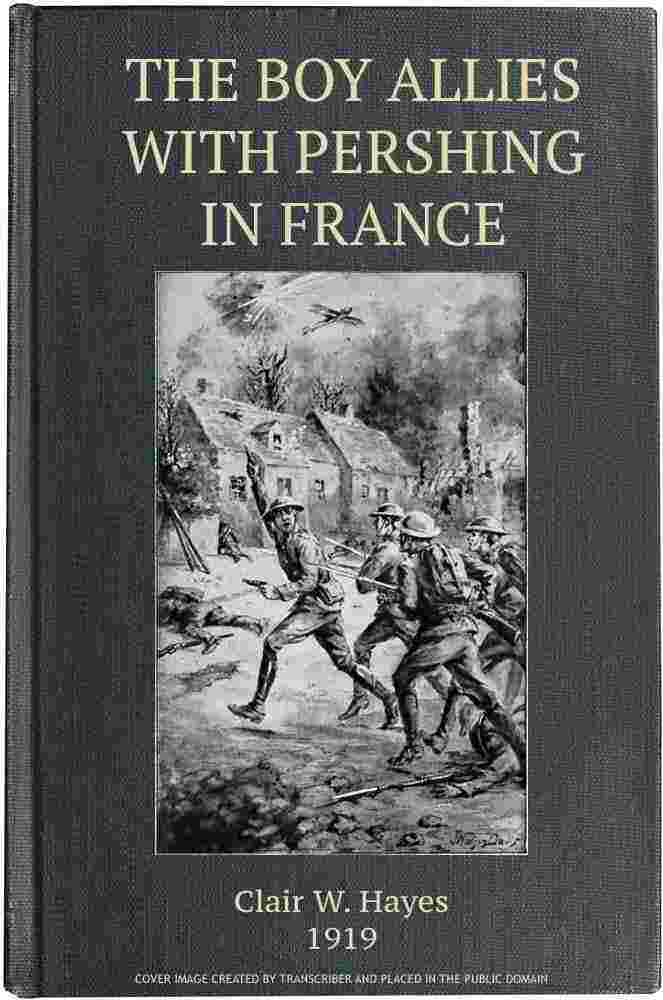
Hal acted quickly. “Sergeant Bowers!” he called sharply. “Take a dozen men and capture that house!”
The Boy Allies at Liege or, Through Lines of Steel
The Boy Allies on the Firing Line or, Twelve Days Battle along the Marne
The Boy Allies with the Cossacks or, A Wild Dash over the Carpathians
The Boy Allies in the Trenches or, Midst Shot and Shell along the Aisne
The Boy Allies in Great Peril or, With the Italian Army in the Alps
The Boy Allies in the Balkan Campaign or, The Struggle to Save a Nation
The Boy Allies on the Somme or, Courage and Bravery Rewarded
The Boy Allies at Verdun or, Saving France from the Enemy
The Boy Allies under the Stars and Stripes or, Leading the American Troops to the Firing Line
The Boy Allies with Haig in Flanders or, The Fighting Canadians of Vimy Ridge
The Boy Allies with Pershing in France or, Over the Top at Chateau-Thierry
The Boy Allies with the Great Advance or, Driving the Enemy through France and Belgium
The Boy Allies with Marshal Foch or, The Closing Days of The Great World War.
THE BOY ALLIES WITH PERSHING IN FRANCE
CHAPTER I
IN NO MAN’S LAND
Hal Paine and Chester Crawford crouched low in a shell hole in No Man’s Land. All morning they had been there and the day had worn on now into the afternoon.
Two hundred yards west of their refuge were the American lines. Sprinters such as Hal and Chester could easily have covered the distance in half a minute; and it was not for want of courage that so far they had failed to make the effort. It was plain common sense that kept them in their present position.
On all sides of them—between the American lines and the most advanced German positions less than two hundred yards from the spot where the opening of this story finds the two boys—the ground was dotted with shell holes similar to the ones in which Hal and Chester found themselves.
Less than fifty yards due north of Hal and Chester was a second inhabited shell hole. From this four German infantrymen had amused themselves during the day by taking occasional shots at the two lads when either exposed himself over the top of their refuge. This was the reason that Hal and Chester, once in the comparative safety of the shell hole, had elected to remain there rather than to risk a dash toward the American lines.
The same reasoning kept the Germans in their refuge. They were not willing to risk a shot from their adversaries by a dash toward the German positions.
It was the twentieth day of March, 1918. Although neither Hal nor Chester knew it then, it was the eve of what was to prove Germany’s second grand attempt to sweep back the Allied and American troops and march triumphantly into Paris.
A warm afternoon sun shone down into the shell hole where Hal and Chester were awaiting the coming of darkness, when, they had decided, they would make an effort to reach their own lines.
“Guess the Boches are not enjoying themselves any better than we are,” Hal said, as he pulled his cap farther down over his eyes.
“I imagine they’re fretting a bit worse,” agreed Chester. “You know the Hun doesn’t bear up very well under adversity.”
“Adversity?” grinned Hal. “It’s the sun they are trying to bear up under now.”
“Well, whatever it is,” declared Chester, somewhat nettled, “I don’t believe they like it very well.”
“I don’t like it either, but what am I going to do about it?” Hal wanted to know.
“You might try a little sprint,” Chester suggested.
“Not much. I feel reasonably secure here and I think I’ll stick awhile. The thing that mystifies me, though, is why the Germans haven’t sent relief to our friends in the next hole.”
“On the same reasoning,” said Chester, “why hasn’t Captain O’Neil made an effort to reach us?”
Hal shrugged his shoulders.
“Guess he is playing for the safety of the greatest number,” was his reply. “If he tried to rescue us the Germans also would probably advance and that would mean a battle. My idea is that Captain O’Neil has been ordered to avoid that right now!”
“All the same,” said Chester, “they are bound to know we’re here, and it seems to me they could do something for us.”
“Don’t croak,” said Hal. “We’re not running this war, you know, and I guess it’s a good thing. Anyhow, we’ve just as much chance to get out alive as those fellows over there,” and he waved an arm in the direction of the shell hole occupied by the Germans.
This act of indiscretion almost proved costly. When Hal’s arm showed above the top of the shell hole a German rifle cracked in the distance. Hal heard the whine of the bullet as it passed within a fraction of an inch of his hand.
“Guess I’d better hug down inside here,” he said calmly. “Fritz almost nicked me that time.”
The boys became silent. Every moment or two, one or the other, exercising extreme caution, peered toward the enemy, for they did not wish to be caught napping, should the Germans, knowing that the odds were two to one in their favor, decide to rush them.
Chester looked at his watch.
“Almost five o’clock,” he said. “It’ll be dark soon and then we can get away from here.”
“Guess Fritz will be as glad as we will,” Hal commented.
As it developed, however, the lads were not to get back to their own lines so easily.
The particular section of the great battle zone in which the lads found themselves when this story opens was perhaps ten miles south and west of St. Quentin, at that time in German hands. The river Oise flowed some five miles to the east and also was held by the enemy.
Darkness now drew on apace and Hal and Chester, making sure that their rifles and side arms were in perfect condition, prepared to quit their refuge.
“Better wait a few minutes,” said Chester. “It’s not quite dark. We would still make pretty fair targets on level ground.”
“It won’t be dark enough to cover us anyhow,” Hal replied. “See the moon.”
Chester gazed aloft.
“By Jove! That’s what I call pretty tough luck,” he said. “Well, we’ll just have to make the most of it; that’s all.”
“The sooner we start, then, the sooner we’ll get there,” declared Hal. “Guns ready?”
“Ready,” was Chester’s brief response.
“Then let’s be moving. Follow me.”
Hal got to his feet, but, with a cry, as suddenly dropped down again.
“Hit, Hal?” cried Chester, as he stooped over his chum.
“No,” replied Hal.
“What’s the matter then?”
“Stick out your nose and have a look,” returned Hal.
Chester did so, and what he saw was this:
Twenty-five yards away, and advancing rapidly, were the four Germans who so recently had occupied the neighboring shell hole. They were firing as they advanced and a bullet sped close to Chester.
“Quick with your rifle, Hal!” the boy cried, and bringing his own weapon to his shoulder regardless of his exposed position, he pulled the trigger.
One of the approaching foes staggered slightly, but he did not fall. The advancing Germans pumped rifle bullets the faster.
“We’ll have to stop them or we are done for,” muttered Hal, as he stood erect in the shell hole.
Despite the hail of bullets that flew about him, Hal was untouched as he took careful aim and fired at the nearest German.
The man stumbled, threw up his arms and flung his rifle a dozen yards away; then, with a cry, he pitched forward on his face.
“One,” said Hal quietly.
A bullet brushed the boy’s cheek, leaving a stream of red in its wake, but Hal did not quail.
Again his rifle spoke and a second German went to the ground.
“Odds even now,” Hal called to Chester. “Let’s get these other two.”
Without waiting for a reply, he leaped from the shell hole and dashed forward.
Chester, who had been unfortunate in his marksmanship and so far had not accounted for one of the enemy, followed Hal closely.
The two remaining Germans, now realizing that they had lost the advantage of two-to-one odds, halted in their impetuous dash forward, turned and ran. By this time Hal and Chester were close behind them and the former shouted:
“Surrender!”
For answer the Germans only ran the faster.
“Well,” Hal muttered to himself, “if you won’t, you won’t.”
Again he raised his rifle and fired.
A third German dropped to the ground.
Chester, close behind the remaining foe, also cried a command to surrender, but the man ran on.
Loath to shoot the man from behind, Chester sprinted and caught up with him. With his rifle in his right hand, he laid his left on the German’s shoulder.
“Halt!” he cried.
The German needed no further urging. He came to an abrupt stop and raised his hands.
“We might as well take this fellow back with us,” said Hal, as he approached at that moment.
“Right you are,” agreed Chester. “We can’t return without some kind of a memento of our trip. A live souvenir is about the best thing I can think of.”
“You’ve got me,” mumbled the German at this juncture, “but I want to tell you that before another twenty-four hours have passed, my loss will be repaid with interest.”
“Wonder if he knows anything, Hal?” questioned Chester.
“Guess he’s not so big that the German high command is tipping him off to all their plans,” said Hal. “He’s angry and wants to talk. That’s about all.”
And still it wasn’t all; and had the lads had the foresight to report the words of their prisoner, action might have been taken that would have nipped the second German offensive in the bud.
With no further word to their prisoner, the lads made off in the semi-darkness for the American lines. These they reached in safety.
But hardly had they passed within the lines when a violent cannonading broke out from the German front.
“Sounds as though they were going to start something,” said Chester. “Maybe our prisoner knows something after all.”
“Oh, I guess not,” replied Hal, and once again passed by an opportunity.
Half an hour later, their prisoner having been turned over to Captain O’Neil, the lads sought their own little dugout and much-needed repose.