
CHAPTER VI
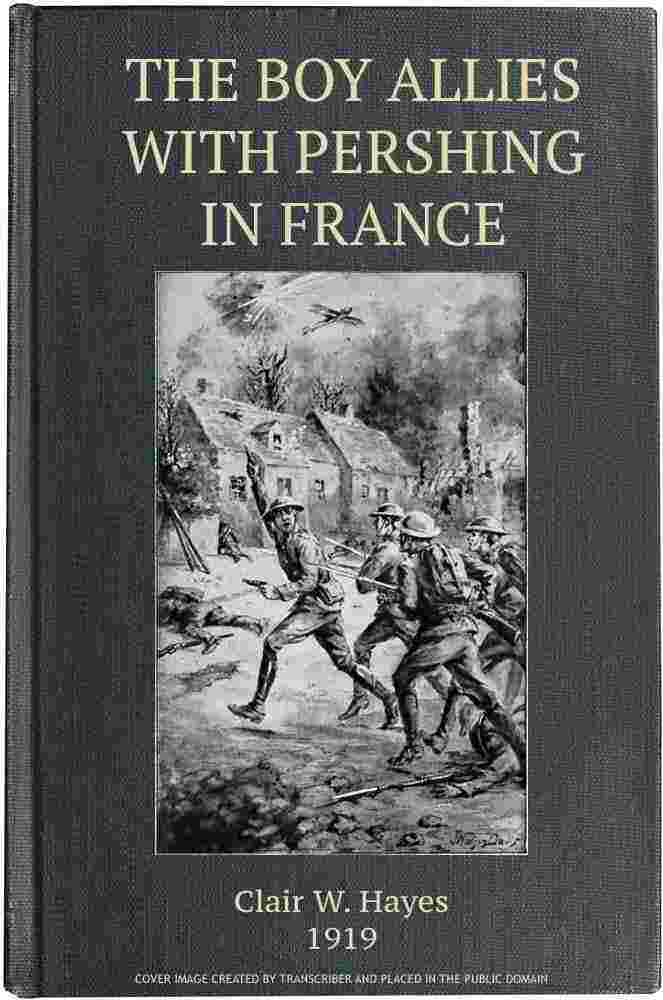
CAPTURE OF THE VILLAGE
While the First and Second Brigades under Colonel Gregory prepared for the early morning attack, the Third and Fourth, under command of Colonel Adams, marched immediately upon receiving the instructions that Hal carried. In the natural course of events Hal, his errand accomplished successfully, would have returned immediately to report to General Lawrence. In fact he had wheeled and was about to walk away when Colonel Adams stopped him.
“Lieutenant,” he said, “I shall move at once in accordance with instructions, but I would prefer that you remain here and that one of my men reported to General Lawrence in your stead.”
“Very well, sir,” was Hal’s reply, although he could not fathom the colonel’s reasons.
Colonel Adams explained:
“I lost most of my officers in the crossing of the canal. I can use you to great advantage. By the way, I don’t seem to recall your name.”
“Paine, sir.”
“Very good. Lieutenant, you will report at once to Captain Graham, of the —th marines.”
He saluted and walked away. He was somewhat surprised, for he did not know that a body of marines had crossed the river with the infantry so recently.
“I’ll bet a hat my friends Jenkins and Smith are around some place,” he told himself as he strode rapidly ahead.
He located the body of marines with little difficulty and reported at once to Captain Graham. As the lad had predicted to himself, Lieutenants Smith and Jenkins were there, and were almost the first to see him.
“Well, I see you’re on the job,” exclaimed Smith, stepping forward as Hal left Captain Graham after reporting and delivering his message from Colonel Adams.
“Right,” returned Hal, “and glad to be here, particularly so as we are about to march.”
“That so?” said Jenkins. “Where to?”
“Dun,” replied Hal. “General Lawrence has determined to push his advantage.”
“Wow!” exclaimed Jenkins. “Hear that, Smith? Didn’t I tell you that once we got started we would be kept on the jump?”
“I’m glad to hear it,” said Lieutenant Smith, who appeared to be considerably more quiet and dignified than his companion. “When do we start, or do you know?”
“Immediately,” said Hal, “and if I am not mistaken, there is the signal now.”
A bugle sounded attention. The men sprang to their places and the ranks closed in the darkness. A moment later came the command to march.
A few moments later Hal found himself in command of a detachment at the extreme right of the advancing column, where Captain Graham had assigned him. Because of the unfortunate lack of higher officers, Hal would command this detachment during the impending engagement. A short distance to Hal’s left Lieutenant Jenkins strode with his men. Lieutenant Smith had been called to the detachment that made up the left wing.
Silently the American columns moved through the darkness. The order had been passed along the line that there must be no talking. It would be well to advance as close to the village as possible without being discovered by the enemy.
From the distance the German artillery still hurled shells toward the American lines at infrequent intervals, but there was nothing now in the nature of a consistent cannonading.
Two hours’ march brought Colonel Adams’ column to the far edge of a small but dense wood. Beyond could be seen a few twinkling lights in the village of Dun.
Colonel Adams called a halt. Here the Americans would wait until an hour after daylight, at which time Colonel Gregory would advance to the attack from the west of the village.
The hours passed slowly and the men fidgeted. They would be cool enough when the time for action arrived, but resting quietly in the darkness and being allowed to utter no word, they grew restless.
Gradually it grew light and the men recovered their spirits. The hour of attack was approaching and the troops were anxious to be about their work.
Hal glanced at his watch in the half light.
“Must be about time,” he muttered.
The words had hardly left his mouth when the signal came, the shrill clear notes of a bugle sounding a charge.
A wild Yankee cheer followed the bugle call and the Americans dashed forward at the double.
In this particular section of the field there were no trenches to be won. The German positions had been fortified so recently that the enemy had had no time to dig himself in. But with the warning of the advance, the German commander rushed his men into formation and awaited the attack.
Machine guns were hurried forward and brought into play upon the men in khaki advancing across the open field.
Under the commands of their officers, the Americans broke their close formation and scattered out, thus making a more difficult target for the enemy. Nevertheless, the enemy rifle and machine-gun fire took a heavy toll in the advancing ranks.
To the far left of the German line, on Hal’s right, a machine gunner was doing fearful execution with a gun that was hidden in a clump of trees at that point.
“By Jove!” muttered Hal. “That fellow is tearing things up. We’ve got to stop him.”
To think with Hal was to act.
As his men dashed forward, he told off half a dozen and, turning over his command to Lieutenant Edgerton, led them sharply farther to the right. Thus they were able to approach the clump of trees without being exposed to the full force of the concealed machine-gun fire.
Bullets from other parts of the field fell among the little party, however, and three men dropped. Besides Hal, this now left three of the original party of seven.
The four were almost upon the little clump of trees before the German who was hidden there with his machine gun noticed their approach, so intent had he been upon his other foes. When he espied them, he turned his gun sharply.
A hail of bullets swept the field.
With a cry to his men, Hal had thrown himself flat upon the ground even before the German had turned his gun in their direction, and thus Hal escaped unscathed. Two of his men, however, were not so fortunate.
Besides Hal, there was now but one man able to fight. Together he and Hal sprang to their feet and dashed forward. Again they escaped what seemed almost certain death by hurling themselves to the ground. A moment later they were up and dashing forward again.
Hal sprang at the German machine gunner from the left, while the remaining marine attacked him from the right. Unable to fire effectively again, and caught between two fires, the German rose, stepped quickly back and produced a revolver.
He took a snapshot at Hal, but the bullet went wild.
Before he could fire again, the marine was upon him and sent him staggering back to escape a bayonet thrust.
Immediately the German dropped his revolver, raising both hands.
“Kamerad!” he cried.
Hal lowered a revolver which he had trained upon the Boche and the marine lowered his rifle.
As he did so, the German suddenly dropped his hand to his belt, drew a second revolver and fired point-blank at the marine. The latter side-stepped swiftly, but although he moved promptly enough he was not equal to the task of escaping the bullet altogether. The ball which the German had aimed at his heart pierced the man’s left arm.
Before the German could fire again and even before Hal could bring his own revolver to bear, the marine jumped forward with a roar.
“Treachery, eh!” he shouted. “I’ll show you!”
He dropped his rifle as he jumped and threw both arms around the German. With his right hand he pinioned the man’s left arm while he seized his opponent’s right wrist with strong fingers. Gradually the man’s arms described an arc until his own revolver was pointed at his head. There was a flash and a sharp report. The marine stepped back and the German crumbled up on the ground. The marine surveyed him disdainfully.
“Kamerad, eh!” he muttered. “Well, I guess you won’t fool anybody else.”
Hal looked at the marine in some amazement. The man was terribly angry and as Hal gazed at the powerful figure he could not keep thinking that there were few soldiers in the German army could stand against him.
“Come!” said Hal sharply. “Man the machine gun there. Wheel it about and open on the enemy to the left.”
“Very well, sir,” said the marine quietly, and followed instructions.
Unaware that Americans had approached so close in this section of the field, and probably placing reliance upon the machine gun that Hal and the marine had just captured, the Germans exposed themselves somewhat recklessly. Thus they were caught in a trap when their own weapon was turned against them.
With loud cries of alarm, the enemy ranks broke and the troops fled in utter rout. This confusion soon spread to other detachments and the enemy fell back upon the village.
From the west, meanwhile, Colonel Gregory had been pushing his attack as Colonel Adams’ columns advanced. Farther back, General Lawrence was hurrying supporting columns to the front. To the very streets of the village the Americans pursued the enemy, and then entered after them. From houses and from around corners the enemy fired upon the Yankee troops, who dashed forward with reckless courage.
Gradually, however, they retired from the village also, as their commanders realized that the American advance could not be stopped there.
At the very edge of the village Colonel Adams halted his men. On the western outskirts, Colonel Gregory did likewise. There they awaited orders before advancing farther.
Soon the orders came.
“Forward!” was the cry.