
CHAPTER IX.
A MESSAGE FROM THE UNKNOWN.
After a few minutes’ travel they emerged without warning into a spherical clearing, perhaps sixty feet in circumference. All about it stood palmetto-thatched huts in which crouched timid-looking women and children. The place was enclosed by a solid wall of trees and closely growing vines. Great gray beards of Spanish moss waved from the trees above them. It was a spot that would have been impossible to find unless one had the key to the forest labyrinth. It was evidently the men’s home.
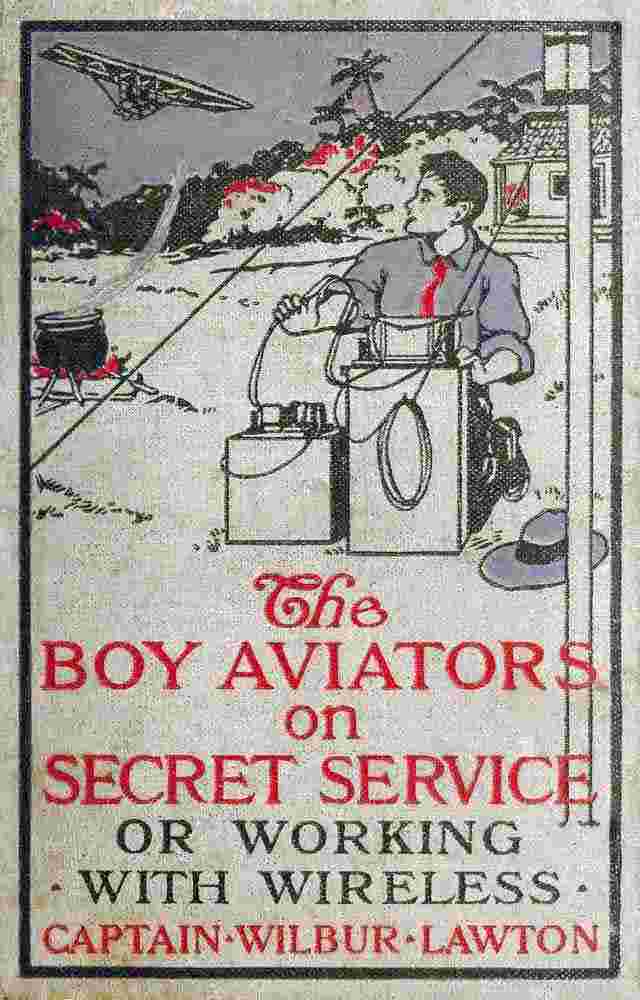
In one portion of the clearing was a singular apparatus that attracted the attention of the boys at once, puzzled though they were over their position, and whether they were in the hands of friends or enemies. This object was a huge iron kettle that was placed over a blazing fire of fat pine-knots. This fire was being fed by a youth who might have been the brother of one of the men who stopped them in the forest. A cover, evidently fashioned from some kind of wood, covered the iron pot and from this lid a pipe of metal led to a crude trough. From the end of the pipe was constantly dripping a colorless liquid which was carefully gathered into a small tin by the man stationed at the trough, and from time to time, he and others in the clearing took a sip from the tin. Overcome by curiosity Harry asked a lanky youth, who slouched by just then, what the affair might be.
“Don’t ask no questions, stranger, and you won’t git told no lies,” was the impudent reply that made Harry hanker—as he whispered to Billy—to “land the perambulating clothes-horse one on the jaw.”
But the mystery was soon to be cleared up and in a surprising way. While the boys were still wondering what sort of a place and into what sort of company they could have fallen, a figure came striding toward them that they at once recognized with a thrill of delight at seeing a familiar face.
The newcomer was Ben Stubbs.
He looked rather sheepish as the boys hailed him with loud shouts of delight and seemed embarrassed when Frank asked him what he was doing in this queer settlement.
“Wall, boys,” he said at length, “I declar’ to goodness I don’ know but what you’ll think I’m a piratical sort of craft, but—but the fact is that these folks around this yere camp are old shipmates of mine in a manner of speaking, an’ so you needn’t be a bit afeard. Yer as safe as if you were in your own bunks.”
As may be imagined this did not at all clear up the clouds of mystery that Ben Stubbs’ sudden appearance had aroused in the boys’ minds.
“Yes, but who are these people?” demanded Frank.
“How did you get here?” chimed in Harry.
“And who may Black Bart be?” was Billy’s contribution.
“And what is that funny pot with a pipe on the top of it over there?” concluded Lathrop.
“One at a time, mates,—one at a time or you’ll swamp me,” cried Ben, getting back a little of his easy-going manner; “wail, now, first of all, I am Black Bart.”
“What?” was the amazed chorus.
“Sure,” was the reply, “but I’ve reformed now, shipmates, so don’t be afeard; but the boys here still call me by the old name.”
“Well, go on, Black Bart,” said Frank, smiling at the idea of good-natured Ben’s ever having owned such a ferocious name.
“Wall,” drawled Ben, “I got here in the Squeegee after I had seen from the Carrier Dove a man snooping around our fire and heard the old ‘Hoo-hoo’ cry—the owl hail, you know.”
The boys nodded.
“We heard it in the jungle before we were surrounded,” said Frank.
“That gave me a queer idea—the hearing of the old cry did”—went on Ben—“that there might be some of my friends hereabout. I had reason to know they were in this part of the country, for after they were driven out of Tennessee by the government a lot of them came down here into the ’glades.”
“Driven out by the government?” echoed Frank.
“Sure,” was the easy reply, “and now to answer your last question—that thing my young shipmate Lathrop calls a ‘funny pot’ is a whisky still and these folks you see around us are moonshiners. There’s a price on the head of most every one of them,” concluded Ben.
The boys looked their questions. Their amazement prevented them speaking.
“Yes,” continued Ben in a low voice, “most of the older ones has dropped a ‘revenue’ at one time or another. Poor devils, if you’d ever seen the way they were hounded you maybe wouldn’t blame ’em so much.”
“Were you ever a moonshiner, Ben?” asked Lathrop in an awed tone.
Ben winked with a wink that spoke volumes.
“Say a friend of the moonshiners, younker, and you’ll be near it,” he replied. “I used to keep a kind of traveling store to help the boys out.”
From which the boys gathered that at one period of his adventurous career the versatile Ben had been a “runner” of moonshine whisky—as the man is called who, at great risks, carries the poisonous stuff into the outer world from the secret mountain stills where it is made. The coincidence of Ben meeting his old friends on the island was after all not so remarkable as it seemed. Since the government has run most of the moonshiners out of the Tennessee and North Carolina mountains hundreds of them have taken refuge in the keys and among the ’glades where their product finds a ready market among the Seminoles—who gladly destroy themselves with “whyome” as they call the product of the illicit stills.
The boys soon found out that it was one of the moonshiners who had tried to get Frank’s revolver from under his pillow while he slept—not with intent to do him any harm but because the sight of the weapon earlier in the evening while they had been singing round the camp-fire—watched as it now appeared by a hundred keen eyes—had excited his desire to own it. The mystery of the motor-boat that kidnapped poor Pork Chops, however, was in no wise cleared up, and as the boys and Ben sat down to a meal of yellow corn pone, broiled wild hog, pompano, fried plantain and a sort of orange preserve, to which they did ample justice, the subject occupied most of their thoughts and conversation. As they ate the moonshiners shyly watched them with their wild, hunted eyes. They refused to sit down to eat with the party of adventurers, but flitted about evidencing much interest at the boys’ table manners and their plain embarrassment at having no other table utensils but their fingers.
The meal concluded, Ben lit his pipe and gave himself up to after-dinner contemplation. The boys wandered about the camp unchecked. The moonshiners seemed even disposed to be friendly, in an offish sort of way, after Ben’s endorsement of the boys. One of them approached them with a pannikin full of the colorless stuff from the still. He explained that they distilled it from fields of cane they had in another part of the island.
The very smell of the stuff sickened the boys, who waved it away as politely as they could. Their refusal did not ruffle the moonshiner, who drained the pannikin off himself with evident relish although the portion he had poured out had been intended to suffice the entire quartette of boys. “Black Bart,” too, had a little fallen off in the estimation of the moonshiners because he also refused to touch their product. They shook their heads over his negative reply to an invitation to drink as men who regret the downfall of a once upright man.
While the boys were wandering about the camp their attention was attracted to a bottle suspended to a pole outside the hut of one of the moonshiners. It was swathed in ribbons and bits of bright tin and seemed to be regarded as some sort of a costly ornament. This was partly explained by the fact that the wife of the owner of the hut was an Indian woman and was the person who had ornamented the bottle for “big medicine.” But a closer scrutiny revealed to the boys a rolled piece of paper inside it on which there was some faint writing. As it seemed to be in English their curiosity was therefore considerably aroused.
They questioned the woman closely about it. At first they could get no satisfactory replies. At length, however, after Frank had given her a bright silver dollar—she refused a paper one—the squaw became more talkative.
“Um-him come from o-tee (islands) long time go.” She pointed to the westward.
“The islands round Cape Sable?” asked Frank.
She seemed to understand, for she nodded.
“My man find him—he float,” she grunted.
“Boys, this bottle was found afloat. This may be a message from some poor fellow who is cast away on the Ten Thousand Islands,” exclaimed Frank.
The others looked skeptical.
“Most of these bottle messages are fakes anyhow,” said Billy, with an air of finality. But Frank was not satisfied. He questioned the woman at greater length. After a long, patient interrogation he found that her husband, who was absent from the camp, had been delivering a consignment of moonshine to a camp of Seminoles in the wildest part of the ’glades and had found the bottle off the mouth of the Shark River. It had a tiny bit of red flannel tied round its neck as if to attract attention to it. This decided Frank. No joker would have gone to that trouble.
He secured the bottle from the squaw for what seemed to him in his eagerness a ridiculously small amount, while she in her turn thought the young Hot-ka-tee (white man) must be crazy to give so much for it, although to be sure, she esteemed it a valuable possession.
With a heavy stone Frank cracked the neck off his purchase and eagerly shook out the note it contained. What he expected to find even he scarcely knew, but the bottle and its hidden message had appealed strongly to the boy’s nature,—in which there was a strong dash of imaginative mingled with the practical sense that had enabled him to carry so many adventures to a successful issue.
The paper was crumpled up and it took a good deal of smoothing out before Frank could read the few faintly pencilled lines that were on its surface. After much puzzling, however, he made out:
“Th-y a —— tak—g m-,” then there was a long blank that exposure had obliterated. The next legible words were: “to the ’glades. ——stole——ret of——ite. Send help.”
For a few seconds the full significance of the words did not penetrate Frank’s brain. The gaps puzzled him and he did not pay much attention to the general significance of the screed. Suddenly, however, the full meaning of his find fairly leaped at him from the page.
The letter had been written by the missing Lieutenant Chapin.
There could be no doubt of it. Reconstructed the letter read:
“They are taking me into the ’glades. They stole the secret of Chapinite. Send help. Chapin, U. S. N.”
Wildly excited over his discovery Frank’s shout brought his companions round him in a minute. Hastily he explained his find. The sensation it created may be imagined. Here was the first definite news of the missing man discovered by an extraordinary chance in the camp of a band of outcast moonshiners.
“Where was this yere communication found?” demanded Ben.
Frank explained where and when the squaw had told him the moonshiner discovered the bottle. Ben knitted his brows for a minute and then spoke with decision.
“They took him into the ’glades up one of the west-shore rivers,” he exclaimed at length. “The tides on this coast would never have drifted the bottle round there. It must have come down the river, maybe from the interior of the ’glades themselves, or maybe he threw it overboard from the Mist when she was wrecked.”
At this moment there came a startling interruption. About a dozen of the wild-looking moonshiners appeared, dragging into the clearing a rumpled heap of humanity whom the boys at once recognized as the man they had caught eavesdropping in Washington, and who had, as they believed, followed them to Miami after failing to destroy the Golden Eagle at White Plains.
The captive—who is known to our readers from his signing of the message from Washington to Florida as Nego—recognized in a flash that he was face to face with the Boy Aviators.
For a fragment of time the group stood as though carved from stone.