
“Explain your statement, sir!” cried the High Priestess, quickly recovering herself.
“I will,” he replied. “The explanation is due to all the people, and should have been made before. You will all remember that ere I became a priest I kept the historic Records of our Library, wherein is written on imperishable parchment every incident that transpires in our valley. In reading these records years ago I discovered an important secret. Our former Ama was childless. She had no daughter to succeed her.”
A murmur of astonishment came from the assembled people. The girl facing them never flinched a muscle.
“Fearing she would be condemned and hated for her failure to supply a successor to the long line of hereditary rulers,” continued Katalat, calmly, “the High Priestess secretly took a child of one of her former priestesses into her palace and proclaimed the infant as her own daughter. When she died, some five years ago, the girl who now stands beside me—the fraudulent substitute—took her place, and none suspected the imposture.
“For myself, I had taken an oath to keep silent unless some act of the false Priestess imperiled the welfare of the nation. In protecting these invaders, our natural enemies, and so bringing upon us the wrath of our justly incensed god, the destruction of our city and the death of hundreds of loyal subjects, this girl has indeed released me from my oath. At last you know the truth—that there is no hereditary High Priestess now living to rule over you, and that therefore her power and supremacy devolve upon me, the lawful High Priest of the Sun.”
That last statement impressed me with the belief that the man was lying. So evidently thought Ama. She drew a breath of relief and actually smiled into the stern faces confronting her—a dazzling, brilliant smile that should have won her case then and there.
“You have listened, my subjects, to this false and absurd accusation,” she said. “Now I ask you to demand from Katalat the proofs of his assertion.”
“The proofs have been submitted to the Triumvirate, to the Counselors and to the Waba Pagatka,” was the quiet rejoinder. “In the Book of Records is the signed confession of our last High Priestess and a copy of the oath she obliged me to take.”
One of the aged Triumvir arose from his seat.
“I have seen and examined the Book of Records, and I testify that the statement of the High Priest is true,” said he.
“I also vouch for the truth of the statement,” said another.
“And I,” added the third.
“If any citizen should still doubt me,” continued the priest, “the record will be shown to him. I have no personal enmity against this girl, who, alas, is now nameless. It was my duty to expose her at this time and I have done so only to promote the future welfare of the Tcha.”
Ama, who had stood proudly erect until now, suddenly reeled and would have fallen had not both Chaka and Paul leaped upon the platform and supported her. As they led her away Katalat smiled his evil smile and turned to Pagatka.
“Arrest those intruders and confine them securely in the House of Seclusion,” he commanded.
“If he tries that dodge we’ll paralyze him!” I shouted, angrily.
But the waba advanced calmly toward us, and a file of his men followed him.
“Come, boys; let’s beat a retreat,” whispered Paul. “We must get Ama back to her palace.”
We turned to obey, Paul and Chaka going first and hurrying the half fainting girl between them. Ned and Archie backed them up, with Nux and Bryonia just behind. Pedro had no electrite, so Joe and I took charge of the rear.
I had scarcely taken three steps when the waba leaped forward and seized my arm. Whirling around I flashed my electrite and tumbled him into a heap. But the current spread and shot far beyond Pagatka, catching unawares old Katalat as he stood grinning on the platform. He threw up his arms and made a dive into the arena, where he lay as one dead.
A roar of fury burst from the throng. Every able-bodied man present sprang from his seat and rushed toward us, and so bitterly were they incensed that I am sure they would have torn us to pieces could they have laid hands on us.
But we fought a good fight, keeping them off with our electrites while we beat an orderly retreat toward the city. The powerful electric charges stunned them by the dozens, and more would have suffered had not the Tribune called aloud for them to desist.
“Let them go! Let them go!” I heard one of the old men cry. “They cannot escape from the valley.”
Believing this to be true, the Tcha held back, for they were not especially anxious to be knocked senseless and they knew from experience that our weapons, although not deadly, were very effective at close range.
So we gained the temple enclosure and Ama’s palace without further trouble; but no sooner were we inside the building than it was surrounded by the ranks of the Tcha. They camped there, too, as if they had no intention of going away until they forced us to surrender.
Ama’s apartments were at the front of the palace on the second floor, at the end of a narrow hallway. When we had securely barricaded the door into this hall we were shut off from communication with any other part of the building. Two of the priestesses had entered with us to wait upon their mistress, and when Ama had retired to her chamber, sobbing as if broken hearted, we took possession of the big reception room and prepared for defense.
“It’s no use, though,” said Paul gloomily. “We’ll have to give in sooner or later. If only we had our gas-jackets it would be a different story.”
“We have one,” returned Chaka significantly.
Yes; we had one. Joe was wearing it to-day, for we had made it a rule that some one of the party should wear the extra jacket constantly, to use in case of emergency.
“Ama must be saved,” remarked Paul, with decision. “I don’t believe that cowardly priest’s story. I am quite sure he forged that record to ruin the girl and give himself supreme power. But the Tcha believe him and they will be sure to do Ama some mischief if she remains here, because she had been our friend, if for no other reason.”
“That’s true,” I agreed. “But the gas-jacket won’t carry two very far, as we know, and the girl can’t very well go alone.”
Allerton was thoughtful for a moment. Then he said:
“Chaka is a little too heavy for this task, as has been proven. We must select the lightest of our party to carry Ama away to the Seagull, where Captain Steele will take good care of her. One of you three boys—”
“Joe’s the lightest,” I said.
“I think you are, Sam.”
“Well, I’m not going,” I declared. “You don’t weigh a pound more than I do, Joe.”
“Don’t argue, Sam,” exclaimed Allerton, sternly. “This is not a matter of choice, but of necessity. You must be far lighter in weight than any of us, and I command you to save Ama.”
“Well, there’s lots of time to decide,” I returned. “We’re all safe enough in this fortress for the present.”
They took this for an admission that I consented; but I had not the slightest intention of deserting my comrades for the sake of a girl.
We now began to examine our arms and equipment, to see how much fight there was left to us. In our storage belts were only a couple of dozen charges for the electrites, all told. Some had four or five, some less. There were extra belts in our room in the wing of the priests’ palace, but we could not get at them now. Our firearms were in even worse condition. There were four shots in Ned’s repeating rifle and one in Paul’s. Every revolver was emptied but mine, and I had just one cartridge to the good.
Not a very encouraging prospect for a party hemmed in by a crowd of enemies eager for their lives; but we must make the best of it.
CHAPTER XXVII
WE SETTLE AN OLD SCORE
After three hours Ama came to us. She had exchanged her regal robes for a simple white toga, in which she appeared very charming in spite of her reddened eyelids and trembling lips. She was a brave girl, I willingly confess, and bore the terrible blow as well as any woman could have done.
Perhaps the bitterness of her disappointment and chagrin was lessened by the thought that her friendship for Paul had brought it upon her. Girls like to make sacrifices for the man they love, I’m told. Repudiated and scorned by the people she had so faithfully served, Ama naturally turned to those who had stood by her in her trouble, and she must have known that every one of us was a faithful friend and devoted to her cause.
Chaka’s conduct filled me with admiration. With all his heart and soul he loved this beautiful girl; yet when he saw that “his brother Paul” loved her, too, and that Ama turned more readily to Allerton than she did to him, he had never faltered in his steadfast affection for them both. The girl’s admission in the theatre that she would accept Paul as her husband settled Chaka’s chances for good and all, and he never whispered or wavered an eyelash. He was a savage, this handsome, dignified young fellow, born in savagery and even yet only half civilized. I wish there were more civilized whites as noble as he.
Ama was able to discuss the day’s events with a fair amount of composure.
“My heart is aching and my head whirls,” she said pitifully; “but one cannot die because an ungrateful people has bitterly wronged her.”
“We may all die soon,” remarked Archie, gruffly.
“Not all,” said Ama, with a wan smile. “When you, my friends, have made your escape from this valley, I will go out and deliver myself up to the cruel vengeance of the Tcha.”
“How can we escape?” asked Allerton.
“Can you not fly away, as you came?” she returned, as if surprised.
“Not without our flying clothes,” he said. “They were taken from us when first we arrived.”
“But they are here,” she exclaimed. “I had them brought to me so I might examine them, and discover the secret of their use. But it was too puzzling; I was stupid and did not understand.”
We listened to her with hearts beating high with hope for the first time.
“What do you mean by ‘here’? Where are these flying-clothes, Ama?” inquired Paul in a voice that trembled in spite of his effort to control it.
She reflected a moment.
“They were put in my wardrobe room. Come; I will show you.”
We all followed her through the gorgeous suite, extensive and magnificent enough for any queen, and at the end of a passage came to the room she had described. The gas-jackets were piled neatly upon a shelf, and with them were the cases containing the themlyne crystals.
I’m almost sure that was the happiest moment of my life. I felt like kissing everybody all around—even including Ama and her maidens. But none of us did anything so foolish and we accepted our good fortune like philosophers.
When we had carried the treasure back into the big reception room I noticed that Paul sat in a corner with Ama and held a lengthy conversation with her. He also held her hand, even though she needed no support at that time. Chaka gazed silently from the window, and thinking that perhaps the interview was of a personal nature we none of us interrupted the conversation, although after an hour or so the wait began to be tedious.
They finally came to us, however, hand in hand, and both their faces were radiant with bliss.
“Ama is coming with us,” announced Paul; “for whether Katalat’s story is true or not the Tcha believe him and this is no place for Ama hereafter. She will wear the extra gas-jacket and I’ll take care of her myself.”
Chaka approached and shook the hands of both very warmly.
“You will be happy, and I am glad,” he remarked simply, and the poor fellow was not to blame if his smile was a little sad and wistful.
“When shall we start?” I asked abruptly, to change the subject.
“At once,” replied our leader.
“Sorry we didn’t get more rubies,” said Archie.
“I’ve a few in my pocket yet, but most of them I left in my room over there,” indicating with a jerk of his thumb the palace of the priests.
Ama turned to him. “I have many of the red stones here, if you wish them,” she said.
“They will be very useful to us all in the world I am taking you to,” asserted Paul, being recalled to the practical side of our undertaking. Perhaps he had lost sight of the fact that Ama was not the only treasure he desired.
The girl led us to another room of the suite, a sort of storage place it seemed. Rubies? Well, well! There were quantities of them, lying loose in boxes or packed in stout sacks. All had been selected for their size and purity as the personal property of the Supreme Ruler. Ama bade us take all we wanted, and between us we managed to stow every stone upon our persons. They were not so very bulky, after all; but their value would make Paul independent for life and redeem his old homestead, as well as repay us all for the risk of this exciting adventure.
We fitted the extra gas-jacket to Ama and then donned our own. There was some question as to whether we had enough themlyne to carry us until we reached the Seagull, so I offered to drop down outside our old quarters, jump in the window and secure the large case of crystals from the chest. This was agreed to, and when we were ready to depart Ama bade good bye to her two faithful maidens and we went out upon a broad balcony that faced the temple. The jackets had already been partly inflated. We were roped together again, Ama between Paul and Chaka, the latter at the end of the string. I was left free for the present, so as to alight at the wing as I had proposed, but I took Ned’s hand and when the gas was turned on we all rose slowly from the balcony and, flopping our wings, made our aërial way over the ruins of the old temple.
Cries of anger greeted us from the populace who watched below, but we paid no heed to them. I saw the poor Waba Pagatka sitting on a bench with his head tied up in a bandage as the result of his encounter with the electrite, and he didn’t seem sorry to see us get away.
A moment later, as we approached the priests’ palace, I released Ned’s hand, let out some gas and dropped swiftly to the ground just beside the wing. Scrambling through the window I unlocked our supply chest and found the large case of themlyne. That was all I dared take and I leaped through the window and left more gas into my jacket, that it might float me again. This took a little time, of course, and my descent had been marked by some of the people nearest the building.
Before I could get away a big fellow rushed around the corner and came straight at me. I pulled my electrite and knocked him over. Another followed and met the same fate. I was now so buoyant that my toes scarcely touched the ground; but I could not rise yet, and here was a third Tcha after me. The electrite promptly settled him just as old Katalat himself appeared, running like a fiend to prevent my escape.
He was not afraid of the electrite, having had one dose of it and knowing that it did not kill; nevertheless I aimed it at the priest and pressed the button. Nothing happened. The storage battery had become exhausted.
The gas-valve was wide open. Slowly I left the ground and soared upward, and at that interesting moment Katalat grabbed my legs and held fast, shouting lustily for help. I remembered there was one cartridge left in my revolver.
I glanced upward and saw that my friends were too far away to be of any assistance to me. A dozen Tcha were rushing to help Katalat secure me and his wicked eyes glared triumphantly into mine as he held me in a vice-like grip.
There was no help for it. I got the muzzle of the revolver against his ear and pressed the trigger. With a cry he reeled backward and ended his career for good and all. Next moment I was in the air and out of danger.
CHAPTER XXVIII
WE WIN AND LOSE
Passing the City of Itza, Chaka announced his determination to rejoin his people and rule over them as their lawful atkayma. Now that Uncle Datchapa was dead he would meet with no opposition, especially if his white brothers continued their trip through the air and did not alight in the city.
Paul protested loudly at first, but a whisper from Ama, whose womanly intuition led her to understand the situation, induced him to let Chaka act as he desired. Their parting, as they embraced in the air, was as affecting as it was novel, and Ama graciously allowed Chaka to kiss her hand by way of farewell. The atkayma handed his electrite to Pedro and divided his rubies among us all, saying he would have no use for them.
“Do not grieve for me, Brother Paul,” said the Maya, pleadingly. “I am sure to be happier in my own country, ruling my people, than in your stiff and luxurious civilization. It’s the call of the wild, I suppose, and I am wise to heed it. Think of me kindly sometimes, you and Ama; but think of me as free and contented, leading the chase and the wars against the Mopanes. And now, farewell!”
He unfastened the rope from his belt, released a portion of the gas from his jacket, and slowly descended into the city. We waited long enough to see him surrounded by the natives, who prostrated themselves humbly before him, and then resumed our journey.
* * * * * * * *
It was a tedious yet arduous trip, that flight over Eastern Yucatan, for the wind was contrary and we had hard work to make satisfactory progress. There was no safety in alighting, so we kept on as best we could.
The night was brilliantly lighted by the stars and moon, and we were too excited to feel fatigue. It was a marvelous experience for Ama, yet the girl was not a bit afraid and endured the strain as well as the stoutest of us.
By daylight we came to the seacoast, and proceeding north, with a slight breeze in our favor now, we presently sighted by the aid of Paul’s field glasses our handsome ship the Seagull. She was standing in toward the shore from the open sea, a proceeding followed daily by my father ever since we had left him, so that he might be on hand to assist us if we suddenly appeared along the shore.
They were all considerably astonished when they discovered us coming by “air route,” and it was amusing to us from our elevated position to observe them craning their necks to watch us. Archie, when we were just over the deck—father had stopped the engines by that time—mischievously dropped a ruby that struck Uncle Naboth plump on his bald head and made him whoop like an Indian.
We landed safely on the dock, and oh, how glad we were to feel the planks under our feet again and be relieved from all anxiety.
Ama received a cordial greeting from both father and Uncle Naboth, and was given the state cabin. It was wonderful how quickly she adapted herself to our ways, and pleasant to see her happiness in her new experiences, which she enjoyed by the side of Lieutenant Paul Allerton.
When we arrived in Havana, where we came to safe harbor, Paul and Ama were quietly married. We gave her a ruby necklace, hastily put together by a clever Cuban goldsmith, as her wedding gift. The bride and groom started at once for a trip to the New Hampshire homestead, where, after paying off the mortgages, Paul intended to visit his family until obliged to rejoin his ship at San Diego.
FOOTNOTES
The Boy Fortune Hunters Series
By FLOYD AKERS
The Boy Fortune Hunters in Alaska
The Boy Fortune Hunters in Panama
The Boy Fortune Hunters in Egypt
The Boy Fortune Hunters in China
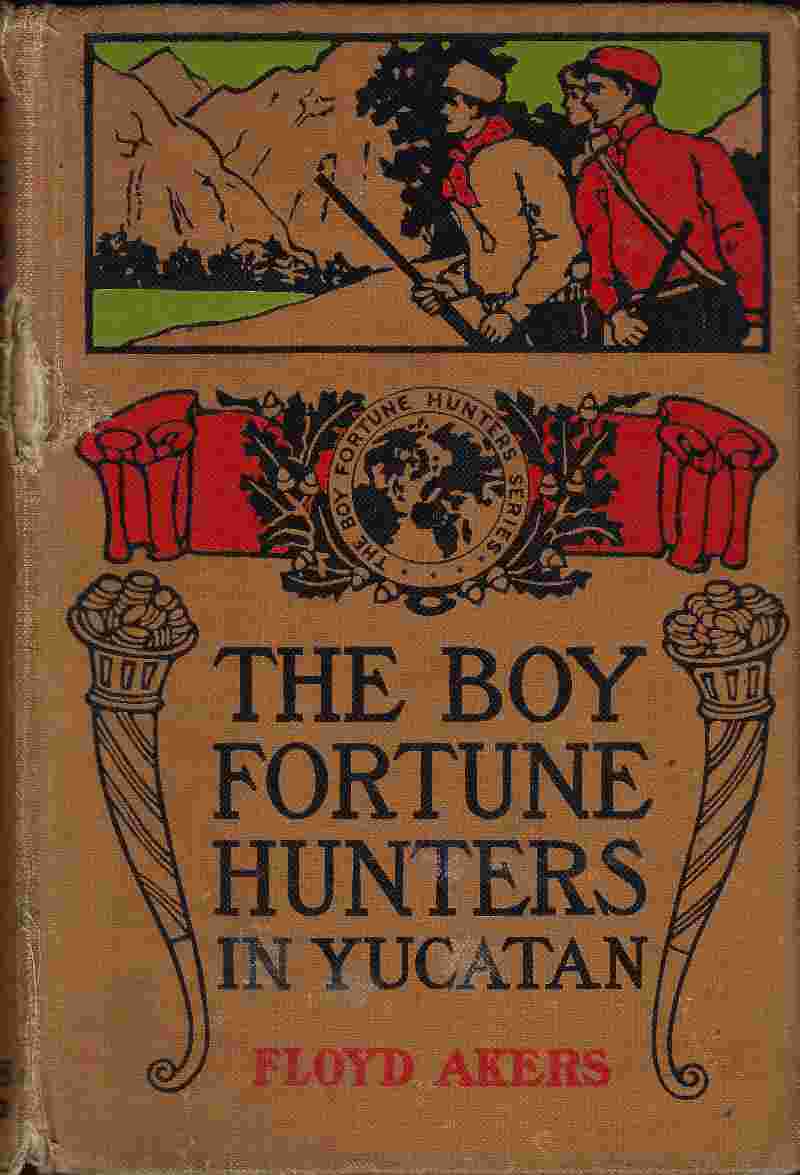
The Boy Fortune Hunters in Yucatan
Mr. Akers, in these new books, has at a single bound taken front rank as a writer for boys. The stories are full of adventure, yet clean, bright and up-to-date. The first volume tells of the exciting scenes in the early days of the Alaskan gold fields. The next book takes “The Boy Fortune Hunters” to the “Canal Zone,” and the third story is filled with stirring incidents in a trip through Egypt. The fourth book relates thrilling adventures in the flowery Kingdom, while the last story carries the youthful heroes through further exciting times in Yucatan.
Illustrated 12mos. Uniform cloth binding,
stamped in three colors.
Price 60 cents each
The Aeroplane Boys Series
By ASHTON LAMAR
I. IN THE CLOUDS FOR UNCLE SAM
Or, Morey Marshall of the Signal Corps
II. THE STOLEN AEROPLANE
Or, How Bud Wilson Made Good
III. THE AEROPLANE EXPRESS
Or, The Boy Aeronaut’s Grit
IV. THE BOY AERONAUTS’ CLUB
Or, Flying For Fun
OTHER TITLES TO FOLLOW
These stories are the newest and most up-to-date. All aeroplane details are correct. Fully illustrated. Colored frontispiece.
Cloth, 12mos. Price, 60c each
The Airship Boys Series
By H. L. SAYLER
I. THE AIRSHIP BOYS
Or, The Quest of the Aztec Treasure
II. THE AIRSHIP BOYS ADRIFT
Or, Saved by an Aeroplane
III. THE AIRSHIP BOYS DUE NORTH
Or, By Balloon to the Pole
IV. THE AIRSHIP BOYS IN THE BARREN LANDS
Or, The Secret of the White Eskimos
These thrilling stories deal with the wonderful new science of aerial navigation. Every boy will be interested and instructed by reading them. Illustrated. Cloth binding. Price, $1.00 each.
The above books are sold everywhere or will be sent postpaid on receipt of price.
Transcriber’s Notes
- Copyright notice provided as in the original—this e-text is public domain in the country of publication.
- In the text versions, delimited italics text in _underscores_ (the HTML version reproduces the font form of the printed book.)
- Silently corrected palpable typos; left non-standard spellings and dialect unchanged.