
CHAPTER XVII—“DAD!—IT’S JACK!”
Jack gave a step forward the better to survey the scene before them. As he did so his right foot struck something, and the next instant there was a sudden sharp jangling of a bell.
In a flash he realized what had happened. A wire connected with the bell had been stretched across the path,—Herrera’s dead line. His forward step had given the alarm, and might prove their undoing and cause the total failure of their plans. Captain Andrews’ arm shot out and dragged the boy back into a clump of brush. He made Jack lie down flat, doing so himself.
“The whole pack will be about our ears in a minute,” he whispered; but he did not reproach Jack, whose face was burning with humiliation.
Sure enough, almost simultaneously there came from the direction of the houses and sheds an excited clamor of voices. Lights flashed and figures could be seen rushing about. Presently they gathered in a knot, and some one appeared to be giving directions; then they scattered in a fan-shaped formation, and moved toward the woods in which the two adventurers lay concealed.
Jack’s heart beat like a trip hammer. Beside him he could hear Captain Andrews breathing heavily. Their discovery, within the next few minutes, appeared inevitable. Flashing their lanterns hither and thither the searching party, which they could now see was composed of negroes, from the Mosquito coast in all probability, advanced toward the jungle.
There were a dozen or more of them, headed by the big fellow whom they had noticed on sentry duty. Almost all of them carried the universal weapon of the negro in the tropics, long, glittering-bladed machetes. Some of them took to the path by which Captain Andrews and Jack had reached their present position. Others plunged into the jungle, cutting away the thick growth with their steel blades.
Their leader shouted something in Spanish. “He’s ordering them to search every inch of the jungle hereabouts,” interpreted Captain Andrews in a whisper. “The precious rascal! I’d like to have my hands on him.”
“It wouldn’t do much good,” was the mournful response; “the odds against us are too heavy for us to do much in case of our discovery.”
“Well, we’ve got the gas-guns, and from what I’ve already seen of them I reckon that they may prove mighty useful in a few minutes.”
As he spoke there came a crashing sound in the undergrowth a few feet from them. The next moment they saw the form of a giant black looming up directly in front of them. The fellow was grunting from his exertions in cutting his way through the underwood, and paused for an instant to catch his breath.
It was a fatal pause for him. Jack gently drew his gas-gun toward him and fired. The negro threw both his hands into the air and dropped with a loud “Oof!”
But the shot had been at such close range that the powerful gas impregnated the air that Captain Andrews and his young companion were breathing. The reek of it stung their nostrils.
“We’ve got to get out of here,” whispered Jack, “or we’ll be as dead to the world as that fellow is.”
Painfully they crept on their stomachs through the thick brush, moving as silently as cats. A single mistake in their movements, the crack of a branch snapped by carelessness might, as they both knew, prove fatal. But they managed to gain a small clearing under some big trees without mishap.
It was at this moment that Jack had a sudden inspiration.
“See here,” he said excitedly, under his breath, “those chaps have worked past us now, to judge by the sounds. They think that we have fled through the woods. What’s the matter with our doubling back on our tracks and marching right into the settlement?”
Captain Andrews, ungiven as he was to emotion, fairly gasped.
“By the beard of Neptune, boy!” he exclaimed, and then, in the same breath, “but it’s not as mad a plan as it sounds. In all likelihood, almost the entire force of guards from the plantation buildings are out after us, and we ought to be more than a match for half a dozen with the gas-guns.”
“Then we’ll do it?” throbbed Jack, with a catch of his breath.
“Yes. We came here to rescue those poor chaps, and, by the Polar Star, we’ll do it if it’s possible.”
Jack impulsively held out his hand. Captain Andrews clasped it warmly. The next moment they were stealthily creeping through the undergrowth, but advancing far more quickly than they had retreated a moment before.
When they once more gained the edge of the jungle. Jack perceived, to his intense satisfaction, that everything was quiet about the handful of buildings before them. So far as could be seen, there was no one about. Evidently then, his surmise had been correct. The majority, if not all of the residents, were abroad in search of the persons who had sounded the alarm bell.
“Which building do you think it likely they are in?” asked Jack, as they paused an instant before plunging from the protection of the woods.
“The one that has that lantern hanging on it,
“I imagine,” was the response from the veteran seaman, “we’ll try that first, anyway. Are you ready?”
Jack nodded. He did not speak, however. It was not a time for mere words. The next moment they had passed from the dark shadows of the jungle into the open space about the plantation buildings. Each clasped his gas-gun ready for instant use. But nobody appeared to bar their progress.
When they gained the structure from which the lamp was hanging, they found that it was a tall building of wood, and seemingly three stories in height.
It was used, though they did not know this at the time, as a drying house for the hemp after it had been through the crushing and separating processes. The door was secured on the outside by a weighty bar of wood. Captain Andrews lifted this out of its sockets, and in a jiffy had flung the door open. Inside was pitchy darkness, so black that it could almost be felt.
Jack had brought along his electric pocket lamp. He drew it out and switched on the current. The rays revealed a large, bare chamber, empty, except for a pile of dry hemp in one corner, and in another a few bales of the product stacked ready for shipment.
“Nothing here,” said Captain Andrews briefly.
“No; but see, there’s a flight of steps in that corner. Let’s go higher and find out what’s on the floor above.”
“It may be wasting precious time, lad.”
“On the other hand, this was the building that was guarded by the sentry. It’s fair to assume, then, that it is in this structure that our friends are confined.”
Captain Andrews had nothing to reply to this logic, and followed Jack up the steps.
At the summit of the rickety staircase was another door, secured, as had been the one below, by a stout bar of wood. Jack tackled this and wrenched it free. As he did so a voice that thrilled him in every fiber came from within the portal.
“Who is it?”
“Dad! It’s me—Jack—I’ve come to save you!” blurted out Jack, tears of sheer gladness springing to his eyes. He flung the door open.
The next instant Jack was clasped in his father’s arms, while about him and Captain Andrews, pressed the other captives, all well and unharmed and half wild with delight as they greeted the lad whose pluck had conquered Herrera’s “deadline.”
CHAPTER XVIII—HEMMED IN BY FLAMES
Naturally, after the first greeting’s had been exchanged, Mr. Jesson’s principal anxiety was for his son Tom. Jack soon set his mind at rest on this subject.
“Tom and Ned Bangs are back on the other side of the woods, with the aero-auto,” he explained.
“Ah, then it has proved a success?” eagerly interjected Mr. Chadwick.
“It is even better than we hoped it would be,” rejoined Jack enthusiastically.
“I wouldn’t be scared to trust myself to that aerial wind-jammer for a voyage to China,” stoutly declared Captain Andrews. “I reckon if Wellman had had a craft like that he’d have crossed the Atlantic easy as shooting.”
“I don’t know but what you’re right,” said Jack; “but the thing to discuss now is how to get out of here. Dad, do you know much about this place?”
“Nothing, except that there is a floor above this. We were confined there the first day of our captivity. But the sheet iron roof used for drying hemp made it so insufferably hot that we would have died if they hadn’t moved us down here,” was the reply.
“Then, so far as you know, there is no way of getting out but by the door we entered?”
“That’s the only way, I guess. We had better make good our escape while those rascally hangers-on about the settlement are off hunting for the fellows who rang their alarm bell.”
Professor Chadwick, to whom Jack had given a hasty outline of the events of the night, moved toward the door as he spoke. But he had not taken more than two steps toward the head of the stairs when he stopped abruptly.
“Hark!” he exclaimed, standing stock still in an attitude of close attention.
The murmur of voices came toward the party. It didn’t take any of them long to surmise what had happened. The searching party was coming back. In a few moments their egress would be cut off and it would be impossible to escape without a fight, the outcome of which was doubtful.
In this emergency Captain Andrews acted quickly. Gas-gun in hand, he ran down the stairway, shouting to the others to “come on.”
They pressed close behind him, each with a grim determination to reach the doorway before the guardians of the plantation noticed that it was open.
But in this they were disappointed. Hardly had Captain Andrews reached the doorway before several forms blocked it. As the doughty sea captain sprang at the foremost of them, at least a dozen of the husky henchmen of Herrera leaped on him.
Before either he or Jack could use their gas-guns, Captain Andrews was borne to the ground, while on top of him were piled half a dozen of the returned search party.
“Back to the upper room,” ordered Jack, “I’m going to fire my gas-gun.”
The boy shouted this warning because he knew that in that narrow space the fumes of the stupefying gas were likely to prove as disastrous to the white men as to the brawny negroes. Professor Chadwick, who well knew the qualities of the gas, retreated with the others. As he did so. Jack saw a rifle aimed at him by one of the negroes who crowded the doorway.
In a moment he had the gas-gun at his shoulder. He pressed the trigger and one of the sleep-laden globules shot out. It struck the armed negro in the chest, and the fellow threw up his arms with a sharp exhalation of his breath. Then he fell, as if his legs had been pulled from under him.
The fellows who were piled on top of Captain Andrews released him and dashed toward their other foe. As they left him the skipper of the Sea King sprang to his feet and discharged his weapon. The air became impregnated with stifling fumes.
Through the reek the seaman struggled to Jack’s side, and before the dazed negroes could realize what had occurred the two whites were shoulder to shoulder on the stairway.
Almost simultaneously the contents of the gas spheres began to have their effect. Man after man of those who remained, for several had fled, staggered and fell, while Jack and the captain retreated up the stairway. They lost no time in reaching the door at the head of the stairs and shutting it to keep out the fumes. They were none too soon. The gas had already affected them, and their heads throbbed and their eyelids felt leaden.
In the corner of the room was a big earthen pitcher of water. The Professor threw the contents of this over his son and Captain Andrews, and though still heavy from the effects of the gas, the shock revived them wonderfully.
“What now?” asked the Professor, after Jack and Captain Andrews had “come back to life” a little.
“Wait till the fumes of the gas have evaporated through the open door downstairs, and then make a dash for freedom,” said Captain Andrews.
“How long will it be before the air is good to breathe?” inquired Mr. Jesson.
“About fifteen minutes,” said the Professor; “the gas is of a very volatile nature, and the fumes will soon clear off. It will be an hour or so at least, however, before the negroes recover.”
“I would suggest, then, that Jack gives us a more detailed account of what occurred after he left Lone Island,” said Mr. Jesson.
Falling in with this idea, they seated themselves about the lad, who at once plunged into the details of the narrative, which, as may be imagined, proved of engrossing interest to all who heard him.
He was interrupted several times by questions and requests for information concerning the operation of the aero-auto, and the relation of his story took longer than had been anticipated. However, even in their critical situation, no one wanted to miss a word of it.
“And so the three gems are safe?” said Professor Chadwick, with a sigh of relief, as the lad concluded.
“Yes. They are at this moment in the Flying Road Racer’s locker, in charge of Tom and Ned,” was the reply.
As Jack spoke they all, by mutual consent, rose and made for the door.
“I shall be glad to get to the air,” remarked Professor Chadwick.
“Yes; it is insufferably hot in here,” agreed Mr. Jesson. “I had not noticed the heat so much while Jack was talking; but now,—phew! It’s like a furnace.”
As he spoke. Jack flung the door open. The next instant he staggered back, the hot blood in his veins frozen with horror.
A rush of air, hot and arid as a blast from a coke oven, struck him in the face. A great puff of smoke followed.
The room below was a vast furnace of red flame. In falling, one of the negro’s lanterns had overturned and rolled against the bales of dried hemp. All the time they had been talking the fire had been waxing more and more furious.
By this time the lower part of the stairway was in flames, and, as Jack held the door open, a tongue of fire, sucked upward by the draft, shot hungrily toward him.
He slammed the door instantly. But the heat of the seething furnace below rendered the air almost unbreathable.
It looked as if, in the very moment of their triumph, the adventurers were doomed to death in the burning building. Trapped and helpless, for an instant they were deprived of words. Was this to be their appalling destiny, their fate,—to be roasted alive without a chance of escape?
CHAPTER XIX—“STAND BY FOR A ROPE!”
There are some situations so overwhelming that the strongest and coolest may well be temporarily stunned by them. The springs of action paralyze, while the mind becomes a blank.
This was the case with our party of adventurers. Added to this, was the horror of knowing that many of the negroes in the room below must have perished in the flames. Jack felt a sickening feeling of panic clutching at his heart.
In one corner of the room the two sailors crouched, stolidly awaiting death. Professor Chadwick and Mr. Jesson alone remained calm. Even Captain Andrews and Abner Jennings appeared dazed and helpless with the sickening sense of the disaster that had overtaken them.
“We must leave this room at once.”
It was Professor Chadwick who spoke, in a voice that did not falter in its resolute tones.
His calmness, in the face of death, restored Jack’s pluck and heartened Captain Andrews and Abner Jennings. Even the two sailors appeared to be less panic-stricken.
“We can only leave it for the room above,” objected one of them, however; “the flames will reach there afore long. Might as well die now as an hour later.”
“Shame on you for American seamen!” burst out Captain Andrews, “rouse up there! While there’s life there’s hope.”
His words were effective. At any rate, no more grumbling was heard as the beleaguered party ascended to the upper chamber. Like the one below it, the place was bare, and Jack flashed his electric searchlight about without discovering any loophole of escape. As was the case in the lower chamber, the walls were unpierced by windows, and the timbers were too solid for it to be feasible to knock them out, except with heavy sledges.
All at once, however, Jack noticed, as he flashed his light about, that in one corner there seemed to be a sort of trap-door in the roof.
He hailed his discovery with a cry of delight. If they could only reach the roof it might be possible for them to attract the attention of some one below who could get a ladder.
Of course, in that event, they would be likely to be made captives, but anything was preferable to a tomb in the flames.
Jack’s discovery acted like a tonic on the despairing feelings of the party. The iron roof was two feet beyond the reach of the tallest of them, but this difficulty was gotten over by Jack clambering to Captain Andrews’ shoulders, and from that situation he was able to reach the trap-door and to open it, for his first fear that it might be locked proved to be without foundation.
Having opened it. Jack clambered through, and lying flat on the roof extended his hands to his father, who, in turn, used Captain Andrews as a ladder. Then came Mr. Jesson, followed by the two sailors. Abner Jennings demurred to taking precedence of the Captain. But,——
“The skipper’s the last to leave the ship, my lad,” declared Captain Andrews, and Jennings, unwillingly enough, clambered on his back and was drawn up.
Then came the Captain’s turn. Abner Jennings, as the strongest of the party, lay flat on his stomach and extended his arms down within the room. To his legs clung the others, acting as anchors. With a mighty heave Captain Andrews, no lightweight, was raised high enough for him to clutch the edge of the trap, after which he completed the operation of getting through for himself.
As he gained the roof they heard a crash beneath them.
“The floor of your jail has fallen through, I reckon. Professor,” grimly spoke the captain.
As Jack heard the angry roar and crackle of the flames beneath them he could not repress a shudder. It was a drop of fifty feet or more to the ground, and they were by no means out of danger.
“Let’s see if any of those black rascals are about,” said Captain Andrews, “if they are we may be able to induce them to get a ladder.”
“Surely they wouldn’t be inhuman enough to let us remain here,” exclaimed the Professor.
“I don’t know,” was the response, “like master, like man, you know; and this might strike Herrera as a very neat way of disposing of us.”
Several forms could be seen flitting about below them. The flames were pouring through the windows of the lower story of the hemp-drying building, casting a ruddy glow in which near-by objects could be seen as plainly as if by daylight.
But the negroes appeared to be giving no thought to the burning structure. Instead, they could be seen dragging piled bales of hemp out of danger of flying sparks. Nor did they pay the slightest attention to the frantic shouts of the party marooned on the top of the blazing building.
“Great heavens! they mean to leave us here to roast to death,” groaned the Professor.
As he spoke there came another crash below them, and the building trembled.
“The floor of the second room has fallen!” cried Mr. Jesson, rightly guessing the cause of the crash. “In a few seconds this roof will become red-hot, and——”
He stopped short. There are some things that cannot be put into words.
The trap-door had been closed, but before long they could distinctly feel the roof under their feet becoming warmer and warmer.
Suddenly Jack espied a great mass of green hemp piled off in one corner, ready to be raked out on the iron roof for drying when the sun arose.
“We can put that under our feet,” he said, “and stick it out a while longer that way.”
So tenacious is the instinct of clinging to life, that even though they knew it would only avert the end by a very short time,—unless a miracle came to aid them,—they adopted Jack’s idea.
But before long the hemp began to smoke and steam. The heat was rapidly drying out the moisture, and then——
Suddenly one of the sailors gave a yell, and shouting,—“I’m going to end it all right now,” made a plunge for the edge of the roof.
His evident intention was to hurl himself down to death.
But before the crazed man could carry out his plan Captain Andrews sprang at the fellow and brought him down with a crash.
“If Providence means us to die, we’ll meet death like men,” he said stoutly; “but it’s not like Americans to give up the ship while there’s a shred of hope.”
The frenzied sailor fought and struggled on the pile of steaming hemp on which the skipper held him. But Captain Andrews’ strong arms pinned him down.
Jack felt his senses reeling. The hot breath of the fire had reached them by this time. The roof gave off heat like the top of a stove. If it had not been for the damp, green hemp they could not have held the situation for an eighth of the space of time that they did.
Their throats grew parched and their tongues swelled till they were painful, and they could shout for aid no longer. For all the attention the negroes below paid to their cries, they might as well have remained silent. The blacks seemed to consider the removal of the hemp to a safe place of far more importance than the lives of the flame-marooned white men.
Just when Jack’s hope had flickered out and a sort of coma of despair was creeping over him the miracle happened.
It was Professor Chadwick who saw it first.
Through the red glow that crimsoned the sky came a huge floating form.
The Professor shouted and pointed upward. Jack raised a pair of dimmed eyes; but the next instant they cleared as if by magic.
“It’s the Flying Road Racer!” he shouted, yelling like a madman. “Hurray! We’re saved! we’re saved!”
And then something in his head seemed to snap with a loud report. He swayed, and would have fallen heavily on the hot roof if his father had not caught him in his arms.
Then he was startled into alertness again by a sharp hail which came from above them.
“Stand by for a rope. We’ll drop as low as we dare!”
CHAPTER XX—A RESCUE BY AIRSHIP
Just what happened in the moments that followed neither Jack nor any of his companions has ever been able to describe in detail. It was a time in which every second counted, while under their feet the flames roared and crackled hungrily.
From the Flying Road Racer a rope came snaking down, and Professor Chadwick caught it. At the corner of the roof in which the adventurers were huddled was a stout post, used sometimes, apparently, for hoisting things from the ground, for a pulley hung from it.
With a flash of inspiration the Professor, with Mr. Jesson and Jack aiding, rove the rope through this pulley. Then, while Tom and Ned maneuvered the Flying Road Racer so that her “bow” pointed downward, all of the marooned adventurers who were able to do so heaved on the rope. In this way the air craft was brought to within three feet of the roof.
Another length of rope was then looped over the side by Tom and made fast to two of the stanchions of the balloon support. The first to test the loop was the companion of the crazed sailor. Half dragged, he scrambled into the body of the suspended car. Professor Chadwick followed, and then came Mr. Jesson, while a delighted cry at his father’s safety came from Tom.
Abner Jennings was the next to be taken on board, and then came Jack. In the meantime Captain Andrews had buckled his belt around the limbs of the crazed sailor and had borrowed Jack’s for the purpose of confining his prisoner’s arms.
Trussed up in this manner the poor fellow was handed up to those on the Flying Road Racer, and then the gallant Captain Andrews made a spring for the swaying loop.
He was in the nick of time. As he gained the tonneau and sank to the floor almost exhausted, there was a deafening roar, and, as if it had suddenly melted away, the entire building collapsed. Jack turned away shuddering as the flame and sparks shot up above the ruins.
The ideas it suggested of the fate that might have been theirs if help had not arrived in the very nick of time, were almost overwhelming.
Tom was at the helm, and Ned it was who had cast off the rope. Slowly, almost Phoenix-like, from amidst the flames rose the Flying Road Racer with her heavy burden.
There was danger in the situation, too. The gas in the bag was inflammable, and the heat of the fire might expand it so that at any minute it might burst the container, and cause an appalling catastrophe. This danger Tom and Ned had willingly faced when they brought the Flying Road Racer to the rescue. But now, all their desires were centered on getting as far away from the fire zone as was possible.
Laden as she was, the great air craft had not the same buoyancy that had been hers when she set out at midnight from the Vagrant. She rose slowly, and although her propeller was whirring at top speed, and her rising planes were set, she once or twice sagged dangerously.
While this behavior on the air craft’s part was worrying her navigators seriously, there came a sudden fresh cause for disquiet. Bullets from the negroes below began to whiz about them.
The fellows had luckily been too much astonished to fire while the task of rescue was going on. The apparition of the sky-ship had taken them so much by surprise that they had temporarily been unable to take any hostile action.
Now, however, they had recovered their senses and were doing all in their power to render the escape of their late prisoners an impossibility. Luckily, however, they did not have enough sense to fire at the balloon bag, or their endeavors might have been crowned with success. Instead, they aimed at the occupants of the suspended car, and what with bad marksmanship and excitement failed to hit any of them. True, a few bullets pinged against the suspension wires and struck the sides of the car; but none punctured the tank, as the boys feared might be the case, or caused any serious injury.
A breeze springing up presently wafted the overladen airship into an upper air current, and before long she was rising merrily. More gas had been turned into the bag, increasing its buoyancy, and by the time the dawn began to show grayly the adventurers were far from the scene of their fearfully narrow escape.
Behind them, however, they could see, as the light grew stronger, a pillar of dark smoke soaring heavenward and marking the site of what had almost proved their funeral pyre.
What with the coming of daylight and the feeling that they had been saved from their greatest peril, the adventurers’ spirits rose wonderfully as they sailed along. Even the crazed sailor showed symptoms of returning sanity, and, as Professor Chadwick expected, his mental disengagement soon passed away. Oddly enough, though, he could never recall the events of that night. They had been wiped from his recollection as an old sum is washed off a slate.
Jupe got out canned goods and made a fairly good breakfast, while they were in mid-air. To some of the party it was the most novel meal they had ever eaten. But neither their recent hardships nor unusual surroundings impaired their appetites. All ate ravenously and felt much better after the meal, which included hot coffee cooked on an electric radiator. This radiator was connected with the dynamo that filled the storage batteries and provided engine ignition and light.
During the meal, Tom told them how he and Ned and Jupe had waited beside the Flying Road Racer after the departure of Tom and Captain Andrews on their scouting expedition. For some time they stood their ground patiently enough, and occupied their time, according to instructions, by reinflating the bag.
This done, there was nothing to do but await the progress of events. Of the search in the jungle they knew nothing. But the sound of shots from the direction of the plantation had first roused their fears that something was wrong.
Then they had perceived the red glare of the fire on the night sky. Certain then that something serious was wrong, Tom took it upon himself to get up the anchors and fly to the rescue. Little did he imagine, however, he confessed, what dire straits his friends were in.
“We owe you a great debt of gratitude, you and Ned Bangs, for your prompt and brave action,” warmly declared Professor Chadwick.
That the others heartily seconded the motion may be imagined. In fact, as they all realized to the full, they owed their lives directly to Tom Jesson’s pluck and brains and his able assistant, Ned Bangs. Jupe, too, came in for his share of praise, for the old colored man had behaved in the great emergency through which they had passed, with remarkable coolness and ability.
As Tom concluded his story. Jack glanced at the barograph. They had risen to three thousand feet, and were moving in a westerly direction. So engrossed had they all been in discussing their wonderful escape, that they had really hardly noticed in what course they were sailing.
“I think it’s time that we decided on a destination,” said Jack, as he noted these things.
“Why not try for Lone Island?” said Mr. Jesson. “The Sea King should be there, and——”
Jack shook his head.
“The Flying Road Racer couldn’t fly as far as that?” asked Captain Andrews, who had been glancing about him at all points of the compass while this talk was going on.
“She could fly as far as that under normal conditions,” was the reply; “but not with such a load on board. We are using up fuel at twice the usual rate, and might have to descend to make more gas for running purposes.”
“Can’t we refill the reservoir in mid-air?”
Mr. Jesson asked the question.
“Too dangerous, except in case of absolute necessity,” said Jack; “it could be done, but there is a certain amount of risk.”
“I think, then, that we had better head about and make for the sea-coast where the Vagrant is hidden,” said Professor Chadwick.
“I don’t agree with you there,” said Captain Andrews positively.
“Why not?”
“Well, in the first place, during the next few days Herrera is going to go through all that vicinity with a fine-tooth comb. He won’t let the gems slip through his fingers without some sort of a battle for them, you can bet.”
“What would your advice be, then?”
“To make for the mountains yonder with all speed. We can lie snugly hidden there for a short time, and can form some definite plan. We are all too much tired and overwrought now to discuss such things intelligently.”
“I think you are right. I know that, now that the strain is over, I feel like taking a long sleep,” said Mr. Jesson.
“Then let us head right on as we are going,” suggested Jack. “That range of hills doesn’t look so very far off. We ought to get there before afternoon. That will give us time to make camp and get things snug for the night.”
And so it was arranged. But Captain Andrews still kept casting anxious glances back toward the coast line.
“What’s the trouble. Captain?” asked Jack presently, noting a trace of uneasiness on the old sailor’s countenance.
“Why, lad, I don’t much like the look of the weather yonder. See that gray haze that’s spreading over the sky so quick? That means wind, and maybe worse, or my name ain’t Sam Andrews.”
“Good gracious!” exclaimed Jack, “we’re in no fix to battle with a storm.”
As he spoke a sharp puff of wind shook the Flying Road Racer.
“Could we land if anything very bad comes on?” asked Captain Andrews, with a yet stronger tincture of anxiety in his tones.
Jack peered over the edge of the car.
“Nothing but dense forests are below us,” he said; “it would be courting death to try to land among them.”
CHAPTER XXI—ALOFT IN THE STORM
In an almost unbelievably short time the wind had increased to a gale. It shrieked and moaned among the wire supports of the car, and the great bag that held it in mid-air swayed and tore furiously at its fastenings.
Jack kept a sharp lookout for a good spot to land, while Tom relieved Ned at the wheel. Once they saw beneath them a big area of smooth, park-like land, almost devoid of trees. It would have made an ideal landing place, but as they tried to force the Flying Road Racer around to head for it the full force of the wind struck them.
While traveling with the gale they had not noticed its full fury. Now, however, it battered them viciously, tearing at the gas bag as if it had been some monster bent on its destruction. The car swung wildly underneath its support, and they had to cling on to avoid being hurled out into space.
Their intention of battling with the wind was quickly given up. Tom brought the helm around and the Flying Road Racer hurtled off before the blast at a speed the indicator showed to be sixty-five miles.
“Is there no possibility of turning around and landing?” asked Mr. Jesson somewhat anxiously.
“It is out of the question,” declared Jack; “we’d rip this craft to pieces if we even attempted to buffet the storm.”
“It’s a bad one, all right,” said Abner Jennings.
“And may be worse afore it’s better,” said Captain Andrews, casting an anxious eye aloft at the scudding clouds among which they were sailing.
“The wind is blowing about sixty miles an hour,” said Jack, looking at the anemometer. “That means practically a hurricane speed.”
“Are we in danger?” asked Mr. Jesson.
“Not as long as we can keep in the air,” said Jack; “but if anything should go wrong it would be awkward, to say the least of it.”
“Then something may happen at any minute?”
“I didn’t say so. Uncle; but, as Captain Andrews said, the wind may grow stronger.”
“It’s hard to tell what these tropical hurricanes will do, once they get started,” said the burly captain. “I’ve seen ’em blow for a week and flatten out whole groves of cocoanuts.”
It grew blacker and blacker. The Flying Road Racer was now scudding through ragged white clouds that drove as fast as she did under a panoply of inky black. The scream of the rigging as the wind rushed against the taut, straining wires, sounded almost like the cries of some live thing in pain.
Every now and again there would come a sudden burst of vicious fury, and once or twice it actually appeared as if the great air craft would be ripped in pieces. But so far every wire and brace and turnbuckle in her construction had held bravely.
Jack watched the engine anxiously, attending to the lubricating devices and adjusting the gas mixers. The machine was behaving splendidly, and Jack felt that if only the connections between the gas bag and the car would hold they might still weather the fury of the gale.
He knew that these tropical hurricanes while furious are often not of very long duration. He stuck to his post, keeping hope alive in his heart, while the others pluckily enough endured the situation without flinching.
All at once, the wind stopped as suddenly as if it had been cut off at a gigantic spigot.
The calm, after that raging, furious gale, was positively startling.
“Is the storm over?” asked Ned.
“No. It’s only just beginning,” was the alarming response from Captain Andrews.
“I understand you now,” came from Mr. Jesson suddenly; “it’s a circular storm.”
“That’s it, sir. In a few minutes it will be blowing just as hard out of the west as a few minutes ago it was blowing from seaward.”
“We’d better put the craft about,” said Tom.
“Yes; bring her round as quick as you can,” said Jack. “Goodness! how queer this sudden calm feels.”
It was indeed an uncanny feeling. So still had the air become that a candle might have been lighted and its flame would hardly have flickered.
Through this stagnant atmosphere the Flying Road Racer was worked around till her bow was pointing seaward.
“Gracious!” exclaimed Tom, “if the wind doesn’t come from the quarter Captain Andrews expected we’ll be blown to bits.”
Jack said nothing. Any reply he might have made was, in fact, cut short at this moment by a moaning sound from the direction of the mountains. It was caused by the wind sweeping through the canyons and deep abysses that scared them.
“Put on full speed, Tom,” urged Jack; “the faster we are going when that wind strikes us the less chance there will be of our being ripped to bits.”
The greatest speed of which she was capable was placed on the Flying Road Racer. The indicator showed in turn fifty, sixty, sixty-five and then seventy miles!
Just as she attained this remarkable speed the wind struck the straining air craft with its full velocity.
“Fo’ de Lawd’s sake!” shrilled out Jupe, “we done bin gone dis time fo’ shoh.”
But he was wrong. The stout fabric of the wonderful craft withstood even the terrific assault now made upon her. But her forward motion suddenly ceased. Caught in the vortex created by the meeting point of the two conflicting storms, she was whirled round and round as if she had been gripped in a maelstrom of the winds.
The boys could do nothing to control this nauseating, dizzying, rotating motion. Upward and forward the Flying Road Racer was forced, climbing at terrifying speed the aerial circular staircase. One by one her occupants succumbed to the effects of the rapid circling. It caused a helpless, miserable feeling similar to seasickness and quite as prostrating.
“Back! back! Go down lower!” shouted Captain Andrews in Tom’s ear.
“We can’t,” yelled the lad; “we’re being dragged to the sky. We’ve lost all control.”
“Oh, but this is fearful!” exclaimed Mr. Jesson. “Nothing made by human hands can stand this much longer.”
Truly it seemed a marvel that the craft had held together as long as it had. So fast were they being swung round and round by this time that the car was suspended at quite a sharp angle, swinging outward from the gas bag by the force of the centrifugal motion.
It was terrifying, awe-inspiring, prostrating. Not one of those clinging for dear life to the dizzy car had ever had such an experience, and one or two among them had faced death not a few times.
All at once there came a sharp snap from above them.
To their overstrung nerves it sounded like a pistol shot.
“One of the wires has parted!” cried Ned in a terror-stricken tone.
“It is the beginning of the end,” groaned Captain Andrews, sinking his head in his hands.
“Can nothing be done?” gasped out Mr. Jesson, who alone of all that pallid-faced crew could find his voice at that instant.
“Nothing,” was the reply. “In ten minutes or less every wire holding us to that gas bag will have parted like that one.”
“And then?”
“And then, my friend, we shall be dropped five thousand feet through space.”
CHAPTER XXII—A VOYAGE OF TERROR
This dire prophecy was, however, not destined to be fulfilled. To the intense joy of the air travelers, the circular motion ceased almost as suddenly as it had begun, and the rest of the wires remained intact. Evidently, the Flying Road Racer had encountered a cross current of wind at the great altitude she had now attained, which brought her safely out of the aerial whirlpool.
It was an almost miraculous escape, and they were all duly thankful when once more their voyage was resumed on an even keel.
But the wind still blew hard, and it was impossible for them to stem it without running too grave a risk to attempt such a task.
In this way an hour or more passed, and then suddenly Jack, who had been looking out ahead, gave a startled cry.
“What’s the matter?” asked his father.
“Matter? Good heavens, we are being blown out to sea!”
While he spoke the Flying Road Racer was being hurtled along at a dizzy sped above bending tree tops and a storm-stressed expanse of country. Tom had brought the craft much lower, and it was now not more than five hundred feet above the earth. Beneath them the landscape whizzed by like a colored moving picture.
But the peril Jack had called attention to lay directly in front of them. Beyond the trees came a strip of white beach, and beyond that again the vast troubled expanse of the heaving ocean billows, lashed into fury by the storm.
Their situation was indeed critical.
“We’re going from bad to worse,” exclaimed Mr. Jesson. “Is there no way of landing?”
“Not without the risk of killing or injuring most of us,” rejoined Jack soberly.
“Why—why, then we’ll be compelled to fly above the ocean?”
“It looks that way. I don’t see what else we can do.”
“But in that case we shall be in grave danger?”
“I don’t think the danger will be much greater than the one we have faced. We have plenty of gas still, and can keep in the air for a long time if need be.”
“A week?” asked Captain Andrews. “These hurricanes sometimes last as long as that.”
“I don’t know that we could hold out for a week,” admitted Jack; “but I do know that we cannot avoid being blown out to sea. If the storm does not abate we are likely to be compelled to spend some time above the water.”
“Well, the wind is coming out of the southwest now. If we keep on this way we ought to be blown clear across the Gulf of Mexico and on to the western shore of Florida.”
It was Captain Andrews who vouchsafed this last remark.
“I don’t know that that would be a bad idea,” commented Professor Chadwick.
“How long ought it to take us, going at this rate of speed?” inquired Abner Jennings.
“Let’s see, the least distance across would be about fifteen hundred miles.”
“Then, at the rate we are being driven, it would take about twenty-four hours to make the passage,” calculated Mr. Jesson.
“About that time—yes,” agreed Jack. “I really think we had better try to do that.”
All agreed that it appeared to be the best plan. While they had been discussing this, they had passed over the last few miles of dry land. Looking down now they saw beneath them a vast expanse of gray, tumbling billows, tossing and rolling before the wind.
“If we ever took a tumble into the sea it would be all up with us,” commented Jack in a low voice to Tom.
“Yes; even a ship could hardly live in such a storm, and yet—look. Jack, back yonder,—isn’t that,—yes, surely it’s a craft of some sort!”
The lad indicated a point to the southward of them. Rising and falling in the great trough of the billows was a small vessel of some sort. For an instant Jack thought it was the Tarantula, but the next moment he made out that the vessel they were looking at had two masts and a yellow funnel amidships.
But another shift of the wind gave them something else to think of right then.
The blast “hauled round,” as mariners call it, and shifted to the south. The Flying Road Racer’s head was twisted around to the north and she was deflected from her course to the eastward and the hoped-for Florida coast.
“What shall we do now?” cried Ned Bangs, when he observed this.
“Keep on running before the wind. It’s all we can do,” rejoined Jack.
The storm-beaten air craft, with its heavy human freight, was now being driven almost due north along the coast. Tom kept the prow pointed so as to bring the course almost parallel with the coast. All the time both he and Jack kept a keen lookout for a possible landing place.
But none appeared. The wind, instead of dying down, grew stronger as the day went on.
“What will be the end of this?” was the thought that crossed the minds of all of them in one form or another.
The sun was obscured by scudding clouds, below them rolled the dismal, desolate expanse of salt water, for by this time they had passed over the peninsula of Yucatan and were out over the open gulf. In the distance to the westward, however, lay a dim coast line, and Tom steered toward it.
Suddenly there came a loud, ripping, crashing sound.
As he heard it Jack gave a cry of dismay. It was echoed by Tom and Ned, who both instantly guessed what had occurred.
The rudder had given way under the strain.
Looking over the side of the car they could see it being swept away by the wind, while astern of the tonneau hung a mass of tangled wreckage.
“Good heavens! This is the worst yet,” groaned Captain Andrews. “Adrift in an airship without a rudder! What under the starry dome can we do now?”
“Nothing but hope and pray for the best,” rejoined Jack. “We are helpless indeed without the rudder.”
Fortunately, however, the propeller still worked, and Tom, abandoning the now useless steering wheel, gave all his efforts to aiding Jack in attending to the engines.
The aerial screw helped to keep the Flying Road Racer on a straight course, and onward she flew, a disabled but still staunch craft.
“Is there anything that we can do to help you?” asked Professor Chadwick, after a while.
“Dere ain’t nuffin’ would help now but about a squar’ mile ob good dry lan’,” gloomily remarked Jupe.
Tom shook his head, and so did Jack.
“No, Father,” said the latter, “there isn’t a thing to be done. So long as we can keep the engine going, though, we can manage, at least, to keep before the wind.”
“We’re getting closer to the coast,” cried Mr. Jesson suddenly.
They were indeed. The forms of distant hills and forests could now be made out, and hope began to revive that they might, after all, find a spot to make a safe landing.
“The wind has shifted again,” announced Captain Andrews, glancing over Tom’s shoulder at the compass. “It’s blowing out of the east now, and if it holds will drive us upon the Mexican coast.”
Hardly had he made this announcement than there was an alarming cracking, snapping sound from the bow of the Flying Road Racer.
A dark, sharp-pointed object whizzed through the air, and the next instant there came a sudden sound of ripping fabric, followed by a hissing noise as of escaping steam.
“Great jumping sea serpents, what’s happened now?” bellowed Captain Andrews.
“A blade of the propeller has torn loose from its hub and pierced the gas bag,” shouted Jack in an alarmed tone.
“We’re falling!” suddenly screamed out Abner Jennings.
“Bound for Davy Jones’ locker, sure as fate!” bawled one of the sailors.
“Get out the life jackets!” yelled Tom at the top of his voice. “They are in that locker on the right-hand side of the tonneau.”
All this time the Flying Road Racer was slowly descending. The broken propeller blade had ripped a big hole in the side of the gas bag, through which the vapor was rushing forth.
“Isn’t it possible to repair it?” cried Mr. Jesson.
Jack shook his head.
“Impossible,” he said. “We had better all get on life jackets as quickly as possible. It’s lucky I had them put in that locker; but something I read about an airship being blown out to sea some months ago made me think of it.”
As quickly as possible all of them invested themselves in the cork-lined jackets, which were covered with stout canvas.
“Look! look!” cried Jack suddenly, “isn’t that an island ahead of us!”
Captain Andrews pierced the gloom with his keen eyes.
“It is! It’s an island, sure enough!” he cried joyfully. “If we can make it we are saved.”
But the Flying Road Racer settled lower even as he spoke.
The angry sea beneath looked savage and cruel as it leaped upward toward them, as if impatient for the end to come swiftly.
Ahead lay the island; a large one, with a sandy beach extending in their direction. Could they reach it before the air craft sank into the waves?
CHAPTER XXIII—THE BOY INVENTORS SOLVE A PROBLEM
The engine had been shut off, and amidst a dead silence, so far as any talk was concerned, the Flying Road Racer drifted down toward the island.
But the gas had escaped so rapidly and the weight in the car was so great, that the island was still a few hundred feet off when they first felt the wind-driven spray dashing against their faces.
“Can we make it?” asked Mr. Jesson in a low, tense voice.
“I think so,” replied Jack; “at any rate, if we can’t, we have the cork jackets on and must swim for it.”
As he spoke, though, the disabled flying craft settled suddenly downward. Above her the collapsed gas envelope was wrinkled and flabby, and barely kept her up.
All at once the crest of a huge wave dashed against the bottom of the aluminum tank. The Flying Road Racer careened so far over that for a moment it looked as if her end had come.
But at the same moment the wind blew stronger and caught the half-empty gas bag. This raised the crippled craft a few feet and drove her forward. The impetus thus given was sufficient to save the adventurers from a dangerous swim.
With a crash that might have been audible at some distance had there been any one to hear it the Flying Road Racer landed in the sand of the island beach at precisely one-thirty on that day of stirring events in the young inventors lives.
Thanks to the shock absorbers, the auto part was not harmed seriously. Five minutes after they had landed the adventurers stood in a group surveying the stranded craft.
“What a wreck!” exclaimed Mr. Jesson, gazing the flabby wrinkles of the gas envelope and at the wound in its side.
The Flying Road Racer did, indeed, look different from the trim craft that had arisen from the deck of the Vagrant not so very long before.
But how much had transpired in those few hours! If time might be reckoned by events the boys could record that they had passed through years of experience since Jack and Captain Andrews struck out on the forest path leading to the plantation houses.
“What a mess!” breathed Abner Jennings, echoing in part Mr. Jesson’s remark.
“It’s my opinion that we ought to thank Providence for getting off with our lives,” said Captain Andrews stoutly. And to this sentiment they all heartily agreed.
“Can you ever repair her. Jack, do you think?” asked his father anxiously.
Jack, who had been surveying the wreck carefully, was not yet ready to give an opinion, however.
“If we could fix that rip in the gas bag it might be possible to patch her up,” he said dubiously. “There is,—or ought to be,—a spare propeller on board, and if the engine is working, it might be feasible to put the craft in order once more.”
“Well, we’d better run her up out of the reach of the waves anyhow,” said Tom.
The air craft had grounded at the margin of the beach, and the spray of the thunderous waves showered her as each broke.
The two sailors and the others came forward to lay hands on the Flying Road Racer, and shove her up the beach. But Jack had a better plan in mind.
“If the motor is working. I’ll run her up under her own power,” he said.
He followed up these words by getting into the driver’s seat, and after Tom had removed the wreck of the propeller, his cousin started up the engine and threw in the clutch connecting it with the driving machinery.
The rear wheels flew round in the sand for a minute, but as the boy applied more power they gripped the surface and the Flying Road Racer—an automobile now—moved rapidly up the beach. Jack ran her in under a grove of trees and then shut off the engine.
“If only we weren’t on an island,” he said, “we could run right through to the city of Mexico!”
“Gee, I wish we could,” said Ned Bangs, “it’s a question of how long the grub will hold out on this island, and we don’t know if any ships come this way.”
“Easy enough to find out,” said Tom rather carelessly.
“Easy enough?” echoed Ned. “Well, Tom Jesson, you’ll have to show me. Here we are, cut off from all communication——”
Tom smiled and shook his head.
“Not while we’ve got the wireless,” he said.
“What do you mean, Tom?” asked Mr. Jesson.
“That when I left the Vagrant I brought her wireless apparatus with me,” said Tom in a quiet tone. “That’s what those bundles were.”
“Good,” exclaimed Mr. Jesson. “We’ll have something to eat and some hot coffee, and then we’ll try to get into communication with the shore, or some vessel, and get them to take us off this desolate place.”
But Jack, who had been looking about the island in their vicinity, dampened their enthusiasm by a sudden question.
“How are you going to fix an aerial?” he asked.
“Easy enough,” said Tom confidently; “some tree will do. Ned Bangs, here, can climb it. Luckily I loaded a lot of copper wire with the other stuff. We can use that for antenna.”
“Why, you monkey!” cried Jack, half laughing, “there isn’t a tree on the island.”
This fact, which none of them had noticed before, was evidently so. The island was covered with a scrub growth, but nowhere did the bushes exceed a height of ten feet.
Professor Chadwick broke in on their dejection.
“Come,” he said, “it’s no use our discussing anything now. Let us have a good meal and then, maybe, we’ll hit upon some plan.”
While Jupe made his preparations for a warm meal, selecting a spot sheltered by brush not far from the remains of the Flying Road Racer, the boys gathered driftwood, of which there seemed to be plenty on the beach, and made a big pile of it. This was lighted, and the warmth of the blaze proved very comforting to the chilled castaways.
As Professor Chadwick had predicted, the meal served to put new heart into them. As they ate they discussed their situation in all its bearings, but without arriving at any conclusion as to their future course.
If they could not get a wireless message to some station on land or ship, their situation looked as if it might speedily become serious. They did not dwell on this aspect of the case, however, but made a determined effort to be as cheerful as possible.
After dinner, if such the meal could be called. Professor Chadwick and Mr. Jesson set out to explore the island. The others, except Jack and Tom, lay down to sleep, being’ thoroughly exhausted by what they had gone through.
The two lads, however, felt too excited to sleep. Instead, they fell to figuring how it would be possible to send out a message telling of their plight, without having a tall pole or tree to which to string their aerials.
The problem was perplexing, and they threshed it over and over for an hour without arriving any nearer a plan for getting their wires into the air. It was Jack who finally hit upon what was literally an inspiration.
Close to them, while they had been talking, lay the pile of life jackets they had taken off when they landed.
“Is there any of that liquid rubber for repairing the tires in the Flying Road Racer?” he inquired of Tom, with seeming meaningless curiosity.
“Why, yes; there’s a gallon can of it. But why?”
“You’ll see directly. Will you get it?”
“Yes, of course,” rejoined Tom, rising from his seat on the sand. “Anything else?”
“That needle and stout thread in the gas bag tool kit and—well, I guess that will be all for now.”
“I wish I knew what you are driving at,” said Tom, as he moved off to get the things Jack had asked for.
“I’m driving at a way to get those aerials up,” rejoined the young inventor briefly.
When Tom returned with the articles Jack had asked for, he found his cousin busily engaged in taking the cork out of one of the life jackets. This was easily done, as it was in granulated form.
Having emptied the jacket, the boy heated some of the liquid rubber over Jupe’s fire till it was about the consistency of cream. This done, he proceeded to coat the canvas of the empty life jacket with the compound. Before he did this, however, he sewed a patch on over the hole he had made to drain the cork, leaving a bit of rubber tube, also found in the supply locker of the Flying Road Racer, sticking out.
Tom, after a few minutes, began to realize dimly what the ingenious lad was doing; but he didn’t get the full understanding of Jack’s idea till the latter, having allowed the rubber coating to dry, walked toward the Flying Road Racer with it.
“I see what you’ve made now. Jack,” he cried. “It’s an airproof canvas bag, and you’re——”
“Going to fill it with gas and see if it will rise,” said Jack.
As he spoke he placed the end of the rubber tube he had left protruding from the canvas life jacket, over a small stop-cock on the gas tank of the Flying Road Racer. When he turned the valve a hissing sound followed and the rubber-coated life jacket began to fill, just as any air-tight envelope would have done.
When it was half full a laughable thing occurred, giving abundant evidence of the bag’s buoyancy. Jack, who was holding it, was suddenly lifted off his feet as the bag began to rise, tearing the end of the rubber tube off the valve as it did so. Just as he was lifted into the air, for he actually couldn’t make up his mind to let go of his invention, Tom seized his feet and dragged him to the sand again. A rope was secured and the bag lashed to a bush after the end of the tube had been tied.
“By cracky!” cried Tom, “that’s the invention of the century. How on earth did you come to think of it?”
“I suppose old Mother Necessity had something to do with it,” said Jack; “but the fact that those life jackets lay right close to us helped a lot. I reasoned it out that they would float on the water, and therefore, if they could be emptied and made air-tight, they would rise when filled with gas equally well.”
“And you’re going to hitch the aerials on to that one and send them up?”
“I’m not sure that one of them will be enough to raise such a weight of copper wire. I guess we’ll make another one.”
“And I’ll help you,” cried Tom enthusiastically.
Half an hour later when Mr. Jesson and his brother-in-law returned from exploring the island, which they had found to be a desolate spot some five miles off shore, they found two busy lads.
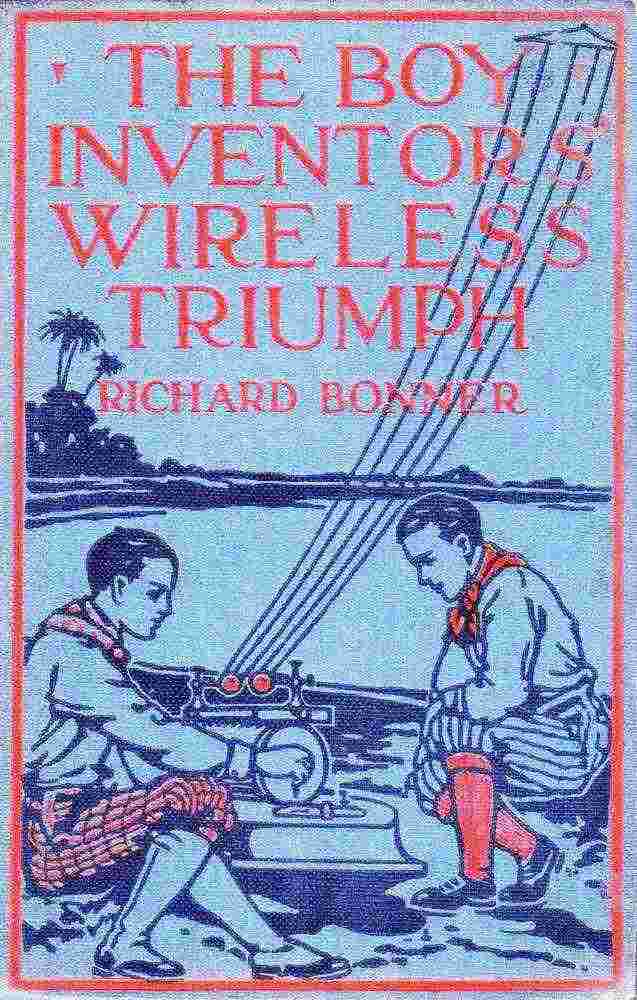
The wires had been strung on “spreaders” cut from the brush. Then one of the ends was connected to each of the buoyant “balloons” that were to carry the antenna aloft.
In the lee of the Flying Road Racer the boys had arranged the wireless equipment, and were now occupied in securing the lower end of the antenna and adjusting the connecting wires from aerials to the instruments.
At last all was ready, and the two canvas “balloons” were cut loose. Slowly but steadily they rose, carrying with them the strands of copper wire,—five of them, each one hundred feet in length. The wind had died down quite a lot, and there was not much strain on the wires as they were pulled skyward like the string of a kite.
As the wires tightened and became extended to their full length the boys broke into a cheer. Held by the captive “balloons,” the five parallel wires made as effective an aerial as if they had been rigged to a lofty pole.
“Boys,” exclaimed Professor Chadwick proudly, “that’s what I call a real wireless triumph!”
“Wait and see if it works first, father,” said Jack, with a happy smile. He had not much doubt on this point, having solved the vexatious problem of getting his wires aloft.