
CHAPTER IX.
A STARTLING SURPRISE.
As the voice of Sherwood rolled across the water in his demand for the surrender of Old Tumult and Town., the old scout burst into a roar of laughter that fairly shook the tree in which he was perched; then, in a tone peculiar to his powerful lungs, he requested the renegade to go to—that very warm region prepared for the wicked.
The enemy were above them, where they could avail themselves of the force of the current, and no sooner did they hear the old scout’s reply, than they began bearing down toward them at a rapid speed.
Our friends could see that the enemy were armed with rifles, but, as they did not fire upon them, they knew the distance was too great for the range of a common firearm, they—the enemy—being over two hundred yards above them.
“Death is a dead certainty with us now, Tumult,” said Town.
“Things look kinder scaly, lad, but I’m thinkin’ that ’ere essence o’ Satan has miscalculated our situation; or else they don’t know as how old Vibrator here can flip lead—that we’ve got rifles, too.”
“But the rain has made my rifle perfectly useless, Tumult, and my ammunition is soaking wet,” said Town., regretfully.
“Vibrator is all right. I didn’t furgit to keep her muzzle down, and her nipple dry. My powder is in a water-proof horn, and now I’ll see if I can’t check the speed o’ them ’ere critters afore they git in range for their bird-pickers.”
As he concluded, the old scout thrust his rifle through the foliage, took a deliberate aim, and fired. Had a torpedo exploded under the advancing canoe, it could not have caused greater consternation than did the shot fired by Old Tumult. It was wholly unexpected by the enemy. Sherwood had convinced the savages that there was nothing to fear from the whites—that their firearms were rendered useless by the rain. But, when one of their number fell dead—shot through the head with a half-ounce ball—all their savage anticipations of a pair of scalps fled, and turning their canoe shoreward, they fled equally as fast.
Old Tumult, with all the lion force of his lungs, gave vent to a triumphant, defiant yell, and a derisive, mocking laugh, that made the very blood of Dick Sherwood’s veins leap hot with rage, and burn with resentment.
“That’ll be apt to set the hounds o’ Satan red-hot,” said the old scout, as the enemy disappeared in the flooded timber; “and we’ve got to keep a close look-out, fur they’ll try every way that their cunnin’ brain kin invent to git our skulps.”
The new danger stimulated, rather than depressed, the spirit of our friends, and they began to view their situation in a rather novel light; but how long this would last was a question of doubt. True, the water was falling fast, still it would be several hours before they could set foot upon the island; and, without great precaution, in that time the enemy might bring to bear upon them some means that would dislodge them. The only difficulty that they experienced in their elevated retreat was the numbness of their limbs, occasioned by inactivity and the cramped position they were compelled to retain.
Town. drew the wet charge from his rifle, and reloaded with powder from Old Tumult’s horn, and thus in a few minutes he had his piece ready for use.
Something like an hour had passed after the defeat of Sherwood, when the attention of our flood-bound friends was attracted by a huge raft of driftwood coming down the river. It was some four hundred yards away when first discovered, and although a number of such rafts of flood-collected debris had passed down the river since daylight, this was the first one that attracted unusual attention from the keen eyes of Old Tumult.
“Thar’s deviltry up, boy,” said the old scout; “that ’ere raft o’ wood and sich, looks a leetle suspicious.”
“What do you judge from?” asked Town.
“Wal, thar’s too many logs piled on top o’ one anuther; and when you see thar’s some brush and such, piled onto the logs, in a kind o’ a careless way, it’s true; but I would not be afraid to bet there war Ingins among that ’ere driftwood.”
“If there is, we will give them a chunk or two of cold lead,” said Town., fixing his eyes upon the raft.
“Ah—they’re too sharp fur that, lad. They’re layin’ ahind the logs—mebbe half buried in the water—and jist as soon as they git close enough, we’ll hear, if we don’t feel, cold lead rattlin’ ’round us. Things begin to look scaly, boy, fur us, or I’m no judge.”
The two men felt no little uneasiness for the next ten minutes as to the real character of the raft. If there were Indians about it, as Old Tumult had no doubt but there were, they were so hidden among the logs and bushes as to defy all efforts of discovery, while at the same time the whites would be exposed to the rifles of the hidden enemy.
They could do nothing but watch and wait, while the raft continued to drift slowly toward them. It was about a hundred yards away when Old Tumult was sure he saw the head of a savage peering over a log, and, to convince himself as to whether such really was the case, he raised his rifle and fired at the object.
But, the scout never knew whether or not it was an Indian’s head, nor what had been the effect of his shot, for, simultaneous with the report of the rifle, the raft dropped into a strong, surging eddy—swung swiftly around a number of times, and then, as if a magazine had exploded in its midst, it flew apart—every log became separated from each other by the circling force of the water; and there, in the midst of the whirling, rolling logs and debris, were a half a dozen Indians, struggling desperately with the waves.
Old Tumult burst into a roar of laughter when he discovered this providential misfortune to the savages.
As the scout had mistrusted, the red-skins had secreted themselves among the logs and debris; and, but for the parting of the raft in the eddy, and the sudden precipitation of the cunning foe into the seething waters, it is very probable that our friends would have been shot down in another moment.
As fast as Old Tumult could load and fire upon the struggling, panic-stricken enemy, he did so with telling effect. And those of the savages that escaped his deadly aim, were overpowered by the waves and swept away.
Again our friends had nothing, for the moment, to fear from the Arapahoes.
A silence ensued.
Town. was thinking of Madge and Clara, while Old Tumult was silently wondering what course the enemy would next resort to, to dislodge them from their retreat.
Suddenly they were startled by the sharp twang of a horn.
The sound came from the eastern shore. They glanced in that direction and discovered a horseman moving along the shore toward the north.
They recognized him at the first glance.
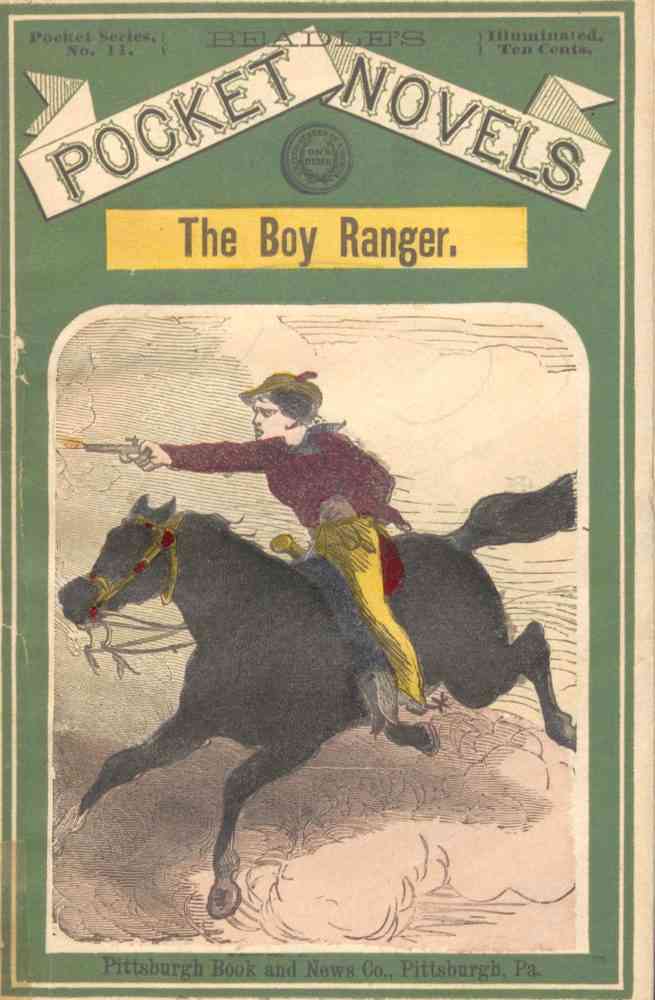
It was Rollo, the Boy Ranger.
Old Tumult placed his hat upon the muzzle of his gun and waved it above his head, shouting at the top of his lungs.
The young ranger drew rein and answered the scout’s shout by a blast from his horn and a waving of his scarlet cap.
“Ay, Rollo, my lad,” called the scout, “it’s rather a cramped condition we’re in, and all fur want o’ help.”
The young ranger was not over two hundred yards away, and had no difficulty in catching the scout’s words.
“Then you shall want no longer, old friend,” replied the ranger; “I will assist you at once.”
“But how kin ye, my lad?” asked the scout.
“I will hasten up the river to King’s Ford and get the old ferryman’s boat,” returned the youth.
“That’ll do, my gallant boy; jist run the boat under this ’ere tree and we’ll be ready to drop down into it.”
With a wave of his scarlet cap, the ranger dashed away on his mission. It was about three miles to what was known as King’s Ford, where an old half-breed by the name of King had built a ferry-boat, for the purpose of transferring the loaded teams of settlers from one side to the other during high waters.
Our friends did not expect the return of the ranger with the boat under two hours, but scarcely an hour had elapsed when, to their surprise, they saw the youth with the boat put around the bend in the stream above, not over three hundred yards distant.
It is necessary that we should here give a brief description of the ferry-boat, for reasons which will be made known hereafter.
It was about twenty feet in length, by half that length in width, and constructed on the principle of a large canoe; then, in order to make it more convenient for loaded teams, a slab floor, or deck, was laid across the top from side to side, thus forming a hold about two feet deep beneath the slab deck. A pair of sweeps and a tiller constituted the propelling and guiding apparatuses of the craft. At the prow of the boat was an opening or hatchway, about two feet square, leading into the hold. This opening was covered with a stout slab in which was fixed a ring and staple for raising.
Old Tumult hailed the approach of the ranger with a wild shout, and then they began to prepare to leave their elevated retreat.
Rollo had no need of the sweeps. The force of the current carried the boat along quite rapidly, and he had only to stand at the tiller and keep the boat in the proper course to pass over the inundated island.
When the boat was within fifty yards of our friends, Old Tumult shouted:
“Ye made a purty quick trip up to the Ford, lad.”
“It would have been, had I went to the ferry, but the fact of it is, I found the boat stranded about a mile above here.”
“Possible!” exclaimed the scout, while Town. peered through the foliage at the ranger with a puzzled expression upon his face.
“Yes,” returned the youth, bending slightly upon the tiller; “the flood had washed it from its mooring and drifted it down stream about two miles, where it lodged, and where I found it.”
“Wal, it’s all luck—bear to the left, lad, bear to the left—let the prow strike the tree midways—bear hard—there—smoke of tortures!”
The exclamation was caused by the ferry-boat striking the tree, or sapling, with such sudden force that our two friends were nearly shaken from its branches. However, the boat came to a stand, and the next moment our friends stood upon its deck.
Old Tumult fairly danced with joy, while Town. was compelled to rub his limbs vigorously in order to restore the circulation.
Old Tumult pushed the boat clear of the tree, and the next moment it was slowly veering off toward the western shore.
The scout and the young ranger entered into a conversation, and in a moment the latter was in possession of all the facts that placed our two heroes in the predicament in which he found them.
Rollo then gave the scout and Town. some joyful news of the whereabouts of the two captives, Madge Taft and Clara Bryant. He had seen them taken to the village of the prophet, while scouting thereabouts, and but for the superiority in number of the savages he would have attempted their rescue. This was joyful news to the scout and Town., not because the maidens were captives in the Indian village, but to know they had survived the peril of the night’s storm.
“Did the captives seem much depressed in spirit?” asked Town.
“Miss Taft,” returned the ranger, glancing toward the shore as if to conceal the smile that passed over his dark, handsome face, “seemed very sad and downcast, when she was conducted by where I was lying concealed in the undergrowth.”
A sigh, that deepened almost into a groan, escaped Town.’s lips.
“I tell ye what, Town.,” said Old Tumult, “I know it goes plaguy tuff with a feller when he’s mixed up in a heart-affair with a purty gal, and that gal’s a prisoner in the hands o’ a pack o’ red-skins. I know it goes tuff, fur I’ve been thar, Town.”
Rollo, the Boy Ranger, smiled again, as he carefully noted his course and moved the tiller accordingly.
A silence, broken only by the swash of the water around the boat, ensued.
Old Tumult was thinking of the past; Town. of Madge, while the ranger, apparently plunged in mental oblivion, began whistling softly.
Suddenly, as if moved by a single and intuitive impulse, the old scout and Town. glanced at Rollo. The eyes of the ranger were fixed upon the forward part of the boat with a strange expression shining from their dark depths.
Again, as if moved by some unknown impulse, the eyes of Old Tumult and Town. sought the object of the ranger’s attention, and to their horror and surprise they beheld the slab over the hatchway pushed aside, and a giant savage leap from the hold of the boat onto the deck, followed by another until four of the painted demons stood before them, their faces aglow with diabolical triumph!