
CHAPTER XVII.
A REVELATION.
True to their promise, Old Tumult and Town. returned to the cabin of Talbott Taft the following morning.
As they approached the lonely hut, they saw no sign of life about it, but pushing on they reached the door, upon which Town. gently rapped. But no one bade them enter, and it was then that a strange suspicion rushed across our two friends’ minds, and pushing the door open they entered.
True enough, their suspicions were verified by seeing Talbott Taft sitting bolt-upright in a chair near a rude table, stone dead!
“Self-destruction,” muttered Town., as he pointed to a glass upon the table, in which there was some liquid of a greenish color; and then as his eyes fell upon a folded paper near the glass, he continued: “and here is no doubt a written confession, and a lengthy one too, for there are a number of pages.”
He unfolded the papers and glanced at the head of the writing, which was well executed, though it showed some nervousness of the writer.
“ROMANTIC IMAGINATION—TRAGICAL REALITY.”
These were the words heading the MS., and Town. at once perceived that the writer thereof had been fostering some romantic hopes that had ended in a tragical death.
The first thing our friends did was to bury the body of the trader by the side of his daughter. This last sad duty performed, the scout and Town. returned to the cabin and seated themselves. Town. now took up the manuscript and began reading it aloud.
It ran thus:
“In one of the loveliest rural districts of Virginia is a grand estate, with a great stone mansion and lovely surroundings—all that heart could wish, art devise, and wealth procure—known as The Golden Horn. Four years ago the owner of The Golden Horn lay dying. He was a bachelor, and no wife nor child was there to mourn his coming death. Only Mrs. Martha Hohn, his house-keeper, sat by his dying bed.
“Mrs. Hohn was herself a widow, with an only child, Cecil, who at this time was away at Richmond attending a boarding-school at the expense of the owner of The Golden Horn. Mrs. Hohn, for years, had secretly aspired to be mistress of The Golden Horn, but all her charms and suavity of manners failed to make an impression on the hard heart of the stern old bachelor. And now he lay dying, and Mrs. Hohn’s aspirations and hopes were dying too.
“‘Martha Hohn,’ he said, as she seated herself by his bed, ‘I’m dying, that’s certain. The death-dews are upon my brow now. And now, Martha, promise me upon my death bed that you will do me a favor after I’m dead and gone. You’ve been kind to me, Martha, and straightforward, and of all others, I would trust none sooner than you with so important a care. Promise me, Martha Hohn.’
“Martha Hohn promised by all that was sacred.
“‘Then,’ continued the dying man, ‘away up in Maine, on the Penobscot river, years ago dwelt an only sister, but she is dead now. She married there, and had a child—a daughter whom she called Clara. Domestic trouble finally parted sister and her husband. He went to the war, and sister died. But her baby lived and was adopted by a Mr. and Mrs. Geoffry Bryant. Where the Bryants are, I do not know, but I want you to find them, Martha, and give to their adopted child, Clara, this will (here he drew from under his pillow a folded paper) which gives to her The Golden Horn. She is the last of my relations now living. For all I know she may be dead. If she is dead, she may have married, and may have a husband or child living; if so, give the will to them.’
“Mrs. Hohn renewed her promise to the dying man, though the devil took possession of her heart the moment she got the will in her fingers.
“The owner of The Golden Horn died, and Mrs. Hohn became more determined than ever to possess the estate.
“She hastened to Richmond and found that her daughter Cecil had just been married to a handsome, but penniless man whose morals were any thing but good. Mrs. Hohn made known her resolve to her son-in-law and daughter. Both were as wicked as she, and so they volunteered their assistance to aid her in her dark scheme.
“The trio went up to Maine and found that Geoffry Bryant had moved several years ago to Ohio. So they followed on to Ohio, and were there disappointed by learning that Mr. Bryant and family had gone with a colony to the then territory of Iowa.
“The trio rigged themselves out with a conveyance and set off for the far West. It was more than two years before they found out the exact whereabouts of Bryant, and during this time they took up their residence with the Arapaho Indians. Cecil’s husband, by dint of much deceit and trickery, worked himself into the confidence of the Indians so thoroughly, that they conferred upon him the honor of prophet. But much to their disadvantage in playing for The Golden Horn, the prophet’s name and fame went abroad among the Arapaho’s enemies, the white settlers, and so it became dangerous for him to venture within a white settlement.
“When Mrs. Hohn found that Bryant resided at Clontarf’s Post, she began laying her plans. She found that Clara, the heir to The Golden Horn, had grown to a beautiful womanhood, and was on the eve of marriage with Town. Farnesworth. All this they learned through Rollo, the Boy Ranger.”
“Smoke o’ torture!” exclaimed Old Tumult, “I told ye that ’ere boy war a young devil.”
Town. made no reply, but read on:
“The first thing to be done was to prevent the marriage of Town. and Clara. And Mrs. Hohn at once proposed that her daughter Cecil win Town.’s affections from Clara, until Clara could be disposed of as they desired.
“About this time Mrs. Hohn very suddenly and mysteriously disappeared from the stage of action. But her son and daughter continued the work of crime.
“Cecil now assumed the name of Madge Taft, and went to reside with Talbott Taft, the Indian trader, as his daughter.
“Here she met Town. Farnesworth, and true enough, succeeded in winning him from Clara.
“The next work to be done was to secure Clara’s right to The Golden Horn. This was the most difficult portion of the whole plot. However, Cecil’s husband, who was none other than Dick Sherwood, resolved to kidnap Clara—carry her to the Indian village, and there force her into a mock marriage with him—obtain a certificate of the marriage—put Clara out of the way, and then return to Virginia, and by presenting the will and certificate both in probate, establish his right to The Golden Horn. Then as it was not known that he was already Cecil’s husband in the vicinity of The Golden Horn, he could enter into another marriage with her, and thereby cover up all suspicions of their previous relationship, should any such suspicions arise.
“The first attempt, however, to carry Clara away resulted in the capture of Sherwood, and but for the timely arrival of Rollo, the ranger, it would have ended in his death by hanging in the forest. The young ranger cut the rope with his saber, the instant that the settlers turned their faces toward the post, and a friend to the unfortunate man came from his concealment in the woods near the scene of the execution, and restored him to consciousness. In order to mislead the settlers, the body of a Sioux Indian, slain by Rollo, was hung to the limb where Sherwood had been left. The wolves and vultures stripped the bones of its flesh, thereby the detection of the cheat was never found out until after the attack at Wildwood lake. This latter affair was all owing to the wicked cunning of Sherwood, alias Father Ainesley. He had hoped, that by drawing the settlers out to the meeting beyond reach of their stronghold, he would not only capture Clara, but wreak vengeance upon them for the ‘hanging affair’ in the forest. In this he partially succeeded through the coöperation of the duck-disguised Arapahoes. Clara was captured by Ainesley during the conflict, and along with Madge, who assumed the rôle of prisoner also, for purposes that are plainly significant, carried away; but she and Madge were recaptured, as was also Sherwood, by Old Tumult and Town. A storm coming up, they sought shelter upon Two Islands. While there, Madge succeeded in releasing Sherwood. And together they escaped, carrying Clara away with them, though Clara knew not the part that Madge was playing.
“Madge shouting for help, when away from the islands, was all a cover to conceal suspicion.
“I will here mention, that Rollo did know of the four savages being in the hold of the ferry-boat. It was an arrangement for the capture of the scout and Town.”
“Ho! ho! ho!” roared Old Tumult; “it war a galorious failure, too, I’m dreamin’, eh boy?”
“Indeed it was,” returned Town., then he read on:
“Rollo and Sherwood laid another trap at the Devil’s Staircase, for the capture of Tumult and his friend, but this failed, also; so Rollo informed me the morning following the defeat.
“The ranger also informed me that through the instrumentality of Madge Taft, Clara had been induced to marry Sherwood. The renegade promised her that he would liberate her and Madge just as soon as the wedding was over, and a certificate of the missionary—who was gotten up on purpose for the occasion, he being a white renegade called Tom Jules—securely in his pocket. Sherwood’s intention was to drown Clara in the lake when pretending to escort her home. Madge was to meet him there at the lake, when they would at once take their departure for the East—he to prove his claim to The Golden Horn as the husband of the deceased heiress. What more would really be necessary to establish his claim, according to the will? Nothing. But, alas! in the very hour, yea, the very minute of their triumph, death seized them both!
“Thus you have a full confession of the sins of Martha Hohn and her son-in-law and daughter. And perhaps you would ask, where was Martha Hohn during the latter part of this wicked drama? I would answer: Martha Hohn writes this confession, for Martha Hohn and Talbott Taft are one and the same! I donned my disguise to aid Dick and Cecil in their work of wickedness that was hatched in my own brain.
“And what has become of Rollo, the ranger, will be asked as time goes by, for Rollo will never again appear on the stage of action. It has often been a source of great wonder to me, that Town. Farnesworth, in his attentions to Madge, and his conferences with Rollo, did not detect that Madge and Rollo were one and the same person!
“Poor Cecil! she was brave, daring and strong, and played her part with all the skill of an accomplished actress. She deserved a better fate, and but for the influence around her, might have won it.
“On the table by my side, in the little tin box, is the will that I promised by all that was sacred to deliver to Clara Holmes. Will the reader of this deliver it to her? It is my last request.
Martha Hohn.”
And thus ended the manuscript, leaving Town. wrapt in wonder and surprise, while Old Tumult seemed terribly agitated.
“Of all the complicated cases of sin and sinners in disguise, this beats me,” exclaimed Town.
Old Tumult made no reply. His agitation seemed to be increasing.
“What’s the matter, Tumult?” asked Town.
“Holmes! Holmes!” muttered the scout, as though he was unconscious of so doing, “as God’s in heaven, it must be so!” and then springing to his feet he cried, excitedly:
“Come, lad, let’s rack out for the post! I believe I’ve struck a bee-line! Fetch the will, lad.”
Town. made no reply, for the scout darted out of the cabin and away toward the post, at such a rapid speed, that he could scarcely keep in sight of him.
“I declare, the old chap is terribly excited,” muttered Town., as he proceeded onward through the forest.
When he reached the post, the old scout bent his footsteps toward Geoffry Bryant’s cabin.
At the door he was met by Clara.
“Why Tumult—Mr. Raynor!” the maiden exclaimed, “you are excited—what is wrong?”
Tumult laid his hand upon the maiden’s head, and gazed into her eyes as though he were going to read her heart through.
“And are you Clara Holmes?” he cried.
“Yes; so mother—Mrs. Bryant—just told me, but—”
“Have you no remembrance of your parents?” interrupted the scout.
“I have none,” returned Clara, sadly.
At this juncture, Mrs. Bryant made her appearance, and having overheard their conversation, said:
“Clara was but two years old when her mother died, Mr. Raynor, consequently she could not be expected to remember much of her.”
“But the father?” exclaimed the scout.
“He parted from her mother a year before she died.”
“Did you know him, Mrs. Bryant?”
“I did not. I never saw him. He went to the Mexican war and never came back.”
“What was his full name?”
“Clement Holmes, so his wife told me.”
“Clement Holmes!” burst from the scout’s lips; “then thank God! Clara, you are my child! I am Clement Holmes!”
Yes, Old Tumult, or Roll Raynor, proved himself to be the father of Clara—Clement Holmes! I will not attempt to describe the scenes of joy and happiness that followed this revelation, for they defy the power of this pen. The reader can imagine what they must have been.
Following the reunion of father and daughter, came the news of Clara being the heiress to a vast fortune in Virginia, by what means is already known.
I will not undertake to narrate the scenes and adventures through which Old Tumult passed after his separation from his wife, up to his meeting with his child; suffice it to say that they were many—wild and dangerous.
Clara, as the wife of Townsend Farnesworth, returned with her husband to Virginia and proved her claim to The Golden Horn.
She forgave him his love affair with Madge Taft, though he can not forgive himself for being made the dupe of the wicked enchantress.
After much persuasion, Old Tumult was induced to leave the West with its wild adventure, and take up his home with his children in Virginia, among the quietudes of civilization. Still, there was scarcely a day during the remainder of his eventful life but what the voice of his heavy rifle, Vibrator, might have been heard rolling in prolonged reverberations through the mountains that formed the southern boundary of The Golden Horn. And after the day’s hunt was over, and the strong old hunter returned to the mansion, with his game-bag well filled, he was always met at the gate by a group of urchins, who welcomed him with their childish shouts of joy, and who called him “Grandpa.”
And here, dear reader, I let drop the curtain over my imperfect—yet I hope interesting—drama, and lay down my pen.
THE END.
A MARVEL OF BEAUTY!
A New Series by the New Art!
THE ILLUMINATED DIME
POCKET NOVELS!
Comprising the best works only of the most popular living writers in the field of American Romance. Each issue a complete novel, with illuminated cover, rivaling in effect the popular chromo,
And yet Sold at the Standard Price—Ten Cents!
Incomparably the most beautiful and attractive series of books, and the most delightful reading, ever presented to the popular reading public.
Distancing all rivalry, equally in the beauty of the books and their intrinsic excellence as romances, this new series will quickly take the lead in public favor, and be regarded as the Paragon Novels!
NOW READY, AND IN PRESS.
No. 1—Hawkeye Harry, the Young Trapper Ranger. By Oll Coomes. Ready.
No. 2—Dead Shot; or, The White Vulture. A Romance of the Yellowstone. By Albert W. Aiken. Ready.
No. 3—The Boy Miners; or, The Enchanted Island. A Tale of the Mohave Country. By Edward S. Ellis. Ready.
No. 4—Blue Dick; or, The Yellow Chief’s Vengeance. A Romance of the Rocky Mountains. By Capt. Mayne Reid. Ready.
No. 5—Nat Wolfe; or, The Gold Hunters. A Romance of Pike’s Peak and New York. By Mrs. M. V. Victor. Ready.
No. 6—The White Tracker; or, The Panther of the Plains. By the author of “The Boy Miners.” Ready.
No. 7—The Outlaw’s Wife; or, The Valley Ranche. A Tale of California Life. By Mrs. Ann S. Stephens. Ready.
No. 8—The Tall Trapper; or, The Flower of the Blackfeet. By Albert W. Aiken. Ready.
No. 9—Lightning Jo, the Terror of the Santa Fe Trail. By Capt. J. F. C. Adams. Ready.
No. 10—The Inland Pirate. A Tale of the Mississippi. By Capt. Mayne Reid. Ready.
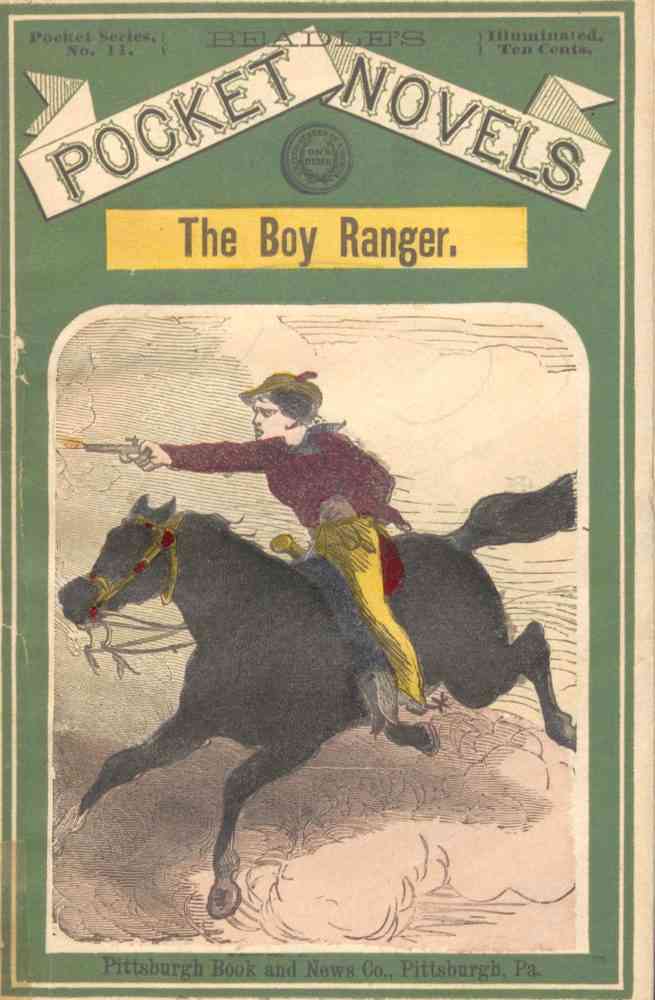
No. 11—The Boy Ranger; or, The Heiress of the Golden Horn. By Oll Coomes. Ready Nov. 24th.
No. 12—Bess, the Trapper. A Tale of the Far South-west. By the author of “Boy Miners,” “White Tracker,” etc. Ready Dec. 8th.
☞ For sale by all newsdealers; or sent, post-paid, to any address on receipt of price—ten cents each.
BEADLE AND ADAMS, Publishers,
98 William Street, New York