
CHAPTER II.
THE “HALTER” OF JUSTICE.
Clontarf’s Post had first been settled by Lionel Clontarf, a gentleman of Irish descent. It was among the first settlements of the then territory of Iowa, and, although in the midst of privations, and harassed by the red man, it grew and prospered as but few under similar circumstances would have done.
Family after family, with brave hearts and willing hands, were added to the settlement, until it numbered some fifty souls.
Stock-raising and agriculture were the chief objects of the settlers, though in course of time a store and Indian trading-post were opened. At this point, all the surrounding settlements—which in fact were few—obtained their supplies, and many dollars’ worth of furs and peltries were brought here and exchanged by the Indians for flour, powder, and ammunition of all kinds, and such trinkets as pleased their savage fancy or wants. The settlers did all within their power to keep up a friendly intercourse between themselves and the Indians. This they would have had no trouble in doing, but for the influence of unprincipled white men, who, driven from the society of their own race, sought shelter within the red man’s lodges, or the mountain fastnesses, where they organized themselves into bands to rob and murder the unoffending settler or emigrant.
Through the instrumentality of these white outlaws, the Indians were kept in an almost constant state of hostilities, and it behooved the whites ever to be upon their guard, and use every exertion toward ridding the country of all those prime roots of border troubles—the white robber, and the white renegade.
Among the latter class of outlaws, who had become notorious for his deep cunning and wickedness, was one Dick Sherwood, whose crimes were multitudinous. And for some cause or other, Clontarf’s Post was the central point around which this moth of Satan seemed to flutter most of all. It seemed that he cherished a natural antipathy toward the place, or some of its people, and tried in vain, by every means that his cunning brain could concoct, to destroy it.
Finally he had the audacious boldness to disguise himself in the paint and garb of an Indian, and come to the post on a pretended mission of peace. He was kindly received by the men of the post, who had supposed him a genuine Indian sent by his people to make some terms of peace, as a deadly hostility had existed between them for the past six months.
A council was called, and a treaty of peace at once entered into, by and between the settlers and the great chief, Rolling Thunder, as he called himself.
After the treaty was concluded, the chief remained at the post a day or two; and, but for his attempting to carry away Miss Clara Bryant, one of the fairest jewels of the post, on taking his leave of the settlement, his disguise would never have been penetrated. However, he was caught at his little game of abduction and taken prisoner. By a vigorous application of water by means of numerous duckings in the river, his feathers were caused to droop and his mask of paint to wash away; and the great messenger of peace—the mighty Rolling Thunder, was found to be the notorious renegade, Dick Sherwood.
The vengeance of the settlers was at once aroused. The villain was locked up in the block-house, the remainder of the night upon which he was captured, and the next day he was led forth for trial.
According to their notion of border justice, the settlers of Clontarf’s Post found Sherwood guilty of crimes punishable by death, and so he was condemned to be hanged in the forest on the morrow.
The morrow came. It was the day upon which our story opens.
The prisoner was led forth from his prison, in the midst of a group of men. It was this group that young Rollo, the ranger, saw from the crest of the prairie wave.
Dick Sherwood was a young man of not more than five and twenty. Of figure he was of medium height, and was a perfect model of the physical man. His head was of the intellectual mold, and but for the evil light in his black eyes he would have been a handsome man.
As his captors led him from the stockade like a haltered ox, his face wore no downcast look, and his step was firm and elastic. Even in his helpless condition, and in face of the death to which he was being hurried, he was recklessly cheerful, and made many remarks touching his situation, that produced laughter among the settlers, and even made a curious impression upon some of their hearts.
The execution was to take place in the woods across the river, and two of the settlers had been sent on some time in advance to select a tree for the purpose, and dig a grave.
When the party crossed the river with the prisoner, they were met by the two men and conducted to the place of execution, which was beneath the branching boughs of a great oak.
A large limb growing out at right-angles with the body of the tree had been trimmed of its shrubbery, and near the foot of the tree a grave was dug.
As the prisoner gazed upon these preparations for his execution, he smiled grimly, defiantly.
“Why go to this trouble, gentlemen?” he asked, pointing toward the grave. “Why not let my body hang for the hungry wolf, the carrion-crow and the vulture to feed upon? Know you not that the spirit will not complain of your treatment of the body? The wolf and the vulture will not devour my bones, and so long as the grim skeleton exists, so long will the spirit remain about it.”
“You are disposed to jest, Dick Sherwood,” said Lionel Clontarf, a stern, stony-hearted man; “you should think of the great Hereafter, and then perhaps your heart will move the spirit differently.”
“Yes,” added Geoffry Bryant, “think of the lives you have destroyed, and the homes you have made sad and desolate, and then, if you have a conscience, you will feel a pang of remorse. Your heart will shrink from the terrible punishment awaiting you.”
“I am really conscious of all this, gentlemen,” replied Sherwood, tauntingly, “but my greatest regrets are that I did not succeed in escaping with Miss Bryant, for then it would have been heaven instead of—”
“Hang the villain! hang the wretch!” burst from the lips of some of the crowd.
“Dick Sherwood,” said old Captain Storms, the leader of the party, “if you have any thing of reason to say, say it at once; if not—”
“Certainly,” interrupted Sherwood; “I was going to suggest that some improvements be made upon that grave for my ease and comfort; but I will not occupy it long, so go your length, gentlemen. Should I ever address you again it will be under different—quite different auspices.”
The settlers grew indignant at these taunting, defiant remarks, and at once proceeded to the execution.
Four men drew the cleared limb as low as possible and held it down. To this Captain Storms tied the rope which already encircled the renegade’s neck.
Lionel Clontarf bound a handkerchief over the prisoner’s eyes, and then, at a signal from Captain Storms, the four men relinquished their hold upon the limb which arose to its natural position, and then Dick Sherwood hung between heaven and earth!
The wretched man struggled desperately, but his efforts momentarily grew feebler. The settlers stood in speechless silence and gazed upon the hanging form until it had ceased to move.
Surely life was extinct.
Finally Captain Storms advanced and placed his fingers upon the renegade’s pulse, and said in a low tone:
“He’s dead, boys, dead, dead; and may God have mercy upon his soul.”
As he uttered the last word a startled exclamation burst from the lips of the crowd.
A horseman had burst suddenly from the forest into their midst.
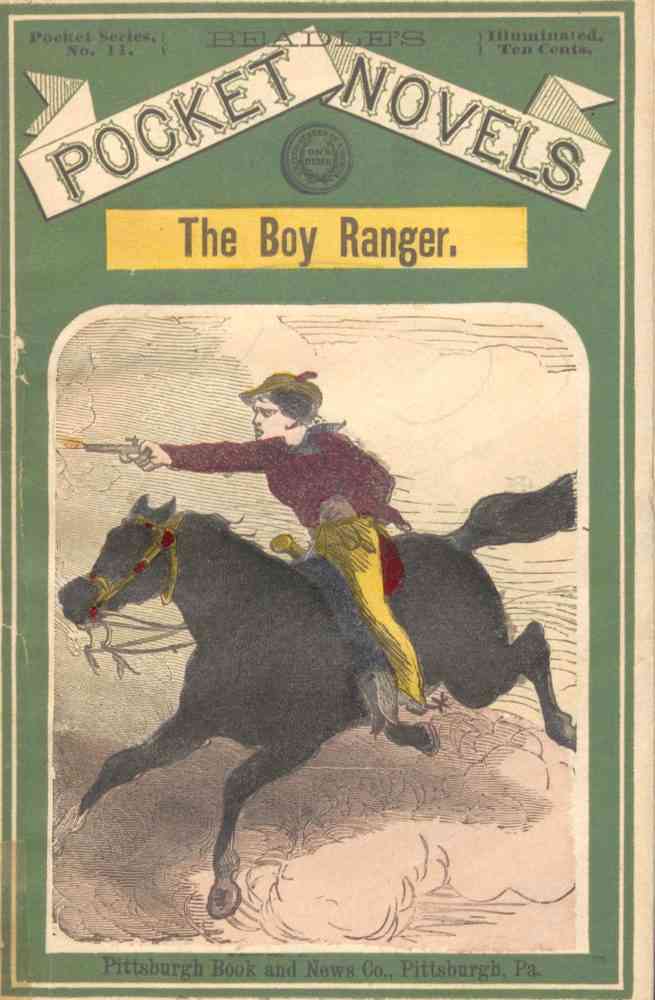
It was Rollo, the ranger! His horse was white with foam, and his own face streaked with perspiration and flushed with excitement.
“Away, men, away!” the youth shouted, wildly, “away for your homes, your wives and your children! The Indians are upon the post!”
“My God!” burst from the lips of Lionel Clontarf; “come, men, follow me! I can already hear the yells of the demons and the clash of arms!”
“But the body of Sherwood,” cried one, “what will be—”
“Let it hang away!” responded old Captain Storms.
Fear seemed to lend the settlers invisible wings as they ran through the woods toward the post, the boy ranger following close at their heels upon his almost exhausted animal.
Had the settlers, however, on turning their backs upon the hanging renegade, given the young ranger a second glance, they would have seen something that would have aroused some curiosity, if not suspicions, in their minds. Wild with excitement and fear, however, they ran on, the safety of their families uppermost in their minds.
When the river was reached, the settlers hastily embarked for the opposite shore in their canoes, the ranger swimming his animal behind.
When they came in sight of the post the men saw that the place was being bravely defended by the few men that had remained behind.
The enemy were mounted, and in number did not exceed a dozen. They had divided their force, and the larger party were directing their attack upon the eastern gate of the stockade.
Seeing the inferiority in number of the enemy, the settlers gave a yell as they approached, and the next moment the savages were flying over the plain at a breakneck speed, leaving one of their number behind, dead.
This bloodless termination—on the part of the settlers—of what promised a bloody affray, resulted in Rollo, the Boy Ranger, being lionized as the real hero of the victory. He was fairly dragged from his pony and forced to accept the warm, heartfelt thanks and blessings bestowed upon him, for his timely warning them of danger.
The young ranger seemed ill at ease within the stockade, and contrary to the wishes of the settlers, he soon took his departure.
“I can not bear the confinement of the settlement,” he said, on leaving the post. “I feel freer when roaming on the great prairie ocean, or threading the shadowy aisles of the forest.”
He rode away toward the north when he left the post, on the trail of the defeated red-skins.
To the surprise of the settlers, on going to inter the body of the slain enemy, they found that it was the body of a white man in Indian disguise. This discovery caused no little food for reflection, and old Captain Storms, well versed in the nature of the Indian, gave it as his belief that the whole party of mounted enemies were a party of white men, and robbers at that, in Indian disguise. The old captain’s reason for this belief was that the enemy had been too bold and reckless in their attack, which set at variance all he had ever seen of Indian caution, cunning and cowardice.
During the remainder of that day and the following night, guards were stationed at all the points surrounding the post, and the stock secured against a night stampede. But, fortunately, no further hostile demonstration was made by the enemy.
The following morning, however, a number of Indians were seen in the edge of the timber along the river on the opposite shore. This prevented the settlers from crossing over to inter the body of Dick Sherwood, the renegade, as they had intended to do.
On the second day, vultures were seen hovering over the forest, and it was then that every Christian energy of the settlers was aroused, and they at once crossed the river and proceeded to the scene of execution.
But to their horror and disgust, they found only a human skeleton bleaching in the sun, where they had last seen the body of the renegade hanging.
The gaunt wolf and the carrion-crow had been there. And as the white, ghastly skeleton swayed to and fro in the breeze—seeming still possessed of life—the settlers shuddered, for it brought up quite forcibly in their minds, the words of the renegade, “As long as my bones exist the spirit will remain about them.”
Was it possible that these words were prophetic?
The remains were taken down and buried, and then the party returned home, feeling that they were at last free from the persecutions of the renegade, Dick Sherwood.