
“That’s right. But come on,” exclaimed Rob, frantically tugging at his chum’s coat-sleeves. Leaving the others behind with orders to telephone to the various villages about, to apprehend the robbers if they appeared there, the boy, followed by his chums, made for his automobile which, it will be recalled, he had left a short distance up the street. A few turns of the crank and a quick snap as spark and gasolene were turned on, and then a quick dash round the corner into H street and a flying leap down the country road leading into the turnpike to New York!
“Do you think we’ll catch them, Rob?” asked. Tubby, bending forward eagerly.
“Don’t know,” was the rejoinder; “we don’t even know that they have gone this way. We can only guess at it and hope we are right.”
On and on flew the auto through the night, past sleeping villages, through lonely patches of road where dark woods grew right up to the sides of the road, up hills and down steep grades, but still no sight of the auto they were pursuing.
Suddenly, as they topped a small rise, Tubby gave a shout. Below them, and not more than a quarter of a mile off, they could see the gleam of a tail lamp.
“It’s an auto!” exclaimed Merritt, “but is it the right one?”
The boys, except Rob, who was at the wheel, arose to their feet in their excitement as they drew nearer the car ahead, which appeared to be stationary.
All at once, however, the sharp staccato rattle of its exhaust sounded, and the dim lights were whisked off at what seemed considerable speed. Evidently the car had been halted for something—perhaps to examine the stolen box—and the sight of the approaching lights had warned its occupants that these might be signs of a pursuer.
Such was the guess the boys made anyhow, and it was not long before all doubts as to who was in the front car were dissipated.
“Stop that car or I’ll fire at you,” roared back a voice which the boys recognized as Dugan’s.
The only answer they vouchsafed was to keep on going.
Bang!
A bullet screamed past from the car in front and whistled by the boys’ ears. They could see the red flash of the discharged pistol against the blackness ahead of them.
“That’s to show you we mean business. The next will come closer,” came the same voice.
“He’s only bluffing. He can’t see anything in this light,” whispered Tubby.
Suddenly from somewhere to the eastward there came a hoarse, harsh whistle.
“A train!” cried Rob, as he heard; “must be a night freight.”
“Reckon that’s what it is. This must be the central division of the Long Island Railroad,” said Tubby. “Wow, we’ve come way out of our way.”
“They must be off, too,” said Rob; “we simply followed our leaders.”
“Say, hold on, Rob!” cried Merritt, suddenly; “look! that train’s almost at the crossing now!”
“That’s right, I just saw the headlight among the trees,” echoed Tubby; “better slow down.”
“Guess so,” assented Rob, as the thunder of the approaching train was borne plainly to their ears. It was evidently, as they had guessed, a night freight, and from the noise the locomotive was making it must have been a big one.
“Woo-oo-oo-ough!”
“There goes the whistle. I guess there are no gates ahead,” said Merritt. “Now’s our chance to sneak upon those other fellows, they—Gee whiz, look at that!”
As he spoke the other auto, which had hesitated for an instant as the whistle of the approaching train sounded, dashed on ahead.
“They’re going to try to beat the train to the crossing,” exclaimed Rob.
“They’ll never do it,” was Merritt’s rejoinder. “Look! Oh, good gracious!”
A sound of splintering wood and ripped mechanism drowned his cry of horror, and those of the other lads. Before their very eyes the locomotive had struck the robbers’ car as it was half way across the tracks and had tossed it to one side—a mass of kindling wood and twisted metal.
“They must both be injured or killed,” cried Rob; “hurry, fellows, maybe we can help.”
The boys jumped out of the auto and ran to the crossing. In the meantime the engine had been brought to a standstill and the train crew were examining the wreck. But although both the railroad men and the boys made a thorough search, they could find no trace of the men who had occupied the machine. Rob and Merritt, as a final recourse, walked some distance back up the track, but without finding any evidence that there had been loss of life or injury.
“They must have been thrown clear of the auto when the crash came, and when they picked themselves up I guess they realized that the best thing to do was to take themselves off,” was the way Rob explained it. Hardly had he completed this theory of what had occurred when his foot struck something. It gave out a metallic ring. Stooping down swiftly, he picked it up and found that it was the tin box from the bank, battered and dented, indeed, but intact and still locked.
Naturally the boys were delighted over their find, which must have been thrown from the auto when it was demolished. As after half an hour more of searching nothing was to be found of Dugan or the Jap, the train crew went back to their train and the boys prepared to turn back, with what pleasant anticipations may be imagined.
“Well, so long, kids,” shouted the conductor of the train after the long line of cars rolled off, “too lucky to happen a second time, I’m thinking.”
Of course, he referred to the fact that no loss of life or injury had occurred in the smash-up, but to the boys his words had an added meaning.
“It is too lucky to happen a second time,” said Rob, hugging the precious tin box.
CHAPTER XXIV.
A BOLT FROM THE BLUE.
Rob woke late the next day. For a few minutes it seemed to him that he must have dreamed all that had occurred the night before, but Lieutenant Duvall’s voice from the room below speedily undeceived him. He recalled it all now—how his father and an astonished crowd of townsfolk had met them on their return from that wild auto ride; how, on the box being opened, it had been found to contain the plans of the highly valued invention, of the exclusive possession of which Japan had been so anxious to deprive the United States.
“Rob, are you awake,” came his father’s voice up the stairway.
“Yes, and I’m ashamed of myself for sleeping so late,” was the lad’s rejoinder. “Gee whiz, half-past nine! I’ll be down in ten minutes.”
The lad was bathed and dressed in record time, and in a few minutes over the promised time made his appearance in the living-room. Lieutenant Duvall rose and greeted him warmly, as he came in. He overwhelmed the boy with his thanks and congratulations.
“It was a fine act—a splendid thing to do,” he said, enthusiastically. “Mr. Blake, you certainly ought to be proud of such a boy. Rob, I have sent a telegram to Washington to-day. Won’t you come out to the experiment station with me and watch some flights while we wait for an answer?” Then seeing the puzzled look on Rob’s face, he broke into a smile.
“You see,” he said, “the telegram concerns you and your plucky young chums. The Department will not pass such bravery by without taking official notice of it.”
Rob colored with pleasure as he accepted the invitation. After a hasty breakfast they set out in the officer’s auto. On the way Merritt and Tubby were called for, and it was a happy party that went spinning over the road toward the old mansion. The air was clear and still, the sea smooth and sparkling under a cloudless sky, and in the atmosphere was the promise of summer.
“A perfect day for flights,” said the lieutenant, “and a perfect day to try a few bomb-dropping experiments.”
“Then you haven’t blown up the old Vesper yet?” said Rob.
“No. She holds together as if she were built of steel instead of wood. I tell you what, we ought to make this day a memorable one; I’ve got an idea in that direction.”
“What is it?” inquired Rob, watching the officer’s twinkling eyes.
“Well, you know, the French claim that the Englishman is wont to remark, ‘By Jove, a fine day; let’s go out and kill something.’ Now, I am going to parody that and say, ‘It’s a fine day, let’s blow up something!’”
“Blow up the Vesper,” cried Tubby.
“That’s it. If we can hit her. I’ve a notion to try it myself. By Jove, I will,” went on the officer, warming to his subject. “I want badly to try out a new cordite bomb we’ve been making this winter, and here’s my chance.”
“Good-bye, old Vesper,” breathed Rob, tragically, extending his arm in the direction in which the two melancholy-looking bare masts of the schooner could be seen looming up.
“Don’t say good-bye yet,” chuckled the officer; “I might miss her.”
The War Department had lost no time in replying to Lieutenant Duvall’s message describing the boys’ courage and enterprise in securing the papers stolen from the shattered safe. It was brought to the officer by an orderly almost as soon as they reached the De Regny place.
“Shall I read it out?” asked the officer, with a smile. “It’ll make your ears burn.”
The boys began to protest, much to the amusement of several officers gathered in what had once been the dining room of the old mansion, but Lieutenant Duvall nevertheless read in a loud, clear voice the following:
“You are instructed to thank lads mentioned in dispatch on behalf of the Secretary of War. Splendid work. More substantial reward (the Special Honor Medal) will follow. Hills, secretary to the Secretary of War.”
“Wow!” breathed Tubby, and then turned very red as a perfect gale of laughter followed his sincere expression of amazement, gratitude and delight—all rolled into one.
“It’s wonderful,” breathed Rob.
“I can hardly believe it,” echoed Merritt, giving himself a surreptitious pinch.
“Now, then, to lunch,” laughed the lieutenant, “and after that, good—bye to the Vesper.”
“Good-bye to the Vesper,” echoed his brother officers, who knew of the program for the afternoon.
* * * * * * * *
It was about two-thirty o’clock, and the sea was unrippled except for the lazy Atlantic heave, when a small launch left Hampton Harbor and sped eastward through the Inlet and then out into the open sea. She rapidly skirted the coast and it was not long before the little craft was past Topsail Island, and on the left hand of her four occupants, the dark trees surrounding the De Regny mansion were visible.
Seaward from the desolate looking place, above which, however, the stars and stripes floated with a bright dash of color, could be seen the two bare masts of the wreck, and this was apparently the objective point of the small launch, for as they neared her one of the men in her stern-seat half rose and, pointing, said:
“There she is now. In half an hour we’ll know if Hank was telling the truth.”
“How was he this morning when you called up the hospital?” asked Bill Bender of the first speaker, who was Stonington Hunt.
The other shook his head.
“Bad,” he said; “I’ll tell you what it is,” he added with a crafty look in his eyes; “if we find this money we don’t need to tell Hank anything about it. We’ll just split it among ourselves. He’ll never leave that bed in the hospital, and it’s just as well for us he won’t.”
“Hold on there a minute, Mr. Hunt,” said Bill Bender; “I won’t consent to that. Hank was pretty square with us and we’ll be square with him. He’ll get his share of the money if it’s there.”
“Don’t be foolish,” remonstrated Stonington Hunt, in his smooth, crafty voice; “he cannot use it and we can. I tell you——”
“Look! Look!” interrupted Freeman Hunt, the youngest member of the party, who had been sitting forward; “what’s that over there by the mansion? See, it’s rising into the air!”
“It’s an aeroplane!” burst out his father; “bother it all, I hope they don’t come flying out this way.”
“They’re a nuisance,” agreed Jack Curtiss, watching like the others the graceful evolutions of the white-winged flying machine as it rose from amid the dark trees and began to circle about like a gliding hawk.
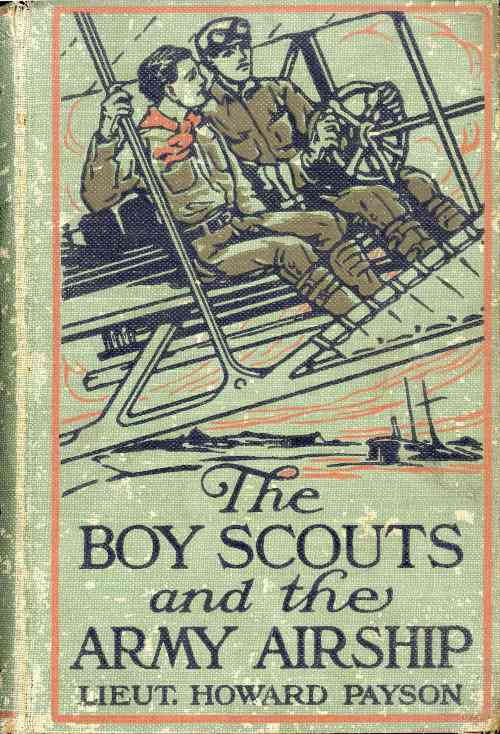
All at once it made a lofty sweep and then started off in a straight line toward the Vesper.
“Look, she’s coming out to sea!” cried Freeman, delightedly, lost in admiration. “Say, she’s a dandy.”
“Why, the thing can fly,” admitted his father, grudgingly, “and—and—why, what’s that fellow in her doing? He’s unfastening something. A black object that is hanging down under the seat. It’s a round thing. It looks like—like—a bomb! Great Scott! He’s going to blow the Vesper up.”
“Rot!” sneered Jack Curtiss, but his face was very pale. As for Bill Bender and Freeman Hunt, they said nothing, but watched the aeroplane soaring far above them with open mouths and staring eyes.
“Shout to him! Call to him!” raved Stonington Hunt. “Tell him there is money on board her. Don’t let him blow that schooner up. Hey-y-y-y-y!”
The distracted man, crazed by the thought of being cheated out of his golden prey at the last minute, stood erect in the boat and waved his arms frantically, but if the figure guiding the flying machine even saw him it gave no sign.
Now the aeroplane was right above the Vesper. The fascinated watchers in the boat could see the flying man’s arm move. Then, like a tiny shoe button—a little black shoe button—something dropped from the big, white airship.
“Gone! Gone!” almost shrieked Stonington Hunt, as he saw.
“Shut up, can’t you?” growled Jack Curtiss, his eyes, like those of the others, fixed upon the falling black sphere.
“Maybe it’s not a real bomb, just a practice one, and——” began Bill Bender, hopefully, when there came a shock through the air that threatened to drive their ear drums in. Sea and sky seemed to rock. Before their startled sight the old wreck rose above the surface of the water as if a giant hand had impelled her, and then settled back as slowly as a harpooned whale. The next instant an immense cloud of vapor arose and swelled to a waving, yellowish pillar in the still air. At the same moment, a mighty reverberating “boom” reached their ears. Above the destruction it had wrought the aeroplane wheeled like a phoenix.
As they gazed, its occupant waved his hand. To Stonington Hunt it seemed that it was a mocking gesture. He fairly snarled, drawing back his lips till his teeth were exposed like a wolf’s.
“Beaten again, and by blind fate, too!” he raved, tearing his hair in his extravagant fury and doing all manner of frenzied things. Even Jack Curtiss and Bill Bender were disgusted at his exhibition of childish rage, and sternly told him to control himself.
As a sort of forlorn hope the launch was run up close to where the Vesper had been last seen, but nothing remained of her but a few timbers floating around on the surface. Some of them were blackened and splintered where the cordite had riven them. The well-aimed bomb had done its work well. The hunters for Hank’s secreted loot were cheated of their treasure trove by the strangest combination of circumstances that ever frustrated a knavish plot.
But Stonington Hunt had, as he had remarked, still a trump card to play. And when the next day it came to his ears that the Boy Scouts had been present at the destruction of the Vesper he was more determined than ever to use it. Going to a small safe in his room, he drew from it certain papers, armed with which, he started for Paul Perkins’s place. He found Mrs. Perkins sweeping the front steps and greeted her with a low bow and a flourish of his hat. Mrs. Perkins feared and disliked Stonington Hunt, and would have avoided him if she could, but before she could say anything the man had pushed through the gate and was beside her.
“Good morning, Mrs. Perkins,” he said, with great effusiveness; “I have called to give Paul one last chance to sell me the rights in that machine of his.”
“He won’t do it, I’m sure, sir. There is no use your bothering,” said Mrs. Perkins. “He—oh, here he comes now,” as Paul came round the corner of the house; “Paul, here’s Mr. Hunt.”
“Oh,” said Paul, with no very noticeable cordiality in his tones.
“Yes, I’ve come to see if you are prepared to sell the machine to me now,” said Hunt, with an odd ring in his voice.
“I cannot, as I told you before,” said Paul, firmly. “I have my reasons, and——”
“I have mine,” snapped Hunt, a savage light appearing in his eyes. He whipped a hand into his breast pocket and produced a handful of papers.
“Mrs. Perkins,” he demanded, “are you prepared to pay me the interest on this mortgage? It amounts to $1,500.”
“Why—why,” stammered Mrs. Perkins, “you have no mortgage on this house. It’s Landis, the real estate man. He——”
“I bought the mortgage from him, madam,” was the rejoinder, “and I am now here to claim my property unless the interest is paid up at once. Of course, I am willing to take the sole rights to that machine in lieu of the interest. I think I’m giving you a good chance; are you willing to take it?”
“I suppose I must,” hesitated Mrs. Perkins; “oh, dear, this is dreadful. Paul, my boy, will you——”
But Paul had vanished mysteriously some minutes before.
“I don’t know what to do, sir,” she stammered, almost weeping, “I cannot pay the mortgage now. Will you not wait?”
“Not another day, madam——”
“You don’t need to,” came a quiet voice from behind them. It was Paul. With him were the three Boy Scouts.
“I’ll pay off that mortgage now, Mr. Hunt,” he went on as Rob, Tubby and Merritt broke into broad smiles at the expression of baffled fury on Hunt’s face.
“Why—what—I don’t——” he began.
“You don’t need to,” said Paul. “Mother, we are rich. Mr. Merrill has disposed of the Motor-Scooter idea to the government. He sent me a check for five thousand dollars yesterday.”
“Oh, Paul, you never told me!” cried his mother.
“I didn’t want to till I could be sure I wasn’t dreaming,” laughed Paul, happily. “Now, then, Mr. Hunt, how much is that mortgage for, and we’ll go before a notary and I’ll pay it up—every penny.”
Hunt’s hands quivered so that he could hardly control them. In his agitation and rage he let fall to the ground one of his papers. It was Tubby who picked it up. On it Mr. Hunt’s not overclean thumb had left a large imprint. The fat boy’s eyes lit up as he gazed at it.
“Give that paper back, you young whipper-snapper!” demanded Stonington Hunt.
“Not till I’ve compared it with something else,” was the quiet rejoinder.
And very leisurely Tubby drew from his pocket something wrapped in paper. This, on being uncovered, proved to be a bit of wood smelling strongly of kerosene.
The rotund youth compared the thumb-print on the papers and the one upon the bit of wood with quiet deliberation, while the others looked breathlessly on. They could not imagine what was coming. Stonington Hunt could, though, for his face was pale and the sweat stood on his brow in shiny beads.
“Are you going to give that paper back?” he demanded in a hoarse voice.
“Yes, when I’ve got a warrant for your arrest for setting fire to Paul Perkins’s wagon house,” was the quiet rejoinder.
“Why—I—you—what do you mean?” exclaimed Hunt, but his eyes were wild and staring and he seemed about to fall to the ground.
“I mean that the thumb-print on this bit of oil-soaked wood and your thumb-print on this paper are the same,” declared Tubby. “If you don’t think so, we’ll go to the magistrate and let him decide.”
“Oh, no! Oh, no! Mercy!” howled Stonington Hunt, suddenly losing all his bravado and sinking on his knees. “Be merciful. Don’t prosecute me.”
“Be quiet and listen,” said Tubby, in the same judicial voice, while his companions gazed on, amazed at the stern expression of the ordinarily careless, good-natured lad’s tones.
“Will you tear up that mortgage?”
“Yes, oh, yes! Give it to me and you will see.”
“Not so fast,” said Tubby, tearing off the bit of paper with the thumb print on it; “I need this. Now, then, tear the rest up.”
“You won’t prosecute if I do?” wailed the groveling wretch.
“No,” promised Paul; “we’ve no wish to be hard on you, badly as you have treated us.”
Hunt, with trembling hands, tore the paper into tiny shreds.
“You’d better burn those,” said Tubby, turning to Paul. “Now, then, Mr. Hunt, you had better get out of here,” he went on to the unmasked rascal. “Do you understand?”
“Yes, and thank you,” rejoined the humbled, quaking man in a trembling tone. He started for the gate. As he reached it a boyish figure came swinging along the street; it was Freeman Hunt.
“Why, hullo, dad,” he said, as he stopped, disdaining to notice the boys; “how ill you look. What’s the matter?”
“Nothing, my boy. Perhaps the sun is a little warm,” was the reply. “I have a headache.”
“Well, you’d better come up to the house. Sister is starting for Maine to visit those friends this afternoon. She wants to say good-bye to you.”
“I will, my boy, and, Freeman, while I think of it, we may as well pack up and go, too. The climate of Hampton does not agree with me.”
* * * * * * * *
Well, the tale is told. That little trip of Stonington Hunt’s extended into weeks, and the weeks into months, and he never came back. Finally his house was sold and the place knew him no more. In the meantime, affairs at Hampton had been progressing much in the usual way. Paul, in due course, received his other five thousand dollars, which was deposited in the bank, the institution having been completely remodeled in the course of repairing the damage wrought by the blowing up of the big safe. And of the part the Motor-Scooter played in the conquest of the Pole, the papers have told.
Nothing more was ever heard of Dugan or the Japanese, although it was said some time ago in a Tokio dispatch that an American named Dugan had been shot in a quarrel with one of the Mikado’s officers. As for Hank Handcraft, he recovered from his lingering illness and was discharged from the hospital, a wreck of the man he had been. On leaving the place he declared his intention of going to see some relatives in England and of spending the remainder of his days there, but whether he did so, or from whom he procured the funds for the trip, the present writer is not informed.
Perhaps some of my readers would like to know what became of Sim. Well, Sim has a job doing odd tasks for Cap. Hudgins out on Topsail Island. Previous to undertaking these duties for the good-hearted captain Sim had another job, but he did not hold it long.
His employer, a well-to-do man in the town, met Sim the first morning he came to work and thereafter did not see him for two whole days. Finally Sim was discovered asleep in the barn on a soft truss of hay.
“Say, have you been sleeping ever since I hired you?” asked Sim’s new employer indignantly.
“I do not come, sir, of a hard-working race,” rejoined Sim, still with his old habit strong upon him; “your ‘ad’ said, ‘Boy wanted to sleep on the place.’”
One afternoon in early June there were unwonted doings in Hampton. The annual Firemen’s Carnival was on, with a parade of Boy Scouts as a special feature. Big crowds lined the streets on foot, in buggies and in autos to see the big parade pass under the flaunting banners and decorations.
The cheers were loud and long for the firemen of the different villages as they swung by with their equipment, but presently a shout went down the line of spectators:
“Here come the Boy Scouts!”
What a shout arose then! The others sounded no louder than a pop-gun beside a cannon, compared to it. Headed by a band playing a lively quick-step the serried ranks of bright young faces and well set-up figures went swinging by, keeping perfect step. At the head of the Eagle division, with its green and black standard, came our young friends. On the breast of each, besides their Red Honors, glittered three brand new gold medals, the gift of the War Department.
“The Boy Scouts’ organization surely is a fine thing for those youngsters,” remarked Lieutenant Duvall to Mr. Blake, as the two stood outside the bank and watched the spectacle.
“It is, indeed,” agreed Mr. Blake. “It is going to make good men of them, too,” he added.
And here, with the blare of martial music in our ears and before our eyes the sight of row upon row of orderly, nattily-uniformed boys swinging by to the lively air of “The Boy Scouts’ March,” we will for the present take leave of our friends of the Eagle Patrol, to resume their acquaintance in another volume of this series, in which their further adventures and exciting doings will be related in full. This volume I shall call, “THE BOY SCOUTS’ MOUNTAIN CAMP.”
THE END.
Boy Scout Series
By LIEUT. HOWARD PAYSON
A series of stories in which self-reliance and self-defense through organized athletics are emphasized, also depicting an accurate description of Boy Scouts activities.
ATTRACTIVELY BOUND IN CLOTH
PRICE, 50 CENTS EACH
POSTAGE 10c EXTRA
- THE BOY SCOUTS OF THE EAGLE PATROL
- THE BOY SCOUTS ON THE RANGE
- THE BOY SCOUTS AND THE ARMY AIRSHIP
- THE BOY SCOUTS’ MOUNTAIN CAMP
- THE BOY SCOUTS FOR UNCLE SAM
- THE BOY SCOUTS AT THE PANAMA CANAL
- THE BOY SCOUTS UNDER FIRE IN MEXICO
- THE BOY SCOUTS ON BELGIAN BATTLEFIELDS
- THE BOY SCOUTS WITH THE ALLIES IN FRANCE
- THE BOY SCOUTS AT THE PANAMA-PACIFIC EXPOSITION
FRANK ARMSTRONG SERIES
By MATTHEW M. COLTON
Six Exceptional Stories of College Life, Describing Athletics from Start to Finish. For Boys 10 to 15 Years.
PRICE, 50 CENTS EACH
POSTAGE 10c EXTRA
Cloth Bound
With Attractive Jackets in Colors.
- FRANK ARMSTRONG’S VACATION
- FRANK ARMSTRONG AT QUEENS
- FRANK ARMSTRONG’S SECOND TERM
- FRANK ARMSTRONG, DROP KICKER
- FRANK ARMSTRONG, CAPTAIN OF THE NINE
- FRANK ARMSTRONG AT COLLEGE
BOYS OF THE ROYAL MOUNTED POLICE SERIES
By MILTON RICHARDS
A new series of stories of Adventure in the North Woods for boys 12 to 16 years.
Handsome Cloth Binding
PRICE, 50 CENTS EACH
POSTAGE 10c EXTRA
- DICK KENT WITH THE MOUNTED POLICE
- DICK KENT IN THE FAR NORTH
- DICK KENT WITH THE ESKIMOS
- DICK KENT, FUR TRADER
- DICK KENT AND THE MALEMUTE MAIL
The Lakewood Boys Series
By L. P. WYMAN, Ph. D.
A new series of copyright stories for boys of High School Age by the Author of “The Golden Boys Series.”
Cloth Bound with Attractive Cover Designs.
PRICE, 50 CENTS EACH
POSTAGE 10c EXTRA
- THE LAKEWOOD BOYS ON THE LAZY S
- THE LAKEWOOD BOYS AND THE LOST MINE
- THE LAKEWOOD BOYS IN THE FROZEN NORTH
- THE LAKEWOOD BOYS AND THE POLO PONIES
- THE LAKEWOOD BOYS IN THE SOUTH SEA ISLANDS
- THE LAKEWOOD BOYS IN MONTANA
- THE LAKEWOOD BOYS IN THE AFRICAN JUNGLE
The Oakdale Academy Series
BY MORGAN SCOTT
A series of real boys’ stories at the Oakdale Academy. Ben Stone, the hero, wins his way under peculiar circumstances and against great odds.
Clean-cut stories of real experiences in athletics and sports of academy life, with adventures, mysteries and clever descriptions.
Just the kind of books a boy 12 to 16 years would like to read.
HANDSOME CLOTH BINDING.
JACKETS IN COLORS
PRICE, 50 CENTS EACH
POSTAGE 10c EXTRA
- Copyright Titles
- BEN STONE AT OAKDALE
- BOYS OF OAKDALE ACADEMY
- RIVAL PITCHERS OF OAKDALE
- OAKDALE BOYS IN CAMP
- THE GREAT OAKDALE MYSTERY
- THE NEW BOYS AT OAKDALE
Border Boys Series
By Fremont B. Deering
Mexican and Canadian Frontier Stories for Boys 12 to 16 Years.
PRICE, 50 CENTS EACH
POSTAGE 10c EXTRA
With Individual Jackets in Colors.
Cloth Bound
- BORDER BOYS ON THE TRAIL
- BORDER BOYS ACROSS THE FRONTIER
- BORDER BOYS WITH THE MEXICAN RANGERS
- BORDER BOYS WITH THE TEXAS RANGERS
- BORDER BOYS IN THE CANADIAN ROCKIES
- BORDER BOYS ALONG THE ST. LAWRENCE RIVER
For sale by all booksellers, or sent on receipt of price by the Publishers
A. L. BURT COMPANY, 114-120 E. 23d St., NEW YORK
Transcriber’s Notes
- Copyright notice provided as in the original—this e-text is public domain in the country of publication.
- Silently corrected palpable typos; left non-standard (or amusing) spellings and dialect unchanged.
- In the text versions, delimited italics text in _underscores_ (the HTML version reproduces the font form of the printed book.)