
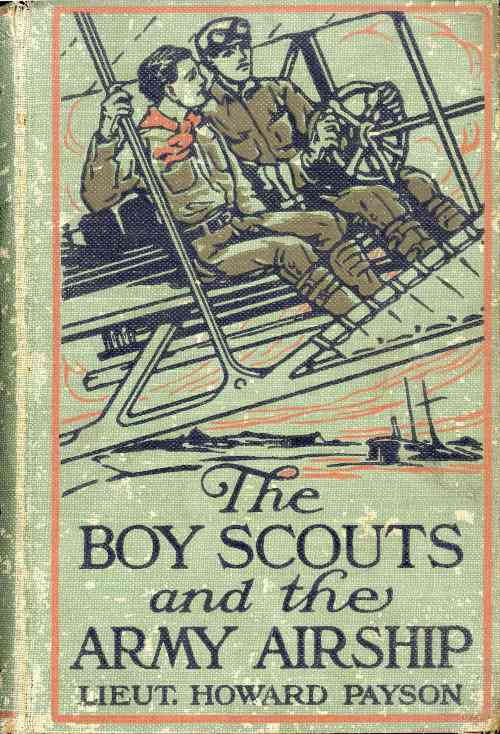
The Project Gutenberg eBook of The Boy Scouts and the Army Airship
Title: The Boy Scouts and the Army Airship
Author: John Henry Goldfrap
Release date: July 31, 2020 [eBook #62792]
Most recently updated: October 18, 2024
Language: English
Credits: Produced by Stephen Hutcheson and the Online Distributed
Proofreading Team at https://www.pgdp.net
... the flier ... now came roaring ... directly above the boys’ heads. (Page 138)
THE BOY SCOUTS
AND THE ARMY AIRSHIP
By LIEUT. HOWARD PAYSON
Author of
“The Boy Scouts of the Eagle Patrol,” “The Boy Scouts on the Range,” “The Boy Scouts’ Mountain Camp,” “The Boy Scouts for Uncle Sam,” “The Boy Scouts at the Panama Canal,” etc.
A. L. BURT COMPANY
Publishers New York
Printed in U. S. A.
Copyright, 1911,
BY
HURST & COMPANY
MADE IN U. S. A.
CONTENTS
- CHAPTER PAGE
- I. Sea Scouts at Play 5
- II. The Spearing of the Sturgeon 18
- III. Jack Curtiss Reappears 32
- IV. Paul Perkins’ Motor Scooter 43
- V. The Boy Who Made the Wheels Go Round 54
- VI. Two Mysterious Men 65
- VII. How a Secret Passage Was Used 74
- VIII. An Unexpected Encounter 84
- IX. Wherein Captain Hudgins’ Bees Swarm 95
- X. Mr. Stonington Hunt—Schemer 106
- XI. The Army Airship 120
- XII. Tubby Escapes an Orange Bomb 133
- XIII. What Happened in the Woods 145
- XIV. Mr. Hunt Delivers a Telegram 156
- XV. A Boy Who Flew 170
- XVI. “There’s Many a Slip——” 182
- XVII. Fire! 193
- XVIII. Jack Uses a File 208
- XIX. The Great Race 221
- XX. A Schooner in Trouble 232
- XXI. Motor-Scooters to the Rescue 246
- XXII. Jim Dugan Again 257
- XXIII. A Chase in the Night 272
- XXIV. A Bolt from the Blue 289
The Boy Scouts and the Army Airship
CHAPTER I.
SEA SCOUTS AT PLAY.
“Go!”
Commodore Wingate of the Hampton Yacht Club gave the word in a sharp, tense voice. The pistol he held extended above his head cracked sharply. The crowds massed upon the clubhouse verandas and in the vicinity broke into hoarse cheers as the tension of waiting was relieved.
“There they go!” came the cry.
Before the puff of blue smoke from the discharged pistol had been wafted away by a light breeze, two eighteen-foot, double-ended whaleboats shot out from either side of the float. For ten minutes or more they had been teetering there, like leashed greyhounds. This was while the final words of instruction were being given. Now the suspense of the preliminaries was over, and the “Spearing the Sturgeon” contest, between the Hawk and Eagle Patrols of Hampton, was on.
Bow and bow the two white craft hissed over the sparkling, blue waters of the inlet. From the clubhouse porch, from the beach, from the sand dunes of the farther side of the Inlet, and from the row of automobiles parked along the beach—which had come from all parts of Long Island—the strivers were cheered.
The afternoon’s program of exciting water sports, arranged by the Scoutmasters of the rival patrols, was now reaching its climax. The packed yacht club and automobile crowds ashore had never seen anything like it before. Among them was our old friend of the first volume of this series—“The Boy Scouts of the Eagle Patrol”—namely, Captain Job Hudgins.
“It’s the beatingest I ever seed afloat or ashore, douse my toplights if it ain’t,” the captain was loudly declaring to a group of cronies.
“Them Bye Scuts did wonders in the west, they tell me,” commented Si Stebbins, the postmaster and village store-keeper. “In my day, though, a bye had ter work an’ not go foolin’ aroun’ in er uniform like them Scuts.”
“What air yer talkin’ about?” put in another voice. “Them Boy Scouts is a good thing fer this town. Didn’t ther newspapers hev all erbout how they beat out a band of cattle rustlers and Injuns in ther west, an’ most got killed doin’ it?”
“They’d hev bin a sight better ter hum minding their own bizness,” opined Jeb Trotter, a village character, but there were few who had watched the exciting afternoon of healthy, wholesome water sports who agreed with him.
As the readers of the “Boy Scouts on the Range” may recollect, it was mentioned in that book that, during Leader Rob’s absence on a friend’s ranch in the west, another patrol—namely, the Hawk—had been formed. On his return, as was natural, the lads of the Eagle had besieged him with proposals to try conclusions with the Hawks. Finally, under Scoutmaster Blake with Wingate’s supervision, a program had been arranged. It included a game of water polo, tub races, a greased pole competition, a race between small cat-boats, and, as a grand wind-up feature, the exciting “Spearing the Sturgeon” game.
Honors were even up to the moment that the two boats dashed away from the float. The laurels of the afternoon would go to the victorious crew. No wonder a cheer went up as the double-enders skimmed over the sparkling water toward a dark object, about six feet in length, near which a canoe, containing the referee, Bartley Holmes, hovered.
The dark object was “the sturgeon.” It was formed of soft wood, and had two realistic eyes painted on the thicker part of its body. It really did look something like a sturgeon, as it lay bobbing about on the water. At the bow of each boat stood a lithe young figure in bathing togs. Each held poised above his head a keen, pointed harpoon. The eyes of both of the spearsmen were riveted, as their crews urged their boats forward, upon the sturgeon’s dark outline.
In the stern of each boat, from which fluttered flags bearing their patrol figures in proper colorings, was poised a steersman, holding a single oar. In the Eagles’ boat the helmsman was Merritt Crawford. In the Hawks’ craft the position was held by a lad named Dale Harding. Skillfully each coxswain directed his flying craft to a point of vantage from which their spearsman could hurl his harpoon to the most effective purpose.
The young harpooners stood tense and rigid as pieces of statuary, every sinew and muscle in their bodies ready for the first “strike.” The Eagles’ harpooner, Rob Blake, the leader of that patrol, was perhaps a little smaller in girth and height than Freeman Hunt, the harpooner and leader of the Hawks, but what Rob lacked in “beef,” he made up in sinuous activity. The fall sun glinted on his tough, brown flesh, as if it had been bronze. “Hard as nails” you would have said if you could have looked him over.
As the green and black “Eagle” standard, and the pink “Hawk” flag began to close in from their different points of the compass, a sharp cry went up from the onlookers.
“K-r-ee-ee-ee-ee!” shrilled the patrol cry of the Eagles from veranda, dune and beach.
Then a breathless hush fell as they waited for the first strike. The referee, in his dark-green canoe, dodged about as actively as a water bug, watching every move closely.
The crews were made up as follows:
| EAGLES. | HAWKS. |
|---|---|
| Spearsman, Rob Blake. | Spearsman, Freeman Hunt. |
| Helmsman, Merritt Crawford. | Helmsman, Dale Harding. |
| Oars: | Oars: |
| Stroke, Tubby Hopkins. | Stroke, Lem Lonsdale. |
| No. 1, Ernest Thompson. | No. 1, Fred Ingalls. |
| No. 2, Hiram Nelson. | No. 2, Grover Bell. |
| No. 3, Paul Perkins. | No. 3, Phil Speed. |
A deep-throated roar went up from the shore as Rob Blake’s harpoon glinted in the sunlight and sank quivering into the soft wood of the sturgeon. Instantly Merritt Crawford swung on his oar, bringing the bow of the boat round. But as he did so, there came another flash, and Freeman Hunt’s harpoon sank deep into the quarry, not six inches from Rob’s spear.
“Pull, you Eagles!” came a wild shout from shoreward.
“Now then, Hawks!” roared back the rival contingent.
Both crews were backing water for all they were worth, each seeking to draw the other’s harpoon out of the “sturgeon.” The harpoons were not barbed, which might have made them dangerous, and a determined pull would be likely to dislodge one.
“Give them rope!” shouted Merritt from the stern of the Eagles’ boat, and Rob, as the Hawks started to pull away, paid out his harpoon line rapidly. This maneuver rested his men while it saved his spear from being damaged. The Hawks, on the other hand, were straining their backs with feverish energy. They fairly dripped as they bent to their oars.
“Now then, come ahead easy!” ordered Rob, and the Eagles’ boat began to creep up.
But still the two harpoons stood upright in the “flesh” of the wooden game. Bartley Holmes came scudding up in his canoe.
“Carefully now, boys! Carefully!” he urged, watching things narrowly.
“They’re trying to work up into their base!” shouted Merritt suddenly, as the boats neared the shore.
“Working into their base” meant that the opposing crew would try to land the “fish” at their starting point. In such case, the first heat would go to them, even if the Eagles’ spear was sticking in the sturgeon at the time.
“Back water!” cried Rob suddenly.
The lad, crouching over the water, had been watching every move of his opponents anxiously. He detected signs of weakening in the crew of the Hawks, and gave the signal to reverse the motion of his boat as the Hawks slacked up ever so little.
The line zanged up out of the water, dripping and taut, as Rob’s crew obeyed the sharp order.
As it did so, there was a cry of dismay from the Hawk supporters, when they beheld Freeman Hunt’s spear, which had not sunk as deep as Rob’s, jerked out of the “fish.” Hunt gritted his teeth angrily. He was not a boy who relished defeat at any game, and the yells of the Eagle adherents enraged him.
“Get after them, you dubs!” he bellowed, as the Eagle boat darted off, towing the captured sturgeon behind them.
It was Hunt’s object to overtake them and spear the “fish” again. In this case a fresh struggle, in which he might prove victorious, would ensue.
Everybody was now on the tiptoe of excitement. It was a race for the Eagles’ base. With Rob’s muscular young crew bending to their oars with the regularity of machine-driven mechanism, the boat bearing the green and black standard fairly hissed through the water. Behind her there towed clumsily the black form of the captured sturgeon.
“More steam! More steam!” shouted Hunt, dancing up and down in the bow of the craft, as the Hawk Patrol boys gave way with all their power. But pull as they would, they were no match for the Eagles, who had rested while they were needlessly exerting their strength.
“Eagles!”
“K-r-ee-ee-ee-ee-ee!”
“Go on, Hawks!”
“Don’t give up!”
“Pull, boys! PULL!”
The yells came now in one continuous roar, but they did not affect the result of the first heat at all.
Bang!
The starter’s pistol cracked once more as the Eagles’ whaler, with the sturgeon in tow, shot across the line. But as she did so, Freeman Hunt made a desperate effort, and by some fluke—for the distance between the boats must have been twenty feet,—succeeded in landing his spear in the sturgeon’s tail.
“Back water! Back water!” Dale Harding began yelling, working his steering oar about.
“Too late,” laughed back Rob good-naturedly. “Try again next heat.”
“What do you mean?” shouted Hunt angrily. “My harpoon is in.”
“Yes, but we had crossed the line as you cast it,” yelled back Merritt.
An immediate appeal to Commodore Wingate followed, the referee being hopelessly outdistanced in that wild dash for the float.
“Silence!” he shouted above the confusion of excited boyish voices. Instantly there was a hush, only broken by some excited supporter of the Hawks having it out with an equally heated adherent of the Eagles.
“My decision is that the Eagles win the first heat,” announced Mr. Wingate. “The sturgeon was across the base line before the Hawks harpooned it.”
Instantly Bedlam broke loose.
“He’s right.”
“He isn’t.”
“I saw it myself.”
“Well, you ought to have your eyes seen to.”
These, and a hundred other argumentative remarks, filled the air, but, of course, like most such outbursts, they had no effect on the referee’s decision. There was a glowering, angry look on Freeman Hunt’s face, though, as the two boats changed bases for the next heat.
“We’ll get you this trip,” he grated, as the Eagle’s boat scraped past his craft.
“Say, Hunt, you’re an awful bad loser,” piped up the corpulent Tubby, winking at the others.
“Oh, I am, am I, you tub of lard. Just you wait. We’ll show you. You may have got that heat by a technical decision, but we’ll beat you fair and square this time.”
“Well, we’re both here to try just that,” Rob reminded the angry boy, as the boats bumped and passed.
“The second of the three heats is now on!” bellowed the announcer through his megaphone.
“Are you ready?” demanded Mr. Wingate, as the occupants of both boats anxiously awaited the signal.
“All right here,” announced Freeman Hunt, on whose face an angry light still showed.
“Go ahead, sir,” cried Rob.
The pistol cracked, and the two boats darted forth once more, now on the second lap of their intense struggle for supremacy.
CHAPTER II.
THE SPEARING OF THE STURGEON.
There were to be three heats in the contest. One having already gone to the Eagles, it behooved the Hawks to exert themselves to the uttermost to even matters up. The short rest at the float had done them good. During the breathing spell, the sturgeon had once more been towed out by Bartley Holmes, and now lay bobbing temptingly, awaiting the young harpooners. Freeman Hunt’s crew, rowing with unwise desperation, were the first at the mark this time. The “sturgeon” gave an awkward wallow and vanished from view for a breath, as Hunt’s harpoon flashed through the air and sank deep into it. An encouraging cheer went up from the shore. Hunt grinned confidently, as Dale Harding ordered his rowers to speed off with their prey.
But Rob’s boat was almost upon the sturgeon as Hunt’s harpoon sank into it. Tautening every muscle the boy hurtled his weapon, less then a second later. But the steel point, instead of sinking in, merely grazed the bobbing, yielding object, and shot into the water with a splash.
“W-e-l-l!”
An ironical groan came from the Hawks’ supporters ashore. The success of the Pink Bird’s patrol encouraged them.
“What did I tell you!” shouted Hunt triumphantly, as Rob, without any expression of anger or chagrin crossing his features, proceeded to haul in his harpoon.
Rob made no reply. Instead he turned to Merritt.
“All the ginger you can, old man,” he said quietly, as the Hawks’ boat dashed off at top speed, towing the captured sturgeon behind them. Already they were two or three boat lengths ahead of the Eagles.
“Fathom! Fathom!” shouted Rob suddenly.
His keen eyes had noticed that the Hawks’ boat had not paid out line to the fathom mark, which was indicated by a bit of red rag tied in the harpoon rope. Instead, they were towing their quarry quite close to their stern.
“It’s out!” shouted back Dale Harding, a flash of defiance in his eye, but the referee’s voice cut in.
“Fathom there! Pay out your line!” he ordered sharply.
Rather sulkily Dale obeyed. This gave Rob another chance. Poising himself carefully, he threw once more. This time his cast landed in the wooden back, but the distance was so great that much of the force of the cast was lost. The steel point of the harpoon hung quiveringly in not more than an inch of wood.
“Yah-h-h-h-h!” yelled the Hawkites disgustedly.
“Good for you, Blake!” came a roar from the Eagle supporters.
“A spurt. Pull, you beggars!” yelled Dale suddenly.
The Hawks’ craft shot forward. Dale’s sharp eyes had seen that Rob’s spear had only lodged lightly in the “fish,” whereas Hunt’s harpoon was firmly embedded. The move was successful. As the lines tautened, Rob’s harpoon point was jerked out of the “sturgeon.” With a shout, the Hawks shot forward for their float.
“W-e-l-l!” yelled the Hawks’ crowd ashore, in further ironical astonishment.
“Hard luck!” encouraged Merritt from the stern, as Rob hauled in. “Try again.”
“All right, if you fellows will put me alongside. I guess all my fingers have turned to thumbs,” rejoined Rob. Not a trace of anger over his failure to spear the fish revealed itself. He seemed as sunny and good-natured as ever.
The Eagles gave way with a will. They would need every ounce of their muscle and reserve force if they were to overtake the seemingly victorious Hawks. But with leaps and bounds, the Eagle boat came upon the other a few hundred feet from the base line. Again Rob cast, and again he missed—but this time there was a reason. As his harpoon had launched through the air, Harding had given the line attached to the “sturgeon” a slight tug. Light as it was, however, it was sufficient to pull the floating target out of the harpoon reach.
“Foul!” shouted Merritt angrily, from the stern of the Eagles’ boat. He, too, apparently, had seen the action of Dale, and instantly called the attention of the referee to it. Bartley Holmes was paddling near by, and immediately came alongside.
“What’s the trouble?” he demanded.
“Why, Dale Harding jerked the rope just as Rob cast,” explained Merritt. “Mustn’t they be penalized for a foul?”
“It was an accident!” cried Harding, turning rather white under his tan. “I was stooping down to fix a toggle pin and maybe I accidentally touched the line. I don’t believe, though, it made any difference.”
“If you touched the line at all, you infringed on a rule,” declared the referee. Then to Rob:
“Do you wish to claim this heat on a foul?”
“No, sir,” rejoined Rob instantly. “If it was an accident, that’s good enough for me. We don’t wish to take advantage of anything like that.”
“All right. Go ahead, then.”
The Hawks’ boat shot forward, and before Rob could gather up his line and coil it for another throw, they had towed the “sturgeon” across their base line.
Instantly from human throats, auto horns, and launch whistles a great uproar arose. While it was at its height, Bartley Holmes once more towed out the sturgeon, and placed it in position for the third and decisive struggle.
“We’ve got to win this final,” Hunt found time to whisper to Harding, while the boats changed bases. “If we capture it, we put the Hawks on top for the winter. If we lose it, we’ll have to take second place.”
“We’ll win it,” Dale assured him positively.
“It won’t be my fault if we don’t,” rejoined Hunt. Victory affected him as much as defeat. His cheeks were now flushed with a color that was not all caused by exertion. He openly triumphed over the Eagles as they rowed past.
The final did not open with the dash that had marked the two other heats. Both crews were evidently conserving their efforts for what they felt was to be a severe struggle. In fact, neither boat appeared in any hurry to reach the mark. Both coxswains contented themselves with keeping bow and bow, eyeing each other warily, however, on the alert for any unexpected move on the part of their rivals.
As before, it was Hunt’s harpoon that first found a resting place. But as it settled in the wood, Rob’s weapon flashed silverly, and skillfully fell so that his line was drawn across the shaft of the Hawk harpoonist’s weapon. Then with a quick jerk of his forearm, and, before the Hawks could slacken up, Rob drew his line taut.
Splash!
Out came the Hawks’ spear and fell into the water in a shower of spray, cunningly dislodged by Rob’s cleverness.
Hunt scowled blackly as the two boats drew alongside to disentangle the weapons. He said nothing, however, but glanced back at Harding. The lines were speedily cast apart, and the two boats drew off for a fresh attack. But as they did so, Dale Harding inclined his steering oar and the Hawks’ boat came crashing down upon the Eagles’ craft. Tubby Hopkins’ oar was caught between them and almost snapped.
“Hold up! Hold up!” he shouted angrily. “What are you trying to do?”
“Keep off there, Dale. How can you be so careless?” admonished Hunt, but, nevertheless, a gleam of satisfaction lit up his eyes as he noted that Tubby’s wrist had been twisted, and from the way in which the fat boy held the member it must have been giving him some pain.
“Don’t let accidents like that happen again, Harding,” warned Bartley Holmes sharply, “or I’ll disqualify you.”
“Row right up on it this time; I want to get a good hold,” hailed Rob to Merritt. The coxswain nodded and as the oarsmen gave way he directed the prow of the boat almost directly at the floating “sturgeon.”
“We’ll wait and see what they do,” declared Hunt, addressing his crew. “If they hook fast, I’ll try Rob’s trick and yank his harpoon out. If they don’t, we’ll drive the spear deep and tug theirs out.”
With a sharp “z-i-i-g!” Rob’s harpoon flew from his hand and sank shivering into the soft wood of the “sturgeon.”
“Good strike!” shouted Bartley Holmes from his canoe.
“Back water, Eagles!” yelled Merritt, as the Hawks came driving down upon the quarry. Hunt’s sinewy form stood erect and tensile for a second, then down drove his arm with every ounce of muscular effort of which he was capable.
“Good boy!” shouted the impartial referee.
The leader of the Hawks had sunk his weapon fully as far into the floating target as had Rob.
“Now for the tug of war,” muttered Holmes, as the two boats drew apart, both harpoon-ropes stretching taut as violin strings. Suddenly Rob almost toppled backward as the strain on the Eagles’ boat was quickly released and she shot forward. His harpoon had pulled out. It had not been lodged deeply enough to resist the strain. On the other hand, Hunt’s weapon seemed to be somewhat wobbly poised. Evidently, the tugging had weakened its grip.
But the Hawks paid no attention to this. Nor indeed could they do anything to repair it without breaking the rules. Instead, they darted off at top speed for the shore. A mighty, ear-splitting roar went up as it was seen that the Hawk standard was for the second time, apparently, victorious.
“It’s two out of three, fellows! We win!” Hunt exclaimed, as his boat shot through the water.
But in the meantime, the Eagles had not been idle. Rob had hauled in his dripping line and now stood once more ready for action. Behind him Tubby was hitting up a terrific stroke. The Eagles’ boat fairly flew in pursuit of the captors of the trophy.
“It’s now or never,” thought Rob, as at twenty feet or more he decided to cast. Another second and it would be too late. With every effort he could muster, the lad launched his harpoon, aiming, not at the body of the fish, but at the Hawks’ weapon.
“He’s done it!” went up a shout of exultation from the Eagles’ rooters, as for the second time that day Rob’s harpoon dislodged his opponent’s spear.
“Confound the luck!” grated out Hunt, as he saw the victory torn from his grasp, as it were. His groan of dismay was echoed by every one in the Hawks’ boat.
“Close in! Close in!” yelled Dale, urging his crew around, while Hunt rapidly manipulated his line, cast it loose of Rob’s, and made ready for a fresh cast.
A current had caught the sturgeon and carried it quite a distance from the two boats, and seaward, while this was going on. A sharp dash followed. It was a culminating tussle. Straining every nerve and muscle, the Eagles and the Hawks flew forward, as swiftly almost as their namesakes.
“Now!” shouted Merritt.
Rob’s harpoon whistled through the air and sank, with a “squdge,” into the side of the bobbing, evasive target.
A second later Hunt’s weapon, too, sought a resting place in the elusive thing. But, alas for Hunt’s endeavor! The very energy he threw into his cast unbalanced him, and he toppled with a splash and a great commotion clean over the bow of his craft and into the water.
He could swim like a fish, and came up a second later, puffing and sputtering. With the stream of water he emitted from his lips as he rose to the surface was mingled some savage language. Hastily he grabbed the gunwale of the Hawks’ boat, and started to clamber into it.
To his intense joy, he saw, as he emerged from his ducking, that his spear seemed to be firmly fixed in the wooden fish.
“Hurry up!” urged Dale. “We’ll get them yet.”
The Eagles rapidly passed the line under the keel of their boat till it trailed out astern.
“Give way!” shouted Merritt, and “give way” with a will did the four pairs of healthy young arms. The Eagle boat fairly cut through the water. The maneuver caught the Hawks napping. Before they could do anything their line was drawn taut, and the harpoon Freeman Hunt had planted was jerked out.
“Hooray!” came a deep, swelling roar, surging toward the contestants, from the shore.
“Now then, Eagles, you’ve got them!”
“After them, Hawks!”
“Don’t give up!”
“K-r-ee-ee-ee!”
These cries and a thousand others, mingled in a perfect babel of sound. To the uproar, however, neither of the crews paid any attention. Their efforts and energies were all bent in one direction—to get across the base line first with the fish. The Hawks’ boat made a creditable spurt, while Hunt gathered up his line ready for a fresh cast. He would make an attempt to snatch victory out of defeat. How much his mind was bent upon success, it was easy to see by his lined brow and narrowed eyes. Closer and closer to the flying Eagles crept the Hawks’ boat.
Unencumbered by a wooden fish to tow, they could make much faster time. Now they were almost upon the prey, and Freeman Hunt drew himself up for a supreme effort. His brown arm drew back, showing the muscles bulging and working under the flesh.
The next instant the harpoonist of the Hawks made his last cast and—lost! His weapon flashed into the water, missing the target by the fraction of an inch. An instant later the Eagles’ boat shot across the base line, amid a pandemonium of cheers, yells, tooting of auto horns and sympathetic groans for the losers. The Eagles had won out in the big event of the day.
CHAPTER III.
JACK CURTISS REAPPEARS.
It was one Saturday night following the aquatic field day. The winter term of hard work had commenced at the Hampton Academy, giving the Boy Scouts less time to devote to their organization work than they had found during the summer. Rob Blake, Merritt Crawford, and Tubby Hopkins were on their way home through the gathering dusk from a game of Hare and Hounds, which had wound up by the catching of the hare at a village called Aquebogue, some distance from Hampton.
At a steady jog trot the three lads were making their way toward their home village. A slight chill predictive of the coming winter was in the air, but for the time of year, mid-October, the evening was unusually calm and warm. It was this late Indian summer that had made the water games possible.
The boys’ conversation, as they jogged along, dealt mainly with the astonishing things that had happened to them on the Harkness ranch in the wildest part of Arizona. All of these were related in detail in “The Boy Scouts on The Range.” Readers of that book will recall how Rob Blake, the son of the president of the National Bank of Hampton; Merritt Crawford, one of the numerous family of the village blacksmith, and Tubby Hopkins, the offspring of a widow in comfortable circumstances, had accepted the invitation of Harry Harkness to get a taste of life on the range.
Their strange encounter with Jack Curtiss and Bill Bender, their former enemies, was related in that volume, together with the surprising and clever manner in which they turned the tables on those worthies. In that book, too, we saw the raw Easterners—Tenderfeet, as they were—become transformed from “greenies” into good shots, capable riders, and excellent woodsmen. During their western stay they had broadened and developed considerably from the lads who some months before had formed the Eagle Patrol, as related in the first volume of this series, “The Boy Scouts of the Eagle Patrol.” They had returned to Hampton better, mentally and physically, for their trip.
But like most lads who have left their native place for even a short time, they found changes when they returned. Freeman Hunt, the son of a well-to-do resident, had formed the Hawk Patrol, and enrolled in it as many boys as he could. In the meantime, the Eagle Patrol had developed, and now numbered twenty stalwart lads, in addition to the original ten whom we know. In some way, however, instead of the spirit of friendliness and good fellowship that should have prevailed, the Hawk and Eagle Patrols found themselves involved in considerable rivalry.
Now rivalry is good. Nothing could be better in athletics or daily life than a healthy spirit of emulation. It is when rivalry degenerates into bitterness that it is time to call a halt. Under Freeman Hunt’s leadership, the Hawks had developed such a spirit. Dale Harding, Hunt’s boon companion, had followed his leader’s example in abetting it, instead of trying to allay hard and angry feelings. In fact, despite all that the scoutmasters could do, the Hawks sought every opportunity to lure the Eagles into open hostilities.
Rob Blake and his crowd had managed hitherto to keep their men in check. But the task was daily getting harder. Freeman Hunt had many good qualities, but he could not bear to be beaten at anything. He was a bad loser. Until the return of Rob and his chums from the West, he had had things pretty much his own way. But since that time, every contest in which the Hawks and Eagles had engaged had resulted in victory for the latter. This galled Hunt and Harding exceedingly. They would have liked to see and to hasten the return of Rob and his companions to the West, or anywhere else, so long as they were left a free field for their endeavors.
The Sturgeon Spearing Contest had proved the climax of affairs between the two patrols. In the dressing-room, after the awarding of the pennant to the Eagles, Hunt had bitterly assailed Rob. The latter had stood taunt after taunt without a word. He good-naturedly ascribed it to Hunt’s natural chagrin at being beaten. Finally, an especially bitter remark had moved him to reply. After all, Rob was only human.
“Say, Hunt,” he said quietly, “don’t you think it would be a heap more manly not to make so much noise about it?”
“No, I don’t,” grated out Hunt, almost beside himself with rage. He came close up to Rob and shook his fist threateningly.
“Who are you, anyhow, to tell me what I’m to do, eh? What have you got to say about it?”
“Just this,” had been Rob’s reply, “that I think you are a pretty bad loser.”
“Oh, you do, eh? Well, I’m a better man than you—so take that!”
Smack!
The infuriated lad had actually allowed his temper to carry his judgment away so utterly as to strike his conqueror in the face.
The other boys in the place had stood about, fairly gasping. What would Rob do? To their astonishment, he did nothing. While an angry, crimson mark grew upon his cheek where the blow had fallen, his countenance was calm and composed. But he caught Hunt’s hand in a grip of iron.
“Look here, Hunt,” he said quietly enough, but every word rang home with sledge-hammer force, “you were beaten to-day. Worse, still, you can’t take it like a man. To cap the climax, you have struck me. Don’t—do—it—again.”
The last words came slowly, but they made Hunt flinch. Even Harding, who had been inclined to urge his crony on, held his breath. Would Rob strike Freeman? That question was soon answered. Rob released the angry boy’s wrists, and let him go. Muttering angrily, Hunt had slunk off to a locker.
“Why didn’t you have it out with him?” Dale asked him later, after Rob and the others had dressed and gone.
“Too many of his crowd around,” Hunt muttered in reply, “but I’ll fix him. You watch me. He’s not going to get away with anything like that.”
“I’m with you in anything you want to do,” Dale assured him.
“I may give you an opportunity before long to show if you mean that or not,” rejoined Hunt, but when Dale pressed him for some explanation, he refused to enlarge on the thinly-veiled threat.
Of this conversation, the lads, however, knew nothing, and were, therefore, considerably astonished when, as they descended a bank leading into the road to Hampton Inlet, a stoutly built lad, accompanied by three others of about his own age and build, stepped from behind a hedge, where they had evidently been lying in wait for the returning lads.
As the three figures stepped forward into the road, and blocked the path of the homing lads, Rob recognized them:
“Oh, it’s you, is it, Freeman Hunt?” he exclaimed.
“Yes, it’s me,” retorted the other belligerently, blocking the way, “I want to settle with you.”
“Settle with me—what for?” exclaimed the astonished Rob.
“For what you did in the locker room at the club the other day. You have made me the laughing-stock of the place. Take off your coat, for I’m going to give you the worst licking you ever had in your life.”
“Mercy me!” exclaimed Tubby, pretending to quake.
“Yes, and you’ll be laughing on the wrong side of your face before I get through with him,” grated Freeman Hunt. “I can lick Rob Blake the best day he ever walked.”
“Do you think so?” asked Rob calmly.
“I do; yes,” pugnaciously rejoined Hunt, thrusting forward his chin in a manner he had seen depicted in pictures of pugilists.
“Well, then,” was the astonishing reply, “let it go at that. We want to get home.”
“Well, what do you think of that?” exclaimed Lem Lonsdale, who was one of the lads accompanying Hunt.