
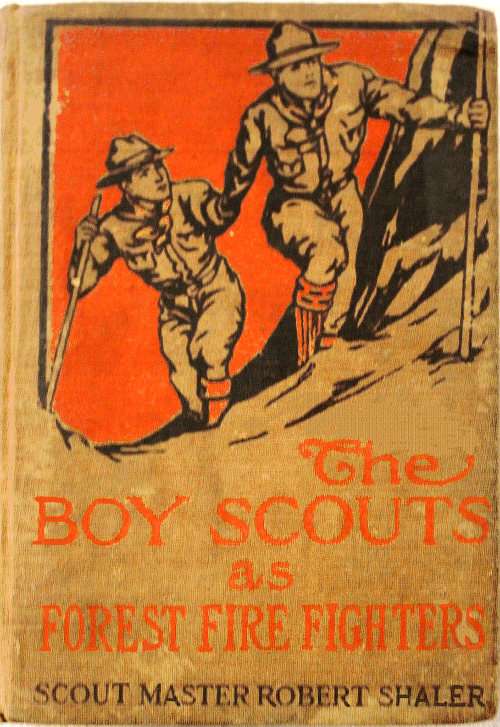
“I’d say it was sure enough wood smoke, from the way it smarts your eyes,” declared another of the group, though no one laughed at his intended witticism, for they had more serious things to weigh upon their minds.
Boys were seen coming on the run from various directions. All of them converged toward the bell, still throbbing its startling message. The cry of Paul Revere in those old Continental days could hardly have thrilled the hearts of those who lived in Massachusetts villages and hamlets any more than the brazen notes of that bell did the gathering scouts.
Some were in uniform, others not, but that was a matter of very little importance just then. They were wild to learn why this hasty call had gone forth; and hoping it meant a chance to enter the fight against the oncoming forest fire.
Not only boys were running, for girls, women, and some men could be seen hastening toward the church. Like wildfire the news would spread that the scouts were going to take a hand in the game, and somehow people had come to place a wonderful amount of faith in Hugh Hardin and his comrades.
True, thirty mere boys could not do much when they tried to pit their puny powers against so savage a thing as a raging forest fire. Still, somehow, those good people had come to feel a degree of confidence in the ability of the troop to accomplish things. Their past history was a splendid one, and on a number of occasions never to be forgotten, they had attained triumphs that made Oakvale very proud to own them.
So from lip to lip went the cry: “The scouts are going out to fight the fire!” Mothers, who had boys enrolled in the troop, surveyed that dark pall of smoke and turned pale with new apprehension. It seemed as though some frightful peril might be hovering off where those fires burned; and while it was right sturdy men should go forth to assist those in distress, each mother’s heart was a battleground of pride and fear as she contemplated the possibility of some disaster overtaking the boy she loved.
The crowd grew in volume as minutes passed. Each scout upon arriving pushed in so as to reach the center of the gathering. When Hugh and Walter Osborne, the Hawk leader, came out of the church, they having been ringing the loud-pealing bell, it was a startling scene that met their eyes.
Fully three hundred people had gathered there. The appearance of the assistant scout master was greeted with loud cheers.
“What’s doing, Hugh?” cried one eager boy.
“Are we going up to the foot of Old Stormberg?” asked another.
When Hugh stepped forward and held up his hand all these voices stopped.
“There is a great need of help up there, they say,” he told them in a ringing tone, “not only to fight the fires, but to save property, perhaps helpless people who have been burned out and are in danger. If we went in a body we might find a chance to make ourselves useful; and so I have decided to ask the members of Oakvale Troop to join with me in the work!”
“Hurrah!”
Scores of lusty voices took up the cheer until the volume of sound rolled along through that entire part of the town. Those women who had remained at home, though still at their gates, with aprons over their heads it might be, seemed readily to guess what that vociferous cheer in boyish voices meant.
The scouts were going! Strange how a little thing like that could give them a thrill, but it seemed to all the same.
“Remember,” continued Hugh, when the clamor which his announcement had caused died away, “it is optional with every one of you whether he goes or not. You can be of great service to those who are in trouble. Still, if any scout’s mother does not wish him to be of our party he should stay at home.”
“No danger of that happening, Hugh!” called out one boy.
“We’ve got the right kind of mothers, and they’ve proved it in the past. Count on a full attendance, Hugh!” another informed him, at which there were further loud cheers.
After that it was hardly to be expected that any mother would dream of objecting to her boy going to the front, no matter how her fond heart might be gripped with natural fears. Pride would step in and make sure that the finger of scorn should never be pointed at her boy.
“Get away home now, fellers,” said Hugh, “and change your clothes. Put on any old suit you’ve got, it doesn’t matter what it looks like. With sparks flying around you’re apt to have some damage done before we come back. Don’t waste any time, but get back here. We start in exactly half an hour.”
He knew that every single boy would be on the run, and eager to get back to the rendezvous long before those thirty minutes had expired.
“Another thing!” Hugh called out as they were starting away, “bring canteens along with you if you have them; and don’t forget your big red bandana handkerchief above all things, with an old campaign hat that will protect your neck from any sparks!”
There never existed a more excited lot of boys than Oakvale boasted about that time. All over town they could be seen running wildly this way and that, with people trying to ask questions which the hustling scouts were too busy to answer.
By the time fifteen minutes had expired a dozen of them had arrived at the designated meeting place, all flushed and eager. One after another the rest came on the run, showing signs of relief at finding they were not too late.
Had any scout been actually left behind on that occasion he would have been the most heart-broken fellow ever seen. The crowd was greater than ever as new arrivals constantly augmented it. A buzz of tongues told that the women were trying to explain how matters stood to those who could not understand what all this excitement meant.
Hugh was keeping count of the boys as they came up. He had them ranged alongside the wall of the church, so that he would know when the full quota had arrived. It pleased him to see how anxious they all were to join their fortunes with the expedition that was about to set forth, bent on a new work of usefulness.
It still lacked five minutes of the appointed time, and yet Hugh believed that every member of the troop who might be expected to gather had done so. Two boys he knew were sick at home, and another was away from town; but the rest were on hand.
“There’s no use waiting any longer, Hugh!” called out Billy Worth. “We’re all on deck, you see.”
Everybody stopped talking when Hugh was seen to step forward again, and raise his hand. This boy had won the respect of Oakvale through his manly qualities. He had even managed to disarm the enmity of certain boys who at one time had striven to throw every obstacle possible in his path.
“We’re going to start off, fellows,” he announced, cheerily; “and it isn’t too late yet for any one who isn’t in good shape to do a lot of work to drop back. Fall in, double file, and we’ll be moving!”
Quickly they obeyed. Not a single boy dropped out of line; indeed, just then it would have required a most powerful lever to have dragged any of them aside. They did not know what awaited them up where that billowing smoke came from; possibly it might mean danger, and surely suffering from the pungent vapor that smarted the eyes, but they believed duty called them, and they were wild to go.
The crowd parted to let them pass through. Other boys who did not belong to the troop cheered them as they walked smartly along, keeping excellent military step.
There were no inspiring notes of the bugle to cheer them this time, no exhilarating throb of the drum to enliven their steps; but nevertheless every boy’s face was an index to the feelings of his heart, and they shone with delight.
On down the street they went, followed by the crowd that seemed bent on seeing the last of them. Never had the scouts presented a more manly bearing, though all of them were shabbily dressed, a few in cast-off khaki suits, others wearing such garments as they could find around home of the kind that it would not matter if they were utterly ruined in the fire-fighting.
Now they had passed beyond the outskirts of the town. The crowd had left them with a parting cheer. Ahead lay the road leading to the region being devastated by the furious flames. Sturdily they set out to walk all the way up to the burning woods in order that they might be of some assistance to those in distress.
CHAPTER V.
CARRIED TO THE FRONT.
“It’s going to be something of a hike for us, I reckon,” Billy Worth remarked, as they covered the first half mile of ground.
While Billy’s ambition knew no bounds, and he was always ready to attempt any feat which others, who were much more nimble, could accomplish, he was often sadly handicapped by his extra weight. Although the rest of the boys were swinging lightly along, and thinking nothing of the exertion, Billy was puffing like a porpoise. He was also secretly mopping his face with his red bandana handkerchief, which he had knotted loosely around his neck, cowpuncher fashion, a trick most scouts are fond of emulating.
“Yes, and we’re all sorry on your account, Billy,” ventured Buck Winters. “Hiking never was your best hold. If a prize was offered to the longest sitter, you’d come under the wire a victor every time.”
“It’ll be a good thing to cut down your heft some, too, Billy,” another scout told him. “Nothing half so fine as sweating it off. That’s what all the prize fighters do when they have to get into trim.”
“Hugh,” called out Alec, for they were not trying to keep any sort of order now, each tramping along with some comrade he had picked out, though not strung out over more than ten yards of road, “have you been able to learn what sort of a fire it is up here?”
“Only that the woods are ablaze for a long distance,” replied the scout master. “Some accounts say the fire front is five miles long, and growing every hour.”
“I asked,” continued Alec, “because there are two kinds of forest fires. One, and the most terrible, is where the trees themselves are burning, and that means the utter ruination of the whole tract. I’ve seen miles and miles up in Michigan where only stumps stand up like fingers. I certainly hope that isn’t going to be the case here, for we’d miss those woods the worst way in summertime.”
“But you spoke of another sort of fire, Alec; tell us about it?” asked Shorty McNeil, whose hobby lay in collecting strange plants, and who on that account would be very sorry to see the forest ruined, since he spent much of his spare time under the trees, searching for new varieties of wild flowers.
“Why, at this time of the year,” Alec went on to explain, “when most of the leaves have fallen, if a spark drops among them and a fire follows it runs along the ground, eating up all the dead stuff. It makes a terrible smoke, and lights up the sky nights, but it isn’t so dangerous as the other sort of fire.”
“Which kind would you think this one will turn out to be, Alec?” asked Billy.
“I’d rather believe it was the bush sort, though it may turn out some of the trees are ablaze, too. You see, all sorts of logs lying on the ground, dead stumps, piles of wood cut for fence rails and that sort of stuff gets to going with the rest, so it makes a fierce blaze.”
“And with this strong wind blowing it must travel pretty fast at that, I take it,” remarked Bud Morgan.
“Look out back there!” shouted Ralph Kenyon, “some sort of car coming along in a big hurry; don’t block the road. Perhaps it’s the Oakvale fire department starting on to lend a hand at putting the blaze down!”
Ralph had once upon a time spent much of his time in the woods. In summer he had hunted for places where patches of wild ginseng or golden rod grew, the roots of which he dug up in season, dried, and sold at a good profit.
Then, too, in the winter, he had been wont to trap all sorts of small fur-bearing animals for the sake of their pelts, which brought him in a fair price when sent to a dealer in the city.
Ralph had seen a great light after he joined the scouts. Nothing could tempt him nowadays to injure an innocent little animal, merely in order that he might increase his savings bank account. He had even grown to enjoy watching them frolic in their native haunts which he knew so well.
While others were thinking wholly of human misery apt to follow this sweep of the fire, Ralph had an aching heart for the wood’s denizens who, caught in the trap, were apt to perish miserably.
The tooting of an automobile horn told that the car coming behind them was close to the bend they had just recently turned. Warned in time, the scouts crowded to the side of the road and left an open space for it to pass through.
No sooner did they glimpse the car than the boys started shouting.
“Why, it’s Mr. Lewis, the liveryman!” one called out.
“And he’s got his big rubberneck twenty-passenger car, too!” cried a second.
“Hey! it’s empty, don’t you notice, fellows!” came from a third keen-eyed boy. The sight-seeing tourist car came to a stop alongside the waiting boys. The man at the wheel gave them a smile.
“Pile aboard every one of you, like hot cakes!” he told them.
“What’s this mean, Mr. Lewis?” asked Hugh. “Have you come after us with your rig to help get us up to the fire lines?”
“Just what I’ve done,” replied the other, heartily. “You boys have done so many fine things for Oakvale that we’re all proud of you. We want to do what little we can to help you along. I thought of my car too late to get you in town, but that didn’t stop me. Find seats all who can, and the rest hang on like grim death. We’re going to start now. All aboard.”
“Those that can’t get aboard get a rail!” called Billy, who being one of the first to clamber up on the “rubberneck” or sight-seeing car had managed to install himself in a comfortable seat in the middle, where he could not be crowded off.
They were soon going along at a fast clip, the boys giving a shout every time one of the “thank-you-mums” in the road, intended to throw off the water in heavy rain storms, caused them to jolt up and down.
“This is a thousand per cent. better than walking, let me tell you, everybody!” asserted Billy Worth.
“It was a fine idea for you to think of us as you did, Mr. Lewis,” said Hugh.
“Save us some hours of hard work, which would leave us in a poor shape to fight fires, I should say,” Bud Morgan declared.
“After I drop you as near the fire as I care to venture with my car,” the liveryman said, “I expect to turn around somehow, and run back for another load. There will be plenty of men volunteers to come up and work. With Oakvale threatened with total destruction, none of the mills or factories will think of keeping their employees on duty, so I ought to pick up a number of loads of fire-fighters.”
“Can’t be too many,” asserted Alec, as though his past experience told him that.
“Whew! but this smoke is no joke, let me tell you!” complained Monkey Stallings, digging his knuckles into his smarting eyes, from which the tears were springing.
“How about it, Hugh,” Alec now asked, “are we going to try and beat out the fire or will we put in our time saving some of the threatened farm buildings? We ought to know all this country up around Pioneer Lake like a book; and once we get our bearings it’ll be easy for us to tell whose place is most in danger.”
“In most cases,” said Hugh, “as far as I know, when a forest fire gets fully started, and with a wind to drive it on, all the men that could be got together can’t stop the spread of the flames. They’re bound to keep on jumping ahead with all the sparks blowing until it rains and puts the fire out.”
“Then we’ll devote our time to helping farmers, will we?” asked one of the boys, a little note of disappointment discernible in his tone, for he had evidently pictured himself as a heroic figure forcing the fire demon to obey his will.
“The chances are,” Hugh told him, “that we’ll get all the work we want in trying to protect the sheds, hay-stacks, barns, and houses that are in danger of being devoured by the fire.”
“That’s correct, Hugh,” assented Alec. “Mr. Lewis, I think you’re wrong in believing any fire could reach Oakvale. There happens to be a pretty wide open stretch to the north of the town, where we play ball, you remember. It couldn’t cross that, as the grass is short, and even boys could beat it out.”
“I was thinking of the sparks that would be blown over the houses,” said the livery-stable owner. “Look up right now and you’ll see signs of them. If it was a dark night you’d never forget the sight.”
“Then let’s hope those clouds that have come up mean business, and it’ll rain before many hours,” said Billy, fervently.
They had made rapid progress and must now be in the region of the fire. The smoke was worse than at any previous time, and others besides Monkey Stallings had commenced to rub their eyes.
“I’ll go a little further,” remarked Mr. Lewis, who had slowed down somewhat; “and when I find a good place to turn I’ll have to ask you boys to vacate.”
Hugh was doubtless figuring on his plan of campaign. Yes, they did know this region pretty well, which would prove a good thing in this emergency. Had it chanced to be strange to them they would not know which way to go in order to render any assistance; and in consequence their coming would be next to useless.
On the way they had passed a number of houses, and found the women folks the only ones at home, besides the children, when there were any. The men had evidently been drafted to fight the fire raging in so many places in the forests around the foot of the mountain.
Even these women were doing what little they could to save their possessions in case the fire came their way. They were drawing water in all sorts of tubs and other receptacles, some even digging ditches on the north side of the farm buildings as though in that Western way they hoped to keep the enemy at a distance.
“Oh! look there!” suddenly exclaimed “Whistling” Smith, a boy whose recognized ability as an imitator of birds had long ago given him this nickname.
“Our first glimpse of the fire line!” said Hugh, as all of them stared hard at what they could see through an opening in the timber bordering the road.
It was true enough. They could watch the play of the flames as they climbed up a tree that may have been dead, for it certainly burned like a torch.
“That looks like business, I’m telling you!” remarked Tom Sherwood, the water athlete of the troop, and who could do almost anything well, since he had both the physique and the quickness of action that are so necessary to success.
“And here’s a wider place in the road where by crowding I may be able to make a turn about,” remarked the driver of the “rubberneck” car.
“Jump off, fellows!” ordered Hugh, suiting the action to the words himself, and making a safe landing.
There was a hasty getaway, Billy turning out to be the only clumsy member of the lot; a slip of his foot just at the instant he sprang causing him to roll over after he alighted. He was seized and dragged to a place of safety by his comrades before the car could back, and run over him.
Mr. Lewis knew how to manage, it proved. He made a couple of turns back and forward, and then had his car facing toward Oakvale.
“Good-by, boys!” he called out to them.
“We’ll surely remember this kindness, Mr. Lewis,” shouted Alec Sands.
“It was only a pleasure to haul such a fine lot of fire-fighters to the work they mean to tackle,” the liveryman replied over his shoulder. “Good luck to you, boys, and mind your eye! Do all the good you can for these poor folks up here, but remember, too, you’ve got mothers at home, and don’t be rash. Avoid the fire-traps, boys!”
CHAPTER VI.
THE BURNING FOREST.
When the car was lost sight of in the pall of smoke that had settled down over that section of the county, Hugh took it upon himself to explain the plan of campaign which he had mentally mapped out while on the road.
“Whatever we do, fellows,” he told the scouts clustering around him, all with eager faces, and perhaps streaming eyes, for that smoke did smart tremendously, “we know there’s no use going behind the line of fire. When it’s once passed over a place either the damage has been done, or else the farm has had a narrow escape. What we want to do is to keep moving along in front of the fire, so as to try to keep it from ruining some of these people.”
“Tell us our duty, Hugh, and you’ll find every scout on the job,” said Alec.
“I know that without you telling me, Alec,” the scout master replied. “Now, to the left lies the Heffner farm. I don’t think the fire can have reached there so far, though it’s heading that way fast. I’m going to take half of your number and strike through the woods here to help Mrs. Heffner. You know she’s been trying to make a living for her little family of children since her husband died two years ago. If anybody needs assistance they do.”
“Only half did you say, Hugh?” exclaimed Shorty McNeil, in a panic lest some of them be left out of the lively game.
“Yes, because I want Alec with the rest to turn off to the right of us. You know how the land lies, and what course to take to get to old Zeke Ballinger’s poultry farm, where he raises squabs, and broilers for the city market. If the fire puts him out of business it’s going to ruin the old man, for he barely makes a living now. Do your level best to save his buildings, Alec.”
“We certainly will, Hugh, and thank you for trusting me with the job. How shall we divide the troop?” asked the leader of the Otters.
“I’ll pick one, and then you do the same,” said Hugh. “We’ll keep it up till all have been selected. Billy, step over here with me.”
Billy felt proud of having been the first choice of the scout master; but he knew very well it was pure personal affection that brought this about, and not any belief that he could render better service than any of the other fellows; indeed, the more agile scouts were apt to discount all of Billy’s efforts, no matter how strenuously he tried to excel.
“I’ll take Tom Sherwood,” said the leader of the Otters, promptly.
Hugh’s second choice proved to be Arthur Cameron, for he knew what a useful member of a rescue party the student of surgery was likely to prove. After that they picked their followers rapidly. It was amusing to notice how each patrol leader made sure to get those of his own command first of all, before turning to others. Still, this was only natural, since they were supposed to know the particular virtues of those with whom they came in frequent contact.
The division was quickly accomplished. Fourteen boys stood back of Hugh and an equal number waited to obey the orders of Alec.
The two leaders only halted to make an arrangement looking to a possible combination of their forces later on. If it was found that their assistance was no longer needed at the place to which they had gone, the party thus set at liberty was to hasten to join the other. After that further plans could be arranged; for evidently there would be plenty of work to do all along the line.
“Is that all, Hugh?” asked Alec, who was plainly impatient to be moving.
“Yes, good-by, and hope you have luck!” the scout master told him.
“Same to you; come along, fellows, we’re off!”
One party plunged into the woods on the right of the road, while the other vanished in the opposite direction. Of course neither knew what obstacles they might encounter on their way, or which mission would prove to be the more difficult.
Hugh had chosen to go to the farm of Mrs. Heffner because his sympathies were more strongly aroused in her case. True, old Zeke Ballinger was to be pitied, for he had every dollar he possessed invested in that little poultry and squab ranch, and would be utterly ruined if the fire took it. Still, he was a man, after all. A lone widow, fighting to make a living off a small farm for her children, should be considered first of all, Hugh thought.
“Sure you’ve got your points of the compass right, are you, Hugh?” asked Billy, with the familiarity that years of friendship for the scout master gave him. When there was need of displaying the spirit of a private in the ranks toward his commanding officer, Billy could do it all right; but as a rule he met Hugh as one chum would another.
“I think I have, to the fraction of a dot,” replied the other. “I know what a bad job it would be to make a mistake.”
“I should say it would,” Billy asserted. “If we happened to get mixed up in the woods, and wandered around, first thing we knew we might find ourselves trapped by the old fire, and beautifully singed in the bargain.”
“We’re heading straight for the Heffner farm,” Hugh assured him. “A little further on we ought to strike the zigzag trail she uses to come out on the main road. If Mr. Lewis had carried us on a little further we’d have struck the junction.”
The other boys were also talking among themselves, but in a subdued sort of way. Glimpses of the fire, which they could catch at irregular intervals, inspired them with considerable respect regarding the conflagration. In fact, they felt somewhat awed, to tell the truth.
In the past some of them had passed through queer experiences with Hugh Hardin as their leader, but never one like this, with the woods on fire, and people to be rescued, as well as property to be saved.
“What’s that strange humming noise we can hear every little while, Hugh?” asked Jack Durham.
“It’s the roar of the fire, as sure as anything,” Ralph Kenyon told him before the scout master could say a word.
“But why does it come and go like that?” insisted Jack. Some of the other boys shrugged their shoulders, and listened to once again catch the peculiar sound mentioned.
“The wind changes, or else drops down to a lull,” Ralph explained. As he was reckoned a clever woodsman, Jack accepted the theory without a protest.
“Ralph is quite right there,” Hugh added. “If that miserable breeze would only die down, the fires might be gotten under control; but so long as it keeps going it is bound to whip a spark into a flame. If an army of men put the fire out in one place they’d hardly turn their backs before the wind would make it spring up again like magic.”
“Hang the wind, anyway!” said Billy energetically. “It blows billions of sparks ahead and starts new blazes by the dozen.”
“It’s only a good thing when you’re sailing a boat, flying a kite, or something like that,” asserted Harold Tremaine, the newest member of the Wolf Patrol, he having taken the place of a boy whose folks had moved away from town some months before.
The going was not so very smooth, even in the daytime, for matted bushes often caused them to make little detours, and there were other obstacles which had to be passed over.
“Gee! I’d hate to be trying to run through here at night-time,” said Billy, as he caught his foot in a wild grapevine and measured his length on the ground.
“With a fire racing after you, eh, Billy?” remarked Ralph Kenyon. “It strikes me you’d stand a pretty good chance of being roasted.”
“Don’t mention such a thing, Ralph, if you care for my feelings,” the stout boy begged him. “I was thinking of some ferocious wild animal rather than of a fire. Hugh, how about that little side road you spoke of; hope we haven’t been so unlucky as to miss it?”
“I expect to come on it in another minute or so, unless all my calculations are wrong, and I don’t believe they are,” was the confident reply which the scout master gave him.
“Seems to me I can see something that looks like a woods lane just ahead there by that silver birch, Hugh!” spoke up Monkey Stallings, who was with them.
“Good eyes, Monkey!” exclaimed Jack Durham. “That it is.”
“Thank goodness!” muttered Billy, who was breathing hard with the great exertions he had been forced to make all this while.
It turned out to be as they said. The cut-off road by which the Heffners were accustomed to come from their farm whenever they started for town lay before them.
“This is something like it,” commented Ned Twyford, as they struck out at a considerably faster gait, once they reached the open ground.
“I should say it was,” Billy said, as though his every word might be uttered in a spirit of sincere thanksgiving.
“We’re getting closer to the fire every step we take, Hugh!” announced Ralph, who had been noting all things.
Hugh knew that as well as anybody. It had been giving him considerable anxiety for several minutes past. Not that he believed there was cause to fear for the safety of himself and comrades, because that had not as yet entered into his calculations. He was thinking of the poor woman, who, alone in that burning forest, with her little children, might be striving to fight the onrush of those greedy flames, eager to lick up her scanty property.
The very thought caused Hugh to start off on a jog-trot. He was immediately copied by all the rest, even fat Billy joining in, although the effort made him pant more than ever, so that his tongue seemed to be protruding from between his teeth.
“Better stop that old trick of yours, Billy,” warned Bud Morgan, noticing this. “Remember once before how you took a tumble and bit your tongue just fierce. Some day you’ll nip off the tip entirely, let me tell you.”
“Glad you told me, Bud,” grunted Billy, who did not take offense easily. “I’d sure hate to be tongue-tied when I go to singing school, or to see the girls.”
“Hold your breath, Billy; you’ll have need of it all,” the other warned him further, and accordingly Billy subsided.
All of them knew they must soon arrive at the Heffner farm. Some, who had been up there before, could picture the place in their minds, and remembered how close the woods came to the buildings on at least two sides. Unfortunately these were the north and west, for the farmer when clearing the land had concluded that the big woods might serve as a sort of wind-breaker in winter, a shield against the extreme cold.
That made it doubly bad under the present conditions. It brought the danger closer to the door of the widow. Between the woods and her outbuildings there lay only a strip of ground which bore an orchard; and it was possible that, as usual, heavy grass had been allowed to die there under the apple trees in the fall.
Hugh was considering all these things as he ran ahead, picturing them in his mind, and trying to figure out just what he should set his force to doing first.
As a rule it is the one who can plan ahead who has the better chance of success. Sometimes his schemes may go amiss, but often he saves a vast amount of time by the process. This was Hugh’s invariable method of doing things, when the chance offered.
Suddenly Hugh felt a thrill pass over him.
“Wasn’t that some one shrieking, and a kid at that?” demanded Arthur, who kept close to the side of the scout master while they ran.
“It sounded like it to me,” Hugh replied, “though it may have been a pig squealing for all we know. Let’s hit it up faster, boys; everybody let out a kink!”
Of course it was hard on Billy, but he was bound to “keep up with the procession,” as he called it, even if he burst off every button on his coat trying.
If the road had not been so very crooked they could easily have seen before this what lay ahead of them. True, the smoke was very dense, and the air seemed to be charged with a myriad of sparks that kept raining down upon them; but at that it was possible to see some distance away.
So fast did those sparks come down that the boys were kept busy brushing them off their shoulders. They also kept an eye on one another’s hat, so as to give warning in case any of the head gear began to smoke.
There could no longer be any doubt concerning the nature of those shrill sounds. Every fellow sensed their meaning, and knew that children were screaming, either in sheer fright or under the stress of great excitement as they worked trying to assist their poor mother to save her possessions.
It was fine to see how those lads set their teeth hard together, and endeavored to put on a spurt, as though intent only on coming upon the scene as speedily as possible.
There was no longer any doubt that the fire had reached the Heffner farm. They could see it in several directions, and the roaring sound had grown much louder now. It thrilled them through and through. Other experiences in the past may have seemed exciting while they lasted, but all of them had to take a back seat when compared with this dash through the woods to the imperiled farm of the Widow Heffner.
All at once they came out of the copse, and the scene was before them. On one side lay the small farm-house, and back of it the barn and other outbuildings, together with several stacks, one of them of straw, showing that the fall threshing had all been completed.
Moving figures could be seen flitting back and forth. Hugh instantly made them out to be those of a woman, and one man, together with several partly-grown children. They were bearing pails of water to dash upon the sides of the outbuildings in the hope that in this way they might save them from going.
Even the children had some sort of pans, and were working with all the zeal possible to add their little mite to the soaking process, meanwhile crying at the top of their shrill voices.
Uttering loud shouts of encouragement, Hugh and his fourteen followers ran forward to the assistance of the brave but almost distracted woman farmer.
CHAPTER VII.
AS BUSY AS BEAVERS.
“Leave it to us, Mrs. Heffner,” Hugh told the woman as he reached her side. “You are all tired out with working. Get your children back to the house, and keep them out of harm’s way. We’ll save your property if it can be done!”
She was wringing her hands and very much excited.
“Oh! I am glad you have come, Hugh, you and your brave friends. Save the place if you can; it is everything I own in the world. The children would starve if it went. But I must keep on working, for every little bit helps!”
Hugh did not waste another second of time. There was need of haste, for already the fire was creeping along through the dead grass in the orchard, heading straight for the outbuildings, and those stacks of hay. The latter must have caught fire before now only that they were covered by a board shield intended to shed rain.
The scout master began to give his orders as though he had been accustomed to running a fire engine all his life, and also commanding a squad of fire-fighters.
“Get any sort of buckets or other things to carry water. Start that pump to going as lively as you can. Jack, you begin, and someone spell you when you slacken up. Don’t let a fire get started, whatever happens. As soon as you see it smoking, pour water on the place. We’ve just got to fight it off, you hear, fellows!”
“That’s the kind of talk, Hugh,” said Billy, as he picked up a wash boiler and appropriated it to his own individual use.
Each boy hunted high and low for any kind of vessel that could be used to convey water to the exposed sides of the outbuildings. At another time many a hearty laugh would have greeted the queer appearance of some of the things they managed to scare up. Several even dashed into the farm-house and came out carrying pitchers, kitchen tins and even coal buckets!
Of course, one fellow at the pump, no matter how hard he worked, could never supply such a string of constantly going and coming carriers. Hugh looked around to see whether there might not be other means for securing a supply of the greatly needed fluid.
“Here, Monkey, you and some of the rest run over to the duck pond there and fill your buckets that way. It’s not much further than to come to the pump; and the supply of water isn’t going to give out either.”
Just then the woman came staggering along with a bucket that she had filled at the pump. She was almost exhausted, and seeing this, Hugh deliberately took her burden away from her.
“I’m going to take your place, Mrs. Heffner,” he told her, and when she made a feeble resistance, he continued: “There’s a shortage of buckets, and I can’t stand around idle while a woman works. Go back and sit down and watch us.”
One thing Hugh noticed with more or less satisfaction. The children had ceased their wild, hysterical screaming as soon as they saw the stream of boys swarming over the place. They had fallen back, and were observing all that went on with wide-open eyes. Confidence had apparently taken the place of fright. With such a small army of willing workers on hand it was quite patent to their childish minds that the fire must surely be beaten back.
Hugh wished he had a little more of that confidence himself, as he saw how the encroaching flames were nearing the outbuildings. He knew that some of them must immediately snatch up old brooms, branches off the trees, or any other sort of smothering article they could secure, and proceed to beat out the flames before they reached the threatened buildings.
Accordingly, he handed his bucket over to one of the other boys, and began to designate those whom he wanted to accompany him in his foray. He was careful to select those who were handicapped in their work by not having the right sort of water carrier. Any with buckets might keep on doing just what now occupied their attention.
In this way Hugh picked out six boys, counting himself.
“Get an old broom or any sort of thing that will be useful in beating out the burning grass!” he told them, and that was the first intimation the boys had as to what the nature of their new occupation was to be.
There was not an idle scout to be seen anywhere. Every fellow worked like a beaver. The lone man, whom Hugh had supposed was a farm hand, stopped in his work once or twice to stare at the rushing squads of boys. His face was blackened with the smoke, and while it had struck Hugh that there was something familiar about the other, he had really never taken a second glance at him.
Hugh did not even wait until all of his bunch had armed themselves with such smothering devices as they could find about the stable. He was already at work at the line of creeping, jumping fire, having selected his point of attack near the straw stack. He pounded, whipped and beat at the fire with all the vim he could muster, even jumping on what obstinately remained, and stamping it out. That stack must not be allowed to come in contact with the fire if it could be prevented through any effort on his part.
Billy was close beside him, having found carrying that wash boiler, even half filled with water, no child’s play. He, too, had discovered an old stable broom, with which he was belaboring the fire with savage fury, pounding it as though he might have a special grievance against its further encroachment.
When all of the squad became busy, they began to make a noticeable impression on the flames. Baffled, the fiery tongues darted out a few times at the fighters, and then seemed to give up the unequal combat.
It was just as Hugh knew would be the case. Hardly would they turn to another section than the smoldering fire was sure to spring up again. So it kept them busy going back again and again to repeat the whipping, only to have the wind play the same trick on them.
Alone, Hugh could never have managed to keep the fire in restraint, but with such able assistance it was finally subdued in that particular quarter.