
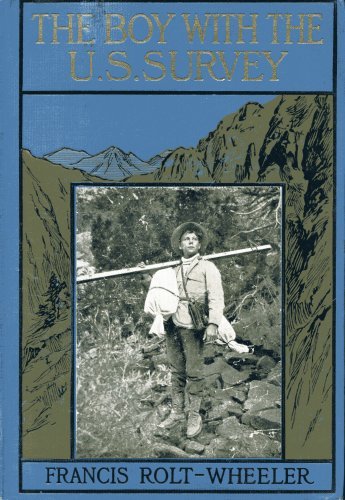
The Project Gutenberg eBook of The Boy With the U. S. Survey
Title: The Boy With the U. S. Survey
Author: Francis Rolt-Wheeler
Release date: November 29, 2010 [eBook #34497]
Language: English
Credits: Produced by Steven desJardins and the Online Distributed
Proofreading Team at http://www.pgdp.net
The Chief Geographer of the United States, Surveying the Sierras, with Assistant Topographer.
U. S. SERVICE SERIES.
THE BOY WITH
THE U. S. SURVEY
BY
FRANCIS ROLT-WHEELER
With Thirty-seven Illustrations from Photographs taken by the U. S. Geological Survey
BOSTON
LOTHROP, LEE & SHEPARD CO.
Published, August, 1909
Copyright, 1909, by Lothrop, Lee & Shepard Co.
All rights reserved
The Boy with the U. S. Survey
Norwood Press
Berwick & Smith Co.
Norwood, Mass.
U. S. A.
To
My Son
ROGER ROLT-WHEELER
PREFACE
Just as manly, courageous, and daring work as has ever been done in the past still is being done, and adventures as great as the world has contained before are happening to-day in these United States. The difference is that while the explorer and adventurer of the past too often sought but personal glory in his exploits, these now are done in the name of and for the benefit of the American people.
The adventures in this volume, startling as they may seem, were recounted to the author by the very men who underwent them; slight details only being changed to fit them into the rapid sequence with which they have to be compressed in the pages of a book. This little company of "men who dare" are real beings, living a real life, and ennobling as well as enriching their country by their efforts. In the administration of this department, manliness, alertness, untiring industry, and unfailing courage are the prime essentials, favoritism is unknown, and every American boy and man has an equal chance.
The world is not yet all sordid and commonplace and the glamour of an undiscovered peril is not yet all worn away. To show the inner and the outer worth of the United States Geological Survey, as well as to depict the adventurous possibilities open to a lad of perseverance and spirit, is the intent and purpose of
The Author.
CONTENTS
| CHAPTER I | |
| PAGE | |
| A Start at the Capital | 1 |
| CHAPTER II | |
| A Tenderfoot Snipe-Shoot | 23 |
| CHAPTER III | |
| Fooling a Rescue Party | 44 |
| CHAPTER IV | |
| In the Giant Tule Swamps | 67 |
| CHAPTER V | |
| Peril in the Grand Canyon | 88 |
| CHAPTER VI | |
| A Lone Hand against Hunger | 109 |
| CHAPTER VII | |
| Saved by His Nerve | 130 |
| CHAPTER VIII | |
| The Land Where it Never Rains | 149 |
| CHAPTER IX | |
| A First-Class Bucking Mule | 172 |
| CHAPTER X | |
| Americans That are Forgotten | 190 |
| CHAPTER XI | |
| Where Primitive Justice Reigns | 210 |
| CHAPTER XII | |
| The Alaskan Trip Begun | 234 |
| CHAPTER XIII | |
| Wrestling with a Mountain Goat | 252 |
| CHAPTER XIV | |
| Breaking the Ice Jam | 268 |
| CHAPTER XV | |
| Facing Death in a Canoe | 290 |
| CHAPTER XVI | |
| Declaring War on Uncle Sam | 311 |
| CHAPTER XVII | |
| Clawed by an Angry Bear | 328 |
| CHAPTER XVIII | |
| Fighting Fire in the Tundra | 344 |
| CHAPTER XIX | |
| Racing a Polar Winter | 362 |
ILLUSTRATIONS
| The Chief Geographer of the United States, surveying the Sierras, with Assistant Topographer |
Frontispiece | |||
| FACING PAGE | ||||
| In the Home of the Kodiak Bear | 8 | |||
|
30 | |||
| In the Tamarack Swamp | 44 | |||
| A Tangle of Swamp | 54 | |||
| Measuring Stream Flow | 72 | |||
| Difficulties of Work | 76 | |||
| Dense Southern Palm Grove | 82 | |||
| Grand Canyon of the Colorado | 94 | |||
| An Awkward Country to Work In | 98 | |||
| "How in the World am I going to get up there?" | 108 | |||
| A Hard Point to Measure | 118 | |||
| Twenty-seven Miles from Water | 152 | |||
| In the Death Valley | 170 | |||
| Crossing a Swollen Stream | 176 | |||
| Bridged by "Double Tree" | 180 | |||
| If He Should Slip! | 186 | |||
| A Grim and Icy Barrier | 252 | |||
| A General View of Tyonok | 256 | |||
| Farewell to Civilization | 260 | |||
| Where an Eternal Gale Rages | 270 | |||
| Morning after the Blizzard | 278 | |||
| Resting after a Long Pull | 288 | |||
| A Short but Dangerous Rapid | 300 | |||
| Skinning a Caribou | 306 | |||
| The End of a Hard Climb | 310 | |||
| The Only Bit of Rock for Miles | 314 | |||
| In Icy Water under a Burning Sun | 348 | |||
| Thus Far with the Boats, and no Farther! | 354 | |||
| Winter's Threat Almost Fulfilled | 370 | |||
|
376 |
THE BOY WITH THE U. S. SURVEY
CHAPTER I
A START AT THE CAPITAL
"Mr. Rivers?"
The Alaskan explorer and geologist looked up from his desk and took in with a quick glance the boy, standing hat in hand beside the door, noting with quiet approval the steady gray eye and firm chin of his visitor.
"Yes?" he replied.
"I'm Roger Doughty," explained the lad sturdily, "and Mr. Herold told me that I should find you here."
"And what can I do for you?"
The boy seemed somewhat taken aback by the direct question, as though he had expected the purpose of his visit to be known, but he answered without hesitation.
"I understood from Mr. Herold that he had spoken to you about me. I want to go to Alaska."
"You mean on the Survey?"
"Yes, sir."
"Your father wrote to me some time ago that you would be coming. He said, if I remember, that you had been nominated one of the new field men under that college scholarship plan."
"I think I am the first, Mr. Rivers," answered Roger with a smile.
"Sit down," said the elder man; then, as the boy hesitated, "just put those books on the table."
The table in question was covered with an immense map showing the vast unexplored and unsurveyed regions of Alaska, that far northern portion of the United States which is equal in size to all the States west of the Mississippi and north of Mason and Dixon's line.
"Mr. Herold spoke of the plan to me," continued the explorer, "but he gave me few of the details. Tell me, if you can, just how the project is to be worked."
"I don't know for certain, Mr. Rivers," replied the boy, "but so far as I can make out, it is this way. You see, Mr. Carneller gave a large fund to get some special boys into the government bureaus to give a chance for the upbuilding of the personnel while still young, and this plan was indorsed in Washington. The scholarship paid everything for two years and gave the usual two months' vacation beside, giving also a liberal allowance for personal expenses."
"And you say this plan is now proceeding?"
"I heard that it was to be tried this first year only in two or three schools. I guess I was lucky, because they started out with us."
"But how does your father like the idea of your roughing it? In the days when I knew him, he believed in keeping his boys near home."
"He wants me to stay, but, you see, Mr. Rivers, I always wanted to get out and do something, and city life isn't what it's cracked up to be. I want to be doing things worth while, things that will tell in the long run, and this poking over columns of figures in a stuffy office doesn't suit me worth a cent when I'm just aching to get out of doors."
The explorer's grave expression relaxed into a half-smile at the boyish but earnest way of describing the feeling he himself knew so well; but he felt it his duty to put bounds to that enthusiasm. Before he could speak in protest, however, Roger continued:
"I know what you're going to say, all right, Mr. Rivers. I know there's just as good work done nearer home as there is far away in Alaska or the Bad Lands or any of those places, but why can't that work be done by the fellows who like to hang around towns? I don't, that's all, and the whole reason I went in for that scholarship and won it"—these last words with an air of conscious pride—"was just so that I could get into real and exciting work."
"If it's work you're after, you've come to the right place, Doughty," was the prompt reply, "but it's more laborious than exciting."
"Why, I thought it was full of excitement!" exclaimed Roger.
"Not especially. The work follows a regular routine on the trail, just as it does anywhere else. It isn't so much the ability to face danger that counts in the Survey, as it is the willingness to do conscientiously the drudgery and hard work which bring in the real results."
"No getting lost and wandering over frozen tundra until nearly at the point of death, and then being rescued just in time?" asked the boy breathlessly, his mind running on an exciting book which had occupied his thoughts a few hours before.
"No!" The negative was emphatic. "The Alaskan parties are composed of picked men, all of whom have had considerable experience and who don't get lost. And if, by any chance, they are late in getting into camp, they know how to shift for themselves. Besides, the chief of the party is ever on the alert for the welfare of his men."
"But aren't there really any snowslides, or rapids, or forest fires, or bears, or anything of that sort?" cried the boy in a disappointed tone. "Surely it isn't as tame as all that?"
"I wouldn't go so far as to call it tame," responded the head of the Alaskan work; "no, it's not tame, but you can't expect a different adventure three times a day, like meals. We don't go out to find adventures, but to do surveying, and are only too thankful when the work goes ahead without any interruption. But of course little incidents do occur. I was considerably delayed in scaling a glacier once, and you're bound to strike a forest fire occasionally, but things like that don't worry us. Rapids are a daily story, too, and of course there are lots of bears."
"Lots of bears!" exclaimed Roger, his eyes lighting up in the discovery that the days of adventure had not yet all passed by, "have you ever been chased by a grizzly bear?"
"Worse than that!" The old-timer was smiling broadly at his would-be follower's interest, being roused from his customary semi-taciturnity by the boy's impetuous enthusiasm. "I thought a Kodiak bear had me one time."
"Worse?" The boy leaned forward almost out of his chair in excitement. "Is a Kodiak bear fiercer than a grizzly? Do tell me about it, Mr. Rivers!"
"Oh, there wasn't much to it, I got away all right." Then, with intent to change the subject, he continued, "but about this desire of yours to go to the field——"
"Please, Mr. Rivers," interrupted Roger, his curiosity overcoming his sense of politeness, "won't you tell me about the bear?"
The bushy brown eyebrows of the explorer lowered at the interruption, but the boy went on hastily:
"I've never met any one before who had even seen a real bear loose, much less had a fight with one. I don't want to seem rude, but I do want to hear it so much."
"You are persistent, at least, Doughty," answered the other, with a suspicion of annoyance in his manner, "but sometimes that's not such a bad thing. Well, if you want to hear the story so much I'll tell it to you, and perhaps it may show the sort of thing that sometimes does come about on the trail. It was this way:
"Some four years ago, the Survey sent me on a trip which included the mapping of a portion of the foothills of the Mt. St. Elias Range. It is a rugged and barren part of the country, but although rough in the extreme, no obstacles had been encountered that hard labor and long hours could not overcome. It was a packing trip and everything had progressed favorably, there was plenty of forage, the streams had been fairly passable, and we feasted twice a day on moose or mountain sheep. For days and weeks together we had hardly been out of sight of caribou. They had a curious way of approaching, either one at a time or else in quite large bands, coming close to the pack-train, then breaking away suddenly at full gallop and returning in large circles. Even the crack of a rifle could not scare them out of their curiosity, and we never shot any except when we needed meat.
"One day I got back to camp with the boys a good deal earlier than usual, somewhere about four o'clock. We had started very early that morning, I remember, trying to gain a peak somewhat hard of access. It was difficult enough, so difficult in fact, that the trial had to be abandoned that day, as we found it could only be approached from the other side. Of course our arrival sent George, the camp cook, into the most violent kind of a hurry. He mentioned to me, as I remembered later, that he had shot at a Kodiak bear somewhere about noon, and though he had found tracks with blood in them, he did not believe that he had wounded the bear sufficiently to make it worth while to track him. But George was hustling at top speed to get dinner, and no one paid much attention to him, I least of all, for I was trying to figure out the best way to climb that peak next day.
"After dinner, it was still early, and as I was anxious to get a line on the geology of the section, in order to determine how far the volcanic formation of the Wrangell mountains intrudes upon the St. Elias Range, I thought an hour would be well spent in investigating. I was not going far from camp, so, as it chanced, I took nothing with me but my geological hammer. About a mile from camp I found a sharp ravine, and I wanted to see whether the granodiorite, which I could see in the walls of the ravine, extended its whole depth. I scrambled down into the ravine, making observations as I went, until the cleft ended in a sort of dry lake bed, shaped like a deep oval saucer. Steep declivities ran upward from the rim of this depression in every way but two, the ravine down which I had come and a creek bed running to the south. Being desirous of tracing the origin of this unusual configuration, I scrambled to the edge, breaking through a clump of bushes on my way.
Photographs by U.S.G.S.
In the Home of the Kodiak Bear.
The pack-train on its way to the camp, where chief of party narrowly escaped death.
"As I did so, I was startled by a deep and vicious growl which seemed to come from my feet, and before I realized what the cracking of the brushwood meant, the cook's story came back to me, and I broke for the ravine. I was too late! There, in the path down which I had come, his muzzle and paws red with the blood from the deep flesh wounds he had received, and which he had been licking in order to try to assuage the pain, stood an immense Kodiak bear. The Kodiak is not as ferocious as the grizzly, but this beast was maddened by the pain of his wound, and by the suspicion that I had followed to work him further ill. My slight geologic pick was of no avail against the huge brute, my road of escape was cut off, and the bear was advancing, growling angrily. I broke and ran for the rim of the lake, hoping to be able to encircle it and return to the opening of the ravine by which I had entered, and as I ran I heard the bear charge after me.
"At the edge I paused, but there was no path along the former beach, and having no alternative I slid down the debris into the lake bed. Blind with rage the bear followed, and for a moment he seemed to have me at his mercy. A hundred yards further on, however, some slender bushes grew out of the shelving bank and with the bear but a few yards behind I leaped for these. Had I missed my grasp, or had they been torn from their slender rooting the story would have ended right there. But they held, and I reached the level of the old beach, leaving my pursuer momentarily baffled below. I lost no time in reaching the ravine, and I think I pretty nearly hold the speed record in Alaska for that half-mile back to camp."
"And the bear?" queried the boy.
"I'm on the Geological Survey, not in the wild animal business," was the ready answer, "and I left that bear alone. I never hunt for trouble."
"And shall I see those bears if I go up with you this summer?" asked Roger.
"Likely enough you will see them if you go up to Alaska, but that will not be this summer."
"Why not, Mr. Rivers?"
"That work needs trained men, as I told you, and you know nothing of the Survey yet. Besides, you will be sent where Mr. Herold thinks best, not where you prefer to go."
"And I had hoped to see Alaska this summer!" cried the boy dejectedly.
"That could not be in any case; all the parties have started already," replied the older man. "You see, in order to make use of every day of the short Alaskan summer, the men start early in the spring when a long trip is planned, so that they will be at the point of start when the break-up comes."
"Then I am too late after all!" said Roger, with the most acute disappointment.
The experienced Alaskan explorer smiled.
"Doughty," he said, "you should realize that you could not possibly have gone up with us this year. Minutes are too precious on the northern trails to spend any of them teaching the routine of camp life or the duties of the Survey. We take absolutely no men who are not experienced. But, besides that, this year would not be the one in which you would wish to go, since the parties now up there are surveying small sections of territory to fill up gaps in the more populated areas."
"Then there is no chance for me?"
"Not this summer. But Mr. Herold did tell me that he had seen you, and perhaps there may be an opportunity later for you to get into the Alaskan work."
Roger bent forward eagerly to find out what was coming.
"If, therefore, you make good in the Survey during the coming year, I might take you with me next summer, in what is going to be one of the most interesting Alaskan trips ever undertaken, wherein I am going to make a reconnoissance of Alaska from south to north, beginning at Cook Inlet and working through to the Arctic Ocean. It will be my personal party, and because the distance is so great it will have to be a forced march every day without a break. That needs toughness, and of course I know nothing of your powers of endurance. One weak man in the party, you see, might delay us so that we would not reach the Arctic until after the freeze-up and then there would be no getting out."
"I may not be very big, Mr. Rivers," said the boy with a conscious gesture, "but I strip well."
The echo from the athletic field sounded strange in that office so full of the actualities of life, and even Roger himself laughed at the way his words sounded.
"I mean," he added, "that I was always able to do good track work and had lots of wind."
"You need more than that. You need muscle and grit. I think you'll do, Doughty," the explorer continued, "but if you want the chance of going with me next spring, you've got to make a reputation for yourself in the Survey. Learn your business as a rodman and so forth, become able to pack a vicious mule, know how to swim an ice-cold river with a six-mile current, get so that you can swing an ax and build a bridge, be an expert canoeist in a boiling rapid, sit anything with four legs that ever was foaled, accustom yourself to sixteen hours on the trail and to picking out the soft side of a rock to sleep on, grow to like mosquitoes, and by that time you'll be about ready for the Alaskan trail. But it's no job for a weakling."
"Those are just the very things I want to be able to do," answered Roger.
"I suppose you think because those seem to imply adventure that it will be all very pleasant in the learning, but there is another factor involved. We can find a hundred boys and men who are ready to face danger and hardship to one who will face the drudgery of every-day existence at the desk or in the field. It is not the shooting the rapids which is difficult, but it is the days of heart-breaking toil in packing around the rapids that test the man. Physical courage has ever been one of the cheapest of commodities, and if we needed only this in our work, it would not be so difficult to fill the ranks with the kind of men the work demands. My own experience would lead me to believe that what we need in the Geological Survey is the 'staying' rather than the 'dashing' qualities. And you must remember that even if you do come with me next year, there's no pull in it to bring you a sinecure, the chief of a party has entirely a free hand in the selection of his assistants, and their value for the work is almost the only consideration. If you come, it will be practically as a camp hand, just to do what you're told, whether it is what you want to do or not. Work on the Survey needs backbone."
Roger's jaw set hard.
"You can enroll me on that party of yours, Mr. Rivers," he said with determination, "and I'll be with you to the last ditch. I'm not altogether a city boy, I've roughed it a good deal, and by the time you're ready to start I'll be as hard as nails. I don't care what trouble it takes, I'm bound to go!"
The older man rose from his seat and put his hand on the boy's shoulder.
"You've the right spirit, Doughty," he said, "and I expect I'll be able to take you. You'd better go down and see the Director and he will get you started, so that you can begin to get ready to come with me next spring. No, on second thoughts," he added, "I'll go down with you myself."
Chatting pleasantly, the two took the elevator to the second floor of the Survey building, where was located the Director's office, and as John, the old colored hallman, told them that the chief was engaged, Rivers led the way into the big room, where Mitchon, the Director's secretary, had his desk.
"Well, Roger," said the latter, for he had met the boy before he had gone up to the Alaskan geologist's office, "did you find out a lot of things about Alaska?"
"Quite a number, Mr. Mitchon," answered the boy.
"And are you still as anxious to go as ever?"
"More!"
The chief of the northern work put his hand on the boy's shoulder. Then, greatly to the secretary's surprise, for he knew how rarely Rivers could be got to talk, the geologist recounted with gusto his endeavors to dissuade the boy by representing the hardships of the trail and how each successive obstacle had but deepened the lad's purpose; and when he told of Roger's determination to acquire in a few months all the accomplishments and virtues of an old-time woodsman, Rivers's short and infrequent laugh found vent.
"And I tell you what, Mr. Mitchon," he concluded, just as two visitors entered the room, "that's the kind of boy these United States want!"
On seeing the Director and his guest, the secretary, who had been leaning back in his swinging chair listening with great amusement and zest, sprang to his feet, but before he could say anything the visitor broke in with warm, enthusiastic tones.
"And that's the kind of lad I like to know. Shake hands, my boy, and tell me your name."
"Roger Doughty, sir," answered the boy, wincing a little under the grip.
"The first of the Carneller nominees," put in the Director.
But the guest had turned, and after greeting the secretary, spoke to Rivers, who still had one hand on the boy's shoulder.
"I think I met you with reference to Alaska," he said readily, "but I do not recall your name."
"Rivers, Mr. President," answered the geologist.
"Mr. President!" Roger felt almost suffocated with joy at hearing that this praise of him had come direct to the ears of the President of the United States.
"I am delighted, Mr. Rivers, delighted," said the President, "to have this opportunity of seeing you again, and to hear you approve this new plan so heartily."
"I didn't approve of it at all, Mr. President," answered Rivers with characteristic abruptness, "but this boy has converted me."
"Tell the President the story, Mr. Rivers," suggested Mitchon.
"I had been pointing out to the lad," accordingly said the geologist, "how exceedingly strenuous is the work on the Alaskan trail, how that none but picked, experienced men of iron constitution and frontier powers of endurance could carry out the work, and how one weak man in the party might cripple the entire season's trip."
The President nodded.
"That is absolutely true," he said; "that is why so many hunting trips are failures when there is a large party along. But I interrupt."
"So I urged that he must get a reputation before coming with me. As far as I can remember, I said to him, 'You must first learn your business as a rodman and so forth, be able to throw a diamond hitch over a vicious mule, climb a peak with no firmer hand-hold than your finger-nails will give you, learn to swim a glacier-fed river with a six-mile current, ride any brute that ever was foaled, run every kind of rapid in any sort of a canoe, find out how to swing an ax and build a bridge, be able to find your way over the most rugged country in the vilest weather or on a pitch-black night, get used to sixteen hours on the trail, and to picking out a soft rock to sleep on, chum up with grizzlies and grow to like mosquitoes, and by that time you will be ready for the Alaskan trail.'"
The President burst into a hearty laugh, and said,
"That ought to have settled him!"
"Hm! Settled him! He just said, 'You can enroll me on that party of yours,' and by all the powers, I will."
"You're right," said the President emphatically, "and I say to the workers of the Survey, as I said to another band of workers once, that it is a good thing that there should be a large body of our fellow citizens—that there should be a profession—whose members must, year in and year out, display those old, old qualities of courage, daring, resolution, and unflinching willingness to meet danger at need. I hope to see all our people develop the softer, gentler virtues to an ever-increasing degree, but I hope never to see them lose the sterner virtues that make men, men."
Roger listened with all his ears, hoping that the President would turn directly to him. Nor was he disappointed. After some congratulatory words to Rivers on the value of the Alaskan work and the ability displayed in its direction, he turned to Roger.
"My boy," he said, "you are starting out the right way. You are the first of a little army of workers who shall help to win the victories of peace. You have a nobler mission than that of preserving a fine tradition unspotted, you have the rare honor of making the tradition. Be manly and straight, give a square deal and never be afraid of hard work, and make for yourself and for those who shall come after you a record worthy of inclusion in the annals of the Geological Survey of which we are so justly proud."
He shook hands with Roger again, and bowing to Rivers and Mitchon, went on his way with the Director. For a moment no one spoke, both men watching the boy keenly. Suddenly the look of solemnity and attention slipped from his face, and stepping forward unconsciously as though to follow, he burst out:
"He's fine! Oh, isn't he just bully!" Then he caught the secretary's smile, and he checked himself. "And wasn't he just kind to me! Oh, Mr. Mitchon, how can I thank you, and you, Mr. Rivers. I have wanted to see the President for years and years, but I never dreamed of seeing him close, like that, and talking to him, except at some public reception, which would seem altogether different."
Tears of pride and joy stood in the lad's eyes, and he choked, unable to go on. The men were touched by the boy's intense patriotism and emotion, and then the secretary said softly:
"That, Roger, will be something to inspire you and make you stronger in all the hard moments of your life. The greatness of the President," he continued, "lies in his power to make greater all those with whom he comes in contact."
"I could never forget it," replied Roger in a low voice.
"And now," resumed Mitchon, "I may tell you that we were sure Mr. Rivers would not advise you to go to Alaska this year, and Mr. Herold told me to take you to Mr. Field, who has charge of the swamp work in Minnesota. You will go out with him as soon as he opens field work, which, I presume, will be next week."
Rivers then turned to the boy.
"Doughty," he said, "probably I shall not see you again until next autumn, when I come back from an inspection of the Alaskan camps, but I don't want to lose track of you. Write to me here, at the Survey, at least once a month, and they will forward my letters. I will not add anything to what the President has said, because I think no more is needed, but I will say that if you make good as well as you promise, I shall be glad to have you in my party. Not," he added, as an afterthought, "because of your scholarship or any friendships you may possess, but because I think you will be willing to work hard and do your best."
"My word," said the secretary with a whistle, "that's a lot—from you."
"It is," answered the geologist, shaking Roger's hand heartily, and leaving the boy alone with Mitchon.
"And now, Roger," said the latter, "I will take you where you can begin to acquire that large stock of experience."
CHAPTER II
A TENDERFOOT SNIPE-SHOOT
"What do you think of a man," said Mitchon to Roger, as they started for Field's office, "who can transform a festering tamarack swamp into a busy and prosperous farming country?"
"He must be a daisy," answered the boy emphatically.
"That's what Mr. Field has done in the last couple of years, and that's what you're to spend the next few weeks in doing. The Survey works for results, and if turning square mile after square mile of rankly timbered bog into a fertile region dotted with busy homesteads isn't getting results, I don't know what is."
"But how is it done?"
"By drainage, my boy, as you will learn. Hundreds of thousands of acres are being reclaimed. That's what makes a country rich; it isn't the gold stored in vaults, but the gold waving on the fields at harvest time."
"But it must take an awful lot of work."
"Of course it takes work. Don't you remember Mr. Rivers told you that there would be no chance to loaf? You'll start on that toughening process soon enough, all right, all right."
Turning a corner of a hallway, Mitchon and the boy passed into a small office, which was undergoing the throes of the annual tidying-up before being left alone all through the summer.
"Mr. Field," said the secretary, as he entered, "this is Roger Doughty, of whom I was speaking to you, who is to go out with you for a couple of weeks until Roberts comes back from the tule swamps and rejoins your party. You will have just about the same men as last year, will you not?"
The swamp surveyor extended a large loose-jointed hand to Roger.
"Glad to see you, Mr. Doughty," he said, and then, in answer to the secretary's question, continued, "I hope we do have the same men, Mr. Mitchon, it makes the work a lot lighter."
"That's what you all say; but it doesn't make so much difference to you as it does to the parties away off from civilization, does it?"
"Well," drawled the other, "Minnesota's civilization in that swamp country doesn't hurt her much yet, I reckon. When you're eleven miles away from the nearest road, and that only a 'corduroy,' in a swamp over which you can't take a horse, and through which you can't take a boat, you begin to think that other human beings live a thundering way off. Why," he said, "I've seen parts of that swamp so soft that we'd have to make a sort of platform of brush and three or four of us pull out one chap who had sunk below his waist, and that with only half a pack instead of the full load. No," he added, turning to Roger, "Minnesota's not so powerful civilized if it comes to that!"
"Why, I hadn't any idea that it was so wild! Is there much of that swamp?" asked the boy.
"Well, the little piece of land we're working on now contains about 2,500,000 acres."
"That's the Chippewa land, isn't it?" asked the secretary.
"Yes, all of it."
"What's Chippewa land?" queried Roger.
"It's land the Chippewa Indians ceded to the government to be held in trust and disposed of for their own benefit. It's worth just about nothing now, but when the land is all drained it'll be a mighty valuable section of the State."
"I saw a report on the crops from some of that reclaimed land," said Mitchon, "and it certainly was calculated to make the worked-out Eastern farms sit up. Well, I suppose I must get back, so I'll wish you good luck, Roger, if I don't see you again. You start soon, do you not, Mr. Field?"
"To-morrow morning."
"So soon? That means hustling."
"No, Mr. Mitchon, everything's ready, I reckon."
"Well," replied the other, "I hope you'll have a pleasant summer, and, Roger, you write and let me know how you like it. Good-by." But he had hardly gone three or four steps from the door when he turned back suddenly and said, "By the way, Roger, there's something I wish you would do for me."
"I'll be only too glad, Mr. Mitchon, if I can," answered the boy readily, eager to show his appreciation of his friend's kindness.
"That's a great snipe country you're going to, and I'm very fond of snipe. I wish you would send me a couple of brace. You organize a snipe-shoot while Roger's with you, won't you, Mr. Field?"
"Well, I'll try, anyway," answered the surveyor, "and we'll do the best we can to give you a feast."
Mitchon nodded and disappeared down the hall, and Field turned to the boy.
"Roger, your name is, isn't it?" he said.
"Yes, sir."
"Mr. Mitchon seems to think you're quite a shot."
"I've done a little shooting, Mr. Field, but I wouldn't like to call myself a crack shot."
"That's all right. Much better not to brag. If Mr. Mitchon wants snipe we'll go out some night and get him so many that he won't know what to do with them."
Roger's eyes glistened at the thought of a night shoot in a country where birds were so plentiful, and he began to congratulate himself that the Survey was just as good as he had expected, and even better.
"Now, son," said his new chief, "what kind of an outfit for the field have you got?"
The boy ran rapidly over the somewhat elaborate stock he had laid in for rough work, and when he came to describe the various shotguns and rifles with which he was provided he dwelt on them in detail, as it had been that part of his outfit in which he had taken the most interest, and in the completeness and excellence of which he felt great pride. But to his annoyance, instead of seeming impressed, the older man chuckled.
"You've got shooting irons enough for a regular stage brigand," he said; "you won't need all that truck, at least as long as you're with me. Take a shotgun, yes, and you can take a revolver along if you want to very much. You've been thinking more about your guns than you have about your boots, though, and you'd better go down and get a pair of river-drivers' boots this afternoon. Ones something like these." He pulled out of a drawer a special catalogue, and opening it, passed it to Roger.
"I've got a regular pair of fisherman's boots," volunteered the boy, "the kind that come 'way up to the hips. I should think they'd be just the thing for swamp work."
The surveyor shook his head,
"No," he said, "that sort of thing won't do. Water and mud will get in those. These others lace up tightly. Of course you'll be wet higher up most of the time, but as long as your feet are tolerably dry, that doesn't matter. Now you get those and do anything else you want,"—then handing him a map—"you'd better look over this too; and meet me at the Union Station to-morrow morning at 8 o'clock, and we'll take the 8.20 for Red Lake."
The trip out to Minnesota was the most enjoyable railroad journey Roger had ever spent. His leader proved as entertaining a companion as a boy need ever meet, and his stories of the wonders of the water power of the United States were more fascinating than any story of adventure.
"I was out in the dry part of South Dakota, one time," he said, "when some people, knowing that I was on the Survey, asked me to locate an artesian well site for them. That was a dry country, I reckon. Why, the little water that was there was so ashamed of itself that it tasted bad. Well, after I had studied the lay of the land for some time, I told them where to sink the well. It was an unlikely looking spot, I'll admit, but I knew there was water there if they would go down deep enough."
"But how did you know," asked Roger. "Did you use a divining rod?"
"I'm not a seventh son of a seventh son," said the older man with a laugh. "No, indeed, that sort of thing is done to-day by science, not by magic. You see, Roger, water will always be found in large quantities in porous rocks like sandstones, and none at all will be discovered in what are called impermeable rocks like shale and limestone."
"Why not?" asked the boy, interrupting.
"Because a porous rock is like a sponge, and will hold the water, and an impermeable rock isn't. So, you see, if a thick bed of shale is underlaid by a thick bed of sandstone, you are pretty sure of getting water if you drive a well through the shale."
"But I don't see how that helps," interjected Roger; "it seems to me it would be as hard to tell that there was sandstone so far below ground as to tell that there was water there. You can't see through rock!"
"No, my boy, but if you know the general make-up of the country, and how the rocks lie in the nearest mountains and in the ravines and so forth, you can tell. For example, if a river bed has been cut through the upper shale to the sandstone and through the sandstone to some other rock beneath, you are sure to find that sandstone under that shale everywhere, until you strike a place where geology will show that there has been some other change. In this particular case, the sandstone and the limestone appear in successive layers in the foothills of the Rockies, so that the water and snow from the mountains drains into the sandstone layer, which, being between two strata of harder rocks, can't sink any further down, but must force its way through the pores of that sandstone as far as the stratum runs. Of course things come up to complicate that, but such is the general plan.