
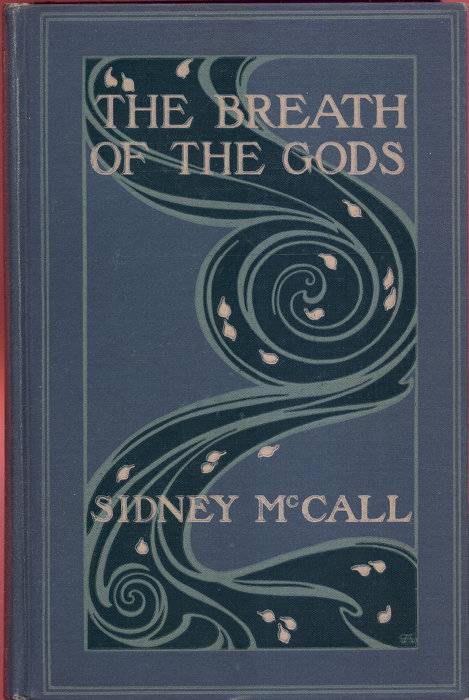
The Project Gutenberg eBook of The Breath of the Gods
Title: The Breath of the Gods
Author: Sidney McCall
Release date: March 18, 2013 [eBook #42365]
Most recently updated: October 23, 2024
Language: English
Credits: E-text prepared by D Alexander, Ernest Schaal, and the Online Distributed Proofreading Team (http://www.pgdp.net)
The Project Gutenberg eBook, The Breath of the Gods, by Sidney McCall
THE BREATH OF THE GODS
THE BREATH OF
THE GODS
BY
SIDNEY McCALL
AUTHOR OF "TRUTH DEXTER"
BOSTON
LITTLE, BROWN, AND COMPANY
1905
Copyright, 1905,
By Little, Brown, and Company.
All rights reserved
Published May, 1905
THE UNIVERSITY PRESS, CAMBRIDGE, U. S. A.
BECAUSE OF FAITH AND REVERENCE,
AND IN SPITE OF ERRORS WHICH I KNOW TO BE
INEVITABLE,
I DARE INSCRIBE THIS BOOK TO
YAMATO DAMASHII
PREFATORY NOTE
No character in this book, belonging either to public or private life, is taken as a whole or in part from any person. The characters are wholly imaginary, and no incident is based on any real incident known to the writer. Even in the descriptions of official buildings, memory is laxly used. In the genre studies alone is realism attempted. Most, if not all, of the questions, remarks, and speculations put into the mouths of peasants and servants have been overheard by the writer.
THE
BREATH OF THE GODS
CHAPTER ONE
The stone dwelling of Senator Cyrus C. Todd, usually as indistinguishable from its neighbors as is one piano key from another, presented at nine o'clock on this night of November third, nineteen hundred and three, a claim to individuality in the excess of light pouring from every window, from the perpendicular wink of every opening door (opened but to close again as quickly); oozing, it would seem, from the very pores of the pale façade, thereby giving to the great flat rectangle of the house a phosphorescent value that set it six feet out into the night.
The upper windows shone more brilliantly than those below. A roller shade had been carelessly left high. Through the film of chamber curtains heads could be seen passing. Once, there was the outflung gesture of a slim, bare arm. Everything bespoke approaching festivity. At this brightest window a silhouette suddenly appeared, sharp, dark, complete. It was that of a Japanese girl with wonderfully looped and curved coiffure, shoulders that sloped tenderly, and a small, straight throat.
Just at this moment, on the shadowed entrance-steps below, answering silhouettes began noiselessly to climb. These were men with thin black legs, and strange burdens, black like themselves. They showed angles as of gnarled roots; one, the great curved body of a gigantic spider. The front door, opening instantly to a ring, disclosed them merely as musicians,—Signor Marcellini of Milan and his colleagues,—bearing basso, cello, and flutes, secure in swart cases.
The lower rooms of the house were slightly chill. Though flooded with soft light, they were not yet fully illuminated. All doors within stood open. It looked almost as if walls had been taken down, so long and mysterious had grown the vistas. Through all tingled an aromatic smell, something a little alien, like crushed herbs,—pungent, and full of vague suggestion. Mrs. Cyrus C. Todd, flowing now down the palm-set stairway in a purple tide of skirts, frothed with dim lace, stopped at a switchboard half concealed in vines, sent forth a gloved, determined hand, and in an instant the secret of the odor was revealed. The rooms, to their farthest angles, literally exuded chrysanthemums. Senator Todd was said to have expended five thousand dollars for these flowers alone. Perhaps he wished to stamp in gold upon the memory of Washington this coming-out party of his idolized, only child. The conceit was fair enough, for Gwendolen was bright, and blonde, and golden in herself. Statesmen and the wives of statesmen did not fail to observe that chrysanthemums were the insignia of official Japan, and that November third happened,—they emphasized "happened,"—to be the birthday of Japan's beloved Emperor. These two facts, joined with the third, that Senator Todd even now had aspirations to the Tokio mission, made a trio of keen angles to be used as wedges for further speculation.
The walls of the lower story had been spread for the occasion with yellow satin, upon which alternated delicate upright strokes of silver and of white. Around, under the ceiling, grew a frieze of living flowers. The great, coarse, woody stems crossed in a lattice-work, with clusters of huge blossoms and green leaves breaking the angles at points of decision possible only to a trained artist, or to a Japanese. The white duck floor-covering spread to a border hand-painted, to match the frieze. Where wall and canvas met, the real flowers again arose,—thick parallel stalks of differing heights, upholding a wainscot border of shaggy gold. Mantles were heaped with them. Japanese pots of them in bloom alternated with conventional ferns and palms. Each electric bulb jutted from the heart of a living flower. The very air had an amber tone.
Overhead, invisible footsteps scurried in short flights. They sounded feminine, young, full of excitement. "Heavens!" Miss Gwendolen de Lancy Todd was crying, "where on earth is my other glove? I am sure I just laid it here! And my orchids! Has anybody sat on my orchids? I think I'll have to marry the young person who sent them, though I forget now who it was!"
"A person of the name Dodge, n'est-ce-pas?" ventured the little French dressmaker, on her knees beside the fair white vision. Pins, retained at the corners of her mouth, added a crushed softness to the pronunciation. She rhymed it with "targe."
"Yes, a name like that, I believe," said Gwendolen, indifferently, and craned her long neck over. "Mother called him some sort of a snip. Are you certain that my dress hangs right now, Madame?"
"Oui, oui. It is perfection," declared Madame, sticking the remaining pins into the black front of her dress.
"Then at last I am actually ready. I believe there's mother calling now. Where did Yuki go? Oh, I see, over there by the window, as calm and cool as if we were going to church instead of to our first ball!"
"Then all my coolness is stopping on my outsides," said the Japanese girl, with a little incipient shrug and giggle, breaking at once into the merriest of low laughs. She crossed the room swiftly, with an unusual, swaying rhythm of movement. "Ah, Gwendolen, my heart it go like yellow butterflies to be downstairs."
Gwendolen turned a radiant face to greet her. "Now isn't she a vision!" cried the girl aloud, in fresh access of admiration for her friend. "Madame, what do you think those French painters of yours would say to her—Chavannes, De Monvel, Besnard,—who owe so much to Yuki's art?"
"You omit Monsieur Le Beau, who is a painter," said the little woman, shyly. She was on good terms with the girls, and had made Yuki, as well as Gwendolen, chic gowns with the breath of Paris upon them. "I knew well the family of Monsieur Le Beau in France," she hurried on, seeing the distressed flush in Yuki's face. "Non, non, Mamselles. I am a chattering old femme. Let me look at you together before you descend the stair." She sat back upon her heels to enjoy the picture.
"Yes," cried Gwendolen, "that's right. Take us both in." Laughingly she drew Yuki's arm, with its long, trailing sleeve of gray, tightly within her own. They rested together, swaying,—smiling,—Yuki's cheek still warm with the name of Pierre Le Beau, two types as far apart as the two sides of earth which had given them race.
Gwendolen was fair almost to the extreme of golden blondness. Her features were small and perfectly related; her nose deliciously interrogative at the tip. Her brows and lashes, drawn in a darker hue, gave touches of character and distinction. She was very slender, erect, and was poised as though she grew in the wind. The long tulle draperies shook and stirred as if vitalized by her energy. She was all white and gold. Her heaped-up skeins of hair, amber necklace, gloves, slippers, and stockings gleamed with a primrose hue, and the freckles on her orchids (poor flowers, just caught up hastily from an ignominious corner) repeated the yellow note.
Beside her, Yuki Onda, a few inches lacking in height, impressive, nevertheless, and held with a striking yet indefinable difference of line, smiled out like a frail Astarte. Her pallor had an undernote of ivory, where Gwendolen's was of pearl. Her head, with its pointed chin, bore, like a diadem of jet,—balanced, like a regal burden,—the spread wings of her hair. Beneath a white, low brow her eyes made almost a continuous, gleaming line. The little nose came down, straight and firm, with a single brush stroke. All the humanity, the tenderness, the womanhood of her face lay in the red mouth and the small, round chin. Her smile was startling, even pathetic, in beauty. Gwendolen had once said, "There is sometimes something in Yuki's smile that makes me want to fight God for her."
Yuki's robe, in deference to hours of pleading from Gwendolen and Pierre Le Beau, was Japanese to the least detail. Mrs. Todd had protested in vain for the "civilized" coming-out gown of white. The robe hung about the girl in long, loose folds of crêpe, mist-gray, rising in soft transitions from the dark band of the hem to pearl tones at the throat. Under it were garments of heavier silk, dawn-colored, showing like morning through thin clouds. Into the curdled substance of the crêpe, cherry-flowers were dyed, or rather, breathed in, by a smiling, wrinkled brown magician at the rim of Yuzen Creek,—pale shapes which glimmered and were gone, rose to the surface and sank again, as though borne in moving water. Besides the black note of her hair there was one strong crash of contrast in the obi, or sash, a broad and dominating zone, black, too, with fire-flies of gold upon it. For hair-ornaments she wore a cluster of small pink flowers that had the look of cherry-blooms, and a great carved ivory pin, pronged like a tuning-fork, an heirloom in her father's family.
"Gwendo—len! Yu-kee! Come down instantly!" rose the voice of Mrs. Todd. "You should have been down ten minutes ago."
"Ah, Madame Todd calls," exclaimed the dressmaker, scrambling to her feet.
"But you are sure you really admire us, Madame?" challenged Gwendolen, before she would stir.
"Oui, charmante, charmante, both are perfection apart—and a vision of paradise together. But go, young ladies, the good mother calls again."
The spoiled child stopped for another instant, this time in the doorway. "All right, mother. Coming this instant!" she hurled downstairs; then to the little Frenchwoman she said, "Do not attempt to sit up, Madame. Yuki is to stay all night, and will help me with the pins. After a glimpse at the reception and some of the goodies below, you must hurry home to your little Jeanne. Take plenty of bonbons with you, and I wish to send that great bunch of daisies, with my love. All children love daisies, n'est-ce-pas?"
At last they were off. Madame could hear Mrs. Todd, relieved, yet petulant, scolding them the whole descending scale of the stairs. Moving through the perfumed disorder of the room, Madame sought out the daisies, and, with filling eyes, whispered aloud in French, "Now may the good God be kind to that loving heart, and send to it only blessing."
Stockings, scarfs, fans, underwear,—a thousand dainty trifles must be gathered up before the little Frenchwoman could give herself consent to go. Madame and Miss Todd had been kind friends to the widowed exile.
Far over to one side of the room she stumbled upon a dark heap that showed gleams of a cherry-colored lining. It emitted, as if consciously, an aroma, subtle, faint, unforgettable, strange scented echoes of a distant land. It was Yuki's long black "adzuma-coat," worn from the Japanese Legation, where Baroness Kanrio and the maids had assisted her to dress, and which, in this bright room, she had slipped laughingly to the floor and forgotten. Madame held it out for a moment. Then she folded and laid it softly on the foot of the bed. Her expression had changed slightly. As if with relief, she snatched up a dressing-gown of blue flannel, that cried "Gwendolen" from every turquoise fold.
"Gwendolen, where is your father hiding?" demanded Mrs. Todd, severely, as the two girls reached the hall.
"Why, how should I know? Dad hasn't worried my mind. Isn't Yuki simply a dream of spring?"
"You forget that I have admired Yuki upstairs," said the harassed matron, and turned her back. "There's another carriage sounding as if it wanted to stop! Every wheel goes over my nerve-centre. Cy, Cy—rus! Where is that wretched man? The musicians should be playing now. The guests will pour in any instant. There is a carriage stopping! It has stopped! Heavens, I shall go mad!"
"Shall Yuki and I run for the drawing-room, mother?"
"Yes, yes, dear. Right under that tallest palm. Be sure to stand ahead of Yuki. Cyrus! Cy—rus! Oh, he is never anywhere when I want him." Her wails preceded her down the hall.
"Are you looking for me, dear?" asked the senator, innocently, strolling out in a leisurely manner from his study, where, against orders, he had been smoking a cigar.
"Am I!" panted his wife. "And you've been smoking!" But indignation must be swept aside. "The carriages are stopping, man! Don't you hear them? I'll be in bed for a month if I live through this night! Start up the musicians, and join us immediately in the front drawing-room."
"Musicians,—musicians?" murmured Cyrus, looking about, "where are the musicians?"
"Not under the hatrack, nor yet in my china-closet," cried his lady, with angry vehemence. "Over there! Yes, there—where you saw the piano wheeled this afternoon; behind that hedge of chrysanthemums!"
"Oh, yes, there in the duck-shooters' lodge. All right, old lady. I'll start 'em. Don't get excited!"
Guests now streamed upstairs toward the dressing-rooms. Signor Marcellini began his most seductive waltz; and the senator stood beside his heaving spouse just as the first smiling acquaintance crossed the door-sill.
"Ah, Governor! Ah, my dear Mrs. Jink!" chortled Mrs. Todd. "This is surely a good omen,—my daughter's first official congratulations to come from you. Gwendolen, let me present Governor Jink and Mrs. Jink, fresh from our own dear Western state. Miss Yuki Onda of Tokio, Mrs. Jink,—Gwendolen's most intimate school-friend, and my Oriental daughter, as I call her. Ah, Sir George! Punctuality is one of the British virtues. Mrs. Blachouse, my daughter, Miss Todd."
The reception swung now, full and free, into the sparkling waters of felicity. Laughter, lights, and the rustling of silken skirts on inner mysteries of silk; music held back by the multitudinous small sounds of human intercourse, with now and then a protesting wail from violins and the guttural short snore of a cello! Laughter, and the clink of glasses on metal trays, the scraping of spoons against porcelain, tinkling of ice in fragile vessels, and incessantly the shuffle of footsteps on soundless, unseen floors! Perfumes of dying flowers and foliage, odors of essences, fumes of fresh-cut lemons, and of wine!
Outside, at the curbing, a continuous roar and rattling of carriages went on. The covered entrance-way, like an elastic tent drawn out, sheltered a thin moving stream of faces. Behind them the scrape of wheels, stamping of horses, and vociferous bawling of drivers sent a premonitory tingling through the blood. At intervals there came the snort and hiss of that modern Fafnir, the automobile, followed by the nauseating taint of gasoline.
To Gwendolen and Yuki it seemed as if the line of visitors would never end. "Yuki, Yuki," whispered the former, "if they keep popping by like this, each with that wooden grin, I shall certainly go into hysterics! Did you see how nearly I broke down in the face of that last fat lady in tight gray sleeves? She looked like a young rhinoceros in its little sister's skin."
"I no longer perceive anybody at all," said Yuki, tranquilly. "I only see the small duck called 'oshi-dori' bobbing down, then up, on the Sumida River."
"Hush!" whispered Mrs. Todd, in evident excitement. "Here comes the Russian ambassador with his entire suite. I was wondering whether he would snub us because of the war-talk, and Yuki, and the chrysanthemums, and the Mikado's birthday! Now, girls, smile your sweetest!"
But the good lady was given a surprise. Yuki leaned back to touch her arm. At the look of irritated inquiry the Japanese girl said clearly, "You must excuse me from this, dear Mrs. Todd; I cannot shake hands with that person. If I shook, I would be the hypocrite." Without waiting for permission or remonstrance, she turned and hurried from the direction in which the Muscovites now approached. Mr. Todd, with hand already extended in welcome, saw nothing of the little by-play. Gwendolen heard, sympathized entirely with Yuki, but wisely held her peace. Mrs. Todd, after a gasp of outraged dignity, recalled herself, perforce, for the new greetings.
Yuki had slipped from the line quietly enough. She walked away now quite slowly and with apparent calm. Within, she was turmoil and distress. Had she done right? Had she offended, beyond forgiveness, her kind friends, the Todds? But, looking from the opposite point, how could she touch, even in social insincerity, the hand of a man whom she felt by instinct to be a subtle enemy of her native land? This very minister was suspected by many to be one of the strongest who urged the weak Czar into insult and hostility. Would Mrs. Todd reprove her publicly? Would Baron Kanrio, when he heard, defend the childish impulse?
A greater one than Kanrio would soon be here. In the agitation of the moment she had forgotten that tremendous fact. Prince Haganè, her father's feudal lord, or daimyo, often called the "Living War-God of Japan," was to come, for a few moments, to this reception, and partly because of her. A Japanese, no matter how great, seldom neglects the privileges of humanity. Yuki's parents had written that the Prince was to see her, and deliver news. What would he say now,—what would her father say,—if told of this rude and un-Japanese yielding to a personal distaste? "Yet," muttered Yuki to herself, through small clenched teeth, "even should Lord Haganè himself command me, I think I would not touch that Russian's hand."
Moving forward slowly, but always in a straight line, she came full against a small white surface on a level with her face, a thing shield-shaped, and framed in black. It did not move aside for her, as similar white patches, vaguely seen, had done. Brought up suddenly, she realized it to be a shirt-front, and presumably behind the shirt-front there must be a living man.
"Oh, beg pardon!" she faltered, shrinking back. "I begs much pardons, sir."
Two eager hands caught her own. A gay, low voice said, laughing, "I have watched your coming. I willed it. How straight you sped, you beautiful, strange bird!"
But Yuki, dazed for the moment, did not answer. She panted slightly, and tried to draw her hands away.
"I have waited here, by the conservatory door. You must be tired with standing. Come in with me, and rest."
Still unable to command herself, she let the speaker lead her into the warm shadows. She hoped he had not seen her rudeness to the Russian minister. Mrs. Todd swept round an angry glance just in time to see them disappear.
Pierre Le Beau found a sheltered seat, and gently, yet in a masterful way, forced her down beside him.
"Oh, Yuki, but you are beautiful to-night! Was I not mad enough with love without this new gray snare of mist, these blossoms drifting along an irresistible tide? It is a lifetime since I have seen you."
The beating of the girl's heart slowly slackened. "The lifetime of a flower, then," she said, smiling upward. "It was but last night, you know, when we all work so hard with the decorators and the chrysanthemums."
"Last century!" he laughed. "I really exist only in the moments when I am with you. All else are dungeon hours, locked with your last 'Good-bye.' Do not shrink from me now, darling. Let me hold you in my arms once this wonderful night."
"My hair you will disarrange, and others notice," she pleaded, holding him back with one white hand. "And, dear Pierre, you rumples my mind more than my hair. I must be calm to-night, and cheerful with many. I am the débutante."
"You are hard to win," said Pierre, "but I believe I like it so. Your Japanese etiquette is a thorny hedge. More than once I've torn my soul upon it. Ah, but even that could not keep me quite away. You struggled hard, you elf of pearl and mist, but at last you said you loved me,—that you wished to be my wife."
He brushed away the hand and caught her. She gave a little shuddering movement in his arms. "That was a terrible, bold thing for a girl of the samurai class to say. My heart shake a finger at me yet, that I have confessed so immodest a thought. I should hereafter be very circumspect with you, to pay for that bad thing!"
"Circumspect!" laughed Pierre. "Yes, we shall both be circumspect like this,—and this!" She wrenched herself from his kisses, and stood upright in the narrow path. "No, Pierre; I mean it. Please do not do such things, or my frightened spirit never will return. I must go to Mrs. Todd; I fear she is angered."
"Angered,—with you?" asked Pierre, arrested by the sincerity of the girl's protest. Yuki turned her head away. Suddenly he recalled the Russian minister's approach, and connected it with Yuki's flight. He stared at her averted countenance. "Yuki, did you leave your friends,—would you offend them,—rather than greet the Russian ambassador?"
"Yes," whispered Yuki, trembling.
The radiance of Pierre's face went out, his head sank. "So that was the reason. You would not touch a Russian! As you know, my mother is a Russian."
"Oh, it is not all Russians! Do not think that I would wound you. Many are good. Mr. Tolstoi, Mr. Wittee, your honored mother, too, I am sure. They hate, as we, the tyrants that wish to crush the people, and to bring on this cruel, unjust war. I saw the petals of our Emperor's flowers shrivel as he passed them by! I, too, would have shrivelled,—my soul would have turned black,—at his breath."
"No war will come!" cried Pierre, vehemently. "I have told you this before. I know it from the inside. There will be no war. Your country will not face Imperial Russia!"
"If those bad ones push us just too far,—if they delay replies, and provoke us just a little more,—Nippon will fight, and I think that God will let us win!"
"Your Christian God must side with Russia. He cannot aid a nation that does not believe in him!" Pierre's eyes held curiosity and a challenge.
Yuki turned slowly to him, answered the look with sombre brooding, and then stared upward to where close moisture of the high glass dome curved space into a frosted shell. "Perhaps, though," she said, pausing between each word, "the Christian God—believe—in—us!"
Before his surprise found vent her mood and tone had changed. "But, no, no, Pierre; we talk no more of tragic things this night, not of war, and hate, and destiny. It is our ball, Monsieur Pierre Marie Le Beau,—I begs you to remember that. And me and Gwendolen are now in society. I am in society,—is it not nice? Come, let us return to society at once." She caught his arm, laughing, and tried to urge him from the bench.
"You witch of moods!" said Pierre. "Are other Japanese girls like you? When I hold you closest, then do you seem most far away. I seize you in a thousand tantalizing forms, only to fear, each time, that never yet have I seen the real Yuki. Ah! take me to your land, my love, and make me one with it. What do I care for war, for Russia, even for France, if once I could believe you entirely my own? You know I am fighting hard to sail with you next spring. The French ambassador here gives me much hope, and in France my relatives are working."
"Yes, yes, we shall go together on that great ship," said Yuki, soothingly, "and together we shall seek my dear parents, and ask them for our happiness."
Pierre's face lighted. "But you will be true to me no matter whether they give consent or not?" he cried. "Swear it, Yuki."
"I will be true to you, Pierre," said Yuki. "You wish to hear that many times, do you not? But I cannot say I will marry you without their consent. But they are kind—they must like you, Pierre." She flushed delicately. "We—we will make them to say 'yes,' Pierre."
Still the young man hesitated. "This condition that you hold so stubbornly is our menace," he began. "I don't urge you to marry me at once, without their good wishes, only to promise that, after trying in every way to gain them, you will take your life into your own hands and come to me."
"Why do we fret and worry about such things so far away? You will take from me all joy of our party. Will you not return to the room with me?"
"No," said Pierre, seizing a hand in his, "I shall hold you until this is a bit more clear. No, Yuki—"
"Yuki,—Yuki!" came a cautious voice, an echo, it seemed, to Pierre's last word. "Where are you? Mother has sent me here. Prince Haganè asked for you. She says to come at once."
"Let my hand go. I must hurry. It is Prince Haganè," whispered Yuki, and, slipping deftly from Pierre, she hurried to join her friend. He followed quickly, stopped in the doorway, and stood there, scowling.
The crowd had thinned. He could see the heads and shoulders of the two girls moving and whispering together as they sped. Beyond them, surrounded by his suite of glittering officials, Spanish-looking men in broadcloth and gold lace, rose the dark, impressive figure of Prince Haganè. He was in the dull silken robes of his own land, unornamented but for a single decoration,—the highest that a Japanese subject, not a prince of the blood, had ever received.
Pierre's first thought was an inconsequent one of childish irritation that the man bore no marks of age. On the other hand, no one could have thought him young. The massive features, bronze in tone, and set in a sort of aquiline rigidity, the conscious, kingly poise of head and throat rising from deep brawny shoulders, the stiff black hair, touched evenly throughout with gray, had none of them the color of youth. Yet beside him youth looked tame, and old age withered. This man was on the very summit of life, the central point of storms, rather than their object. His deep-set eyes gazed now far beyond to the future, then back into the past, with equal certainty of vision.
Such was the great man Haganè—"Ko-shaku Haganè," feudal, not imperial, prince; a title signifying the highest rank attainable by a subject not descended from the gods. Native ballads called him the "Right Arm and the Left Ear" of the Emperor. Woodcuts of his splendid, ugly head, set by country farmers within household shrines, proclaimed him the Living War-God of Nippon. His victories and innovations at the time of the Chinese struggle had spread his fame through two worlds.
As Yuki and Gwendolen drew near, Mrs. Todd first perceived them. "Here they are. Present me first, Cyrus,—then Gwendolen, then Yuki," the matron gave whispered command. Haganè responded to the first two greetings with unsmiling courtesy, offering a perfunctory extension of his thick hand.
"Now, your Highness," said Todd, his thin, jovial voice carrying easily to where Pierre stood, "here's somebody that will look more natural. Step up, Yuki-ko. You aren't afraid!"
Haganè had already fixed keen eyes upon the girl. His hands fell to his sides. A faint smile, merely a gleam on metal, hurried across his face. Pierre saw his lips move. Yuki went closer, hesitated, gained courage, and looked up into the broad face. Pierre saw Mrs. Todd and Gwendolen exchange smiling glances. Todd threw back his head to laugh. The smile returned to Haganè, unexpected, intensified, brilliant, as if a new day had broken. Pierre winced. He saw Yuki sway again,—put forth two white hands, falter, then sink suddenly prone, her palms outspread, her white forehead on the floor, her whole slim, crouching body topped by the great black burden of the sash, instinct with reverence not far from adoration.
Haganè lifted her immediately, his smile deepening. Mrs. Todd turned away, embarrassed. The small ripple of excitement in the onlookers died; but Pierre, with angry eyes, sought Yuki, and drew her slightly to one side.
"When you are my wife there will be no such ridiculous kow-towing," he said.
"Who is your friend, Yuki?" asked the great man, stepping condescendingly near.
She performed the introduction well, speaking in English without a tremor of the low voice.
"Ah," said Haganè, speaking also in English, "I am recently from the country of Monsieur, which, I do not mistake in conjecturing, is France? Perhaps you are a visitor here, like myself." He put out the great hand, and after an imperceptible hesitation Pierre thrust his own within it. The grasp turned him pale.
"Your Highness is correct in both surmises," he answered stiffly; "I am of France, and I am a visitor. At an early date I anticipate the pleasure of being in your Highness's country."
"Indeed? Pray remind me of this meeting when you arrive, Monsieur. Shall you sail soon?"
"Not for many months, I fear," said the Frenchman. "But I shall certainly avail myself of your kind suggestion."
Yuki's eyes were urging him to go. The girl herself could not have told why she felt apprehension in the proximity of these two men. Haganè had never been antagonistic to foreigners, and she knew that, in Japan, she and Pierre could not have another friend so powerful. Yet she was uneasy.
Pierre, with a last bow, went. The little episode stirred him. The thought rushed through him, too, that here was possibly an invincible friend. He would make the most of it. Even Yuki's abject obeisance, which before had stung him, shone now in the light of desirable dependence on the great man's word. Let him, Pierre, secure his appointment, and, with Haganè his friend, the old gods might shake their heads and growl in vain.
He went into the street. The long rooms had suddenly grown too small for his aspirations. One friendly cigarette was smoked, and then another. Life seemed a jolly thing, that hour, to Pierre.
CHAPTER TWO
Haganè's entrance had broken the receiving line. He became at once the personage, the dominating influence. Guests moved about now, or gathered into little social groups at will. The long apartment filled evenly, a third to the ceiling, with a shifting surface of triangles which were shoulders,—white shoulders, black shoulders, pink shoulders, sometimes a military pair of gold-lace shoulders, each pair surmounted by a head. The rooms, emptying ever, were ever filling, as in some well-constructed drinking-fountain,—the very walls soaked in the hum and timbre of human voices.
Gwendolen, freed from the thralls of official hostess-ship, gathered to herself young men in passage, as a spray of scented golden-rod gathers bees. She had a smile for all, a witty retort, or an insinuating whisper, followed by a provocative look. Old maids, and mothers with unattractive daughters, were wont to call Gwendolen a heartless coquette. As for the coquetry, it was indefensible; as to the heart, young men held varying opinions with regard to that coveted article.
The social atmosphere, charged with evanescent gayety, intoxicated her. She felt like a flower held under the surface of champagne. Through all the glamour spread a tincture of chrysanthemums. Ever after—sometimes in lands very far away from Washington—the odor of these blossoms had power to bring before her, as in an illuminated vision, the yellow walls, the moving heads, and, clearest of all, the slender, mist-gray figure of Yuki Onda; the delicate, happy face under the great loops of blue-black hair.
As Gwendolen talked and strolled, promising a dance to one, refusing it to another, with unreasoning caprice and the manner of a young empress, her hazel eyes, under their long lashes, shot more than once an undetected glance to a certain corner where, beside a pedestal of drooping fern, stood a lonely guest. This person was young, good to look at in a buoyant, breezy sort of way, and of the sex which (alas, yet beyond contesting!) most keenly interested the fair observer. After such glances she usually fell to fondling her sheaf of orchids, and once pressed it up against her face. At this the brown eyes in the corner gleamed, and took on the alertness of a terrier whose master snaps a playful finger.
Mrs. Todd became solicitous that her guest of honor should be fed, but hesitated to ask him for fear that her "foreign food" might prove unpalatable. This apprehension was finally confided on tiptoe to her lord. "Heavens! Susan," said the unfeeling mate, with the twinkle which she dreaded, "do you suppose a Japanese commissary department has been trotting beside him through Asia, Europe, Boston, and New York? Set him before a mess of caviare, lobster à la Newburg, and extra dry, and see what he does to it. Where did Gwendolen go?"
"She's over there by the punch-bowl, I believe," responded Mrs. Todd, in absent-minded fashion. The good lady still hung, ponderously vague, between her husband's opinion of Haganè's gastronomic culture and her own half-solaced fears.
Todd craned his neck over the crowd. "Oh, there she is, just by the punch-table. The young men are thicker than fleas on a candy kitten. Wonder whether it's Gwennie or the punch."
"A little of both, I presume," said Mrs. Todd, austerely. She often found her spouse unsympathetic.
"I don't blame 'em then,—dinged if I do," cried he, with a joyful, premonitory lurch. A firm hand clutched him.
"I'm going for the prince now. He is talking to Yuki. Shall I send her away? She looks as she did on confirmation day, the little idiot. The way these Japanese worship their country and each other is simply ridiculous. What do you think about keeping her with me and the prince, Cy?"
Todd glanced at Yuki. His face softened. She had indeed an upraised, glorified look, as if a beatified vision instead of a very solid living man leaned down to her words.
"Keep her, by all means. She'll know how to wait on her bronze idol," said he, lightly, and dived into the crowd.
Apart from Yuki, Mrs. Todd found unexpected solution in her task of feeding the lion. His private secretary, Mr. Hirai, was not merely an Oxford graduate, but an accomplished man of the world. He made everything easy. At the hostess's first hint of invitation the Japanese started in a solid body toward the supper-rooms. Several ladies who had met members of the party in Boston or New York adhered, smiling, to the moving group. Yuki fell back with the secretary, and began chattering to him in Japanese, her dark eyes slowly turning to stars, her pale cheeks kindling into rosy fire. All of the company centred about Haganè, as thoughts centre about a master will. The occasion which Mrs. Todd dreaded proved to her one of the pleasantest incidents of the whole successful affair. Haganè, in his enjoyment of the delicate fare, entirely justified his host's prophecy. The true hostess is never quite so happy as when she sees her guests enjoying the good things which she, through anxious hours, has been solicitous in providing.
Meantime Mr. Todd had reached his daughter. The young men drew back a little in deference to the age and relationship of the intruder, but did not get beyond range of allurement.
"It's come, little girl," he whispered, with eyes as young and bright as hers. "It came by wire just a few minutes ago. It's here!" He tapped significantly at the left side of his coat.
"The appointment? Oh! does mother know?"
"Not yet," admitted the senator, with the look of an urchin caught stealing jam. "Perhaps we'd better—"
"You bet we'd better!" She threw back her head and laughed the merriest laugh in all the world. Then she ran her sparkling eyes about the circle of withdrawn, boyish faces. "You must excuse me; dad has a secret, and that means insanity for me if I can't hear it at once. You wouldn't have me go mad—now, would you?—before the first waltz plays!"
"Certainly not!" laughed the chorus.
"But, Miss Gwendolen," ventured a bold swain, "how about that first waltz? For whom are you keeping it?"
"Well," said the girl, pausing, and letting shy archness possess her downcast lids, "I did not want to tell you, but since you force me to it,—I am keeping the first waltz for—mother!"
With another laugh, full of bright mockery, she caught her father's arm, and hurried him away. The excitement of the past hour was nothing to what she now felt. Chattering, sparkling, laughing, tossing, gesticulating at times with her sheaf of flowers, she was a slim fountain of youth, with a noon-day sun above it. "You really have the appointment!" she cried to him, when they were well out of hearing. "I knew you must get it, though the President certainly took his time. And we shall sail next spring with Yuki! What! we go before next spring? Oh, how perfectly delicious! And mother doesn't know? Now, dad, I am surprised at you! You must be sure to let mother know first, or her feelings will be hurt. Oh, aren't we a pair of rascals, dad? Such nice rascals! I do like ourselves,—now don't you, dad?"
Pierre Le Beau had, a few moments before, abandoned his lonely sentinelship at the conservatory door; but, in the corner where the fern stood, the sturdier watcher, brown of face and square of shoulder, held a tenacious post. A deflection of visual lenses (though to outward appearance his eyes seemed clear enough) kept him from beholding more than one person in the crowded rooms. If she had been aware of the silent challenge, her knowledge was cleverly concealed. Yet now, on her father's arm, she drifted steadily, though with seeming unconsciousness, toward that special nook. The watcher put a hand on a Roman chair beside him, suggestively unoccupied.
Abreast of the little group,—the gold chair, great fern, and dim inhabitant—Gwendolen stopped. A smile went forth that lit the shadows, as she said quite clearly, "Thank you, I believe I will. I should like to get a bit of a rest before dancing."
Senator Cyrus C. Todd did not lack intuition. "Ah, there's Skimmer. Very chap I wanted to see!" he mumbled to himself, and hurried off in an opposite direction.
He of the brown eyes leaned confidently down. "You chose my flowers!" he vaunted.
Exultation was not the most desirable note to adopt with Gwendolen. She answered nothing for a moment. She was busy adjusting herself to an "unconscious" pose, as perfect as the bold lines of the chair and her own graceful figure could combine to produce. She looked down upon the orchids with a thoughtful, pensive gaze, then slowly upward to the speaker. "Ah, was it then—you—who sent them?"
"Yes; didn't you know? Was it too cheeky, having met you but a glorious once?"
No reply. Gwendolen lifted the flowers and brushed her soft lips across them. Her companion drew himself erect among the drooping green shadows of the fern, swallowed hard, and asked, in a chastened voice, "Did that bloomin' blot of a florist forget to put my card in, after all I said?"
Gwendolen's upraised eyes were now those of a commiserating dove. "I'm sorry, but I did not see any card among the flowers."
The fern had a short ague and stood still. "I'll take a surgeon along when I go to see that florist."
"I wouldn't," said the girl, pityingly. "It was the loveliest sheaf I ever saw. He deserves something better than broken bones for arranging it."
"Yes, they were jolly. They must have pleased you," said the young man, with a wintry gleam of resignation. "I was bent on finding something that really looked like you. I went all over Washington, New York, and Philadelphia in person. But I was so careful of the card! I told the foo—the man, over and over again, to be sure and enclose it. It was printed out in full,—'T. Caraway Dodge, First Secretary of American Legation, Tokio, Japan.'"
"You think you have found something that looks just like me?" asked the girl, slowly, ignoring the latter half of his speech. Her face was full of deprecating interest. She daintily drew forth a single strange blossom, and held it, poised for contrast, against the dark leaves of the fern. Thus detached, it bore an unfortunate resemblance to a ghostly spider.
"Oh, not stuck off on a cork, like that!" cried the tortured donor. "All in a lump, don't you know,—beaten up like the whites of eggs, with gold-dust sprinkled over, and parsley around the edges!"
"All in a lump—beaten up like eggs—parsley around the edges," began Gwendolen, gravely, when suddenly she tripped and fell against her own laughter. Her pretty shoulders quaked. She bent far over for control, and tried to hide the treacherous mirth.
But Dodge had seen enough for him. "By Jiminy! you've been jollying me all the time! And I swallowed it like a bloomin' oyster!" He came around to the front, drew up a stool, flung himself upon it, and looked up with grins that bespoke a renewed zest for life. "Now honest, Miss Todd, you owe me something for this. Didn't you know who sent them? Didn't you really find that card in the box?"
"No, I didn't—honest—but—m-mother did!" confessed Gwendolen, now half-stifled with laughter.
"And you didn't resent it? And you thought them pretty from the very first moment?" cried the youth, on a high note of satisfaction. He reached up now boldly, took the single flower from her hand, pinched off the end of a long fern-leaf to back it, and deliberately arranged himself a button-hole.
Gwendolen wiped the tears of merriment from her bright eyes. "Pretty?" she echoed. "It is too tame a word. I thought them a dream,—an inspiration,—a visual ecstasy!"
"Yes, I said they were like you," returned the impudent Dodge, as well as he could for the distorted countenance bent above the process of pinning in his flower. "There," he said, anent this finished operation, "it's in. I think it becomes me. I didn't run my finger to the bone but once. Now tell me what ma-ma thought of the flowers and the card?"
In spite of her usual self-possession, the girl was stricken dumb. To add to her confusion, a deep embarrassing blush rose relentlessly to her throat and face, and would not be banished.
"You won't repeat it!" cried the terrible youth. "You don't dare to,—but I will. Mama said,—lifting her lorgnettes (here he deliberately mimicked the air of a middle-aged grande dame),—'T. Caraway Dodge! Who is T. Caraway Dodge? Oh, I see,—a snip of an attaché!'"
A look into the stupefied face above him showed that his bold guess had been true. Intoxicated by success, he ventured another toss.
"If you say the word, I come pretty near repeating your answer."
Behind the astonishment, then the consternation of the girl's face, a harder something flashed. She was not accustomed to have the lead so rudely taken. This young person must be disposed of on the instant. His impudence would have given points to Jonah's gourd. She now rose to her feet, held her chin unnecessarily high, and, with the air of a young Lady Macbeth, drawled out,—"I will spare you the trouble, Mr. T. Caraway Dodge. Much as I dislike to be rude, the words I said were these—" She paused. Dodge rose too. The brown eyes and the hazel were nearly on a level. He was laughing. "Well?" he reminded at length.
His unconsciousness of offence gave the last flare to her indignation.
"I said to those present, 'The sending of so costly a bouquet by Mr. Dodge is a little—er—pushing, and the sender must be told so; but since, by accident,—the flowers just happen to suit my gown—'"
"Nonsense!" laughed the rash Dodge, "you never talked that way in your life, unless you deliberately made it up. That's your stunt now, of course. Any one could see it. What is more likely, you said—what I planned for you to say was,—'Oh, here are the flowers I have been waiting for! I think I'll have to marry the person who sent me these!—There's the music of the first waltz! It's a peach! Come,—you haven't promised it, have you? Everybody is waiting for the hostess to begin. Let us start the ball rolling!"
In sheer incapacity to resist, a weakness wrought of a benumbing conflict of anger, mirth, and amazement, Gwendolen leaned to him,—and her débutante ball opened with her, joyous, whirling in the arms of Mr. T. Caraway Dodge.
After this initial favor, he was rigidly, even scornfully, ignored; but little cared Dodge for that. He had had his day. The impetus given could carry him smiling on through hours of cold neglect. He was determined to be the gayest of that circling round of joy, and succeeded. Stout matrons, lean old maids, Chinese, Spanish, Russian, Dutch, Peruvian, Pole,—just so it wore skirts and could move its feet, all were food for his new mill of ecstasy.
Gwendolen danced oftenest with Pierre. He was literally a perfect dancer, and to-night he said that the champagne all went to his heels. Yuki, in her decorous Japanese draperies, wound about by stiff brocades, did not attempt foreign dancing.
Haganè and the older members of the suite left early. Hirai, the secretary, remained, evidently charmed by the long eyes of his young countrywoman. During the time she was not talking to him or Pierre, Yuki remained near Mrs. Todd, delighting the soberer friends who came to speak with them by her beauty and intelligence. In the pleasure of seeing this enjoyment of her Oriental protégé, Mrs. Todd forgot to scold about the affair of the Russian minister, and made only one remark about Yuki's undignified and un-American "kow-tow" to the prince.
"I was just pushed down, Mrs. Todd," protested Yuki, earnestly. "Some hand from my own land pressed me before I knew. So was I taught to greet our feudal daimyo when I was the very little girl; so all in Nippon, of old customs, greet him now. I will try never again to do such a thing in America."
"Well, well, that's all right!" said the matron, patting her slim shoulder. "You are a good little girl, if you did kow-tow. There's Gwendolen with Pierre again! Doesn't she look well to-night?"
"Well!" echoed Yuki, as her eyes followed the flying shapes. "'Well' is so faint a little word. To me Gwendolen looks beautiful,—beautiful—like the Sun Goddess in our land. She is like a bush of yama-buki in the wind! I never saw nobody at all so beautiful as our Gwendolen!"
"And to think she must give up this brilliant social success, and go to a heathen country for four years!" mused Mrs. Todd, gloomily. She had, of course, been told the great news.
If Yuki heard the muttered words, she did not show resentment. The smile of intense affection had not left her face as she said aloud: "Anywhere that Gwendolen goes, I think she will find happiness. She has in her eyes the light of a happy karma. Evil and sorrow cannot stay with her long."
"Well, and what of you, my little Japanese daughter?" asked Mrs. Todd, touched by the unselfish words.
"Oh, me!" said Yuki, becoming instantly grave. "I do not think about my karma,—each person cannot see his own, or know of it; it clings about him too close. But if I should think—No, I cannot! I am afraid! Ah, here comes back the sunshine. It is Gwendolen, fanning! Ah, so hot a little sunshine is Gwendolen! Sit here, and let me make the fan go fast for you, Gwendolen,—your wrists—your throat—that will make coolness quicker than just your face!"
Both girls laughed now, and talked together; Pierre joined them; Dodge ventured near; the senator came up. It was a sparkling group, with the centre always Gwendolen; yet even to Mrs. Todd's unimaginative eyes, the loneliness of the little gray figure, the strange blue-black hair, and pointed, faintly tinted face, struck a note of mystery,—of something very near to sadness.
CHAPTER THREE
Mr. Cyrus Carton Todd, born in the farming district of Pennsylvania, of English and Scotch ancestry, had, as a mere boy, gone to seek his fortune in the West. This was not, of course, an original thing to do. Young men and old, families and whole communities were, at this time, streaming, like banners, out toward the alluring, unknown lands. Cyrus chose a broad, lonely stretch of moor in the very heart of a state sparsely settled, but not too far from the fertile Mississippi basin. Agriculture, rather than stock-raising, had from the first been his design. The small, hoarded patrimony went into fences, a horse, a plough, and a great lethargic sack of seed. Quick to recognize the advantages of new methods and new machinery, he became, before the age of thirty, one of the successful "large farmers" of his adopted state.
He loved, with a passionate, personal love, his broad black fields. He knew, before they ventured one slim, verdant herald to the air, the stirring of immortal essence in his buried grain. He thrilled, sometimes with the stinging of quick tears, when first the green prophecy ran, like an answering cry, from furrow to swart furrow. He moved, at harvest-time, among the hung, encrusted stalks with the deep joy of a creator who sees his work well done. Every process was vital,—the sowing, reaping, storing, and, last of all, the hissing of the great gold torrents as they plunged headlong into caverns of waiting cars. His acreage was wide, but not too wide for his heart. His great working force of men was organized and controlled with the tact and ease of a leader. Mrs. Todd, the daughter of an Illinois farmer, (of late she was successfully forgetting the fact), came into his life when, as a girl of eighteen, she had "visited" a neighbor's home. Todd was then thirty-one. The difference in age seemed great to him, but apparently not to Susan. She arrived in mid-autumn, at the height of a golden yield. Cyrus loved the whole world then, and it was not difficult for the rosy girl to secure for herself a special niche.
They were married in the following spring, when the planting was over, and Cyrus's fields ran with an emerald fire. The farmer turned, perforce, to contemplation of his house. Bare walls and rough pine floors were well enough for him, but better should be found for Susan. She assisted him in selecting the new furnishings, and then, with the self-possession known only to a woman and a hen, entered upon her kingdom.
Her presence, for a long while after, affected Todd as something in the nature of a miracle. Women had borne little part in his life. The dainty touches of ornament which his wife's quick fingers gave the little home, the good, unheard-of things she cooked for him, the demonstrative affection she was ever ready to bestow (for indeed she loved him dearly), kept him in a sort of daze of unbelieving bliss. He felt that he and life were even. Now he began to learn what money, hitherto a neglected factor in his success, had the power to grant.
The plain cottage grew into an attractive, vine-held home. Going to his fields each morning, after a perfect breakfast, he argued aloud to himself, and frequently pinched his own arm to prove the brightness true. Everything prospered. The men liked him, the dogs fawned upon him, the horses whinnied at his voice. And then, just as he told himself he couldn't possibly make room for another joy,—came Gwendolen.
Cyrus, when his eyes had cleared of the golden blur, drew a chair to the bed, put his two elbows on the rim, set his face upon his hands, and deliberately made acquaintance with his daughter. The miracle of his wife's love, the immortality of springing seed, the awe left over from his boyish dreams of heaven, all hid themselves in that small, pink frame, and looked out upon him through its feeble gaze.
He wished to name her "Susan," after his wife, and, as it happened, after his mother also. Mrs. Todd would not consider it. She desired her child to have a "pretty" name, something high-sounding, even sentimental, that would look well in a novel. Her thought whirred like a distracted magnet between three euphonious points,—"Gwendolen," "Guinevere," and "Theodora." At Guinevere Cyrus at once took an obstinate stand. It suggested to him guinea-hens.
"Then 'Theodora,' Cy. What is the matter with 'Theodora'?"
"It sounds like the tin tail to a fancy windmill. I can just see it spin!" declared the anxious father.
"But the sentiment! It means 'gift of God,'" pleaded Mrs. Todd, in the voice she usually kept for church.
"Shucks! She don't need a label, 'made in heaven,'" said Cy. "Nobody 'd take her as coming up from the other place. Why, if she dropped there now, she'd put out flames like a hand extinguisher,—the blessed cheraphim!"
"Well, 'Gwendolen,' then. Surely you can't find any such ridiculous objections to 'Gwendolen.'" The young wife now was plainly on the verge of tears.
"It's fancy and high-falutin' for my taste," said honest Cyrus, "but it's not so bad as those others. If you want it, have it! I can't stand out against you, darling. I can call her 'daughter' when I'm tired."
So Gwendolen she was christened, and in time Cyrus became not only reconciled, but actually proud of the pretty name, saying that it sounded yellow, like her hair.
In earlier years of struggle,—pleasant stress it had always been—Cyrus Todd, in the wide, lonely life of the prairie, had become a reader of books. His pious English mother had not died before transmitting to her boy her veneration for the great souls of the past. Among his very few possessions, brought originally from Pennsylvania, were three books;—Shakespeare, the Bible, and, strangely enough, a copy of Marco Polo. During the days of poverty these three formed his sole, incessant reading. Afterward he bought more books, generally bound garbage-heaps of literature, perpetrated in rich boards, and disseminated by strenuous agents who urged to purchase with a glibness unknown to any since Beelzebub. A few good books came to him, generally by a fortuitous mischance. Imitating his neighbors, he sent in subscriptions to the "Western Farmer's Evangel" and "The Horn of Plenty." He read everything, bad or good, keeping new words and phrases strictly out of his daily vocabulary. His time had not yet come for mental segregation.
Chiefly because of this modest simplicity of his speech, no one suspected him of the growing passion. Never was a figure less scholarly to view. His keen eyes of bluish green, with their trick of closing slightly from underneath when interested, seemed to look out toward horizons of actual experience, rather than along those shadowy vistas down which the pilgrim band of thinkers moves. His limbs, loosely hung, were made for striding over furrows. His mouth, thin-lipped and straight, sensitive at the corners to any hint of humor or of pathos, showed early lines of shrewdness and self-restraint. Never a great talker, he was, as a listener, an inspiration. His silences in conversation were not of the brooding, introspective kind in which one seems to be planning his own next remark, but of deep and intelligent interest in what his companion was saying. He was alert, practical, interested in many things, sympathetic with many views.
Within the badly printed pages of the "Farmer's Evangel" he found his first clue to the outer world. This was an illustrated article on rice culture,—in Japan. Before he had turned the first column he felt the threads of destiny pull.
"Them little chaps is all right, I guess," he remarked aloud, at the top of the second column.
"No red rust on Johnny Jap!" he murmured admiringly, at the third.
With the fourth and last strip of reading, mated to a pictured group of Chinese coolies flailing rye, he let the paper fall and his soul go straying.
The descriptions of Japanese method and result were bald enough and full of error. Beneath them, as through a tangled undergrowth, he saw reality. Joining this new knowledge to remembered tales of Marco Polo, an electric spark flashed out. Old Marco was not a mere romancer, then, fellow of Sinbad and Munchausen, but a speaker of truths! There existed still, somewhere on earth, those marvellous countries with old, old cultures stored for us with prophecy, and a crowded generation through which must still run the living sap. If one went west, always west, to the edge of a great water, beyond that water he would reach Japan,—as once Columbus cut the sands of Hispaniola. At that first moment came into Todd's mind, half dreamily, though not the less imperishable because of shimmering mist, a determination to travel, some day, to that Far East, and see for himself what Marco Polo must have seen.
Todd, after his marriage, continued to grow rich. The pretty cottage was abandoned for a great house near "town." It had hallways, a porte cochère, and a huge billiard-room which none but the cat ever visited. The town itself, in its spidery focus of busy railways, had not existed when Cyrus first came. He had often strolled, whistling, through future business blocks, and over smoking breweries.
The Todds "grew up," as they termed it, with the place, Cyrus specially clinging with tenacious loyalty to the state which had made the background of so much happiness. As Gwendolen passed from a golden childhood into a maidenhood no less bright, Mrs. Todd was heard to murmur reluctantly mild objurgations against the "rawness" of the West, its unconventionality, and lack of true culture.
At fourteen, Gwendolen was not only precocious in school-work and music, but her beauty promised to be of so unusual and unmistakable a type that Mrs. Todd took fond alarm, and declared that the child must go at once to New York, where she could be decently "finished." Gwendolen protested and wept. She had her father's happy heart, and thought that nothing could be quite so near perfection as their life at home. Mrs. Todd, secure in her conviction, proved inexorable. Cyrus was appealed to, and something in the dejected look of his face gave his wife a thrill of triumph. She soon prevailed, and Todd, in person, prepared to lead his one lamb to the sacrificial altar of "society."
He left her on the brown-stone doorstep in New York, his heart far heavier than her own. The gay metropolis had no attractions then. He took the next train home, tasting his first real sorrow since his mother's death. He felt cold and chill at the thought of the big home emptied now of his idol.
Mrs. Todd met him, not with the expected torrent of tears, but with a face red and twitching in excitement. The leading political party of his state had "split," and he, the farmer, Cyrus Todd, was to be run for United States senator. This strange news proved indeed an antidote for melancholy. In less than an hour he had been into town, and learned for himself how the "land lay." Two candidates, well matched, with equal backing, had just been declared by a great uprising of conservative voters utterly unsatisfactory. Todd was asked to be the dark horse. He would have turned from the proposition flattered and abashed, with the one remark that he "wasn't the cut of cloth for a politician," but ambition had begun to work like a fever in the veins of Mrs. Todd.
Already the magnate of her small community, she wished to test her powers in the capital itself. She knew that Gwendolen was to be a beauty, and recognized the potency of an attractive débutante, allied to a rich father and an aspiring mama. The longest letter ever penned by her fat hand now sped to Gwendolen. Her arguments were good, though turgidly expressed. Gwendolen took fire. In a tumult of violet-tinted letters, chokingly perfumed, she assured her father that the school in which she now languished was a cheerless jail. She said that the plain fare, particularly the raw beef, choked her, and that the rooms were kept so hot that soon she must go into consumption. Above all, she was dying by inches so far away from her "dear, precious, darling, angelic dad!" It was this last representation that won. Todd gave in his name, made a few public speeches that surprised him more than his friends by their humor, sparkle, and good sense, and with little further effort received the nomination.
For more than four years, now, the Todds had lived in Washington. Mrs. Todd's initial step had been to buy a good, substantial home in a fashionable neighborhood. She soon realized that she was not to dominate society; but, after a few months of sulking, she adjusted herself comfortably to the new conditions, and enjoyed her life thoroughly. Gwendolen was put to the best private school in the city. She could be at home now, in the evenings, to play her father "those tinkly, skee-daddly pieces" which he liked. No homely melodies for Senator Todd! His childhood was passed without them, and they bore no tender recollections. Chopin, and an occasional rag-time bit, stirred his veins. Gwendolen's music-master had kept to himself hopes that, in the girl, he might have a brilliant result;—her parents had neither the knowledge nor the insight to perceive it for themselves.
Gwendolen was fashioned for brilliant playing. Elemental or sombre music baffled her. She played with laughter, sometimes with fire,—by preference in the full light of the sun. Through Tschaikowsky's broken rainbows she passed like a spirit. Beethoven, in his glad moods, seemed a mirror in which she saw herself. Chopin as a sentimentalist she despised, even while she thrilled to his unearthly delicacy of phrasing. She grew steadily, yet remained unconscious of the increasing power. She only knew that, in certain moods, it was almost a necessity to play, and that people liked to hear her.
As time went on, Mr. Todd's political estimate of himself began to be echoed jeeringly by his opponents, and sometimes reluctantly by his friends. He had realized early enough that official exigency in Washington was his cross, his penalty, the price he was doomed to pay. The intricacies of method surprised and repelled him; the insincerity met on all sides he designated despairingly as the "San José scale" of humanity. Graft, political jobbery, the oppressions of power, sickened him. "I don't like it, Susan. I wasn't made for this sort of a harness," he complained one day to his wife. "A fellow can't walk straight or talk straight in this life; and some of these old rum-soaked bosses have actually lost the power of saying what they mean. These female lobbyists, too, they make a man ashamed to look a good wife in the face. I wish we could quit. I like politeness and manners,—I've turned off the road for a sick lizard—but I'll be ding-danged if I can grin and scrape in the evening to a man who, in that same morning's newspaper, has called me a liar and a thief!"
Mrs. Todd joined him in a sigh. "I know it's hard, dear. I realize just what you mean. There is some of it in my own career, though of course I don't expect anybody to think of me! The airs put on by these mushroom aristocrats who have pulled themselves up by their own boot-straps are enough to make one ill. But we must not think of ourselves. It's Gwennie! Washington is better for her future prospects than our dear Western home. We must try to endure Washington a little longer for her sake." Mrs. Todd made strong effort to look and feel like an impersonal martyr. She did not succeed very well. Hypocrisy had a tendency to shrivel under the keen eyes that now twinkled appreciatively upon her.
"Just so," drawled Cyrus. "For daughter's sake only we continue to sip the nauseating draught. I agree, then. I guess our inwards will not be seriously impaired." It was perhaps as near insincerity as Todd ever approached, this clinging, despite better knowledge, to uncultured forms of speech. Even in the senate he showed determination to remain a raw Westerner, rather than identify himself with that sandpapered and lacquered body of gentlemen.