
Epilogue
SINCE writing the above story of my adventures and experiences in the city of Mictolan, I have read it to Itza. “Why!” she exclaimed, “You have left out some of the most important facts. You haven’t explained about the Bridge of Light or Nohul Voh’s tube or the light in his house. And after all the trouble and time you and your friends have devoted to studying them!”
To my surprise, I discovered she was right. I had mentioned the ideas and theories I had formed in Mictolan, but these, I had later found, were not entirely correct. Fortunately I had preserved the bamboo tube, and my friend Dr. Farrabee had written a special treatise on it. Its contents were, he found, an entirely new element related to radium but possessing several unique properties. Thus, while lead is (to all intents and purposes) a radium insulator, it offers no resistance to the rays of this new element that Dr. Farrabee has named Nohulite at my request. But remarkably enough, any cellulose tissue or fibre completely isolates Nohulite. As is well known, radium destroys organic tissue and affects bone. But Nohulite appears to have no effect upon bone itself, though it destroys animal fat almost instantly. Its most remarkable property, however, is that in the presence of metals it discharges rays or electrons in inconceivable quantities without appreciable loss of energy or bulk to itself. Although this discharge, this fusillade, if I may use the term, is quite invisible to the human eye, yet the instant it comes into contact with a metallic element it produces an intense heat and a colored glow, the amount of heat and the color of the glow depending upon the metal and its purity. This phenomenon, according to Dr. Farrabee’s exhaustive monograph, is due to resistance. In other words, just as current of electricity passing through a resistant material, such as iron, will cause that material to become incandescent, so the discharge of electronic energy from Nohulite, striking a resistant material, produces heat and an incandescent glow. But contrary to what one would expect, the purer the metal the greater the resistance. Hence, when, in the passages of the temple, I turned the ray upon the rocks, a red glow—due to the presence of iron—resulted with comparatively little heat. But when it was turned upon gold—or pure copper—a tremendous amount of heat was generated instantly. Even the mysterious and seemingly inexplicable manner in which the rays had revealed the otherwise green arrows in the Cave of the Bats has been explained by Dr. Farrabee’s experiments. Chromium oxides glow brilliant green under the rays, and no doubt the arrows were either cut into the rock, and filled with chrome—which would be indistinguishable by the naked eye from the rest of the stone—or they had been painted with some chromium oxide upon the rocks. Even if they were completely covered with a thin layer of limestone—as they probably were—they would still be revealed by the ray of Nohulite.
Unfortunately I brought back no samples of the other materials I had seen in the valley, and there were only my observations and descriptions of the various phenomena to aid in formulating theories and hypotheses. I had assumed that the Bridge of Light was a jet of vapor or gas ionized by contact with radium or some radioactive mineral. But neither Dr. Farrabee, Professor Le Conte nor Sir William Lille agree with me. They are unanimous in declaring that, in their opinions, the vapor was in itself sufficiently solid to support the weight of human beings. At first this sounds incredible, for we invariably think of vapors or gases as thin, fluid and incapable of supporting solid objects. But it must be borne in mind that the terms “fluid” and “solid” are relative only. In comparison with air or helium gas, water is a “solid.” In comparison with water, mercury is a “solid.” Air will not support wood, but water will; water will not support iron, but mercury will. Conversely, compared to iron, mercury is a liquid; compared to wood, water is a liquid. And whether or not any material—so-called fluid or liquid—will support a given object depends entirely upon the relative weight—per cubic inch—of the two. Hence, if we can imagine a gas or vapor weighing more per cubic inch than a human body, that gas would support a man. And there is no scientific or other reason why there should not be gases heavy enough to do so; why there should not be gases as much heavier than water as helium or hydrogen gas is lighter than water. That the Bridge of Light glowed in various colors was perhaps (these eminent scientists admit) caused by radioactive minerals. In fact, such a stream of vapor, undoubtedly containing metallic elements or particles, if passing through rock containing Nohulite, would almost certainly glow with the various colors of the metallic elements produced by the Nohulite rays. Also, the scientists I have mentioned, as well as Professor Nordstrom, the world renowned authority on rare earths, seem to be fairly well convinced that Nohul Voh’s light (as well as the various other lights of Mictolan) was produced by a use of the same remarkable Nohulite. Dr. Farrabee’s experiments, as I have said, have proved that each metal, and metallic salt or solution, produces a distinct color under the Nohulite action. But so far he has been unable to find a single known metal that reacts with a white glow. The nearest he has come to this is by the use of a mixture of thorium and potassium. This gives a very brilliant but soft yellow light. Indeed, if any considerable quantity of Nohulite were available, had I in fact brought out a few hundred pounds of the material, I would have been a multimillionaire, and the artificial lighting systems of the world would have been revolutionized. So remarkable are the properties of the mineral, so insignificant its loss of energy that, ever since I have returned from Mictolan—and Dr. Farrabee completed his studies—a period of more than two years, his home and my home have been illuminated from top to bottom with Nohulite lamps. Each contains less than one-tenth of a gram of Nohulite, and each produces light of practically one hundred candlepower. And yet, so far, no diminution can be detected either in amount of light or the quantity of Nohulite.
Finally there is the strange, ever-rotating green sphere that so puzzled me in Nohul Voh’s room. But no scientist has yet been able to formulate a more satisfactory or more reasonable theory to explain it than that which I decided upon myself.
There is one more paragraph I must add. I have hesitated hitherto to write this story of Mictolan. I realized that to do so would be to attract the attention of promoters, speculators, exploiters. And I realized that even if I had closed the entrance to the Cave of the Bats, even if the Bridge of Light never again spanned the chasm, even if I refused to divulge the exact location of the valley, it would be found as soon as the world learned of the riches of the place. An airplane could locate it easily; no matter how inaccessible it might be overland, airplanes could land in the valley. And for the same reason I had pledged my scientific friends to absolute secrecy regarding the origin of the priceless Nohulite.
But now all is changed. Mictolan, I feel sure, has forever vanished from the face of the world. Soon after the terrific and disastrous earthquakes that shook Guatemala four months ago, a government airplane, carrying relief to one of the stricken cities, reported passing over an immense lake filling what was apparently the crater of an enormous extinct volcano. The lake, so the observer reported, showed indications of having recently been formed. Dead and uprooted trees still floated upon its surface and, projecting a few feet above the surface of the water were the summits of two ancient Mayan temples. In every detail the description and the location of the lake coincide with Mictolan, and I am absolutely convinced that Mictolan, with all its people, was completely destroyed, completely submerged by the great cataclysm of nature.
The End.
Transcriber’s Note:
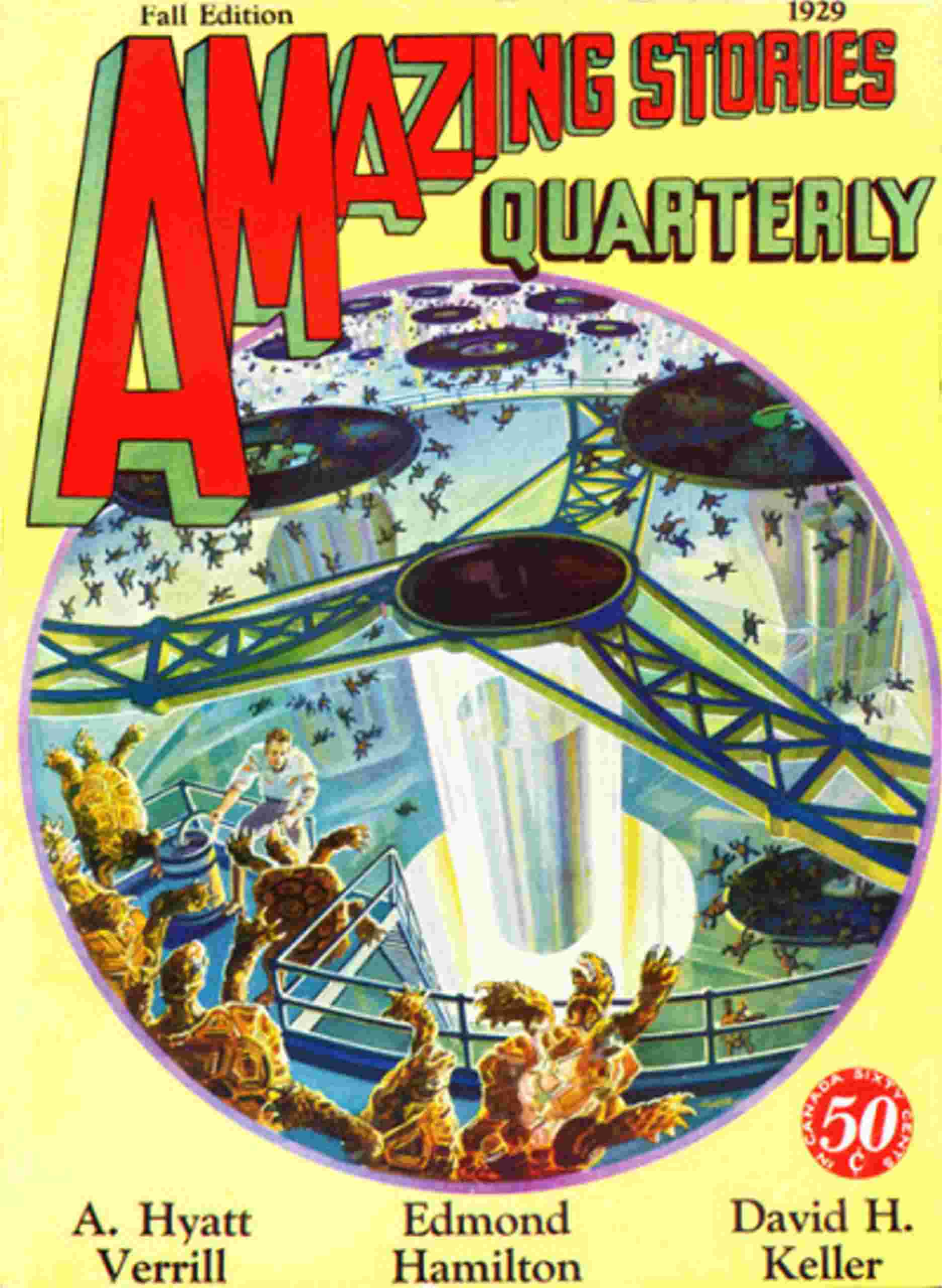
This etext was transcribed from Amazing Stories Quarterly, Fall 1929 (vol. 2, no. 4, pp. 436–505).
Obvious errors in spelling, hyphenation and punctuation have been silently corrected in this version, but minor inconsistencies and archaic forms have been retained as printed. Some illustrations have been moved to fit the story. The title “INTRODUCTION” and a table of contents have been added.