
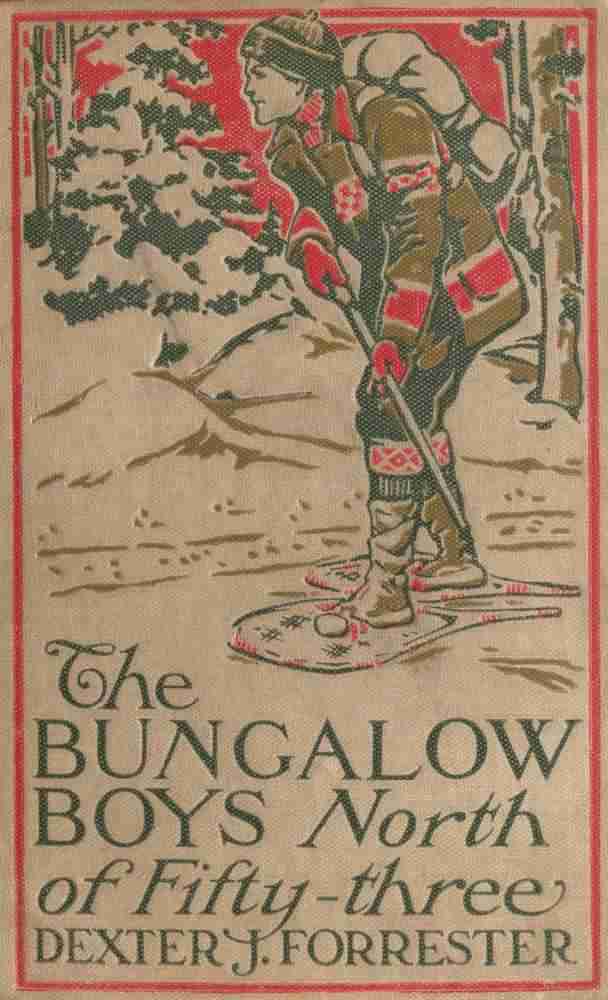
CHAPTER VI—STOPPING TO REST.
Large natures are apt to take heavy blows more calmly, at any rate so far as outward appearances are concerned, than smaller ones. The Dacre boys, broadened and deepened by their adventurous lives, were not as cast down over the disaster that had befallen them as might have been many lads less used to meeting hardships and difficulties and fighting them as American boys should.
Therefore it was that, keen as was their interest in the stake that lay ahead of them, they yet found time to notice the sights about them and to talk as they moved along over the snow much as they might have done under quite ordinary circumstances.
If anything, Jack had shown his anger and chagrin more perceptibly than Tom when the blow had first fallen. But now he was in as perfect command of his faculties as his elder brother. He was able even to crack a joke now and then with seeming indifference to the object of their journey and the perils that might lie in front of them, perhaps just around the next turn of the trail, for all that they knew.
As for Tom, following the calm, almost stoical way with which he had met the discovery of their loss, he had become possessed of an unconquerable desire to find the man who had robbed them and if possible hand him over to the authorities. Failing this, Tom found himself possessed of a grim, bulldog determination to make the man give up the spoils. As for the man himself, he felt no wish to punish him under those circumstances. That was for the law to do. The main thing was to get back the black fox’s skin, for he was sure the creature had been killed.
At about noontime Tom called a halt. Jack was for pressing right on without stopping to eat, but Tom would not allow this.
“It’s no use two fellows wearing themselves out,” he said; “we shall work all the better for having stopped to ‘fire up.’”
“Well, it looks to me like so much lost time,” observed Jack, siting down, however, at the foot of a tree and loosening his snowshoe thongs. This was in itself a sign of weariness, but Tom pretended not to notice it.
He set Jack to work hacking fragments from a dead hemlock which was still upstanding, for, although there were plenty of fallen trees about, timber that has been lying on the ground is never such good kindling as upstanding deadwood, because it is almost sure to be damp. While Jack was about this task, Tom cleared a space in the snow, and then he drew from his pack a blackened pot, which had boiled tea on many a trail.
When Jack had the kindling and some stouter bits of wood for the permanency of the fire, Tom filled the pot with snow and then set a match to the pile of shavings. They had been raked together lightly and the heavier wood set up in somewhat the form of an Indian’s tepee.
The dry kindling caught as if it had been soaked in kerosene. Up shot the cheery red flames, and the blue smoke curled merrily away as the wood crackled joyously. There is magic in a fire in the woods. In a trice a match and dry timber can convert a cheerless camp into a place fit for human habitation and happiness.
The snow was melted by the time the kindling had died down and Tom could make a bed of red coals. In these he set the pot once more, this time with tea added to the boiling water. It was sweetened with some of a precious store of molasses, carried in a bottle and used as a special luxury. As for milk, even of the condensed variety, the Bungalow Boys on their trips along the trap line had long since learned to do without it.
With jerked deer meat, prepared the week before, and some soggy flapjacks baked in an aluminum oven, they made a satisfactory meal. By way of dessert, each boy stuffed some dried apricots into his mouth to chew as they moved along. Thus refreshed, thongs were tightened, duffle packed, and they were once more ready for the trail.
All that afternoon they followed along the man of mystery’s track, but in no place could they find a spot where he had paused to camp. He must have eaten whatever refreshment he had while riding on his sled or while on foot, for no traces of a fire or a resting place could the boys’ eyes discover.
One clew alone the thief had left behind him, and that was in the form of numerous stubs of cigarettes which had been rolled by hand out of coarse yellow paper. But outside of this sign there was nothing but the sled marks to guide them. One thing about the trail that has not yet been mentioned is that the man was back-trailing. That is to say that, on leaving the boys’ camp, he had followed the same path by which he had come, and in places the two tracks could be seen where the sled had swung out a little.
After a time they found that a snow storm, which must have fallen in the vicinity during the night, had entirely wiped out the “coming” track, leaving only the fresh marks of the “going” trail.
From this fact the boys deduced that the man might have turned off somewhere on his journey to their camp, but they cared little for this. It was his fresh trail that they were following hot upon, like hounds upon the scent.
All the way, too, went the trail of the wolverine, and, judging from the tracks, the boys guessed that the animal had been traveling fast. This looked ominous, for the wolverine is not, as a rule, an energetic animal, and proved at least to Tom’s mind that the robber must be traveling very quickly.
He pointed this out to Jack, who agreed with him. But neither of the boys said a word about turning back. They were far too nervy for that, and, having started out, such an idea as quitting did not once enter their heads. All that afternoon they kept grimly on.
At about three o’clock, or shortly thereafter, the sun grew dim and low. Half an hour later only a pale twilight lingered about them, for at that time of year in the northern wilds the evening sets in early.
Above their heads, from the darkening canopy of the sky, the stars, a million pin points of light, began to shine. The snow turned a dull, steely blue as the light shut in. A slight breeze stirred in the hemlocks and spruces. It began to grow noticeably colder, too.
But as the daylight died another light, a wonderful mystic glory of radiance, began to glow in the northern sky. Against its wavering, shimmering, unearthly splendor every twig on every tree stood out as though carved in blackest ebony. The brush was shrouded in deepest sable, and the shadows lay upon the snow as black as a crow’s wing.
Everywhere was a deep, breathless hush, except where the light wind caused a huddled mass of snow on an interlaced branch to slip ground-ward. The great solitudes appeared to be composing themselves for sleep. On the hard, frozen surface the boys’ snowshoes creaked almost metallically as they pressed on, following in the dimming light the two parallel lines that had begun to burn themselves into their brains.
They knew when they set out that it was going to prove a stern chase; now they saw that unquestionably it was likewise to be a long one. How long they could not guess. They passed a small stream. In the silence they could hear the ice “crack-cracking!” with that startling sound that is one of the most mystic of the voices of the woods. It grew bitterly cold. Tom began to look anxiously about him. They must find a lodging for the night. The question of sleeping in the open did not bother him. Timber was plenty, and they could make an evergreen shelter and soon have a roaring fire to warm their blood. He was merely prospecting for a place that looked a likely one.
And then, suddenly, something happened that sent an involuntary chill running up and down the spines of both boys.
From the westward, through the long, melancholy aisles of straight-trunked trees, the sound had come. Out of the silence it was borne with a chilling forboding to them. It was a long-flung, indescribably forlorn sound, and seemed to fill the silences, coming from no definite spot after an instant’s listening.
It deepened and swelled, died away and rose like the sound of distant church bells. Then, while they stood listening, involuntarily brought to a swift, startled halt, it died out uncannily, sinkingly, and the silence shut down again.
“It’s the wolves!” said Tom in a low, rather awestruck voice.
The boy was right. The gray rangers of the big timbers were abroad seeking their meat from God.
CHAPTER VII—IN THE TRAPPER’S HUT.
Now, to a reader who has never been a woodsman, who has never penetrated the silences that lie north of Fifty-three, the word “wolves” conveys a distinct impression of uneasiness.
The cold fact is that the northern woodsman stands rather in contempt of wolves. He has no use for them, but he does not fear them; and the wolves for their part—except in some startling exceptions—leave mankind alone.
The boys had been long enough in the Northland to share this feeling, and it was not fear that brought them to a halt at the long, melancholy ululation that told them of the “gray brothers” wishing each other “good hunting.” It was quite another feeling: the sense of their isolation, that the moaning cry had brought sharply home to them, the loneliness of the solitudes about them, the possibly dangerous nature of their quest.
“Wow! but that sound always makes me shiver,” said Jack, glancing about him, as if he expected to see a gray head pop out from behind the trees at any moment.
“Yes, it never sounded very good to me, even when we were lying snugly in our bunks on the good old Yukon Rover,” agreed Tom. “I wish we could find some trapper’s shack or hut hereabouts. I wouldn’t mind making a good camp with some company around, for to-night anyhow.”
“Why, you talk as if we might be a long time in the woods,” said Jack, in rather dismayed tones.
“And so we may be, for it is up to us now to keep on that trail till we find the man that made it, or else run it out.”
Jack did not make any reply to this. His spirits had been good all day, and he had looked upon the chase rather in the light of an enjoyable adventure than anything else.
But now the twilight desolation, the fading line of light in the west and the long howl of hunting wolves, which ever and anon swelled and died out in the distance as they stood there, combined to give him a sense of forboding and creepiness.
Tom’s cheery voice aroused him.
“We can push on a way yet, anyhow,” his elder brother was saying; “even half a mile farther will be better than nothing, and who knows that we may not come on some Indian camp or trapper’s shack, where we can get a hot supper and find, maybe, some news of our visitor.”
Jack, thus admonished, roused himself. By an effort he put aside his gloomy thoughts. Side by side through the trees the two young adventurers forged ahead. But Jack soon began to sag behind. It was plain that he was beginning to get fagged. It was small wonder. They had come thirty-five miles that day, as Tom’s speedometer showed, which is a fair journey for a grown man, let alone boys. A seasoned woodsman can make fifty miles a day on snowshoes and pull up with no feeling but a huge appetite. But, although the boys were well muscled and used to following the trail, they could not hope to compete with the lifelong rangers of the forest in endurance.
Tom was just thinking of making camp right where they then were, in a grove of hemlocks and stunted spruces, when he gave a sudden cry of joy.
“Hurray! Jack, old boy! Talk about luck!”
“What’s up?”
“Don’t you know yet?”
“I do not.”
“Then you are a worse woodsman than I thought you.”
“You might explain. Have you gone crazy?”
“Not just yet. Don’t you smell anything?”
“Um—a-h-h-h! Yes, I do. Smoke.”
“Wood smoke, Jack, and wood smoke means a fire, and fire means a human being.”
“Yes, and a human being may—mean—may mean——”
“Well?”
“A human being that may make us a lot of trouble; for instance, the man who stole that skin!”
“Cracky! It may be he! Wait right here till I creep ahead a little.”
Dodging here and there behind tree trunks, Tom stole cautiously forward. He made not a sound as he went except when now and again the snow creaked under his feet. As he moved, he was doing some rapid thinking.
All day long they had been striving with all their strength to get near the man of the long trail who had stolen their black fox skin. Yet now that he might be at hand, almost within earshot of them, Tom found his heart pounding in a most uncomfortable way. What kind of a man might he be? Perhaps some desperado who could easily overpower them. Perhaps there were even a gang of them.
All these discomforting thoughts kept popping into Tom’s mind as he made his way onward as cautiously as a scout. But suddenly, as he bent forward, his rifle that he carried slung by a bandolier over his shoulders bumped his back. It was like a dose of magic elixir and brought his courage back in a flash.
“Well,” he thought, “if that rascal wants trouble, he can——”
He came to a quick halt.
“Here’s the end of the trail!” he gasped.
Before him, not ten rods away and just over a slight rise, which had prevented his seeing it before, was a small log hut.
It stood on the brink of a little lake, the latter, of course, frozen many inches thick. About it was a clearing where the logs to build it had been felled. But what brought Tom up with a round turn was the sight of sleigh tracks leading up to the door.
From the chimney a thin wisp of bluish smoke was curling, undoubtedly the subtle aroma they had sensed at a distance. Tom stood as still as a graven image for a minute, listening intently. Over everything about him hung the hush of the wilderness at nightfall.
For a space he stood thus, and then, giving his rifle a quick hitch so that it would be in readiness to his hand, he strode forward on his snowshoes with long, certain strides.
CHAPTER VIII—THE GHOSTLY CRY.
There was a big wood pile at one side of the hut, from which the owner evidently drew for his fuel supply. Tom used this as a sort of screen to conceal his advance, and, slipping behind it, gained a place where, through a chink in the logs, he could gaze into the interior. It was deserted. Of that he was sure immediately after his first glance, for the shack consisted only of the one room.
Having made sure of this, he continued his way around to the front of the place, and then discovered to his astonishment that the sled tracks went straight onward through the snow. It was easy for him to guess that the man they were pursuing had camped for a short time in the hut, cooked himself a meal and left the fire in the stove burning. When he saw several brown-paper cigarette butts lying scattered on the snow in front of the place, the identity of the visitor to the lonely hut became a certainty.
The problem of a place to pass the night was thus solved, for it is the rule of the waste places that the benighted traveler may make himself at home whenever he happens to come across a shelter. Tom gave a loud “Hullo!” and there came back an answering hail from Jack. In a few minutes the younger of the Bungalow Boys was at Tom’s side.
“Well, here’s our hotel, all ready and fixed up for us, even the fire lighted in readiness for us,” laughed Tom as Jack came up.
“But what does the owner say about it?”
“Not being at home just at present, he hasn’t anything to say; however, our friend of the black fox skin stopped here, rested his bones, fed his dogs, to judge from all the litter around, and then passed on.”
“But isn’t there a chance that he may come back?”
Jack spoke rather timidly. He was tired and a little nervous, and the thought that the fellow who had robbed them might be prowling about somewhere rather scared him.
“No danger of that. I wish he would. Then we could end this thing up right here.”
“Been inside yet?” asked Jack, by way of changing the subject.
“No; I waited for you. Come on, let’s go in and see what sort of a place it is and who lives in it. I guess it belongs to a trapper, all right, from the looks of it.”
An inspection of the big room inside proved the correctness of Tom’s surmise. Traps of all sorts and sizes were littered about the room or hanging on nails. A rough table, chairs formed out of boxes, the stove, whose smoke had first caught their attention, and some pots, pans and other equipment completed the furnishings. In one corner was a rough bunk containing dirty bedding.
One thing caught Tom’s eye immediately, and that was a barrel in one corner of the place. All about it several small skins such as beaver, marten and weasel were scattered on the floor. Closer inspection showed that the barrel contained some more of the same kind of pelts. It looked as if somebody had hastily rummaged through the barrel of skins and selected what he wanted.
“I’ll bet that rascal who stole the black fox has been on a raiding expedition here, too,” cried Tom indignantly. “What a shame!”
“Yes, looks as if he’d helped himself,” agreed Jack, unstrapping his pack and taking off his snowshoes.
They spread their provisions out on the table, got in plenty of wood and water, and lighted a coal-oil lamp which they found on a shelf. When the door was shut and secured by a big wooden bar which was adjusted from within, they set about getting supper. In the yellow lamplight, with the kettle singing on the stove and some jerked meat bubbling in a sort of stew Tom had fixed up, the place looked quite cosy and homelike.
“Wonder how poor old Sandy is getting along?” said Jack, as they sat down to eat.
“Oh, he’ll be all right,” replied Tom. “Of course, he’ll be lonesome and all that, but he’s quite safe unless some other fellow takes it into his head to come a-raiding.”
“Well, lightning never strikes twice in the same place,” responded Jack, “and it is hardly likely that a second thief would come along so soon.”
“Just what I think,” agreed Tom.
Having finished their supper, they washed up the dishes and set about preparing to make everything snug for the night. From time to time they could hear the distant howling of the wolves, bur that only made the hut seem more snug and secure.
“I wonder what the owner would say if he found us making ourselves so very much at home?” said Jack, as he inspected the none too clean bedding.
“Oh, he would be glad to see us, I guess,” replied Tom. “Visitors are welcome in this wilderness, and as for making ourselves at home that is the right of every traveler in the woods when he needs hospitality and the host happens to be out.”
“Still, I don’t imagine the hospitality includes helping yourself to skins, like that rascal we’re trailing did.”
“I hardly should think so,” rejoined Tom dryly. “Fellows like that don’t have a bed of roses when they are caught. It is as bad as horse stealing in the West.”
“I know I can think of a good many punishments fitting for the rascal who stole our black fox.”
“So can I, without straining my imaginative powers, either.”
Both lads were thoroughly exhausted by their labors of the day, and after a little more talk they made up a good roaring fire to keep the hut warm through the night, and turned into the bunk. For some little time they lay awake, listening to the crackling of the blaze and the sighing of the wind which was stirring outside.
From time to time, too, they could still hear the howling of the wolf pack, and occasionally the night air would ring with the sharp cry of some small animal pounced upon by a great snow owl or a weasel. But both lads were well used to these sounds of the northern night, and it was not long before their senses began to swim and they dropped off into sound and refreshing sleep.
Just what time it was when they both awakened together they did not know, but the cause of their sudden arousing was a startling one. Borne to their ears there had come a strange sound, a long, low, howling sort of moan.
“Wow-ow! Ow-hoo-ha-hoo-wow-w-w-w-w-w!”
That is about as nearly as the sound can be indicated in print.
Both boys sat bolt upright, wide-eyed with alarm. Jack felt the skin on the back of his scalp tighten as he listened. The lamp had been left alight, although it was turned low, and in the dim light each lad could read fear and perplexity in the other’s countenance.
“Wh-wh-what is it?” gasped out Jack.
“I der-der-don’t know,” stuttered Tom, equally at a loss and almost as badly disturbed by the weird nature of the wailing cry.
CHAPTER IX—TOM CALMS JACK’S FEARS.
“Wow-yow-wyow-ow-oo-oo-oo!”
Again came the cry, punctuating the night in the same ghastly, unaccountable manner.
“Is it wer-wer-wer-wolves?” stammered Jack.
Tom shook his head.
“Nothing like them. It beats me what it can be. I never heard such a sound.”
“It gives me cold shivers,” confessed Jack.
“Maybe it is only a wildcat,” said Tom, regaining his nerve which had been badly shaken by his sudden awakening and the ghastly cries.
“Doesn’t sound much like one,” objected Jack; “it sounds more like—more like——”
He broke off short, for now something occurred that made each boy feel as if his hair was standing on end and ice water being poured in liberal quantities down his spine.
“There is death in the snows, death-death-death-to-all-who-brave-the-trail!”
“Gracious!” gasped Jack; “it’s a ger-ger-ghost!”
“Nonsense,” said Tom sharply.
Although he was badly scared himself, he kept his nerve better than his younger brother, but the sepulchral voice made him shudder as he listened.
The uncanny sound of the wailing chant died out. Then fell a deep silence, broken only by the sighing of the night wind.
“But if it isn’t a ghost, what is it?” demanded Jack.
“I don’t know, but of one thing I’m certain, it isn’t a ghost. There are no such things, and only fools and kids believe in them.”
“Well, nobody else would be outside in the snow making such noises,” declared Jack. “It is a spirit or something, that’s what it is. Maybe somebody was murdered here and it is his——”
“Say, if you talk any more nonsense, I’ll—I’ll—” burst out Tom disgustedly, but just then came an interruption.
It was the sepulchral voice again.
“The-white-death-is-abroad-in-the-land! O-wo-w-ow-oo-oo-oo-oo!”
The voice broke off in a terrifying scream that brought both boys out of the bunk and to their feet. Tom picked up his rifle.
“Maybe it is somebody lost in the woods,” suggested Jack, glad of any theory that might reasonably account for the alarming voice.
“Rubbish! Nobody lost in the snow would make that racket. Besides, there’s all that stuff about death!” Tom shuddered. “It’s got me guessing.”
“It’s aw-awful!” stammered poor Jack.
“But I mean to find out what it is.”
Tom compressed his lips and looked very determined. He began examining the lock of his repeating rifle, and then moved toward the doorway.
“What! You are going out there?” demanded Jack.
“I surely am. I mean to satisfy myself just what it is, or who it is, that is making that ghostly noise.”
“But it can’t be human,” urged Jack. And then, recollecting some ghost stories he had read, he continued: “It might ber-ber-blast you, or something.”
“Rubbish! I’ll blast it, if I can get hold of it!” declared Tom, who couldn’t help smiling, perplexed though he was, at Jack’s real alarm.
The boy’s hand was on the bar that held the door securely shut, when the voice arose once more. It was certainly not a little awe-inspiring. The mere facts that they could not tell with accuracy from just what direction it came, and also that they were the only living beings in that part of the country, made it all the more frightful. “Be-ware—be-ware-of-the-white-death-of-the-north!” came the voice. “Turn-back. Go-where-you-came-from. The-trail-leads-to-destruction-swift-and-terrible!”
Tom waited no longer. He flung open the door and rushed out into the darkness. Behind him came Jack, also armed, and trying desperately to keep his teeth from chattering. The Northern Lights were flashing and splashing the sky with their weird radiance, and the snow lay whitely all about the hut.
Had there been any man or animals within the cleared space, they must have been able to see their forms.
But nothing was to be seen.
The two alarmed boys standing there looking this way and that, like startled deer, were the only living things near the hut. Tom was badly mystified. The whole thing certainly flavored of the supernatural, and yet the boy’s better sense told him that it could be no such thing. There must be some way of accounting for that voice, but for the life of him Tom could not hit upon a solution of the mystery, try as he would.
At length, after making as thorough an examination of the space surrounding the hut as they could, the two lads were fain to go back again into the structure, and at least one of them was heartily and unfeignedly glad to be able to do so.
Tom felt that, had he been able to account for the strange and supernatural voice in any imaginable way, he would not have been so worried over it. It was the very fact that the whole thing was inexplicable in any ordinary way that made it more alarming.
The bar was secured in place and both boys got back into the bunk. But sleep did not visit them for a long time. They were under far too great a strain for that. They lay awake listening nervously for a repetition of the spectral voice, but none came.
“Perhaps in the morning we may find something that will throw some light on the matter,” said Tom, after a prolonged silence.
“Yes, I suppose we’ll find a phonograph or something out there,” scoffed Jack. “It’s no use talking, Tom, I tell you that nothing earthly made those sounds.”
“What do you think it was, then?”
“Just what I said: a ghostly warning to us not to go farther.”
“Very kind of the ghost, I’m sure. I didn’t know they were such benevolent creatures.”
“Oh, you needn’t laugh. I’ve read lots about ghosts giving warnings and so on. That voice was to tell us to beware how we proceed.”
“Rot! As if a ghost would care! I only know of one person who might be desirous of seeing us turn back.”
“Who is that?”
“The fellow that stole that black fox.”
“Then you think——”
“I don’t think anything. Now try to get to sleep till morning.”
Jack lay awake long after Tom was asleep once more. But the voice did not come again, and at last his eyelids, too, closed, not to open till it was broad day.
CHAPTER X—THE MYSTERY SOLVED.
“Ah, ha! I fancy that this is a clew to Mr. Ghost!” exclaimed Tom.
He was bending over a sort of megaphone of birch bark, which had been rolled up into a cone-shaped formation. He held it aloft triumphantly.
“So this is what your spook made those noises with, Jack, old fellow, and scared you half to death.”
“He did no such thing,” protested Jack, getting very red in the face. “I did think, though, that there must be something of this kind behind it.”
The two boys had left the hut almost as soon as it was daylight to prosecute their search for some trace of the cause of the alarm they had experienced during the night. Tom already had a theory in his head as to what it was that had made the sounds, and, deducing from the fact that the thief alone would desire to try to scare them, the first things he looked for were traces of some prowler in the vicinity of the hut.
He had discovered footprints among some trees on the edge of the clearing, the prints of a big, soft moccasin-shod man. Then came the finding of the peculiar woods-made megaphone with which, beyond doubt, the man who had tried to scare the boys off his trail had uttered the alarming sounds.
Of this they could be reasonably certain, but it was beyond their power to make out how the man had come to turn back and put his plan to frighten them off his tracks into execution. Tom was inclined to think that he must have turned back soon after he left the hut and discovered who were the occupants. Then he had secreted himself not far off till nightfall and improvised his “ghost party.”
“At any rate, he gave us a fine scare,” declared Tom, as they walked back to breakfast before taking the trail again, “for I’ll admit that I felt just as creepy as you looked.”
“And that was some creepy,” admitted Jack.
And so the matter was, for the time, dismissed from their minds, and over their breakfast they fell to discussing further plans when they should start on again.
The meal had been finished, the dishes hastily wiped and put neatly away, and a penciled note left by Tom on the table thanking the unknown owner of the hut for his hospitality, when both boys were startled at the sound of a dog whip being cracked viciously somewhere in the vicinity. Then came a voice:
“Allez! Allez vitement! Ha! Pierre! Ha! Victoire!”
Both boys ran to the door. Coming toward them at a good pace was a sled drawn by four Mameluke dogs. Seated upon it was a strange figure. It was that of a venerable-looking man with a long white beard, out of which his sun-browned face looked oddly, as if peering from a bush. He wore a bright-red “parkee,” deerskin moccasins and a heavy fur cap. In his mouth was a short clay pipe, at which he was puffing ferociously.
“Father Christmas!” cried Jack. “Santa Claus in real life!”
In fact, the old man on the sled did bear a marked resemblance to that popular Yuletide saint.
As he saw the boys, he uttered an exclamation of astonishment. He cracked his whip again, and the Mamelukes, yapping and snarling, drew the creaking sled up to the door. The old man checked the dogs with a word, and then turned to the boys.
“Ah! mes garçons,” he cried; “where you come from, eh? You look plantee young to be out on the trail alone.”
While the old man busied himself in unpacking the goods he had brought back from the trading post some fifty miles away, Tom told him of how they had passed the night in the hut. Then the old man told them that he was the owner of the hut, by name Joe Picquet, an old voyageur of the wilderness.
When Tom told the old fellow of the raiding of his fur treasury, Joe Picquet burst into an excitable fury. He shook his fists and swore to punish the man who had done it with all manner of torments, if he could catch him. A hasty investigation of the barrel showed, however, that the thief had only deemed two skins worth taking. One of these was a silver fox pelt, for which old Joe had counted on getting a thousand dollars, and perhaps more.
“Ah, he is a mauvais chien!” he burst out, when Tom told him how they, too, had suffered at the hands of the marauder. “Joe Picquet make it ver’ hot for him if he get hands on him. Sacre! One silver fox pelt worth all dese put togeder!”
“Possibly you may have passed him on the trail?” said Tom.
“No, I pass only one man. Li’l old man all same lak me,” said Joe positively.
“Did he have a sled with four dogs?”
“Oui, certainment. But he was harmless-looking fellow. He no would rob like the man that was here. Non, it would be impossible to teenk of eet.”
“I’m not so sure of that,” rejoined Tom dubiously. “Oh, by the way, was he smoking cigarettes?”
Old Joe knit his bushy eyebrows in deep thought.
“Oui, he was smoke. Certainment. Li’l yellow cigarettes he was smoke! Bah!”
“Then it was the same man for certain,” said Tom positively. “Look here.”
He indicated the stumps of yellow cigarettes scattered all about.
“Ah! You are right, mon garçon. Boosh! What a bad mans he must be! So you are follow him, eh? You teenk you catch him?”
“We certainly hope to, or at any rate to get close enough to him to put the authorities on the trail,” said Tom.
“But you are only two li’l boys.”
“Not so very little,” rejoined Tom, while he could not restrain a smile, for Joe Picquet himself was shorter than either of the Dacre boys.
The little old man kept his eyes on his dogs in a speculative mood for a few seconds. The boys did not disturb him. At last he broke out with an exclamation.
“Boosh! How you lak it I go long wid you hunt dees bad man?”
“Why, it would be the very thing! But are your dogs fit for a long journey?”
Old Joe laughed scornfully.
“Mon garçon, attendez. Dey are the finest team of malukes in whole Yukon country. Old Joe is poor, but he wouldn’t tak one, two, t’ree hundred dollar for one of dem. I feed dem, den we start back again. The man I passed go slowly. Maybe he teenk he scare you away. Ha! ha! He badly fooled. Boosh! I go feed dem now.”
He made a peculiar sound with his lips, and instantly the dogs began jumping about in great excitement.
“Attendez, mes gallons,” said the old man, holding up a forefinger impressively; “do not touch dem now. Dey are good dogs, but all malukes plenty mean. You got beat, beat them all time or dey teenk dey boss and bite you plentee hard, I bet you.”
The boys had heard before of the savage, intractable natures of mameluke dogs and how they can be kept submissive to their owners only by harsh treatment. A mameluke is practically a wild beast broken to harness. They are swift and sure over the frozen lands, but there their association with man ends. They do not wish to be petted, and are likely to retaliate with their teeth on anyone who attempts friendly relations with them.
Muttering angrily to himself, old Joe pottered off to a barrel in the rear of his hut where he kept a plentiful provision of fish for the dogs. Presently he reappeared, and began throwing it among them, cracking his big black-snake whip in a regular fusillade as the dogs fought and snarled furiously over their food.
“Ah, Pierre! mauvais chien! Allez! Hey, Victoire! Wha’ for you bite ole Pete, hey! Boosh! Take your time!”
But the old man’s cries as he darted here and there among them had no effect on the dogs, who finished their meal with frenzied snappings and one or two fights which had to be broken up by main force.
“Now, I go get few teengs an’ we start,” said old Joe, when the animals had lain down in the snow to digest their not over-plentiful meal.
“Boosh! We geev that feller warm reception when we find him, I bet you.”
When old Joe reappeared from the hut, he carried with him a long, wicked-looking old squirrel gun. Its barrel was almost six feet long and it was of a dark, well-worn brown color.
“What are you going to do with that?” asked Tom, as the old man tenderly fumbled with the lock.
“Maybe have use heem. Boosh! No can tell,” he replied oracularly.
“Jiminy!” whispered Jack to Tom, as with their new ally they set out once more along the trail, “old Santa Claus can look positively ferocious when he wants to, can’t he?”
“Yes, but I’ve got a notion that he carries that funny old shooting iron more for effect than anything else. Still, I’m glad we have him along; he may prove a valuable ally,” surmised Tom.
“Well, with Santa Claus on our side we ought to have better luck along the trouble trail,” agreed Jack.
The dogs sprang forward, and Tom and Jack sped after them on rapidly moving snow-shoes.
Crack! crack! went the dog whip.
“Boosh!” cried the old man, with whom the exclamation appeared to serve all purposes.
The dogs sprang forward, and Tom and Jack, relieved of their burdens which now lay on the sled, sped after them on rapidly moving snowshoes. Their chase of the unknown thief now began to look like business.
CHAPTER XI—THE NEW-FOUND FRIEND.
Old Joe Picquet came to an abrupt halt. All that morning they had followed the trail of the thief and had now arrived at a small lake, Dead Rabbit Lake.
“Boosh!” exclaimed the old man angrily, “I am one fool. Someteeng I jus’ see I nevaire notice before.”
He pointed down at the trail of the man they were pursuing.
“You look! You see something funny 'bout dat snowshoe?” he asked.
Both Tom and Jack examined the footmarks without seeing anything odd in them. It was then that Joe gave them an exhibition of his skill in trailing.
“His toe turn oop,” he said. “Dese snowshoes mooch broader, too, than dose we wear here. Dese shoes made in some factory. See! They no good.”
“Like the man that wears them,” sniffed Jack. “Then you think, Joe, that he must be a stranger up here?”
“I not know,” rejoined Joe with a shrug, “no can tell. But dose snowshoes no made oop here. Come from south, maybe. Boosh!”
“If he is a stranger, he is a good traveler anyhow,” was Tom’s comment.
Not long after, they came upon a spot where the man had halted and built a fire. Joe Picquet felt the ashes, running them slowly through his gnarled fingers.
“Boosh! He still long way in front of us,” he said disgustedly. “Dis fire been cold long time. He keel his dogs, he no look out. Boosh! Allez, Pete! Hey, Dubois!”
On they went again on the monotonous grind of the chase. They passed small lakes, sections of muskegs, swamps, rocky hillsides and deep valleys. But all lay deep under snow and ice. The sun beat down, and the glare from the snow began to affect Jack’s eyes.
“I soon feex that,” said old Joe.
“How?” asked Jack, winking and blinking, for everything looked blurred and distorted.
“I get you pair of snow-glasses. Boosh.”
“Snow-glasses. Have you got some with you?” asked Tom.
Old Joe shook his head.
“Non. But I get some vitement. Very quickly.”
“Are we near to a store, then?” asked Jack.
“No, Otter Creek is twenty miles away.”
“Then I don’t see——”
“One second, mon ami. You shall see. Old Joe live long in the woods. He can do many teeng. You watch.”
Near the trail they were still following with the same pertinacity stood a white birch clump. Old Joe called a halt, and with his knife stripped off a big slice of bark from one of them. This he fashioned into a kind of mask. But instead of cutting the eye-holes all round, he left part to stick out like shelves under the orifices. These were to prevent the light being reflected from the snow directly into Jack’s eyes. A bit of beaver skin from the load formed a string to tie the odd-looking contrivance on, and from that moment Jack was not bothered with his eyes.
“In wilderness men do widout many teengs; except what dey make for demself,” quoth old Joe, as they took up the trail once more.
Soon after noon they stopped to eat. It was a hasty meal, for they felt that they could ill afford to waste any of the daylight. Then on again they went, old Joe urging his dogs along remorselessly.
“They look pretty tired,” suggested Tom once.
Old Joe gave one of his shrugs and took his pipe from his mouth.
“Dey what you call beeg bluff,” said he. “All time dey play tired. Boosh! Dey no can fool me. Allez!”
Crack went the whip, and the cavalcade moved on as briskly as before.
It was twilight when, on rounding a turn in the trail in a deep valley, they suddenly heard the barking of dogs. Those of their own team answered vociferously, old man Picquet yelling frantically at them above the din.
The cause of the noise ahead of them was soon apparent. From the midst of a clump of second growth Jack-pine proceeded a glow of firelight. It was a camp. They soon saw that it consisted of one tepee. From the opening in the roof of this, sparks were pouring and smoke rolling out at a great rate, telling of a good fire within.
The barking dogs rushed at them savagely, and old Joe had all he could do to keep his own from attacking the strangers. In the melee that would have been sure to follow such an attack, the sled would certainly have been upset even if one or two of the dogs had not been killed; for when mamelukes fight, they fight to the death.
In the midst of the uproar, the flap of the tepee was thrust aside and a figure came toward them. It was an Indian. He called to his dogs, who instantly crept back toward the tent, growling and snarling and casting backward glances at the invaders.
“Boosh!” exclaimed old Joe as he saw the Indian coming toward them, “dat Indian my fren’ long time! Bon jour, Pegic. How you do to-day?” Then followed some words in the Indian dialect which, of course, the boys did not understand.
The Indian invited them into his tepee. He was camping alone and had killed a small deer that morning. The meat hung in the tepee, and as soon as his guests were seated, he set about cutting steaks and frying them over the fire.
Then, on tin plates, he handed each of the boys and old Joe a portion, accompanied by a hunk of baking powder bread. The long day’s journey in the cold, nipping air had made them ravenously hungry. They fell to with wolfish appetites on Pegic’s fare. The Indian, his jaws working stolidly, watched them eat. He was a small man and rather intelligent-looking.
After the meal, the dogs were fed and old Joe told the boys that they would stay with Pegic for the night. As both lads were just about tired out, this arrangement suited them down to the ground, and in the glow of Pegic’s fire they lay down and were soon asleep.
Then old Joe began to ask the Indian questions. Indians must be dealt with calmly and above all slowly, and in a roundabout way. Haste or undue curiosity upsets them. To ask an Indian a brief question is in all probability to have it unanswered. Hence old Joe proceeded with caution. The conversation was carried on in Pegic’s dialect, which the old French-Canadian understood perfectly.
First of all he asked the Indian how long he had been camped there.
“Two days,” was the reply.
“To-day a man passed here?”
The Indian nodded gravely, staring into the fire.
“It is even so. Just as you say, my friend.”