
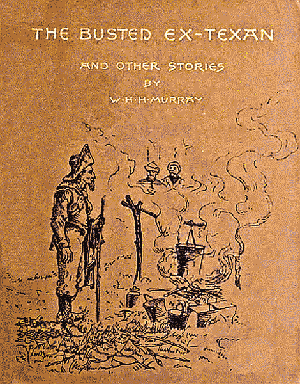
"These orders were obeyed with alacrity. Not a man flinched. The loop of the lasso settled over the polished horns to the roots, and Don Juan San Diego set it tight with a twang. Napoleon Bonaparte and George Washington rushed headlong upon her and hung to horns and ears; while the man from Michigan fastened a grip on her lifted tail, as she tore past him, which straightened him out like a lathe. As to myself, I could only stand and gaze with solicitude upon the terrific contest, on the issue of which depended not only the chances of my speculation, but even the preservation of my self-esteem.
"The combat deepened and enlarged itself, as it were. A bull-dog, who was wandering along the road in search of adventure, and two foxhounds joined in the fight. The calf, the only one of the seven thousand five hundred and twenty-three I was ever destined to behold, broke from its pen and ran bellowing to its mother. The dogs bayed, the niggers yelled, the Mexican swore in his delightful tongue; and the stuttering Michigander remained silent, simply from his inability to pronounce the profanity of his feelings.
"Suddenly the cow, which had been slowly working her way, with her several attachments clinging to her, toward the road which ran along the front of the field, turned and started pell-mell toward the river, which flowed wide and deep, through the rushes, at the rear of it. She left the path and took to the corn, and through the mass of growing stalks she swept like a whirlwind. Onward she came. I anticipated the awful catastrophe, and stood riveted to the spot. The old captain still sat in the gravel, where the cow had bowled him, his hand grasping the shattered cane, and his game leg extended. He too foresaw the inevitable. Through the corn came the cow, like a black Saturn attended by her satellites. But her career was too terrific for these to hold to their connection. The laws of the universe forbade it. Napoleon Bonaparte de Neville lost his hold as she crashed into the sorghum patch. George Washington Marlborough tripped over an irrigation ditch, and soared away at a tangent, like a sputtering remnant of a burnt-out world. Don Juan San Diego went the wrong side of a mulberry tree, and the lasso parted with a snap. He never stopped until his momentum carried him through the slats of the neighboring cow-pen. Only the long-legged Michigander kept his hold, and he looked like a pair of extended scissors. I stood aghast at the impending ruin of my hopes, with my lower jaw dropped. The captain alone retained his presence of mind. As the black unit of my last Texan speculation shot by him, with Michigan, elongated like a peninsula, fastened to her tail, he rolled up to his knees and roared:—
"'Starboard your helm, boy! Luff her up! Luff her up, for the love of God, or the colonel is busted!'
"It is doubtful if the Michigan man ever heard the stentorian call of the captain, for sound travels only thirteen hundred feet to the second, and the cow was certainly going considerably faster than that; and, besides, he was himself engaged, with a terrific earnestness, in a vain effort to extricate a word out of his throat, which stuck like a wad in a smutty gun—a word of undoubted Saxon origin and of expressive force, and which has saved more blood-vessels from bursting than the lancet of the phlebotomist, for as he streamed past there was left floating upon the air a long string of d's, thus: d——d——d—d—d—d-d-d...!
"No one who did not hear them could ever conceive of the awful
sputtering, hissing sound that they caused in the atmosphere as they
came out of the mouth of the mad and stuttering Michigander; and as he
and the cow bored a hole through the reeds on the bank of the river,
and, hitting a cypress stump, ricochetted into the water, that fiery
string of d's, still hot and sputtering, reached half across the field.
"The splash of the two as they struck the water brought the old captain to his feet, and, in spite of his rheumatic leg, he rushed toward the river, crying:—
"'Man overboard! Man overboard! Gone clean over the forechains! Life-floats to port and starboard!'
"With such a frightful catastrophe, gentlemen, the remembrance of which actually makes me nervous, my last speculation in Texas ended. Going over the whole matter with the captain that evening,—a process which took us well into the night,—it was our united opinion that the speculation was a failure. This conviction was mutual and profound. The cow was not only gone, but she had shown such disinclination to be domesticated, and such a misapprehension of the true purpose of life, that the prospect was truly disheartening.
"'Why, damn it, colonel,' said the captain, 'we've no evidence that the old cow wanted to be milked!'
"To this discouraging conclusion of the captain's I was compelled to give a sorrowful assent. I recognized that my speculation was in arrears, as it were, and that it would never figure up a profit.
"Therefore, next day I divided my few personal effects between the captain and the noble men who had risked their lives for an idea; who had seen the tragedy played out and the curtain rung down to my last appearance, as it were. And, with the few dollars which alone remained of the fortune which I took with me to Texas, I mounted my horse and started northward, to join that noble army of martyrs, that brotherhood of sufferers, that fraternity of the busted, whose members are legion, and who are known as 'Ex-Texans.'"
The hilarity of the camp that evening under the foot-hills will never be forgotten by those of us who composed the happy number, and who listened with streaming eyes and aching sides to the narrative of our unfortunate guest. He told his story with a directness and simplicity of narrative, with a gravity of countenance and plaintiveness of voice, which heightened the humor of the substance. Never did the stars, which have seen so much of human happiness, which have listened to so much of the rollicking humor of those who were fashioned for laughter, looked down upon a jollier camp. Long after our guest had ended his narrative and was apparently sleeping in happy forgetfulness of his Texas speculation, succeeding pauses of silence would come roars of laughter. The remembrance of the humorous tale banished sleep, and, even after slumber had fallen on us all, fun still held possession of our dreams. For Dick, starting from sleep in a nightmare of hilarity, roared out: "Luff her up, luff her up, or the colonel is busted!"
Ay, ay, thank God for laughter. Thank him heartily and ever, dear
friend, blow the winds, run the tides as they may. The sorrows of life
may be many, and its griefs may be keen, and we who are frosted with
years and you who are blooming have felt and will feel the sting of
false friends and the burden of losses; but, lose what we may, or be
pained as we have been and shall be, we are happy in this,—we who know
how to laugh,—that we find wings for each burden, solace for pains, and
return for all losses, in our sweet sense of humor, thank Heaven! So,
whether rich men or poor, healthy or sick, brown-headed or gray, we will
go on like children, with eyes for all beauty and hearts for all fun.
Let lilies teach us, and of the birds of the air let us learn. The day
that is not shall not make us anxious, for of each day is the evil
enough, and the morrow shall take care of itself.
HOW DEACON TUBMAN AND PARSON WHITNEY CELEBRATED NEW YEAR'S.
"Mirandy, I'm going up to see the parson," exclaimed the deacon, when the morning devotions were over, "and see if I can thaw him out a little. I've heard that there used to be a lot in him in his younger days, but he's sort of frozen all up latterly, and I can see that the young folks are afraid of him and the church too, but that won't do—no, it won't do," repeated the good man emphatically, "for the minister ought to be loved by young and old, rich and poor, and everybody; and a church without young folks in it is, why, it is like a family with no children in it. Yes, I'll go up and wish him a Happy New Year anyway. Perhaps I can get him out for a ride to make some calls on the people, and see the young folks at their fun. It'll do him good, and them good, and me good, and everybody good." Saying which, the deacon got inside his warm fur coat, and started toward the barn to harness Jack into the worn, old-fashioned sleigh, which sleigh was built high in the back, and had a curved dasher of monstrous proportions, ornamented with a prancing horse in an impossible attitude, done in bright vermilion on a blue background!
"Happy New Year to you, Parson Whitney! Happy New Year to you," cried the deacon, as he stood in the doorway of the parsonage and shook the parson by the hand enthusiastically, "and may you live to enjoy a hundred."
"Come in, come in," cried Parson Whitney, in response. "I'm glad you've come; I'm glad you've come. I've been wanting to see you all the morning," and in the cordiality of his greeting he literally pulled the little man through the doorway into the hall, and hurried him up the stairway to his study in the chamber overhead.
"Thinking of me! Well, now, I never!" exclaimed the deacon, as, assisted by the parson, he twisted and wriggled himself out of his coat, that he filled, a little too snugly for an easy exit. "Thinking of me, and among all these books too—Bibles, catechisms, tracts, theologies, sermons. Well, well, that is funny. What made you think of me?"
"Deacon Tubman," responded the parson, as he seated himself in his armchair, "I want to talk with you about the church."
"The church!" ejaculated the deacon in response. "Nothing going wrong, I hope?"
"Yes, things are going wrong, deacon," responded the parson. "The congregation is growing smaller and smaller, and yet I preach good, strong, biblical, soul-satisfying sermons, I trust."
"Good ones! good ones!" answered the deacon promptly, "never better—never better in the world."
"And yet the people are deserting the sanctuary," rejoined the parson solemnly, "and the young people won't come to the sociables, and the little children seem actually afraid of me. What shall I do, deacon?" and the good man put the question with pathetic emphasis.
"You've hit the nail on the head, square as a hatchet, parson," responded the deacon. "The congregation is thinning. The young people don't come to the meetings, and the little children are afraid of you."
"What's the matter, deacon?" cried the parson in return. "What is it?" he repeated earnestly. "Speak it right out; don't try to spare my feelings. I will listen to—I will do anything to win back my people's love," and the strong, old-fashioned Calvinistic preacher said it in a voice that actually trembled.
"You can do it—you can do it in a week!" exclaimed the deacon encouragingly. "Don't worry about it, parson; it'll be all right, it'll be all right. Your books are the trouble."
"Books?" ejaculated the parson. "What have they to do with it?"
"Everything," replied the deacon stoutly. "You pore over them day in and day out; they keep you in this room here when you should be out among the people,—not making pastoral visits,—I don't mean that,—but going around among them, chatting and joking and having a good time. They would like it, and you would like it, and as for the young folks—how old are you, parson?"
"Sixty next month," answered the parson; "sixty next month," he repeated solemnly.
"Thirty! thirty! that's all you are, parson, or all you ought to be," cried the deacon. "Thirty, twenty, sixteen!—let the figures slide down and up, according to circumstances, but never let them go higher than thirty when you are dealing with young folks. I'm sixty myself, counting years; but I'm only sixteen, sixteen this morning, that's all, parson," and he rubbed his little round plump hands together, looked at the parson, and winked.
"Bless my soul, Deacon Tubman, I don't know but that you are right!" answered the parson. "Sixty? I don't know as I am sixty," and he began to rub his own hands, and came within an ace of executing a wink at the deacon, himself.
"Not a day over twenty, if I am any judge of age," responded the deacon deliberately, as he looked the white-headed old minister over with a most comic imitation of seriousness. "Not a day over twenty, on my honor," and the deacon leaned forward toward the parson, and gave him a punch with his thumb, as one boy might deliver a punch at another, and then he lay back in his chair and laughed so heartily that the parson caught the infectious mirth and roared away as heartily as himself.
Yes, it was impossible to sit hobnobbing with the little, jolly deacon on that bright New Year's morning and not be affected by the happiness of his mood, for he was actually bubbling over with fun, and as full of frolic as if the finger on the dial had, in truth, gone back forty-odd years, and he was "only sixteen. Only sixteen, parson, on my honor."
"But what can I do?" queried the good man, sobering down. "I make my pastoral visits."
"Pastoral visits!" responded Deacon Tubman. "Oh, yes, and they are all well enough for the old folks, but they ar'n't the kind of biscuit the young folks like—too heavy in the centre, and over-hard in the crust for young teeth, eh, parson?"
"But what shall I do? what shall I do?" reiterated the parson, somewhat despondently.
"Oh! put on your hat, and gloves, and warmest coat, and come along with me. We will see what the young folks are doing, and will make a day of it. Come! come! let the old books, and catechisms, and sermons, and tracts have a respite for once, and we'll spend the day out-of-doors, with the boys and girls and the people."
"I'll do it!" exclaimed the parson. "Deacon Tubman, you are right. I do keep to my study too closely. I don't see enough of the world and what's going on in it. I was reading the Testament this morning, and I was impressed with the Master's manner of living and teaching. It is not certain that he ever preached more than twice in a church during all his ministry on the earth. And the children! how much he loved the children, and how the little ones loved him! And why shouldn't they love me, too? Why shouldn't they? I'll make them do it! yes, I'll make them do it! The lambs of my flock shall love me." And with these brave words Parson Whitney bundled himself up in his warmest garments, and followed the deacon downstairs.
"Tell the folks that you won't be back till night," called the deacon from the sleigh; "for this is New Year, and we're going to make a day of it," and he laughed away as heartily as might be—so heartily that the parson joined in the laughter himself as he came shuffling down the icy path toward him. "Bless me! how much younger I feel already!" said the good man as he stood up in the sleigh, and with a long, strong breath breathed the cool, pure air into his lungs. "Bless me! how much younger I feel already!" he repeated, as he settled down into the roomy seat of the old sleigh. "Only sixteen to-day,—eh, deacon?" and he nudged him with his elbow.
"That's all, that's all, parson," answered the deacon gayly, as he nudged him vigorously back; "that's all we are, either of us," and, laughing as merrily as two boys, the two glided away in the sleigh.
Well, perhaps they didn't have fun that day, these two old boys that had started out with the feeling that they were "only sixteen," and bound to make "a day of it!" And they did make a day of it, in fact, and such a day as neither had had for forty years; for, first, they went to Bartlett's Hill, where the boys and girls were coasting, and coasted with them for a full hour,—and then it was discovered by the younger portion of his flock that the parson was not an old, stiff, solemn, surly poke, as they had thought, but a pleasant, good-natured, kindly soul, who could take and give a joke, and steer a sled as well as the smartest boy in the crowd; and when it came to snow-balling, he could send a ball further than Bill Sykes himself, who could out-throw any boy in town, and roll up a bigger block to the new snow fort they were building than any three boys among them. And how the parson enjoyed being a boy again! How exhilarating the slide down the steep hill; how invigorating the pure, cool air; how pleasant the noise of the chatting and joking going on around him; how bright and sweet the boys and girls looked, with their rosy cheeks and sparkling eyes; and how the old parson's heart thrilled as they crowded around him when he would go, and urged him to stay,—and little Alice Dorchester begged him, with her little arms around his neck, to "jes' stay and gib me one more slide, please!"
"You never made such a pastoral call as that, parson," said the deacon, as they drove away amid the cheers of the boys and the "good-bys" of the girls, while the former fired off a volley of snow-balls in his honor, and the latter waved their muffs and handkerchiefs after them.
"God bless them! God bless them!" said the parson. "They have lifted a load from my heart, and taught me the sweetness of life, of youth, and the wisdom of Him who took the little ones in His arms, and blessed them. Ah, deacon," he added, "I've been a great fool, but I'll be so, thank God! no more."
Now, old Jack was a horse of a great deal of character, and had a great history; but of this none in that section, save the little deacon, knew a word. Dick Tubman, the deacon's youngest, wildest, and, we might add, favorite son, had purchased him of an impecunious jockey, at the close of a disastrous campaign, that cleaned him completely out, and left him in a strange city a thousand miles from home, with nothing but the horse, harness, and sulky, and a list of unpaid bills that must be met before he could leave the scene of his disastrous fortunes. Under such circumstances it was that Dick Tubman ran across the horse, and partly out of pity for its owner, and partly out of admiration of the horse, whose failure to win at the races was due more to his lack of condition and the bad management of his jockey than lack of speed, bought him off-hand, and, having no use for him himself, shipped him as a present to the deacon, with whom he had now been four years, with no harder work than ploughing out the good old man's corn in the summer, and jogging along the country roads on the deacon's errands. Having said thus much of the horse, perhaps we should more particularly describe him.
He was, in sooth, an animal of most unique and extraordinary appearance; for, in the first place, he was quite seventeen hands in height, and long in proportion. He was also the reverse of shapely in the fashion of his build: for his head was long and bony, and his hip bones sharp and protuberant; his tail was what is known among horsemen as a rat-tail, being but scantily covered with hair, and his neck was even more scantily supplied with a mane, while in color he could easily have taken any premium put up for homeliness, being an ashen roan, mottled with flecks and patches of divers hues; but his legs were flat and corded like a racer's, his neck long and thin as a thoroughbred's, his nostrils large, his ears sharply pointed and lively, while the white rings around his eyes hinted at a cross, somewhere in his pedigree, with Arabian blood. A huge, bony, homely-looking horse he was, who drew the deacon and Miranda into the village on market days and Sundays, with a loose, shambling gait, making altogether an appearance so homely and peculiar that the smart village chaps riding along in their jaunty turn-outs used to chaff the good deacon on the character of his steed, and satirically challenge him to a brush. The deacon always took their badinage in good part, although he inwardly said more than once, "If I ever get a good chance, when there ar'n't too many around, I'll go up to the turn of the road beyond the church, and let Jack out on them;" for Dick had given him a hint of the horse's history, and told him "he could knock the spots out of thirty," and wickedly urged the deacon to take the starch out of them airy chaps some of these days. Such was the horse, then, that the deacon had ahead of him, and the old-fashioned sleigh, when, with the parson alongside, he struck into the principal street of the village.
Now, New Year's Day is a lively day in many country villages, and on this bright one especially, as the sleighing was perfect, everybody was out. Indeed, it had got noised abroad that certain trotters of local fame were to be on the street that afternoon, and, as the boys worded it, "there would be heaps of fun going on." And so it happened that everybody in town, and many who lived out of it, were on this particular street, and just at the hour, too, when the deacon came to the foot of it, so that the walk on either side was lined darkly with lookers-on, and the smooth snow-path between the two lines looked like a veritable homestretch on a race-day.
Now, when the deacon had reached the corner of the main street and turned into it, it was at that point where the course terminated and the "brushes" were ended, and at the precise moment when the dozen or twenty horses that had just come flying down were being pulled up preparatory to returning at a slow gait to the customary starting-point at the head of the street, a half-mile away, so that the old-fashioned sleigh was surrounded by the light, fancy cutters of the rival racers, and old Jack was shambling awkwardly along in the midst of the high-spirited and smoking nags that had just come flying down the stretch.
"Hellow, deacon," shouted one of the boys, who was driving a trim-looking bay, and who had crossed the line at the ending of the course second only to a pacer that could "speed like a streak of lightning," as the boys said,—"Hellow, deacon; ain't you going to shake out old shamble-heels, and show us fellows what speed is to-day?" And the merry-hearted chap, son of the principal lawyer of the place, laughed heartily at his challenge, while the other drivers looked at the great angular horse that, without any check, was walking carelessly along, with his head held down, ahead of the old sleigh and its churchly occupants.
"I don't know but what I will," answered the deacon, good-naturedly;
"don't know but what I will, if the parson don't object, and you won't
start off too quick to begin with; for this is New Year's, and a
little extra fun won't hurt any of us, I reckon."
"Do it, do it; we'll hold up for you," answered a dozen merry voices. "Do it, deacon: it'll do old shamble-heels good to go a ten-mile-an-hour gait for once in his life, and the parson needn't fear of being scandalized by any speed you'll get out of him, either;" and the merry chaps haw-hawed as men and boys will, when every one is jolly and fun flows fast.
And so, with any amount of good-natured chaffing from the drivers of the "fast 'uns," and from many that lined the road too,—for the day gave greater liberty than usual to bantering speech,—the speedy ones paced slowly up to the head of the street, with old Jack shambling demurely in the midst of them.
But the horse was a knowing old fellow, and had "scored" at too many races not to know that the "return" was to be leisurely taken, and, indeed, he was a horse of independence, and of too even, perhaps of too sluggish, a temperament, to waste himself in needless action; but he had the right stuff in him, and hadn't forgotten his early training either, for when he came to the "turn," his head and tail came up, his eye brightened, and, with a playful movement of his huge body, and without the least hint from the deacon, he swung himself and the cumbrous old sleigh into line, and began to straighten himself for the coming brush.
Now, Jack was, as we have said, a horse of huge proportions, and needed "steadying" at the start, but the good deacon had no experience with the "ribbons," and was therefore utterly unskilled in the matter of driving; and so it came about that old Jack was so confused at the start that he made a most awkward and wretched appearance in his effort to get off, being all "mixed up," as the saying is,—so much so that the crowd roared at his ungainly efforts, and his flying rivals were twenty rods away before he even got started. But at last he got his huge body in a straight line, and, leaving his miserable shuffle, squared away to his work, and, with head and tail up, went off at so slashing a gait that it fairly took the deacon's breath away, and caused the crowd that had been hooting him to roar their applause, while the parson grabbed the edge of the old sleigh with one hand and the rim of his tall black hat with the other.
What a pity, Mr. Longface, that God made horses as they are, and gave them such grandeur of appearance when in action, and put such an eagle-like spirit between their ribs, so that, quitting the plodding motions of the ox, they can fly like that noble bird, and come sweeping down the course as on wings of the wind!
It was not my fault, nor the deacon's, nor the parson's either, please remember, then, that awkward, shuffling, homely-looking old Jack was thus suddenly transformed, by the royalty of blood, of pride, and of speed given him by his Creator, from what he ordinarily was, into a magnificent spectacle of energetic velocity.
With muzzle lifted well up, tail erect, the few hairs in it streaming straight behind, one ear pricked forward and the other turned sharply back, the great horse swept grandly along at a pace that was rapidly bringing him even with the rear line of the flying group. And yet so little was the pace to him that he fairly gambolled in playfulness as he went slashing along, until the deacon verily began to fear that the honest old chap would break through all the bounds of propriety and send his heels antically through his treasured dashboard. Indeed, the spectacle that the huge horse presented was so magnificent, his action so free, spirited, and playful, as he came sweeping onward, that cheers and exclamations, such as, "Good heavens! see the deacon's old horse!" "Look at him! look at him!" "What a stride!" etc., ran ahead of him, and old Bill Sykes, a trainer in his day, but now a hanger-on at the village tavern, or that section of it known as the bar, wiped his watery eyes with his tremulous fist, as he saw Jack come swinging down, and, as he swept past with his open gait, powerful stroke, and stiffles playing well out, brought his hand with a mighty slap against his thigh, and said, "I'll be blowed if he isn't a regular old timer!"
It was fortunate for the deacon and the parson that the noise and cheering of the crowd drew the attention of the drivers ahead, or there would surely have been more than one collision, for the old sleigh was of such size and strength, the good deacon so unskilled at the reins, and Jack, who was adding to his momentum with every stride, was going at so determined a pace, that, had he struck the rear line, with no gap for him to go through, something serious would surely have happened. But, as it was, the drivers saw the huge horse, with the cumbrous old sleigh behind him, bearing down on them at such a gait as made their own speed, sharp as it was, seem slow, and "pulled out" in time to save themselves; and so without any mishap the big horse and heavy sleigh swept through the rear row of racers like an autumn gust through a cluster of leaves.
By this time the deacon had become somewhat alarmed, for Jack was going nigh to a thirty clip,—a frightful pace for an inexperienced man to ride,—and began to put a good strong pressure upon the bit, not doubting that old Jack—ordinarily the easiest horse in the world to manage—would take the hint and immediately slow up. But though the huge horse took the hint, it was exactly in the opposite manner that the deacon intended he should, for he interpreted the little man's steady pull as an intimation that his inexperienced driver was getting over his flurry and beginning to treat him as a big horse ought to be treated in a race, and that he could now, having got settled to his work, go ahead. And go ahead he did. The more the deacon pulled, the more the great horse felt himself steadied and assisted. And so, the harder the good man tugged at the reins, the more powerfully the machinery of the big animal ahead of him worked, until the deacon got alarmed, and began to call upon the horse to stop, crying, "Whoa, Jack! whoa, old boy, I say! Whoa, will you now, that's a good fellow!" and many other coaxing calls, while he pulled away steadily at the reins.
But the horse misunderstood the deacon's calls, as he had his pressure on the reins, for the crowd on either side were now yelling, and hooting, and swinging their caps, so that the deacon's voice came indistinctly to his ears at the best, and he interpreted his calls for him to stop as only so many encouragements and signals for him to go ahead; and so, with the memory of a hundred races stirring his blood, the crowd cheering him to the echo, the steadying pull and encouraging cries of his driver in his ears, and his only rival, the pacer, whirling along only a few rods ahead of him, the monstrous animal, with a desperate plunge that half lifted the old sleigh from the snow, let out another link, and, with such a burst of speed as was never seen in the village before, tore along after the pacer at such a terrific pace that, within the distance of a dozen lengths, he lay lapped upon him, and the two were going it nose and nose.
What is that feeling in human hearts which makes us sympathetic with man
or animal who has unexpectedly developed courage and capacity when
engaged in a struggle in which the odds are against him? And why do we
enter so spiritedly into the contest, and lose ourselves in the
excitement of the moment? Is it pride? Is it the comradeship of courage?
Or is it the rising of the indomitable in us, that loves nothing so much
as victory, and hates nothing so much as defeat? Be that as it may, no
sooner was old Jack fairly lapped on the pacer, whose driver was urging
him along with reins and voice alike, and the contest seemed
doubtful, than the spirit of old Adam himself entered into the deacon
and the parson both, so that, carried away by the excitement of the
race, they fairly forgot themselves, and entered as wildly into the
contest as two ungodly jockeys.
"Deacon Tubman!" said the parson, as he clutched the rim of his tall hat, against which, as the horse tore along, the snow chips were pelting in showers, more stoutly, "Deacon Tubman! do you think the pacer will beat us?"
"Not if I can help it! not if I can help it!" yelled the deacon in reply, as, with something like a reinsman's skill, he instinctively lifted Jack to another spurt. "Go it, old boy!" he shouted encouragingly. "Go along with you, I say!" and the parson, also carried away by the whirl of the moment, cried, "Go along, old boy! Go along with you, I say!"
This was the very thing, and the only thing, that huge horse, whose blood was now fairly aflame, wanted to rally him for the final effort; and, in response to the encouraging cries of the two behind him, he gathered himself together for another burst of speed, and put forth his collected strength with such tremendous energy and suddenness of movement that the little deacon, who had risen, and was standing erect in the sleigh, fell back into the arms of the parson, while the great horse rushed over the line a winner by a clear length, amid such cheers and roars of laughter as were never heard in that village before.
Nor was the horse any more the object of public interest and remark—we may say favoring remark—than the parson, who suddenly found himself the centre of a crowd of his own parishioners, many of whom would scarcely be expected as participants of such a scene, but who, thawed out of their iciness by the genial temper of the day, and vastly excited over Jack's contest, thronged upon the good man, laughing as heartily as any jolly sinner in the crowd.
So everybody shook hands with the parson and wished him a Happy New Year, and the parson shook hands with everybody and wished them all many happy returns; and everybody praised old Jack, and rallied the deacon on his driving; and then everybody went home good-natured and happy, laughing and talking about the wonderful race, and the change that had come over Parson Whitney.
And as for Parson Whitney himself, the day and its fun had taken twenty years from his age, and nothing would answer but the deacon must go home and eat the New Year's pudding at the parsonage; and he did. And at the table they laughed and talked over the funny incidents of the day, and joked each other as merrily as two boys. Then Parson Whitney told some reminiscences of his college days, and the scrapes he got into, and a riot between town and gown, when he carried the "Bully's Club;" and the deacon responded by narrating his experiences with a certain Deacon Jones's watermelon patch when he was a boy, and over their tales and their mulled cider they laughed till they cried, and roared so lustily at the remembered frolics of their youthful days that the old parsonage rang, the books on the library shelves rattled, and several of the theological volumes actually gaped with horror.
But at last the stories were all told, the jokes all cracked, and the laughter all laughed, and the little deacon wished the parson good-by, and jogged happily homeward; but more than once he laughed to himself, and said, "Bless my soul! I didn't know the parson had so much fun in him." And long the parson sat by the glowing grate after the deacon had left him, musing of other days, and the happy, pleasant things that were in them; and many times he smiled, and once he laughed outright at some remembered folly, for he said, "What a wild boy I was, and yet I meant no wrong; and the dear old days were very happy."
Ay, ay! Parson Whitney, the dear old days were very happy, not only to thee, but to all of us, who, following our sun, have fared westward so long that the light of the morning shows dull through the dim haze of memory. But happier than even the old days will be the young ones, I ween, when, following still westward, we suddenly come to the gates of the new east and the morning once more; and there, in the dawn of a day which is cloudless and endless, we find our lost youth and its loves, to lose them and it no more forever, thank God!
THE LEAF OF RED ROSE:
THE OLD TRAPPER'S STORY.
A story? Why, yes. If Henry, there, will translate it
And put it in verse and print as he promised
To do when it happened. Will he do it? I doubt.
He dislikes to dabble with rhyme and with measure.
Says that good honest prose is the best and the sweetest
If the words be well chosen, short, Saxon, and pithy.
And that making of verse is the business of women,
Of green boys at school, and of lovers when spooning.
But try him. It may be he will. For a lesson
Is in it, and that makes it worth telling.
The woods have their secrets and sorrows and struggles
As well as the cities. You can find in the woods
Many things, if you look, beside trees, rocks, and mountains.
Jack Whitcomb he said his name was, though I doubted.
For the name on his bosom, tattooed in purple,
Didn't point quite that way. But that doesn't matter.
One name in the woods is as good as another
If a man answers to it and it's easily spoken.
So we called him Jack Whitcomb and asked nothing further.
Brave? Why, of course he was brave. Men are not cowards.
Cowards don't come to the woods. They stay in the cities,
Where policemen are thick and the streets are all lighted.
In the woods men trail with their ears and eyes open,
And sleep when they sleep with their hands on their rifles.
Why? Well, panthers are plenty and cunning and quiet,
And a man is a fool that goes carelessly stumbling
Under trees where they crouch, under crags where they gather.
Furthermore, with the saints, now and then there are sinners
That live in the woods; and some half-breeds are wicked,
And know nothing of law unless taught by a bullet.
I've done what I could to teach knaves the commandments.
Yes. Jack Whitcomb was brave. Brave as the bravest.
His glance was as keen and his mouth was as silent
As a trailer's should be who looks and who listens
By day and by night, having no one to talk to.
His finger was quick when it handled the trigger,
And his eye loved the sights as lightning loves rivers.
I've seen him stand up when the odds were against him.
Stand up like a man who takes coolly the chances.
That proves he was brave as I understand it.
One day we were boating on far Mistassinni.
We were fetching the portage above the great rapids,
Where they whirled, roaring down, freshet full, at their whitest,
When we saw from a rock that stretched outward and over
The wild hissing water as it swept on in thunder,
A canoe coming down, rolling over and over,
With a little papoose clinging tight to the lashings;
And as it lanced by Jack went in like an otter.
How he did it God knows, but at the foot of the rapids,
Half a mile farther down racing onward, I found him
High and dry on the beach in a faint like a woman,
With the little papoose pulling away at his jacket.
And when he came to, he put child to his shoulder,
Nor stopped till it lay in the arms of its mother.
We were trailing, Henry and I, trailing and trapping
In the land to the north, where fur was the thickest,
And knaves were as plenty as mink or as otter.
We took turns at sleeping, and trailed our line double
To keep our own skins, if we didn't get others.
It was folly to stay where we were, and we knew it,
For the knaves they got thicker, and soon there was shooting
Going on pretty lively. But we held to the business
And scouted the line once a week like true trappers.
And no accident happened save some holes in our jackets,
And my powder-horn emptied by a vagabond's bullet.
So we mended our clothing and felt pretty lively.
But the signs pointed one way. Our enemies thickened
Around us each day, and we weren't quite decided
To stand in for a fight and settle the matter,
Or pull up our traps and get out of the country,
When it settled itself. And in this way it happened.
We were scouting the lake on the west shore one morning,
To find the knaves' camp and how many were in it,
When a short space ahead there came of a sudden
A crash as of thunder, and we knew that a dozen
Or twenty placed rifles had burst an ambushment.
And then in an instant there sounded another.
Two sharp, twin reports and the death yells that followed
Told us as we listened where the lead had been driven.
Knew who he was? Of course. The man was Jack Whitcomb.
Do you think men who live by trapping and shooting
Don't learn to distinguish the voice of their rifles?
Jack was trailing the lake to find our encampment,
For far away in the south there had come to his cabin
A rumor that we in the north land were holding
Our line and our furs with a good deal of shooting.
So he left his own traps and came by swift trailing
To give us the help of another good rifle.
That was just like Jack Whitcomb. If you were in trouble
He was there by your side. You could always count on him,
With finger on trigger and both barrels loaded.
So Henry and I both took to our covers
Right and left of the trail Jack must take in retreating.
We didn't wait long, for the boy knew his business,
And soon he came backward, loading and running,
Like a man who was busy but wouldn't be hurried
Beyond his own gait, if he stopped there forever.
As he passed our two covers I piped him a whistle;
And he stopped in his tracks, and with low, pleasant laughter,
Stood there in full view coolly capping the nipples.
I have shot on each Gulf, both Southern and Northern.
I have trailed the long trail between either ocean.
Brave men I have seen, both in good and in evil,
But never a braver than the man called Jack Whitcomb.
Well, why describe it? Call it scrimmage or battle,
It was done in a minute, or it may be a dozen.
It came like a whirlwind, and we three were in it
As men are in whirlwinds. It came like the thunder,
With a crash and a roar and a long running rumble
Dying down into silence. There were dead and some wounded,
And a few lucky knaves that fled wildly backward;
And Henry and I, when it passed, were left standing
By the body of him whose name was Jack Whitcomb,
Who lay as he fell, when headlong he tumbled,
His rifle still clinched and both barrels smoking.
I have seen in my life many wounds made by bullets,
And a good many gashes by spear-points and arrows.
I have learned in my trailing a good many simples
Which have power to keep men from crossing the river
Before the Lord calls with voice that is certain.
And the wound that we found on Jack Whitcomb's body,
Though ugly and deep, was not beyond curing.
We cleansed and we stanched it and fought a brave battle
With death, for his life, and we won. For Jack mended.
We made a canoe and we bore him far southward.
A hundred good miles down the river we boated,
Till we came to his house of huge logs, strongly builded,
Beneath the big pines on the bank of a rapid,
Which under it flowed its soft rush of brown water.
'Twas a place to bring peace to a heart that was troubled,
If peace might be found this side of the silence
Which brings peace to all that know sorrow in living.
Yes, we boated him down to his home by the rapids.
His home? No, rather his house let us call it.
For how can a house be a home with naught in it?
In house that is home must be love, warm and human,
A voice that is sweet, a heart that is gentle,
A soul that is true, and beside these a cradle
That prattles and coos; and the quick-falling patter
Of little white feet that run hither and thither.
To his house, and not to his home, then, we brought him,
For certainly nothing and no one was in it,
Save himself and a dog, a bed and a table,
Some chairs, a few books, and a—Picture.
And this was the story that he told us in dying.
The man might have lived, beyond doubt, had he cared to.
But he didn't. No motive, he said. And he had none,
As we felt later on, when he told us his story.
So he died without word or sign. And in silence
We stood and saw him go forth on his journey
Without speaking a word, without a hand lifted
To hold or to stop him, for we did not feel certain
What was wisdom for one who went forth in such fashion.
Perhaps it was best he should go and be over
With pain, loss and trouble for ever and ever.
Henry says, it were well we should all of us go
When life has no aim and no hope; and no doing
Remains to be done; and days are but eating
And drinking and breathing, only these and no more.
But before he went forth he gave me a message.
"I loved her," so his story began. Henry,
You remember the look on his face as he said it,
As he lay with his eyes fixed fast on the Picture?
"She was strong, and she drew me as life draws the young
And as death draws the old. I could not resist her.
She was vital with force, to attract and to hold.
She raced me a race for my life, and she won it.
I was man, not a boy, and I loved as man loves
When the forces of life are in him full-flooded
As rivers in meadows, when they flow to the sedges.
Did she love me? Perhaps. Who can tell? She was woman,
And hence she was dark as the night, and as hidden!
Who could find her? Who the depth of her nature
Might measure? I tried but could not. Then boldly
I spake—spake as man speaks but once unto woman.
True and straight did I say it man fashion.
But she drew back offended; she shrank from my praying,
And with coldness of tone and suspicion dismissed me.
Had a man shown a tithe of that look in his eye,
On his face, he or I would have died on the instant.
But what can a man do, when scorned by a woman?
So I left her.
I need not say more. My life it was ended.
It wasn't worth living;—I am made in that fashion.
So I came to the woods. Where else when in trouble
Can man go and find what he needs, consolation?
·
Go you down to her house, in the city, John Norton,
To the house where she lives, and give her this message.
Word for word let her hear it,—say where you left me.
There's gold in that box to pay your expenses.
Word for word as I tell you, nor say a word further."
Then he bade us good-by, and marched away bravely,
As a man on a trail that is somewhat uncertain.
And under the pines on the bank of the rapids
We buried the man whom the woods called—Jack Whitcomb,
And the picture he loved we placed on his bosom.
···········
I went down to her house in the city. A cabin
Of stone, brown as tamarack bark, trimmed with olive.
It was high as a pine that stands on a mountain.
The door was as wide as the mouth of a cavern.
At the door stood a man rigged up like a soldier;
His face was as solemn as judgment to sinners;
He looked at me some, and I looked him all over,
Then he suddenly bowed like a half-breed with manners,
And told me to enter, and he would call Madame.
The room was as large as a town house where settlers
Hold meetings to vote themselves office and wages.
The walls were like caves in far Arizona.
All covered with pictures of houses and battles;
Of ships blown onward by gales in mid-ocean;
Of children with wings, pretty queer-looking creatures;
Of men and of women, and some were half-naked.
But the floor was of oak, which gleamed like a polish;
And with mats thick as moss, and with skins it was covered,
So I felt quite at home, as there I stood looking,
And noting the size and signs of the cabin.
Then, all of a sudden, there came a soft rustle,
Like the rustle of leaves when the wind blows in autumn.
And down the wide stairway across the great hall,
To the door of the room in which I was standing,
Stately and swift, came a woman and entered.
Tall as the tallest. Made firmly, knit firmly
Both in form and in limb, but full and well rounded;
Dark of eye, dark of face, with hair like a raven,
Like the girls of Nevada, where live the old races,
Whose blood is as fire, and whose skin is of olive,
Whose mouths are as sweet as a fig when it ripens.
Arms bare to the shoulders. Neck and bosom uncovered.
Her gown of white satin gleamed and flowed downward
And round her in folds of soft, creamy whiteness.
No ring on her hand, nor in ear. Not a circle
Of gold round her throat. One armlet of silver,
And one at her wrist loosely clasped, small and slender.
So she entered and stood, and looked me all over.
Then slowly she spake. "Your name, sir, and business?"
"Madame," I said, "in the woods men call me John Norton;
John Norton, the Trapper." Then I stopped mighty sudden,
For her face it grew white to the lips and the chin,
And she swayed as a tree to the stroke of the chopper
When he sinks his axe in to the heart and it totters
And quivers. So I stopped, stopped quick and stood looking.
Then her dark face it lighted, and she said, speaking quickly:
"John Norton, I know you. I know you are honest.
You live in the woods. You are good. I can trust you.
All men, I have heard, come to you in their trouble.
Have you seen in the North, have you met in the woods,
Has there come to your cabin a man, tall as you,
Brave as you and as tender? A man like to this?"
And out of her gown, from the folds on her bosom,
She lifted a locket of pearl-colored velvet,
Touched a spring, and I saw, as the lid of it opened,
The face of the man I and Henry had buried!
"John Norton," she cried, and her eyes burned like fever.
Her hand shook and trembled, her face was as marble,
"Have you seen in the woods man like to this picture?
Speak quick and speak true as to woman in trouble.
For I did him great wrong, I thought he held lightly
My fair name and fame; held lightly my honor.
I thought he meant evil, and my heart, filled with anger,
Dismissed him in scorn; but I learned, I learned later,
He was true, and spake truth and loved me as heaven."
Then I stood and I looked and held my face steady,
So it gave her no sign of what I was thinking.
I saw she was honest, and I wished then to spare her,
But my word it was pledged, pledged to him in dying,
To stand as I stood, face to face with this woman,
In her house, in that room, and give her his message.
Beside, not to know is far worse than the knowing
At times. So I rallied and told her the message,
Word for word, as he charged, the night he lay dying
In his house on the bank above the swift rapids.
"Madame," I said, "I have seen man like that picture,
Face and form. He was brave as you say. He was tender.
He was true unto death, and he loved you as heaven.
And these are the words that he sent you in dying.
I, a man of the woods, bring you this as last message,
From one who now sleeps on the bank of the rapids
Of that northern river which pours its brown water
To the Lake of St. John from far Mistassinni.
'Tell her, John Norton, I loved her. Loved her in living,
With a love that was true, and with same love in dying.
Loved her like a man, like a saint, like a sinner,
For time now and time ever. That the one picture
She gave me I kept;—living, dying, and after.
That it lies on the breast of the man that you buried;
On the breast of the man who living did love her,
And that there it will lie until it shall crumble,
With heart underneath it, to dust. So tell her.
And in proof that I tell her the truth, and did tell it
The night when we met, and I told her I loved her,
Give her this, the watch that I wore on the evening
We met, and the evening we parted. Let her open
And see. With her eyes let her see that I loved her.
So say and no more."
Thus I spake. Word for word as he told me I spake.
I gave her the watch, and I said no word further.
I had done as I pledged, I had said as he charged me,
So I stopped and stood waiting for word of dismissal.
But she said not a word, nor made she a sign.
The watch she took from me, touched the spring and it opened,
And there, 'twixt the glass and the gold, withered and faded,
Lay a leaf of Red Rose. One leaf, and—no more.
For a moment she stood; stood, and gazed at the leaf,
Her face grew as white as her gown, and she trembled
And shook like a white swan in dying, then she cried,
"My God, I have killed him, my lover!"
And down on the floor, on the skins at her feet
She dropped as one stricken by bullet or lightning.
It was only last month that we two, in trailing,
Trailed a hundred good miles across to the rapids.
For we wanted to see before going northward
If evil had come to the grave of our comrade.
But the grave lay untouched, by beast or by human.
The grass on the mound was well rooted and growthful.
At the foot of the grave the rose-tree I planted
Was as high as my head. And the leaves of the roses
Lay as thick as red snow-flakes on the mound that was under.
And we knew that on breast, as he slept, was her picture.
So we felt, as we gazed, it was well with Jack Whitcomb.
But often at night, when alone in my cabin,
I hear the low murmur of far northern rapids.
And often I see the great house and its splendor,
And wonder if death has helped the proud woman
To lay off her grief and escape from her sorrow.
And blazed a line through the dark Valley of Shadow,
And brought her in peace to the edge of the clearing,
Where I know she would see Jack Whitcomb stand, waiting.
So I say it again, and I say it with knowledge,
That the woods have their sorrows as well as the cities.
And he knows but little of this great northern forest
Who thinks there's naught in it save trees, lakes, and mountains.