
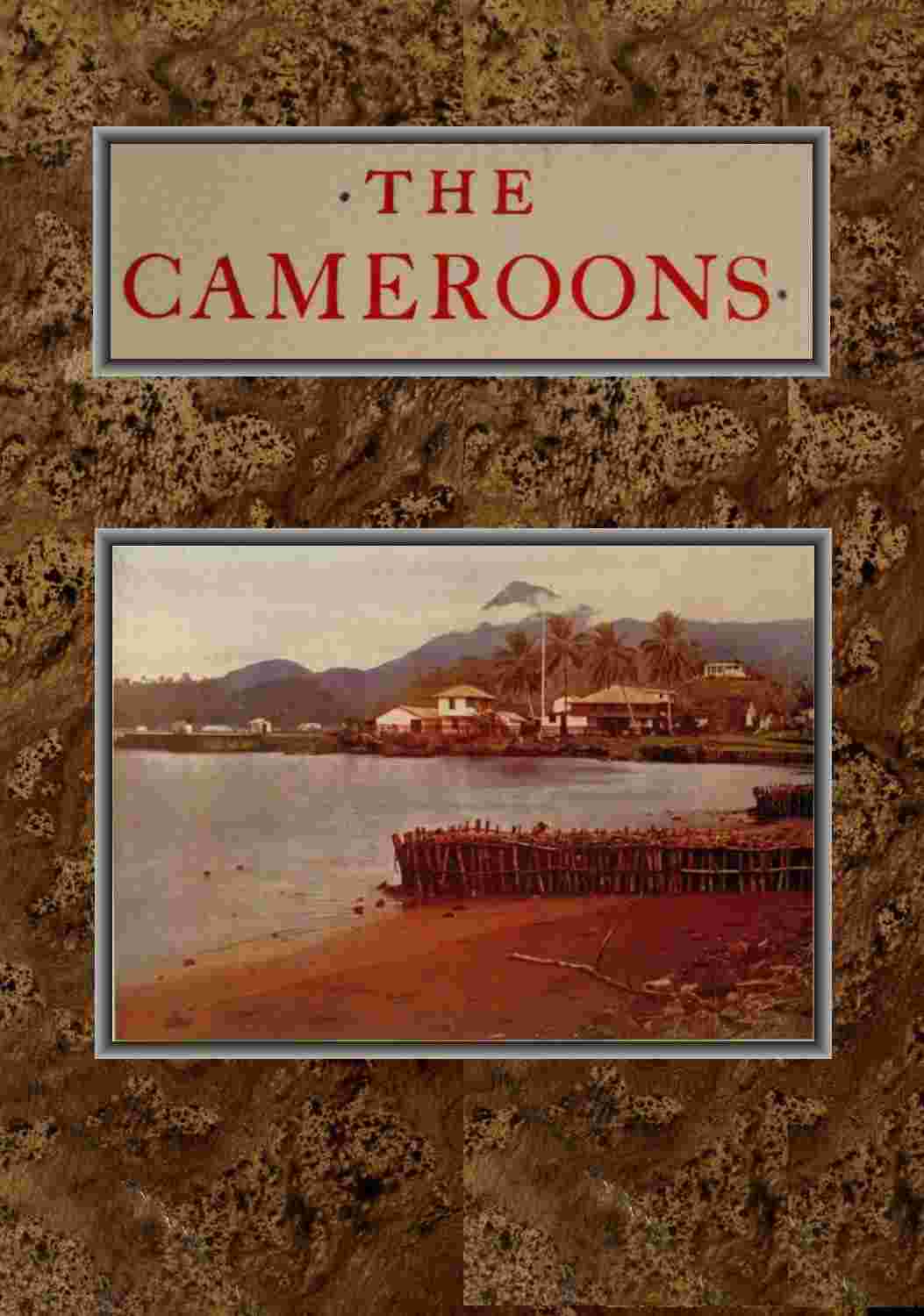
The Project Gutenberg eBook of The Cameroons
Title: The Cameroons
Author: Albert Frederick Calvert
Release date: February 14, 2021 [eBook #64553]
Most recently updated: October 18, 2024
Language: English
Credits: Chuck Greif and the Online Distributed Proofreading Team at http://www.pgdp.net (This file was produced from images available at The Internet Archive)
|
List of Illustrations (etext transcriber's note) |
THE CAMEROONS
THE
CAMEROONS
BY
ALBERT F. CALVERT, F.C.S.,
Knight Grand Cross of The Royal Order of Isabel
the Catholic, Knight Grand Cross of The
Royal Order of Alfonso XII., etc.
AUTHOR OF
The German African Empire, South-West Africa,
Nigeria and its Tinfields, The Political Value of our Colonies,
The Exploration of Australia,
Mineral Resources of Minas Geraes, Brazil, etc.
London:
T. WERNER LAURIE, Ltd.,
8, Essex Street, London.
1917.
E. Goodman & Son, The Phœnix Press, Taunton.
PREFACE.
ALTHOUGH the designs, which German philosophers conceived and German statesmen and strategists spent thirty years in perfecting, for the conquest of our Cape territories and the creation of a Greater Germany extending from the Mediterranean to Table Bay, are best illustrated and exposed by the defiantly defensive policy they pursued in South-West Africa, the rise, development and fall of the German Colonial Empire is more completely epitomised in the chapter dealing with the Cameroons.
The establishment of the German East African protectorate forms a story that is intensely interesting, inasmuch as it reveals the duplicity of Teutonic methods in their relations with native races, European rivals and their own agents. Bismarck, the last barbarian of genius, repudiated Dr. Karl Peters when, equipped with private capital and acting on his own initiative, he was acquiring in the hinterland of Zanzibar a well-watered, fertile province equal in extent to South Germany, and obtaining from the Sultan the concession for the ports of Dar-es-Salaam and Pangani. It was necessary in 1884 for Germany to assure England that the Imperial Government had no intention of securing possessions in a region which was admittedly within Britain’s sphere of influence, and Bismarck pursued Dr. Peters to Africa with an official intimation that the State would not grant him protection for the lives of his party, or for any possessions he might acquire opposite Zanzibar. But when the intrepid Teuton, as the representative of the German East Africa Company, had accomplished the spade work and returned to Berlin, the Government continued negotiations with the Sultan through their Consul-General at Zanzibar. The formal ratification of the treaties made in the name of the Company, was followed by a revolt of the Arabs, and when the Company’s representatives had been allowed to be murdered or put to flight, Bismarck was able to declare that the situation that had arisen was beyond the control of private enterprise, and an expedition, under Major von Wissman, was accordingly despatched to East Africa to suppress the slave traffic which still flourished in that region. For the furtherance of such a humane and civilising purpose, the co-operation of the British fleet was readily enlisted, and with this support and the energetic measures taken by von Wissman’s army of ex-British native soldiers, the disaffected populace was eventually “pacified,” even if the slave traffic was not suppressed. The Company’s claims to the territorial concessions granted under the treaties having been made good—Great Britain could not, in politeness, protest against the acquisition of Mount Kilimanjaro, since the amiable Kaiser had expressed a sentimental wish that the highest peak in Africa might be within the sphere of German kultur!—the Reichstag voted ten and a half million marks for the maintenance and development of these newly acquired territories. Then, and not until then, did England realise that with the connivance of Downing Street and the assistance of British men-of-war, this rich and important territory, with an area of 384,000 square miles, had become a Protectorate of Germany. Having duped England, punished the natives, and established their rule, it was only necessary to recall Dr. Peters and hand him over to the tender mercies of his official and political enemies, to make this chapter of the history of German empire building characteristic in its completeness.
What Germany succeeded in doing in East Africa after years of intrigue and deceit, and the expenditure of much blood and money, she accomplished in the acquisition of Togoland with a minimum of cost or trouble. Dr. Nachtigal, in the capacity of German Trade Commissioner, was sent to West Africa by his Government to enquire into and report upon the progress of German commerce in those latitudes. He was despatched at a time when the English Government had completed their leisurely deliberations upon the appeal of the peoples of Togoland and the Cameroons to be taken under the protection of the British flag, and Mr. Hewitt, a British Consul, was voyaging to the Gulf of Guinea for the purpose of complying with the native request, when Nachtigal arrived there on his commercial mission. The German Commissioner, acting under instructions from the Imperial Chancellor, hastily unfurled the flag of the Fatherland at Lome, in Togoland, and succeeded in reaching Duala, and formally placing the Cameroons under German rule, before Hewitt arrived upon the scene. Lord Granville addressed a reproof to Bismarck for not having divulged the nature of the errand upon which Nachtigal had been sent, and the incident was closed. In the three decades that followed, the German administrators in Togoland, with the thoroughness with which the Teuton is gifted, taught the natives the “sharp lesson” considered necessary to prepare them for the reception of Germany’s civilising rule, furnished the colony with 200 miles of railway, over 750 miles of excellent roads of native construction, a score of postal and telegraph stations, and a telephone system, and established a wireless station—the most powerful in the world outside Europe—which was not only in communication with Berlin, 3,450 miles distant, but with East Africa, the Cameroons and South-West Africa. The final installations at Kamina were completed in June, 1914; in August the German operators learnt by wireless that Great Britain had declared war on Germany; and on 26th August the Kamina Station notified Berlin that the colony of Togoland, the smallest, completest, and only financially independent German possession, had capitulated to an Anglo-French force.
The German annexation of South-West Africa was a more intolerably humiliating and provocative act of aggression; it is one that only now—after the territory has been recovered by the brilliant campaign of the Union Army under General Louis Botha—can be forgiven Lord Granville. Prior to 1883 the natives of Damaraland and Namaqualand, suspicious of the intentions of Germany, had petitioned to be taken under British protection. Downing Street experienced a temporary uneasiness, but Bismarck’s assurance that Germany had no intention of establishing Crown colonies in Africa, extinguished the fleeting distrust. The Cape Colony was not so easily satisfied. A British Commissioner, who was appointed to confer with the native chiefs, reported favourably upon the proposal to officially confirm the authority of the Cape Government over the region extending northward from the Orange River to Portuguese Angoland. Sir Bartle Frere, the Governor of Cape Colony, urged upon the home Government the desirability of the step, and the Colonial Office decided upon the formal acquisition of the port at Walfisch Bay. Bismarck, hesitating to commit what might be construed as a deliberately hostile act, invited Great Britain to state her intentions with regard to the rest of the south-west territory, but failing to receive any definite reply, he decided upon bold if impudent measures, and in April, 1884, the Chancellor announced that the territory north of the Orange River was under the protection of the German Empire. As Bryden says, in his History of South Africa, “it was an unfriendly act, carried out in an unpleasant manner, and the British Colonists in South Africa are not soon likely to allow it to pass out of remembrance.” It not only destroyed the symmetry of a British South Africa, and gave Germany rights in territories marching with British colonies, but it added 322,450 square miles of African territory to the German Colonial Empire, for which a Bremen merchant named Luderitz parted with a hundred pounds and a score of old muskets.
Germany’s method of developing her new possession in South-West Africa was entirely in keeping with her manner of acquiring it. From the first she proceeded to colonise on military lines. Railways were constructed with regard to their strategic importance; they were made on what is still called the Cape gauge; and were directed towards the Union border. A standing army was raised and compulsory service was instituted. An artillery depot established at Windhoek, the capital, contained a worthless collection of old gun-carriages and bales of locally-collected hay. This was to secure the colony against the imaginary evil intentions of the inoffensive and unarmed Ovambos, who inhabit the north-east corner of the colony. At Keetmanshoop, some hundreds of miles further from Amboland, but within 150 miles of Cape territory, was a great arsenal, furnished with guns and shells, rifles and cartridges, ambulances, transport vehicles, and military stores and supplies sufficient to equip and maintain an army of fifteen thousand men for two years. In the face of these facts and figures, we may be forgiven for doubting the honesty of the German Colonial Secretary’s denial that Germany ever had any intention of occupying, either permanently or temporarily, the territory of the South African Union, and of disregarding the expression of Lord Haldane’s pious belief that the Kaiser’s life’s purpose was “to make the world better,” and that in Germany’s method of colonial expansion, “she was penetrating everywhere to the profit of mankind.”
In some ways the story of Germany’s annexation of the Cameroon provinces, and her subsequent extension of that area, is the most interesting of all, because if she secured her footing in East Africa by subterfuge, and in South-West Africa by the exercise of sharp practice supplemented by a certain display of bold decision, she edged her way into the Gulf of Guinea by virtue of no other quality than that of sheer bluff, but, having consolidated herself in the positions she had thus gained in West Africa, she allowed the world to understand that she was determined to expand her sphere of influence, if necessary, by recourse to arms. In 1885 Germany legalised her occupation of the Cameroons by placating France with an exchange of unimportant territories, and renouncing in favour of Britain her nominal claims to St. Lucia and to Forcados, at the mouth of the Niger River.
Having thus solidified their position, and secured themselves against what Passarge calls “the intrigues and provocations of the English,” the German administrators proceeded to Germanize their new province and systematically to develop its tropical resources. Although they established customs houses, courts of justice and post-offices, and constructed about 125 miles of a projected railway system of 285 miles, and, between 1898 and 1911, increased the total trade of the colony by nearly forty million marks, the colony did not prove a departmental or material success. The staffs of the Experimental Institute of Agriculture at Victoria and the Department of Agriculture at Buea, devoted their energies to the scientific raising of tropical economic plants, to experiments in plantation culture, and to the training of young natives in the virtues of Teutonic industry and organisation, while, by Government Proclamation, all native children were compelled to attend the Government schools, acquire an intelligent knowledge of the language and history of Germany, and practice the art of singing German patriotic songs. Despite this paternal concern for the agricultural and educational well-being of the natives, the application of German methods proved a disappointment. The children at the end of their school course considered themselves too superior to undertake manual labour, while the men, resenting the German indifference to their national feeling and inherited methods of work, developed the spirit of native unrest. A lack of sympathetic understanding of the natives was attended by culpably injudicious treatment of them by the German officials, and the relations between the authorities and the aborigines led to the frequent employment of the Imperial troops, while the inadequacy of means of internal communication rendered the progress of “one of the most productive countries in the world” both slow and difficult.
But, disappointing and costly as was the German failure to administer and develop the Cameroons, the Teutonic lust for territory was unabated, and, in its resolve to extend its holding in this quarter of the globe, the Government did not hesitate to emperil the peace of Europe. When the German cruiser Panther appeared at Agadir, in July, 1911, the object of the Wilhelmstrasse was not to protect purely imaginary German interests in that part of Morocco, but to maintain a menacing attitude that would compel the French to cede to the Bully of Europe their territory to the south of the German Cameroons. The negotiations for the transfer were concluded in June, 1913, and fifteen months later French and British troops commenced a joint expedition to wrest from the German authority, by military means, the province from which the former had been ejected by diplomatic blackmail and the insistant rattle of the sword in the scabbard.
It is instructive to recall the methods by which Germany acquired her African possessions, if only for the partial answer it provides to the question as to what the Allies intend to do with them. It is absolutely certain that however the Allies agree to dispose of the four colonies in question, they will never be restored to Germany, notwithstanding the fact that Herr Dernburg has committed the Emperor to the pledge that he will never consent to make peace except on terms which include their surrender. Germany got into Africa as a burglar effects an entrance into a well-stored building, but it is not because her gains were ill-gotten that she will be deprived of them. Having experimented in the civilisation of natives for three decades, she has revealed an utter inability to colonise for the benefit of mankind, but the hopeless failure of the German system of imposing her rule upon subject races, is not the reason why she will henceforth be debarred from participation in the work of civilising the world. The colonial possessions of Germany, as well as of England, France and Belgium, form part of the stakes for which all Europe is in arms, and they will become the spoils of the conquerors. As the Imperial Chancellor has announced, the future of the Cameroons will be decided not in West Africa, but in another theatre of war.
Germany’s explanation of her desire to acquire colonies was based upon her need for extra territory capable of supporting her growing population. For this purpose she acquired East Africa, and immediately set about the task of raising, equipping and drilling a large force of black troops. She seized the French Cameroons, and at once increased the handful of natives which the French had found sufficient for the maintenance of order in the colony, to an army of 1,550 black and 185 white troops, and she had planned the formation of additional corps of mounted infantry, and the rearming of all the troops with modern rifles. As soon as wireless telegraphy became a practical means of communication, a wireless station was installed in Togoland which rendered the little colony of inestimable potential value from a military point of view, while in South-West Africa, the extent and completeness of her defensive and offensive preparations, is abundant proof that the real value to Germany of this territory lay in the proximity of the region to the Boer States, disaffected to Great Britain. “The land was not taken for bona fide colonisation,” wrote the Rev. William Greswell over thirty years ago, “only as a point d’appui.” Germany pushed forward her military preparations in East, West and South Africa, as she did in Prussia, because she had convinced herself of England’s ultimate inability to hold India, Egypt and her colonial dominions. Her professors assured the Kaiser and his junker parasites, that the English had lost both “the qualities of creative genius in religion and the valour in arms of a military caste”, that we had become “a timorous, craven nation, trusting to its fleet”; and that, while we had “failed to impress our dominion” on the chiefs of the Indian Tributary States, the colonies were “shivering with impatience under the last slight remnant of the English yoke.”
Because of their arrogant attempt to put their theories and their conclusions to the test, the German people are being stripped of all their overseas possessions. They have already lost their South-West Protectorate and Togoland, and the Allies are now successfully engaged in crushing German resistance in Eastern Africa. It is not my purpose in this little book to follow the fortunes of the Allied troops; it will be time enough to write the story of the campaigns when the task is accomplished, and the future administrations of the colonies are in operation. My object in the following pages is to give the public the particulars about the Cameroons which I have collected not without the expenditure of a considerable amount of time and trouble. A natural desire to ascertain the nature of the difficulties that would have to be surmounted by the allied forces, and a desire to learn something of the natural resources and commercial potentialities of the territory that was about to be acquired, sent me to bookshops and libraries in search of works that would satisfy my curiosity. I was disappointed to find that the information I wanted was not available in English form, English authors having decided, apparently, that the colony did not lend itself to interesting or marketable compilation, and since the British Government had not accredited a Consul to the Cameroons, not even a belated Consular Report was procurable. In this extremity I turned my attention to such German publications as were obtainable in this country and, from the official writings of Dr. Paul Rohrback, Dr. Grotefeld, Dr. Paul Preuss, Dr. Walter Busse, Herr Eltester, and Siegfreid Passarge, I gathered a mass of information concerning the geographical and geological features, the vegetation and forestry, and the natives and native cultivation, together with an interesting summary of the progress made under the German system of development and the success they had attained in their experiments in plantation cultivation. In a paper written by Captain W. A. Nugent, R.A., who had been a member of the Boundary Commission in 1907, and acted as British Commissioner appointed to survey and fix the boundary between the German Cameroons and Nigeria in 1912, I found a full and admirable description of the territory traversed. This volume contains the result of my researches, selected and arranged in such a manner as will, I trust, be found acceptable to English readers who share my curiosity concerning the natural resources, the commercial position and the prospects of the colony, and who also entertain the hope that part of it, at least, will ultimately form a link in the chain of British overseas dominions.
ALBERT F. CALVERT.
Royston,
Eton Avenue, N.W.
CONTENTS
| PAGE | |
| Discovery and Exploration | 1 |
| Plantation Cultivation | 24 |
| Native Education | 56 |
| The Cameroon-Nigerian Boundary | 62 |