
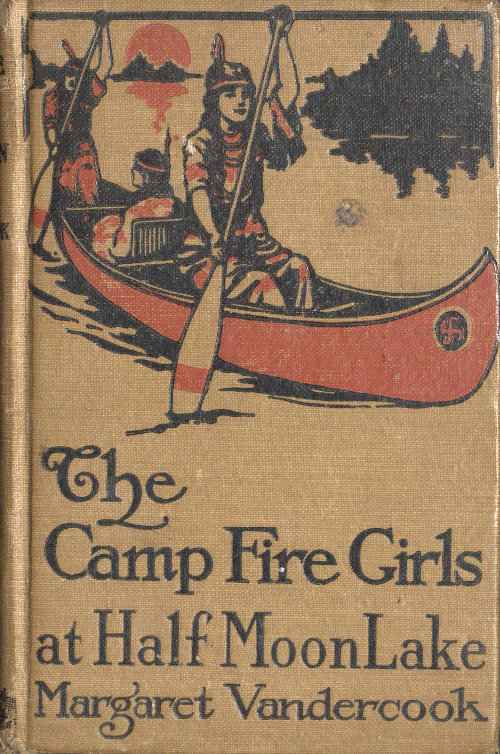
The Project Gutenberg eBook of The Camp Fire Girls at Half Moon Lake
Title: The Camp Fire Girls at Half Moon Lake
Author: Margaret Vandercook
Release date: July 15, 2018 [eBook #57508]
Language: English
Credits: Produced by Stephen Hutcheson and the Online Distributed
Proofreading Team at http://www.pgdp.net
“I Am a Stranger in This Locality,” He Explained.
THE
CAMP FIRE GIRLS
AT
HALF MOON LAKE
BY
MARGARET VANDERCOOK
Author of “The Ranch Girls” Series, “The Red Cross Girls” Series, etc.
ILLUSTRATED
PHILADELPHIA
THE JOHN C. WINSTON CO.
PUBLISHERS
Copyright 1921, by
The John C. Winston Company
STORIES ABOUT CAMP FIRE GIRLS
List of Titles in the Order of their Publication
- The Camp Fire Girls at Sunrise Hill
- The Camp Fire Girls Amid the Snows
- The Camp Fire Girls in the Outside World
- The Camp Fire Girls Across the Sea
- The Camp Fire Girls’ Careers
- The Camp Fire Girls in After Years
- The Camp Fire Girls at the Edge of the Desert
- The Camp Fire Girls at the End of the Trail
- The Camp Fire Girls Behind the Lines
- The Camp Fire Girls on the Field of Honor
- The Camp Fire Girls in Glorious France
- The Camp Fire Girls in Merrie England
- The Camp Fire Girls at Half Moon Lake
CONTENTS
- Chapter Page
- I. Indian Summer 7
- II. Half Moon Lake 19
- III. Old Friends 29
- IV. The Hermit 43
- V. A Conversation and a Loss 57
- VI. “A Man for a’ That” 72
- VII. Friendship 83
- VIII. Midwinter 92
- IX. The Poet’s Corner 107
- X. Holiday Guests 116
- XI. Juliet Temple 128
- XII. Friends That Were 142
- XIII. Anxious Waiting 154
- XIV. Christmas Eve 162
- XV. Romance 173
- XVI. An Encounter 195
- XVII. Closed In 204
- XVIII. Spring 212
ILLUSTRATIONS
- “I am a Stranger in This Locality,” He Explained Frontispiece
- PAGE
- For a Moment the Man Stared in Silence 59
- Sally’s Hands Beat Against the Closed Door 160
- “I Wish You Would Help Me About Something,” She Said 189
The Camp Fire Girls
At Half Moon Lake
CHAPTER I
Indian Summer
Two girls were following a narrow trail.
About them the woods were scarlet and flame, golden and bronze, and in contrast the blue-green depth of tall pine and cedar trees.
Down a steep hill the trail led; on either side a thick underbrush of wild grapevines and blackberries that twisted and sprawled, showing shriveled clumps of seed pods where formerly the fruit had ripened.
One of the girls, wearing a corduroy costume of hunter’s green and a tam-o-shanter of the same shade, was carrying a rifle, while over her shoulder hung a brace of rabbits and half a dozen quail.
Following close behind her the second girl’s costume was of the same character, a short skirt and coat with leather leggings and high boots, but of dark blue.
“Do you think we are lost, Gill?” she inquired cheerfully.
Her companion shook her head.
“Well, as David Murray says, we are where we shouldn’t be and don’t know where we are, but I should never call that being lost, would you, Bettina?”
Grasping a small birch tree firmly so as not to be obliged to continue her descent, and forcing Bettina to imitate her example, Gill turned halfway around.
“To get down this hill and find our camp before dusk I suggest that we follow the fashion set by ‘The Waters at Lodore’. I am not sufficiently literary to recall the exact lines of the poem, I leave that to you, Princess, but there was something about their dashing, splashing and tumbling, something quick and active, and in contrast to our methods for this past hour. Farewell, valor at present is the better part of discretion, to transpose the axiom.”
As she ceased speaking, releasing the slender young tree and bracing her feet together, Mary Gilchrist began to slide down the steep incline.
In the heart of the Adirondack forest it was now early in the month of November and about four o’clock in the afternoon. Overhead the sun was still shining and the sky a warm blue, yet from the ground arose a light mist, playing in and out amid the underbrush and the bases of the trees, ethereal and evanescent, the floating draperies of unseen fairies holding an autumn carnival.
Bettina Graham continued her downward progress more slowly and cautiously.
Over the trail beech leaves and birch leaves and the long fingers of the pine had blown in little drifts of amber and green which, mixing with the decaying wood and wet earth, formed a slippery aisle.
Ten minutes elapsed before Bettina rejoined her companion. She then discovered Mary Gilchrist seated upon an overturned log, her gun and game on the ground beside her, her hat in her lap, while she shook bits of brushwood, twigs and leaves from her hair and removed them from her apparel.
The autumn sun shone through an arch of branches overhead on the red-brown of her hair, on her eyes so nearly the same color, on her healthy, lightly freckled skin, and her full, irregular lips.
“I am glad the turn in the trail concealed the latter part of my prowess as a mountaineer, Bettina. I certainly came down swiftly enough toward the end. In fact, I had hard work holding on to my rifle,” Gill announced, shaking her head a second time so that a bronze leaf slid on to the earth. “But if I lost my dignity I did not lose my gun or game.”
“You are not hurt, are you, Gill?” Bettina asked, looking with admiration and amusement at her companion.
Then as she shook her head:
“Do you know, Gill, it has been a curious fact in our Camp Fire life together, living as we have for the past few years in different places and under such a variety of conditions, to find here and there one of us discover the environment for which she must have been intended. Vera Lagerloff and Alice Ashton, for instance, were at their best when doing reconstruction work in France. You, Gill, were very busy and useful over there, and yet no one has known the real you until these past few weeks in the mountains. Yet why should this be true when you lived all your past life in the western prairie country until your desire to drive a motor in France led you to join our Camp Fire and help with the relief work?”
“I sometimes feel that I have not yet found my true environment. Do you remember the wonderful new play Tante read aloud the other evening, ‘Beyond the Horizon’, whose theme is that each human being must live in harmony with his own nature, else he will never find happiness or success?”
Mary Gilchrist smiled.
“I remember it after a fashion, but, Bettina dear, please don’t ask me to understand literary subtleties. You know there is no one in the world who cares less than I for books, although to my shame I confess it, but I don’t believe I ever read or studied voluntarily save when I thought it my duty. Every interest with me is an outdoor interest and I confess I have never loved any place so well as these Adirondack forests. Somewhere in my past I must have had an Indian ancestor, not a squaw, but a great chief who roamed these hills, hunting and fishing, sleeping and living outdoors when it was possible, because I feel at present as if I never wished to do anything else, except perhaps see my friends and family now and then. But enough of conversation, Bettina, woodsmen or woodswomen we have been told were a silent race and we must learn the law of the woods. What I really would like to know is in what direction we should travel to reach camp in the shortest length of time. We have been following a deer trail I believe that has led us nowhere. However, we cannot be many miles out of the way. We must move now toward the west, and, Bettina, let’s not separate again, you know you have no sense of direction once you are more than a mile away from camp.”
Unable to dispute this assertion, Bettina Graham, who was beginning to grow tired while her companion appeared as fresh as when they set out, followed obediently beside her.
A half hour longer they walked, Gill rarely hesitating, although keeping her compass in her hand and glancing at it occasionally, when suddenly both girls stopped short.
They were not alone in this portion of the woods. Not far off some one else was moving, finding the way slowly and uncertainly.
Mary Gilchrist glanced at her rifle, which she carried with skill and assurance.
“I cannot imagine who can be in the woods at so late an hour. I must try and find out.”
Placing her fingers on her lips the girl uttered a shrill, clear call.
Silence.
A moment later she repeated the call.
Then both girls heard a voice shouting in a tone of mingled terror and relief.
“I have lost my path. Won’t some one come and find me? I can never manage to reach you.”
The girls exchanged glances.
“A lost knight in the dark forest, Bettina! Well, these are the days when women are the modern crusaders, so let us to the rescue!”
Not many minutes after, the two girls came upon a young man of about twenty lying gracefully outstretched on the ground upon a fragrant bed of balsam, with an open book in his hands.
As Bettina and Mary drew near he arose.
“I was resting,” he explained, “knowing that you would have less difficulty in discovering me if I remained quiet in one spot.”
His manner was so self-possessed and self-assured that Bettina smiled, observing, however, that Gill appeared annoyed.
Small wonder! Their faces were flushed, their clothes covered with brambles from their search, while he showed no sign of discomfort. His hair, worn longer than was usual, was of a bright gold, his skin pallid and his cheeks slightly sunken, making his long, curiously shaped gray eyes more conspicuous.
“Yes, one can see you have not disturbed yourself,” Gill returned. “Yet if you wish to be out of the woods before twilight, you had best make some effort. Fortunately I discovered the trail we were seeking while looking for you. Please follow me.”
She turned sharply and moved off, her figure vanishing between the trees, every inch of her body alert, vigorous, almost boyish, with her rifle and game over her shoulder.
Nevertheless the newcomer glanced at her with an expression of disapproval, while his eyes sought Bettina for sympathy.
“I am a stranger in this locality,” he explained. “I intend spending the winter at a cabin in one of the clearings. ‘Long, long is the autumn dream in these corridors of heaven’,” he quoted.
“Yes, I know,” Bettina answered; “still, I think it might be just as well not to discuss the beauty surrounding us for a short time and follow our guide. You cannot depend on me and I am sure you appear to be an equally unreliable woodsman. Gill,” Bettina called, realizing that Gill was walking more rapidly than usual and that they might be forced to run rather than lose sight of her.
Out of breath they both were when finally they caught up. A few yards farther on, the path broadened, leading between an avenue of sugar maples raining golden leaves.
“You have been hunting,” the young man remarked in an effort to induce Mary Gilchrist to behave as if she were aware of his existence.
The fact was too obvious to require an answer, notwithstanding Gill nodded.
“Do you actually mean you have shot and killed those pretty little things yourself, those gentle, furry rabbits with their soft eyes and cotton tails and the quail one can hear calling to one another with their sweet, throaty notes? The wild animals one might be willing to destroy, although I scarcely think that fair in their own haunts. Surely a portion of this world should be reserved to them as well! But even when one reconciles oneself to the idea of a man hunting, the thought of a woman or girl being willing to kill is beyond my conception.”
Bettina saw the hot color flood Gill’s cheeks, saw her bite her lips.
“Well, you may now broaden your conceptions! I have been hunting since I was a little girl, was taught by my father a good many years ago. Do you know I have an idea, that were we to invite you to have dinner with us to-night, no one would enjoy the game I have just killed more than you. There are so many people in this world who like to sentimentalize and leave the hard work to others, while they enjoy the results. You were quite willing to remain on your couch of balsam needles this afternoon while we scoured the woods in search of you. Your plan is an excellent one, so long as it is successful. Never do the difficult or disagreeable tasks; always find some one to do them for you.”
Ordinarily gay and sweet tempered, Bettina glanced at the younger girl in surprise.
If Gill were wounded by the stranger’s speech, her revenge had been swift and sure. Evidently her point had struck home, since, although he appeared angry, he made no reply.
By this time they had reached a spot so near their camp that Bettina herself recognized the environment.
A white birch tree stood alone in a small clearing, rising thirty feet in the air; on this autumn afternoon the foliage was still so dense that one could barely see the light between the thick branches.
Their path led past this tree only a few yards away.
The three of them paused.
Issuing from between the leaves came the note of an animal, or bird, wild and plaintive, yet unfamiliar.
In an instant Mary Gilchrist loaded her rifle, lifted it and fired.
The same instant Bettina gave a quick cry of warning. The next a small figure fell from the tree, limp and headlong as a wounded bird.
CHAPTER II
Half Moon Lake
Bettina had the little figure stretched out with the head sloping downward and was opening her first aid kit with trembling fingers when the others reached her.
Blood was staining the little girl’s Camp Fire dress and bright crimson sweater.
“Get me some water at once, I don’t believe the wound is serious. You can trust me, I am studying surgery.”
Bettina was gone for several moments.
On her return she saw that the little victim’s eyes were open and that she was attempting to talk. The wound had proved only a flesh wound and the shot had not lodged in her arm, notwithstanding, their new acquaintance was making a careful investigation.
A few feet away Mary Gilchrist stood, never having moved, or offered a word of apology, or of fear, or remorse. The face was an odd one, animated, filled with color and life; it was charming, yet once the color and animation departed, except for the fine eyes, the face was plain, the features were so irregular, the nose sky tipped, the lips too full, the chin revealing more character than beauty. Extremely pale, her expression at present was more sullen than sorrowful.
“Let me walk back to camp, I should like it better,” the little girl insisted, when Bettina and the stranger had volunteered to carry her. Her arm was bound and hung in an improvised sling.
Not many yards further on the smoke of a camp fire could be seen in the late afternoon haze.
The small procession walked three abreast with Mary Gilchrist a few steps behind.
“We, too, plan to spend the winter in the Adirondacks, with our Camp Fire club, our guardian and a few relatives and friends,” Bettina explained. “We have a beautiful camp on Half Moon Lake, but you will soon see for yourself! The arrangement is a good deal of a surprise. After a summer in England[1] we intended to make a trip through Ireland, but after a few weeks found the country so unsettled we decided to sail for home. Most of us were really very glad. I was, because I had discovered this little girl in Ireland by that time. Chitty I told you was a Lancashire girl, the daughter of a miner. She lived with us in England and then ran away with her father to Ireland, so we never expected to see her again. Her name is really Elce. Chitty is a queer, Lancashire word that means a tiny, black kitten and was a title the miners gave her, as their mascot. But the name does not suit; Chitty is a blackbird and has a magical voice.”
Bettina Graham smiled down at the little girl of about twelve years of age, whose uninjured arm was slipped through hers.
“We are now in sight of our camp. See, is it not lovely as I said? The Indians call this locality ‘Place Where the Storm Clouds Met in Battle with the Great Serpent.’ We call our camp, ‘Tahawus,’ which means cloud.”
The young man whistled softly.
They were descending a low hill, sparsely covered with beeches, poplars and birch trees and a few evergreens, where but the thick growth evidently had been cleared away. The hill led down into a narrow valley, a broad stripe of shining ribbon. In the center lay a lake upon which a motor launch and several row boats were washing softly to and fro. Beyond Half Moon Lake rose an extraordinarily high mountain with files of spruce trees stationed like sentinels up and down. Over the mountain at this hour showed the first pale glimmer of a crescent moon. About an eighth of a mile from the lake stood a wide, low cabin built of logs with a generous veranda. Beside it were two smaller cabins of perhaps only two or three rooms, but connected with the large house by enclosed runways.
In front of one of the smaller houses a camp fire was burning. Wreaths of smoke were curling out of the chimney of the central cabin, as in spite of the Indian summer days, the autumn nights were cold.
Several girls in Camp Fire costumes were preparing the evening meal over the open fire, while three older women were walking slowly up and down at no great distance away.
“You will stay and have dinner with us?” Bettina said cordially. “We both are strangers to the life of the woods, yet hospitality is one of its first laws. By the way, I have not told you my name, nor have you told me yours. I am Bettina Graham, my father is Senator Graham of Washington. My friend is Mary Gilchrist. Gill, won’t you speak for yourself? Do come and walk beside us.”
But Mary Gilchrist made no rejoinder, nor did the newcomer urge her. To Bettina his manner if a little abstracted was perfectly courteous, but between him and Mary Gilchrist the antagonism, born of their meeting, her recent impulsive action had augmented.
“My name is Drain, Allan Drain. I beg your pardon, I did not realize I had not introduced myself. I believe I did tell you I was studying surgery. The choice is not mine, it is what my family wish for me, not what I wish for myself. I want to be a poet, a great poet. I am almost glad my health has broken down so I am forced to spend this winter alone amid the everlasting hills.”
Bettina felt slightly embarrassed, but need not have concerned herself as she was not in her companion’s thoughts.
Entirely self absorbed, he had thrown back his head, showing that his features were strongly marked, his nose prominent, the cheek bones high.
It struck Bettina that his star gazing at present was inward and at his own dream of his own star. He seemed a vain and not a practical person. If Gill’s estimate of his character were severe, yet it might hold a germ of truth.
“Then why do you study surgery?” Bettina demanded. “Still if one is a poet, a real poet, I do not believe another profession can keep one from fulfilling his gift. One might not write so much poetry, but it might be all the more beautiful.”
Her companion shook his head.
“No, you are altogether wrong; that is what too many people argue. A poet must live his own life in freedom and among his dreams. But one must eat, for even poets require food. My own people are poor, but I have an uncle who is a distinguished surgeon and, as he has no children, wants me to follow in his footsteps, and is willing to pay for my education. Don’t think I do not see the greatness of surgery, but I am entirely unfitted for the profession and the life is too difficult. I don’t like an active existence; perhaps your friend was right: I may prefer to leave the hard tasks to others and only enjoy the results of their effort.”
Tahawus camp was now only a few yards away. Bettina turned and moved back a few paces to join her friend.
“Gill, go to your own room at once if you prefer. I will explain how the accident occurred. Of course you had no way of guessing, but it may be painful to have to confess before so large an audience.”
Mary Gilchrist shook her head.
“No, Princess, you are kind as ever, but I must do my own confessing. I feel as if I had no right to continue a member of our Camp Fire after my behavior, when all my life I have been warned against just such recklessness. Why, except for the good fortune I did not deserve, I might have—” but here Gill faltered and stopped.
She then moved on ahead and Bettina saw her pause before the group of older women. A moment after they were listening to her story.
Half an hour later Bettina joined her in her cabin, in the meantime having introduced the young poet to Mrs. Burton, the Camp Fire guardian, to Miss Patricia Lord, and to her own mother.
She discovered Gill sitting on the edge of her bed.
“I am to talk over matters with Tante in the morning when we can be alone. Of course she was very kind. Aunt Patricia, however, told me what she likes to call the plain truth. Bettina, do you think it my duty to leave this fairyland as a punishment for my behavior? Perhaps if I remain I shall only get into a worse difficulty! Have you ever in your life met anyone you disliked so instinctively that you felt assured the influence over you could only be for evil? You may think me absurd as you like, but the young man we met by accident this afternoon immediately had that effect upon me.
“I trust I may never see him again, in fact I mean to make an effort not to see him. I’ll not come to supper, I do not wish for any. You may give him my share. One thing I do know we ought never to be brought into contact with each other, and yet now he is apt to appear at camp at any moment and I shall be responsible, since you would never have been able to discover him had you been alone!”
Suddenly Gill’s chin went up and her color returned.
“You don’t think I am cruel really, do you, Bettina, more so than the other girls? I only shot the game because I heard Aunt Patricia say Mrs. Burton required it and there was no chance to buy fresh provisions until the end of the week. However, I don’t believe I shall ever hunt again. Perhaps in any case I had best not spend the winter at Half Moon Lake; after all, I may be happier at home! There are in my character certain faults the Sunrise Camp Fire has not yet found out. We were too busy in France to think of ourselves or of each other.”
Bettina smiled.
“Why, Gill, what a depressed mood you are in! It is most unlike you. Small wonder you do not like our poet if already he has had this influence upon you! By the way, he is having a beautiful time at this moment with Tante and mother and I don’t believe will ever trouble any of us. It strikes me that he feels entirely superior to girls and requires an older audience to appreciate him. Farewell, of course I’ll bring you your supper. Chitty is not suffering in the least and things will adjust themselves in the morning when the poet shall have disappeared and been forgotten.”
“There is no hope of his disappearing,” Gill returned disconsolately. “One does not so readily dispose of one’s evil genius.”
However, she joined with Bettina’s laughter at her expense.
CHAPTER III
Old Friends
“Well, thank goodness our youthful guest has departed at last. I was fearful that he would stay so long we could not have our hour together before bedtime. It is a magical night; do you suppose it would do you any harm, Polly, if for a little while we go outdoors? Then perhaps we shall be safe from interruption. I am afraid I am selfish enough to want you to myself now and then, dear, as I used to in the old days.”
“Nonsense, it was I who wanted you, and too often failed to secure you. You were the favorite then as you have been ever since. This evening, for instance, you so charmed the young poet that he completely ignored the girls. In fact, you flattered him as no one of the Camp Fire girls would have condescended to flatter. However, you doubtless have prepared your own punishment, for I am convinced he will expect you to read his poetry.
“Suppose we do slip out of doors for half an hour. I will put on this old fur coat as a protection against the cold, and the night is divinely clear.”
A few moments later the two women, who were among the original group of Camp Fire girls, stole quietly out of the cabin and arm in arm walked down toward the shores of Half Moon Lake.
“I wonder, Betty, how long you will be able to endure the solitude of our winter woods? I trust until after the snow falls; it has been so long since we were together in any intimate way. Yet I’m afraid you’ll soon be growing lonely and anxious for the society life you love and that loves you.”
“Nonsense, Polly! You will not be able to be rid of me so promptly. And why should I be lonely with you and my own Bettina here? Certainly I have seen but little of either of you in these past years when you have been living and working in Europe. So long as my husband remains in the West and my son at college I shall stay with you until you, or more probably Aunt Patricia, drive me away. Do you know, Polly, actually I need to make my own daughter’s acquaintance, to earn her affection and confidence as you possess it. It is true, although I do not enjoy the confession, that I do seem to understand boys better than girls and more easily make friends with them. Tony and I have always been more intimate than I have ever managed to be with Bettina. The Slim Princess, as Andrew calls her, has been her father’s daughter more than mine. Polly dear, how have you managed to be so successful a Camp Fire guardian so many years? Frankly, I did not think it was in you! You were more reserved as a girl, more self-centered than the rest of us, because of course you were a genius, dear, and that means one must lead a more introspective life. Yet you have managed to be an artist and a wonderful Camp Fire guardian as well. How many different temperaments you have seen unfolded, how many girls you have helped through an infinite variety of experiences! I wonder if the other mothers are as jealous of you as I am?”
“Don’t be ridiculous, Betty,” Mrs. Burton answered, none too amiably, since as a matter of fact amiability was not one of her ruling traits of character. “I have simply had a good time with my Sunrise Camp Fire girls, been as much of a friend to them as I have known how to be. And they have borne with my bad health and bad tempers with amazing sweetness and understanding. In truth, you realize, Betty, that this winter in the Adirondacks is not what I had hoped and planned for this winter. With all my heart I wished to go back to my stage work! I had discovered a wonderful new play and was intending to begin rehearsals as soon as I reached New York. Then this abominable illness of mine returned while we were in Ireland. I took a severe cold over there amid the Irish mists. So between my husband and Aunt Patricia Lord and half a dozen doctors, no choice was left me. The Camp Fire girls are here in the mountains with me for my consolation more than for their pleasure, I am afraid. We will have a shut-in winter together in this fairy land. I sometimes wonder what may happen to us after a time when the snows begin and this place is a great ice palace. But surely it is too lovely for me to complain! Look, dear, the evening star is just going down beyond the farthest hill:
“Thou fair-haired Angel of the Evening,
Now while the sun rests on the mountains, light
Thy bright torch of love—thy radiant crown
Put on, and smile upon our evening bed!
Smile on our loves; and, while thou drawest the
Blue curtains of the sky, scatter thy silver dew
On every flower that shuts its sweet eyes
In timely sleep. Let thy west wind sleep on
The lake; speak silence with thy glimmering eyes,
And wash the dusk with silver. Soon, full soon,
Dost thou withdraw; then the wolf rages wide,
And the lion glares through the dun forest.
The fleeces of our flock are covered with
Thy sacred dew; Protect them with thine influence.”
Then was a brief silence; the woods were still at the moment, the two friends speechless and there was only the light lapping of the waters against the shore.
“Polly O’Neill Burton, long ago I was told that Sara Bernhardt could make men and women shed tears simply by reciting the multiplication table or the alphabet. I believe you can accomplish the self-same result. I presume that you feel you have grown stale with these years of abandoning your art, yet I sincerely believe that when you return to the stage you will be the greater artist. No human being with your temperament, Polly, can have passed through the emotional experiences of the years in Europe and not be inspired by them. I am sorry for your present disappointment, sorry you must wait another year to produce the new play, yet when the time arrives I shall be prouder of you than ever!”
“You are a dear, Betty. I hope you are a prophet as well, because sometimes I am afraid that my day as an artist is past. One so quickly is forgotten and I have been away from my audiences for so long a time. However, I don’t intend to be dismal. I am not permitted to be, as a matter of fact, by Aunt Patricia. At the mildest protest on my part, she is unmerciful; I suppose that is why I do my complaining to you, Betty. Was there ever such a character as Aunt Patricia? I believe she grows fiercer in manner and kinder in heart with each passing year. Her reconstruction work in France was so remarkable that the French government wished to present her with a medal of honor, which Aunt Patricia was about to refuse with scant courtesy when I induced her to allow me to write the letter of thanks at the time she declined the offer. There are moments when she is so autocratic I feel I must rebel and yet I am utterly devoted to her and under eternal obligations.”
“So are we all, Polly, since she saved your life in France and may be saving it again with her care of you this winter. So don’t behave like an unruly child. You do manage to keep absurdly young, Polly. Molly, your own twin sister, and I have confessed to each other that we feel ten years your senior. Is it because you are a genius or because you have remained the guardian of the Sunrise Camp Fire girls and been with girls so much that you continue one of them?”
“I decline to answer. Remember, Betty, it was you and not I who captured the young poet’s attention this evening. I wonder if he is to be our nearest neighbor during the winter? I trust not, for I believe he would be of small service should we get into a difficulty. We are more apt to be forced to look after him. By the way, Betty, I am glad the William Blake poem did not invoke a shiver in you. It struck me that the suggestion of the wolf raging wide through the dun forest was unpleasantly suggestive, although we are assured that the wolf has vanished from the Adirondack Mountains as surely as the Indian braves and that only their ghosts haunt their beloved woods.”
Again for a few moments there was a renewed silence, the two friends of many years with their arms entwined about each other continuing to walk up and down contemplating the exquisite landscape under the approaching shadow of the night.
Nearly of the same height, Polly O’Neill Burton, who in social life was Mrs. Richard Burton, was far slenderer than her companion, giving her an effect of greater youth.
Betty Graham, who had been Betty Ashton in former days, had grown from a pretty girl into a rarely beautiful and charming woman, distinguished for her grace of manner and social gifts. She was more beautiful than her friend. Even as a girl Polly O’Neill had never been beautiful in any conventional fashion. Her face was long, her features slightly irregular, with a broad, low brow and delicate, pointed chin. She had a wealth of dusky black hair and amazing blue eyes of swiftly changing color and expression and a wide, mobile mouth.
Once long ago Betty Ashton had said: “One never is aware of the fact that Polly possesses any other features than her eyes and mouth. Her eyes always hold your attention until she begins to speak and then the movement of her lips, the haunting quality of her voice absorb one.”
To-night the figure which moved beside her seemed to be thinner and frailer than at any time since her marriage.
Trying Miss Patricia might be upon occasions, yet at present Betty Graham could only rejoice at the thought of her constant vigilance. Equally devoted she and the Camp Fire girls might be, yet they possessed neither the wisdom nor the authority of Miss Patricia. She remembered that although pliable in small matters, in any question of her art Polly O’Neill had been singularly obstinate. Had she not in her girlhood disappeared from her family and friends and in defiance of their wish devoted herself to her career?
At present would she remain shut up in the winter woods with the new play waiting to be produced and New York City only a few hours away?
“Why don’t you study your new part, Polly, while you are growing stronger? Would it not help to keep you amused?”
Mrs. Burton shook her head.
“No, only make the waiting more trying. I have promised my husband and Aunt Patricia to devote this winter to my health. I shall keep my word, but beyond this winter I have made no promise. Betty, did you hear a strange sound? I am very nervous to-night and seem often to hear voices in the wind and murmurings as if all the fairy folk were whispering together. No, I am not mad; remember, Betty, how nearly I came to being born in Ireland, where not to believe in fairies is to forswear one’s birthplace. Besides, I often try to reproduce the sounds I hear in nature. It is a great training for one’s voice. And this aids one in acting. Suppose we go back now to the cabin. I want to see that my Camp Fire girls are ready for bed. A narrow escape from a tragedy this afternoon and yet Mary Gilchrist, Gill I prefer calling her, is usually the most sensible one of us. One’s guardian angel seems to take a holiday now and then, and yet Gill’s saved her in the end. Good gracious, here comes Aunt Patricia! I vainly hoped she would not discover that we were out of doors.”
Through the darkness a tall, severe figure could be seen moving with long, masculine strides.
“Polly O’Neill, is this the fashion in which you endeavor to regain your health? I presume you go out into the night air because you know it is so particularly bad for you and in order to give additional trouble to the people who are compelled to care for you?”
“It is a warm, clear night, Aunt Patricia. Besides, no one, as you say, is compelled to care for me. When I am so ill as to be especially troublesome I can send for a nurse. Betty and I were just going indoors.”