
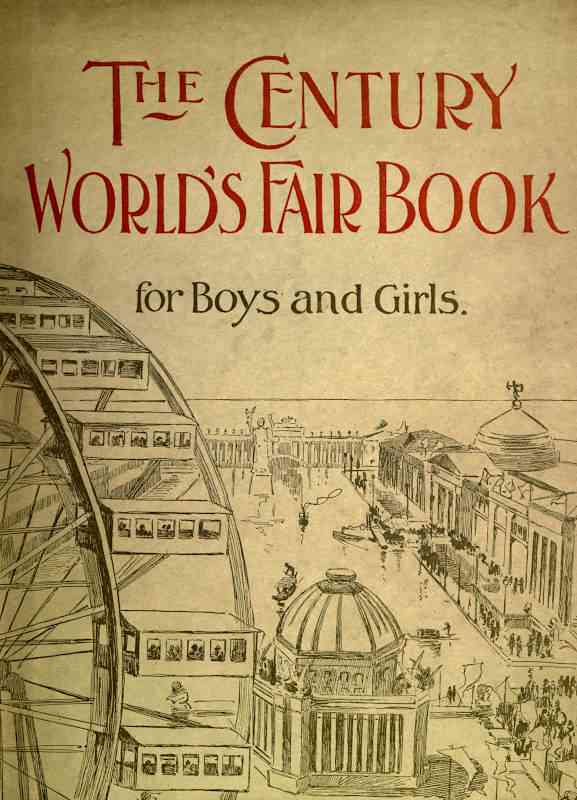
CHAPTER XIX
Mr. Douglass has a Remarkable Experience.
“No, sir; not this afternoon, sir. I’m very sorry, but that’s the orders. We have to be very careful with her, sir. There hasn’t been anybody in it for full two hours,” said the man at the gate.
“But it’s one of the advertised attractions of the Midway, and I insist,” said Mr. Douglass. He had already been in the Ferris Wheel once before, and had not meant to return to it, but circumstances were too strong for him, and here he was, ready to pay, but unable to get a ticket.
“Insist or not,” said the man at the gate; “you can’t get in if you want to; we can’t let you in if we want to. The wheel is sulky, and has been turning slow and ugly like that since noon to-day.”
“But I leave the city to-night,” said the tutor, “and I will not leave without another ride in the great wheel.”
“Very good,” said the man, turning on his heel; “get in if you can. The machinery is out of order, and we can’t stop the wheel—maybe you can”; and he walked off whistling “Comrades.”
The man’s indifference roused Mr. Douglass. “We’ll see,” said he, “whether I won’t have one more ride on the Ferris Wheel!”
After a brief glance around him, his eye caught the sign of the Bedouin encampment. Rushing toward it, he threw a twenty-dollar gold piece upon the counter, told the attendant to keep the change, and was soon in earnest conference with the Arab sheiks.
He gave each a golden double eagle, and they bowed low. “Allah be praised, the white chief’s will shall be done!” they exclaimed.
Then, without losing a moment, the three hurried to the great Ferris Wheel, which still went painfully, jerkily about, with a low growl that boded mischief. But if the wheel was out of temper, so was Mr. Douglass; and, saying “Ready!” to the Arabs, he placed himself between them, one grasping each of his arms. “Let go!” the tutor called; and at the word, the sinewy Arabs raised him from the ground, and, after one or two preliminary swings, hurled him through the air as if he had been a stone from a sling.
Crash! went the tutor through the glass, just scraping his way between two of the iron bars, but landing safely in a car.
“There!” he cried, “I shall have another ride in the wheel!”
Up it went, over, down, and he came slowly toward where the Arabs stood in earnest talk. As he approached, one stepped forward:
“Give more bakshish!” he cried, “or—”
Mr. Douglass shook his head. The Arabs shook their fists. He laughed at them. Then, raging with fury, one turned and said in Arabic to the other:
“Seeme letim sleyd!”
No sooner said than done. Each Bedouin seized one of the gigantic supports that upheld the wheel, and pulled with all his might. They were both well-developed and had a strong pull. With a long pull and a strong pull and a pull all together, they sprung out the supports, the great wheel fell from its place, and the Bedouins, seeing the mischief they had done—and perhaps repenting of it, for they were only hasty, not wicked—leaped upon their priceless donkeys, and were soon lost in the suburbs of Chicago. Unlike the cat, they did not return, and have nothing more to do with the story. But no doubt they often regretted, as they grew older, the hasty outburst of temper that was now to do so much mischief.
For the wheel, with Mr. Douglass an unwilling passenger, dropped to the ground, and rolled slowly up the Plaisance.
Its first victim was the Turkish village, and when the wheel had passed, the village looked like a flat, hand-colored map.
Mr. Douglass, as soon as he saw what the Arabs were at, had climbed out of the car, and, more like a spider than a tutor, made his way to the axle, where he stood upright, walking backward upon the axle as the wheel ran forward. From this well-chosen perch, he could, and did, witness the ensuing scene—which was described by the Chicago reporters as “unusual.”
The Turkish village, being a trifle lumpy, diverted the wheel but little, and the next assault was upon the corner of the Panorama of the Alps. The end of the canvas became entangled in the wheel, and was stretched from one side to the other, so that subsequently many thought that there had been a land-slide when they saw the wheel pass.
Mr. Hagenbeck’s far-famed Animal Show also came in for a share of damage, the wheel crushing one corner of the menagerie, and picking up the small performing-bear in such a way that he was compelled to leap from car to car as each came upright, and walk the wheel as if it were a circus ball. He was rescued unhurt, but considerably fatigued, when the wheel finally—but it was not yet through.
Glancing to the other side of the Plaisance, the Libbey Glass Company was splintered into what one of the Irish dairymaids declared to be “smithereens,” and the monster rolled onward to where the International Dress and Costume Exhibit was situated. Here it broke in one side of the building, and then, catching sight of the contents, with a shriek from every cog fled into the Fair Grounds, cutting its way through the Illinois Central and Intramural bridges, with no more than slight crunches. The bear and Mr. Douglass were still walking their tread-mills, and the Panorama of the Alps still decorated a whole side of the wheel.
But the great wheel, though out of temper, was not yet without feeling. It swerved aside upon reaching the Woman’s Building, plunged into the Lagoon, where, frightened by the squawking of the swans, it shot madly toward the Government Building. Probably it would have gone entirely through except for the fact that the Department of Justice lay directly in its course. It could not face the stern portraits of judges upon its walls, and, destroying only the big tree and a few other antiquities of slight importance, it encountered the Liberal Arts Building but slightly checked in speed.
Mr. Douglass was tired of his ride, and, from the bear’s growling, concluded that his fellow-passenger was also ready to stop.
“I wish,” said Mr. Douglass (never relaxing his backward walk), “that I had omitted this last visit to the Fair. It is rather exciting, but too wearisome after my long weeks of tramping. I am glad to see the Building of Manufactures ahead. The wheel may get through it, though I couldn’t; but it won’t go much farther.”
But he was wrong. The lath and plaster offered little resistance to the iron wheel, and the little elevator boy in the center of the building opened all the throttles, shot bodily out through the roof, elevator and all, and landed in the Viking ship, much put out but little hurt.
On its way down the center aisle, the wheel picked up the big telescope, and on its next revolution flung that marvelous instrument high in air. But Ben Franklin was waiting for just such a chance, and he promptly accepted it. Chucking aside his key and kite-line, he stepped lightly out from the portico of the Electricity Building and caught the telescope on the fly (for which feat he afterward received a vote of thanks from the University of Chicago), placed it carefully on the Wooded Island, and modestly resumed his place on the pedestal, saying simply, “A penny saved is two pence clear.”
Cutting a clear channel through the biggest building, the wheel leaped the Basin—a sight that so astonished Miss Progress that she called to the Sciences and Arts to save themselves, came down from her perch, fled shrieking into Machinery Hall, and took the Crane for the other end.
Miss Republic noticed the passing of the wheel, but, until it was gone, did not understand what was going on.
The wheel was now headed directly for Agricultural Hall, but as it came within a threatening distance, the three young women of the Zodiac family, with a single impulse, threw their globe at the wheel—at the same time uttering three shrieks that did more execution than the ball they had thrown. The ball shattered one of the towers on the Convent; but the shrieks saved the Agricultural Building, with all its priceless corn-cobs, preserved prunes, and patent harvesters.
Scared from its course, the wheel sought an avenue of escape. To Mr. Douglass’s horror, and the bear’s regret, its course lay toward the Moving Sidewalk. Striking the wrong (the incoming) side, the wheel began to see that it had made a mistake, for gradually it was compelled to slow up.
Mr. Douglass and the performing-bear seized the opportunity to take a short rest. Both were experienced travelers, and never failed to take advantage of any chance to relieve the monotony of a journey.
Meanwhile, an alarm had been sounded upon all the trumpets held by figures upon the Administration Building; telephones were at work calling aid; the Fire Queen and all the patrol-wagons were dashing to and fro; the Krupp gun was loaded and trained upon the wheel; and all was bustle and excitement.
Buffalo Bill, Texas Jack, and Professor Hagenbeck with high boots on, came riding like mad across the Court of Honor, and charged bravely down upon the motionless wheel. When within range, Mr. Cody opened fire, and succeeded in breaking all the windows that still remained intact in any of the wheel cars. Texas Jack lassoed the bear, and dragged the grateful beast from the top of the wheel, whereupon the professor consoled the little animal by giving him the usual lump of sugar taken from the professor’s coat-tail pocket. Just at this moment, Engines “999,” “John Bull,” and “De Witt Clinton” arrived for the purpose of hauling the wheel back to its place.
They were just too late.
The wheel having lost headway and remained still for a short time, now began to be carried back along the sidewalk. It rounded the curve, ran along the pier to the end, and, on coming back, had acquired a speed that sent it off upon a new expedition.
This time the Statue of the Republic realized there was something irregular in the action of the wheel, and aroused from her lethargy enough to step languidly ashore and let the wheel go by. The Krupp gun was discharged, but the missile, missing the wheel, put an end to the battle-ship “Illinois,” who went into plaster chips with her flag still flying.
Mr. Douglass said, pettishly, “I am getting very much bored at having to run about on this axle, and I do think the authorities of the Fair ought to do something to protect a visitor from such an accident.”
But his conscience told him that he had done wrong in entering the wheel without having secured permission.
As the great unicycle ran for the Transportation Building, the statue of “Land” remarked, “For the land’s sake!” and hastily put on brakes, a course for which he was commended by Messrs. Fulton and Watt, his neighbors. Stephenson, however, blamed him for not first securing one of the air-brakes, of which there were plenty inside the building.
Striking the Intramural line, the wheel ran over Festival Hall, exploding the bellows of the great organ, and then ran triumphantly up and bursted the Horticultural bubble of glass.
Just here, however, the wheel and Mr. Douglass caught sight of the dome of the Illinois State Building, and the iron creature turned aside with a sigh that could be plainly heard at the British Building on the lake-shore, and then ran down the Midway like a hunted stag.
Here Professor Hagenbeck and his young men received the wheel with stern glances that even that awful monster of iron and glass found irresistible. With a few lashes of his long whip, the professor soon reduced the wheel to submission, and at the word of command it ran to its place, climbed into position, and was still. The professor immediately gave the wheel a lump of sugar from his coat-tail pocket, patted it upon the cogs, and saying, “There will be no further trouble, I think,” walked serenely back to lunch.
He had forgotten Mr. Douglass!
How was the poor tutor to reach the ground?
He tried to climb down one of the spokes, but slipped, lost his hold, and was falling, falling, fall—
“I really believe, boys,” said Mr. Douglass, “that I’ve been asleep. I’ve had a remarkable dream. It was—” But the brakeman called:
“New York, last stop, all out!”
Transcriber’s Notes:
Leading blank pages have been removed.
Silently corrected one typographical punctuation error.
Spelling corrected: Pittsburg-->Pittsburgh, alloted-->allotted.
Otherwise, inconsistent hyphenation and spelling has been retained.