
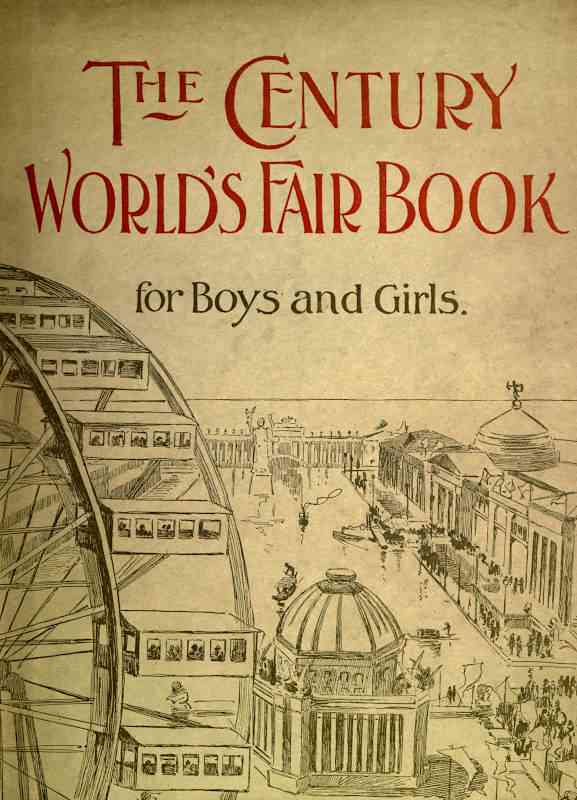
CHAPTER I
Started by Cable — The Journey by Sleeper — Arrival in Chicago — Finding
Rooms — The Fair at Last!
“MR. DOUGLASS wants to see you, Master Harry,” said the maid, coming to the door of the boys’ room.
“What’s he found out now, I wonder?” said Harry to Philip, in a low tone. “I don’t remember anything I have done lately.”
“He’s in a hurry, too,” said the girl, closing the door.
Harry ran down to Mr. Douglass’s room on the first floor. The two boys were beginning their preparation for college, and were living in a suburb of New York city with their tutor, Mr. Douglass, a college graduate, and a man of about thirty-five. Harry’s father, Mr. Blake, was abroad on railroad business, and did not expect to return for some months. Philip was Harry’s cousin, but the two boys were very unlike in disposition—as will be seen. Their bringing up may have been responsible for some of the differences in traits and character, for Harry was a city boy, while his cousin was country-bred.
When Harry knocked at the door of Mr. Douglass’s study, he knew by the tutor’s tone in inviting him in that the teacher had not called him simply for a trivial reprimand. It was certainly something serious; perhaps news from Harry’s father and mother.
“Sit down, Harry,” said the tutor,—“and don’t be worried,” he added, seeing how solemn the boy looked. “I have had a message by cable from your father; but it’s good news, not bad. Read it.”
He handed Harry the despatch. It read:
Take Hal and Phil to Fair. My expense. Letter to Chicago. See Farwell about money and tickets.
“Rather sudden, isn’t it?” said Mr. Douglass, smiling.
“Yes,” said Harry, “but—immense! Don’t you think so?”
“I’m glad to go,” the tutor said. “It seems to me that a visit to the Fair is worth more than all the studying here you boys could do in twice the time you’ll spend there; and it’s a lucky opportunity for me.”
“Then you’ll go?” said Harry, to whom the news seemed a bit of fairy story come true, with the Atlantic cable for a magic wand.
“Of course,” answered the tutor. “The only thing that surprises me is the quickness of your father’s decision.”
“That’s just like him,” said Harry. “He’s a railroad man, you know, and they always go at high pressure. Why, he’d rather talk by telephone, even when he can’t get anything but a buzz and a squeak on the wire, than send a messenger who’d get there in half the time.”
“But has he said anything about sending you before?”
“No. The fact is, people abroad are slow to know what a whacker this Fair is! They think it’s a mere foreign exposition. Father’s just found out that Uncle Sam has covered himself with glory, and now he wants Phil and me to see the bird from beak to claws—the whole American Eagle.”
“But sha’n’t we have trouble about tickets?” asked Mr. Douglass.
“No,” said Harry. “Father’s a railroad man. That’s what ‘See Farwell’ means. You let me go to see him. He’s the general manager, or some high-cockalorum. He’ll see us through by daylight.”
“Very well,” said Mr. Douglass, “I’m just as glad to go as you are. Philip and I will attend to the packing, and you shall go to New York this afternoon and see Mr. Farwell. Now you can tell Philip about it.”
Harry ran out of the room, slamming the door behind him, but Mr. Douglass only laughed. Perhaps he would have slammed it, too, if he’d been in the boy’s place.
“Well?” said Philip, looking up from the Xenophon he was translating.
“Thanks be to Christopher Columbus!” said Harry, with a jig-step.
“Has he done anything new?” Philip asked, looking over his spectacles.
“I guess not,” said Harry, “but we’re going to the Fair.”
“How can we?” Philip asked.
Harry threw the cable despatch down upon the table, and turned to get his hat. Philip read the telegram, carefully wiped his glasses, rose, put the Xenophon into its place upon his book-shelves, and said:
“Xenophon will have to attend to his own parasangs for a while.”
“You pack up for me, and I’ll see to the railroad-tickets,” said Harry. “I have just about time to catch the train for New York.”
That was a hard and busy day for all three of the party. Perhaps Harry’s share was the easiest, for, by showing his father’s despatch to Mr. Farwell, he had everything made easy for him. Still, even influence might not have secured them places except for the aid of chance. It happened that a prominent man had, at the last moment, to give up a section in the Wagner sleeper, and this was turned over to Harry. So, late in the afternoon the boy came back with what he called “three gilt-edged accordion-pleated tickets.”
Meanwhile Mr. Douglass and Philip had put into three traveling-bags as much as six would hold, and the party went to bed early to get a good rest before the long journey.
Next day at nearly half-past four the three travelers walked through the passageway at the Grand Central Depot, had their tickets punched,—and Philip noticed that the man at the gate kept tally on a printed list of the numbers of different tickets presented,—and entered the mahogany and blue-plush Wagner cars.
In a few minutes some one said quietly: “All right,” and the train gently moved out.
“I can remember,” said Mr. Douglass, “when a train started with a shock like a Japanese earthquake. Now this seemed to glide out as if saying, ‘Oh, by the way, I think I’ll go to Chicago!’”
Harry laughed. “Yes,” he said, “and how little fuss there is about it. Why, abroad, I remember that they had first a bell, then a yell, then a scream, then the steam!”
As the train passed through the long tunnel just after leaving the station, Mr. Douglass remarked:
“How monotonous those dark arches of brickwork are!”
“Yes,” said Philip, “they should have a set of frescos put in them.”
“But no one could see the pictures,” said Mr. Douglass, “we pass them so fast.”
“That’s true,” said Harry, with a pretended sigh; “but they might have to be instantaneous photographs.”
Philip looked puzzled for a minute and then laughed. After they left the tunnel, they passed through the suburbs of New York, entered a narrow cut that turned westward, and were soon sailing along the Hudson River—or so it seemed. There was no shore visible beside them, except for an occasional tumble-down dock, and beyond lay the river—a soft, gray expanse relieved against the Palisades, and later against more distant purple hills. It was a rest for their eyes to see only an occasional sloop breaking the long stretch of water, and the noise of the train was lessened because there was nothing to echo back the sounds from the river.
Mr. Douglass found his pleasure in the scenery, the widenings of the river, the soft outlines of the hills, the long reflection of the setting sun. But the boys cared more to see the passengers.
“Isn’t it funny,” said Philip, “how Americans take things as a matter of course? I really believe that if the train was a sort of Jules Verne unlimited express for the planet Mars, the people would all look placid and read the evening papers.”
“Of course,” said Harry. “What else can they do? Would you expect me to go forward and say: ‘Dear Mr. Engineer, but do you really think you know what all these brass and steel things are? Don’t you feel scared? Won’t you lie down awhile on the coal, while I run the engine for you?’”
“Nonsense!” said Philip, laughing. “But they might show some interest.”
“They do,” said Harry; “but that’s not what I’m thinking of. I’m thinking I’ll be a civil engineer.”
“Why?” said Philip.
“Just think,” Harry answered, pointing from the car window, “what a good time they must have had laying out this road! Why, it was just a camping-out frolic, that’s all it was.”
“Didn’t you hear the waiter say dinner was ready?” said Mr. Douglass.
“No,” said Philip; “but I knew it ought to be, if they care for the feelings of their passengers. Where is the dining-car?”
“At the end of the train,” said Mr. Douglass. “Come, we’ll walk through.”
So, in single file (“like cannibals on the trail of a missionary,” Harry said), they passed from car to car. The cars were connected by vestibules—collapsible passageways, folding like an accordion—and it was not necessary to go outside at all. The train was an unbroken hallway.
“It is much like a long, narrow New York flat,” said Philip. “People who live in flats must feel perfectly at home when they travel in these cars.”
They found the dining-car very pretty and comfortable. Along one side were tables where two could sit, face to face. On the opposite side of the aisle the tables accommodated four. The boys and their tutor took one of the larger tables. The bill of fare was that of a well-appointed hotel or restaurant,—soup, fish, entrées, joint, and dessert,—and it was difficult to realize that they were eating while covering many miles an hour; in fact, the only circumstance that was a reminder of the journeying was a slight rim around the edge of the table to keep the dishes from traveling too.
“It is strange,” said Mr. Douglass, “how people have learned to eat dishes in a certain order, such as you see on a bill of fare. Probably this order of eating is the result of tens of millions of experiments, and therefore the best way.”
“The best for us,” said Philip; “but how about the Chinese?”
Mr. Douglass had to confess himself the objection well taken.
“I believe the Chinese were created to be the exceptions to all rules,” he said.
The dining-car had an easy, swaying motion that was very pleasant, and altogether the dinner was a most welcome change from the ordinary routine of a railway journey.
As the boys walked back to their own section, Philip noticed a little clock set into the woodwork at one end of the smoking-car. He was surprised to see that it had two hour-hands, one red and one black.
He pointed it out to Mr. Douglass, who told him that the clock indicated both New York and Chicago times—which differ by an hour, one following what is called “Eastern,” the other “Central” time.
By the time they were again settled in their places it was dark outside; and, as Philip poetically said, they seemed to be “boring a hole through a big dark.” One of the colored porters looked curiously at Philip, as if he had overheard this remark without understanding its poetical bearing.
“He thinks you are a Western desperado!” said Harry, with a grin.
“Boys,” said Mr. Douglass, “the porters will soon make up the beds, and I want you to see how ingeniously everything is arranged.”
Here is what the porter did:
He stood straddling on two seats, turned a handle in the top of a panel, and pulled down the upper berth. It moved on hinges, and was supported after the manner of a book-shelf by two chains that ran on spring pulleys.
Then he fastened two strong wire ropes from the upper to the lower berths.
“What’s that for?” asked Harry.
“To prevent passengers from being smashed flat by the shutting up of the berth,” Philip answered, after a moment’s puzzling over the question.
“You can have the upper berth, Philip,” said Harry, impressively. “It’s better ventilated than the lower, they say; but I don’t mind that.”
Meanwhile the porter took from the upper berth two pieces of mahogany, cut to almost fill the space between the tops of the seats and the side roofs of the car. The edges were grooved, and slid along upon and closely fitted the top of the seat and a molding on the roof. These side-pieces were next fastened by a brass bolt pushed up from the end of the seat-back.
Then the bed-clothing (kept by day in the lower seats and behind the upper panel) was spread on the upper berth, and the mattress of the lower berth was made up from the seat-cushions, supported upon short slats set from seat to seat.
While the beds were being made, the boys were amused to see some ladies laughing at the man’s method of getting the clothes and pillows into place. A woman seems to coax the bed into shape, but a man bullies it into submission.
“They think it’s funny to see him make a bed,” said Harry, in an undertone; “but if they were to try to throw a stone, or bait a fish-hook, I guess the darky would have a right to smile some too.”
To finish his work, the porter hung a thick pair of curtains on hooks along a horizontal pole, and then affixed a long plush strip to which were fastened large gilt figures four inches high—the number of the section.
“It would be fun to change the numbers around,” remarked Harry, pensively. “Then nobody would know who he was when he got up. But perhaps it would make a boy unpopular if he was caught at it.”
Mr. Douglass admitted that it might.
As the porter made up their own section, Harry pulled out his sketch-book and made a little picture of him.
“It’s hard times on the railroad now,” he remarked, as he finished the sketch. “See how short they have to make the porters’ jackets! But it must save starch!”
The boys had wondered how the people would get to bed, but there seemed no difficulty about it. As for our boys, who had the upper berth, one by one they took off their shoes, coats and vests, etc., and then climbed behind the curtains, where they put their pajamas over their underclothes.
After they were in bed, they talked but little, for they were tired.
“This rocking makes me drowsy,” Philip said; “it’s like a cradle.”
“Yes,” Harry answered, as the car lurched a little—“a cradle rocked by a mother with the St. Vitus’s dance!”
While going to sleep, the boys were puzzled to account for the strange noises made by the train. At times it seemed to have run over a china-shop, and at other times the train rumbled hoarsely, as if it were running over the top of an enormous bass-drum.
Soon the great train was transporting two boys who were fast asleep in Section No. 12; they woke fitfully during the night, but only vaguely remembered where they were, until the cold light of morning was reflected from the top of the car.
Dressing was more difficult than going to bed, but by a combination of patience and gymnastics Harry and Philip were soon able to take places in the line that led to the wash-room. Thence, later, they came forth ready for breakfast (for which they had to “line up” again), and another all-day ride.
At breakfast, the next table to them was occupied by a gentleman named Phinney, and his son. Harry knew the son slightly, having once been his schoolmate. Young Phinney was making a second visit to the Fair, and he told Harry that on the former trip the train had run around Niagara Falls in such a way as to give the passengers an opportunity to view them.
Railway Approach.
Galleries of Fine Art.
Machinery Hall, 17 1-2 Acres.
Administration Building.
Illinois State Building.
Assembly Hall and Annex to Agricultural Building.
Fountain.
Transportation Exhibit, 18 2-3 Acres.
Horticultural Hall, 6 1-2 Acres.
Villages of all Nations.
Women’s Building.
State Buildings and Buildings of Foreign Governments.
63 Acres reserved for Live-Stock Exhibit.
Hall of Mines and Mining, 8 3-4 Acres.
Forestry Building, 2 1-2 Acres.
Electrical Building, 9 3-4 Acres.
United States Government Building.
Dairy Building, 3-4 Acre.
Sawmills.
Agricultural Building, 15 Acres.
Manufactures and Liberal Arts Building, 44 Acres.
Casino and Pier.
Fisheries Building and Deep-Sea Aquaria, 3 Acres.
U. S. Naval Exhibit.
The train had stopped there for five minutes, and they had climbed down near the rapids to a point where there was an excellent view of “the great cataract”—so young Phinney called it. He gave the boys some pictures showing the falls, and indeed there was a picture of the falls upon the side of the breakfast bill of fare.
During the forenoon the train was passing through Canada—the boys’ impression of that country being a succession of flat fields, ragged woods, sheep, swine, and a few pretty, long-tailed ponies grazing upon browning turf. Philip said that it was like “the Adirondacks spread flat by a giantess’s rolling-pin.”
At Windsor the train, separated into sections, was run upon a ferry-boat (upon which one small room was marked “U. S. Customs”) and carried over to Detroit. Here Mr. Douglass made the boys laugh by suddenly jumping back from the window. He had been startled by a large round brush that was poked against the window from outside to dust it.
From Detroit the train ran through Michigan—mainly through a flat country of rich farming land. Philip, who had never been West, was much surprised at the uninterrupted stretches of level ground. Mr. Douglass asked him what he thought of the region. Philip adjusted his glasses and replied slowly: “Well, it’s fine for the farmers, but it is no place for speaking William Tell’s piece about ‘Ye crags and peaks, I’m with you once again!’”
“You must not forget, though,” said Mr. Douglass, “that it is the rich farming lands that really underlie America’s prosperity. When you see the Fair, you will understand better what a rich nation we are; but without our great wheat-lands we should, like England, be dependent upon commerce for our very existence.”
The boys were much less talkative as the train neared Chicago. They were somewhat tired, and were also thinking of the amount of walking and sight-seeing that was before them.
All at once, at about half-past five, New York time (for the travelers had not yet changed their watches to an hour earlier), Mr. Douglass pointed out of the right-hand forward window. Both boys looked. There, in the distance, rose above the city houses a gilded dome, and from the opposite car-window they saw just afterward a spider-web structure.
“I know it!” Philip sang out; “that’s the Administration Building. But what is the other?”
“The Ferris Wheel,” answered Harry.
“Yes,” said the tutor, “we are going to leave the car not far from the Plaisance gate.”
“Sixtieth street next!” cried the brakeman.
“Come, we get out here. It’s nearest the grounds, and I have been told it is wise to lodge as near as possible.”
When the cars stopped, the party descended upon a platform with “rails to the right of them, rails to the left of them,” and trains and crowds in all directions. Mr. Douglass led the way out into the huddled settlement of apartment-houses, hotels, and lodgings that has sprung into existence around Jackson Park, the Fair Grounds.
Then began their search for rooms. At first it seemed discouraging; neatness outside was not always a sign of what to expect inside. They labored up-stairs and down again several times. At one attractive private house they entered, expecting quiet, homelike rooms. In the tiny parlor they found five cots set “cheek by jowl” as close as they could be jammed. They smiled at this, but found the rest of the rooms as fully utilized. Mr. Douglass made some objection, and was told by the self-possessed landlady that “some very fine gentlemen thought her fifty-cent beds were very elegant.” At another house they were passing, a boy who couldn’t have been over five years old rushed out like a little Indian on the warpath, crying, “Hi! You lookin’ fer rooms?” Amused at the little fellow’s enterprise, our travelers followed him, the boy going forward on his sturdy little legs, and crying, “Hi, there, Mama! Here’s roomers! I got you some roomers!”
But unfortunately the boy proved more attractive than the rooms. After a long walk, but without going far from the Fair Grounds, they took rooms at a very good hotel. The price was high, perhaps, but reasonable considering the advantages and the demand for lodgings. They took two rooms, one with a double bed for the boys, the other a single room for the tutor.
Gladly they dropped the satchels that had made their muscles ache, and after leaving the keys of their rooms with the hotel clerk, they set forth for their first visit to the Fair. In order that guests should not forget to leave their keys, each was inserted at right angles into a nickel-plated strip of metal far too long to go comfortably into the pocket even of an absent-minded German professor.
“One advantage of being in a hotel,” said Mr. Douglass, as they walked toward the entrance of the grounds, “is the fact that on rainy, disagreeable days we can get meals there if we choose. It is not always pleasant to have to hunt breakfast through the rain. But usually we shall dine where we happen to be in the grounds; there are restaurants of all sorts near the exhibits, from a lunch-counter up.”
Along the sidewalk that led from their hotel to the entrance were dining-rooms, street-peddlers’ counters, peddlers with trays—all meant as inducements to leave money in the great Western metropolis. One thing the boys found very amusing was an Italian bootblack’s stand surrounded on three sides by a blue mosquito-netting.
“If it had been on all sides,” said Harry, “I could have understood it, because it might be a fly-discourager. But now I think it must be only a way of attracting attention.”
They had arrived, luckily, on a “fête night.” Though tired and hungry, they all agreed that it would never do not to take advantage of so excellent a chance to secure a favorable first impression. So they bought tickets at a little wooden booth, and, entering a turnstile one by one, were at last in the great White City.