
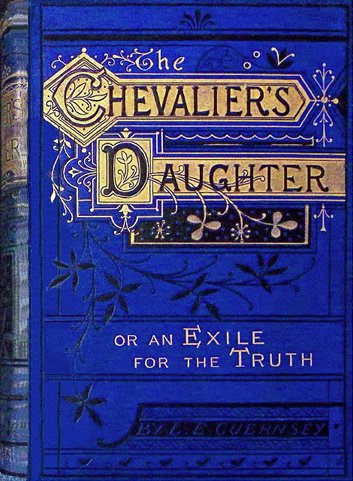
The Project Gutenberg eBook of The Chevalier's daughter
Title: The Chevalier's daughter
or, An exile for the truth
Author: Lucy Ellen Guernsey
Release date: April 9, 2024 [eBook #73365]
Language: English
Original publication: London: John F. Shaw and Co, 1880
Transcriber's note: Unusual and inconsistent spelling is as printed.
We were soon safely hidden among the tall bushes and
wild vines, which covered the top of the rock, but not too soon, for
we were hardly settled before the head of the procession appeared in
sight.
[The Stanton-Corbet Chronicles.]
[Year 1660]
THE
CHEVALIER'S DAUGHTER;
OR,
An Exile for the Truth.
BY
LUCY ELLEN GUERNSEY
AUTHOR OF
"LADY BETTY'S GOVERNESS," "WINIFRED,"
"LADY ROSAMOND'S BOOK."
New Edition.
LONDON:
JOHN F. SHAW AND CO.
48 PATERNOSTER ROW, E.C.
STORIES BY L. E. GUERNSEY.
OLDHAM; OR, BESIDE ALL WATERS.
"The characters of the girls are capitally sketched"—The Christian.
"The doctrinal teaching, warm, earnest, and devotional tone of the story, are all we could desire."—Record.
Large Crown 8vo, cloth, 5s.
LOVEDAY'S HISTORY. A Story of Many Changes.
"One of the most fascinating stories we have read."—Daily Review.
"A very interesting book, written in a very Christian and charitable style."—Woman's Work.
"This delightful book."—Record.
Crown 8vo, cloth, 5s.
THE FOSTER SISTERS. A Story of the Great Revival.
"A pretty story of the last century; the style is bright and sparkling."—Athenæum.
"The story is charmingly told."—Guardian.
Crown 8vo, cloth, 5s.
THE CHEVALIER'S DAUGHTER; Or, An Exile for the Truth.
"One of those quaint old world stories which the author knows so well how to write."—Leeds Mercury.
Crown 8vo, cloth, 5s.
LADY BETTY'S GOVERNESS; Or, The Corbet Chronicles.
"An unusually successful attempt to reproduce the manners of the seventeenth century."—Saturday Review.
Crown 8vo, cloth, 5s.
LADY ROSAMOND'S BOOK; Or, Dawnings of Light.
"A well-told story, written in quaint old-time style, the plot interesting and well sustained, and the tone good."—Leeds Mercury.
Crown 8vo, cloth, 3s. 6d.
WINIFRED. An English Maiden of the Seventeenth Century.
"A truly delightful story, drawn to the life."—Leeds Mercury.
LONDON: JOHN F. SHAW AND CO.
48, PATERNOSTER ROW, E.C.
NOTE.
THESE memoirs were written by my respected grandmother when she was
quite an old lady. I well remember as a child seeing her writing upon
them, my grandfather sitting near, and she now and then suspending her
pen to talk over some incident with him. Matters have not improved in
France since her time, but 'tis said that the young dauphin is quite
a different man from his father, and if he ever comes to the throne,
an effort will be made in behalf of toleration for the persecuted
Protestants. I hope so, I am sure. But to return to the memoir.
After my grandparents' deaths, which took place within a week of each
other, the papers were mislaid, and I only found them by accident in
an inner cupboard of a curious old carved cabinet (I suspect the very
one described in these pages), which my younger brother took a fancy
to repair. I have amused the leisure afforded me by a tedious sprained
ankle in arranging and transcribing these papers, which seem to me both
interesting and profitable.
ROSAMOND GENEVIEVE CORBET.
Tre Madoc Court, May 1st, 1740.
CONTENTS.
CHAPTER
XX. "You shall have no Choice"
THE CHEVALIER'S DAUGHTER
CHAPTER I.
EARLY RECOLLECTIONS.
I WAS born in the year of grace 1660, at the Tour d'Antin, a château not very far from the little village of Sartilly in Normandy.
My father was the Chevalier d'Antin, a younger son of the Provençal family of De Fayrolles.
My mother was an English lady, daughter of a very ancient Devonshire family. Her name was Margaret Corbet, and the branch of that tribe to which she belonged had settled in Cornwall. I remember her as a very beautiful woman, with crispy waved blonde hair and a clear white skin more like alabaster than marble, and no tinge of color in her cheeks. I never saw any other person so pale as she, though her lips were always red. She had beautiful gray eyes, with long black lashes, and clearly defined arched eyebrows meeting above her nose, which gave a very serious and even solemn expression to her face. This expression accorded well with her character, which was grave and thoughtful and very deeply religious. I never saw any person whose faith was so much like sight as hers. Nevertheless, she could smile very sweetly, and even laugh merrily at times, but not very often. For a shadow hung over our house from my earliest years—the same shadow which darkened so many other French families at that time.
My father was a pleasant, lively, kindhearted gentleman, who worshipped his beautiful wife, and treated her as if she were indeed some fragile statue of alabaster which might be broken by rough usage.
He was, as I have said, a younger son. His elder brother lived far-away in Provence—at least his grand château was there; but he and his wife spent most of their time at court, where they both held offices about the king and queen. By some family arrangement which I never understood, our own Tour d'Antin came to my father, thus putting him in a much more comfortable position than that of most younger brothers, as there was a large and productive domain and certain houses at Granville which brought good rents. Besides, there were dues of fowls and so forth from the tenants and small farmers. Indeed, my father, with his simple country tastes, was far richer than his elder brother, and that though my father's purse was always open to the poor, especially those of our own household of faith.
The Tour d'Antin was a large building of reddish stone, partly fortress, partly château. I suspect it had some time been a convent also, for there was a paved court surrounded by a cloister, and a small Gothic chapel which was a good deal dilapidated, and never used in my time. The fortress part of the house was very old. It consisted of a square and a round tower, connected by a kind of gallery. The walls were immensely thick, and so covered with lichens and wall plants that one could hardly tell what they were made of.
In the square tower my mother had her own private apartment, consisting of a parlor and an anteroom, and an oratory, or closet, as we should call it in England, the last being formed partly in the thickness of the wall, partly by a projecting turret. It seemed an odd choice, as the new part of the house was so light and cheerful, but there was a reason for this choice which I came to understand afterward.
The rooms communicated by a gallery with the newer part of the house, where was a saloon, my father's special study and business room, and various lodging rooms. This same gallery, as I have said, led to the oldest part of the château—the round tower, which was somewhat ruinous, and where nobody lived but the bats and owls, and, if the servants were to be credited, the ghosts of a certain chevalier and his unhappy wife, about whom there was a terribly tragical legend. There was a steep stone staircase leading to the top of the round tower, from whence one could see a very little bit of the sea and the great monastery and fortress of St. Michael.
There was no view of the sea from any other part of the house, which lay in a sort of dell or depression quite sheltered from the winds, but from the hill behind us, one could see the whole extent of the sands which lay between Granville and the Mont St. Michel, and the mount itself, a glorious vision in a clear bright day, and a gloomy sight when it lowered huge and dark through the mists of November.
We young ones used to look at it with sensations of awe, for we knew that inside those high frowning walls, shut deep from light and air, were horrible dungeons, in which some of "the Religion" had perished in lingering misery, and others might, for all we knew, be pining there still. Formerly, we were told, the pinnacle of the fortress was crowned by a mighty gilded angel, an image of the patron saint of the place, but it did not exist in my day.
The wide expanse of sand of which I have spoken was and is called the Grève, and was no less an object of terror to us than the fortress itself. It is a dreary and desolate plain, abounding in shifting and fathomless quicksands, which stretch on every hand and often change their places, so that the most experienced guide cannot be sure of safety. Not a year passes without many victims being swallowed up by the Grève, and these accidents are especially frequent about the time of the feast of St. Michael, on the 29th of September, when crowds of pilgrims flock to the mount from all over France. On the eve of All Souls' Day—that is, on the 2d of November—as all good Catholics in La Manche believe, there rises from the sands a thick mist, and this mist is made up of the souls of those unfortunates—pilgrims, fishermen, and smugglers—who have from time to time found a horrible and living grave in its treacherous depths, and who, having died without the sacraments, are in at least a questionable position.
To the south and south-east of the Tour d'Antin lay wide apple orchards, laden with fruit in good years, and seldom failing altogether in bad ones. There was also a small vineyard, but we made no wine, for Normandy is not a wine country. The very children in arms drink cider as English children drink milk, and it does not seem to hurt them. We had a garden for herbs and vegetables—mostly salads, carrots, and various kinds of pulse. Potatoes, which are growing very common in England now, and were cultivated to some extent even then, were unknown in France till long afterward, and are not in use at present except as a rare luxury.
My mother had a flower-garden—very small, and carefully tended by her own hands. At the end of our garden stood a small unpretending stone building, not the least like a church, which was nevertheless the only place of worship of the Protestants for some miles around. For the domain d'Antin was a kind of Protestant colony in the midst of Catholics. All our own tenants were of "the Religion," and there were a few of the same way of thinking, both in Granville and Sartilly, who came to the "Temple," as it was called, on the rare occasions when we had a visit from a pastor.
On such occasions, we had sometimes as many as fifty worshippers. When I recall the aspect of that little congregation, with their solemn earnest faces, their blue eyes fixed on the preacher, the old men and women with their heads bent forward not to lose a word, the very children in arms hushed and silent, and then look round on our English congregation, with half the men asleep, the old clerk nodding in his desk, or droning out the Amens, as my naughty Walter says, like a dumbledore under a hat—when I contrast the two, I sometimes wonder whether a little persecution would not be good for the church on this side of the water. It seems a poor way of praising the Lord for all his benefits to go to sleep over them.
As I have said, the domain d'Antin was a kind of Protestant colony in the midst of Roman Catholics—only we did not use the word Protestant at that time. We were among ourselves "the Reformed," or "the Religion;" among our enemies the "Heretics," "the religion pretended to be reformed," and so forth. Our family had belonged to this party ever since there had been any "Reformed" in France, and even before.
For our ancestors had come into Provence from among the Vaudois, of whom it was and is the boast that they had never accepted the Romish corruptions of the true Gospel, and therefore needed no reformation. For some hundreds of years after their emigration, these people had lived in peace with their neighbors. They had found Provence a wilderness, all but abandoned to the wolves. They made it a smiling garden. Vineyards and olive orchards, fruit and grain sprung up where they trod. They were considered as odd people, eccentric, perhaps a little mad, who would not swear nor drink to excess, nor sing indecent songs, nor frequent companies where such things were done; but then they were quiet and peaceable, full of compassion for those who needed help, paying dues to State and Church without a murmur, and if they did not attend mass or confession, the quiet old parish curés winked with both eyes, for the most part, or contented themselves with mild admonitions to such as came in their way.
But in the year 1540 all this was changed, and a tempest fell on the peaceable inhabitants of Provence—a tempest as unexpected by most of them as a thunderbolt out of a clear sky. The preaching of the true Gospel, which was begun about the year 1521 by Farel and Le Fevre, spread like wildfire all over the kingdom. Crowds attended everywhere on the ministrations of the reformed preachers, and in many places, the parish priests were left to say mass to the bare walls.
It seemed at first as if France would soon break away from Rome, as Germany had done. But the fair dawn was soon overclouded. Persecution arose because of the word, and many were offended and returned to their former observances.
The Vaudois settlers in Provence were the greatest sufferers. They were true to the faith of their forefathers, and no menaces could shake them. Two of their villages—Merindol and Cabrières—were burned to the ground. In the former only one person was left alive—a poor idiot who had given to a soldier two crowns for a ransom. The commander of the expedition, d'Oppide, gave the soldier two crowns from his own purse, and then caused the poor idiot to be bound to a tree and shot. The men of Cabrières being promised their lives and the lives of their families, laid down their arms, and were cut in pieces on the spot. Women and children were burned in their houses, others fled to the mountains and woods to perish of want and cold, and the name of Vaudois was almost extinguished in Provence. * Almost, but not altogether.
* All these details and many more may be found in de Félice's
"Histoire des Protestants de France," and in many Catholic writers as
well.
A hidden seed still remained among the poor and lowly, and some great houses still openly professed their faith and protected their immediate dependents. Among these was the family to which my grandfather belonged. Through all the troubles and wars of the League—through the fearful days of St. Bartholomew, when France ran blood from one end to the other—the family of my ancestors kept their heads above the flood without ever denying their faith. It remained for my uncle, the head of our family, to sully our noble name by real or pretended conversion, in order to curry court favor from Louis XIV. He has left no descendant to perpetuate his shame. That branch of the family is extinct, the last son being killed in a disgraceful duel.
It was before this disgrace fell upon us that my father, in consequence of the family arrangement I have spoken of, took possession of the domain in Normandy. He was not a very young man when, in a visit he made to Jersey, he met and married my mother, who had also gone thither on a visit.
We could see the island of Jersey on a clear day, like a blue cloud on the horizon, and used to look at it with great interest as a part of England, which we pictured to ourselves as a land of all sorts of marvels.
From the time of the execution of the Edict of Nantes in 1598 to the death of Henry IV., those of the Religion in France enjoyed a good degree of peace, and their temples (which they were not allowed even then to call churches) multiplied all over the land. But the Bearnois, as the people loved to call him, was hardly cold in his grave before his successor began his attempts to undo what his great progenitor had done, and from that time to the final revocation of our great charter in 1685, every year—nay, almost every month—brought down new persecutions, new edicts on the heads of the "so-called Reformed." These edicts were such as touched the honor, the safety, the very life of every Protestant. I shall have to speak very largely of these edicts as I proceed, for some of them had a direct effect on my own destiny.
I have given a description of the Tour d'Antin as my birthplace, but in truth my earliest recollections are of a very different dwelling. For a long time after my birth, my mother was in very delicate health and quite unable to nurse me herself, so I was given over to the care of a former servant of our family named Jeanne Sablot, who had lately lost a young infant. Jeanne took me home to her own house, and I only saw my dear mother at intervals of a month or two till I was ten years old. Jeanne had two children of her own, David and Lucille, both older than I, and my sworn friends and protectors on all occasions. Jeanne's parents had come from Provence, and she was like an Italian, both in looks and ways. Her husband, Simon Sablot, was a tall, blue-eyed, fair-haired Norman, somewhat heavy and slow both in mind and ways, a devout Christian man, respected even by his Roman Catholic neighbors for his just dealings and generous hand.
But indeed we all lived in peace in those days. Catholics and Protestants were neighborly together in the exchange of good offices. Even the old curé did not hesitate to exchange a kindly greeting with one of his heretical parishioners, or to accept a seat and a drink of sparkling cider in his dwelling. The great wave of persecution which was sweeping over France had hardly reached our obscure harbor, though we began to hear its roar at a distance.
The old farm-house in which my foster-parents lived was roomy enough and very fairly neat, though the walls and beams were black as ebony, and varnished with the smoke of wood fires. I can see at this moment the row of polished brass pans shining like gold in the firelight, the tall drinking-glasses on the shelf, the oddly carved cabinet with bright steel hinges, which Jeanne called a "bahut," and cherished with pride because it had come down from her Vaudois ancestors, and the round brass jar used for milking, and into whose narrow neck it required some skill to direct the stream from the udder aright.
I can see my foster-father seated in his great chair in the chimney corner, and my good nurse baking on the griddle cakes of sarrasin, which the English call buckwheat. These cakes were very good when they came hot and crisp from the griddle; but it was and is the custom to bake up a huge pile of them, enough sometimes to last several weeks, and it cannot be denied that toward the end, one needed to be very hungry to relish them. We had corn bread also, for Simon cultivated one of the best of the small farms into which the domain was divided; but we ate it as a great treat, as English children eat plum-cake.
We lived somewhat more luxuriously than most of our neighbors, for Jeanne had been cook at the great house like her mother before her, and Simon was wont to boast that his wife could dress him a dish of eggs in as many different ways as there are days in a month. Still we lived very plainly, and I fared like the rest. I learned to read from Jeanne, who was a good scholar and spoke very pure French, and she also taught me to sew, to spin, and to knit, for the Norman women are famous knitters. Besides these lessons, which were my tasks and strictly exacted, I learned to milk and churn, to make hay and plant beans, and, in short, to do all that Lucille did.
We all had our daily tasks of Scripture to learn by heart, according to the admirable custom of the French reformers, and we also learned and sang Clement Marot's hymns and psalms. I have still in my possession an old French Bible with these psalms bound in the same volume. The index is curious: certain psalms are distinguished as "To be sung when the church is under affliction and oppression; when one is prevented from the exercise of worship; when one is forced to the combat; to be sung on the scaffold." Such are some of its divisions—very significant, certainly.
On Sundays we learned the Catechism, and the "Noble Lesson" which had come to us from our Vaudois ancestors, read the stories in the Bible, and took quiet walks in the fields and lanes. Our Roman Catholic neighbors used to assemble after mass on the village green for dancing and other sports, but none of the Reformed were ever seen at these gatherings.
Once, when David was about fourteen, he ran away from home and went to Granville to see the great procession on the feast of St. Michael, which fell that year on a Sunday. Lucille did not know where he had gone, but I did, for he had told me his intention, and I had vainly tried to dissuade him. I did not mean to tell, but I was forced to do so. I shall never forget the horror of his mother nor the stern anger of his father.
"The boy is lost to us—lost forever!" I heard Jeanne say to her husband.
"No, no, ma bonne!" answered Simon soothingly. "The boy has done wrong, no doubt, but he will return—he will repent—all will be well."
"Ah, you do not know!" returned Jeanne in a shrill accent of horror. "There are monks at Granville—missionaries. He will be betrayed into some rash act of worship—a reverence to the image—an entry into the church. They will call it an act of catholicity—they will take him away—he will never return to us. Or if he should refuse them, they will accuse him of blaspheming the Virgin and St. Michael."
Jeanne threw herself down in her seat and covered her eyes, and Simon's calm face was clouded with grave anxiety; but he spoke in the same reassuring tone.
"Little mother, you are borrowing trouble. Is not our Lord at Granville as well as here, and can he not take care of our son? I trust he will be betrayed into no rashness; though the idle curiosity of a child has taken him in the way of danger."
"But, Father Simon, will God take care of David now that he has been a naughty boy?" I ventured to ask.
Simon smiled.
"Ah, my little one, what would become of the best of us if God did not take better care of us than we do of ourselves. Nevertheless, to run into needless danger is a sin of presumption. There are dangers enough hanging over our heads, let us be as careful as we may."
I had lived, so to speak, in an atmosphere of danger all my life, but I think I now realized it for the first time.
"What do you mean by an act of catholicity?" I asked. "Is it anything wicked?"
Simon and his wife looked at each other, and then my foster-father put out his hand and drew me to his side.
"Listen to me, little Vevette!" said he, laying his hand on my head and turning my face toward his. "It is hard to sadden thy young life with such a shadow, but it is needful. Yes, the shadow of the cross, which God hath laid on his church, falls also on the little ones. Attend, my child! Thou must never, never," he repeated, with some sternness in his voice, "on any pretext, or on any persuasion, no matter from whom it comes, enter a church or bow thy head to any image, or kiss any image or picture, or make the sign of the cross, or sing any hymns so-called, or canticle to the Virgin or the saints. If thou dost any such thing, the priests will perhaps come and take thee away from thy parents to shut thee up in a convent, where thou wilt never more see one of thy friends, and from which thou wilt never escape with life except by renouncing thy God and thy religion!"
"I will never renounce my religion!" I cried with vehemence. "My uncle did so, and my father says he has disgraced his ancient name."
"Alas, poor man, if that were all!" said Simon. "But now wilt thou remember these things, my child?"
"I will try," said I humbly; for I remembered that only yesterday I had been humming the air of a hymn to the Virgin which had struck my fancy. "But oh, Father Simon, do you think they will take David away and shut him up in the monastery yonder?"
"I trust not," said Simon, and then he added, with vehemence, "I would rather he were sunk before my eyes in the deepest sands of the Grève."
"I think Vevette is as bad as David," said Lucille, who had not before spoken. "She knew he was going, and she did not prevent him. If I had known, I should have told mother directly."
"Yes, thou art only too ready to tell," replied her mother. "Take care that no one has to tell of thee."
"And remember that spiritual pride is as great a sin as disobedience, and goes before a fall as often, my Loulou," added her father.
"I did not know what to do," said I. "Mother Jeanne does not like to have us tell tales;" which was true.
"Thine was an error in judgment, my little one. I am not angry with you, my children. Another time, you will both be wiser, and David also I trust. Nov run up to the top of the hill and see if you can see him."
We went out together, but not hand in hand as usual. A drizzling rain was falling, but we were too hardy to mind that. Our sabots or wooden shoes were impervious to wet, and our thick homespun frocks almost as much so. No sooner were we out of hearing of the elders, than Loulou overwhelmed me with a torrent of reproaches mingled with tears.
"It is you—you, Vevette, who have sent my brother away," she cried. "You knew he was going, and you did not try to stop him."
"That is not true," said I calmly. I was as angry as herself, but it was always a way of mine that the more excited I was, the quieter I grew. "I said everything I could."
"Yes, you said everything; why did not you do something. If he had told me—but no! Everything is for Vevette, forsooth, because she is a demoiselle. His poor sister is nothing and nobody. You try every way to separate him from me, and make him despise me. I wish—" but a burst of angry sobs choked her voice.
"Yes, I know what you wish, and you shall have your wish," said I, for I was now at a white heat.
Loulou began to be scared, and, as usual, as I grew angry, she began to cool down.
"Well, I think you ought to have told, but to be sure you are only a little girl," she added condescendingly. "As father says, when you are older you will know better."
This put the climax. Nobody likes to be called "only a little girl."
I did not say a word, but I fumed and walked away from her. I had had a glimpse of a figure coming up the hollow lane, and I was determined to meet David before his sister did.
"Vevette, where are you going?" called Loulou. "Come back; you will be wet through."
I paid no attention to her, but, quickening my steps, I passed a turn in the lane, and as I did so, David caught me in his arms.
"Vevette! What are you doing here, and what makes you so pale? Is your heart beating again?" For I was subject to palpitations which, though probably not dangerous, were alarming. "Here, sit down a moment. What frightened you?"
"You—you did," I gasped, as soon as I could speak. "I thought they would carry you off—that we should never see you again."
"Was that all? There was no danger," said David, with an odd little smile. "I did not go near them."
"Did not go near them!" repeated Lucille, who had now come up with us. "Why not?"
"I did not think it right," answered David manfully. "I meant to go when I set out, but Vevette's words kept ringing in my ears: 'It is mean and cowardly to pain thy mother's heart just for a pleasure.' So I turned aside and went to sit a while with Jean Laroche, who is laid up still with his sprained ankle."
"Then you never went near the procession at all—you never saw it," said Lucille, in a tone of disappointment, as David shook his head. "I thought you would at least have something to tell us. What are you laughing at, mademoiselle, if I may be so bold as to ask?"
"At you," I answered with perfect frankness. "At first you are enraged enough to kill me because I did not keep David from going, and now you are vexed at him because he did not go."
"But you did keep me, and I should have come home at once, only the poor Mother Laroche asked me so earnestly to come in and amuse Jean a little. But I must hurry home. Come, girls."
Lucille and I did not go into the house, but into the granary, which was one of our places of retirement. I took up an old psalm-book and began turning over the leaves. Lucille stood looking out of the door. At last she spoke.
"So you did hinder him, after all?"
"Yes, what a pity!" I answered mischievously. "Else he might have something to tell us. But I am only a little girl, you know. When I am older I shall know better. But there, we won't quarrel," I added. I could afford to be magnanimous, seeing how decidedly I had the best of it. "It is worse to be cross on Sunday than to go to see processions. Come, let us kiss and be friends."
Lucille yielded, but not very graciously. In fact, she was always rather jealous of me. She said I set her father and mother up against her, which certainly was not true, and that David liked me the best, which might have been the case, for she was always lecturing him and assuming airs of superiority, which irritated him, good-tempered as he was. I do not think she was very sorry when it was decided that I should leave the cottage and go home for good.
I have dwelt more lengthily on this childish affair because it was the first thing which made me at all sensible of the atmosphere of constant danger and persecution in which we lived even then.
CHAPTER II.
THE TOUR D'ANTIN.
THE very next day I was sent for to go and see my mother. Jeanne accompanied me, and had a long private conference, from which she returned bathed in tears. I anxiously asked the cause of her grief.
"The good Jeanne is grieved to part with thee, my little one," said my mother kindly. "Thy parents wish thee henceforth to live at home with them."
I did not know whether to be pleased or grieved at this news. I adored my beautiful pale mother, but it was with a kind of awful reverence—something, I suppose, like that a nun feels toward an image of the Virgin; but I had never learned to be at all free with her. Could I ever lay my head in her silken lap when it ached, as it often did, or could I prattle to her as freely of all my joys and sorrows as I did to Mother Jeanne? Other images also arose before my eyes—images of lessons and tasks and the awful dignity I should have to maintain when I was Mademoiselle Genevieve instead of only little Vevette.
To offset these I had my room—a room all to myself—a bed with worked hangings, and a carved cabinet. Then there were lessons on the lute and in singing, which I had always wished for. On the whole, however, the grief predominated, and I burst into tears.
"Fie then!" said Jeanne, quite shocked at my want of breeding, though she had been sobbing herself a moment before. "Is it thus, mademoiselle, that you receive the condescension of madame your mother? What will she think of your bringing up?"
"Madame could think but ill of her child did she show no feeling at parting with her nurse," said my mother kindly. "But cheer up, my little daughter; I hope you will be happy here. We will often visit our good friend. Come, do not show to your father a face bathed in tears."
I wiped my eyes, kissed my mother's hand, which she held out to me, and managed to say, "Thank you, madame!" in a manner not quite unintelligible.
Then Jeanne humbly preferred her request. Might I return to the farm for one day to partake of a farewell feast which she had it in mind to prepare?
My mother smiled and consented, and I returned to the farm feeling that I had had a reprieve.
The feast was a grand affair, though the company was small, consisting only of our own family and Father Simon's father and mother—very old people who lived in a cottage down near the sea-shore.
Father Simon picked out his reddest apples and the finest clusters of raisins and nuts. Mother Jeanne made the most delicious galettes and cream soup thickened with chestnuts, and spread her whitest and finest cloth. The old people were the only persons of the company who thoroughly enjoyed themselves. Old Sablot chirped like a cricket, and told old stories of the wars of the League and of Henry of Navarre, and his wife commended the soup and cakes, the eggs and custards, and imparted choice secrets in cookery to her daughter-in-law, who received them with all due deference, though she often said that no Norman woman ever learned to cook. But she was always a most dutiful daughter to the old people, and had quite won their hearts, though they had been somewhat opposed to Simon's marriage in the first place.
We children were very silent, as indeed became us in presence of our elders. And though we were helped to everything good on the table, we had not much appetite, and stole out, as soon as we were dismissed by a nod from the mother, to hide ourselves in the granary. Here we had a playhouse and some dolls of our own making, though we—that is, Lucille and I—were rather ashamed of playing with them.
David had also a work-bench with tools and a turning-lathe, which had been his grandfather's. The old man had given them to him on his last birthday, and David had learned to use them very cleverly.
We did not speak for a moment or two, and then David observed:
"How dusty it is here! To-morrow we must sweep out all the chips and shavings, and make the place tidy."
"To-morrow I shall not be here," said I sorrowfully.
"I suppose David and I can make the place neat for ourselves if you are not here," said Lucille, taking me up rather sharply.
"Lucille!" said her brother reproachfully. And then turning to me, "But you will come and see us very often."
"If I can," said I; "but I suppose I shall have a great many lessons to do now."
"Of course you will," said Lucille; "you will have to learn to play the lute and to write and work embroidery, and a hundred other things. You will be a great lady, and we cannot expect you to come and visit us. David ought to know better than to think of such a thing."
"Lucille, you are too bad to say such things!" I cried passionately. "To spoil our last day so. I believe you are glad I am going away."
"I am not either," she answered indignantly; "I am as sorry as David, only I don't want to be left out in the cold while you two pity and pet one another."
"Children, children!" said a voice which made us all start.
We looked toward the door, and there stood the curé of the parish, Father Francois. He was old and fat, and somewhat too fond of eating and drinking; but he was a kind old man, and lived in peace with every one, Reformed or Romanist.
"What then!" he was wont to say. "They are all my sheep, though some of them will persist in going astray. It is not for me to throw stones at them or set the dogs on them. Let me rather win them back by kindness."
"Children!" said he gravely. "Are you quarrelling?"
"No, monsieur," answered David, taking off his hat to the priest, while Lucille and I drew together and clasped hands, forgetting our difference in fear of we knew not what.
The old man observed the movement, and said, in a tone of some emotion:
"But what, my little girls; are you afraid of?"
"No," answered David; "Monsieur has always been kind, but he must know—"
"I know, I know!" said the priest, as David paused. "But fear nothing from me. I shall not harm you. But, oh, my children, if you would but return to the bosom of our Holy Mother! Now, tell me, my son—just as a friend, you know—why will you not invoke the mediation of the blessed saints?"
"Because, monsieur, it is contrary to the Holy Scriptures," answered David respectfully.
"But the example of the holy saints of old, my son—the teachings of the earliest church—consider!"
"Monsieur," replied David, "as to the earliest teachings of the church, I suppose they are to be found in the Gospels, and I read there that when certain women would have brought their children to our dear Lord, the disciples, instead of interceding for them, forbade them."
"Oh, the Scriptures—always the Scriptures!" said the priest, pettishly enough.
"They are the words of God, monsieur!"
"True, my child, but you may see by their effects that they are not fit for every one to read. And yet I don't know how it is," he added musingly; "they certainly are the words of God, and meant to do people good, but no sooner do they begin to study than they become heretics."
The old curé ruminated a moment over this riddle, and then, apparently giving it up as hopeless, he took a large pinch of snuff and smiled benignly upon David.
"Ah, well, my son, I did not come to argue, but to ask a favor in the interest of charity. My poor sister, who is dying in a decline, as you know, has a fancy for some fresh eggs, and there are none to be had. But I know your mother has uncommon skill in the management of poultry, and I thought perhaps she might help me to one or two."
"That I am sure she will," said David. "If monsieur will walk into the house and sit down, I am quite certain I can find two or three eggs quite new laid."
Father Simon looked surprised as the old priest entered, but made him courteously welcome, and Mother Jeanne directed Lucille to put up a jug of cream and a small jar of marmalade for the invalid. The curé thanked her, accepted a glass of cider, and offered his snuff-box to old Sablot.
"Tut, tut! Don't be afraid, man," said he as the other hesitated. "That is not an act of catholicity, as they call it!" And he muttered something under his breath which did not sound like a blessing.
"Monsieur need not wonder that we are timid," remarked Father Simon.
"No, no, it is no wonder; and from all I hear, I fear that times are not likely to be easier for you, my poor Sablot. Have you been to Sartilly of late?"
"No, monsieur, I have little to take me that way."
"It is as well. Take care if you do go. It is said there are wolves about, or likely to be; and you know that she-wolves carry off children at times. Many thanks to you, Jeanne," he added, rising and taking the little basket which my foster-mother had prepared; "my blessing be upon you! An old man's blessing can do no harm, you know. Farewell!"
He closed the door, and for a moment the party sat looking at each other in silence.
"What does he mean?" asked Jeanne at last.
"He means to give us a warning, the poor, kind old man," said Simon. "I doubt not, he made his errand on purpose."
"Why did he not speak more plainly then?" said Jeanne in some impatience. "Of what use is such a warning as that?"
"I suppose he dared not. Remember, my Jeanne, in what a difficult place he stands. He has risked the displeasure of his superiors already by not giving information."
"But what can he mean by wolves on the road to Sartilly?" asked Jeanne.
"That we must find out, and meantime we must be doubly on our guard."
"They are all alike—all wolves alike!" said the old man, in his thin voice. "Some are in their own skin, some in sheep's clothing; some are like the loup-garou,* and speak with the voice of a man; and they are the worst of all."
* What the Germans call the wehr-wolf, a creature compounded of brute
and human.
"I do not think the curé looks much like a wolf," I ventured to say; for I had been rather taken with the old man's ways. "He is too fat. Wolves are always thin, and they howl and snarl."
"Ah, mademoiselle! But remember the loup-garou can take any forum or any voice he pleases," said the old man.
"Is there really a loop-garou?" asked David. "I thought it was only an idle tale."
"An idle tale indeed! What is the world coming to? Did not my grandfather know one—a man who used to turn himself into a wolf and scour the country at night, followed by his pack, and devouring all in his way, but especially women and children. They caught him at last, and he was burned at Sartilly, protesting his innocence all the time."
"Perhaps he was innocent," said David.
"Thou shouldst not answer thy grandfather, David," said his mother mildly; "that is rude."
"No, no; he meant no harm," said the old man. "Let it pass. You women are always finding fault with a boy. But as to the loup-garou. However, we will tell no more tales to scare mademoiselle. It is well, at all events, to remember that the good Lord is above all. But it was good snuff the poor priest had."
I inwardly resolved that I would try to procure some snuff for the old man, and that I would bribe him with it to tell me more tales of the loup-garou, about which I was very curious. I knew there was no use in asking Mother Jeanne, for she never would tell me frightful stories.
Indeed, the Reformed were not nearly as much under the influence of superstition as their neighbors of the other faith. To the last, every corner had its goblins. In this dell, the "Washers" were to be seen by the unwary night traveller, and he who acceded to their courteous request to assist them in wringing a garment, had his own heart's blood wrung out, and became a pale spectre himself. If he escaped these ghostly laundresses, there were the dancers on the field above, who were equally dangerous, and another female demon who allured young men into lonely places and there murdered and devoured them. Our country neighbors here in Cornwall are bad enough, with their piskies, and fairies, and wish-hounds, and what not, but they are not so bad as the people in Normandy and Brittany.
That night Lucille and I slept together for the last time. Her jealousy was quite overcome for the time, and we promised that we would always be good friends, and built many castles in the air on the basis of that future friendship. She was a girl of strong character in some respects, and of great talents, but she had one fault which made her and those about her very uncomfortable at times, and which came near working her utter ruin. It is not likely that she will ever see these memoirs, but if she should do so, she would not be hurt by them. The fires of affliction which she has passed through have burned up the dross of her character, and little is left but pure gold.
The next morning we went up to the château, and Jeanne took leave of me with many tears.
Father Simon had prayed especially and earnestly for me at our morning devotions, and had solemnly given me his blessing. David had shaken hands with me, and then run away to hide his feelings. It was a sorrowful parting on both sides, and when I had a last sight of Jeanne turning at the bend of the path to wave her hand to me, I felt more like an exile in a strange land than a child coming home to its father's house. So I thought then, knowing nothing of an exile's woes.
"Now, my child," said my mother, coming into my little room, where I had shut myself up to weep, "let these tears be dried. They are natural, but even natural grief must not be indulged too far. Bathe these eyes and flushed cheeks, arrange your dress, and come to me in my room in half an hour."
My mother spoke gently and kindly, but with decision, and there was that about her which made her least word a law. Besides, I believe, to say the truth, I was rather tired of my grief, and quite willing to be consoled, and to indulge my curiosity as to my new home. So I bathed my eyes as I had been bidden, smoothed my hair, which never would stay under my cap properly, but was always twisting out in rebellious little curls, and began to examine my room.
It was an odd little nook, opening from my mother's, as is the custom in France for young ladies of good family. It occupied one of the corner turrets which flanked the square tower of which I have spoken. The walls were so thick and the inclosed space so small that I used to compare the room in my own mind to one of the caves hollowed in the rock by the persecuted Vaudois of which I had heard from Jeanne. The bed was small, with heavy damask hangings and an embroidered coverlet. There was no carpet on the floor, which was of some dark wood waxed to a dangerous smoothness; but a small rug was laid by the side of the bed and before the little toilette-table. The rest of the furniture consisted of a chair and stool, and a small table on which lay a Bible and two or three books in a language which I did not understand, but which I took to be English. In an ordinary French family, there would have been a crucifix and a vase for holy water, and probably an image of the Virgin as well; but it may well be guessed that no such furniture found a place in our household.
Small and plain as the room was, it seemed magnificent in my eyes, and I felt a great accession of dignity in being able to call this magnificent apartment my own. I looked out at the window—a very narrow one—and was delighted to find that it commanded a view of the high road and a very little tiny bit of sea, now at ebb and showing only as a shining line on the edge of the sands. In short, I had not half completed the survey of my new quarters before I was in the best of spirits, and when my mother called me, I was able to meet her with a smiling face. I should have said that my room was elevated half a dozen steep steps above my mother's. Indeed, there were hardly two rooms in the house on a level with each other.
"Why, that is well," said my mother, kissing my cheek. "You are to be my companion and pupil now, little daughter, and I hope that we shall be very happy in each other's society."
She then made me sit down on a low seat beside her own chair, and examined me as to what I had learned. She heard me read, examined me in the Catechism, and asked me some questions on the Gospels, to all of which I gave, I believe, satisfactory answers. She looked at my sewing and knitting, and praised the thread, both linen and wool, with which I had taken great pains.
"That is very good thread," said she; "but I must teach you to spin on the wheel, as they do in England. You shall learn English too, and then we can talk together, and there are many pleasant books to read in that language. You must learn to write also, and to embroider."
"Is English very hard, madame?" I ventured to ask.
"It is called so, but I hope to make it easy to you. By and by, when we have mastered the writing, we will have some lessons on the lute. But now we must consult Mistress Grace about your dress. Your father will like to see you habited like a little lady."
My mother blew the silver whistle which always lay beside her, and Mistress Grace entered from the anteroom. She was a tall, thin personage, English to the backbone. I never saw a plainer woman in my life, but there was that in her face which at once attracted confidence and regard. She was my mother's special attendant, and ruled the household as her vicegerent with great skill and firmness. The servants called her Mamselle Grace, or, more commonly, simply Mamselle, and treated her with great respect, though they sometimes laughed at her English French after her back was turned. I was taught to call her Mrs. Grace, in English fashion.
I was greatly in awe of her at first, but I soon learned to love her as well as Mother Jeanne herself.
Mrs. Grace greeted me with prim courtesy.
"We must take orders for some dresses for our young lady, Grace," said my mother, speaking French. "Will you see what we have for her?"
Mrs. Grace opened an armoire, from which she drew a quantity of stuffs and silks, and an animated conversation ensued.
My mother kindly allowed me to choose what I liked best, and we were in the full tide of discussion, when there was a knock at the door, and my father entered with a very disturbed face, which brightened as he met my mother's glance.
"Heyday, what have we here?" said he. "Has Mrs. Grace taken a new doll to dress?"
"This is our little one, Armand," said my mother. "I have taken her home, judging that it is time to complete her education, and also for a companion."
"That is well," said he. "Come hither, my little one, and see thy father."
I approached timidly, bent my knee, and kissed the hand he held out to me.
He laid the other on my head and solemnly gave me his blessing. Then, holding me off and looking at me:
"Why, 'tis a true Corbet," said he; "the very image of thy mother, dearest Margaret." Then with a sudden change of tone, "I only wish she and thou were safe in the dear old mother's wing, the gray house at Tre Madoc."
My mother's pale cheek flushed a little. "Has anything new happened?" she asked.
"New? Yes! The vultures are gathering to the carcass, Margaret. We are to be left in peace no longer in our quiet corner. The old convent at Sartilly is opened once more with a band of nuns and a black Dominican for a confessor. They call it a hospital—we all know what that means nowadays."
My mother threw an arm round me as if to protect me, and I felt it tremble.
"Then that was what the curé meant," said I, struck with a sudden light. I was a quick child, and the danger which was always in the background sharpened the wits of all children of the Religion. "That was what he meant by the wolves!" And then, struck by the impropriety I had committed in speaking without being addressed, I faltered, "I beg your pardon, monsieur."
"There is no offence, my child; and you must not say monsieur, but my father," said he, sitting down and drawing me to him. "Tell me what was that about the curé and the wolves."
I repeated my story.
"You are a clear-headed little maiden," said he, "and have a quick wit. What did Simon Sablot think of the matter?"
"He said, monsieur—my father," I added, correcting myself, "that the good man meant to give us a warning, and had probably made his errand on purpose."
"More likely to spy out the nakedness of the land," muttered Grace, to whom all priests were alike.
"Nay, my Grace, do the poor man justice," said my father. "The Jesuits cannot make the whole nation over into tigers, not even the priests. The poor old man has grown-up on our lands, as his father did before him, and I believe he feels kindly toward us. But I wish, oh I wish thou and the little one were in safety, my Marguerite."
My mother said some words in English which I did not understand, and then in French, "But what shall we do, Armand, to guard against this new danger?"
"We can only do as we have done in our family, but I fear we must abandon our Sunday gatherings for the present. The risk will be too great with such neighbors to spy upon us. But we will consult together. Run away now, my little one, and explore the house, only do not go into the upper rooms of the round tower. Some of the floors are dangerous. However, you may go to the battlements if you like. The stairs are safe enough."
"Only return at once when you hear the bell," said my mother. "To-day shall be a holiday for you; to-morrow we will begin our lessons. But first go with Grace and let her take your measure."
"Why is it so dangerous to have a hospital at Sartilly?" I ventured to ask Grace at a pause in her operations. "I thought a hospital was a place where poor sick people were taken care of."
"So it is in a Christian land, mademoiselle," answered Grace; "there are many such in England. But now and here, a hospital means a place where young people of the Religion are shut up away from their parents and taught to worship images and say prayers to the Virgin and the saints—yes, pretty saints some of them," she added, in English. "There, I beg your pardon, mademoiselle. It is not good manners to speak in a foreign tongue before those who do not understand it."
"Madame says she will teach me English soon," I observed. "I shall like that, if it is not too hard."
"Oh, it will not be hard to you; you are half an English woman," replied Grace.
"And will you tell me tales sometimes about England, and the place where my mother lived when she was a young lady? I shall like so much to hear them. I love to look at Jersey when we can see it, because it is a part of England."
Grace's heart was quite won by this request. She kissed me, and called me a pretty dear in her own tongue, which phrase, of course, I did not understand, only I saw that it meant something kind and friendly.
Once released, I ran all over the house, peeped into the great old kitchen, where I received many welcomes and blessings from the old servants, and ascended to the top of the round tower to gaze at the sea and at Mount St. Michael, now glowing in the autumn sunshine. True to the habits of implicit obedience in which I had been brought up, I did not even open the door which led into the upper floors of the tower, though I confess to a strong temptation to do so.
I admired the salon hung with tapestry and adorned with carved furniture and various grim family pictures. I wondered what was in the cabinets, and studied the story of Judith worked in the hangings, and had not half finished my survey, when the bell rang, and I hastened to my mother's room.
We dined in considerable state, being waited on by two men servants, while Mistress Grace stood behind her lady's chair and directed their movements. The fare, though plain enough, was dainty compared to what I was accustomed to at the cottage, and I should have enjoyed my dinner only for a feeling of awkwardness, and a look in Mistress Grace's eyes as if she were longing to pounce upon me. I got pounced upon many a time after that, fur great stress was laid upon table etiquette in those days. More than once I was sent away from the table in disgrace, not so much for mistakes I made, as for fuming or pouting at having them corrected.
The next day my lessons began. I had my task of Scripture and the Catechism to learn, as at the cottage. Great stress was laid in the families of the Religion on this learning of the Scriptures, and with good reason, for we were liable at any time to be deprived of our Bibles, or indeed to be shut up where we could not have read if we had them; but that which was stored in our minds no one could take from us. I learned to write and began English, and, thanks to the pains and skill of my mother and the conversations I held with Mrs. Grace in our working hours, I soon learned to speak the language with considerable fluency, as well as to read in two or three English books which my mother possessed. I learned to spin on the little wheel which my mother had had sent her from England, and was greatly delighted when I was allowed to carry down to Mother Jeanne some skeins of thread of my own manufacture.
"But it is beautiful—no less," said Jeanne; "and done, you say, not with spindle and distaff, but with the little machine I have seen in madame's boudoir. See, Lucille, my child!"
"It is good thread, but I do not see that it much better than ours," said Lucille, somewhat slightingly. "And I do not see why one should take so much pains to learn to spin in this new fashion. The spindle and distaff are much better, I think, because they can be carried about with one. I can spin when I am going to the fountain for water or to the pasture for the cows. Vevette cannot do that with her grand wheel."
"That is true," said I, a little taken down; "but one can accomplish so much more. My mother can spin more with the wheel in an hour than one can do with the distaff in half a day, and I am sure the thread is more even."
"Ah, well, the method of my grandmother is good enough for me," said Lucille. "I am a Norman girl, and not an English lady." And she took up her distaff as she spoke, and began drawing out her flax with a care and attention which showed she was offended.
"Do you think, Mamselle Vevette, that madame would condescend to let me look at this wheel of hers?" said David. "I should like so much to see it."
"Why, do you think you could make one like it?" I asked. "Oh, do, David! Make one for Lucille, and I will teach her to use it."
"Thank you!" said Lucille in a tone which did not bespeak much gratitude. "I have already said that Norman fashions are good enough for me."
And then, softening her tone as she saw how mortified I was, "I dare say David would like to make a wheel, and if he succeeded, you would have one of your own as well as madame."
I may as well say here that, after many efforts and failures, and by the help of his uncle, who was the blacksmith at Sartilly, David succeeded in constructing a very nice spinning-wheel, which he presented to me on my birthday. I wonder whether that wheel is still in use, or whether it has been thrown aside in some garret?