
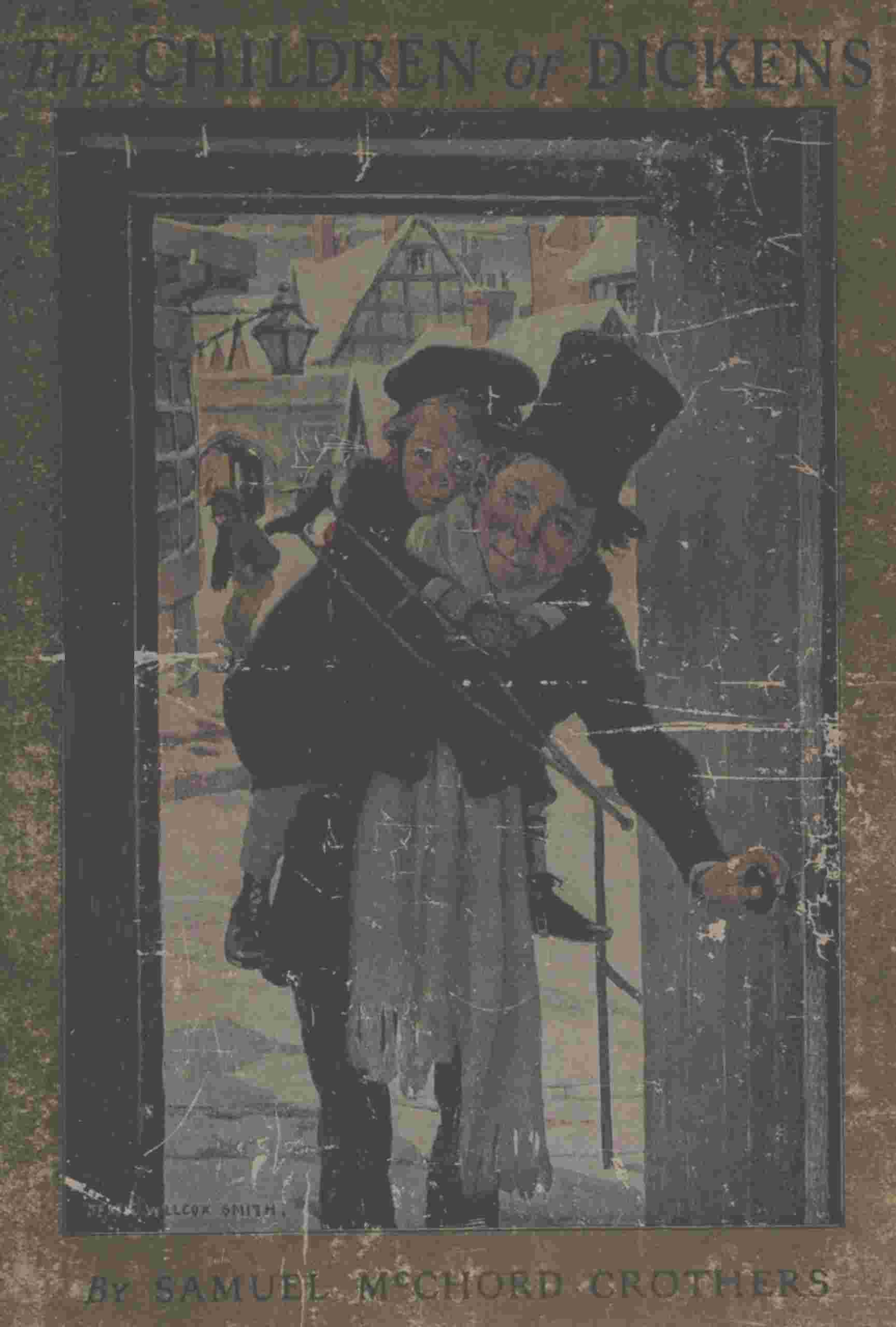
ON THE ROAD TO DOVER
VI
ON THE ROAD TO DOVER
AFTER his friends the Micawbers had left London David Copperfield was very lonesome and decided to set out on a journey and find his aunt, Miss Betsy Trotwood. He had a box which he intended to send to the coach office in Dover, and he had a half-guinea in his pocket.
Unfortunately he met a long-legged young man who was driving a donkey cart, who robbed him of his box and his money. David followed the young man as long as he could and then sat down by the side of the road. He searched his pockets and found only three halfpence. But his experience with Mr. Micawber had taught him that he could borrow money at a pawn-shop. He tells the story of what happened.
I went to the next street and took off my waistcoat, rolled it neatly under my arm, and came to the shop door. Mr. Dolloby was the name over the door.
Mr. Dolloby took the waistcoat, spread it on the counter, held it up against the light, and at last said:
“What do you call a price for this here little weskit?”
“Oh, you know best, sir,” I returned modestly.
“I can’t be buyer and seller too,” said Mr. Dolloby. “Put a price on this little weskit.”
“Would eighteen pence be—” I hinted.
Mr. Dolloby rolled it up again and gave it back to me.
“I should rob my family if I was to offer ninepence for it.”
This was a disagreeable way of putting it, for I did not want to ask Mr. Dolloby to rob his family on my account. I would have to make the best of my way to Dover in a shirt and a pair of trousers.
That night I lay behind a wall. Never shall I forget the feeling of loneliness as I lay down without a roof over my head. But soon I was asleep, and slept until the warm beams of the sun awoke me.
The next day was Sunday. In due time I heard the church bells ringing. I passed a church or two where the congregations were inside. The peace and rest of Sunday morning were on everything but me. I felt quite wicked in my dust and dirt, and my tangled hair.
I got that Sunday to the bridge at Rochester footsore and tired, and eating food that I had bought for supper. I toiled on to Chatham and crept upon a sort of grass-grown battery, where a sentry was walking to and fro. Here I lay near a cannon, happy in the society of the sentry’s footsteps, though he knew nothing of my being there.
Very stiff and sore of foot I was in the morning, and quite dazed by the beating of drums and marching of troops, which seemed to hem me in on every side when I went down toward the long, narrow street. Feeling that I could go but a very little way that day, if I were to reserve my strength for getting to my journey’s end, I resolved to make the sale of my jacket its principal business. Accordingly, I took the jacket off, that I might learn to do without it; and carrying it under my arm, began a tour of inspection of the various slop-shops.
It was a likely place to sell a jacket in; for the dealers in second-hand clothes were numerous, and were, generally speaking, on the lookout for customers at their shop doors. But, as most of them had, hanging up among their stock, an officer’s coat or two, epaulets and all, I was rendered timid by the costly nature of their dealings, and walked about for a long time without offering my merchandise to any one.
This modesty of mine directed my attention to the marine-store shops, and such shops as Mr. Dolloby’s, in preference to the regular dealers. At last I found one that I thought looked promising, at the corner of a dirty lane, ending in an inclosure full of stinging nettles, against the palings of which some second-hand sailors’ clothes, that seemed to have overflown the shop, were fluttering among some cots, and rusty guns, and oilskin hats, and certain trays full of so many old rusty keys of so many sizes that they seemed various enough to open all the doors in the world.
Into this shop, which was low and small, and which was darkened rather than lighted by a little window, overhung with clothes, and was descended into by some steps, I went with a palpitating heart; which was not relieved when an ugly old man, with the lower part of his face all covered with a stubby gray beard, rushed out of a dirty den behind it, and seized me by the hair of my head. He was a dreadful old man to look at, in a filthy flannel waistcoat, and smelling terribly of rum. His bedstead, covered with a tumbled and ragged piece of patchwork, was in the den he had come from, where another little window showed a prospect of more stinging nettles, and a lame donkey.
“Oh, what do you want?” grinned this old man in a fierce, monotonous whine. “Oh, my eyes and limbs, what do you want? Oh, my lungs and liver, what do you want? Oh, goroo, goroo!”
I was so much dismayed by these words, and particularly by the repetition of the last unknown one, which was a kind of rattle in his throat, that I could make no answer; whereupon the old man, still holding me by the hair, repeated:
“Oh, what do you want? Oh, my lungs and liver, what do you want?”
“I want to know,” I said trembling, “if you would buy a jacket?”
“Oh, let’s see the jacket. Bring the jacket out.”
With that he took his trembling hands, which were like the claws of a bird, out of my hair.
“How much for the jacket?” cried the old man. “Oh, goroo, how much for the jacket?”
“Half a crown,” I answered.
“Oh, my lungs and liver, no. Oh, my eyes, no. Eighteen pence. Goroo.”
Every time he said goroo his eyes seemed in danger of popping out of his head.
“Well,” said I, “I’ll take eighteen pence.”
“Oh, my liver,” cried the old man, throwing the jacket on the shelf. “Get out of the shop. Don’t ask for money, make it an exchange.”
He made many attempts to make me consent to an exchange, at one time coming out with a fishing-rod, at another with a fiddle, at another with a cocked hat, at another with a flute. But I wanted the money to buy food. At last he began to pay me in halfpence at a time, and was full two hours getting by easy stages to a shilling.
My bed that night was under a haystack, where I rested comfortably, after having washed my blistered feet in a stream. When I took the road again next morning it was through hop fields and orchards. The orchards were ruddy with bright apples, and in a few places the hop-pickers were already at work. I thought it all extremely beautiful, and I would have enjoyed it if it had not been for the people I met on the road.
The trampers were worse than ever that day, and inspired me with a dread that is yet quite fresh in my mind. Some of them were most ferocious looking ruffians, who stared at me as I went by; and stopped, perhaps, and called after me to come back and speak to them; and when I took to my heels, stoned me. I recollect one young fellow—a tinker, I suppose, from his wallet and brazier—who had a woman with him, and who faced about and stared at me thus; and then roared at me in such a tremendous voice to come back, that I halted and looked round.
“Come here, when you’re called,” said the tinker, “or I’ll rip your young body open.”
I thought it best to go back. As I drew nearer to them, trying to propitiate the tinker by my looks, I observed that the woman had a black eye.
“Where are you going?” said the tinker, gripping the bosom of my shirt with his blackened hand.
“I’m going to Dover,” I said.
“Where do you come from?” asked the tinker, giving his hand another turn in my shirt to hold me more securely.
“I come from London,” I said.
“What lay are you upon?” asked the tinker. “Are you a prig?”
“N—no,” I said.
“Ain’t you! If you make a brag of your honesty to me,” said the tinker, “I’ll knock your brains out.”
With his disengaged hand he made a menace of striking me, and then looked at me from head to foot.
“Have you got the price of a pint of beer about you?” said the tinker. “If you have, out with it, afore I take it away.”
I should certainly have produced it, but that I met the woman’s look, and saw her very slightly shake her head, and form “No” with her lips.
“I am very poor,” I said, attempting to smile, “and have got no money.”
“Why, what do you mean?” said the tinker, looking so sternly at me, that I almost feared he saw the money in my pocket.
“Sir!” I stammered.
“What do you mean,” said the tinker, “by wearing my brother’s silk handkerchief? Give it over here!” And he had mine off my neck in a moment, and tossed it to the woman.
The woman burst into a fit of laughter, as if she thought this a joke, and tossing it back to me, nodded once, as slightly as before, and made the word “Go!” with her lips.
It was on the sixth day of my flight that I came to my aunt’s house. My shoes were by this time in a woeful condition. My hat was crushed and bent. My shirt and trousers were stained with peat, dew, grass, and the Kentish soil on which I had slept. My hair had known no comb or brush since I left London. From head to foot I was powdered with chalk as if I had come out of a lime kiln.
There came out of the house a lady with a handkerchief tied over her cap, a pair of gardening gloves on her hands, and carrying a great knife. I knew her, immediately, to be my Aunt Betsy.
“Go away!” said Miss Betsy, shaking her head. “Go along! No boys here!”
“If you please, ma’am,” I began. She started and looked up.
“If you please, aunt.”
“Eh!” exclaimed Miss Betsy in a tone of amazement I have never heard approached.
“If you please, aunt, I am your nephew.”
“Oh, Lord!” said my aunt, and sat flat down on the garden path.
“I am David Copperfield. I have been very unhappy since my mother died. I was put to work that was not fit for me. It made me run away to you. I was robbed when I set out and have walked all the way and have never slept in a bed since I began the journey.”
My aunt got up in a great hurry, collared me and took me into the parlor. Her first proceeding was to unlock a tall cupboard, bring forth several bottles, and pour some of the contents of each into my mouth. I think they must have been taken out at random, for I am sure I tasted aniseed water, anchovy sauce, and salad dressing. Then she put me on the sofa, with a shawl under my head, and, sitting by my side, repeated at intervals, “Mercy on us!”
Then I was given a bath, which was a great comfort. For I began to be sensitive of pains from lying out in the fields. When I had bathed they enrobed me in a shirt and a pair of trousers too big for me, and tied me up in two or three big shawls. What sort of a bundle I looked like I do not know. Feeling very drowsy, I lay down on the sofa and was soon fast asleep.
Then I was put to bed in a pleasant room at the top of the house. It was overlooking the sea, on which the moon was shining. After I had said my prayers and the candle had burned out I sat looking at the moonlight on the water. Then I turned to the white curtained bed. I remember how I thought of all the solitary places under the night sky where I had slept, and I prayed that I might never be houseless any more, and never might forget the houseless.