
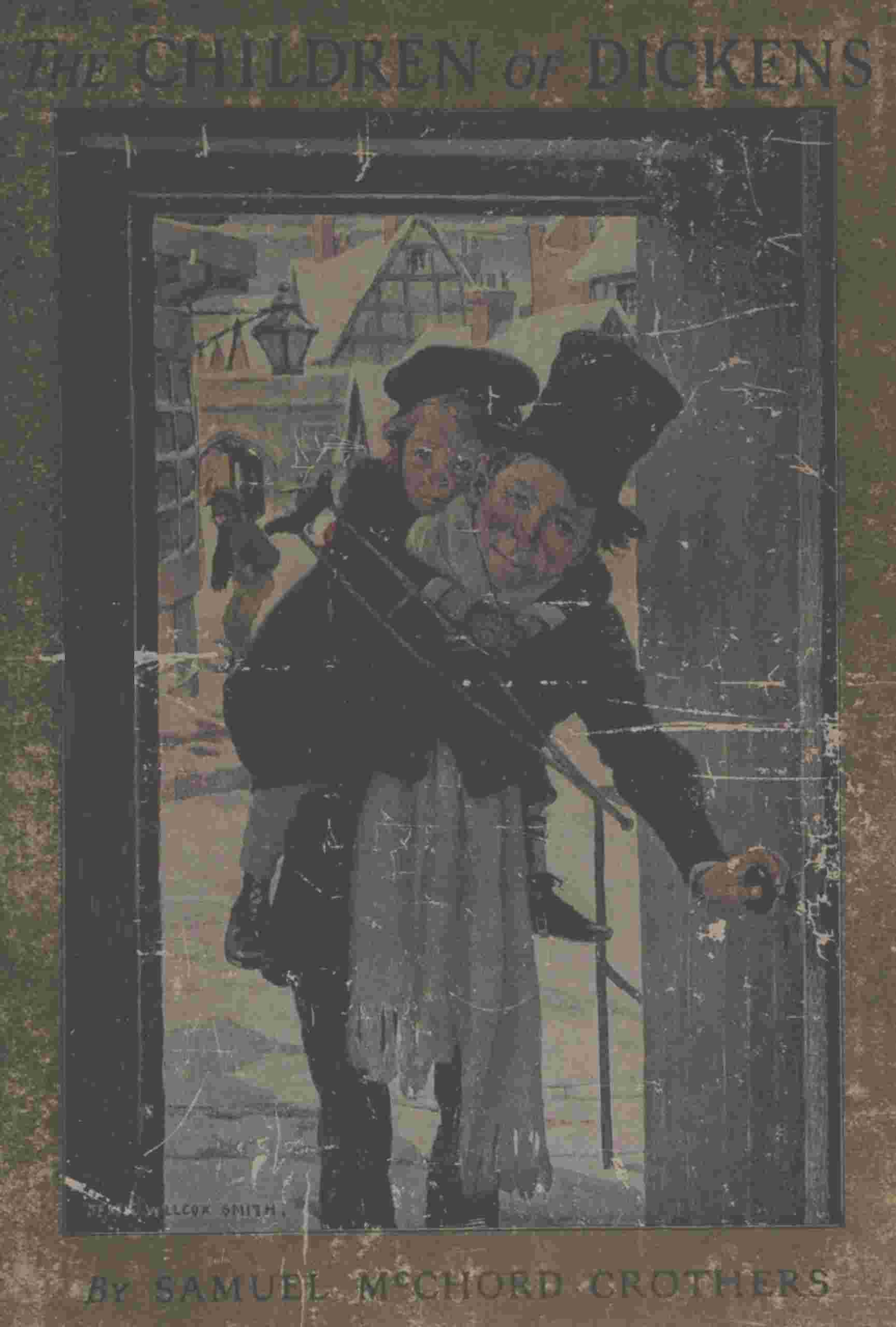
JOE THE FAT BOY
VII
JOE THE FAT BOY
WHEN we think of famous people, we take for granted that they did something remarkable. But this is not always true. One of the most famous characters of fiction is the Fat Boy in The Pickwick Papers. Everybody remembers him. But what did he do to earn his reputation? He did nothing at all but go to sleep under all circumstances. It was his gift.
Joe was the footman, or rather the footboy, of Mr. Wardle, a good-natured gentleman who lived at Dingley Dell. Now four other good-natured gentlemen had started out from London in search of adventures. Their names were Mr. Pickwick, Mr. Snodgrass, Mr. Tupman, and Mr. Winkle. They didn’t know where they were going, but that didn’t matter. They intended to have a good time and to see the country. When they returned they were sure that they would have something to tell about. So when they came to the pleasant city of Rochester, they were delighted to find that there was to be a great review of the troops. The soldiers were to take part in a mimic battle. Everything was to be like real war, except that nobody was to be hurt. This was just what Mr. Pickwick and his friends wanted to see.
It was all very fine so long as the soldiers were firing in other directions. But it was different when Mr. Pickwick saw the muskets pointed in their direction. This was getting decidedly dangerous.
“What are they doing now?” inquired Mr. Pickwick.
“I rather think,” said Mr. Winkle, “that they are going to fire.”
“Nonsense,” said Mr. Pickwick.
“I—I—really think they are,” urged Mr. Snodgrass, somewhat alarmed.
“Impossible,” replied Mr. Pickwick. He had hardly uttered the words when the whole half-dozen regiments levelled their muskets at Mr. Pickwick and his friends, and there burst forth the most tremendous discharge. Mr. Pickwick assured his friends that there was no danger.
“But suppose,” said Mr. Winkle, “that some of the men should have ball cartridges by mistake. I heard something whistle in the air just now.”
“We had better throw ourselves on our faces, hadn’t we?” said Mr. Snodgrass.
“No, it’s over now,” said Mr. Pickwick.
But it wasn’t over. A minute after, the order was given to charge with fixed bayonets, and Mr. Pickwick and his friends saw the six regiments charging across the field to the very spot where they were standing.
“Get out of the way!” cried the officers.
“Where are we to go to?” screamed Mr. Pickwick.
There was nothing for Mr. Pickwick and his friends to do but to get out of the way as fast as they could. There was a gentle wind blowing, and it carried Mr. Pickwick’s hat across the field. He ran after it as fast as he could, till it went under the wheels of a carriage from which the horses had been taken out. In the carriage was a stout old gentleman in a blue coat and bright buttons, corduroy breeches and top boots, two young ladies in scarfs and feathers, and an aunt. At the back of the carriage was a huge hamper with cold chicken, ham, tongue, and all the materials for a picnic, and on the box sat a very fat and very red-faced boy, sound asleep.
The stout gentleman in the blue coat was Mr. Wardle, who instantly became a warm friend of Mr. Pickwick, and invited him to get into the carriage and have something to eat.
“Come along, sir, pray come up. Joe! That boy has gone to sleep again. Joe, let down the steps.” The fat boy rolled slowly off the box, let down the steps, and held the carriage door invitingly open.
“Room for you all, gentlemen,” said the stout man. “Joe, make room for one of these gentlemen on the box. Now, sir, come along.” And he pulled Mr. Pickwick and Mr. Snodgrass in by main force.
When they were all in the carriage, Mr. Wardle called to Joe, who had again gone to sleep, to prepare for the lunch.
“Now Joe, knives and forks.” The knives and forks were handed to the ladies and gentlemen inside.
“Plates, Joe, plates!” But Joe had dropped to sleep again. “Now, Joe, the fowls. Come hand in the eatables!”
There was something in the last words that roused Joe to the greatest activity, for he was always ready to eat.
“That’s right—look sharp. Now the tongue—now the pigeon pie. Take care of the veal and ham—mind the lobsters—take the salad out of the cloth—give me the dressing.” The various dishes were placed in everybody’s hands and on everybody’s knees.
“Now, ain’t this capital?” inquired Mr. Wardle.
“Capital!” said Mr. Winkle, who was carving a fowl on the box.
Everybody was eating and talking at the same time, and they felt that they had always known each other. All except Joe, who preferred a nap to conversation.
“Very extraordinary boy, that,” said Mr. Pickwick. “Does he always sleep that way?”
“Sleep!” said the old gentleman, “he’s always asleep. Goes on errands fast asleep, and snores as he waits at the table.”
“How very odd,” said Mr. Pickwick.
“Ah! odd indeed,” returned the old gentleman; “I’m proud of that boy—wouldn’t part with him on any account—he’s a natural curiosity! Here, Joe—Joe—take these things away, and open another bottle—d’ye hear?”
The fat boy rose, opened his eyes, swallowed the huge piece of pie he had been in the act of masticating when he last fell asleep, and slowly obeyed his master’s orders—gloating languidly over the remains of the feast, as he removed the plates, and deposited them in the hamper. The fresh bottle was produced, and speedily emptied: the hamper was made fast in its old place—the fat boy once more mounted the box—the spectacles and pocket-glass were again adjusted—and the evolutions of the military recommenced. There was a great fizzing and banging of guns, and starting of ladies—and then a mine was sprung, to the gratification of everybody—and when the mine had gone off, the military and the company followed its example, and went off too.
“Now, mind,” said the old gentleman, as he shook hands with Mr. Pickwick at the conclusion of a conversation which had been carried on at intervals, during the conclusion of the proceedings—“we shall see you all to-morrow.”
“Most certainly,” replied Mr. Pickwick.
“You have got the address?”
“Manor Farm, Dingley Dell,” said Mr. Pickwick, consulting his pocket-book.
“That’s it,” said the old gentleman. “I don’t let you off, mind, under a week; and undertake that you shall see everything worth seeing. If you’ve come down for a country life, come to me, and I’ll give you plenty of it. Joe—he’s gone to sleep again—Joe, help Tom put in the horses.”
The horses were put in—the driver mounted—the fat boy clambered up by his side—farewells were exchanged—and the carriage rattled off. As the Pickwickians turned round to take a last glimpse of it, the setting sun cast a rich glow on the faces of their entertainers, and fell upon the form of the fat boy. His head was sunk upon his bosom; and he slumbered again.