
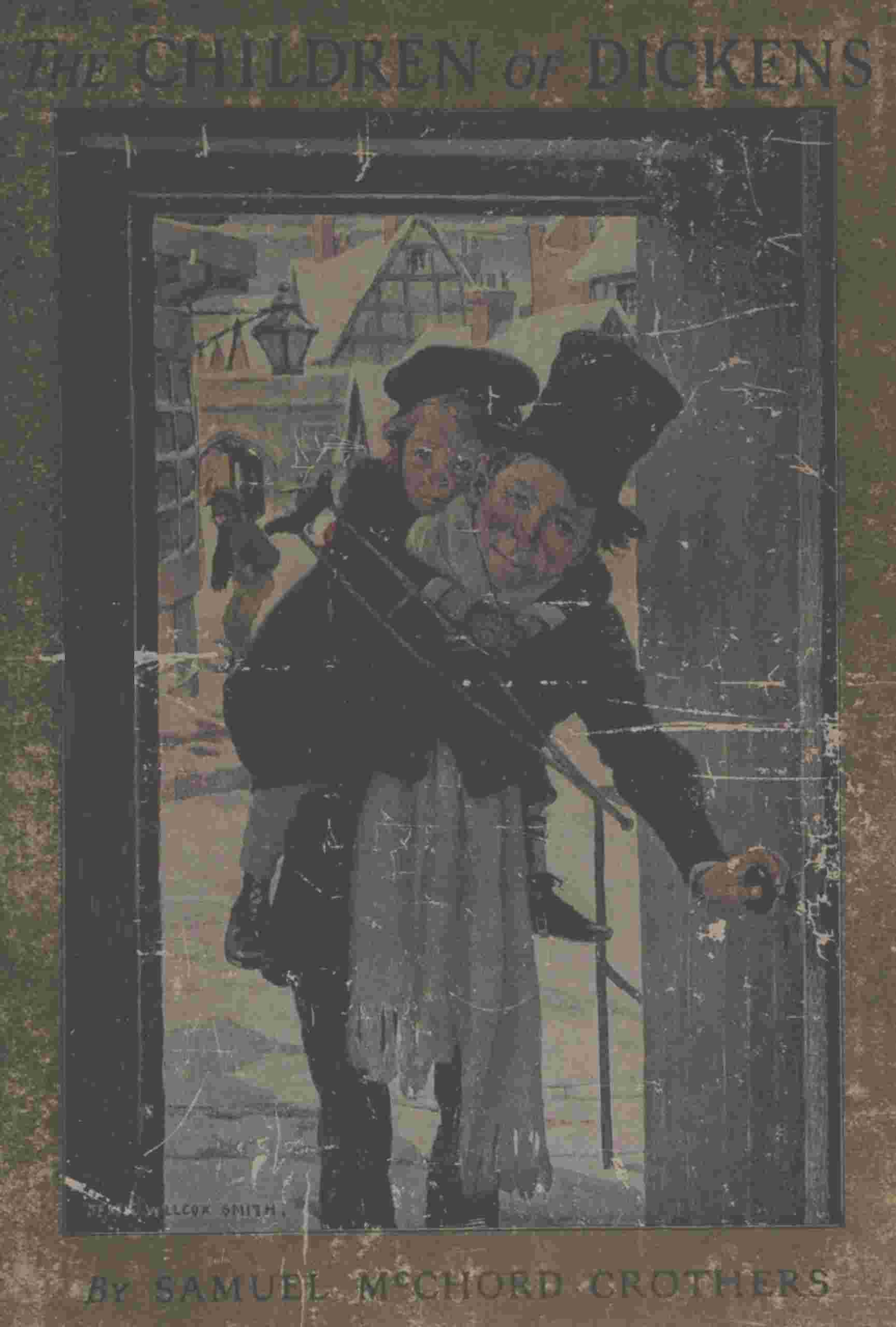
THE JELLYBY CHILDREN
IX
THE JELLYBY CHILDREN
TO know the Jellyby children you must know their mother. Mrs. Jellyby had a very kind heart and wanted to do good. Unfortunately the people she wanted to do good to lived a long way off. This was very inconvenient, as it was very difficult to get at them, especially as she didn’t know their names or what they looked like. The people she was particularly interested in lived in Borrioboola-Gha, on the left bank of the Niger, in Africa. Mrs. Jellyby had to write a great many letters to all sorts of people about the state of things in Borrioboola-Gha, and this took up the time she might otherwise have given to her children.
What Mrs. Jellyby would have done if she had lived in Africa, we do not know. But in London she didn’t find much to interest her: everything was too near. So the little Jellybys were left to grow up as best they could. There was no one whose business it was to see that they were properly fed or clothed or taught how to behave. Mrs. Jellyby couldn’t look after them, because she was too busy making plans for the Africans. And Mr. Jellyby couldn’t do it, for he had to listen to Mrs. Jellyby and do errands for her. So nobody did it, and the little Jellybys got on as best they could, which was not very well.
In Bleak House, Dickens makes Miss Summerson tell of her visit to Mrs. Jellyby.
We were to pass the night, Mr. Kenge told us, at Mrs. Jellyby’s; and then he turned to me, and said that he took it for granted that I knew who Mrs. Jellyby was.
“I really don’t, sir,” I returned.
“Indeed! Mrs. Jellyby is a lady of great strength of character. She devotes herself entirely to the public.”
“And Mr. Jellyby, sir?”
“Ah! Mr. Jellyby,” said Mr. Kenge, “I do not know that I can describe Mr. Jellyby better than by saying he is the husband of Mrs. Jellyby.”
We arrived at our destination and found a crowd of people, mostly children, about the house at which we stopped, which had a tarnished brass plate on the door, with the inscription, JELLYBY.
“Don’t be frightened!” said Mr. Guppy, looking in at the coach-window. “One of the young Jellybys been and got his head through the area railings!”
“Oh, poor child,” said I, “let me out, if you please!”
“Pray be careful of yourself, miss. The young Jellybys are always up to something,” said Mr. Guppy.
I made my way to the poor child, who was one of the dirtiest little unfortunates I ever saw, and found him very hot and frightened, and crying loudly, fixed by the neck between two iron railings, while a milkman and a beadle, with the kindest intentions possible, were endeavoring to drag him back by the legs, under a general impression that his skull was compressible by those means. As I found (after pacifying him) that he was a little boy, with a naturally large head, I thought that, perhaps, where his head could go, his body could follow, and mentioned that the best mode of extrication might be to push him forward. This was so favorably received by the milkman and beadle, that he would immediately have been pushed into the area, if I had not held his pinafore, while Richard and Mr. Guppy ran down through the kitchen, to catch him when he should be released. At last he was happily got down without any accident, and then he began to beat Mr. Guppy with a hoop-stick in quite a frantic manner.
Nobody had appeared belonging to the house, except a person in pattens, who had been poking at the child from below with a broom; I don’t know with what object, and I don’t think she did. I therefore supposed that Mrs. Jellyby was not at home; and was quite surprised when the person appeared in the passage without the pattens, and going up to the back room on the first floor, before Ada and me, announced us as, “Them two young ladies, Missis Jellyby!” We passed several more children on the way up, whom it was difficult to avoid treading on in the dark; and as we came into Mrs. Jellyby’s presence, one of the poor little things fell down-stairs—down a whole flight (as it sounded to me), with a great noise.
Mrs. Jellyby, whose face reflected none of the uneasiness which we could not help showing in our own faces, as the dear child’s head recorded its passage with a bump on every stair—Richard afterwards said he counted seven, besides one for the landing—received us with perfect equanimity. She was a pretty, very diminutive, plump woman, of from forty to fifty, with handsome eyes, though they had a curious habit of seeming to look a long way off. As if—I am quoting Richard again—they could see nothing nearer than Africa!
“I am very glad indeed,” said Mrs. Jellyby, in an agreeable voice, “to have the pleasure of receiving you. I have a great respect for Mr. Jarndyce; and no one in whom he is interested can be an object of indifference to me.”
We expressed our acknowledgments, and sat down behind the door, where there was a lame invalid of a sofa. Mrs. Jellyby had very good hair, but was too much occupied with her African duties to brush it. The shawl in which she had been loosely muffled, dropped on to her chair when she advanced to us; and as she turned to resume her seat, we could not help noticing that her dress didn’t nearly meet up the back, and that the open space was railed across with a lattice-work of stay-lace—like a summer-house.
The room, which was strewn with papers and nearly filled by a great writing-table covered with similar litter, was, I must say, not only very untidy, but very dirty. We were obliged to take notice of that with our sense of sight, even while, with our sense of hearing, we followed the poor child who had tumbled down-stairs: I think into the back kitchen, where somebody seemed to stifle him.
But what principally struck us was a jaded, and unhealthy-looking, though by no means plain girl, at the writing-table, who sat biting the feather of her pen, and staring at us. I suppose nobody ever was in such a state of ink. And, from her tumbled hair to her pretty feet, which were disfigured with frayed and broken satin slippers trodden down at heel, she really seemed to have no article of dress upon her, from a pin upwards, that was in its proper condition or its right place.
“You find me, my dears,” said Mrs. Jellyby, snuffing the two great office candles in tin candlesticks which made the room taste strongly of hot tallow (the fire had gone out, and there was nothing in the grate but ashes, a bundle of wood, and a poker), “you find me, my dears, as usual, very busy; but that you will excuse. The African project at present employs my whole time. It involves me in correspondence with public bodies, and with private individuals anxious for the welfare of their species all over the country. I am happy to say it is advancing. We hope by this time next year to have from a hundred and fifty to two hundred healthy families cultivating coffee and educating the natives of Borrioboola-Gha, on the left bank of the Niger.”
As Ada said nothing, but looked at me, I said it must be very gratifying.
“It is gratifying,” said Mrs. Jellyby. “It involves the devotion of all my energies, such as they are; but that is nothing, so that it succeeds; and I am more confident of success every day. Do you know, Miss Summerson, I almost wonder that you never turned your thoughts to Africa.”
This application of the subject was really so unexpected to me, that I was quite at a loss how to receive it. I hinted that the climate——
“The finest climate in the world!” said Mrs. Jellyby.
“Indeed, ma’am?”
“Certainly. With precaution,” said Mrs. Jellyby. “You may go into Holborn, without precaution, and be run over. You may go into Holborn, with precaution, and never be run over. Just so with Africa.”
I said, “No doubt”—I meant as to Holborn.
“If you would like,” said Mrs. Jellyby, putting a number of papers towards us, “to look over some remarks on that head, and on the general subject (which have been extensively circulated), while I finish a letter I am now dictating—to my eldest daughter, who is my amanuensis——”
The girl at the table left off biting her pen, and made a return to our recognition, which was half bashful and half sulky.
“I shall then have finished for the present,” proceeded Mrs. Jellyby, with a sweet smile; “though my work is never done. Where are you, Caddy?”
“‘—Presents her compliments to Mr. Swallow, and begs—’” said Caddy.
“‘And begs,’” said Mrs. Jellyby, dictating, “‘to inform him, in reference to his letter of inquiry on the African project—’ No, Peepy! Not on any account!”
Peepy (so self-named) was the unfortunate child who had fallen down-stairs, who now interrupted the correspondence by presenting himself, with a strip of plaster on his forehead, to exhibit his wounded knees, in which Ada and I did not know which to pity most—the bruises or the dirt. Mrs. Jellyby merely added, “Go along, you naughty Peepy!” and fixed her fine eyes on Africa again.
However, as she at once proceeded with her dictation, and as I interrupted nothing by doing it, I ventured quietly to stop poor Peepy as he was going out, and to take him up to nurse. He looked very much astonished at it, and at Ada’s kissing him; but soon fell fast asleep in my arms, sobbing at longer and longer intervals, until he was quiet. I was so occupied with Peepy that I lost the letter in detail, though I derived such a general impression from it of the momentous importance of Africa, and the utter insignificance of all other places and things, that I felt quite ashamed to have thought so little about it.
“Six o’clock!” said Mrs. Jellyby. “And our dinner hour nominally (for we dine at all hours) five! Caddy, show Miss Clare and Miss Summerson their rooms. You will like to make some change, perhaps? You will excuse me, I know, being so much occupied. Oh, that very bad child! Pray put him down, Miss Summerson!”
I begged permission to retain him, truly saying that he was not at all troublesome; and carried him up-stairs and laid him on my bed. Ada and I had two upper rooms, with a door of communication between. They were excessively bare and disorderly, and the curtain to my window was fastened up with a fork.
“You would like some hot water, wouldn’t you?” said Miss Jellyby, looking round for a jug with a handle to it, but looking in vain.
“If it is not being troublesome,” said we.
“Oh, it’s not the trouble,” returned Miss Jellyby; “the question is, if there is any.”
The evening was so very cold, and the rooms had such a marshy smell, that I must confess it was a little miserable; and Ada was half crying. We soon laughed, however, and were busily unpacking, when Miss Jellyby came back to say, that she was sorry there was no hot water; but they couldn’t find the kettle, and the boiler was out of order.
We begged her not to mention it, and made all the haste we could to get down to the fire again. But all the little children had come up to the landing outside, to look at the phenomenon of Peepy lying on my bed; and our attention was distracted by the constant apparition of noses and fingers in situations of danger between the hinges of the doors. It was impossible to shut the door of either room; for my lock, with no knob to it, looked as if it wanted to be wound up; and though the handle of Ada’s went round and round with the greatest smoothness, it was attended with no effect whatever on the door. Therefore I proposed to the children that they should come in and be very good at my table, and I would tell them the story of Little Red Riding Hood while I dressed; which they did, and were as quiet as mice, including Peepy, who awoke opportunely before the appearance of the wolf.
Soon after seven o’clock, we went down to dinner. The dinner was long, because of such accidents as the dish of potatoes being mislaid in the coal scuttle. Mrs. Jellyby paid no attention to such matters and told us all about the various committees, and the five thousand circulars that were sent out. After dinner, Mr. Jellyby sat in a corner in a state of great dejection. I sat in another and told Peepy, in whispers, the story of Puss in Boots, until Mrs. Jellyby, accidentally remembering the children, sent them to bed. As Peepy cried for me to take him, I carried him up-stairs.
“What a strange house!” said Ada, when we got up-stairs.
“My love,” said I, “it quite confuses me. I can’t understand it.”
“What?” asked Ada.
“All this, my dear,” said I. “It must be very good of Mrs. Jellyby to take such pains about a scheme for the benefit of Natives—and yet—Peepy and the housekeeping!”