
THE DOLL’S DRESSMAKER
XIII
THE DOLL’S DRESSMAKER
THE fact that Dickens when he was only twelve years old was put to work and had to make his own living made him feel old when he was really very young. He had to look after himself as if he had been a man. In Our Mutual Friend he gives us a picture of an old young person, Jenny Wren, the Doll’s Dressmaker, who talked as if she were forty, when she was only twelve and small for her age. Her father was a drunkard and she had been compelled to act as head of the house.
She was a queer little person with bright, snapping eyes and a sharp tongue. She sat in a little old-fashioned armchair which had a little working-bench before it. She had set up in business as a doll’s dressmaker and manufacturer of pincushions and pen-wipers.
If you were in London you would have to go a long way to find the Doll’s Dressmaker. First you crossed Westminster Bridge, and then you came to a certain little street called Church Street, and then to an out-of-the-way square called Smith Square, in the centre of which was a very ugly church. Then you came to a blacksmith-shop and a lumber-yard, and a dealer in old iron. There was a rusty portion of an old boiler that you had to walk around. Beyond that there were several little quiet houses in a row. In one of these houses was the little Doll’s Dressmaker. That was the way Bradley Headstone and Charley Hexam found the house where Jenny Wren lived.
Copyright by Charles Scribner’s Sons
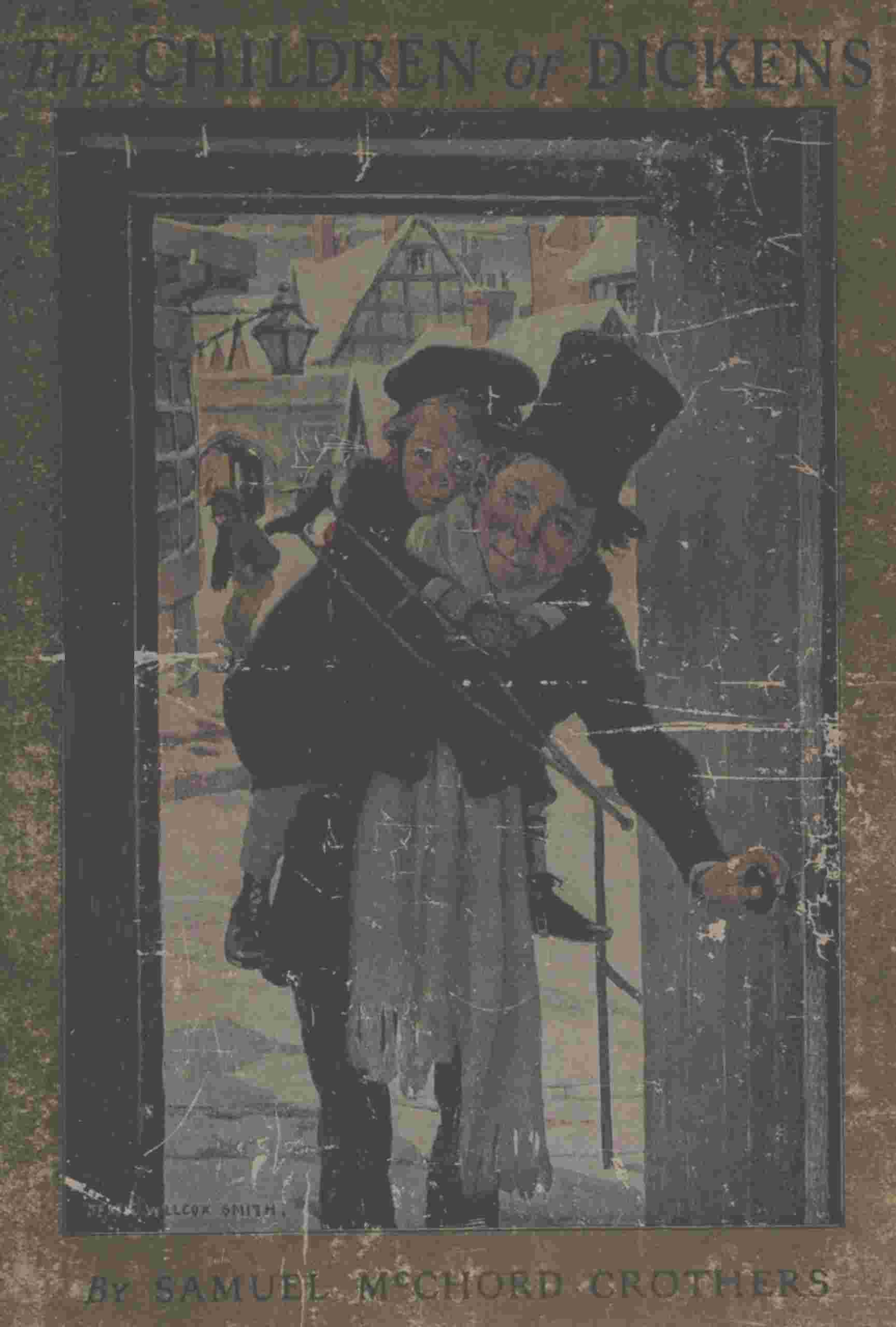
JENNY WREN, THE LITTLE DOLLS’ DRESSMAKER
They knocked at the door and saw a queer little figure sitting in an armchair.
“I can’t get up,” said the child, “because my back’s bad and my legs are queer. But I’m the person of the house. What do you want, young man?”
“I wanted to see my sister.”
“Many young men have sisters. Give me your name, young man.”
“Hexam is my name.”
“Ah, indeed?” said the person of the house. “I thought it might be. Your sister will be in, in about a quarter of an hour. I am very fond of your sister. She’s my particular friend. Take a seat. And this gentleman’s name?”
“Mr. Headstone, my schoolmaster.”
“Take a seat. And would you please to shut the street door first? I can’t very well do it myself, because my back’s so bad, and my legs are so queer.”
They complied in silence, and the little figure went on with its work of gumming and gluing together with a camel’s-hair brush certain pieces of cardboard and thin wood, previously cut into various shapes. The scissors and knives upon the bench showed that the child herself had cut them; and the bright scraps of velvet and silk and ribbon also strewn upon the bench showed that when duly stuffed (and stuffing too was there) she was to cover them smartly. The dexterity of her nimble fingers was remarkable, and, as she brought two thin edges accurately together by giving them a little bite, she would glance at the visitors out of the corners of her gray eyes with a look that outsharpened all her other sharpness.
“You can’t tell me the name of my trade, I’ll be bound,” she said, after taking several of these observations.
“You make pincushions,” said Charley.
“What else do I make?”
“Pen-wipers,” said Bradley Headstone.
“Ha! ha! What else do I make? You’re a schoolmaster, but you can’t tell me.”
“You do something,” he returned, pointing to a corner of the little bench, “with straw; but I don’t know what.”
“Well done you!” cried the person of the house. “I only make pincushions and pen-wipers to use up my waste. But my straw really does belong to my business. Try again. What do I make with my straw?”
“Dinner-mats.”
“A schoolmaster, and says dinner-mats! I’ll give you a clue to my trade, in a game of forfeits. I love my love with a B because she’s Beautiful; I hate my love with a B because she is Brazen; I took her to the sign of the Blue Boar, and I treated her with Bonnets; her name’s Bouncer, and she lives in Bedlam.—Now, what do I make with my straw?”
“Ladies’ bonnets?”
“Fine ladies’,” said the person of the house, nodding assent. “Dolls’. I’m a Doll’s Dressmaker.”
“I hope it’s a good business?”
The person of the house shrugged her shoulders and shook her head. “No. Poorly paid. And I’m often so pressed for time! I had a doll married, last week, and was obliged to work all night. And it’s not good for me, on account of my back being so bad and my legs so queer.”
They looked at the little creature with a wonder that did not diminish, and the schoolmaster said: “I am sorry your fine ladies are so inconsiderate.”
“It’s the way with them,” said the person of the house, shrugging her shoulders again. “And they take no care of their clothes, and they never keep to the same fashions a month. I work for a doll with three daughters. Bless you, she’s enough to ruin her husband!”
The person of the house gave a weird little laugh here, and gave them another look out of the corners of her eyes. She had an elfin chin that was capable of great expression; and whenever she gave this look, she hitched this chin up. As if her eyes and her chin worked together on the same wires.
“Are you always as busy as you are now?”
“Busier. I’m slack just now. I finished a large mourning order the day before yesterday. Doll I work for lost a canary-bird.” The person of the house gave another little laugh, and then nodded her head several times, as who should moralize, “Oh this world, this world!”
“Are you alone all day?” asked Bradley Headstone. “Don’t any of the neighboring children——?”
“Ah, lud!” cried the person of the house, with a little scream, as if the word had pricked her. “Don’t talk of children. I can’t bear children. I know their tricks and their manners.” She said this with an angry little shake of her right fist close before her eyes.
Perhaps it scarcely required the teacher-habit to perceive that the doll’s dressmaker was inclined to be bitter on the difference between herself and other children. But both master and pupil understood it so.
“Always running about and screeching, always playing and fighting, always skip-skip-skipping on the pavement and chalking it for their games! Oh! I know their tricks and their manners!” Shaking the little fist as before. “And that’s not all. Ever so often calling names in through a person’s keyhole, and imitating a person’s back and legs. Oh! I know their tricks and their manners. And I’ll tell you what I’d do to punish ’em. There’s doors under the church in the Square—black doors, leading into black vaults. Well! I’d open one of those doors, and I’d cram ’em all in, and then I’d lock the door and through the keyhole I’d blow in pepper.”
“What would be the good of blowing in pepper?” asked Charley Hexam.
“To set ’em sneezing,” said the person of the house, “and make their eyes water. And when they were all sneezing and inflamed, I’d mock ’em through the keyhole. Just as they, with their tricks and their manners, mock a person through a person’s keyhole!”
An uncommonly emphatic shake of her little fist close before her eyes seemed to ease the mind of the person of the house; for she added with recovered composure, “No, no, no. No children for me. Give me grown-ups.”