
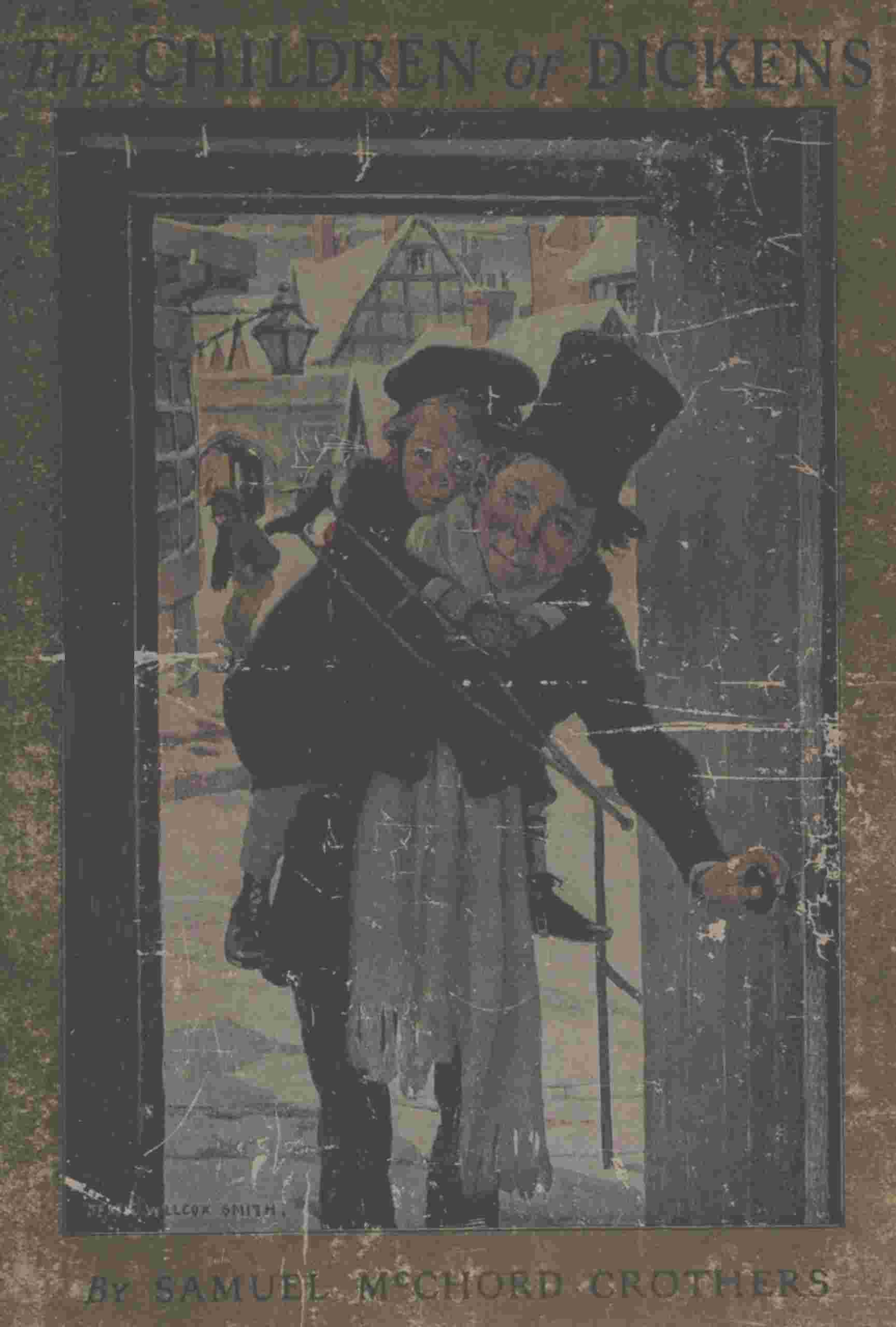
LITTLE NELL
XIV
LITTLE NELL
ONE of the strange things about London is the number of little shops in out-of-the-way places, where they sell things that one would suppose nobody would be looking for. The shops seem hidden away, and the game is for the customers to find them. And very often the customers don’t find them.
In one of these little streets was an old curiosity shop, kept by a little old man with long gray hair. The shop was full of old and curious things which the old man had collected and heaped upon the floor. There were suits of armor, and bits of old china and figures carved out of wood. The room was dark, and it was hard to walk around without stepping upon some of the curiosities.
The one bright spot in the old man’s life was his love for his granddaughter, little Nell Trent. For her he had been saving everything he could, but of late he had been losing more than he had gained. It would have been a rather dull life for little Nell if it had not been for Kit Nubbles.
Kit was a shock-headed, awkward boy who lived with his mother not far away, and he came every day to help Nell’s grandfather in the shop. He had an uncommonly big mouth, very red cheeks, and an old hat without any brim. Kit liked to “show off,” especially when Nell was around. He had a remarkable way of standing sideways as he spoke and thrusting his head over his shoulders. When he found that it would make Nell laugh, he did it again and again.
Copyright by Charles Scribner’s Sons
LITTLE NELL AND HER GRANDFATHER AT MRS. JARLEY’S
And there was a dwarf named Quilp who was as ugly as he looked, and delighted in nothing so much as in making everybody afraid of him. He lived down by the river. He had a business of his own. He bought old copper and rusty anchors from ships that had been broken up. But his real occupation was in making everybody who came under him miserable. At last Nell and her grandfather, in order to escape from Quilp, made up their minds to leave London, and go off into the country where they might find peace. They didn’t care where they went so that Quilp could not follow them. This would have been a very good plan if they had had money for their journeys, but as they hadn’t they had to depend on the kindness of the people on the road.
In their wanderings Nell and her grandfather fell in with some queer people. While they were resting near a village church, they came upon two men who were travelling over the country giving Punch and Judy shows. One of them, a merry-faced man with twinkling eyes and a red nose, was named Short. His companion, Codlin, was a more courteous and gloomy person. Mr. Codlin took the figure of Judy out of the box and said:
“Look here, here’s all this Judy’s clothes falling to pieces again. You haven’t got a needle and thread, I suppose?”
Nell had a needle and thread and soon was at work on Judy’s dress, and soon they were friends, and Codlin and Short took them to the wayside inn where they met other travellers who were going to fairs. The chapter which tells of the talk at the Jolly Sandboys is one which the lover of Dickens likes to read more than once.
THE JOLLY SANDBOYS
THE Jolly Sandboys was a small roadside inn with a sign representing three Sandboys increasing their jollity with as many jugs of ale and bags of gold, creaking and swinging on its post on the opposite side of the road. As the travellers had observed that day, there were many indications of their drawing nearer and nearer to the race town, such as gypsy camps, carts laden with gambling booths, itinerant showmen of all kinds, and beggars and trampers of every degree.
Mr. Codlin entered the inn, where a mighty fire was blazing on the hearth and roaring up the wide chimney with a cheerful sound. There was a large iron kettle bubbling and simmering in the heat. And when the landlord lifted the lid, there was a savory smell. The glow of the fire was upon the landlord’s bald head and upon his twinkling eyes. Mr. Codlin drew his sleeve across his lips and said in a murmuring voice, “What is it?”
“It’s a stew of tripe,” said the landlord, “and cowheel, and bacon,” smacking his lips, “and steak, and peas, cauliflowers, new potatoes, and sparrow-grass, all working together in one delicious gravy.”
Very soon all the hungry wayfarers were sitting down to supper while the rain fell in torrents on the roof.
Supper was not yet over, when there arrived at the Jolly Sandboys two more travellers bound for the same haven as the rest, who had been walking in the rain for some hours, and came in shining and heavy with water. One of these was the proprieter of a giant, and a little lady without legs or arms, who had jogged forward in a van; the other, a silent gentleman who earned his living by showing tricks upon the cards, and who had rather deranged the natural expression of his countenance by putting small leaden lozenges into his eyes and bringing them out at his mouth, which was one of his professional accomplishments. The name of the first of these newcomers was Vuffin; the other, probably as a pleasant satire upon his ugliness, was called Sweet William. To render them as comfortable as he could, the landlord bestirred himself nimbly, and in a very short time both gentlemen were perfectly at their ease.
“How’s the Giant?” said Short, when they all sat smoking round the fire.
“Rather weak upon his legs,” returned Mr. Vuffin. “I begin to be afraid he’s going at the knees.”
“That’s a bad lookout,” said Short.
“Ay! Bad indeed,” replied Mr. Vuffin, contemplating the fire with a sigh. “Once get a giant shaky on his legs, and the public care no more about him than they do for a dead cabbage-stalk.”
“What becomes of the old giants?” said Short, turning to him again after a little reflection.
“They’re usually kept in caravans to wait upon the dwarfs,” said Mr. Vuffin.
“The maintaining of ’em must come expensive, when they can’t be shown, eh?” remarked Short, eyeing him doubtfully.
“It’s better that, than letting ’em go upon the parish or about the streets,” said Mr. Vuffin. “Once make a giant common and giants will never draw again. Look at wooden legs. If there was only one man with a wooden leg what a property he’d be!”
“So he would!” observed the landlord and Short both together. “That’s very true.”
“Instead of which,” pursued Mr. Vuffin, “if you was to advertise Shakspeare played entirely by wooden legs, it’s my belief you wouldn’t draw a sixpence.”
“I don’t suppose you would,” said Short. And the landlord said so too.
“This shows, you see,” said Mr. Vuffin, waving his pipe with an argumentative air, “this shows the policy of keeping the used-up giants still in the carawans, where they get food and lodging for nothing, all their lives, and in general very glad they are to stop there. There was one giant—a black ’un—as left his carawan some years ago and took to carrying coach-bills about London, making himself as cheap as crossing-sweepers. He died. I make no insinuation against anybody in particular,” said Mr. Vuffin, looking solemnly round, “but he was ruining the trade;—and he died.”
The landlord drew his breath hard, and looked at the owner of the dogs, who nodded and said gruffly that he remembered.
“I know you do, Jerry,” said Mr. Vuffin with profound meaning. “I know you remember it, Jerry, and the universal opinion was, that it served him right. Why, I remember the time when old Maunders as had three-and-twenty wans—I remember the time when old Maunders had in his cottage in Spa fields in the winter time when the season was over, eight male and female dwarfs setting down to dinner every day, who was waited on by eight old giants in green coats, red smalls, blue cotton stockings, and high-lows: and there was one dwarf as had grown elderly and wicious who whenever his giant wasn’t quick enough to please him, used to stick pins in his legs, not being able to reach up any higher. I know that’s a fact, for Maunders told it me himself.”
“What about the dwarfs, when they get old?” inquired the landlord.
“The older a dwarf is, the better worth he is,” returned Mr. Vuffin; “a gray-headed dwarf, well wrinkled, is beyond all suspicion. But a giant weak in the legs and not standing upright—keep him in the carawan, but never show him, never show him, for any persuasion that can be offered.”
While Mr. Vuffin and his two friends smoked their pipes and beguiled the time with such conversation as this, the silent gentleman sat in a warm corner, swallowing, or seeming to swallow, a sixpennyworth of halfpence for practice, balancing a feather upon his nose, and rehearsing other feats of dexterity of that kind, without paying any regard whatever to the company, who in their turn left him utterly unnoticed. At length the weary child prevailed upon her grandfather to retire, and they withdrew, leaving the company yet seated round the fire, and the dogs fast asleep at a humble distance.
MRS. JARLEY AND HER WAX-WORKS
OF all the adventures of little Nell, the meeting with Mrs. Jarley was the most delightful. It happened just at the right time. Nell and her grandfather were trudging along the road. It was late in the afternoon and they didn’t know where they were to find a resting-place. They came to a common and saw what in England is called a caravan. It is not such a caravan as one would find in Bagdad, made up of camels. It was a little house on wheels. It had white curtains on the windows, and the window-shutters were of green, with bright red trimmings. There was a door with brass knockers and there were two fat horses to draw it. They all belonged to a stout, good-natured lady named Mrs. Jarley, who was at the moment arranging her tea things for a comfortable afternoon tea.
Mrs. Jarley looked up and saw little Nell. “Are you hungry, child?”
“Not very, but we are tired, and it’s a long way.”
“Well, hungry or not,” said Mrs. Jarley, “you had better have some tea, and I suppose the old gentleman is agreeable to that.”
So they sat down on the grass and had tea and bread and butter and generous slices of ham.
Then Mrs. Jarley invited Nell and her grandfather to be her guests in the little house on wheels. There wasn’t very much room, but Mrs. Jarley was so hospitable that they at once accepted her invitation and made themselves at home. Half of the little house had berths for sleeping, very much as if it were a ship. The other half was a kitchen, with a little stove in it. It also had several boxes and kettles and saucepans.
When they got started after breakfast in the morning, little Nell’s spirits rose and she forgot her troubles.
“Well,” said Mrs. Jarley, “how do you like this way of travelling?”
Nell said she liked it very much.
“That’s the happiness of you young people,” said Mrs. Jarley. “You don’t know what it is to be low in your feelings. You always have your appetites too—and what a comfort it is.”
Then Mrs. Jarley brought out a large roll of canvas about a yard wide, and spread it on the floor.
“There, child,” she said, “read that.”
Nell walked down it, and read aloud, in enormous black letters, the inscription, “JARLEY’S WAX-WORK.”
“Read it again,” said the lady, complacently.
“Jarley’s Wax-Work,” repeated Nell.
“That’s me,” said the lady. “I am Mrs. Jarley.”
Giving the child an encouraging look, intended to reassure her and let her know that, although she stood in the presence of the original Jarley, she must not allow herself to be utterly overwhelmed and borne down, the lady of the caravan unfolded another scroll, whereon was the inscription, “One hundred figures the full size of life,” and then another scroll, on which was written, “The only stupendous collection of real wax-work in the world,” and then several smaller scrolls with such inscriptions as, “Now exhibiting within”—“The genuine and only Jarley”—“Jarley’s unrivalled collection”—“Jarley is the delight of the Nobility and Gentry”—“The Royal Family are the patrons of Jarley.” When she had exhibited these leviathans of public announcement to the astonished child, she brought forth specimens of the lesser fry in the shape of handbills, some of which were couched in the form of parodies on popular melodies; as, “Believe me if all Jarley’s wax-work so rare”—“I saw thy show in youthful prime”—“Over the water to Jarley”; while, to consult all tastes, others were composed with a view to the lighter and more facetious spirits, as a parody on the favorite air of “If I had a donkey,” beginning:
—besides several compositions in prose, purporting to be dialogues between the Emperor of China and an oyster, or the Archbishop of Canterbury and a Dissenter on the subject of church-rates, but all having the same moral, namely, that the reader must make haste to Jarley’s, and that children and servants were admitted at half-price. When she had brought all these testimonials of her important position in society to bear upon her young companion, Mrs. Jarley rolled them up and, having put them carefully away, sat down again, and looked at the child in triumph.
“Never go into the company of a filthy Punch any more,” said Mrs. Jarley, “after this.”
“I never saw any wax-work, ma’am,” said Nell. “Is it funnier than Punch?”
“Funnier!” said Mrs. Jarley in a shrill voice. “It is not funny at all.”
“Oh!” said Nell, with all possible humility.
“It isn’t funny at all,” repeated Mrs. Jarley. “It’s calm and—what’s that word again—critical?—no—classical, that’s it—it’s calm and classical. No low beatings and knockings about, no jokings and squeakings like your precious Punches, but always the same, with a constantly unchanging air of coldness and gentility; and so like life, that if wax-work only spoke and walked about, you’d hardly know the difference. I won’t go so far as to say, that, as it is, I’ve seen wax-work quite like life, but I’ve certainly seen some life that was exactly like wax-work.”
“Is it here, ma’am?” asked Nell, whose curiosity was awakened by this description.
“Is what here, child?”
“The wax-work, ma’am.”
“Why, bless you, child, what are you thinking of? How could such a collection be here, where you see everything except the inside of one little cupboard and a few boxes? It’s gone on in the other wans to the assembly-rooms, and there it’ll be exhibited the day after to-morrow. You are going to the same town, and you’ll see it, I dare say. It’s natural to expect that you’ll see it, and I’ve no doubt you will. I suppose you couldn’t stop away if you was to try ever so much.”
“I shall not be in the town, I think, ma’am,” said the child.
“Not there!” cried Mrs. Jarley. “Then where will you be?”
“I—I—don’t quite know. I am not certain.”
“You don’t mean to say that you’re travelling about the country without knowing where you’re going to?” said the lady of the caravan. “What curious people you are! What line are you in? You looked to me at the races, child, as if you were quite out of your element, and had got there by accident.”
“We were there quite by accident,” returned Nell, confused by this abrupt questioning. “We are poor people, ma’am, and are only wandering about. We have nothing to do;—I wish we had.”
“You amaze me more and more,” said Mrs. Jarley, after remaining for some time as mute as one of her own figures. “Why, what do you call yourselves? Not beggars?”
“Indeed, ma’am, I don’t know what else we are,” returned the child.
“Lord bless me,” said the lady of the caravan. “I never heard of such a thing. Who’d have thought it!”
She remained so long silent after this exclamation, that Nell feared she felt her having been induced to bestow her protection and conversation upon one so poor, to be an outrage upon her dignity that nothing could repair. This persuasion was rather confirmed than otherwise by the tone in which she at length broke silence, and said:
“And yet you can read. And write too, I shouldn’t wonder?”
“Yes, ma’am,” said the child, fearful of giving new offense by the confession.
“Well, and what a thing that is,” returned Mrs. Jarley. “I can’t.”
Mrs. Jarley’s wax-works were carried in other wagons to the town where they were to be exhibited, and little Nell was engaged to point to each wax figure, and explain to the audience what it represented. Dozens of figures of noted persons, all with wax faces, and all dressed in brilliant clothes, stood stiffly in a row.
Dickens describes the scene where Mrs. Jarley instructs Nell as to her duties:
When the festoons were all put up as tastily as they might be, the stupendous collection was uncovered, and there were displayed, on a raised platform some two feet from the floor, running round the room and parted from the rude public by a crimson rope breast high, divers sprightly effigies of celebrated characters, singly and in groups, clad in glittering dresses of various climes and times, and standing more or less unsteadily upon their legs, with their eyes very wide open, and their nostrils very much inflated, and the muscles of their legs and arms very strongly developed, and all their countenances expressing great surprise. All the gentlemen were very pigeon-breasted and very blue about the beards; and all the ladies were miraculous figures; and all the ladies and all the gentlemen were looking intensely nowhere, and staring with extraordinary earnestness at nothing.
When Nell had exhausted her first raptures at this glorious sight, Mrs. Jarley ordered the room to be cleared of all but herself and the child, and, sitting herself down in an armchair in the centre, formally invested her with a willow wand, long used by herself for pointing out the characters, and was at great pains to instruct her in her duty.
“That,” said Mrs. Jarley in her exhibition tone, as Nell touched a figure at the beginning of the platform, “is an unfortunate Maid of Honor in the Time of Queen Elizabeth, who died from pricking her finger in consequence of working upon a Sunday. Observe the blood which is trickling from her finger; also the gold-eyed needle of the period, with which she is at work.”
All this Nell repeated twice or thrice, pointing to the finger and the needle at the right times, and then passed on to the next.
“That, ladies and gentlemen,” said Mrs. Jarley, “is Jasper Packlemerton of atrocious memory, who courted and married fourteen wives, and destroyed them all by tickling the soles of their feet when they were sleeping in the consciousness of innocence and virtue. On being brought to the scaffold and asked if he was sorry for what he had done, he replied yes, he was sorry for having let ’em off so easy, and hoped all Christian husbands would pardon him the offense. Let this be a warning to all young ladies to be particular in the character of the gentlemen of their choice. Observe that his fingers are curled as if in the act of tickling, and that his face is represented with a wink, as he appeared when committing his barbarous murders.”
When Nell knew all about Mr. Packlemerton, and could say it without faltering, Mrs. Jarley passed on to the fat man, and then to the thin man, the tall man, the short man, the old lady who died of dancing at a hundred and thirty-two, the wild boy of the woods, the woman who poisoned fourteen families with pickled walnuts, and other historical characters and interesting but misguided individuals. And so well did Nell profit by her instructions, and so apt was she to remember them, that by the time they had been shut up together for a couple of hours, she was in full possession of the history of the whole establishment, and perfectly competent to the enlightenment of visitors.
Mrs. Jarley was not slow to express her admiration at this happy result, and carried her young friend and pupil to inspect the remaining arrangements within doors, by virtue of which the passage had been already converted into a grove of green baize hung with the inscriptions she had already seen (Mr. Slum’s productions), and a highly ornamented table placed at the upper end for Mrs. Jarley herself, at which she was to preside and take the money, in company with his Majesty King George the Third, Mr. Grimaldi as clown, Mary Queen of Scots, an anonymous gentleman of the Quaker persuasion, and Mr. Pitt holding in his hand a correct model of the bill for the imposition of the window duty. The preparations without doors had not been neglected either; for a nun of great personal attractions was telling her beads on the little portico over the door; and a brigand with the blackest possible head of hair, and the clearest possible complexion, was at that moment going round the town in a cart, consulting the miniature of a lady.
It now only remained that the compositions in praise of the wax-works should be judiciously distributed; that the pathetic effusions should find their way to all private houses and tradespeople; and that the parody commencing “If I know’d a donkey,” should be confined to the taverns, and circulated only among the lawyers’ clerks and choice spirits of the place. When this had been done, and Mrs. Jarley had waited upon the boarding-schools in person, with a hand-bill composed expressly for them, in which it was distinctly proved that wax-work refined the mind, cultivated the taste, and enlarged the sphere of the human understanding, that lady sat down to dinner.