
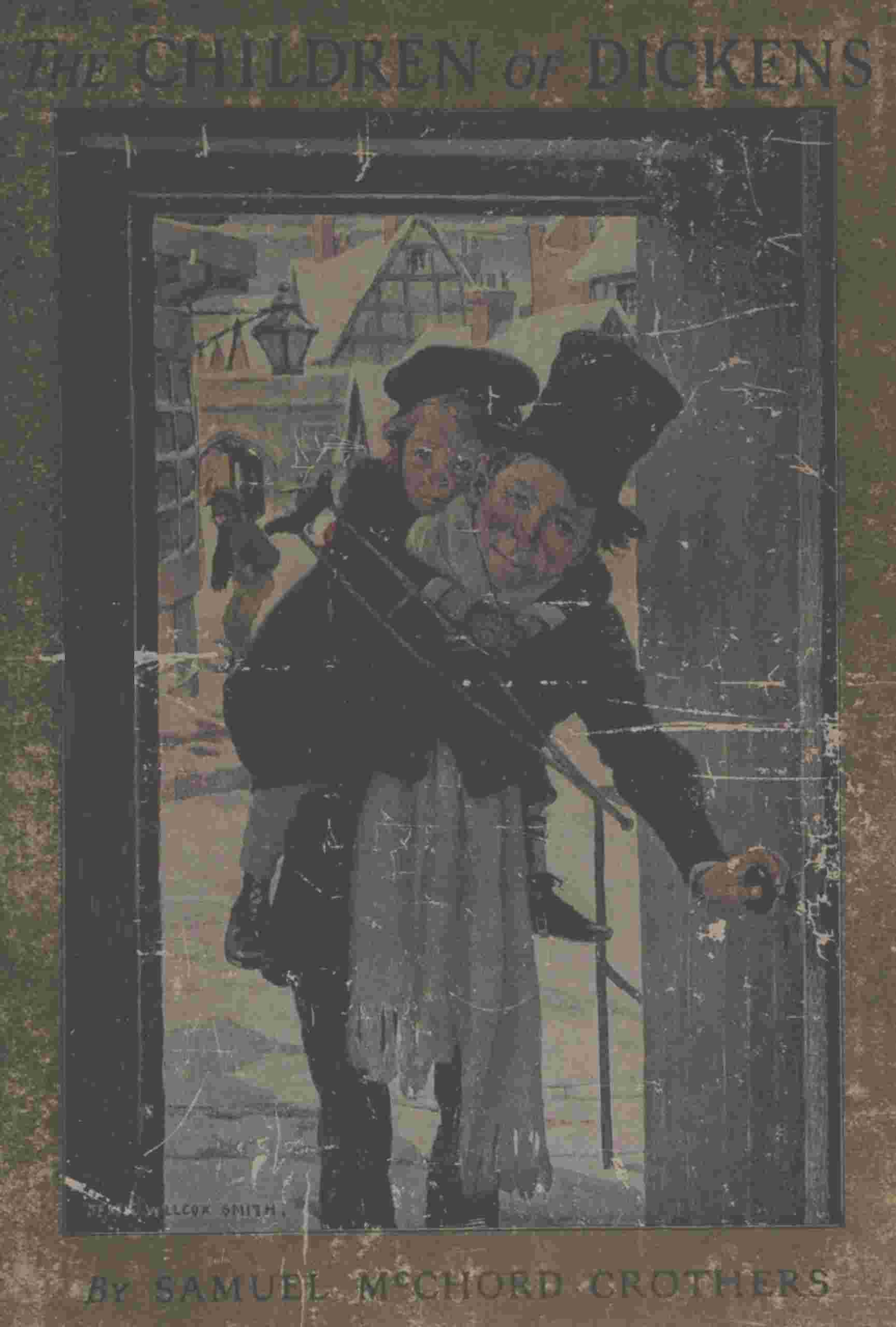
THE BOY AT TODGERS’S
XVII
THE BOY AT TODGERS’S
WHEN Mr. Pecksniff and his two daughters came to London, they found their way to Mrs. Todgers’s Boarding House. It was early in the morning and they rang two or three times without making any impression on anything but a dog over the way. At last a chain and some bolts were withdrawn, and a small boy with a large red head, and no nose to speak of, and a pair of huge boots under his arm, appeared. The boy rubbed his nose with the back of his shoe brush and said nothing.
“Still abed, my man?” asked Mr. Pecksniff.
“Still abed!” replied the boy, “I wish they wos still abed. They’re very noisy abed, all calling for their boots at once. I thought you was the Paper and wondered why you didn’t shove yourself through the grating as usual. What do you want?”
The boy was called Bailey, and though he was a little cross when the Pecksniffs came because it was so early in the morning, he was usually the soul of good humor. Indeed, good humor was about the only thing he had, for no one had taken the trouble to teach him good manners.
Bailey would roll up his sleeves to the shoulders and find his way all over the house, and wherever he went he made things lively. He wore an apron of coarse green baize. He would answer the door and then make a bolt for the alley, and in a moment be playing leap-frog, till Mrs. Todgers followed him and pulled him into the house by the hair of his head.
When the two Miss Pecksniffs were sitting primly on the sofa, Bailey would greet them with such compliments as: “There you are agin! Ain’t it nice!” This made them feel very much at home.
“I say,” he whispered, stopping in one of his journeys to and fro, “young ladies, there’s soup to-morrow. She’s making it now. Ain’t she putting in the water? Oh! not at all neither!”
The next time he passed by he called out:
“I say—there’s fowls to-morrow. Not skinny ones. Oh, no!”
Presently he called through the keyhole:
“There’s a fish to-morrow—just come. Don’t eat none of him!” And, with this warning, he vanished again.
By-and-by, he returned to lay the cloth for supper, it having been arranged between Mrs. Todgers and the young ladies that they should partake of an exclusive veal-cutlet together in the privacy of that apartment. He entertained them on this occasion by thrusting the lighted candle into his mouth, and exhibiting his face in a state of transparency; after the performance of which feat he went on with his professional duties; brightening every knife as he laid it on the table, by breathing on the blade and afterward polishing the same on the apron already mentioned. When he had completed his preparations, he grinned at the sisters, and expressed his belief that the approaching collation would be of “rather a spicy sort.”
“Will it be long before it’s ready, Bailey?” asked Mercy.
“No,” said Bailey, “it is cooked. When I come up, she was dodging among the tender pieces with a fork, and eating of ’em.”
But he had scarcely achieved the utterance of these words, when he received a manual compliment on the head, which sent him staggering against the wall; and Mrs. Todgers, dish in hand, stood indignantly before him.
“Oh, you little villain!” said that lady. “Oh, you bad, false boy!”
“No worse than yerself,” retorted Bailey, guarding his head, in a principle invented by Mr. Thomas Cribb. “Ah! Come now! Do that agin, will yer!”
“He’s the most dreadful child,” said Mrs. Todgers, setting down the dish, “I ever had to deal with. The gentlemen spoil him to that extent, and teach him such things, that I’m afraid nothing but hanging will ever do him any good.”
“Won’t it?” cried Bailey. “Oh! Yes! Wot do you go a lowerin’ the table-beer for then, and destroying my constitooshun?”
“Go down-stairs, you vicious boy,” said Mrs. Todgers, holding the door open. “Do you hear me? Go along!”
After two or three dexterous feints, he went, and was seen no more that night, save once, when he brought up some tumblers and hot water, and much disturbed the two Miss Pecksniffs by squinting hideously behind the back of the unconscious Mrs. Todgers. Having done this justice to his wounded feelings, he returned underground; whence, in company with a swarm of black beetles and a kitchen candle, he employed his faculties in cleaning boots and brushing clothes until the night was far advanced.
But it was at the Sunday dinner that Bailey shone in glory. When the hour drew near, he appeared in a complete suit of cast-off clothes several times too large for him, and a clean shirt of extraordinary size. This caused the boarders to call him “Collars.” Then Bailey would announce joyfully: “The wittles is up.”
When all were seated, Bailey would stand behind the chair winking and nodding with the greatest good humor. His idea of waiting on the table was to stand with his hands in his pockets and his feet wide apart. This was on the whole the best thing to do, for when a dish passed through his hands it was quite likely to drop on the floor.
Mrs. Todgers was always scolding Bailey, who deserved it all, and Bailey was always threatening to leave and be a soldier boy.
“There’s something gamey in that, ain’t there? I’d sooner be hit with a cannon-ball than a rolling-pin, and she’s always a catching up something of that sort and throwing it at me, when the gentlemen’s appetites is good. But I ain’t going to have every rise in prices wisited on me.”
Mrs. Todgers got rid of Bailey after a while, but the boarders never got the same amount of amusement from his successor. The house always seemed a little dull after he left.