
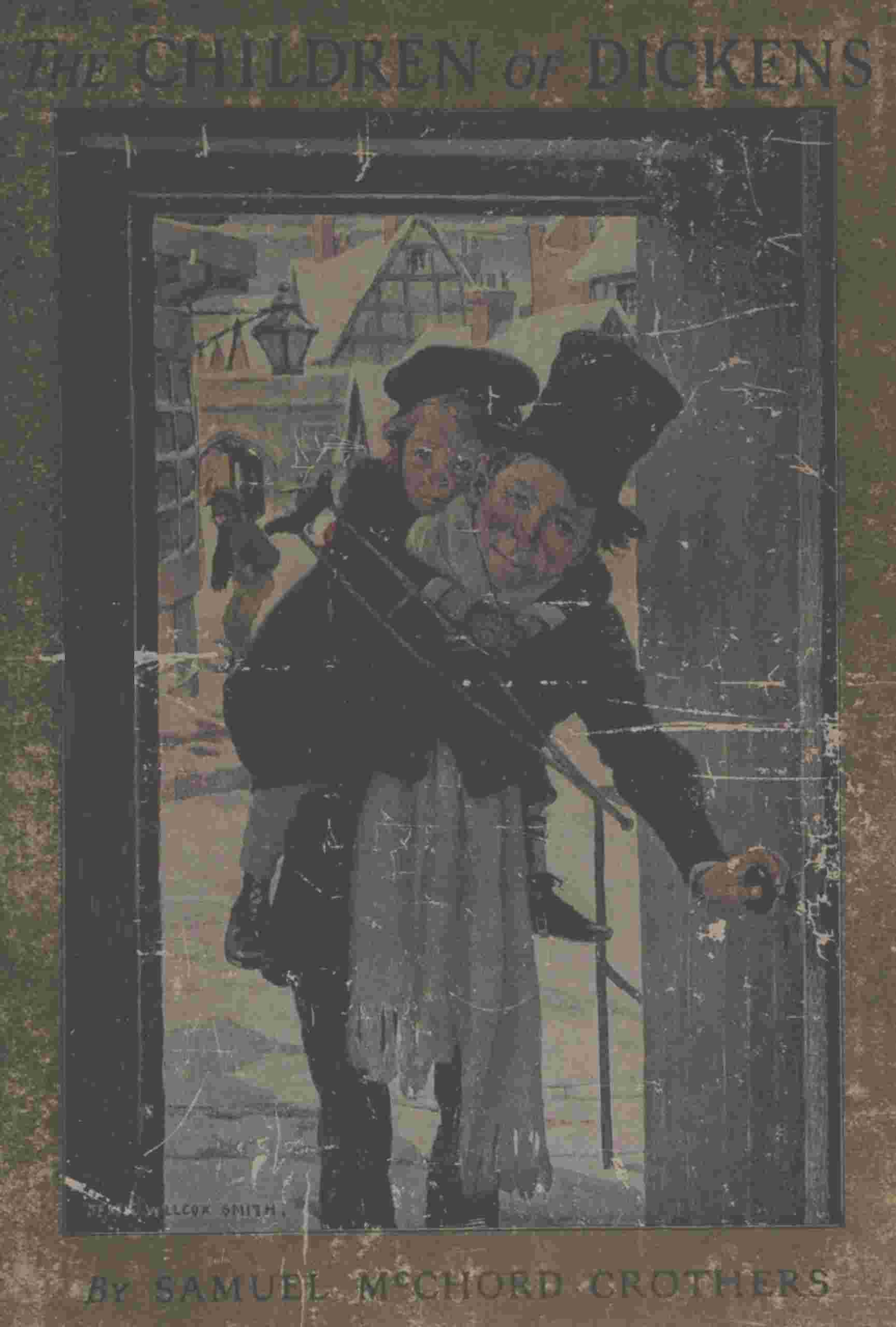
A CHRISTMAS TREE
XXIV
A CHRISTMAS TREE
MOST people love Christmas trees, but the first Christmas trees one sees are the most wonderful of all. Dickens tells about the tree he saw when he was just the right age to appreciate its wonderfulness. He never afterward saw anything that was equal to it in magnificence. All sorts of objects clustered on the branches like magic fruit. And the best thing about it all was that many of these things were for him.
All toys at first, I find. Up yonder, among the green holly and red berries, is the Tumbler with his hands in his pockets, who wouldn’t lie down, but whenever he was put upon the floor, persisted in rolling his fat body about, until he rolled himself still, and brought those lobster eyes of his to bear upon me—when I affected to laugh very much, but in my heart of hearts was extremely doubtful of him. Close beside him is that infernal snuff-box, out of which there sprang a demoniacal Counsellor in a black gown, with an obnoxious head of hair, and a red cloth mouth, wide open, who was not to be endured on any terms, but could not be put away either; for he used suddenly, in a highly magnified state, to fly out of mammoth snuff-boxes in dreams, when least expected. Nor is the frog with cobbler’s wax on his tail, far off; for there was no knowing where he wouldn’t jump; and when he flew over the candle, and came upon one’s hand with that spotted back—red on a green ground—he was horrible. The cardboard lady in a blue-silk skirt, who was stood up against the candlestick to dance, and whom I see on the same branch, was milder, and was beautiful; but I can’t say as much for the larger cardboard man, who used to be hung against the wall and pulled by a string; there was a sinister expression in that nose of his; and when he got his legs round his neck (which he very often did), he was ghastly, and not a creature to be alone with.
When did that dreadful Mask first look at me? Who put it on, and why was I so frightened that the sight of it is an era in my life? It is not a hideous visage in itself; it is even meant to be droll; why then were its stolid features so intolerable? Surely not because it hid the wearer’s face. An apron would have done as much; and though I should have preferred even the apron away, it would not have been absolutely insupportable, like the mask. Was it the immovability of the mask? The doll’s face was immovable, but I was not afraid of her. Perhaps that fixed and set change coming over a real face infused into my quickened heart some remote suggestion and dread of the universal change that is to come on every face and make it still? Nothing reconciled me to it. No drummers, from whom proceeded a melancholy chirping on the turning of a handle; no regiment of soldiers, with a mute band, taken out of a box, and fitted, one by one, upon a stiff and lazy little set of lazy-tongs; no old woman, made of wires and a brown-paper composition, cutting up a pie for two small children, could give me a permanent comfort, for a long time. Nor was it any satisfaction to be shown the Mask, and see that it was made of paper, or to have it locked up and be assured that no one wore it. The mere recollection of that fixed face, the mere knowledge of its existence anywhere, was sufficient to awake me in the night all perspiration and horror, with, “Oh, I know its coming! Oh, the mask!”
I never wondered what the dear old donkey with the panniers—there he is! was made of, then! His hide was real to the touch, I recollect. And the great black horse with the round red spots all over him—the horse that I could even get upon—I never wondered what had brought him to that strange condition, or thought that such a horse was not commonly seen at Newmarket. The four horses of no color, next to him, that went into the wagon of cheeses, and could be taken out and stabled under the piano, appear to have bits of fur-tippet for their tails, and other bits for their manes, and to stand on pegs instead of legs; but it was not so when they were brought home for a Christmas present. They were all right, then; neither was their harness unceremoniously nailed into their chests, as appears to be the case now. The tinkling works of the music-cart, I did find out, to be made of quill toothpicks and wire; and I always thought that little tumbler in his shirt-sleeves, perpetually swarming up one side of a wooden frame, and coming down, head foremost, on the other, rather a weak-minded person—though good-natured; but the Jacob’s Ladder, next him, made of little squares of red wood, that went flapping and clattering over one another, each developing a different picture, and the whole enlivened by small bells, was a mighty marvel and a great delight.
Ah! The Doll’s house!—of which I was not proprietor, but where I visited. I don’t admire the Houses of Parliament half so much as that stone-fronted mansion with real glass windows and doorsteps, and a real balcony—greener than I ever see now, except at watering-places; and even they afford but a poor imitation. And though it did open all at once, the entire house-front (which was a blow, I admit, as cancelling the fiction of a staircase), it was but to shut it up again, and I could believe. Even open, there were three distinct rooms in it: a sitting-room and bedroom, elegantly furnished, and best of all, a kitchen, with uncommonly soft fire-irons, a plentiful assortment of diminutive utensils—oh, the warming-pan!—and a tin man-cook in profile, who was always going to fry two fish! What Barmecide justice have I done to the noble feasts wherein the set of wooden platters figured, each with its own peculiar delicacy, as a ham or turkey, glued tight on to it, and garnished with something green, which I recollect as moss! Could all the Temperance societies of these later days, united, give me such a tea-drinking as I have had through the means of yonder little set of blue crockery, which really would hold liquid (it ran out of the small wooden cask, I recollect, and tasted of matches), and which made tea, nectar. And if the two legs of the ineffectual little sugar-tongs did tumble over one another, and want purpose, like Punch’s hands, what does it matter? And if I did once shriek out, as a poisoned child, and strike the fashionable company with consternation, by reason of having drunk a little teaspoon, inadvertently dissolved in too hot tea, I was never the worse for it, except by a powder!
Upon the next branches of the tree, lower down, hard by the green roller and miniature gardening-tools, how thick the books begin to hang. Thin books, in themselves, at first, but many of them, and with deliciously smooth covers of bright red or green. What fat black letters to begin with! “A was an Archer, and shot at a frog.” Of course he was. He was an Apple-pie also, and there he is! He was a good many things in his time, was A, and so were most of his friends, except X, who had so little versatility that I never knew him to get beyond Xerxes or Xantippe—like Y, who was always confined to a Yacht or a Yew Tree; and Z condemned forever to be a Zebra or a Zany. But, now, the very tree itself changes, and becomes a bean-stalk—the marvellous bean-stalk up which Jack climbed to the Giant’s house! And now, those dreadfully interesting, double-headed giants, with their clubs over their shoulders, begin to stride along the boughs in a perfect throng, dragging knights and ladies home for dinner by the hair of their heads. And Jack—how noble, with his sword of sharpness, and his shoes of swiftness! Again those old meditations come upon me as I gaze up at him; and I debate within myself whether there was more than one Jack (which I am loath to believe possible), or only one genuine original admirable Jack, who achieved all the recorded exploits.
Good for Christmas time is the ruddy color of the cloak, in which—the tree making a forest of itself for her to trip through, with her basket—Little Red Riding-Hood comes to me one Christmas Eve to give me information of the cruelty and treachery of that dissembling Wolf who ate her grandmother, without making any impression on his appetite, and then ate her, after making that ferocious joke about his teeth. She was my first love. I felt that if I could have married Little Red Riding-Hood, I should have known perfect bliss. But it was not to be; and there was nothing for it but to look out the Wolf in the Noah’s Ark there, and put him late in the procession on the table, as a monster who was to be degraded. Oh, the wonderful Noah’s Ark! It was not found seaworthy when put in a washing-tub, and the animals were crammed in at the roof, and needed to have their legs well shaken down before they could be got in, even there—and then, ten to one but they began to tumble out at the door, which was but imperfectly fastened with a wire latch—but what was that against it! Consider the noble fly, a size or two smaller than the elephant: the lady-bird, the butterfly—all triumphs of art! Consider the goose, whose feet were so small, and whose balance was so indifferent, that he usually tumbled forward, and knocked down all the animal creation. Consider Noah and his family, like idiotic tobacco-stoppers; and how the leopard stuck to warm little fingers; and how the tails of the larger animals used gradually to resolve themselves into frayed bits of string!
Hush! Again a forest, and somebody up in a tree—not Robin Hood, not Valentine, not the Yellow Dwarf (I have passed him and all Mother Bunch’s wonders, without mention), but an Eastern King with a glittering scimitar and turban. By Allah! two Eastern Kings, for I see another, looking over his shoulder! Down upon the grass, at the tree’s foot, lies the full length of a coal-black Giant, stretched asleep, with his head in a lady’s lap; and near them is a glass box, fastened with four locks of shining steel, in which he keeps the lady prisoner when he is awake. I see the four keys at his girdle now. The lady makes signs to the two kings in the tree, who softly descend. It is the setting-in of the bright Arabian Nights.
Oh, now all common things become uncommon and enchanted to me. All lamps are wonderful; all rings are talismans. Common flower-pots are full of treasure, with a little earth scattered on the top; trees are for Ali Baba to hide in; beefsteaks are to throw down into the Valley of Diamonds, that the precious stones may stick to them, and be carried by the eagles to their nests, whence the traders, with loud cries, will scare them. Tarts are made, according to the recipe of the Vizier’s son of Bussorah, who turned pastrycook after he was set down in his drawers at the gate of Damascus; cobblers are all Mustaphas, and in the habit of sewing up people cut into four pieces, to whom they are taken blindfold.
Any iron ring let into stone is the entrance to a cave which only waits for the magician, and the little fire, and the necromancy, that will make the earth shake. All the dates imported come from the same tree as that unlucky date with whose shell the merchant knocked out the eye of the genie’s invisible son. All olives are of the stock of that fresh fruit concerning which the Commander of the Faithful overheard the boy conduct the fictitious trial of the fraudulent olive merchant; all apples are akin to the apple purchased (with two others) from the Sultan’s gardener for three sequins, and which the tall black slave stole from the child. All dogs are associated with the dog, really a transformed man, who jumped upon the baker’s counter, and put his paw on the piece of bad money. All rice recalls the rice which the awful lady, who was a ghoul, would only peck by grains, because of her nightly feasts in the burial-place. My very rocking-horse—there he is, with his nostrils turned completely inside-out, indicative of Blood!—should have a peg in his neck, by virtue thereof to fly away with me, as the wooden horse did with the Prince of Persia, in the sight of all his father’s court.
Yes, on every object that I recognize among those upper branches of my Christmas tree, I see this fairy light! When I wake in bed, at daybreak, on the cold, dark, winter mornings, the white snow dimly beheld, outside, through the frost on the window-pane, I hear Dinarzade: “Sister, sister, if you are yet awake, I pray you finish the history of the Young King of the Black Islands.” Scheherazade replies: “If my lord the Sultan will suffer me to live another day, sister, I will not only finish that, but tell you a more wonderful story yet.” Then, the gracious sultan goes out, giving no orders for the execution, and we all three breathe again.