
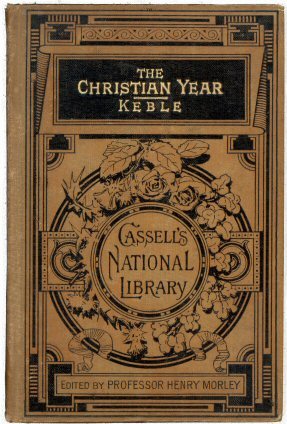
The Project Gutenberg eBook of The Christian Year
Title: The Christian Year
Author: John Keble
Editor: Henry Morley
Release date: July 1, 2003 [eBook #4272]
Most recently updated: April 24, 2013
Language: English
Credits: Transcribed from the 1887 Cassell & Company edition by David Price
Transcribed from the 1887 Cassell & Company edition by David Price, email ccx074@pglaf.org
CASSELL’S NATIONAL LIBRARY.
THE
CHRISTIAN YEAR
BY
THE REV. JOHN KEBLE.
CASSELL & COMPANY, Limited:
LONDON, PARIS, NEW YORK & MELBOURNE.
1887.
INTRODUCTION.
John Keble, two years older than his friend Dr. Arnold of Rugby, three years older than Thomas Carlyle, and nine years older than John Henry Newman, was born in 1792, at Fairford in Gloucestershire. He was born in his father’s parsonage, and educated at home by his father till he went to college. His father then entered him at his own college at Oxford, Corpus Christi. Thoroughly trained, Keble obtained high reputation at his University for character and scholarship, and became a Fellow of Oriel. After some years he gave up work in the University, though he could not divest himself of a large influence there for good, returned home to his old father, who required help in his ministry, and undertook for his the duty of two little curacies. The father lived on to the age of ninety. John Keble’s love for God and his devotion to the Church had often been expressed in verse. On days which the Church specially celebrated, he had from time to time written short poems to utter from the heart his own devout sense of their spiritual use and meaning. As the number of these poems increased, the desire rose to follow in like manner the while course of the Christian Year as it was marked for the people by the sequence of church services, which had been arranged to bring in due order before the minds of Christian worshippers all the foundations of their faith, and all the elements of a religious life. A book of poems, breathing faith and worship at all points, and in all attitudes of heavenward contemplation, within the circle of the Christian Year, would, he hoped, restore in many minds to many a benumbed form life and energy.
In 1825, while the poems of the Christian Year were gradually being shaped into a single work, a brother became able to relieve John Keble in that pious care for which his father had drawn him away from a great University career, and he then went to a curacy at Hursley, four or five miles from Winchester.
In 1827—when its author’s age was thirty-five—“The Christian Year” was published. Like George Herbert, whose equal he was in piety though not in power, Keble was joined to the Church in fullest sympathy with all its ordinances, and desired to quicken worship by putting into each part of the ritual a life that might pass into and raise the life of man. The spirit of true religion, with a power beyond that of any earthly feuds and controversies, binds together those in whom it really lives. Setting aside all smaller questions of the relative value of different earthly means to the attainment of a life hidden with Christ in God, Christians of all forms who are one in spirit have found help from “John Keble’s Christian Year,” and think of its guileless author with kindly affection. Within five-and-twenty years of its publication, a hundred thousand copies had been sold. The book is still diffused so widely, in editions of all forms, that it may yet go on, until the circle of the years shall be no more, living and making live.
Four years after “The Christian Year” appeared, Keble was appointed (in 1831) to the usual five years’ tenure of the Poetry Professorship at Oxford. Two years after he had been appointed Poetry Professor, he preached the Assize Sermon, and took for his theme “National Apostasy.” John Henry Newman, who had obtained his Fellowship at Oriel some years before the publication of “The Christian Year,” and was twenty-six years old when it appeared, received from it a strong impulse towards the endeavour to revive the spirit of the Church by restoring life and soul to all her ordinances, and even to the minutest detail of her ritual. The deep respect felt for the author of “The Christian Year” gave power to the sermon of 1833 upon National Apostasy, and made it the starting-point of the Oxford movement known as Tractarian, from the issue of tracts through which its promoters sought to stir life in the clergy and the people; known also as Puseyite because it received help at the end of the year 1833 from Dr. Pusey, who was of like age with J. H. Newman, and then Regius Professor of Hebrew. There was a danger, which some then foresaw, in the nature of this endeavour to put life into the Church; but we all now recognise the purity of Christian zeal that prompted the attempt to make dead forms of ceremonial glow again with spiritual fire, and serve as aids to the recovery of light and warmth in our devotions.
It was in 1833 that Keble, by one earnest sermon, with a pure life at the back of it, and this book that had prepared the way, gave the direct impulse to an Oxford movement for the reformation of the Church. The movement then began. But Keble went back to his curacy at Hursley. Two years afterwards the curate became vicar, and then Keble married. His after-life continued innocent and happy. He and his wife died within two months of each other, in the came year, 1866. He had taken part with his friends at Oxford by writing five of their Tracts, publishing a few sermons that laboured towards the same end, and editing a “Library of the Fathers.” In 1847 he produced another volume of poems, “Lyra Innocentium,” which associated doctrines of the Church with the lives of children, whom he loved, though his own marriage was childless.
The power of Keble’s verse lies in its truth. A faithful and pure nature, strong in home affections, full of love and reverence for all that is of heaven in our earthly lot, strives for the full consecration of man’s life with love and faith. There is no rare gift of genius. Keble is not in subtlety of thought or of expression another George Herbert, or another Henry Vaughan. But his voice is not the less in unison with theirs, for every note is true, and wins us by its purity. His also are melodies of the everlasting chime.
“And be ye sure that Love can bless
E’en in this crowded loneliness,
Where ever moving myriads seem to say,
Go—thou art nought to us, nor we to thee—away!”“There are in this loud stunning tide
Of human care and crime,
With whom the melodies abide
Of the everlasting chime;
Who carry music in their heart
Through dusky lane and wrangling mart,
Plying their daily task with busier feet,
Because their secret souls a holy strain repeat.”
With a peal, then, of such music let us ring in the New Year for our Library; and for our lives.
January 1, 1887.
H. M.
DEDICATION.
When in my silent
solitary walk,
I sought a strain not all unworthy Thee,
My heart, still ringing with wild worldly talk,
Gave forth no note of holier minstrelsy.
Prayer is the secret, to myself I said,
Strong supplication must call down the charm,
And thus with untuned heart I feebly prayed,
Knocking at Heaven’s gate with earth-palsied
arm.
Fountain of Harmony! Thou Spirit
blest,
By whom the troubled waves of earthly sound
Are gathered into order, such as best
Some high-souled bard in his enchanted round
May compass, Power divine! Oh, spread Thy
wing,
Thy dovelike wing that makes confusion fly,
Over my dark, void spirit, summoning
New worlds of music, strains that may not die.
Oh, happiest who before thine altar wait,
With pure hands ever holding up on high
The guiding Star of all who seek Thy gate,
The undying lamp of heavenly Poesy.
Too weak, too wavering, for such holy task
Is my frail arm, O Lord; but I would fain
Track to its source the brightness, I would bask
In the clear ray that makes Thy pathway plain.
I dare not hope with David’s harp to
chase
The evil spirit from the troubled breast;
Enough for me if I can find such grace
To listen to the strain, and be at rest.
THE CHRISTIAN YEAR.
Morning.
His compassions fail not. They are new every morning.
Lament. iii. 22, 23.
Hues of the rich
unfolding morn,
That, ere the glorious sun be born,
By some soft touch invisible
Around his path are taught to swell;—
Thou rustling breeze so fresh and gay,
That dancest forth at opening day,
And brushing by with joyous wing,
Wakenest each little leaf to sing;—
Ye fragrant clouds of dewy steam,
By which deep grove and tangled stream
Pay, for soft rains in season given,
Their tribute to the genial heaven;—
Why waste your treasures of delight
Upon our thankless, joyless sight;
Who day by day to sin awake,
Seldom of Heaven and you partake?
Oh, timely happy, timely wise,
Hearts that with rising morn arise!
Eyes that the beam celestial view,
Which evermore makes all things new!
New every morning is the love
Our wakening and uprising prove;
Through sleep and darkness safely brought,
Restored to life, and power, and thought.
New mercies, each returning day,
Hover around us while we pray;
New perils past, new sins forgiven,
New thoughts of God, new hopes of Heaven.
If on our daily course our mind
Be set to hallow all we find,
New treasures still, of countless price,
God will provide for sacrifice.
Old friends, old scenes will lovelier be,
As more of Heaven in each we see:
Some softening gleam of love and prayer
Shall dawn on every cross and care.
As for some dear familiar strain
Untired we ask, and ask again,
Ever, in its melodious store,
Finding a spell unheard before;
Such is the bliss of souls serene,
When they have sworn, and stedfast mean,
Counting the cost, in all t’ espy
Their God, in all themselves deny.
Oh, could we learn that sacrifice,
What lights would all around us rise!
How would our hearts with wisdom talk
Along Life’s dullest, dreariest walk!
We need not bid, for cloistered cell,
Our neighbour and our work farewell,
Nor strive to wind ourselves too high
For sinful man beneath the sky:
The trivial round, the common task,
Would furnish all we ought to ask;
Room to deny ourselves; a road
To bring us daily nearer God.
Seek we no more; content with these,
Let present Rapture, Comfort, Ease,
As Heaven shall bid them, come and go:—
The secret this of Rest below.
Only, O Lord, in Thy dear love
Fit us for perfect Rest above;
And help us, this and every day,
To live more nearly as we pray.
Evening.
Abide with us: for it is toward evening, and the day is far spent.—St. Luke xxiv. 29.
’Tis gone,
that bright and orbèd blaze,
Fast fading from our wistful gaze;
You mantling cloud has hid from sight
The last faint pulse of quivering light.
In darkness and in weariness
The traveller on his way must press,
No gleam to watch on tree or tower,
Whiling away the lonesome hour.
Sun of my soul! Thou Saviour dear,
It is not night if Thou be near:
Oh, may no earth-born cloud arise
To hide Thee from Thy servant’s eyes!
When round Thy wondrous works below
My searching rapturous glance I throw,
Tracing out Wisdom, Power and Love,
In earth or sky, in stream or grove;—
Or by the light Thy words disclose
Watch Time’s full river as it flows,
Scanning Thy gracious Providence,
Where not too deep for mortal sense:—
When with dear friends sweet talk I hold,
And all the flowers of life unfold;
Let not my heart within me burn,
Except in all I Thee discern.
When the soft dews of kindly sleep
My wearied eyelids gently steep,
Be my last thought, how sweet to rest
For ever on my Saviour’s breast.
Abide with me from morn till eve,
For without Thee I cannot live:
Abide with me when night is nigh,
For without Thee I dare not die.
Thou Framer of the light and dark,
Steer through the tempest Thine own ark:
Amid the howling wintry sea
We are in port if we have Thee.
The Rulers of this Christian land,
’Twixt Thee and us ordained to stand,—
Guide Thou their course, O Lord, aright,
Let all do all as in Thy sight.
Oh! by Thine own sad burthen, borne
So meekly up the hill of scorn,
Teach Thou Thy Priests their daily cross
To bear as Thine, nor count it loss!
If some poor wandering child of Thine
Have spurned to-day the voice divine,
Now, Lord, the gracious work begin;
Let him no more lie down in sin.
Watch by the sick: enrich the poor
With blessings from Thy boundless store:
Be every mourner’s sleep to-night,
Like infants’ slumbers, pure and light.
Come near and bless us when we wake,
Ere through the world our way we take;
Till in the ocean of Thy love
We lose ourselves, in Heaven above.
Advent Sunday.
Now it is high time to awake out of sleep: for now is our salvation nearer than when we believed.—Romans xiii 11.
Awake—again
the Gospel-trump is blown—
From year to year it swells with louder tone,
From year to year the signs of wrath
Are gathering round the Judge’s path,
Strange words fulfilled, and mighty works achieved,
And truth in all the world both hated and believed.
Awake! why linger in the gorgeous town,
Sworn liegemen of the Cross and thorny crown?
Up from your beds of sloth for shame,
Speed to the eastern mount like flame,
Nor wonder, should ye find your King in tears,
E’en with the loud Hosanna ringing in His ears.
Alas! no need to rouse them: long ago
They are gone forth to swell Messiah’s show:
With glittering robes and garlands sweet
They strew the ground beneath His feet:
All but your hearts are there—O doomed to prove
The arrows winged in Heaven for Faith that will not love!
Meanwhile He passes through th’ adoring
crowd,
Calm as the march of some majestic cloud,
That o’er wild scenes of ocean-war
Holds its still course in Heaven afar:
E’en so, heart-searching Lord, as years roll on,
Thou keepest silent watch from Thy triumphal throne:
E’en so, the world is thronging round to
gaze
On the dread vision of the latter days,
Constrained to own Thee, but in heart
Prepared to take Barabbas’ part:
“Hosanna” now, to-morrow “Crucify,”
The changeful burden still of their rude lawless cry.
Yet in that throng of selfish hearts untrue
Thy sad eye rests upon Thy faithful few,
Children and childlike souls are there,
Blind Bartimeus’ humble prayer,
And Lazarus wakened from his four days’ sleep,
Enduring life again, that Passover to keep.
And fast beside the olive-bordered way
Stands the blessed home where Jesus deigned to stay,
The peaceful home, to Zeal sincere
And heavenly Contemplation dear,
Where Martha loved to wait with reverence meet,
And wiser Mary lingered at Thy sacred feet.
Still through decaying ages as they glide,
Thou lov’st Thy chosen remnant to divide;
Sprinkled along the waste of years
Full many a soft green isle appears:
Pause where we may upon the desert road,
Some shelter is in sight, some sacred safe abode.
When withering blasts of error swept the
sky,
And Love’s last flower seemed fain to droop and die,
How sweet, how lone the ray benign
On sheltered nooks of Palestine!
Then to his early home did Love repair,
And cheered his sickening heart with his own native air.
Years roll away: again the tide of crime
Has swept Thy footsteps from the favoured clime
Where shall the holy Cross find rest?
On a crowned monarch’s mailèd
breast:
Like some bright angel o’er the darkling scene,
Through court and camp he holds his heavenward course serene.
A fouler vision yet; an age of light,
Light without love, glares on the aching sight:
Oh, who can tell how calm and sweet,
Meek Walton, shows thy green retreat,
When wearied with the tale thy times disclose,
The eye first finds thee out in thy secure repose?
Thus bad and good their several warnings
give
Of His approach, whom none may see and live:
Faith’s ear, with awful still delight,
Counts them like minute-bells at night.
Keeping the heart awake till dawn of morn,
While to her funeral pile this aged world is borne.
But what are Heaven’s alarms to hearts
that cower
In wilful slumber, deepening every hour,
That draw their curtains closer round,
The nearer swells the trumpet’s sound?
Lord, ere our trembling lamps sink down and die,
Touch us with chastening hand, and make us feel Thee nigh.
Second Sunday in Advent.
And when these things begin to pass, then look up, and lift up your heads; for your redemption draweth night. St. Luke xxi. 28.
Not till the
freezing blast is still,
Till freely leaps the sparkling rill,
And gales sweep soft from summer skies,
As o’er a sleeping infant’s eyes
A mother’s kiss; ere calls like these,
No sunny gleam awakes the trees,
Nor dare the tender flowerets show
Their bosoms to th’ uncertain glow.
Why then, in sad and wintry time,
Her heavens all dark with doubt and crime,
Why lifts the Church her drooping head,
As though her evil hour were fled?
Is she less wise than leaves of spring,
Or birds that cower with folded wing?
What sees she in this lowering sky
To tempt her meditative eye?
She has a charm, a word of fire,
A pledge of love that cannot tire;
By tempests, earthquakes, and by wars,
By rushing waves and falling stars,
By every sign her Lord foretold,
She sees the world is waxing old,
And through that last and direst storm
Descries by faith her Saviour’s form.
Not surer does each tender gem,
Set in the fig-tree’s polish’d stem,
Foreshow the summer season bland,
Than these dread signs Thy mighty hand:
But, oh, frail hearts, and spirits dark!
The season’s flight unwarn’d we mark,
But miss the Judge behind the door,
For all the light of sacred lore:
Yet is He there; beneath our eaves
Each sound His wakeful ear receives:
Hush, idle words, and thoughts of ill,
Your Lord is listening: peace, be still.
Christ watches by a Christian’s hearth,
Be silent, “vain deluding mirth,”
Till in thine alter’d voice be known
Somewhat of Resignation’s tone.
But chiefly ye should lift your gaze
Above the world’s uncertain haze,
And look with calm unwavering eye
On the bright fields beyond the sky,
Ye, who your Lord’s commission bear
His way of mercy to prepare:
Angels He calls ye: be your strife
To lead on earth an Angel’s life.
Think not of rest; though dreams be sweet,
Start up, and ply your heavenward feet.
Is not God’s oath upon your head,
Ne’er to sink back on slothful bed,
Never again your loans untie,
Nor let your torches waste and die,
Till, when the shadows thickest fall,
Ye hear your Master’s midnight call?
Third Sunday in Advent.
What went ye out into the wilderness to see? A reed shaken with the wind? . . . But what went ye out for to see? A prophet? yea, I say unto you, and more than a prophet. St. Matthew xi. 7, 9.
What went ye out to see
O’er the rude sandy lea,
Where stately Jordan flows by many a palm,
Or where Gennesaret’s wave
Delights the flowers to lave,
That o’er her western slope breathe airs of balm.
All through the summer
night,
Those blossoms red and bright
Spread their soft breasts, unheeding, to the breeze,
Like hermits watching still
Around the sacred hill,
Where erst our Saviour watched upon His knees.
The Paschal moon above
Seems like a saint to rove,
Left shining in the world with Christ alone;
Below, the lake’s still face
Sleeps sweetly in th’ embrace
Of mountains terrac’d high with mossy stone.
Here may we sit, and dream
Over the heavenly theme,
Till to our soul the former days return;
Till on the grassy bed,
Where thousands once He fed,
The world’s incarnate Maker we discern.
O cross no more the main,
Wandering so will and vain,
To count the reeds that tremble in the wind,
On listless dalliance bound,
Like children gazing round,
Who on God’s works no seal of Godhead find.
Bask not in courtly bower,
Or sun-bright hall of power,
Pass Babel quick, and seek the holy land—
From robes of Tyrian dye
Turn with undazzled eye
To Bethlehem’s glade, or Carmel’s haunted strand.
Or choose thee out a cell
In Kedron’s storied dell,
Beside the springs of Love, that never die;
Among the olives kneel
The chill night-blast to feel,
And watch the Moon that saw thy Master’s agony.
Then rise at dawn of day,
And wind thy thoughtful way,
Where rested once the Temple’s stately shade,
With due feet tracing round
The city’s northern bound,
To th’ other holy garden, where the Lord was laid.
Who thus alternate see
His death and victory,
Rising and falling as on angel wings,
They, while they seem to roam,
Draw daily nearer home,
Their heart untravell’d still adores the King of kings.
Or, if at home they stay,
Yet are they, day by day,
In spirit journeying through the glorious land,
Not for light Fancy’s reed,
Nor Honour’s purple meed,
Nor gifted Prophet’s lore, nor Science’ wondrous
wand.
But more than Prophet,
more
Than Angels can adore
With face unveiled, is He they go to seek:
Blessèd be God, Whose grace
Shows Him in every place
To homeliest hearts of pilgrims pure and meek.
Fourth Sunday in Advent.
The eyes of them that see shall not be dim, and the ears of them that hear shall hearken. Isaiah xxxii. 3
Of the bright things
in earth and air
How little can the heart embrace!
Soft shades and gleaming lights are there—
I know it well, but cannot trace.
Mine eye unworthy seems to read
One page of Nature’s beauteous book;
It lies before me, fair outspread—
I only cast a wishful look.
I cannot paint to Memory’s eye
The scene, the glance, I dearest love—
Unchanged themselves, in me they die,
Or faint or false their shadows prove.
In vain, with dull and tuneless ear,
I linger by soft Music’s cell,
And in my heart of hearts would hear
What to her own she deigns to tell.
’Tis misty all, both sight and
sound—
I only know ’tis fair and sweet—
’Tis wandering on enchanted ground
With dizzy brow and tottering feet.
But patience! there may come a time
When these dull ears shall scan aright
Strains that outring Earth’s drowsy chime,
As Heaven outshines the taper’s light.
These eyes, that dazzled now and weak,
At glancing motes in sunshine wink.
Shall see the Kings full glory break,
Nor from the blissful vision shrink:
In fearless love and hope uncloyed
For ever on that ocean bright
Empowered to gaze; and undestroyed,
Deeper and deeper plunge in light.
Though scarcely now their laggard glance
Reach to an arrow’s flight, that day
They shall behold, and not in trance,
The region “very far away.”
If Memory sometimes at our spell
Refuse to speak, or speak amiss,
We shall not need her where we dwell
Ever in sight of all our bliss.
Meanwhile, if over sea or sky
Some tender lights unnoticed fleet,
Or on loved features dawn and die,
Unread, to us, their lesson sweet;
Yet are there saddening sights around,
Which Heaven, in mercy, spares us too,
And we see far in holy ground,
If duly purged our mental view.
The distant landscape draws not nigh
For all our gazing; but the soul,
That upward looks, may still descry
Nearer, each day, the brightening goal.
And thou, too curious ear, that fain
Wouldst thread the maze of Harmony,
Content thee with one simple strain,
The lowlier, sure, the worthier thee;
Till thou art duly trained, and taught
The concord sweet of Love divine:
Then, with that inward Music fraught,
For ever rise, and sing, and shine.
Christmas Day.
And suddenly there was with the Angel a multitude of the heavenly host, praising God. St. Luke ii. 13.
What sudden blaze of song
Spreads
o’er th’ expanse of Heaven?
In waves of light it thrills along,
Th’
angelic signal given—
“Glory to God!” from yonder central
fire
Flows out the echoing lay beyond the starry choir;
Like
circles widening round
Upon a clear
blue river,
Orb after orb, the wondrous sound
Is echoed on for
ever:
“Glory to God on high, on earth be peace,
And love towards men of love—salvation and
release.”
Yet stay,
before thou dare
To join that
festal throng;
Listen and mark what gentle air
First stirred
the tide of song;
’Tis not, “the Saviour born in
David’s home,
To Whom for power and health obedient worlds should
come:”—
’Tis
not, “the Christ the Lord:”
With fixed
adoring look
The choir of Angels caught the word,
Nor yet their
silence broke:
But when they heard the sign where Christ should
be,
In sudden light they shone and heavenly harmony.
Wrapped in
His swaddling bands,
And in His
manger laid,
The Hope and Glory of all lands
Is come to the
world’s aid:
No peaceful home upon his cradle smiled,
Guests rudely went and came, where slept the royal Child.
But where
Thou dwellest, Lord,
No other thought
should be,
Once duly welcomed and adored,
How should I
part with Thee?
Bethlehem must lose Thee soon, but Thou wilt
grace
The single heart to be Thy sure abiding-place.
Thee, on
the bosom laid
Of a pure virgin
mind,
In quiet ever, and in shade,
Shepherd and
sage may find;
They, who have bowed untaught to Nature’s
sway,
And they, who follow Truth along her star-paved way.
The
pastoral spirits first
Approach Thee,
Babe divine,
For they in lowly thoughts are nursed,
Meet for Thy
lowly shrine:
Sooner than they should miss where Thou dost
dwell,
Angela from Heaven will stoop to guide them to Thy cell.
Still, as
the day comes round
For Thee to be
revealed,
By wakeful shepherds Thou art found,
Abiding in the
field.
All through the wintry heaven and chill night
air,
In music and in light Thou dawnest on their prayer.
O faint not
ye for fear—
What though your
wandering sheep,
Reckless of what they see and hear,
Lie lost in
wilful sleep?
High Heaven in mercy to your sad annoy
Still greets you with glad tidings of immortal joy.
Think on
th’ eternal home,
The Saviour left
for you;
Think on the Lord most holy, come
To dwell with
hearts untrue:
So shall ye tread untired His pastoral ways,
And in the darkness sing your carol of high praise.
St. Stephen’s Day.
He, being full of the Holy Ghost, looked up steadfastly into heaven, and saw the glory of God, and Jesus standing on the right hand of God. Acts vii. 55
As rays around the
source of light
Stream upward ere he glow in sight,
And watching by his future flight
Set the clear heavens on fire;
So on the King of Martyrs wait
Three chosen bands, in royal state,
And all earth owns, of good and great,
Is gather’d in that choir.
One presses on, and welcomes death:
One calmly yields his willing breath,
Nor slow, nor hurrying, but in faith
Content to die or live:
And some, the darlings of their Lord,
Play smiling with the flame and sword,
And, ere they speak, to His sure word
Unconscious witness give.
Foremost and nearest to His throne,
By perfect robes of triumph known,
And likest Him in look and tone,
The holy Stephen kneels,
With stedfast gaze, as when the sky
Flew open to his fainting eye,
Which, like a fading lamp, flash’d high,
Seeing what death conceals.
Well might you guess what vision bright
Was present to his raptured sight,
E’en as reflected streams of light
Their solar source betray—
The glory which our God surrounds,
The Son of Man, the atoning wounds—
He sees them all; and earth’s dull bounds
Are melting fast away.
He sees them all—no other view
Could stamp the Saviour’s likeness true,
Or with His love so deep embrue
Man’s sullen heart and gross—
“Jesus, do Thou my soul receive:
Jesu, do Thou my foes forgive;”
He who would learn that prayer must live
Under the holy Cross.
He, though he seem on earth to move,
Must glide in air like gentle dove,
From yon unclouded depths above
Must draw his purer breath;
Till men behold his angel face
All radiant with celestial grace,
Martyr all o’er, and meet to trace
The lines of Jesus’ death.
St. John’s Day.
Peter seeing him, saith to Jesus, Lord, and what shall this man do? Jesus saith unto him, If I will that he tarry till I come, what is that to thee? follow thou Me. St. John xxi. 21, 22.
“Lord, and
what shall this man do?”
Ask’st thou, Christian, for thy friend?
If his love for Christ be true,
Christ hath told thee of his end:
This is he whom God approves,
This is he whom Jesus loves.
Ask not of him more than this,
Leave it in his Saviour’s breast,
Whether, early called to bliss,
He in youth shall find his rest,
Or armèd in his station wait
Till his Lord be at the gate:
Whether in his lonely course
(Lonely, not forlorn) he stay,
Or with Love’s supporting force
Cheat the toil, and cheer the way:
Leave it all in His high hand,
Who doth hearts as streams command.
Gales from Heaven, if so He will,
Sweeter melodies can wake
On the lonely mountain rill
Than the meeting waters make.
Who hath the Father and the Son,
May be left, but not alone.
Sick or healthful, slave or free,
Wealthy, or despised and poor—
What is that to him or thee,
So his love to Christ endure?
When the shore is won at last,
Who will count the billows past?
Only, since our souls will shrink
At the touch of natural grief,
When our earthly loved ones sink,
Lend us, Lord, Thy sure relief;
Patient hearts, their pain to see,
And Thy grace, to follow Thee.
The Holy Innocents.
These were redeemed from among men, being the firstfruits unto God and to the Lamb. Rev. xiv. 4.
Say, ye celestial guards, who wait
In Bethlehem, round the Saviour’s palace gate,
Say, who are these on golden wings,
That hover o’er the new-born King of kings,
Their palms and garlands telling plain
That they are of the glorious martyr-train,
Next to yourselves ordained to praise
His Name, and brighten as on Him they gaze?
But where their spoils and
trophies? where
The glorious dint a martyr’s shield should bear?
How chance no cheek among them wears
The deep-worn trace of penitential tears,
But all is bright and smiling love,
As if, fresh-borne from Eden’s happy grove,
They had flown here, their King to see,
Nor ever had been heirs of dark mortality?
Ask, and some angel will
reply,
“These, like yourselves, were born to sin and die,
But ere the poison root was grown,
God set His seal, and marked them for His own.
Baptised its blood for Jesus’ sake,
Now underneath the Cross their bed they make,
Not to be scared from that sure rest
By frightened mother’s shriek, or warrior’s waving
crest.”
Mindful of these, the
firstfruits sweet
Borne by this suffering Church her Lord to greet;
Blessed Jesus ever loved to trace
The “innocent brightness” of an infant’s
face.
He raised them in His holy arms,
He blessed them from the world and all its harms:
Heirs though they were of sin and shame,
He blessed them in his own and in his Father’s Name.
Then, as each fond
unconscious child
On the everlasting Parent sweetly smiled
(Like infants sporting on the shore,
That tremble not at Ocean’s boundless roar),
Were they not present to Thy thought,
All souls, that in their cradles Thou hast bought?
But chiefly these, who died for Thee,
That Thou might’st live for them a sadder death to see.
And next to these, Thy
gracious word
Was as a pledge of benediction stored
For Christian mothers, while they moan
Their treasured hopes, just born, baptised, and gone.
Oh, joy for Rachel’s broken heart!
She and her babes shall meet no more to part;
So dear to Christ her pious haste
To trust them in His arms for ever safe embraced.
She dares not grudge to leave
them there,
Where to behold them was her heart’s first prayer;
She dares not grieve—but she must weep,
As her pale placid martyr sinks to sleep,
Teaching so well and silently
How at the shepherd’s call the lamb should die:
How happier far than life the end
Of souls that infant-like beneath their burthen bend.
First Sunday after Christmas.
So the sun returned ten degrees, by which degrees it was gone down. Isaiah xxxviii. 8; compare Josh. x. 13.
’Tis true, of old the unchanging sun
His daily course refused to run,
The pale moon hurrying to the
west
Paused at a mortal’s call, to aid
The avenging storm of war, that laid
Seven guilty realms at once on earth’s defiled breast.
But can it be, one suppliant
tear
Should stay the ever-moving sphere?
A sick man’s
lowly-breathèd sigh,
When from the world he turns away,
And hides his weary eyes to pray,
Should change your mystic dance, ye wanderers of the sky?
We too, O Lord, would fain
command,
As then, Thy wonder-working hand,
And backward force the waves of
Time,
That now so swift and silent bear
Our restless bark from year to year;
Help us to pause and mourn to Thee our tale of crime.
Bright hopes, that erst the
bosom warmed,
And vows, too pure to be performed,
And prayers blown wide by gales of
care;—
These, and such faint half-waking dreams,
Like stormy lights on mountain streams,
Wavering and broken all, athwart the conscience glare.
How shall we ’scape the
o’erwhelming Past?
Can spirits broken, joys o’ercast,
And eyes that never more may
smile:—
Can these th’ avenging bolt delay,
Or win us back one little day
The bitterness of death to soften and beguile?
Father and Lover of our
souls!
Though darkly round Thine anger rolls,
Thy sunshine smiles beneath the
gloom,
Thou seek’st to warn us, not confound,
Thy showers would pierce the hardened ground
And win it to give out its brightness and perfume.
Thou smil’st on us in
wrath, and we,
E’en in remorse, would smile on Thee,
The tears that bathe our offered
hearts,
We would not have them stained and dim,
But dropped from wings of seraphim,
All glowing with the light accepted love imparts.
Time’s waters will not
ebb, nor stay;
Power cannot change them, but Love may;
What cannot be, Love counts it
done.
Deep in the heart, her searching view
Can read where Faith is fixed and true,
Through shades of setting life can see Heaven’s work
begun.
O Thou, who keep’st the
Key of Love,
Open Thy fount, eternal Dove,
And overflow this heart of
mine,
Enlarging as it fills with Thee,
Till in one blaze of charity
Care and remorse are lost, like motes in light divine;
Till as each moment wafts us
higher,
By every gush of pure desire,
And high-breathed hope of joys
above,
By every secret sigh we heave,
Whole years of folly we outlive,
In His unerring sight, who measures Life by Love.
The Circumcision of Christ.
In whom also ye are circumcised with the circumcision made without hands. Coloss. ii. 11.
The year begins with Thee,
And Thou beginn’st with woe,
To let the world of sinners see
That blood for sin must flow.
Thine infant cries, O
Lord,
Thy tears upon the breast,
Are not enough—the legal sword
Must do its stern behest.
Like sacrificial wine
Poured on a victim’s head
Are those few precious drops of Thine,
Now first to offering led.
They are the pledge and
seal
Of Christ’s unswerving faith
Given to His Sire, our souls to heal,
Although it cost His death.
They to His Church of old,
To each true Jewish heart,
In Gospel graces manifold
Communion blest impart.
Now of Thy love we deem
As of an ocean vast,
Mounting in tides against the stream
Of ages gone and past.
Both theirs and ours Thou
art,
As we and they are Thine;
Kings, Prophets, Patriarchs—all have part
Along the sacred line.
By blood and water too
God’s mark is set on Thee,
That in Thee every faithful view
Both covenants might see.
O bond of union, dear
And strong as is Thy grace!
Saints, parted by a thousand year,
May thus in heart embrace.
Is there a mourner true,
Who fallen on faithless days,
Sighs for the heart-consoling view
Of those Heaven deigned to praise?
In spirit may’st thou
meet
With faithful Abraham here,
Whom soon in Eden thou shalt greet
A nursing Father dear.
Would’st thou a poet
be?
And would thy dull heart fain
Borrow of Israel’s minstrelsy
One high enraptured strain?
Come here thy soul to
tune,
Here set thy feeble chant,
Here, if at all beneath the moon,
Is holy David’s haunt.
Art thou a child of tears,
Cradled in care and woe?
And seems it hard, thy vernal years
Few vernal joys can show?
And fall the sounds of
mirth
Sad on thy lonely heart,
From all the hopes and charms of earth
Untimely called to part?
Look here, and hold thy
peace:
The Giver of all good
E’en from the womb takes no release
From suffering, tears, and blood.
If thou would’st reap
in love,
First sow in holy fear:
So life a winter’s morn may prove
To a bright endless year.
Second Sunday after Christmas.
When the poor and needy seek water, and there is none, and their tongue faileth for thirst, I the Lord will hear them, I the God of Israel will not forsake them. Isaiah, xli. 17.
And wilt thou hear
the fevered heart
To Thee in silence cry?
And as th’ inconstant wildfires dart
Out of the restless eye,
Wilt thou forgive the wayward though
By kindly woes yet half untaught
A Saviours right, so dearly bought,
That Hope should never die?
Thou wilt: for many a languid prayer
Has reached Thee from the wild,
Since the lorn mother, wandering there,
Cast down her fainting child,
Then stole apart to weep and die,
Nor knew an angel form was nigh,
To show soft waters gushing by,
And dewy shadows mild.
Thou wilt—for Thou art Israel’s
God,
And Thine unwearied arm
Is ready yet with Moses’ rod,
The hidden rill to charm
Out of the dry unfathomed deep
Of sands, that lie in lifeless sleep,
Save when the scorching whirlwinds heap
Their waves in rude alarm.
These moments of wild wrath are Thine—
Thine, too, the drearier hour
When o’er th’ horizon’s silent line
Fond hopeless fancies cower,
And on the traveller’s listless way
Rises and sets th’ unchanging day,
No cloud in heaven to slake its ray,
On earth no sheltering bower.
Thou wilt be there, and not forsake,
To turn the bitter pool
Into a bright and breezy lake,
This throbbing brow to cool:
Till loft awhile with Thee alone
The wilful heart be fain to own
That He, by whom our bright hours shone,
Our darkness best may rule.
The scent of water far away
Upon the breeze is flung;
The desert pelican to-day
Securely leaves her young,
Reproving thankless man, who fears
To journey on a few lone years,
Where on the sand Thy step appears,
Thy crown in sight is hung.
Thou, who did sit on Jacob’s well
The weary hour of noon,
The languid pulses Thou canst tell,
The nerveless spirit tune.
Thou from Whose cross in anguish burst
The cry that owned Thy dying thirst,
To Thee we turn, our Last and First,
Our Sun and soothing Moon.
From darkness, here, and dreariness
We ask not full repose,
Only be Thou at hand, to bless
Our trial hour of woes.
Is not the pilgrim’s toil o’erpaid
By the clear rill and palmy shade?
And see we not, up Earth’s dark glade,
The gate of Heaven unclose?
The Epiphany.
And lo, the star, which they saw in the east, went before them, till it came and stood over where the young Child was. When they saw the star, they rejoiced with exceeding great joy. St. Matthew ii. 9, 10.
Star of the East,
how sweet art Thou,
Seen in life’s early morning sky,
Ere yet a cloud has dimmed the brow,
While yet we gaze with childish eye;
When father, mother, nursing friend,
Most dearly loved, and loving best,
First bid us from their arms ascend,
Pointing to Thee, in Thy sure rest.
Too soon the glare of earthly day
Buries, to us, Thy brightness keen,
And we are left to find our way
By faith and hope in Thee unseen.
What matter? if the waymarks sure
On every side are round us set,
Soon overleaped, but not obscure?
’Tis ours to mark them or forget.
What matter? if in calm old age
Our childhood’s star again arise,
Crowning our lonely pilgrimage
With all that cheers a wanderer’s eyes?
Ne’er may we lose it from our sight,
Till all our hopes and thoughts are led
To where it stays its lucid flight
Over our Saviour’s lowly bed.
There, swathed in humblest poverty,
On Chastity’s meek lap enshrined,
With breathless Reverence waiting by,
When we our Sovereign Master find,
Will not the long-forgotten glow
Of mingled joy and awe return,
When stars above or flowers below
First made our infant spirits burn?
Look on us, Lord, and take our parts
E’en on Thy throne of purity!
From these our proud yet grovelling hearts
Hide not Thy mild forgiving eye.
Did not the Gentile Church find grace,
Our mother dear, this favoured day?
With gold and myrrh she sought Thy face;
Nor didst Thou turn Thy face away.
She too, in earlier, purer days,
Had watched thee gleaming faint and far—
But wandering in self-chosen ways
She lost Thee quite, Thou lovely star.
Yet had her Father’s finger turned
To Thee her first inquiring glance:
The deeper shame within her burned,
When wakened from her wilful trance.
Behold, her wisest throng Thy gate,
Their richest, sweetest, purest store,
(Yet owned too worthless and too late,)
They lavish on Thy cottage-floor.
They give their best—O tenfold shame
On us their fallen progeny,
Who sacrifice the blind and lame—
Who will not wake or fast with Thee!
First Sunday after Epiphany.
They shall spring up as among the grass, as willows by the water courses. Isaiah xliv. 4.
Lessons sweet of
spring returning,
Welcome to the thoughtful heart!
May I call ye sense or learning,
Instinct pure, or Heaven-taught art?
Be your title what it may,
Sweet this lengthening April day,
While with you the soul is free,
Ranging wild o’er hill and lea.
Soft as Memnon’s harp at morning,
To the inward ear devout,
Touched by light, with heavenly warning
Your transporting chords ring out.
Every leaf in every nook,
Every wave in every brook,
Chanting with a solemn voice,
Minds us of our better choice.
Needs no show of mountain hoary,
Winding shore or deepening glen,
Where the landscape in its glory
Teaches truth to wandering men:
Give true hearts but earth and sky,
And some flowers to bloom and die,
Homely scenes and simple views
Lowly thoughts may best infuse.
See the soft green willow springing
Where the waters gently pass,
Every way her free arms flinging
O’er the moist and reedy grass.
Long ere winter blasts are fled,
See her tipped with vernal red,
And her kindly flower displayed
Ere her leaf can cast a shade.
Though the rudest hand assail her,
Patiently she droops awhile,
But when showers and breezes hail her,
Wears again her willing smile.
Thus I learn Contentment’s power
From the slighted willow bower,
Ready to give thanks and live
On the least that Heaven may give.
If, the quiet brooklet leaving,
Up the stony vale I wind,
Haply half in fancy grieving
For the shades I leave behind,
By the dusty wayside drear,
Nightingales with joyous cheer
Sing, my sadness to reprove,
Gladlier than in cultured grove.
Where the thickest boughs are twining
Of the greenest darkest tree,
There they plunge, the light declining—
All may hear, but none may see.
Fearless of the passing hoof,
Hardly will they fleet aloof;
So they live in modest ways,
Trust entire, and ceaseless praise.
Second Sunday after Epiphany.
Every man at the beginning doth set forth good wine: and when men have well drunk, then that which is worse; but thou hast kept the good wine until now. St. John ii. 10.
The heart of
childhood is all mirth:
We frolic to and fro
As free and blithe, as if on earth
Were no such thing as woe.
But if indeed with reckless faith
We trust the flattering voice,
Which whispers, “Take thy fill ere death,
Indulge thee and rejoice;”
Too surely, every setting day,
Some lost delight we mourn;
The flowers all die along our way
Till we, too, die forlorn.
Such is the world’s gay garish feast,
In her first charming bowl
Infusing all that fires the breast,
And cheats the unstable soul.
And still, as loud the revel swells,
The fevered pulse beats higher,
Till the seared taste from foulest wells
Is fain to slake its fire.
Unlike the feast of heavenly love
Spread at the Saviour’s word
For souls that hear His call, and prove
Meet for His bridal board.
Why should we fear, youth’s draught of
joy
If pure would sparkle less?
Why should the cup the sooner cloy,
Which God hath deigned to bless?
For, is it Hope, that thrills so keen
Along each bounding vein,
Still whispering glorious things unseen?—
Faith makes the vision plain.
The world would kill her soon: but Faith
Her daring dreams will cherish,
Speeding her gaze o’er time and death
To realms where nought can perish.
Or is it Love, the dear delight
Of hearts that know no guile,
That all around see all things bright
With their own magic smile?
The silent joy that sinks so deep,
Of confidence and rest,
Lulled in a father’s arms to sleep,
Clasped to a mother’s breast?
Who, but a Christian, through all life
That blessing may prolong?
Who, through the world’s sad day of strife,
Still chant his morning song?
Fathers may hate us or forsake,
God’s foundlings then are we:
Mother on child no pity take,
But we shall still have Thee.
We may look home, and seek in vain
A fond fraternal heart,
But Christ hath given His promise plain
To do a Brother’s part.
Nor shall dull age, as worldlings say,
The heavenward flame annoy:
The Saviour cannot pass away,
And with Him lives our joy.
Ever the richest, tenderest glow
Sets round the autumnal sun—
But there sight fails: no heart may know
The bliss when life is done.
Such is Thy banquet, dearest Lord;
O give us grace, to cast
Our lot with Thine, to trust Thy word,
And keep our best till last.
Third Sunday after Epiphany.
When Jesus heard it, He marvelled, and said to them that followed, Verily I say unto you, I have not found so great faith, no, not in Israel. St. Matthew viii. 10.
I marked a rainbow in the north,
What time the wild autumnal sun
From his dark veil at noon looked forth,
As glorying in his course half
done,
Flinging soft radiance far and wide
Over the dusky heaven and bleak hill-side.
It was a gleam to Memory
dear,
And as I walk and muse apart,
When all seems faithless round and drear,
I would revive it in my heart,
And watch how light can find its way
To regions farthest from the fount of day.
Light flashes in the
gloomiest sky,
And Music in the dullest plain,
For there the lark is soaring high
Over her flat and leafless
reign,
And chanting in so blithe a tone,
It shames the weary heart to feel itself alone.
Brighter than rainbow in the
north,
More cheery than the matin
lark,
Is the soft gleam of Christian worth,
Which on some holy house we
mark;
Dear to the pastor’s aching heart
To think, where’er he looks, such gleam may have a
part;
May dwell, unseen by all but
Heaven,
Like diamond blazing in the
mine;
For ever, where such grace is given,
It fears in open day to shine,
Lest the deep stain it owns within
Break out, and Faith be shamed by the believer’s sin.
In silence and afar they
wait,
To find a prayer their Lord may
hear:
Voice of the poor and desolate,
You best may bring it to His
ear;
Your grateful intercessions rise
With more than royal pomp, and pierce the skies.
Happy the soul whose precious
cause
You in the Sovereign Presence
plead—
“This is the lover of Thy laws,
The friend of Thine in fear and
need,”
For to the poor Thy mercy lends
That solemn style, “Thy nation and Thy friends.”
He too is blest whose outward
eye
The graceful lines of art may
trace,
While his free spirit, soaring high,
Discerns the glorious from the
base;
Till out of dust his magic raise
A home for prayer and love, and full harmonious praise,
Where far away and high
above,
In maze on maze the trancèd
sight
Strays, mindful of that heavenly love
Which knows no end in depth or
height,
While the strong breath of Music seems
To waft us ever on, soaring in blissful dreams.
What though in poor and
humble guise
Thou here didst sojourn,
cottage-born?
Yet from Thy glory in the skies
Our earthly gold Thou dost not
scorn.
For Love delights to bring her best,
And where Love is, that offering evermore is blest.
Love on the Saviour’s
dying head
Her spikenard drops unblamed may
pour,
May mount His cross, and wrap Him dead
In spices from the golden
shore;
Risen, may embalm His sacred name
With all a Painter’s art, and all a Minstrel’s
flame.
Worthless and lost our
offerings seem,
Drops in the ocean of His
praise;
But Mercy with her genial beam
Is ripening them to pearly
blaze,
To sparkle in His crown above,
Who welcomes here a child’s as there an angel’s
love.
Fourth Sunday after Epiphany.
When they saw Him, they besought Him that He would depart out of their coasts. St. Matthew viii. 34.
They know the Almighty’s power,
Who, wakened by the rushing midnight shower,
Watch for the fitful breeze
To howl and chafe amid the bending trees,
Watch for the still white gleam
To bathe the landscape in a fiery stream,
Touching the tremulous eye with sense of light
Too rapid and too pure for all but angel sight.
They know
the Almighty’s love,
Who, when the whirlwinds rock the topmost grove,
Stand in the shade, and hear
The tumult with a deep exulting fear,
How, in their fiercest sway,
Curbed by some power unseen, they die away,
Like a bold steed that owns his rider’s
arm,
Proud to be checked and soothed by that o’er-mastering
chains.
But there
are storms within
That heave the struggling heart with wilder din,
And there is power and love
The maniac’s rushing frenzy to reprove,
And when he takes his seat,
Clothed and in calmness, at his Savour’s
feet,
Is not the power as strange, the love as blest,
As when He said, “Be still,” and ocean sank to
rest?
Woe to the
wayward heart,
That gladlier turns to eye the shuddering start
Of Passion in her might,
Than marks the silent growth of grace and
light;—
Pleased in the cheerless tomb
To linger, while the morning rays illume
Green lake, and cedar tuft, and spicy glade,
Shaking their dewy tresses now the storm is laid.
The storm
is laid—and now
In His meek power He climbs the mountain’s
brow,
Who bade the waves go sleep,
And lashed the vexed fiends to their yawning
deep.
How on a rock they stand,
Who watch His eye, and hold His guiding hand!
Not half so fixed, amid her vassal hills,
Rises the holy pile that Kedron’s valley fills.
And wilt
thou seek again
Thy howling waste, thy charnel-house and chain,
And with the demons be,
Rather than clasp thine own Deliverer’s
knee?
Sure ’tis no Heaven-bred
awe
That bids thee from His healing touch withdraw;
The world and He are struggling in thine heart,
And in thy reckless mood thou bidd’st thy Lord depart.
He,
merciful and mild,
As erst, beholding, loves His wayward child;
When souls of highest birth
Waste their impassioned might on dreams of earth,
He opens Nature’s book,
And on His glorious Gospel bids them look,
Till, by such chords as rule the choirs above,
Their lawless cries are tuned to hymns of perfect love.