
The little Flying-Fish seated itself on its perch, and called out:
"It's nearly half-past three. We must rest. Everybody must rest. Let's go to sleep." And it, too, pulled down its eyelids with its left paw, buried its nose in a nightcap, and wrapped its wings round its head.
The Historian stretched out a hand, took the six hard-boiled eggs from the Hen, dropped them through a hole in his beak, put the hand of the clock back to zero, then he, too, shut his eyes.
"He sleeps," murmured Smaly and Redy.
Smaly tiptoed across to the Historian.
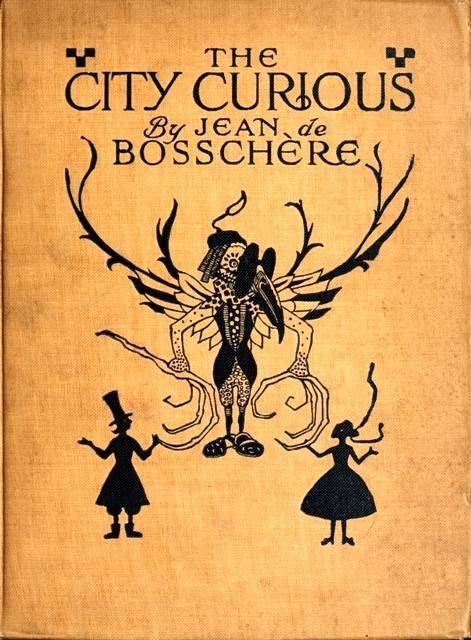
He was a curious sort of man, extremely thin, his face dominated rather than adorned by an immense beak, which apparently he could not open; and he had little twinkling eyes like an elephant's, which twinkled even more when they were shut than when they were open. He wore a sort of wrapper, trimmed with fur round the neck, sleeves, and legs. Neither Redy nor Smaly could quite decide what the Historian was made of, whether of Manchester pudding, of pie-crust, or gingerbread, and they did not dare try and taste him for fear of waking him up.
The Historian was sitting with one ankle across the knee of his other leg, and had rolled round his thin calf the manuscript upon which he had been working. This manuscript was trained to roll itself up slowly round his leg whilst he wrote it.
Smaly looked carefully all round him. The Hen was sleeping, the two Fish slept also, the Historian slept profoundly without snoring. He had always wanted to be able to snore; but he could never succeed because of his beak, and therefore he had invented a sort of little suction-pump run by a motor, which he kept beside him, and which snored quite as well as a man.
Except Smaly and Redy every one was sleeping in the house of the Historian. Outside in the sun-baked square the Chief Contractor, the Confectioner, Mistigris, the Young Stork, and the Crow slept also, heaped one upon the other in a casual manner, only the Despoiler, who was always afraid that some one would find out that he was only made of cardboard, never slept in public. He always retired to rest in a little room under the roof of his house.
When Smaly had made quite sure that there was no one to see them, he took Redy by the hand and began gently to unroll the Historian's manuscript. Smaly and Redy began to read it to each other in low voices, word by word, like children who go upstairs one leg at a time. This is what they read:
"Thursday, half-past three.
"All buildings except the cherry-tart destroyed in the market square.
"The Prisoner crossed the river while it was dry.
"Rolled across the park of chocolate-moulds, crushing everything beneath him.
"He then rolled on over the great kitchen, which was happily empty.
"(The two little people made of suet have been shut in with me.)
"Up past the public square, and the two little people tried to talk to him.
"The Rats worked hard at keeping the prison together; but there are cries everywhere.
"Every one is calling out 'The Prisoner is coming.'"
"How annoying this is," said Redy, "we're reading it backwards."
"Annoying," said a deep voice which came from the closed beak of the Historian. He had forgotten that he was asleep, and lifting up his foot he kicked the two inquisitive little people to the other end of the room.
But the sight of the Flying-Fish and the Hen sleeping reminded him that he, too, was not really awake, so he closed his eyes and did not move again.
Smaly was able to go on unrolling the whole of the manuscript.
CHAPTER VIII
Redy and Smaly read of the childhood of the Prisoner.
They read as follows:
"THE STORY OF DJORAK
"This is what I, the Historian, have been able to discover about the life of Djorak, called The Prisoner, before he came to us. He told it to me himself before he was placed in his prison of sugar-canes.
"He is a sailor.
"He has been tattooed.
"Nearly everything that has been tattooed upon him is very terrible; for instance, one can read upon his shoulder-blade:
"'Eat meat raw if you can't get it cooked.'
"Indeed, he has himself avowed to me that he used to eat all sorts of animals, rabbits, sheep, and even birds.
"On his other shoulder was written:
"'Avoid water like poison.'
"He had also inscribed about his person:
"'Drink your gin and whisky neat.'
"'Always have a hot drink in the evening.'
"'Reverence the sun and each of the winds as it blows.'
"On his breast he bore a heart cruelly transfixed with arrows.
"I gathered that from his childhood he was rough and disobedient. That when as a little boy he used to go into the wood behind the house to smoke, his mother always followed him and carefully presented him with an ash-tray, yet he never made use of the tray; but kept it in his pocket and scattered the ash all over the wood.
"Instead of cutting his toe-nails as we do with the help of a long-handled pair of scissors and a telescope, he preferred to take each nail off separately, trim it, and put it back, although this invariably made his mother cry.
Page 122
"He was so perverse that when any one asked him what the time was he would always insist on telling it by the barometer, although he knew perfectly well that the exact time is only to be found on the clock.
"He always marked out the tennis-court with green chalk, because he maintained that the white looked too loud and left marks upon the grass.
"Evidently from his earliest youth he was of the stuff of which criminals are made.
"When he grew up he married and became the father of three adorable little girls."
At the mention of the three little girls Redy and Smaly stopped and looked at each other.
"Those are the three little daughters of the Prisoner," whispered Redy.
Smaly went on reading:
"When his wife died," Smaly read, "he decided to give to his daughters a good, if rather original education.
"Every alternate week he dressed them as boys, and during that week they behaved as boys, and the next week they would become girls again. 'That will accustom them to anything,' he used to say. 'Nothing in life should be difficult to them after that.'
"Three young men fell in love with them, but unfortunately called on their father to demand them in marriage one Monday morning when the three girls were dressed as boys, and considered as such by their father.
"The three young men were thrown out of the house with great violence by the infuriated parent. One young man lost his hat, the second lost his arms and his walking-stick, and the third lost one of his legs.
"Certainly Djorak's love for his daughters was very intense.
"It was this love which was his ruin.
"One day in the presence of the King of his country he boasted of being the father of the three most beautiful young girls in his country.
"What an imprudence! The King himself possessed a daughter whose beauty, to say the least of it, was not remarkable, and the King, who was very intelligent, was perfectly well aware of the fact. He was furious when he heard Djorak's boast. He had him arrested and tried before the high court, who decided that the punishment of death was barely sufficient for such an audacious criminal.
"The punishment of death in Djorak's country is by beheading with the sword; a criminal's head is only cut off once—but it is once and for all."
CHAPTER IX
The elder Flying Fish loses one eye, and the Hen finds it: The Historian wakes up, and Smaly and Redy run out of the house: The Healer mends the paw of the Confectioner.
The Flying-Fish upon their perches now began to shake their wings and then their paws, and last of all their heads.
"Are we really awake?" asked the elder Flying-Fish of the younger.
"It seems to me that we are more or less shaken up," replied the little Flying-Fish.
The two Fish prepared themselves to fly forthwith once more upon their arduous duties, for the Flying-Fish in this country act as sentinels and look-out men, and also cry the hours publicly.
Just as they were about to set off the little Flying-Fish noticed that the other had lost an eye.
"That must have been when I shook my head," exclaimed the elder Flying-Fish with conviction, and both flew down on to the floor to look for the missing eye. The Hen joined them in their search, and as she fluttered down she managed to upset a glass retort from which an opalescent vapour began to escape.
Soon the whole laboratory was filled with this vapour in layer upon layer of different colours, from deep rose at the base up through violet and pale green to a layer of no colour at all, which was succeeded by a layer of blue.
Through the vapour Smaly and Redy could hear that the Fish and the Hen were continuing their search for the lost eye. Sometimes they were quite near the two little people, although no one could see any one else.
It was the Hen who finally discovered the lost eye.
"Why, it's still shut," said the younger Fish to the elder.
"Doubtless it must have fallen out before I had really shaken myself awake," replied the elder.
Taking the eye from the hands of the Hen, the Fish held it in its cupped paws to shake it, as one shakes a coin, to see whether it will come down heads or tails. When it had been well shaken the eye was open.
The little Fish took the eye and replaced it in the elder Fish's head; then they both flew out, making a buzzing noise like gigantic bluebottles.
The layers of coloured vapour now began to twirl about and mix like wreaths of steam, and once again various objects in the room became visible. The Hen saw that the big toes of the Historian had begun to move, and knowing that these signs of wakefulness would presently mount as far as his head, she hastened back to her little pots of white and yellow paste.
Indeed, the Historian was already almost awake; he had put down his hand and stopped the little snoring machine.
Smaly and Redy joined hands and ran out of the door.
Directly they appeared in the square the Wigs seized hold of them and ran them into the kitchen once more, which by now had been built up again. Smaly and Redy began to hope that the evening was not far off, for they were becoming more and more anxious to see the three girls. They opened their mouths and began their little chant:
Fine, sweet——
But at this moment Redy noticed that the sun had not moved during all the hours of the siesta. Nobody had explained to them that since all the Wigs had been asleep the sun had naturally thought it would be ill-mannered to continue his advance.
Redy and Smaly stood alone in the kitchen wondering what to do, when the door opened and a middle-sized man walked in, saying in a severe voice:
"Where the dickens have those idiots got to?"
Smaly hid himself behind Redy, and Redy hid herself behind a large plant, which grew in one of the ornamental vases at the side of the Chief Contractor's throne.
The man who came in had evidently been born with the idea of one day being a very big man. But he had been destined by his parents to become a great Healer, and as soon as he had discovered this it occurred to him that it would be better to be merely of medium height, so that he did not have to make his back ache bending over the beds of sick people. Therefore he at once left off growing, excepting in girth; and since he always wished to ride about the country it was obvious that he did not want his legs to be too strong, therefore he had small legs, enormous shoulders, a hump both back and front, and a large stomach.
The Healer was accompanied by a page made in the shape of a drum. This drum, besides having the head of a page and two solid little legs mounted upon roller-skates, was hung about with an immense number of instruments, with tubes of gum, sealing-wax, and candles. In one of his hands he carried a funnel made of fish-glue, down which he poured medicine into the mouths of sick people.
In the other he had a corkscrew for pulling out bad teeth.
"It's simply freezing in this horrible kitchen," said the Healer, looking about him. "Where on earth have they got to?" Then turning to the page he added: "Fetch my cloak out of the right-hand pannier."
He gave a shove to the drum, which skated off to the door where two donkeys stood side by side. One donkey could certainly never have supported the Healer, therefore he had to have two, and between them was fastened a comfortable arm-chair. The page came back trailing a large cloak behind him, made of the leaves of aromatic herbs.
When the Healer had put it on he looked like a mound entirely covered with ivy. The bag which he carried slung on his right-hand side was almost hidden by his cloak, so was that on his left.
Upon one of these, which contained little bottles and boxes, one could just read the word "Medicines," and upon the other "Rewards to be taken after medicine."
The Healer continued to call out "Where are they, where are they?" gazing everywhere through his large single eyeglass, which was so big he could look through it with both eyes at once.
He drew near to the plant behind which Smaly and Redy were hiding, and just as it seemed as though he must discover them, they managed to hide themselves beneath the folds of his cloak. They were only just in time.
The Chief Contractor, the Crow, and the Despoiler, followed by several Wigs, now came in.
"Where are they?" cried the Healer, turning towards them.
"Here is the first of them," answered the Chief Contractor, pointing to the Confectioner, who was being supported by Mistigris and Papylick; and Smaly and Redy, peeping out from beneath the cloak, began to understand that the Healer was not searching for them, but for sick people.
"Dear me. It's his paw that's hurt," said the Healer, and indeed this was not difficult to see, for the Stork had already laid down upon the table the broken paw of the Confectioner.
The Healer lit a candle, took his sealing-wax, and set to work.
Outside an agitated crowd had assembled.
Every one seemed to be crying and wailing.
Already in the crowd there were newsboys selling accounts of the latest disaster to the Wigs.
In the great square hundreds of frenzied people, at the risk of losing their shoes or their heads, danced frantically round and round.
"What misery, what misery," murmured every one in the kitchen, gazing at the mask called "Supreme Sorrow," which the Chief Contractor had placed over his face.
"Who on earth will rebuild the market square?" muttered the Young Stork, gently closing up with his nail some little holes which he had discovered in the back of the Despoiler.
"Well, in the first place, who is going to draw the plans?" asked the Despoiler.
"We don't need any plans," answered Papylick.
"They will draw the plans after they have put up the building," remarked the Crow in a low voice to Smaly, whom he had discovered under the Healer's cloak.
"If they have any plans they can quite well build up all the tarts and puddings in the square again."
"The plans have all been burnt," announced the Chief Contractor.
"But in the first place no one knows whether the plans or the buildings were made first," objected the Crow.
No one had anything to say to this, so every one remained silent, sunk in the deepest perplexity. Papylick at last suggested that they should ask the advice of the Mother of the Crow.
By this time the Healer had finished his mending.
The Confectioner, placing his hand against his mother-of-pearl forehead, murmured, "I have a pain there."
"That must be the fever," said the Despoiler.
"Fever?" demanded the Healer sharply. "How can there be fever when I have glued his paw on again? He hasn't got fever at all. It's worrying that's given him a headache. What Wig worthy of the name is not worrying at this moment when such a grave and terrible problem lies before us."
CHAPTER X
The Wigs all imagine they suffer from headache: The Rats come to the Healer to be cured of the ravages of hot Soy: The Chief Contractor has to make himself ill eating the musical instruments.
Directly he heard the word "problem" the Chief Contractor put on the mask of the "Mathematician."
"It is indeed atrocious, this problem that confronts us," continued the Healer, "and who can there be amongst us who is not full of distress when he considers that in the whole of our country there is no one who can tell us whether we should begin by making the plans or the buildings. I trust for the sake of your honour that you all have a headache," and so saying the Healer walked towards the pair of donkeys.
"I, too, hope so," said the Chief Contractor, hastily slipping on the mask called "Migraine."
"I, too, hope so," said his wife, who had just come in.
You, gentle reader, will find on another page a portrait of this lady, who was extremely vain and dressed very extravagantly.
She bore a great resemblance to a butterfly.
"We all hope so," said every one in the kitchen, and the crowd in the square took up the remark, so that all over the town the Wigs were sighing and placing their right hands upon their foreheads.
Soon they felt so bad that they all wetted their handkerchiefs in the fountain of rose-water and wrapped them round their heads.
There was a great silence....
"I hope so, too," piped the Crow, a little late because he had only just succeeded in putting on his spectacles.
The Stork re-entered, pushing the Mother of the Crow in her oyster-shell, and followed by the Healer. At once the Stork began to pull out all the fish-bones which during his absence ill-natured persons had stuck in the back of the Despoiler.
But all thought of the grave problem to be discussed was forgotten, for at this moment there entered many more victims of the travelling prison. (Smaly, who up to now had not been so very, very astonished at anything he had seen or heard since he had passed through the chocolate door, really was a little surprised when he saw these victims.)
The chief sufferers seemed to have been the Rats, whose business it was to keep the sugar-cane forest well watered. Nearly all had one leg which was much longer than the other, or a very long arm, or an elongated nose, or a tail that went on for ever.
"They must have been walking upon hot Soy," whispered a Wig to Smaly.
This Wig was a Dwarf with a very large head, and he carried a watering-can, out of which he perpetually drank a few drops.
Smaly and Redy, their eyes round with curiosity, questioned him eagerly.
"The Prisoner wanted to cripple us all for the rest of our days," said the Dwarf, drinking a little more water, for he suffered from a continual thirst.
"If you know what a match is," observed the Crow, settling his spectacles, "you will very soon understand what has happened."
"Yes," continued the Dwarf, looking anxiously into the bottom of his watering-can. "When the prison had crossed the square the Architect made an attempt to save the plans."
"By the Architect he means the Confectioner," whispered Redy to Smaly.
"He rushed after the Prisoner, crying out to him to stop; but the Prisoner only looked at him with his big eyes and, ceasing for a second to break the sugar-canes, seized hold of a little wax vesta. He stared at the Architect with eyes full of hate, and cried, 'I think no more of you than I do of this match.'"
"No, no," interrupted one of the Rats, "that's not how it happened at all." He carried one long leg on a crutch, and his elongated tail was tied to the queue of his wig. "That's not how it happened at all," he repeated.
"Do you mean to tell me he did not show the match?" asked the Dwarf.
"Certainly not," replied the Rat.
Smaly asked the Rat what the Prisoner had really done.
The Rat, with fear in his eyes at the mere memory, made answer:
"He struck his match on a little box so that it sprang into flame, and offered it to the Architect through the sugar-canes. The Architect, of course, ran away, and in running he broke his leg."
"Ah! I'd forgotten that detail," said the Dwarf.
"A detail!" cried several of the Rats. "A detail! But only look at our arms and legs."
"The Architect knew quite well," explained the first Rat, "that if the match fell on the liquid Soy it would become hot immediately and everything would start to grow—and only look at our legs and arms!"
Smaly began to understand why it was that the Confectioner walked about on high pattens, and why the Rats wore boots. He saw that though all these people owed their pleasant life to Soy because it made everything grow without any trouble, yet they feared it, feared it even more than they feared the flies which used to come when they were asleep and eat the sugar of which their faces and hands were composed.
The Dwarf had pulled on a pair of boots without any soles, and placed a large pot of flowers on his head, and he now began to imitate the Rats watering the ground, affecting an extreme fear of wetting his feet, for it was because their boots had melted in the hot Soy that the Rats' paws had grown so long.
This imitation on the part of the Dwarf was interrupted by the sound of trumpets, for the Rats and the Wigs had already begun to recover from their emotion under the care of the Healer, and seizing hold of little trumpets of chocolate and sugar they had begun to blow upon them.
Some seized drums and violins and even bag-pipes, and it was impossible to say whether any one was speaking or not, the noise was so loud.
"Take away the mouthpieces and the violin strings," commanded the Chief Contractor.
"There aren't any," cried the Rats and the Wigs, hastily eating them all.
Then they continued to play their instruments; but these no longer made any noise.
The Healer was by now attending to the last of the victims. He had poured cordial into their mouths from the page's funnel, and they had all become absolutely drunk. Then he peeled off from their legs the strips of leather which had remained stuck to them, and cooled their little paws with pistachio-nut ice. When he had finished he took out from the sack labelled "Rewards" a little trumpet, a punchinello, a drum, and a paper windmill, and handed them round.
The Chief Contractor, however, refused to allow the noise to begin again, and placing over his face a mask called "Calming Influences," he followed the Healer, and every time when the latter gave as a reward an instrument of music, the Chief Contractor ate it himself.
That night the Chief Contractor had a bad attack of indigestion, and it was the poor Confectioner, with his mended leg, who had to make the distribution of provisions.
CHAPTER XI
The young girls dance for the Rats, then play a curious game of tennis: They fail to understand Smaly's point of view.
The convalescent Rats all sat in a row upon a circular bench, still holding between their fingers the musical instruments which now lacked mouthpieces.
To distract their thoughts some charming young girls of the country, dressed in fine and beautifully embroidered stuffs, began to dance and juggle for their amusement.
Some of the dances were very complicated and elaborate; but some, on the other hand, were so simple that the performers had no need to exert themselves at all. They merely seated themselves upon the ground and sniffed luxuriously at jasmine and heliotrope blossoms. This dance was so simple that it was not necessary for there to be any dancers.
After several of these simple and extremely comfortable dances the Rats begged the young girls to play a game of tennis.
Accordingly eight of the most accomplished players arranged themselves about the court, and at each corner they placed two teacups to hold the balls.
Thus there were eight teacups.
The court was divided by a rose-coloured ribbon.
Four players arranged themselves on either side of the ribbon, each standing behind the other.
The two leaders in each group held rackets made of vermicelli, while the two couples standing behind held rackets made of stretched parchment.
The game was about to begin.
Two accordion-players began to play a quadrille.
The Rats licked their chops and, pulling at their moustaches, strutted about full of joy.
Two chariots, filled with a pearly and transparent paste, were brought up, and several dancers taking long pipes began rapidly to make balls of it, and to blow them at the rackets; the paste seemed to be of some sugary substance, and if they blew too hard the balls exploded without leaving so much as a trace.
Several balls vanished in this way.
Then a pretty blue ball, spangled with gold, hit one of the vermicelli rackets. The ball went right through the racket; but since it had lost velocity, it hung motionless in mid-air.
While the ball was hanging thus, the two players who had the rackets of parchment tossed up to decide which of the two should send the ball back.
This fell to the part of the fair girl, who advanced with the stately steps of a quadrille, while the ball hung awaiting her, and with one short stroke she hit it towards one of the teacups.
The ball rushed forward undeviatingly; but, as it neared the cup, its speed slackened so as not to break it. Finally it crept in as gently as a baby is put in a cradle.
"For you, Vera, for you," cried the fair girl who had hit the ball.
"Thank you, my love," replied she who had been called Vera.
And thus the game went on; whenever a girl hit one of the balls hanging in mid-air she cried out the name of the friend to whom she offered it.
By this ingenious method, without disputes or complications, the eight cups received each its ball, and when the game was over Vera took her ball, Dorothea hers, Simonetta hers, and so on, until each girl had her ball.
They then all embraced, and twining their arms about each other began to go back along the road down which they had arrived.
When they passed by Smaly, who was still standing at the door of the kitchen, he demanded:
"But who won?"
The young girls were quite unable to understand what this question meant. They smiled divinely at him with their delicately curved mouths, then each one showed him her ball made of pearly sugar.
CHAPTER XII
The Mother of the Crow tells of the life and death of Djorak in his own country.
All this time Smaly and Redy had remained in the great kitchen. Suddenly they heard a voice say:
"It's confoundedly cold in this disgusting kitchen."
"Hullo, who is that?" asked Smaly and Redy together.
"It's I," replied the Mother of the Crow.
Peering about them they discovered her where she had been left forgotten under the table, still sitting in her oyster-shell.
"I'm cold," she said again.
"What can we do for you?" exclaimed Redy pityingly.
"Yes, how can we help?" asked Smaly.
"Take me back to my tree of coral."
"They won't let us go out of here," exclaimed Redy and Smaly.
"Then put the Tea-Cosy over me," suggested the poor old Mother of the Crow, whose teeth were chattering in her beak.
And so it was done.
There was no longer anything to see but a Tea-Cosy. The Mother of the Crow was completely hidden.
"Now I'm nice and warm," said the Mother of the Crow.
It was really quite a new experience for Smaly and Redy to hold a conversation with a Tea-Cosy. The Mother of the Crow was a great chatterbox, and she knew a thing or two, and several things more after that.
"What are you doing here?" asked the Tea-Cosy.
Redy and Smaly folded their hands, and began:
Fine, sweet——
"I know, I know," interrupted the Tea-Cosy, "but I meant what are you doing here in the great kitchen?"
"We're waiting for the sun to go down," was the response.
"And you can't leave till then," replied the Tea-Cosy. "Then tell me a story, a nice long story. I love long stories," added the Tea-Cosy with enthusiasm.
"Are you equally fond of telling long stories?" asked Redy and Smaly, both seized with the same idea.
"I like it even better than gooseberry-fool and candy-sugar caterpillars," replied the Tea-Cosy in a voice that trembled with excitement.
Page 165