
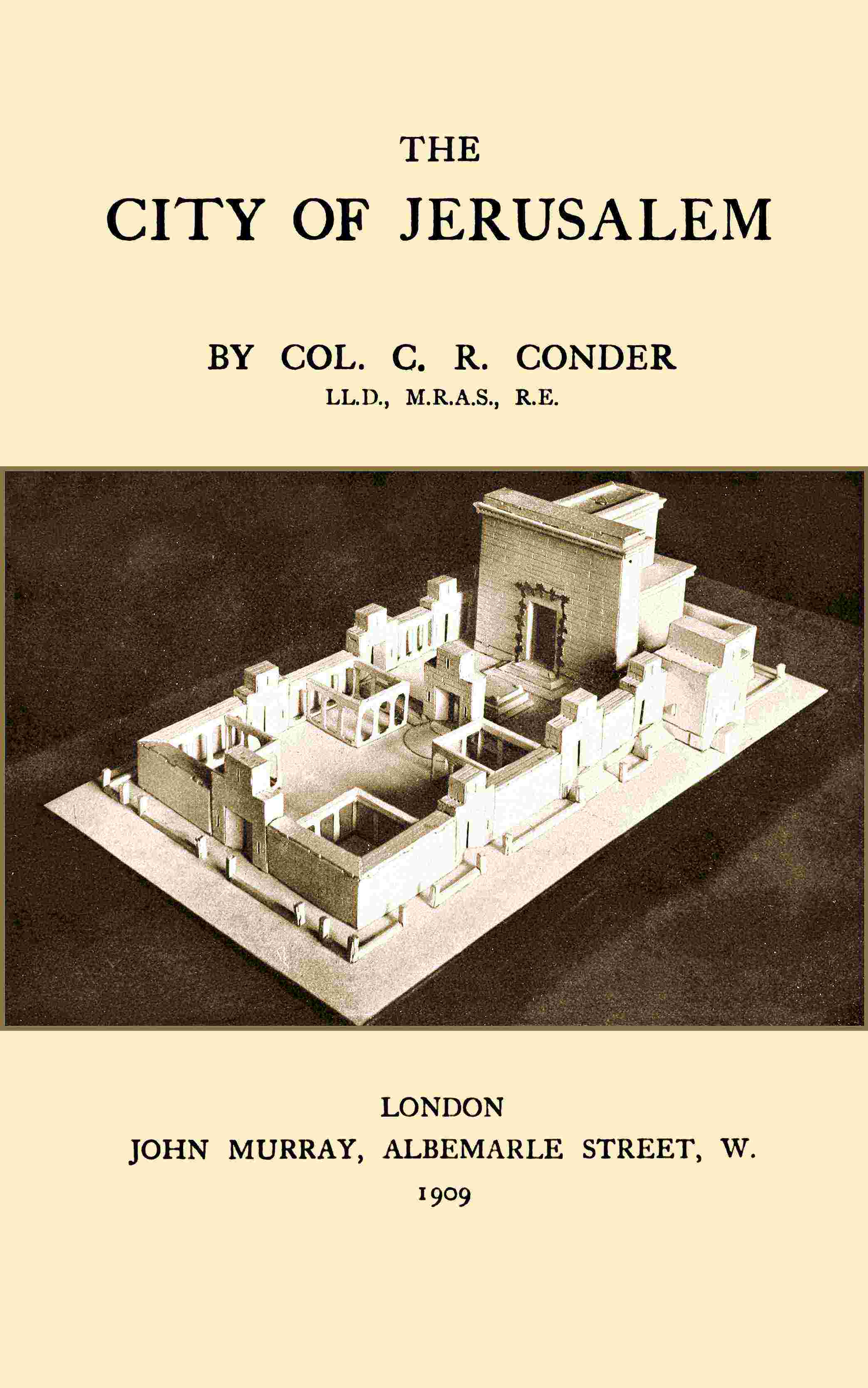
The Templars carried out considerable works in the Ḥaram area. They added a Norman porch to the Aḳṣa Mosque, and a refectory, on the west of that building which was converted into a church with three apses on the east; and a long hall south of them was perhaps the vestry, with windows on the south Ḥaram wall, and pillars with braided shafts and elaborate capitals. John of Würzburg, about 1160 A. D., says that “the new and large church is not yet finished.” Their hospice was called “the Palace of Solomon,” and the same writer says, “There is the wonderful stable, of such size as to be able to hold two thousand horses, or five hundred camels.” He evidently means the vaults now called “Solomon’s Stables,” near the south-east part of the Ḥaram, for he says, “Near the Templar buildings, on the city wall, was the house of Simeon the Just.... In this house [converted into a church] blessed Simeon lies buried. In the same church, in the crypt below, ... is the wooden Cradle of Christ.” The crypt in question still exists at the south-east angle of the Ḥaram, and a cradle (a Roman statue niche) is still shown. The stables were formed by setting on end the great Herodian stones (drafted on one side) which formed stout piers with barrel vaults for roof. The holes made for the halters of the horses can still be seen, and the so-called “Single Gate,” in the south wall east of the Triple Gate, now walled up, shows its late date by its pointed arch. This was one entry to the Templars’ stables, and a larger one was made by altering the Triple Gateway itself, at the west end of the vaults. Theodorich says that the stables would hold ten thousand horses, and that the Templar Hospice included “gardens, halls, vestibules, consistories, rain-water tanks, splendid cisterns hewn beneath, baths, barns, granaries, wood-houses, ... and on the west the new house of the Templars with cells and refectories.... The roof, contrary to the custom of the country, has a high-pitched ridge.” There was a garden near the Chapel of the Cradle, and the city wall outside the Aḳṣa formed an “out-work” as it does now. The church itself had a dome—probably the Arab dome of the mosque.
The Dome of the Rock was not altered, but the octagonal wall was painted inside in fresco; and remains of this work were still visible when the marble facing was removed in part in 1873. The holy rock was covered with marble flags, and an altar erected on it. The footprint of Muhammad was shown as that of Christ. Ibn el Athîr, writing of 1187, says that Saladin ordered this marble pavement to be removed. He also covered up the frescoes, which represented Jacob’s Vision at Bethel and the Presentation in the Temple, with Latin verses inscribed beneath or around. The beautiful grille of French hammered iron-work, with lily heads between the spikes, was also now carried round the circle of the drum, between the piers and pillars. The cave under the rock was called “Confessio,” and was said to be the place where our Lord met the woman taken in adultery. It still contains a Norman altar with twisted pillars. Above this was an image of Christ, and a picture of Zacharias and the Angel.530 The Templar churches in Europe were built round or polygonal in imitation of the Templum Domini, or “Temple of the Lord,” which was the new name for the Dome of the Rock now surmounted by a cross. The “Cloisters of the Canons” (now removed) appear to have occupied the north part of the platform. The Dome of the Chain was called the “Chapel of St. James,” and the “Dome of the Roll” became the “School of the Virgin”; for the legends of the apocryphal gospels created several new sites in the Ḥaram. Another image of Christ also stood over the porch of the west door, built, in 831 A. D., by El Mâmûn.
The upper city and the environs of Jerusalem remain to be described as they were in the latter part of the twelfth century. The Hospice of St. Mary of the Germans stood on the east side of German Street, just about where Agrippa’s palace had been, in the north-east corner of the upper city. The Chapel of St. Thomas of the Germans was probably the small one to be found in a Jew’s house west of the same street. I explored these sites in 1881, and found remains of a large mediæval building531 which was newly built about 1160 A. D., according to John of Würzburg, who complains that before that date “no part of the city even in the smallest street had been given to the Germans,” and that the “new” St. Mary of the Germans “received hardly any benefactions from other nations.” The constant struggle between the emperor and the Pope discouraged German colonisation; for the kings of Jerusalem were vassals of the Pope alone. The Teutonic order was at first only a branch of that of the Hospital, and it is not known when they became independent.532 On December 9, 1143, Celestin II.—who was Pope for only six months—wrote to Raymund the master of the Hospital of St. John as to “the new Hospital for Germans in Jerusalem,” placing it under him and all future masters, but directing that the prior and attendants should be of Teutonic race. The order did not become important till 1229, when the knights took the side of Frederic II. against the commands of Pope Gregory IX.; and they had little property of their own till John of Brienne (in 1220) gave them lands in Galilee. But there were Germans in Jerusalem of the sub-order before the city fell to Saladin, as will appear immediately.
To the left (or west) of the Street of Judas’ Arch was St. Martin. This may have been where the name “House of the Holy Ghost” still applies to a Jewish house, as it is noticed next to “St. Peter of the Chains,” which was the name then given to the House of Annas near the Sion Gate—now the Armenian nunnery, or “Convent of the Olive Tree,” as already noticed533 with St. Thomas, at the Syrian monastery, which has a fine Norman gateway on the north side. St. James the Less—east of the present Protestant Church—is also of this age. St. George, north of the House of Annas, now belongs to the Greeks, and apparently belonged to them in 1167 A. D.534 The “Church of the Three Maries” also still exists, east of David’s Tower, as does St. Mark north of St. George. In the barbican were the House of Caiaphas (or St. Saviour) and the Cœnaculum (now Nebi Dâûd), which latter was a large church built on the site of the ancient St. Sion. The upper storey was the supposed site of the “upper chamber” of the Last Supper, and in the lower storey, or crypt, the Holy Ghost was believed to have descended on the Apostles at Pentecost. The home of St. John, where the Virgin died, was just south of the House of Caiaphas.
The Latin descriptions never mention the churches of the Greeks, Syrians, Georgians, Armenians, or Copts in the Holy City. The Latins had appropriated all the principal holy places. The abbot Daniel speaks of a monastery of St. Saba, apparently near the Tower of David; and John Phocas (in 1185 A. D.) mentions the Georgian hermits who lived in the tombs and caves on the east side of the Kidron Valley. The crosses that these and other recluses535 cut on the walls can still be seen. The large Armenian Church of St. James on Sion probably existed in the twelfth century. The interior is now cased with porcelain tiles, and the floor is covered with fine carpets. The shrine on the north, supposed to contain the head of James the Less, is adorned with tortoise-shell, and in the great hall to the south is a remarkable fresco which may be of the twelfth or thirteenth century, representing Hell (as was then customary) as a monster with a huge mouth, into which naked souls are driven by the pitchforks of devils.
We hear very little about the water-supply of the city, except that there were large tanks in the Ḥaram. The “Lake of Baths,” mentioned in 1137,536 is probably the present “Patriarch’s Bath,” or Pool of Hezekiah, and the Piscina Interior—or supposed Bethesda—near St. Anne has been already mentioned. Outside the city the Mâmilla Pool was called the Lake of St. Egerius; and, about 1172, the Germans (that is to say, probably the Teutonic Order) constructed the present Birket es Sulṭân under the west wall of the upper city.537 It was for “the common use of the town,” and was called the German Lake. On the old map of 1308 these two reservoirs already bear the titles “Upper” and “Lower Gihon.” The Well of Job, as already explained,538 was reopened in 1184 by the Franks. Pilate’s aqueduct does not appear to be ever mentioned.
It is necessary to distinguish Queen Melisinda’s nunnery of St. Lazarus, founded in 1147, at Bethany, from another St. Lazarus—the Lepers’ Hospital, served by the Order of St. Lazarus—which was established outside the north wall, near the postern of the same name. No traces of this building are known as yet to exist. It is mentioned as early as 1130 A. D., and in 1144 Baldwin III.—whose nephew was a leper—confirmed the grant of a vineyard made by King Fulk to “the lepers of St. Lazarus.” In 1150 he gave another to the same establishment, “situated on the plains of Bethlehem”; and Humphrey of Toron settled upon it thirty bezants annually, from the tithes of Toron, in the next year. It existed down to 1186, and it is always described as being “near,” or even “touching,” the wall.539 East of this, but still west of the great north road, was the old Church of St. Stephen, founded by Eudocia; and under the cliff of “Jeremiah’s Grotto” was the Templars’ Hospice already noticed. The chapel north of the cliff, though evidently Norman work, does not appear to be ever mentioned. I have described the fresco of Christ and the twelve Apostles which it contained.540 Many Crusaders’ tombs occur on this side of the city, especially east of the Gate of St. Stephen, and near the Postern of the Magdalen.541 Outside the gate, south of the Templars’ Hospice, there was also an important cemetery, about 500 feet from the wall and east of the main road.542 It was evidently for laymen, because the bodies are laid with the head to the west, whereas priests were buried with head to the east. Thus at the resurrection the congregation was supposed to stand up facing the clergy, who accompanied the hosts of heaven. Under a pavement at this site were found lamps, crosses, and coins, and on the flagstones were coins of Justinian, Maurice, Justin, and Justinian II., with a fine pectoral cross having an evangelist represented on each arm. These remains bring us down to the seventh century, but above them were found Saracen coins, and others of the Latin kingdom. This graveyard may have belonged to the Church of St. Stephen, like the tomb farther west (about 120 yards from the wall) which I described in 1881. A very remarkable mosaic pavement also occurs, some 700 feet north-west of the same Gate of St. Stephen, and may have belonged to the church. In design it so closely resembles pictures in the Roman catacombs that it might be supposed to be as old as the third or fourth century. It represents an Orpheus harping to beasts, with figures of a satyr and a centaur. But two smaller figures of Theodosia and Georgia are introduced, with their names, and are clearly Byzantine in style. The property of the Church of St. Stephen (according to a deed dated 1163 A. D.) adjoined that of the Hospital—probably to its west—and, as we have seen, had the Templar Hospice to its east.543 Another tomb close by544 is inscribed in Greek with words from the first verse of the 91st Psalm, according to the Septuagint version: “He that dwelleth in the help of the Most High.”
Leaving this group of buildings north of the wall, we may now pass east to the “Church of the Virgin’s Tomb,” or “Our Lady of Josaphat,” as it was called in the twelfth century, close to Gethsemane. The fine Norman arch of its facade, on the south side, is that of the church as restored by Queen Melisinda in 1161 A. D.545 This church, wherein she was buried the same year, was perhaps the most richly endowed of any except the cathedral. A bull of Pope Alexander IV., dated January 30, 1255, recapitulates the names of forty-eight villages belonging to St. Mary of Jehosaphat, and the church had lands also in Calabria, Apulia, and Sicily, on which to rely when all the Palestine revenues ceased. It was, however, deserted in 1254 A. D., and lapsed once more into the power of the Greek patriarch. John of Würzburg states that the cave chapel, at the bottom of the steps, was adorned by a cenotaph of the Virgin, having beautiful marble casing, a many-coloured picture, and a dome above it covered with silver and gold, and Latin verses. An image of St. Basil stood to the right of the entrance, with other verses in honour of Mary.
The history of the Church of the Ascension is less easily followed.546 The abbot Daniel, about 1106 A. D., found only a small church here, but says that it had formerly been a large one. Probably a chapel was erected after the destruction of the seventh-century church in 1010 A. D., but this was afterwards replaced by a “large church,” according to John of Würzburg, having a dome open to the sky in the middle, like the rotunda of the Holy Sepulchre, and like the old Church of Ascension described in 680 A. D., which replaced the original basilica of Constantine. The existing remains of Norman pillars in the irregular boundary wall show that the site was surrounded by a circular building 95 feet in diameter. Probably in plan it was not unlike the Dome of the Rock, but this mediæval church has been entirely destroyed. The little domed building in the centre, covering the footprint of Christ, was erected in 1617 by the Moslems, who still are in possession, and was restored in 1834. A minaret not more than three centuries old rises on the west side of the enclosure, and beneath is the Cave of St. Pelagia, also now in the hands of the Moslems. The church itself belonged to the Augustinian order.
Our pilgrimage round mediæval Jerusalem thus ends at the appropriate site of Chaudemar (Aceldama), where the powdered dust of the bones of countless pilgrims still covers the floor of the great pit, on the south precipice of Hinnom. The rock fosse measured 30 feet by 20 feet, and the vaulted roof, supported on two stout piers of masonry—drafted and with rustic bosses—is 34 feet above the floor. The rock to the west is carved with endless rows of crosses. Zuallardo, in 1586, pictures this building as covered with four small domes which do not now exist. As early as 1143, William, patriarch of Jerusalem, took charge of the “church in the field Acheldamach, where the bodies of pilgrims are buried, with all the land of the field, granted facing it by ancient Syrians.”547 It continued to be used for pilgrim burials even two centuries later.
Such was the Holy City in the day when Saladin won it from the Christians, and destroyed the Latin kingdom of Jerusalem.
FOOTNOTES TO CHAPTER XIII
495 Will. of Tyre, “Hist. Bel. Sacr.,” i. 11. “Pusillus, persona contemptilis, vivacis ingenii, et occulum habens perspicuum, gratumque, et sponte fluens ei non deerat eloquentia.”
496 Ibid., i. 8–10.
497 See “The Latin Kingdom of Jerusalem,” 1897, published by Pal. Expl. Fund, 1 vol. octavo, 443 pp.
498 Röhricht, “Regesta,” Nos. 4, 8.
499 “Latin Kingdom of Jerusalem,” pp. 95–8, 107–8.
500 Will. of Tyre, iii. 1-viii. 24; Albert of Aix, ii. 20-vi. 50.
501 Will. of Tyre, xxi. 25.
502 Röhricht, “Regesta,” No. 85.
503 Ibid., Nos. 137, 225, 226.
504 Her son, Baldwin V., died as a child a year after his uncle Baldwin IV.
505 Röhricht, “Regesta,” No. 92, 1120 A. D.
506 “Latin Kingdom,” pp. 175–80.
507 John of Würzburg, xiii. and xxviii.
508 “Citez de Jhérusalem,” “e ces rues apeloit un la juerie”; see Röhricht (1130 A. D.), “Regesta,” No. 133, “in parte Hierosolymorum quæ specialiter Judæaria vocatur.”
509 Count Rivoira, “Arch. Lomb.,” 1908, p. 630, remarks: “Sospetto che gli artefici di Sicilia lo sfoggiassero direttamente per influenza moresca.”
510 Apparently a lingua Franca term, Umm-el-Kuzinât, “mother of kitchens,” otherwise Coquinati; “Citez de Jhér.,” and “Regesta,” No. 431.
511 Röhricht, “Regesta,” No. 421.
512 See map (“Mem. West Pal. Survey,” Jerusalem vol., 1883, p. 383), “Jerusalem in 1187 A. D.”
513 “Regesta,” No. 421.
514 “Mem. West Pal. Survey,” Jerusalem vol., pp. 237–9.
515 Ibid., pp. 264–7.
516 Ibid., pp. 235–6.
517 “Excav. at Jer.,” 1898, pp. 68–75, 336.
518 Zuallardo, “Devot. Viag.,” p. 131; Theodorich (c. 1172 A. D.), “Vallum quoque sive fossatum extrinsecum, muro appositum, et propugnaculis atque minis munitum existit, quod barbicanam vocant.”
519 For coats-of-arms on pillars at Bethlehem see “Mem. West Pal. Survey,” iii. p. 84. By an unfortunate error the graffiti which I copied on pillars of south door of the cathedral have been printed (together with a tombstone from the Hospital) in the wrong place (“Mem.,” iii. p. 137); they include the names “Isaak,” “David,” “Anton Pico 1636,” and “Piero Vandam 1384.”
520 Rev. J. Hamlet in Pal. Expl. Fund Quarterly, April 1887, p. 76.
521 Zuallardo, “Devot. Viag.,” 1586, p. 207.
522 John Phocas (1185 A. D.) says that the emperor Manuel (1143–80) adorned the Holy Sepulchre with gold.
523 Theodorich.
524 Felix Fabri (c. 1480 A. D.), vol. i. pt. ii. p. 394, translation in the series of the “Pal. Pilgr. Texts Soc.”
525 “Regesta,” Nos. 142, 189, etc.
526 Pal. Expl. Fund Quarterly, Jan. 1899, p. 43, Jan. 1902, pp. 42–56; Robinson, “Later Bib. Res.,” 1852, p. 184, quoting Tobler, who examined this church in 1840.
527 See “Latin Kingdom of Jerusalem,” pp. 203–7.
528 Pal. Expl. Fund Quarterly, Jan. 1897, p. 29.
529 See “Latin Kingdom of Jerusalem,” pp. 202–3; “Regesta,” Nos. 347, 447, 462, 568, 572, 630.
530 John of Würzburg; Theodorich; Ibn el Athîr, quoted by Guy le Strange, “Pal. under the Moslems,” 1890, p. 134.
531 “Mem. West Pal. Survey,” Jerusalem vol., 1883, p. 272.
532 Röhricht, “Regesta,” No. 214 note, p. 55. The German hospice is noticed in 1173 (No. 496) and 1177 (No. 548).
534 “Regesta,” No. 461. Besides this, and the Coptic St. George north-west of Hezekiah’s Pool, there was another St. George north-west of the cathedral, north of the Greek Convent of St. Demetrius (Herr Schick, Pal. Expl. Fund Quarterly, July 1900, p. 253).
535 Such as Eugenius, Elpidius, and Euphratas, mentioned in a mosaic text as “hermits” on the Mount of Olives. Pal. Expl. Fund Quarterly, Jan. 1895.
536 “Regesta,” No. 170.
537 Ibid., Nos. 543 (Lacus Legerii); 504, 537 (L. Germani), “The new cistern” (John of Würzburg), also noticed in the “Citez de Jhérusalem.”
539 “Regesta,” Nos. 136, 227, 259, 266, 397, 487, 628, 656. The convent is noticed as endowed by King Amaury in 1155 (Nos. 284, 303, 308) before his accession: see Nos. 327, 338.
541 “Mem. West Pal. Survey,” Jerusalem vol., pp. 297–301; Pal. Expl. Fund Quarterly, April 1902, p. 120.
542 “Mem. West Pal. Survey,” Jerusalem vol., p. 385; Pal. Expl. Fund Quarterly, April 1897, p. 105, Oct. 1902, p. 404.
543 Pal. Expl. Fund Quarterly, July 1901, p. 233; “Regesta,” No. 391.
544 Pal. Expl. Fund Quarterly, 1890, pp. 158, 306.
545 “Latin Kingdom of Jerusalem,” pp. 194, 195, 404.
546 “Mem. West Pal. Survey,” Jerusalem vol., pp. 398, 399; Pal. Expl. Fund Quarterly, Oct. 1896, p. 311.
547 “Regesta,” No. 215.