
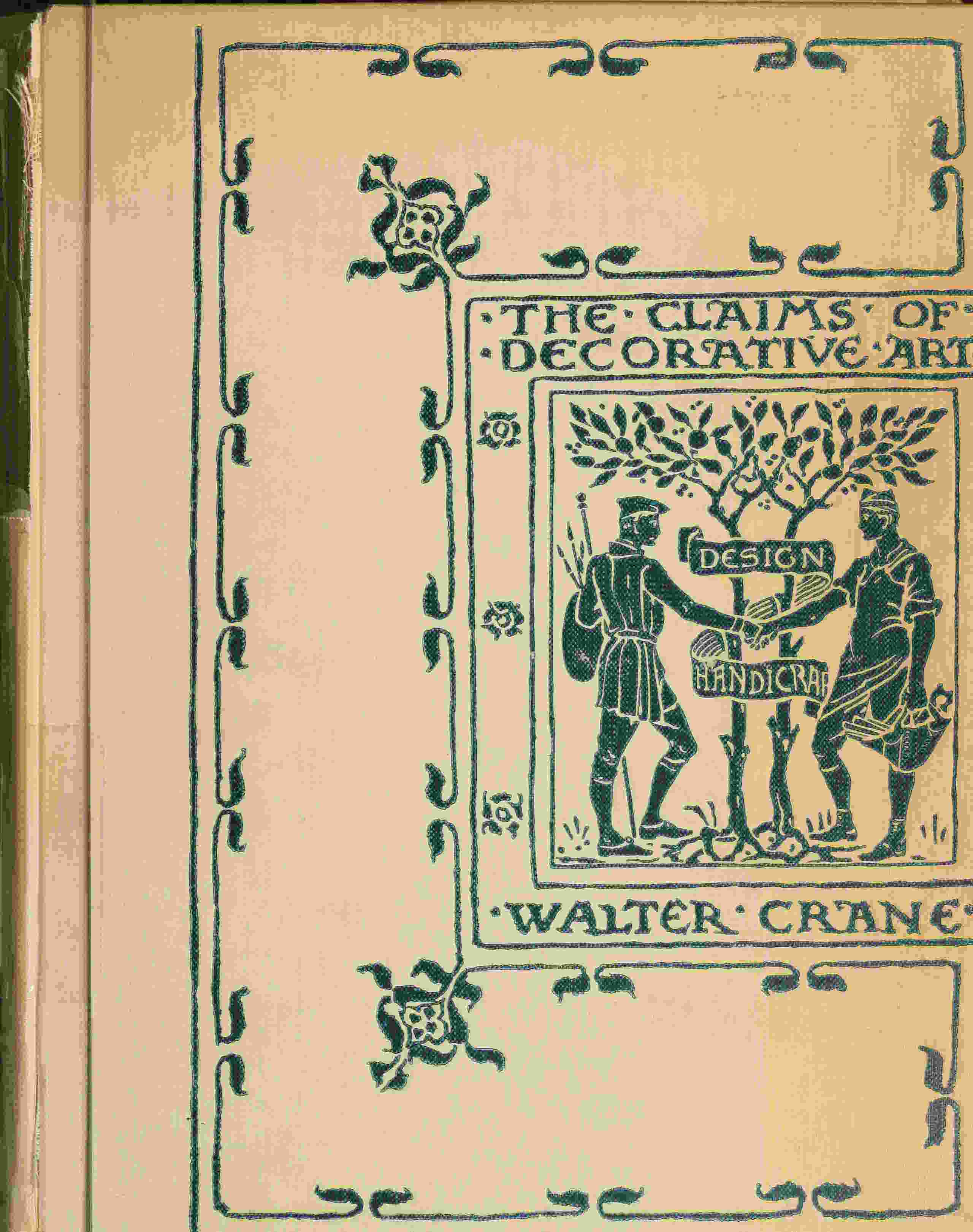
THE IMPORTANCE OF THE APPLIED ARTS, AND
THEIR RELATION TO COMMON LIFE
MAN in a natural and primitive condition does not begin to think of art until his physical wants are satisfied, since art is, in its true sense, after all only a spontaneous manifestation of mental life in form, colour, or line,—the outcome of surplus human energy. It is only under what is called modern civilisation that this natural order is artificially reversed, and men are forced, to attempt at least, to produce forms of art in order to satisfy their physical wants. Our troubles and failures in art may mostly be traced, directly or indirectly, to this condition of things—all the horrors and abominations perpetrated in the name of art, from the productions of the poor man whom necessity compels to chalk on the pavement, through the countless vanities and inanities of the fashionable store, to the refined cruelty of what is known as the “pot-boiler” in the “fine art” exhibition.
The primitive hunter in his cave, when his earliest efforts in applied art, in the form of flint weapons, had secured to him a sufficiency of fish and game and furred overcoats, began to record his impressions of the chase, and to scratch the forms of his favourite animals on their bones. If these representations of reindeer, mammoth, and bison be indeed the earliest examples of art, it would seem that the first impulse in art is imitative rather than what I should term expressive or decorative—the spirit of the picturesque sketcher recording his impressions of natural forms rather than the ordered, systematic, applied art of the inventive designer, who uses natural forms or colours much as a musician his notes to produce a rhythmical arrangement—a tune, a pattern. If this inference is correct, we may perhaps take comfort in the thought that out of our present pictorial zeal and cultivation of the picturesque sketcher we may be led to the study of the more ideal and intellectual side of art.
However the conscious invention of line, and its variation in pattern came about, whether by the burnt stick of the idler (according to Mr. Whistler), or on the soft clay of the primitive potter, it is tolerably obvious that certain primitive patterns are derived from certain necessities of construction, such as the chequer from the square plait of a rush matting, where not taken straight from Nature’s pattern book as in fish or serpent scale, and fan from leaf and shell. One of the most natural impulses in man is to make a mark or a cut upon something directly he has time on his hands. We can watch the development of this impulse in children. One line or mark suggests another, and strokes following one another in a certain order are found to have a pleasant and interesting effect. Strings of them round clay vessels were found to make them more exciting to the eye than the plain surface. The handles of dishes and hunting knives and horns, bows, hatchets, nay, even man’s own skin, all offered opportunities for the early ornamental impulse in carving and painting patterns. The implements in constant use, on which, indeed, rude as they were, life itself depended; the things most familiar, most valuable, constantly before the eyes or in the hands,—these were the first things to receive the touch of art, which was then “applied,” indeed, and applied only.
If we follow the manifestations of the artistic sense through the great historic periods we shall always find life and art, beauty and use, hand in hand,—the utmost artistic skill of invention and craftsmanship lavished upon cups and bowls, upon lamps and pitchers, upon dress and jewellery, upon arms and armour. We shall find the highest imagination, the most graceful fancy, and even wit, humour, and satire in the service of architecture, recording and reflecting the sentiment of the people: built into cathedral aisles and vaults, or glowing from the windows, frescoed upon the walls, or gleaming in the splendour of mosaic, or carved in endless fertility of resource on the stalls and misereres.
Under economic conditions of the production of all things for the service or delight of man for use instead of, as now, for profit, the craftsman was an artist, and all objects under his hand naturally developed a characteristic beauty. Ornament was organic, completely adapted to its material, and expressive of its object; but with all our industrial organisation, subdivision of labour, and machine production, we have destroyed the art of the people, the art of common things and common life, and are even now awakening to the fact.
Under a commercial system of production and exchange all art has been rigidly divided into classes, like the society it reflects. Since we have to sell it across the counter, as it were, we must take the weights and scales to it—we must apply to an article of commerce the tests and standards of commerce. Thus we have divided beauty and use, and made them up in separate parcels; or, perhaps, having reduced both to powder, we try a conscious blend of the two to suit average tastes. We have the arts all ticketed and pigeon-holed on the shelves behind us. We have “industrial,” “decorative,” or “applied” art, as we now call it, and “fine” art—fine art and “the arts not fine,” as my friend Mr. Lewis Day has it. Thus by degrees the vast general public, who must get their ideas of art, like other things, ready-made, have been taught to understand by the word “art” chiefly that form of portable and often speculative property—cabinet pictures in oil. Nor is this altogether wonderful, considering how, under our system of wholesale machine production, the appliances of common life have lost their individuality, interest, and meaning, together with their beauty. We are not sensible of any particular individual effort of thought or invention in an object which is only one of thousands turned out exactly like it. Plates, cups and bowls, chairs and tables; the moulding and panelling of our wood-work, and the metal-work of our sacred hearth itself, are taken as matters of course, like other productions of commerce. They were not specially made for you and me; they must be made to suit Smith and Jones equally well, or equally ill; and we shall probably be charmed to see them in each other’s houses. We know that furniture and fittings are only made to sell at a profit while the fashion lasts. Trade demands its “novelties” every season, and it would never pay to let a man sit contentedly in the chair that was solidly built for his grandfather. Much better let him fall between two stools (as it were), in his uncertainty of choice in regard to which of the confidently named upholsterers’ styles he will seat himself in.
Then as to the application of art to the walls of his dwelling itself is the average man in a much better case? You cannot expect him to put up costly and permanent decorations for the benefit of his landlord, either outside or inside. He is a wandering hermit-crab, only too glad to find an empty shell that will reasonably fit him, at a not too exorbitant rent; and as for decoration—well, at least there are paint and paperhangings.
Of course they that are rich can hire a great architect and dwell in a perfect grammar of ornament. They can import the linings of Italian temples and tombs, and the spoils of Eastern mosques, to breakfast, dine, or play billiards in. The only fear is that Tottenham Court Road will soon bethink itself of cheap imitations of such antique wreckage; that Westbourne Park and Camden Town may be even with Mayfair and South Kensington! Cannot the moderate citizen already command his household gods in any style at the shortest notice? Great is commercial enterprise! Nothing is too high or too low for it. Where your fancy is, there will the man of profits be also.
The distinct awakening of interest and practice in the applied arts, which is a mark of our time, I should be the last to belittle or attempt to ignore; but at the same time, with all it has done and is doing for our education, with all the remarkable skill and reproductive antiquarian energy it has called forth, I feel that we are landed in a strange predicament. For while on the one hand new sensibility to beauty in common things, and new desire for them, are awakened, on the other they are in danger of being choked by that very facility of industrial production which floods the market with counterfeit, set in motion by all the machinery of that commercial enterprise which is the boast of the age, but which all the time, by the very necessity of its progress, is fast obliterating the remains of ancient art and beauty from the face of the earth. So that it will be written of us that we were a people who gathered with one hand while we scattered with the other.
Economic conditions prevent our artisans from being artists. They have become practically, and speaking generally, slaves of machines. The designer is another being from the craftsman. It is only by a study of the conditions of the material in which a design is to be carried out that we can get even workable designs; and even at the best the designer who has no practical acquaintance with any of the handicrafts necessarily loses that stimulus to invention—that suggestive adaptability which the actual manipulation of the material and first-hand acquaintance with its own peculiar limitations and advantages always give.
One who develops a faculty for design has rarely a chance of being other than a designer. He has no time to make experiments, to strike out new paths. He must stick to the line by which he has become known in order to get a living. Nothing narrows a man so much as working continually in the same groove. The utmost that can be said for specialising a single capacity is that you get an extraordinary mechanical or technical facility at the cost of all other qualities. It may not be possible to be supreme in more than one art, but the arts illustrate each other, and a knowledge of other arts and their capacities and limitations is sure to react upon an artist’s practice in the one which most absorbs him.
It is true we hear of artists here and there who, though in the eye of the world inseparably associated with some particular form of, say, pictorial ability, nevertheless cultivate some secret amour in the form of a handicraft.
Professor Herkomer invited us the other day to see his wonderful application of the arts—his demonstration of their practical unity on his own premises at Bushey; and a most striking, interesting, and instructive exhibition it was. Perhaps few who know him only by his pictures would suspect him of being an accomplished artist and craftsman in many other arts, notably in wrought iron. From the personal point of view he offers a solution of the problem of how to associate art with everyday life. He is devoting his energy and artistic skill and invention to making domestic art, including architecture, monumental. The works at Bushey, if Professor Herkomer will allow me to say so, exemplify not only the power of individual direction and organisation, but also the power of co-operation and unity of aim in the arts founded upon, solidified, and supported by family traditions of skill, invention, and workmanship in the crafts, and how effectively all may be united in a common purpose. Another noteworthy fact was the remarkable way in which scientific and mechanical invention can be made to serve artistic purposes, as in Professor Herkomer’s application of the dental point to the carving and chasing of metal; and in the drilling machines we saw preparing work for the wood-carver. In so far as such a use of machinery does not necessarily condemn any man to be the slave of it, to be a machine-minder all his life, it would seem to be the natural and reasonable use of machinery in the preparation of work—to save the drudgery and waste of energy in its preparatory stages, and so reserve the delicate hand-work until the stage at which it becomes really effective.
There was another thing that struck me about Professor Herkomer’s work, and that was the feeling and poetic sentiment he had enshrined in some of his beautiful carved cabinets. We all know the sentiment and charm of association which naturally gather in time about some piece of domestic furniture. Now art applied to furniture has the same, or rather a higher, power than time, for it can, by beauty of design and workmanship, invest a seat or a cabinet or a fireplace with a poetry of its own, far more subtle, penetrating, and suggestive than perhaps any form of art, because indissolubly associated with daily life and its drama. But when we hand over the production of these things to the trader, how can we expect anything of the sort? How can any sentiment or poetic thought collect about an arm-chair, for instance, that will not bear the weight of time, and has never received the touch of art?
I daresay furniture may be found to serve our turn, good enough for our shifting life of hurry, and strong enough to last out its own fashion. I only say that if we care for genuine art in these things, we cannot get them under the ordinary conditions of trade.
Yet there is not a thing we use, not the commonest appliance in our houses, that does not show some effort at least to have been spent upon it to make itself presentable to humanity. Unfortunately, nowadays, when native instinct and individual feeling have been so much swamped by forced mechanical industrial production, and the search for mere mechanical smoothness and superficial polish, instead of the finish which only comes of thought and loving care; these efforts to be ornamental are too consciously afterthoughts, while the eye is on the market and its blind chances and uninspiring averages. The added ornament to a thing of utility, instead of being a manifestation of the craftsman’s feeling who made it, and his sense of pleasure in his work, is too often some miserable shred torn from the reminiscences of some dead language of decoration; all its grace and spirit gone, and even if moderately adapted in type and form to its purpose, is not calculated to bring a light to any eye, or joy to any heart, since it is but the product of joyless toil and competitive production—the mechanical smirk on the face of the thing of commerce that it is, intended to beguile the simple-minded and unwary into the momentary belief that it is a desirable and beautiful thing, when, in another sense than the poet’s, it
This unhappy cheapening and vulgarising of ornament, so far from fostering a taste for art, only degrades and distorts the natural feeling for beauty, which with reasonable scope and pleasant surroundings would develop itself as it has always done. Let not commerce pride itself in cant phrase on its claim that it places “art within the reach of all,” for how could that have become necessary until art had first been put out of reach? What could compensate for whole tracts of country desolated, and for the crowding of the people in our cities under conditions which put ideas of human dignity and beauty practically out of the question for the million?
Among secondary reasons for the decay of inventive and spontaneous design in the applied arts, I believe the hard-and-fast line which has been drawn between the artist and the craftsman is answerable, and the separation of the designer and the workman.
The designer is perhaps kept chained to some enterprising firm. Novelties are demanded of him—something “entirely new and original” every season, but not too much so. It is not surprising that the best talents should get jaded under such influences; that fancy should become forced or fantastic, and motive weak and tame, or perhaps lost altogether in a search after superficial naturalism, in defiance of fitness to material or use. Such a nemesis is too apt to overtake the specialised designer, who designs on paper only, without the stimulus of close acquaintance with, and practice in, some handicraft. The mere change of occupation is refreshing and invigorating, and stimulates the invention.
In so far as I have been successful as a designer, it has been, I believe, largely owing to my making myself acquainted with the conditions of the material in which a design was to be carried out; by striving to realise in thought, at least, the particular limitations and conditions under which it was intended to be worked; and I have always found that those very limitations, those very conditions, are sources of strength and suggestion to the invention. For I am old-fashioned enough to believe that every material has its own proper language—regarded as a medium for expression in design—and it is the business of the designer to find this out.
The naturalistic or imitative impulse in art which is characteristic of our time, with the enormous and surprising development of the photograph, has had very visible effects upon art of all kinds. It is quite distinct from the expressive or inventive impulse, and though they may be a ground of reconciliation, the former is of far less consequence to art in its applied or related form than the latter.
What may be called the dominant art always seems to impress its own peculiar characteristics upon every other. Whereas in former periods—ancient, classical, mediæval, Renaissance—architecture may be said to have ruled over, or to have embraced all the arts, which in their earlier history were really essential parts of it; and even when, by degrees, the family parted company and went out individually to seek their fortunes, more or less independently of each other, evidences of their architectural descent still clung to them—as in the architectural construction and character of portable furniture and fittings, and of their ornamental details.
Sculpture and painting to this day are obliged to retain the rudiment which betrays their architectural parentage; in the one case by the plinth which supports the bust or the statue, and in the other by the moulding of the frame, with which the least architectural or decorative picture cannot dispense.
But pictorial art has now usurped the first place in the popular mind. It has influenced architecture; directly, in so far as it has led to the erection of a new type of building—the picture gallery-a place built with the sole aim of displaying pictures not painted originally with any idea of concert, or to be seen side by side. Surely a remarkably inartistic way of regarding art! Indirectly, the effect of pictorial art and pictorial ways of looking at things is seen in what has been called “the architecture of the sketch-book”—the somewhat restless and fantastic designs in a mixed style, chiefly in domestic work, full of little bits, nooks, and corners, which are characteristic of the last decade. For all that, a pleasant change and relief from the dull monotony of the quasi-classic style which preceded it. Sculpture, too, has not escaped the pictorial influence, as is shown, for instance, in the naturalistic school of modern Italy, which closely imitates in marble textures, surfaces, and momentary grimaces as closely as possible, but with more skill than taste. Abundant examples of such misapplied imitative skill are to be found in other arts, such as wood-carving, pottery painting, metal work, and textiles; although it is only fair to say that, of late years, in these arts there has been a distinct return to truer principles of design, with the revival of a feeling for the capacity of the material which embodies it, and a recognition, over and above mere reproduction of old work, of the distinction between art and nature, which is so often lost sight of. We are, however, never sure amid the vagaries of fashion that we shall not suffer a relapse,—that we are not threatened with an irruption of tea-roses, in high relief, on our curtains and chintzes, and landscapes (not carboniferous) on our coal-boxes.
On the whole, however, the applied arts have shown a laudable independence and defiance of the pictorial mood. The dog no longer appears (after Landseer) on the hearthrug, but is often, in metal, relegated to his proper place on the hearth itself. So far so good. Albeit the desire for some of the happy results in art which belong to ages of greater simplicity of life has produced in some cases strange results, and some combinations of ancient kitchen and modern drawing-room one has seen are not altogether happy. We get an impression of the affectation of primitive simplicity and homeliness with modern luxury and artificiality, from which, at any rate, we can draw a moral on the connection between art and life.
The movement, initiated by Mr. William Morris and the gifted artists associated with him, to which we owe so much, began in a genuine return to honesty of purpose, and to sincere design and sound workmanship, founded upon a study of good models in the past; but it was the outward and visible sign of an intellectual movement which has its eyes upon the future, and, like all revivifying and stimulating impulses in art, it is the offspring of hope and enthusiasm.
Let us look to it that this English Renaissance of ours is not extinguished,—that it does not fall utterly into the iron grasp of commercialism. We may figure art as the fair Andromeda chained to the rock of modern economic conditions, in danger from the all-devouring, desolating monster of gain, until the deliverer shall come.
This is in sober truth the situation. Under our system of centralised industrial production, local art and industry are everywhere being dispossessed, and local characteristics and varieties are being fast obliterated. The machinery of trade forces prevailing patterns everywhere, and the mass of the world cannot pick and choose, or turn the stream of invention for their particular delight. It must accept the latest novelty of commerce, and content itself for all shortcomings with her assurance that it is “just out” and will certainly be “the fashion.” Thus it comes about that our cups and bowls, our tables and carpets, rather speak of the enterprise of a firm than historic traditions of a people, or the skill of a race of artists and craftsmen. The zeal to make things “pay” hath eaten us up, in the artistic sense. It is all very well to talk of informing with art the common accessories of life, to cultivate the handicrafts with enthusiasm, to distinguish ourselves by beauty of design and technical excellence among the nations of the earth, and after all, for a man to find that in proportion to the extra care, delicacy, and invention—in proportion as the craftsman works in the spirit of the artist, and is true to himself, without regard to trouble or time—the more difficult will he find it to make his living.
While such enormous differences in reward and chance of appreciation exist, as they do at present, in art, it is not encouraging to the artist in wood, stone, or metal to find that, however sincerely he may work, he must work in comparative obscurity, and with a very modest scale of remuneration. As long as the chance of both individual distinction and substantial reward is so conspicuously in favour of the pictorial artist, in spite of the best schools of design, and all the machinery for diverting the stream of artistic feeling, skill, and invention into their proper channels, I am afraid the tendency will be for every student who fancies he develops artistic ability to press into the already overcrowded ranks of picture-painters.
When we hear, for instance, of five shillings being offered as a price for carved panels in a cabinet, it is not stimulating to those who look to winning a competency in the practice of so highly skilled and artistic a craft as wood-carving.
We may lay such facts at the door of competition or apathetic indifference to applied art, as it pleases us; but I venture to think that if the crafts and arts were recognised in public exhibitions of art, which are now practically devoted to one form of painting, it would do something. It would at least offer a chance for individual distinction in some other form of art. The work of the designer and craftsman could be seen, and by degrees people would begin to realise that beauty of design and workmanship counted for something besides in painting, and that the main business of an artist was not to emulate the photograph, or to take the wind (or the effect) out of the canvas of his neighbour in the pictorial struggle for existence (through unnatural selection), known as a “Fine Art Exhibition.”
The arts are really inseparably associated and interdependent. None is greater or less than another, and all are in some sense applied. We are all consciously or unconsciously affected by our surroundings. We may become sensitive to beautiful shapes and colours, or lines, and afflicted by those ugly and coarse, or grow callous and insensible to them, which is perhaps the commonest result. It is therefore hardly possible to attach too much importance to art in its applied forms, seeing its intimate association with and bearing on life itself through all sources of refined pleasure.
In those periods of the past which we regard as great epochs in art, the arts and crafts are in harmony and close relationship with each other. The culminating glory and mastery of Renaissance painting could hardly have existed without being founded upon the firm basis of the handicrafts, set as it were like a gem in a not less beautiful framework of invention in all branches of design; and we know that more than one great Florentine painter came out of a goldsmith’s workshop. Such pictures as that of “The Adoration of the Magi,” by Mabuse (shown at Burlington House a winter or two ago), or Crivelli’s “Annunciation” in our National Gallery, seem to sum up the contemporary beauty of the handicrafts, and give them back to us again. A beautiful book was lately brought out, of Italian ornament, taken from the patterns and on dresses and hangings in pictures in the National Gallery; and taking the fifteenth-century painters generally we might get a perfect cyclopædia of applied design from the beautiful details which enrich their pictures. It was not archæology then, but the love of beauty and richness, the delight in the splendour of life, which led them to paint such things, and also, probably, because they were craftsmen themselves as well as painters.
I believe we are making a mistake in training students in art, from first to last, solely with the pictorial view. The imitative powers are cultivated to the utmost, while the inventive are neglected. The superficial effects of nature are studied, while the expressiveness and value of pure line, and its bearing on applied art, are very much overlooked. Thus the designing, constructive power seems to be considered secondary to the depicting power, or rather one phase of it; the consequence is we get large numbers of clever painters and graphic sketchers, but very few designers. Everything is looked at from the pictorial point of view, and the term artist has been narrowed to mean the pictorial or imitative painter.
I should like to see a reversal of the principle. I should like to see a course of training in the handicrafts come first, as the most important to the cultivation of a sense of beauty in common life, not to speak of its importance to an industrial country, in an industrial age.