
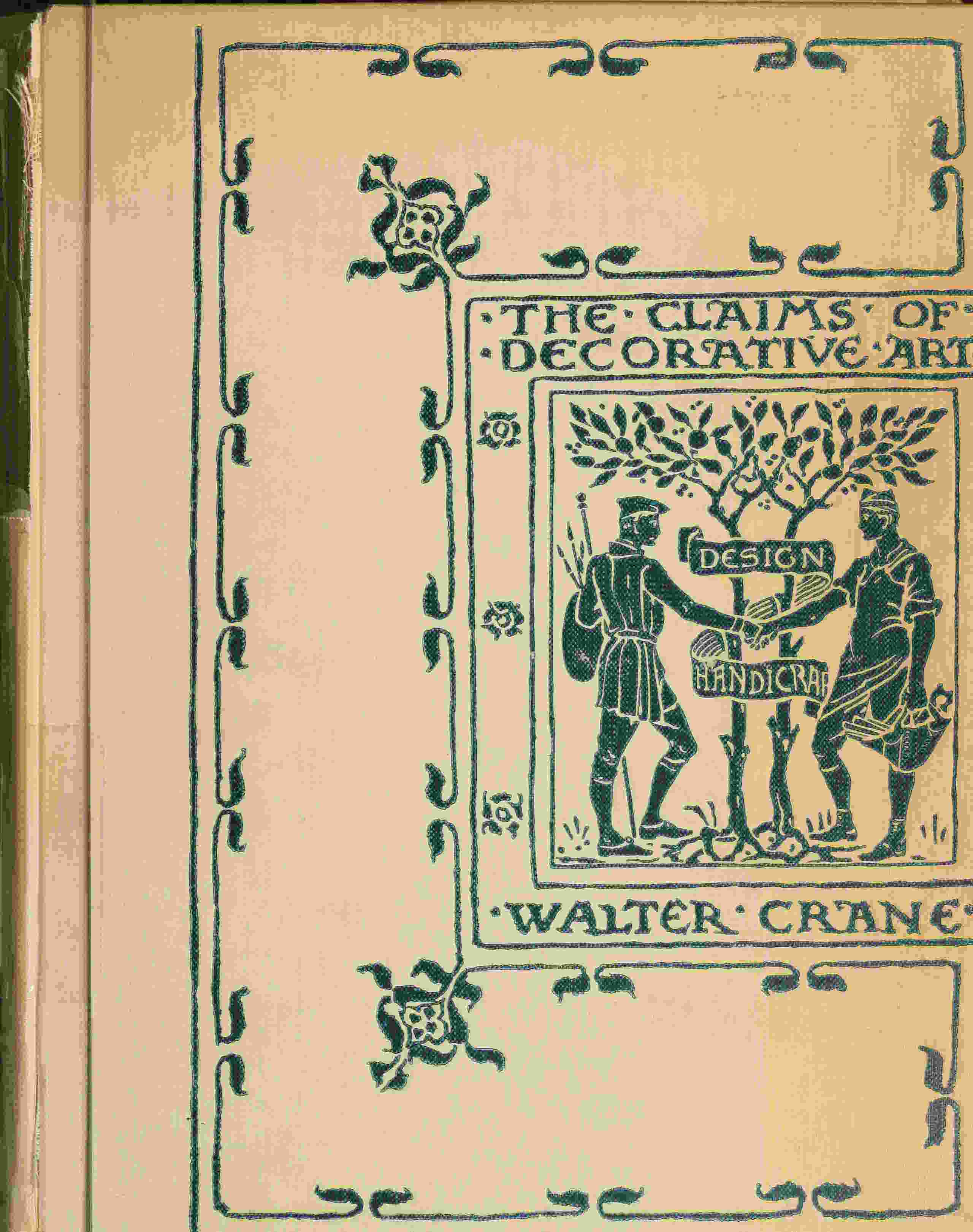
THE CLAIMS OF DECORATIVE ART
AN archbishop at an Academy dinner, doubtless with an amiable desire to administer consolation to those less favoured ones whose works did not adorn the walls around him, is reported to have said, in effect: “Never mind. It is not given to every one to be a Raphael, a Phidias, or a Michael Angelo (the exhibition being, by implication, of course full of them); but let them not therefore despair, let them turn their attention to Decorative Art, for there was a large field in which they might yet distinguish themselves.”
Now, although I do not suppose that even an archbishop could be found now to say anything of this kind, so rapidly have we advanced, yet it struck me at the time as the expression of a very curious view of art. It was not the unfortunate selection of names, all of which stood for artists pre-eminently decorative; it was not the placid assumption that the Academy represented both the best judgment upon, and the best work in, art which the country produced; it was not this so much as the assumption that what is called decorative art belonged distinctly to a lower category, that its demands upon the mind, both of the artist and the spectator, were much less, and, in short, the whole thing was of lower aim, and required less skill and power to produce than what is called pictorial art. If, however, we are justified in drawing any conclusions from the history and practice of art, they seem to invert this view altogether.
I have no wish to set the sisters one against the other, or make odious comparisons, and indeed there is no need to do so, as, in my belief, both kinds of art in their higher development join hands. Their true relative position, indeed, may be expressed by the two limbs of a pair of compasses, inseparable and mutually dependent and helpful. It is certain that painting and sculpture, as commonly understood, cannot be in a good state, cannot reach any perfection, where the multitudinous arts that surround and culminate in them—that frame them in, in short—are not also in vigorous health and life. As well expect flowers to bloom without roots and stems, light, heat, and air, as to think that beautiful pictures or statues, or the sense that produces and admires them, can exist where there is no beauty in everyday things, no sources of harmonious thought about us, or delight of the eye in pleasant colour or form in things of daily use and surrounding. I would go further, and say that where decorative or applied art is in a wholesome condition good pictorial or dramatic art will follow on as natural effect in the chain of evolution from certain ascertainable causes.
This is sufficiently obvious to actual workers in art; but “Truth,” as has been said, “never can be confirmed enough,” and I am afraid that it has by no means reached this stage with a great majority of the people, not to speak of academicians and archbishops, and that it yet needs demonstration to many that beauty, both in life and art, is not something accidental and fanciful, the luxury and pursuit of a few dreamers and misguided beings; that it is an organic thing, having its own laws, however various, its own logical causes and consequences; that it, like everything else, is a result of that continual fierce and strenuous struggle for existence throughout nature; a living thing, and therefore ever-varying in its forms, having its own ever-recurring seasons—growth, perfection, decline, and renaissance—as we follow it down the long stream of time, and mark its many habitations from age to age.
We may well treasure the broken caskets, the priceless shells and fragments of art, cast by the ruthless flood of years on the desert shores; but let us not, in our anxiety and admiration for the beauty that is of the past, forget that beauty is a living force with us, a living presence, and that, like her prototype, for those who have eyes, she rises from our northern seas every summer morning, without the trouble of going to Cyprus. But she must be fed, clothed, and housed, and for these necessities we, as decorative artists, must be held mainly responsible. We are the trustees, as it were, of the common property of beauty, and we are the administrators of it, to use a well-worn phrase, from the cottage to the palace. Whether as architects, sculptors, painters, and designers, each after our kind, by the forms, the colours, and the patterns we put out, we are insensibly forming the tastes, by association, of present and future generations. And, to return to the question touched at the outset, herein is the mark and goal of decorative art, properly speaking; that whereas other considerations may weigh largely in painting a picture, such as desire to get force or expression, though, personally, I should say they should never outweigh considerations of beauty; yet in decorative art, or, as it is not very logically called, applied art, these considerations are supreme. Decorum, balance, harmony, these are the graces who must advise us, though a whole crowd of secondary considerations clamours to be heard.
The current notion of decoration is summed up in the expression “flatness of treatment,” and to the notion that this is the whole of the law and the prophets of decorative art may be dimly traced, perhaps, the conception of it in the mind of the archbishop, and in those of many superior persons. Hence, too, the flat-ironed primulas and the genus of enfeebled flora and fauna generally, which so often, alas, do duty as decoration. As if decorative art was a voracious but dyspeptic being, and required everything in heaven and earth to be thoroughly well boiled down before it could be properly assimilated.
Flatness of treatment, of course, is well enough; it is the most single and obvious answer to one of the many problems a decorative artist has to consider. It is a part of his business, no doubt, to assert the wall, but his work does not begin and end there. But even if this was the last word of decorative art, it is by no means so simple a matter as it sounds. A world of judgment must come in, as at every step in all art properly so called. It needs our best faculties, whether we treat things in the flat or the round; but as well might one be satisfied with the definition of painting as “the imitation of solid bodies on a plane surface,” as with “flatness of treatment” as adequate characterisation of decoration.
The real test in decoration is adaptability, either to position or material. The exigencies of both often open the gates of invention; but assuredly no decoration has a right to the name which does not satisfy these conditions.
These are, after all, but the bones and the scaffolding, and though it is highly necessary to have them in their right places, the real triumphs of decoration come afterwards. And truly, the world, to the decorative artist, is all before him, where to choose. Nay, like every true artist, he has to make his own world, and people it with his thoughts. And in respect of thought decorative or monumental art, in its higher forms, is capable of expressing, by its command of figurative and emblematic resources, more than is possible to purely pictorial art. There is, in fact, nothing beyond its range, by reason of its being more suggestive than imitative; and in this direction it becomes again, as at its beginning, but in a higher sense, a language—a picture-writing.
And what language can be more definite and enduring, whether we read it from the artist’s or the historian’s, the antiquarian’s or the philosopher’s point of view? How faint an idea should we get of the nations of antiquity if all their art had perished! And it is all strictly decorative art, from the incised bones of the cave men to the frieze of the Parthenon. Therefore, say some, paint your own time, its manners and its customs, its coats and its trousers. By all means, if you see your way to it; but it would be a mistake to suppose that this was the only way of painting it. The mind has its habits and costumes as well as the body—a far more extensive wardrobe, indeed, which promises still to increase. Art does not live for the antiquary alone. He is never likely to be in want of material, even if Derby Days and Railway Stations were never put on canvas.
I know no better definition of beauty than that it is “the most varied unity, the most united variety.”
Well, certainly there is no lack in our day of variety—I mean in the sense of style and material. To the worker in art it is a truly formidable prospect, and to enter the lists he needs to be well mounted and armed, in view of the forces arrayed against him. Modern life with all its hideous luxury and squalor; its huge, ever-spreading, unwieldy, unlovely cities; the bare skeleton and bald framework of new aims and inventions breaking through the rich tattered garment of ancient life and customs. How to reconcile these things, how to assert the supremacy of Beauty, to raise her standard everywhere, how to bring sweetness out of strength, would seem to need the strength and courage of an artistic Samson. At the same time it is as well to remember that too much preparation may be as much an encumbrance as a defence, and that great effects are sometimes produced by very simple means; that giants have been floored by a well-directed stone in a sling, and the Philistines routed in consequence. I say it is as well to bear this in mind when we take our artistic life in our hand and go forth—to meet the monsters of our time clad in plate-glass, cast-iron, and fortified in desirable residences.