
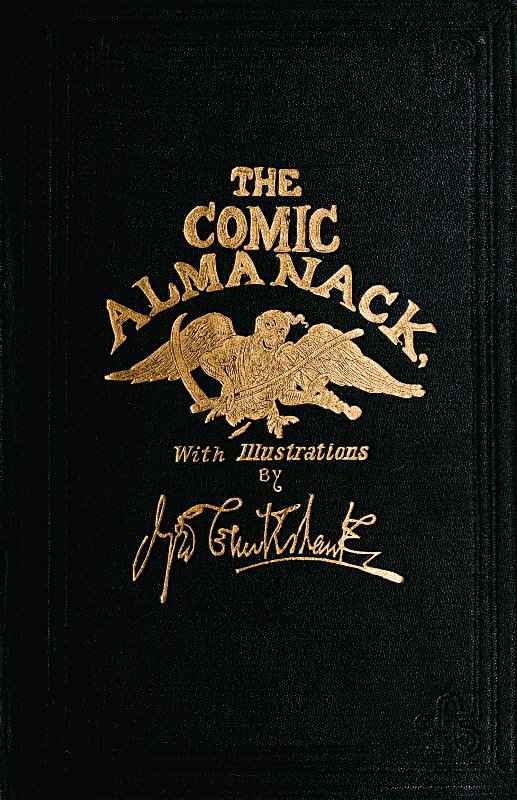
THE
COMIC ALMANACK
For 1836.
PROCLAMATION.
| JANUARY. | [1836. | ||
|---|---|---|---|
| "Kind Reader!" (as old Francis always said,) | |||
| Beware of counterfeits, for Frank is dead; | |||
| Some Quack survives—physician—if he will, | |||
| To swallow, of our physic, many a pill. | |||
| We'll spread the caustic 'midst the town's applause, | |||
| And thank the public that the blister draws. | |||
| M | Season's | Odd Matters. | WEATHER. |
| D | Signs. | ||
| 1 | When it | ||
| My | |||
| 2 | freezes | "HARD FROST." | |
| profound | |||
| 3 | and | The day is clear, the frost is hard,— | |
| I very much incline, | |||
| 4 | blows | As I'm a dab, to have a skate | △ ⚹ ☉ |
| Upon the Serpentine. | |||
| 5 | take | ||
| There's Mr. Tait,—he cuts an eight; | prognostifications | ||
| 6 | care of | He cannot cut a nine; | |
| And I could cut as good a figure | |||
| 7 | your | On the Serpentine. | of the |
| 8 | nose | I hate the eight of Mr. Tait, | |
| For he's no friend of mine; | weather | ||
| 9 | that it | He used me once so ungenteely | |
| On the Serpentine. | |||
| 10 | doesn't | ||
| For in the tête of Mr. Tait | ☿ △ ♂ ☉ ⚹ | ||
| 11 | get | There harbour'd a design, | |
| To break the ice with Sophy Price | for | ||
| 12 | froze | Upon the Serpentine. | |
| the past | |||
| 13 | and | He cut in there, and cut me out | |
| Of my sweet Valentine, | year | ||
| 14 | wrap up | Which cut quite cut me to the heart, | |
| Upon the Serpentine. | |||
| 15 | your | ||
| She cut me, while I thought that I | □ ☌ ⚹ ☉ | ||
| 16 | toes in | Was cutting such a shine, | |
| By cutting out her pretty name | have all | ||
| 17 | warm | Upon the Serpentine. | |
| proved | |||
| 18 | worsted | So, Billy, bring my polish'd skates,— | |
| My love I wont resign; | so correct, | ||
| 19 | hose. | She meets her knight, I know, to-day, | |
| Upon the Serpentine. | |||
| 20 | At | ||
| And if my sweet wont follow suite, | □ ♄ | ||
| 21 | night | But still my suit decline, | |
| The thaw I'll wait, to seal my fate, | □ ☿ ♄ △ ♂ | ||
| 22 | ere you | All in the Serpentine. | |
| and | |||
| 23 | slip | ||
| I have | |||
| 24 | into | ||
| 25 | bed | ||
| ☉ □ △ | |||
| 26 | you | ||
| herein, | |||
| 27 | may | ||
| as well as | |||
| 28 | sip a | ||
| 29 | can of | ||
| ☍ ☌ △ ♄ | |||
| 30 | good | ||
| in all | |||
| 31 | flip. | ||
SLANGOLOGY.
Paragraphs Extraordinary.
[Advertisement.]—We never admit puffs into our paper in any disguise or under any circumstances, for we are sure that "the man who would make" a puff "would pick a pocket." It is a love for veracity alone that induces us to state, that Monsieur Charlatan's TUSKOLATUM MYSTIFICATUM for renewing decayed TEETH is the most wonderful and surprisingly efficacious invention ever invented. How will those ancient maidens rejoice, who have only a colt's tooth in their heads, when they are told, that by sowing this panacea in their gums overnight, a fine crop of full-grown grinders will sprout up by the following morning! We speak from our own experience; and whereas, before we used this extraordinary invention, our great anxiety was how to get teeth for our food, the only matter that now troubles us is how to get food for our teeth.
Accidents.—We are happy to state that there is a great diminution in the number of accidents in the past week. Only 250 persons have been drowned by steam-boats; 320 women and children burnt to death by their clothes catching fire; 560 run over by omnibusses and cabs; 252 poisoned by taking oxalic acid instead of salts; 360 scalded to death by the bursting of steam-boilers; 200 blown to atoms by the explosion of powder-mills; and about 100—there or thereabouts—stabbed by drunken soldiers, off duty; all which evinces a great increase of vigilance, carefulness, and humanity, highly creditable to all parties concerned.
| 1836.] | FEBRUARY. | ||
|---|---|---|---|
| Look, Mrs. B——, what a crowd I see, | |||
| And the bells they make such a clatter; | |||
| And the people run, and I hear a gun! | |||
| Whatever can be the matter? | |||
| Mrs. C——, my dear, it's no good, I fear, | |||
| For us honest women and our spouses, | |||
| For the people say, the King's going to-day, | |||
| To open two very bad houses. | |||
| M | Season's | Odd Matters. | WEATHER. |
| D | Signs. | ||
| 1 | In | ||
| 2 | this | "TRANSFER DAY." | other |
| 3 | gay | As I was walking past the Bank, | matters, |
| (I know not why I stroll'd that way,) | |||
| 4 | month | I saw a lady tall and lank, | ☽ ☍ |
| With golden ringlets mix'd with grey; | |||
| 5 | I | And as she tripp'd, or strove to trip, | ☋ ♅ ♑ ♎ ⚹ |
| Adown the steps, so light and gay, | |||
| 6 | would | The greasy granite made her slip, | so |
| And down she fell on Transfer Day. | |||
| 7 | not | worthily | |
| I rais'd her up with gallant air; | |||
| 8 | choose | For I'm a Major on half-pay, | stepped |
| Who only live to serve the fair, | |||
| 9 | to | At any time, in any way: | |
| And while she blush'd a purple hue, | |||
| 10 | walk | Her eyes obliquely shot a ray, | ♃ ☉ ♐ ♋ ♉ |
| Which seem'd to say, "You will not rue | |||
| 11 | the | Your service on a Transfer Day." | into the |
| 12 | streets | And while the glance she threw at me | shoes of my |
| Was thro' my heart a-making way; | |||
| 13 | in | I straight began a colloquy, | |
| And to myself I thus did say: | |||
| 14 | dancing | If tradesmen, when their bills they bring, | |
| Would be contented with half-pay; | ♊ ☿ ⚹ | ||
| 15 | shoes | I'd soar aloft on freedom's wing, | |
| Nor care a rush for Transfer Day. | renowned | ||
| 16 | nor | ||
| But needy men the needful need; | |||
| 17 | would | So, spite of ringlets golden grey, | |
| And eyes that squint, I'll take the hint, | ☍ ☿ | ||
| 18 | I | Nor throw the lucky chance away. | |
| Full soon I found—ah! pleasing sound!— | predecessor, | ||
| 19 | for | With wealth she could my love repay; | |
| No longer mute, I urg'd my suit, | |||
| 20 | the | Upon that very Transfer Day. | |
| ♀ ♂ ☿ | |||
| 21 | world | I leave untold our courtship fond:— | |
| I made her Mrs. Major Cox; | the great | ||
| 22 | be | And in return for Hymen's bond, | |
| She kindly placed me in the stocks. | FRANCIS | ||
| 23 | seen | Her heart is good, her temper mild; | |
| She rules with more than sov'reign sway; | MOORE, | ||
| 24 | to | Nor have I thought myself beguil'd, | |
| Or once regretted Transfer Day. | Defunct, | ||
| 25 | trip | ||
| 26 | along | ||
| ♊ ☌ ⊕ ♓ | |||
| 27 | in | ||
| which shoes, | |||
| 28 | light | ||
| by-the-bye, | |||
| 29 | nankeen. | ||
Humbuggum Ass-trologicum, pro Anno 1836.
VOX MULTORUM, VOX STULTORUM: the Voice of the Many is the Voice of a Zany.—It brawleth at all Places and Seasons.
I DO herewith, present thee with an hieroglyphic, after the accustomed usage of my lamented precursor and prototype, Francis Moore, defunct. It prefigureth a mighty change now lying in the womb of futurity, and which doubtless will be brought forth in due season by the great man-midwife, Time.
And now do I most entreatingly invite thee to cast a Parthian glance at my foregone prophetic lucubrations, and especially towards that symbolical prefiguration or hieroglyphic, by which I brightly shadowed forth a certain notable event, the fulfilment whereof did so closely follow the heels of the prediction as to cause the multitude to marvel;—and when thou hast sufficiently pondered thereupon, I would ask thee whether thou dost not in verity deem me a fit and worthy successor of the renowned Francis Moore, defunct?
I do thus throw myself on thy candour, because certain of mine adversaries do most unworthily insinuate, that my astrological skill is stark naught; that I hold no correspondence with the stars; that I am no more acquainted with the Great Bear than with the Great Mogul; that I gather no signs of the Times from the signs of the Zodiac; and, in brief, that I am no conjuror! My only familiar, they affirm, is a little, insignificant, diminutive thing, called Common Sense, whose aid any one may have if he chooses; that the said Common Sense collects together certain things called Past Events, with which he compares Present Appearances, and they help him to Future Probabilities; they are then put into the crucible of Ordinary Judgment; and my sagacious and veracious prophecies and hieroglyphics are the result of this simple alchemy!
Candid Reader! Let thine own discretion decide, whether logical judgment or astro-logical fudgement be the art which influenceth my lucubrations.
INVITATION OF "THE SELECT"
To
Bartholomew Fair.
| MARCH. | [1836. | ||
|---|---|---|---|
| Some ready cash Dick wants to borrow | |||
| About this time—perhaps for rent; | |||
| But like most folks, he finds with sorrow | |||
| He's just too late—it's always Lent. | |||
| M | Season's | Odd Matters. | WEATHER. |
| D | Signs. | ||
| 1 | Blowing | ||
| 2 | growing | "DAY AND NIGHT EQUAL." | although |
| 3 | here's a | 'Tis Six o'Clock;—and now the Sun | ☊ ♅ ♌ ♑ |
| His daily course begins to run; | |||
| 4 | clatter! | While Folly's children slink away, | somewhat |
| Like bats who dread the glare of day, | |||
| 5 | what the | From Masquerade or Fancy Ball, | clumsy |
| Where pleasure reign'd in Fashion's Hall; | |||
| 6 | deuce | And sneak along, like guilty creatures, | |
| With tir'd limbs and haggard features. | |||
| 7 | can be | ♄ ☉ ♊ ♃ ☌ | |
| The sons of toil, as they come near 'em, | |||
| 8 | the | With coarse-spun jokes begin to jeer 'em; | withal, |
| While, au contraire, each motley hero, | |||
| 9 | matter? | Whose wit is now far under zero, | |
| With 'not a gibe to mock their grinning,' | |||
| 10 | tiles | Has but a sorry chance of winning. | ♏ ♐ ♀ ♎ |
| 11 | and | The Clown, with phiz so dull and sad, | do fit me |
| Looks grave as Ghost of Hamlet's Dad; | |||
| 12 | chimney | And Falstaff, now he's lost his stuffing, | with |
| Looks lean as lath, and pale as muffin; | |||
| 13 | pots | While Harlequin, half muzz'd with wine, | marvellous |
| Don't care a rush for Columbine, | |||
| 14 | come | But leaves her, like a careless loon, | accuracy: |
| To draggle home with Pantaloon; | |||
| 15 | down | And Romeo, with empty purse, | |
| Abandons Juliet to her nurse. | |||
| 16 | and pay | ♂ ♌ ♓ ♄ ♑ | |
| The child of labour, when he sees | |||
| 17 | their | Such silly spectacles as these,— | for these |
| How dissipation is repented,— | |||
| 18 | duty | May with his station be contented; | reasons, |
| For mete them both with equal measure, | |||
| 19 | to the | He'll find the hardest toil is pleasure. | I say, |
| 20 | crown, | ||
| 21 | while | ♓ ☊ | |
| 22 | surly | it behoveth | |
| 23 | north | me to | |
| 24 | usurps | ||
| 25 | the | ||
| ♓ ♌ ♄ ☌ ☊ | |||
| 26 | south | ||
| be tender | |||
| 27 | and | ||
| of my | |||
| 28 | makes a | ||
| 29 | dusthole | ||
| ☉ ☿ ♂ ☽ | |||
| 30 | of your | ||
| 31 | mouth | ♂ ♊ ☿ ☽ | |