
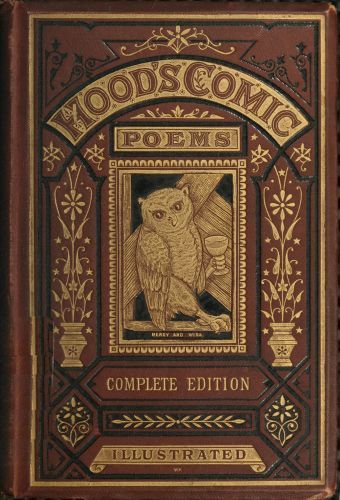
The Project Gutenberg eBook of The Comic Poems of Thomas Hood
Title: The Comic Poems of Thomas Hood
Author: Thomas Hood
Author of introduction, etc.: Tom Hood
Release date: March 9, 2018 [eBook #56712]
Most recently updated: January 24, 2021
Language: English
Credits: Produced by Chuck Greif, MWS, Bryan Ness and the Online
Distributed Proofreading Team at http://www.pgdp.net (This
file was produced from images generously made available
by The Internet Archive/American Libraries.)
THE
COMIC POEMS
OF
THOMAS HOOD.
FAULTS ON BOTH SIDES.
WAR DANCE—THE OPENING OF THE BALL.
THE COMIC POEMS
OF
THOMAS HOOD.
WITH A PREFACE BY
THOMAS HOOD THE YOUNGER.
A NEW AND COMPLETE EDITION.
LONDON:
E. MOXON, SON, AND COMPANY,
DORSET BUILDINGS, SALISBURY SQUARE, E.C.
Ballantyne Press
BALLANTYNE AND HANSON, EDINBURGH
CHANDOS STREET, LONDON
PREFACE.
If the general public, acquainted only with the comic works of Thomas Hood, were taken by surprise when they found how he could handle serious and solemn themes; those who saw him in the flesh must have been equally astonished to learn how grave and melancholy a man the famous wit was to all appearance. The chronic ill health, which gave this expression to his countenance, was, however, powerless to affect the tone of his mind. “Here lies one who spat more blood and made more puns than any man living,” was the epitaph he half-jestingly proposed for himself. The connection between the disease and the comic faculty is not so unreasonable as it appears at first. The invalid, who could supply mirth for millions while he himself was propped up with pillows on the bed of sickness, was not a jester whose sole stock in trade consisted in mere animal spirits—which are too often mistaken for wit, but have in common with other spirits a tendency to evaporate somewhat rapidly. Hood’s wit was the fruit of an even temperament, a cheery and contented mind endowed with a keen appreciation of the ludicrous. This acute perception of what is ludicrous is the foundation of all wit, but it may influence the mind in two ways. It may render its possessor as indifferent to the feelings as it makes him alive to the failings of others. How often does the wit, delighting in the flash and report of his jest, forget the wound it may inflict!
But, on the other hand, the shrewd appreciation of the weaknesses of others assists a kindly and well-balanced mind to avoid the infliction of pain; and the wit of Thomas Hood was of this nature. It was all the brighter because it was never stained by a tear wantonly caused. Even the temptations of practical joking—and they have a strong influence on those who enjoy the comic side of things—never betrayed him into any freak that could give pain. He worked away industriously with wood, paint, and glue to send his friend Franck a new and killing bait for the early spring—a veritable Poisson d’Avril, constructed to come in half after a brief immersion, and reveal the inscription, “Oh, you April Fool!” He could gravely persuade his young wife, when she was first learning the mysteries of housekeeping, that she must never purchase plaice with red spots, for they were a proof that the fish were not fresh. But he was incapable of any of the cruel pleasantries for which Theodore Hook was famous: indeed, the only person he ever frightened, even, with a practical joke, was himself; when as a boy he traced with the smoke of a candle on the ceiling of a passage outside his bedroom a diabolical face, which was intended to startle his brother, but which so alarmed the artist himself, when he was going to bed forgetful of his own feat, that he ran down stairs—in a panic and in his night-dress—into the presence of his father’s guests assembled in the drawing-room. He used to enjoy so heartily and chuckle so merrily over his innocent practical jokes and hoaxes (he was never more delighted than when a friend of his was completely imposed on by a sham account of a survey of the Heavens through Lord Rosse’s “monster telescope”) that the tenderness he showed for the feelings of others is more remarkable. The same forbearance characterises his writings. In spite of many and great provocations, he seldom, or never, wrote a bitter word, though that he could have been severe is amply indicated in his “Ode to Rae Wilson,” or still more in certain letters on “Copyright and Copywrong,” which he was spurred on by injustice and ill-usage to address to the Athenæum. He was a Shandean, who carried out in his life as well as his writings the principles which Sterne confined to the latter.
The first appearance of Thomas Hood as a comic writer was in the year 1826, when he published the First Series of “Whims and Oddities.” The critics in many instances took offence at his puns, as might have been expected, for his style was new and startling. His book was full of word-play, and it is easy to conceive—as he wrote in his address to the Second Edition—“how gentlemen with one idea were perplexed with a double meaning.” However, the public approved if the critics did not, and called for a second and soon after a third edition. Finally, after the publication of a second series, a fourth issue, containing the two series in one volume, was demanded. “Come what may,” said Hood, “this little book will now leave four imprints behind it—and a horse could do no more!”
He had by this time commenced the Comic Annuals, a series which he carried on for many years, and by which he established his fame as the first wit and humourist of his day. When this publication ceased he wrote first for Colburn’s New Monthly, of which he was appointed Editor on Hook’s death; and subsequently, and up to the time of his death, in his own periodical, Hood’s Magazine.
Puns have been styled the lowest form of wit, and the critics have fallen foul of them from time immemorial until the present day. But a pun proper—and there should be a strict definition of a pun—is, it is humbly submitted, of so complicated a nature as to be anything but a low form of wit. A mere jingle of similar sounds, or a distortion of pronunciation does not constitute a pun—a double meaning is essential to its existence—a play of sense as well as of sound. That the latter was in Hood’s opinion the more important feature of the two is to be inferred from his statement that “a pun is something like a cherry: though there may be a slight outward indication of partition—of duplicity of meaning, yet no gentleman need make two bites at it against his own pleasure.” In other words, the sense is complete without any reference to the second meaning. Tested by this rule, the majority of so-called puns, which have brought discredit on punning, would be immediately condemned, the only excuse for the form in which they are written being the endeavour to tack on a second meaning, or too often only an echo of sound without meaning.
Perhaps the best defence of punning is to be found in the following stanzas of “Miss Kilmansegg:”
In double X Ale, and Dublin Stout,
That the single sorts know nothing about—
And the fist is strongest when doubled—
And double aqua-fortis, of course,
And double soda-water, perforce,
Are the strongest that ever bubbled!
Swims on a Lake, with her double thereon;
And ask the gardener, Luke or John,
Of the beauty of double-blowing—
A double dahlia delights the eye;
And it’s far the loveliest sight in the sky
When a double rainbow is glowing!
As well as a double allowance of coals—
In a coat that is double-breasted—
In double windows and double doors;
And a double U wind is blest by scores
For its warmth to the tender-chested.
And a double barrel and double snipes
Give the sportsman a duplicate pleasure;
There’s double safety in double locks;
And double letters bring cash for the box;
And all the world knows that double knocks
Are gentility’s double measure.
And a double at Whist and a double Times
In profit are certainly double—
By doubling, the hare contrives to escape;
And all seamen delight in a doubled Cape,
And a double-reef’d topsail in trouble.
And of course there’s a double pleasure therein,
If the parties were brought to telling:
And however our Denises take offence,
A double meaning shows double sense;
And if proverbs tell truth,
A double tooth
Is Wisdom’s adopted dwelling!”
The reputation of Thomas Hood as a wit and humourist rests on his writings chiefly. His recorded sayings are few, for in general society he was shy and reserved, seldom making a joke, or doing it with so grave a face that the witticism seemed an accident, and was in many cases possibly allowed to pass unnoticed, for a great number of people do not recognise a joke that is not prefaced by a jingle of the cap and bells. When in the company of a few intimate friends, however, he was full of fun and good spirits. Unfortunately, on such occasions the good things were not “set in a note-book,” and so were for the most part lost; though at times an anecdote, well-authenticated, turns up to make us regret that more have not been preserved.
One such anecdote, which has not hitherto appeared in print, may not be out of place here. Hood and “Peter Priggins”—the Rev. Mr. Hewlett—went on a visit to a friend of the latter’s, residing near Ramsgate. As they drove out of the town they passed a board on which was printed in large letters
BEWARE THE DOG.
A glance at the premises which the announcement was intended to guard showed that the quadruped was not forthcoming, whereupon Hood jumped out of the gig, and, picking up a bit of chalk (plentiful enough in the neighbourhood), wrote under the warning—
WARE BE THE DOG?
These introductory remarks cannot be better wound-up than by a quotation from a preface to “Hood’s Own,” in which is laid down the system of “Practical Cheerful Philosophy,” which is reflected in his writings, and which influenced his life. The reader will more thoroughly appreciate the comic writings of Thomas Hood after its perusal:
In the absence of a certain thin “blue and yellow” visage, and attenuated figure,—whose effigies may one day be affixed to the present work,—you will not be prepared to learn that some of the merriest effusions in the forthcoming numbers have been the relaxations of a gentleman literally enjoying bad health—the carnival, so to speak, of a personified Jour Maigre. The very fingers so aristocratically slender, that now hold the pen, hint plainly of the “ills that flesh is heir to:”—my coats have become great coats, my pantaloons are turned into trowsers, and, by a worse bargain than Peter Schemihl’s, I seem to have retained my shadow and sold my substance. In short, as happens to prematurely old port wine, I am of a bad colour with very little body. But what then? That emaciated hand still lends a hand to embody in words and sketches the creations or recreations of a Merry Fancy: those gaunt sides yet shake heartily as ever at the Grotesques and Arabesques and droll Picturesques that my good Genius (a Pantagruelian Familiar) charitably conjures up to divert me from more sombre realities. It was the whim of a late pleasant Comedian, to suppose a set of spiteful imps sitting up aloft, to aggravate all his petty mundane annoyances; whereas I prefer to believe in the ministry of kindlier Elves that “nod to me and do me courtesies.” Instead of scaring away these motes in the sunbeam, I earnestly invoke them, and bid them welcome; for the tricksy spirits make friends with the animal spirits, and do not I, like a father romping with his own urchins,—do not I forget half my cares whilst partaking in their airy gambols? Such sports are as wholesome for the mind as the other frolics for the body. For on our own treatment of that excellent Friend or terrible Enemy the Imagination, it depends whether we are to be scared and haunted by a Scratching Fanny, or tended by an affectionate Invisible Girl—like an unknown Love, blessing us with “favours secret, sweet, and precious,” and fondly stealing us from this worky-day world to a sunny sphere of her own.
This is a novel version, Reader, of “Paradise and the Peri,” but it is as true as it is new. How else could I have converted a serious illness into a comic wellness—by what other agency could I have transported myself, as a Cockney would say, from Dullage to Grinnage? It was far from a practical joke to be laid up in ordinary in a foreign land, under the care of Physicians quite as much abroad as myself with the case; indeed, the shades of the gloaming were stealing over my prospect; but I resolved, that, like the sun, so long as my day lasted, I would look on the bright side of everything. The raven croaked, but I persuaded myself that it was the nightingale! there was the smell of the mould, but I remembered that it nourished the violets. However my body might cry craven, my mind luckily had no mind to give in. So, instead of mounting on the black long-tailed coach horse, she vaulted on her old Hobby that had capered in the Morris-Dance, and began to exhort from its back. To be sure, said she, matters look darkly enough; but the more need for the lights. Allons! Courage! Things may take a turn, as the pig said on the spit. Never throw down your cards, but play out the game. The more certain to lose, the wiser to get all the play you can for your money. Come—give us a song! chirp away like that best of cricket-players, the cricket himself. Be bowled out or caught out, but never throw down the bat. As to Health, it’s the weather of the body—it hails, it rains, it blows, it snows, at present, but it may clear up by-and-bye. You cannot eat, you say, and you must not drink; but laugh and make believe, like the Barber’s wise brother at the Barmecide’s feast. Then, as to thinness, not to flatter, you look like a lath that has had a split with the carpenter and a fall out with the plaster; but so much the better: remember how the smugglers trim the sails of the lugger to escape the notice of the cutter. Turn your edge to the old enemy, and mayhap he won’t see you! Come—be alive! You have no more right to slight your life than to neglect your wife—they are the two better halves that make a man of you! Is not life your means of living? So stick to thy business, and thy business will stick to thee. Of course, continued my mind, I am quite disinterested in this advice—for I am aware of my own immortality—but for that very reason, take care of the mortal body, poor body, and give it as long a day as you can.
Now, my mind seeming to treat the matter very pleasantly as well as profitably, I followed her counsel, and instead of calling out for relief according to the fable, I kept along on my journey, with my bundle of sticks,—i.e., my arms and legs. Between ourselves, it would have been “extremely inconvenient,” as I once heard the opium-eater declare, to pay the debt of nature at that particular juncture; nor do I quite know, to be candid, when it would altogether suit me to settle it, so, like other persons in narrow circumstances, I laughed, and gossipped, and played the agreeable with all my might, and as such pleasant behaviour sometimes obtains a respite from a human creditor, who knows but that it may prove successful with the Universal Mortgagee? At all events, here I am, humming “Jack’s Alive!” and my own dear skilful native physician gives me hopes of a longer lease than appeared from the foreign reading of the covenants. He declares, indeed, that, anatomically, my heart is lower hung than usual—but what of that? The more need to keep it up!
EDITORIAL NOTE.
This new issue of Hood’s Poems has been completely revised, and will be found not only larger in size, but far richer in contents, than any previous edition. This, with the companion volume of “Serious Poems,” will be found to contain the entire poetical works of Thomas Hood. The volume has been, moreover, enriched by the addition of a large number of the highly humorous illustrations, in which Thomas Hood’s comic power was displayed.