
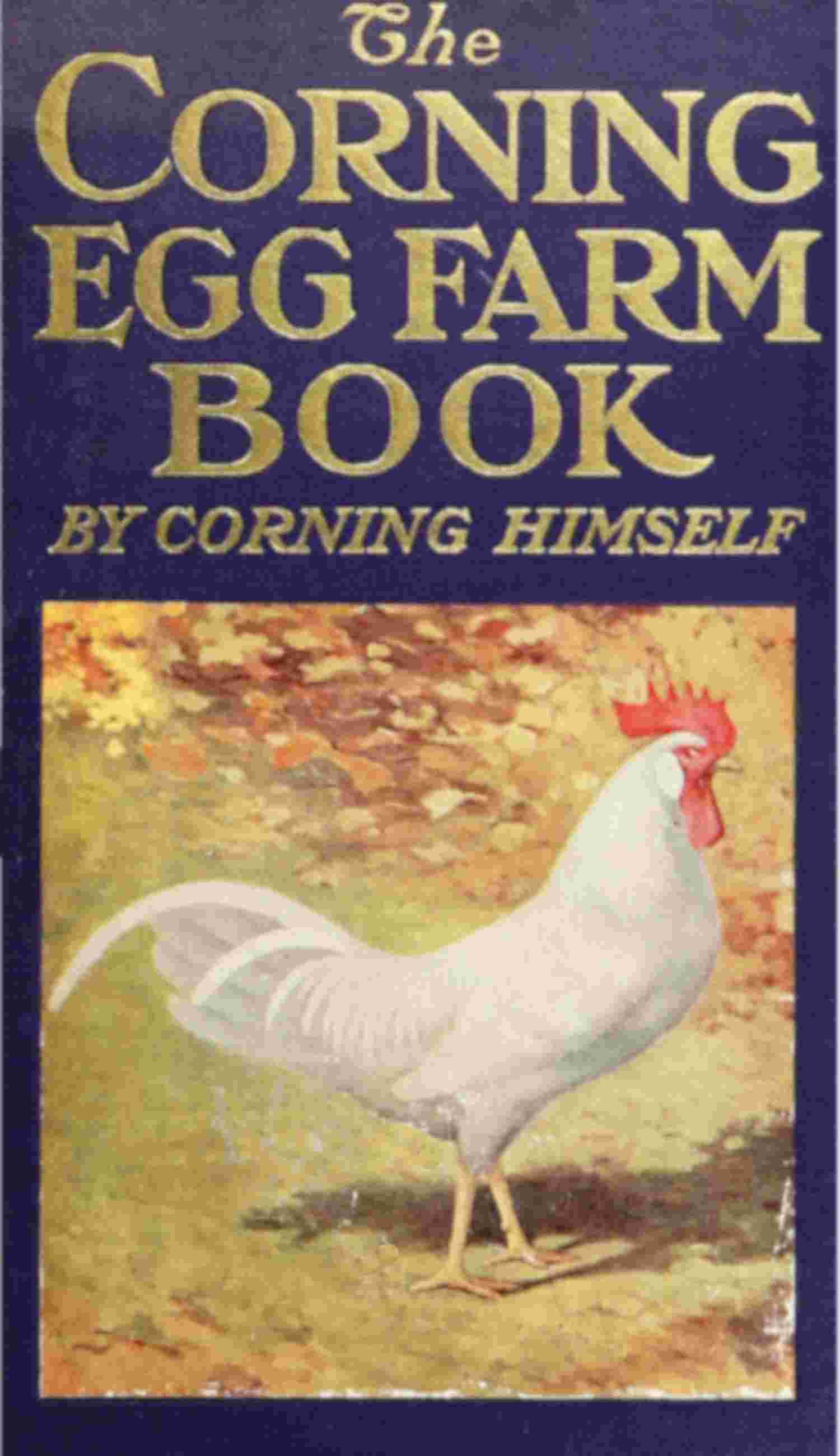
Having determined, in 1905, to engage in some business connected with the feathered tribe, we decided to try out the squab proposition versus market poultry. After searching over a period of many months, in various parts of the country, with the idea of finding a place where the existing buildings might be utilized for our needs, we finally were obliged to abandon this idea and purchased, early in the year 1906, twelve and a half acres of land, now known as Sunny Slope Farm. This property lies about two miles west of Bound Brook, New Jersey, which town is reached by the Central Railroad of New Jersey, the Baltimore & Ohio, the Philadelphia & Reading and the Lehigh Valley Railroads, and the Farm is most accessible, as it is on the trolley line which connects Bound Brook and Somerville.
In the early Spring of 1906 we began our buildings, erecting a house, for raising squabs, which would accommodate five hundred pairs of breeding birds, a hen house of the scratching shed variety, capable of accommodating some two hundred and fifty hens, and a work-shop with living apartments for the resident man.
We also sunk a well one hundred and seventeen feet deep, erecting over it a sixty foot wind-mill tower, which carries an eighteen hundred gallon tank. From this pipes were laid to convenient parts of the property.
Three hundred pairs of Homer pigeons were placed in the house built for that purpose, and we went diligently to work to prove that this was the quick and easy way to wealth which the ingenious writers of squab literature proved so conclusively on paper.
On the chicken side of the experiment we seemed to lean (possibly because of the fact that squabs take one into the slaughter house business) towards one or more of the market breeds, and, to meet the needs of this part of the business, we understood that any of the “Rock” family were best for the purpose.
Started with 60 Buff Rock Eggs
We purchased an incubator with the capacity of sixty eggs, being fearful of attempting the operation of a larger machine, because, like a great many novices, we had the feeling that an incubator was a very dangerous thing, and that anyone without a vast amount of experience should not attempt to handle it. We placed in this diminutive machine sixty Buff Rock eggs, and obtained a very fair hatch. With daily contact our fear of the machine decreased, and we exchanged it for one with a capacity of one hundred and twenty-five eggs, and this, in turn, was exchanged for one holding two hundred and fifty eggs.
INTERIOR STERILE LAYING HOUSE NO. 3 IN 1910
We obtained fairly large flocks of youngsters that season, but, as we had the usual hallucination that poultry culture was really a miracle, and required neither work, capital, nor brains, that all you had to do was to accept the profit and the chickens did it all themselves, we did not get so very far. The growth of the birds was so slow they did not reach a profitable weight until the broiler market had dropped the price to its lowest level. The pullets which we carried through the winter never produced an egg, for the simple reason that we had never studied the question out as to how the hen produces an egg. In other words, our lack of knowledge of the right methods was the reason for charging up a considerable loss instead of profit so far as the first season’s work with hens went.
We very early discovered there must have been a considerable amount of fiction in the writings on the squab industry. One reads that a pair of pigeons eats nothing like the amount of food which is required for one hen, and that they never eat more than their exact wants require, and that when they have young in the nest, this amount is very slightly increased. We found, however, that they ate in season and out of season. In fact one recalls, in this connection, and with considerable amusement, the song, in the light opera “Wang,” of the elephant who ate all day and the elephant who ate all night.
During our work with pigeons we tried out a number of different varieties: Homers, Dragoons, Runt Dragoon crosses, Homer Runt crosses, Maltese Hens, and the various crosses with Runt Dragoons; also Carneaux. We were led to buy these fancy breeds through the stories of extreme prices paid for large squabs, and we bred some heavy weights only to find, from the commission man who made a specialty of these birds, that it was impossible to pay the price which such birds were really worth, as trade for this class was extremely limited.
Very early in our experience we realized that the poultry side of our experiment was very much more to our liking and offered so much greater and more profitable outlook for our energies that we rang down the curtain on Squab raising—and turned our attention exclusively to the Hen.
While our minds were still running in the line of poultry for market purposes we tried out the Black Orpingtons, the idea being that, on account of their size, they would make ideal roasting fowls. We found, however, that they were a very much inbred variety, and it was almost impossible to hatch the eggs. Out of one hundred eggs, for which we paid twenty dollars, eight chicks hatched, and these were not of sufficient vitality to live.
ENTRANCE TO THE FARM IN 1909
More Money in Eggs
During all this time, however, we were studying the poultry question, and had arrived at the conclusion that there was more money in eggs, properly produced and marketed, than in any other branch. One of the difficulties we met with in our investigations was the fact that so many different writers had such a variety of ideas on the same subject, and practically no two of them agreed on any given part of poultry culture. What seemed to us even more confusing was that, in most cases, the writer summed up his article by contradicting everything he had said in the previous chapters. We were finally forced to the conclusion that the raising of poultry had not yet been reduced to a science, but was almost entirely made up of guesses. In our investigations, however, we found in the writings of the late Prof. Gowell, of Maine, an entirely different condition. He was the first man, so far as our observations went, who worked on the principle that effect followed cause, in poultry as in everything else. We studied his bulletins with great interest, and decided we would endeavor to prove that the same results gotten by him could be duplicated by others.
Adopted White Leghorns
We had also been studying the condition of the egg market, so far as New York and vicinity was concerned, and had found that this market paid a premium for a white shelled egg. This, then, was the determining factor in the selection of the breed of fowls, and after gathering all the information we could regarding birds which laid white eggs, we were satisfied, taking everything into consideration, that for an Egg Farm, the Single Comb White Leghorn, was the only fowl.
In the Spring of 1907 we collected a breeding pen, from different sources, of thirty Single Comb White Leghorn yearling hens, and three strong, vigorous cockerels. We purchased an incubator holding three hundred and ninety eggs, and three out-door brooders, and built a number of small Colony Houses to move the birds into as soon as they were large enough to be transferred from the brooders. The hens chosen for the initial breeding pen of the Farm were most carefully selected, for even then we had in mind the result which we intended to reach, as to the ultimate type of layer on the Farm. We placed the resulting eggs from this breeding pen in the incubator, using a primitive turning machine to keep them in proper condition until the requisite number was acquired to fill the incubator. Our hatch was a very good one, and we succeeded in raising a fair number of the youngsters hatched.
During the Summer we erected what is now known on the Farm as the No. 1 Laying House. This was built one hundred feet long, by twelve feet wide, and on the same twenty foot section construction which has proved to be so successful a plan for poultry houses. The one mistake in this house was its width, and that has now been remedied by widening it to the standard, sixteen feet in width, and sixty feet in length have been added to it.
The youngsters on range grew rapidly. We marketed the cockerels at between eight and ten weeks of age, and they weighed from one and a quarter pounds to a pound and three quarters. These were sold “on the hoof,” as we had decided for the future to do nothing in the slaughter house line, and to this decision we have strictly adhered, shipping alive also all culls and birds of any age showing imperfections, the majority of our stock finding ready market for breeding purposes when we are ready to dispose of it.
As a correct record of the mortality of our hatching, and the number of cockerels marketed, had been kept, we found that we should have in the Colony Houses about two hundred and twenty-five pullets to place in No. 1 House.
In catching up the birds we found that the number figured on was about right. These two hundred and twenty-five birds went into the House, October 31st. They were already laying on the Range.
First Use of Roosting Closets
It was a very interesting sight to us to watch these birds at work in the first house which had ever been successfully built without partitions, in other words, one large flock with the run of the entire house. Others had tried it, and had failed. They had had draughts, and had found the house, therefore, very undesirable. We conceived the idea of roosting closets, with a partition extending some little distance beyond the dropping boards, running from the ceiling to the floor, thus breaking the house up so far as extended circulation of air went, and at the same time giving the birds the benefit of the larger area.
It was also a matter of great interest to two novices to watch the egg output in this first house. On the first day of November five eggs were gathered; on the second, seven; the third saw a drop to four. Of course these pullets had been giving us more eggs than this on the Range, but a transfer from one place to another always means a set-back to a layer.
The middle of the month saw the hens producing above seventeen eggs a day. December was started with an output of forty, and from that the birds ran into larger numbers daily until the last of December, when, with the mercury registering well down around zero, they were turning out one hundred eggs a day. The increase in the egg output continued steadily, and we found that March was the record month, but the highest single day was in April, when the pen produced one hundred and seventy eggs.
AS YOU APPROACH THE CORNING EGG FARM FROM THE PUBLIC HIGHWAY,
IN 1911
Showing 264-Foot Brooder House, Breeding Cockerel House and Office
We were well satisfied with the result of the Winter’s work with these pullets, and, although we did not have the knowledge that has since come to us in feeding for eggs, the output was a most creditable one, and we found a ready market at a good price.
Early in the Fall we had mapped out our plans for a very decided increase in plant for the coming season. The excavation for the Incubator Cellar, sixteen by fifty feet, had been made, and the Brooder House above it was enclosed without difficulty before weather of any great severity overtook us. We were blessed with a very late Fall, and mild weather continued, with only occasional dips, well into December, 1907.
We installed in the Cellar ten incubators, with a capacity of three hundred and ninety eggs each. The Brooder House, with its arrangement for Hovers and Nursery pens, was all completed, and the month of March found us placing eggs in the machines.
In the Fall of 1907 we had enlarged our Breeding House, so that we were able to place in it some two hundred and fifty breeders. Out of our original pen of thirty, we had lost two. From different sources we bought yearling hens, and with our original twenty-eight, made up the breeding pen.
Of course, as we had planned to endeavor to produce some three thousand pullets for the Fall of 1908, we were obliged to very materially supplement the product of our own breeders, with eggs from other sources, and this we did, buying eggs from different breeders, in widely separated territories.
As the hatching season advanced we added one more incubator to our battery of ten, and we placed in these incubators a total of eleven thousand eight hundred and four eggs, of which two thousand and ninety-six showed dead germs and clear eggs on the fourteenth day test.
The resulting number of chicks placed in the Brooder House was five thousand eight hundred and sixty-six for the entire season.
We found that the eggs purchased did not produce anything like the number of chicks, that is, strong, livable chicks, that did the eggs coming from our own breeding pen, which proved to us that the method of feeding and caring for breeding stock, pursued by others, fell very far short of the results gotten by our own methods.
We Count Only Livable Chicks
The lesson of incubation, which it is so difficult to make people understand, is not so much a question of how many chicks may be hatched from a given number of eggs as of how many strong, livable chicks are brought out. We very early in our hatching experience decided to count only those chicks, which were strong, and apparently capable of a steady growth and a sturdy maturity. Thus, the count of the number of chicks produced, does not really show the number which came out of the shells.
OFFICE BUILDING
We were extremely fortunate in handling the youngsters in the Brooder House, and our mortality was very low, and when the youngsters were placed in the Colony Houses, which had been built during the early Spring months, and placed out on the Range in readiness for them, they were a sturdy, vigorous crowd.
Percentage of Cockerels Low
The number of cockerels was very low, and these, as rapidly as they developed, were taken away from the pullets and placed in a fattening pen which had been provided, and as our stock was still an “unknown quantity” in Poultrydom, we marketed the larger part of them at broiler size.
The pullets came on finely, and the records show that a large number of them came into eggs when they were a few days over four months of age.
Through the connivance of an employé we made a heavy loss in the way of theft, and, when the final round-up of the pullets came, we found we had one thousand nine hundred and fifty-three.
During the Summer, we had built the No. 2 Laying House, sixteen feet wide by one hundred and sixty feet long, and in this house the first fifteen hundred pullets were installed, the balance going into No. 1 Laying House.
A number of visitors had called at the Farm during the Summer of 1908, and we had listened to the different stories of the ease with which five thousand laying pullets were produced annually, but at the end of this season we had much more respect for the number five thousand than we ever had before, and realized very fully what it meant to produce that number of females each year.
With the placing of these fifteen hundred pullets in this House of one hundred and sixty feet in length by sixteen feet wide, without being divided into separate pens, each hen having the entire run of the House and no more (that is, she did not leave the house for a yard, but stayed right in that space and did her work), we accomplished what, from the standpoint of all authorities on the subject of Poultry, was an impossible thing to do, and have the hen produce anything. And yet each hen had only two and one third square feet of floor space, which included the dropping boards.
The secret of being able to work the hen successfully in such a limited space per bird is in the length of the house. In reality, every bird has one hundred and sixty feet by sixteen feet in which to exercise and roam.
The four hundred and fifty-three pullets which were placed in No. 1 Laying House were given the entire run of this house, of one hundred feet by twelve feet, and yet the Egg Record for the ten months, in which these birds never left either house, is rather in favor of the house containing the fifteen hundred pullets. The average number of eggs per pullet in these houses, from December 1st, 1908, to September 30th, 1909, was 143.25. Many people who had seen the No. 2 House filled with the fifteen hundred pullets could hardly believe what they saw.
The Great Flock System Succeeds
The extreme health and great vigor of the birds was evident to anyone who looked in through the wire doors. Articles were written in numerous papers stating that the thing was impossible, and that, before many months, absolute failure would result. But in spite of all the prophecies the great flock system, in the Corning style House, proved by its great success, that a decided forward step had been made in economical management and housing of poultry.
We had gone ahead handling poultry in just the same way that any business would be handled, plus the scientific study of the anatomy of the hen, and what it was necessary to breed in order to accomplish a great success as a producer of large, white, uniform eggs, with the ability added to that formula, of turning them out in large quantities.
Callers at the Farm brought very forcibly home to us the fact, then quite unappreciated by us, that the methods employed, and the results obtained, were very remarkable from the standpoint of anything done in Poultry Culture up to that time. It was pointed out that in almost every other case it was not known by the poultryman just where he stood at any time of the year, let alone being able to tell where he stood every day of the year. The success of The Corning Egg Farm really has that feature as its foundation stone.
Before the close of the ten months of laying of the 1953 pullets we had received a number of overtures to put our methods and results into a book, and, after a time, such a book was written. The tremendous sale and success of that book is now a matter of history, and the great number of people who were helped to better things in poultry, and the still greater number of novices who were started on the road, were enabled, through this book, to reach a success which, as many of them testify, would have been impossible without it. In eighteen months over one hundred and forty thousand copies of this first book were sold. Hundreds of people came to the Farm to find out for themselves whether or not the statements in the book were true, and these people found everything, down to the smallest detail, just exactly as represented.
Foreigners Visit the Farm
The Visitors’ Register, which is kept at the Farm, shows callers from almost every nook and corner of the Globe. In Scotland, a short distance from Glasgow, there is now almost a perfect duplicate of Sunny Slope Farm. The owner, who has twice crossed the ocean and come to the Farm, states that if you were blindfolded and taken from Glasgow the three miles out to his property it would be quite impossible for you to tell whether you were in New Jersey or Scotland, so absolutely alike are the buildings in every detail.
BREEDING COCKERELS, FALL OF 1909
In England, a short distance from Tunbridge, the Corning Laying House is again found. At this Farm both White and Black Leghorns are carried, and the owners write that they are meeting with great success in following the Corning Method.
Investigated for Germany
Germany sent a man who spent twelve months investigating the different methods of poultry raising and housing, and he visited all the plants of any note whatever from the Atlantic to the Pacific, including Canada, down to the Gulf of Mexico. He did not make his mission known, and it was only after his return to his native country that his identity was disclosed. His report is of more than passing interest to The Corning Egg Farm, as it states that the Method and System envolved on The Corning Egg Farm surpasses anything that has as yet come under his observation. The investigator is not only conversant with what he saw in the line of poultry breeding during his twelve months’ sojourn in America, but he is thoroughly posted in regard to everything in Europe.
The pullets were hardly placed in the Nos. 1 and 2 Laying Houses, in the Fall of 1908, before we began to plan for the Spring of 1909. We had enlarged the Breeding House again, so that we now had housed some four hundred and seventy-five yearling and two year old hens. These were made up from our breeding pen of the year before, and as many of our two hundred and twenty-five pullets as qualified. We bought a few other yearling hens from different sources, and likewise the necessary complement of cockerels.
Selection of Cockerels
We gave great care to the selection of the males heading the breeding pen, every bird having perfect head points, being strong and vigorous, and as large as we could find him, where we felt sure that no outside blood had been introduced.
The Brooder House during the Fall, was materially added to, giving us twenty Hover Pens, three feet wide, and twelve Nursery Pens, each nearly five feet wide, this giving us a Brooder House 118 feet long by 16 feet wide.
We again this year (1909) supplemented our own breeding pen with purchases of eggs from different sources.
Pullets Lay in 129 Days
Our hatches this Spring were very successful, and the chicks which went up into the Brooder House were strong and vigorous. The mortality was low, and when placed on Range they grew rapidly. The pullets came into eggs, as they had in the two previous years, within a few days after they passed the four months’ mile-stone.
We had added some six Colony Houses to our range equipment. The building originally designed for pigeons we planned to change over into a Breeding House, for, in the Fall of 1909, we would have a sufficient number of yearling hens to carry quite a breeding establishment. This house was about completed in the month of May, when it mysteriously took fire, and was a complete loss. Fortunately the fire broke out at about ten o’clock in the morning, and, by the timely assistance of the boys of the Wilson Military Academy, under the able direction of the Military Officers of that Academy, we were able to confine it to this one building in spite of the fact that a high wind was blowing, which carried the sparks directly on to the other buildings. The water supply on the Farm proved more than adequate to the necessities of the occasion, and the loss was entirely covered by insurance.
As we desired to recognize the services of the young men, and at the suggestion of the Commanding Officer, medals were struck off commemorative of the fire and of the bravery displayed by these young men at this time, and were presented to them.
An addition to the Breeding House, extending over the site of the burned building, was immediately erected, and the small building which had been used as a fattening pen for cockerels was rebuilt, and became the breeding pen for the production of unrelated cockerels.
Also during this season the No. 3 Laying House was built, this being an exact duplicate of the No. 2 House.
Our selection of Breeders for 1910 was of course made from the birds which had completed their first ten months of pullet laying, in the houses Nos. 1 and 2. The mortality during these months had been about 7 per cent. With our method of selection only 950 of these birds qualified to be used as yearling breeders, and these were placed in the Breeding House which had been prepared for them. We had made a most careful selection of cockerels, and these we had reared in two Colony Houses, placed in a large yard, where we were planning to eventually erect a Cockerel House for the housing of cockerels specially selected for breeders.
The balance of the birds from Nos. 1 and 2, together with our breeders of 1909, were sold, and we were able to face the hatching season of 1910 with a very decided step forward towards the realization of the ideal yearling breeder, which The Corning Egg Farm is working nearer to each season.
INTERIOR LAYING HOUSE NO. 2 IN 1910
We placed in the Laying Houses Nos. 2 and 3 about 2750 pullets, and our respect for the man who could successfully, yearly, produce and raise to maturity five thousand pullets, increased materially.
Keeping Down Labor Bill
The question of keeping down the labor bill on the Farm has at all times been a matter of careful study, and the machinery which is in use is of large capacity, enabling us to turn out whatever may be required in a very short space of time, and allowing the men to get at other work. As an illustration; the Clover Cutter on the Farm has a capacity of 3000 pounds an hour, cut in one-fourth-inch lengths, which enables us, when we are cutting green food, to turn out the amount required for the day, fill the tubs, and have it on the way to the Laying Houses, in less than fifteen minutes.
The question of economy in time in handling the Incubator Cellar had been a problem, which we finally solved by piping gas into the Cellar and Brooder House, from the mains which are laid in the road passing the Farm. Thus we did away with the danger of fire from sixteen incubator lamps (for we now had in the cellar sixteen machines) and the twenty Hover lamps, and the time and labor of cleaning and filling them. We placed a governor on the gas main, so that it was impossible to increase the pressure at any time of the day or night, and the gas worked most satisfactorily in incubation and brooding.
The extensions on the Farm planned for 1910 were a Cockerel House, for the housing of breeding cockerels, and the widening and lengthening of No. 1 Laying House. These alterations were made in No. 1, so that it was an exact counterpart of Nos. 2 and 3. We also planned, as soon as the breeding season was over, and the 1910 breeding pen was shipped to the various buyers who had purchased these birds for August delivery (and the entire pen was sold early in 1910), to add another section to the Breeder House, and to build a few more Colony Houses. Then we built what we thought would be an adequate Office to handle the business of the Farm, but which has since proved large enough for only one quarter of the present requirements. We increased the size of the Egg Packing Room, and installed a freezer with a capacity of over two thousand pounds of green bone. This practically covers the enlargements on the plant for 1910.
Adopted Hot Water Incubators
For three years we had been investigating quietly the so-called Mammoth Incubators, or in other words, the Coal Heated, Hot Water Incubator, and before the close of the hatching season of 1911 we had decided to install two such machines in a cellar 146 feet long by 22 feet wide—this cellar to be built so as to allow us to extend the present Brooder House to the same length and width as the cellar.
This cellar has since been constructed, with a Brooder House over it, so that we now have capacity for the incubation of 15,600 eggs at one time.
The Hot Water System for heating the air supplying the Hovers has also been installed, and the Brooder House now has a capacity of some 12,000 youngsters, before it is necessary to move any of them to the Range.
The Breeder House has again been enlarged, and, with the addition, a year hence, of another Breeding House, which is planned to be 180 feet long by 16 feet wide, and a larger house for the breeding of unrelated cockerels, The Corning Egg Farm will have reached the limit planned for since the inception of the Farm. We shall then have a capacity of 4500 sterile pullets, 3500 yearling hens for breeding purposes, and housing for 1200 cockerels.
Why Great Farms Fail
One reads of Poultry Farms carrying anywhere from twenty to forty thousand layers. Experience has taught us that the plant that gets beyond the size where those financially interested can supervise and know the condition of the Farm from one end to another daily, falls down of its own weight, as it is impossible to find men, unless financially interested, who will look after the endless details, which spell success or ruin on a large poultry plant.
The planning and designing of all buildings on The Corning Egg Farm was done by ourselves, and all the construction has been done under our personal supervision. In the first two years we did not contract even the labor, employing simply “handy men” who worked with us under our instructions. Latterly, with the large amount of routine and office work pressing upon us, we found it to be wise economy to contract the labor, ourselves supplying the material and supervising the work.
The buildings, with the arrangement of all equipment, are built in accordance with ideas thought and worked out by ourselves, on lines which seemed to us common sense, and economical in time and money for the handling of Poultry.
Until within the last two years we had never seen another poultry farm, and those we have seen have only strengthened our conviction that no serious error has been made in laying out The Corning Egg Farm Plant.