
tha Pobl Bohodzhak Paull han Egles nei";
which has been thus rendered:—
Gave Paul an almshouse and the church repair."
Two words here prove how Cornish was affected by the Roman occupation—pobl for people, and egles for church.
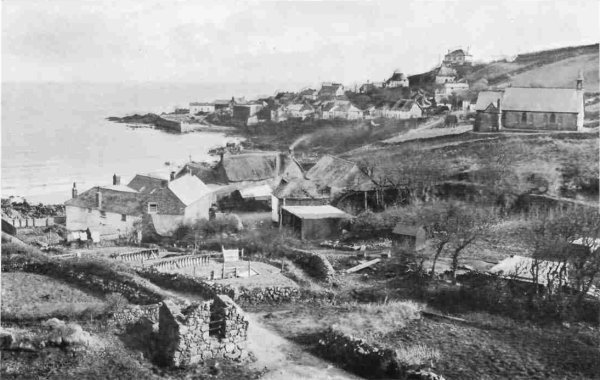
When Paul was burned Mousehole suffered also, and its only house that survived was the manor of the Keigwins, now the "Keigwin Arms," whose appearance quite justifies the antiquity claimed for it. Borrow, when he came here, must have been struck by the similarity of the name of Mousehole with that of Mousehold Heath, with which he was so familiar at Norwich; there seems no satisfactory explanation of either name. Perhaps both embody some Celtic root. Mousehole was once called Porth Enys, the island-port; and there is a little islet, St. Clement's, lying off it. The place is in every way quieter than Newlyn; there are fewer visitors in the summer months, less bustle on the quays, less stir of fish-auctions; even the artists are rarer. All is quaintness and primitive seclusion. There may be a somewhat too aggressive savour of pilchards; but we must excuse this when we remember what the pilchards mean to these fisher-folk, who were once considered somewhat of a race apart, with a supposed infusion of Spanish blood in them. There was a quay here and a chapelry in very early days, and the place was active enough before Penzance had come forward as a port at all; it is said that there was also a small oratory on St. Clement's Isle. The fisher-folk have spent a good deal on improving their harbour. The coast is grand and cavernous. On both sides, near Newlyn and at Lamorna, there is some busy quarrying; the quarries at Lamorna supplied much of the granite for the Thames Embankment. Being a favourite trip from Penzance, the cove at Lamorna is pretty well known; it opens to the sea from a very beautiful little valley formed by the Lamorna stream, wooded with hazels and alders. There need be no complaint just here that Cornwall is treeless, though beyond and above the land stretches unwooded and desolate. But it is a grand sort of desolation; only in thick weather or fierce driving storms do we feel in a kind of lost world. At the head of the Lamorna valley is an estate known as Trewoofe, or Troove, with a remarkable fogou (subterranean passage), not easy to find and not easy to enter. It runs for about 36 feet, being 6 feet high and nearly as wide, and is formed of rugged unhewn blocks. Stories tell that it successfully sheltered a party of fugitive Royalists once, and it may also have been used by smugglers of later date; but for its origin we must go farther back, and perhaps it takes us to the dim days when race was struggling with race on this far western limit of land. There are so many prehistoric relics near as to be almost bewildering, and this is surely not the place in which to discourse learnedly of them all; besides which, the utmost learning does little but reveal our dense ignorance of their real significance. Troove belonged to the Le Veales, or Levelis, family, who came over with the Conqueror, and flourished in this spot for six centuries, dying at last in the person of Arthur Levelis, who was buried at St. Buryan in 1671. The modern house retains only a few fragments of the mansion; but the doorway remains, its jambs sculptured with queer figures, and three calves' heads carved above it as the family arms. About half a mile westward is Boleigh, or Boleit, with the Pipers—two rough granite figures. When Athelstan traversed Cornwall from end to end, about the year 936, he is said to have fought his last battle against the defeated British at Boleit; not content with the whole of Cornwall, he crossed to the Scillies and took these also. It is quite possible that there was fighting here at that time, but very certainly the Pipers were not then raised as burial monoliths; they are clearly of far earlier date. In an open field near is the stone circle of Dawns mên, the dancing-stones, known as the Merry Maidens; there are nineteen rough boulders of granite, and there was probably a twentieth. Naturally, there is the usual story that they were maidens who danced on the Sabbath and were thus punished, the Pipers being similarly doomed for playing the dances.
Though St. Buryan lies about three miles from the coast, it must be visited for the beauty of its church and the interest of its traditions. The church is so named after Buriena, a beautiful Irish girl who came to Cornwall to become a saint, but it is very difficult to decide definitely as to her personality. We may conjecture that she came to Cornwall about the same time as St. Piran, perhaps in his company, and that she set up her cell in a field formerly called the Sanctuary, and later the Sentry. The present church is always understood to have been founded by Athelstan, when he sighted the Scilly Isles from this high ground, and vowed that if he returned safely from their conquest he would endow a collegiate establishment here. The expedition to Scilly accomplished, he observed his vow, and founded an establishment consisting of a dean and three prebendaries, with jurisdiction over the parishes of Buryan, Levan, and Sennen. There was trouble later, because the Buryan priests claimed freedom from episcopal control; but we find the Bishop of Exeter dedicating the church here in 1238, of which some Norman arches, font, and stoup survive; Athelstan's church has quite vanished. The building is about 100 feet long, and compared with the nave the chancel is almost like a cathedral choir, thus proving its collegiate character, the stalls still remaining. Much foolish restoration has done irreparable damage, but the church is still beautiful in design and detail; unhappily the screen was badly mutilated, and many bench-ends destroyed. When Blight wrote his admirable book on the churches of West Cornwall the Miserere seats could be raised; later, they were very stupidly fixed down. On the floor of the tower lies the ancient tomb of "Clarice La Femme Cheffrei De Bolleit," with an inscription in Norman-French characters of the thirteenth century, begging visitors to pray for her soul, and promising a ten days' pardon to those who do so; there can be no harm in our testing the efficacy of this offer. The tower that rises above this remarkably interesting grave is 90 feet in height, and as the church itself stands high it forms a fine landmark. Outside there is a shaftless cross of Celtic appearance, but not supposed to be Celtic in origin, though it certainly may have been adapted from a Celtic original. There is another old cross outside the churchyard gate, which may perhaps at one time have been included within the sacred pale, as traces of burial have been found. But churchyards were not often diminished in this manner, and the graves must probably be otherwise accounted for. In the church is an altar-cloth, now rarely used, worked by two maiden ladies more than two centuries since.
St. Buryan is familiar to all visitors to the Land's End, as the cars usually make it a halting-place. Even more famous, and perhaps more attractive to the conventional sight-seer, is the Logan Stone of Treryn, or Treen; but what makes this spot truly worth seeing is not the mass of poised rock, which certainly stirs clumsily when pushed, but the grand headland itself, on which there is a dinas, or old entrenchment. The coast here has more beauties than can be named, but this immemorial stronghold of a vanished race, on its magnificent bluff of granite that juts from a turf-clad neck of land, is far more glorious than any logging-stone, even though it may have been displaced and replaced by a nephew of the poet Goldsmith. The little hamlet of Treen is just across the fields. Logan rocks are simply a freak of nature, in spite of the Druidic nonsense that has been talked about them; softer soils have been eroded beneath, and the rock has remained balanced. Treen is in the parish of St. Levan, but we have to pass Porthcurnow Cove before reaching that saint's immediate locality. Porthcurnow, with its fine shore and grand seas, and its memories of Tregeagle, whose doom is to sweep the sands from Porthcurnow to the farther side of Land's End, has in some sense had its romance knocked out of it by the establishment of the Eastern Telegraph Company, and the presence of about a hundred keen, sport-loving telegraphists. They have a comfortable settlement for their exile here, with excellent cricket and tennis grounds and perfect accommodation. Their duties resemble those of any telegraph instrument-room in the country, but the locality should render their leisure hours delightful. Hunt tells a tale of a Spectre Ship at Porthcurnow, but all these traditions were dying when he told them, and that is a good while ago now. The name of Porthcurnow is interesting, as it probably embodies the root of the name of Cornwall itself; and there was once a very ancient chapel here, raised on a burial cairn of far greater antiquity; very slight traces remain. Perhaps Penberth and St. Loy's Coves ought to have been mentioned; but we must pass on to St. Levan, who was a very attractive saint, with an engaging touch of human nature about him. Even so, his identity is a little doubtful. The prefix St. is quite modern in Cornwall, and as this parish was once spoken of as Siluan, and is still sometimes called Slevan, it is possible that the real saint was Silvanus, and not Levan at all. Whoever he was, he had a little oratory and holy well on the cliff below the site of the present church; and he lived on a single fish each day. One day two fish persisted in being caught; and when he reached his cell he found that his sister Breaca (whose name survives at Breage) had paid him a visit with her two children. This legend goes on the usual supposition that the saint was really the Irish Levan, brother of St. Breage. Unhappily the children ate so eagerly that they were choked by the fishbones, in memory of which bream (or sometimes chad) used to be called "choke-cheeld." Mr. Baring-Gould says this caused a coolness between brother and sister. He had another unpleasantness with a woman Joanna, who lived near, who was a rigid vegetarian, and quarrelled with the saint for catching his fish on Sunday. He said that to fish was no worse than to do gardening. We may repeat these old stories, but the Cornish folk of to-day know nothing of them; they are dead, except as matter for the guide-books. St. Levan Church is snugly sheltered. It has been carefully restored and is very attractive, with a good tower, some fine bench-ends, and a beautiful screen. Outside the church is a cleft boulder of granite, and there used to be a local saying that when a pack-horse should ride through St. Levan's stone the world would come to an end. A little beyond is the really delightful Porthgwarra, with its rugged stone slip and tunnels leading to the little fishing-cove. Visitors are beginning to discover Porthgwarra, and it is one of those quiet, lonely haunts where lodgings must be booked long in advance. Cornwall has a good many such—the resort of those who shun the ordinary watering-place.
CHAPTER X
THE SCILLY ISLANDS
Geologically, we are still on the mainland when we reach the isles of Scilly; they belong to the axis of the Cornish peninsula, and are in what may still be called, comparatively, the narrow seas. The hundred-fathom line lies far beyond them; these waters, though thoroughly oceanic in character, are not oceanic in depth. We may regard the islands as the last upward thrust of the granitic backbone that runs, at a diminishing gradient, from Dartmoor to Land's End, while the submarine plateau follows a similar gradient. Structurally, therefore, these isles are a continuation of Land's End, but the granite has become less consistent and more friable; it is largely broken into felspar, quartz, and mica, with schorl, chlorite, and hornblende. No great elevation is attained—nothing above 160 feet; the grandeur of the coasts, which certainly does not equal that of North Cornwall, consists in their rugged wildness and the fantastic weathering of their crags. Contorted formations, logans and rock-basins, reveal the decomposition of softer measures that has been proceeding for ages. The isles lie about 27 miles west of Land's End, but the journey from Penzance to St. Mary's is about 40 miles, and the small steamers that make the passage usually take about four hours. More often than not this passage is an uncomfortable one; the islands stand in the ocean gateway of the two Channels, and they catch whatever is going in the way of sea, while of course winds play upon them with unbroken force. It is rather surprising that their strategic importance should be neglected by the Government. There was indeed some talk of forming a naval base here, but the scheme seems to have been abandoned; yet a station with extensive harbourage could be planned without vast cost, and would be a dominant factor in controlling the navigation of the English Channel. During the Franco-German War, when the navy of Germany was much less powerful than that of France, Germany made considerable use of the Scillies as a neutral port for the convenience of vessels making the Channel; and a time may easily come when a naval base here would be of untold advantage to Great Britain, as its absence might become a positive disaster.
The archipelago occupies an area of about 30 square miles, the isles, reckoning many that are mere fragments of rock, numbering about two hundred; the principal of which range in size from the 1,600 acres of St. Mary's to the five acres of Little Ganniley. St. Mary's is about three miles long and two in breadth, with a circumference of nine miles and a population of about 1,500—about three-quarters of the entire population. It contains the capital, Hugh Town, which is more often simply styled St. Mary's, and which stands chiefly on a neck of land that appears to be rather perilously threatened by the sea. Four other islands are inhabited—Tresco, St. Martin's, St. Agnes, and Bryher; they are all considerably smaller. The first to come into definite view from a vessel making the isles is St. Martin's, with its day-mark standing at a height of about 160 feet.
It must be confessed that, for their beauty, the islands depend very largely on sunshine and atmospheric effect; without the sun they can become very dreary. Meteorologic figures prove that the average summer temperature is only 58° Fahrenheit and the winter about 45°; so that there is little oppressive heat, and frost is very rare. But in spite of these figures the islands can become sultry under a blaze of sunshine; and in winter the winds are sometimes piercingly keen. No trees will grow unless protected from this wind; yet the tropical vegetation that flourishes in the open air conclusively proves the remarkable equability of the climate; while rainfall, which is seldom excessive, is quickly absorbed or evaporated. To the lover of history, legend, and romance the Scillies are a rich mine of treasure, and their inaccessibility keeps them immune from the spoiling tendencies of fashion. At one time this inaccessibility was far greater, and only those came to Scilly who had business there. It is claimed by tradition that these islets are a portion of the lost land of Lyonesse, the old-world haunt of Arthur and Tristram—a land of villages, pastures, smiling vales, now buried beneath the waves. Persons sometimes apply the name of Lyonesse to the whole of Cornwall, but this is a mistake; the true Lyonesse of legend was a tract of country lying to the south-west of Land's End, which we may connect, racially or otherwise, with the Leon of Brittany. There are many traces of submerged forest in Mount's Bay and elsewhere along the southern coast; and the old Cornish name of St. Michael's Mount represents that rock as having once stood in the centre of woodland. It is impossible to say when or how the Scillies first became insular, whether by sudden cataclysm or by gradual erosion; the latter seems more likely, but tradition has preferred to speak of a sudden catastrophe, such as that which is supposed to have overwhelmed Cardigan Bay. There is a story which says that a member of the Trevilian family was only saved from the inrush of waters by the speed of his horse, which struggled inland from the pursuing waves, reaching a rocky cleft on the shore at Perranuthnoe. It is possible that slow erosion may have paved the way to some such immediate disaster, such as that caused by a great storm in 1099, when, according to the Saxon Chronicle, many villages and churches were swept away. It was this storm, accompanied perhaps by a tidal wave, that converted the estates of Earl Godwin into the dreaded Goodwin Sands; and it may have caused tremendous damage, not definitely recorded, in the West. But another tradition attributes the formation of the islands to magic. It was said, by those who placed Arthur's last great battle in the West of England, that, after the fight was over, the triumphant Mordred chased the King's despairing followers to the extreme limits of Lyonesse, where they lay "between the devil and the deep sea," like the Israelites pursued by Pharaoh. The cruel Mordred was close at their heels, rejoicing in the prospect of exterminating the last remnant of Arthur's Round Table, when suddenly the wizard Merlin appeared in his path. The magician raised his hand and summoned the elements to his aid. The earth began to heave and the rocks to split; waters came rushing into immense fissures and yawning chasms. Mordred and his men turned back horror-stricken, attempting to flee from this upheaval of nature; but the ocean was too quick for them. Where there had been smiling acres of pasture and tillage, valley and moorland, waves were now seething and foaming; there was no refuge to the east or to the west; the breakers overtook them on all sides. But while they were thus overwhelmed in the ruin of Lyonesse, the followers of Arthur stood on land that had been spared. This far-west cluster of hill-summits had been changed into a group of islets; and in this home of refuge that was miraculously left to them, the fugitives settled into peaceful residence, building houses and churches. Such, the story says, is the ancestry of the Scillonians.
All this belongs to the region of romance; history knows nothing of it. Even the name of Scilly is a puzzle, though perhaps the best authorities think that it derives from the widespread tribe of the Silures. Strictly speaking, the name Scilly only attaches to one small islet lying off Bryher, but somehow it has affixed itself to the whole group. Many derive it from silya or selli, meaning conger-eels, a favourite Cornish dish; others suggest the Celtic sulleh, or "sun-rocks," denoting the old sun-worship. It is interesting to note that there is a Sully isle lying off Glamorgan, south of Cardiff, and there may have been some connection between the two names, for Scilly was sometimes spelt Sully; there is also a Scilly in Ireland. The Romans usually called the islands Sillinæ, but Sulpicius Severus used the form Sylinancis, which Sir John Rhys associates with the Silulanus of an inscribed stone at Lydney. Another name was Silura; Richard of Cirencester wrote of the Sygdilles, "also denominated the Œstromenides and Cassiterides"; the Danes spoke of the Syllingar; and in French charts the isles are "les Sorlingues." The whole question is very difficult, and this is hardly the place in which to discuss it. It is almost certain that the isles cannot have been the Cassiterides, or tin-islands; they present only slight traces of tin-working, and it is far from likely that the tin-workers of Cornwall would have shipped their metal to this isolated spot in order to find a market with foreign traders. It is more probable that the name of Tin Islands was applied by the ancients to the British Isles in general, whose number and extent were little known in those days. Rome seems to have used the isles as a place of banishment and penal settlement, and in days of early Christianity two heretical bishops were exiled here. Early in the tenth century Athelstan made a progress through Cornwall, ostensibly to conquer it as a part of Wessex; and when he reached the high land near the present St. Buryan it is said that he sighted these islands in the distance and was not content till he had visited them. He vowed to build a church on the spot where he then stood if he returned safely from the expedition. The church of St. Buryan stands as a memorial of his fulfilled vow. On the isles themselves he is said to have founded Tresco Abbey, dedicated to St. Nicholas, which became a wealthy religious establishment, though now only a few fragments remain. Later in the same century King Olaf of Norway came hither during one of the marauding cruises that made him a terror of the British shores. It is related that a hermit living at St. Mary's gave him timely warning of a mutiny among his seamen; Olaf crushed the mutiny, but received a severe wound. He was carried to the monastery at Tresco, and consented to be baptized; after which he became a saint himself, and churches were dedicated to him—there is one such at Exeter. Longfellow has told us of
Westward to the Hebrides,
And to Scilly's rocky shore;"
and he was probably not the only Norse Viking whose keel touched here. Other saints have left their mark on Scilly: Samson of Glamorgan came hither, about the middle of the sixth century, after founding a church near Fowey; he is the same Samson that we find at Guernsey, who afterwards became Bishop of Dol. The island that bears his name, rendered familiar to many delighted readers by Besant's Armorel of Lyonesse, is no longer inhabited, but bears many marks of its former population. Traces of old habitation abound; there are many barrows and one perfect kistvaen. Among other saints, Teilo seems to have been at St. Helen's. St. Agnes, like the parish so named on the mainland, is almost certainly a dedication to the Celtic Ann. It was natural that Tresco should become the ecclesiastical centre of Scilly. The abbey and all the churches of the islands were granted by Henry I. to the monks of Tavistock; at the Dissolution the abbey reverted to the Crown, and passed to the Godolphins, whose name survives at Dolphin Town. It is likely that the private history of the isles was romantic and exciting enough, but there is little to record until the days of the Civil War, when they became a last refuge of the fugitive Charles II. before his escape to France. In the meantime the Governor, Sir John Grenville, had fortified the isles and held them for the King; they became a centre of active privateering. The Royalist garrison did not limit themselves to attacking Parliamentary vessels; they molested Dutch shipping as well; so that the Admiral, Van Tromp, made an attack on them, but without result. It is said that he parleyed with Grenville, trying to induce that gallant soldier to yield Scilly into Dutch hands; but Grenville was too loyal an Englishman for such treachery—he would rather the Parliament took the isles than that they should become Dutch. It was with no disgrace that he was forced to yield, at last, to such worthy opponents as Blake and Sir George Ascue. In the days of our French wars, a century since, the islands were garrisoned, and became a port of supply for British ships, as well as a rendezvous for vessels waiting convoy. A great deal of smuggling was done here, and it has been said some wrecking; but, here as elsewhere in Cornwall, the lights that were thought to be exposed with such wicked intent were often merely meant as signals to those who were watching for an opportunity to run a cargo. There was little need indeed at Scilly for any artificial increase of wrecks; Nature did her part far too well in this particular, from the disaster to Sir Cloudesley Shovel to that of the Minnehaha in the present year. A small detachment of Royal Artillery and some engineers are stationed here. Beyond this, the islands are practically defenceless, except for the protection of their rough seas, fierce inter-channel currents, and the off-lying deadly fangs of rock.
The event of chief moment to modern Scilly was certainly the arrival of Mr. Augustus Smith in 1834. The isles at that time were in a bad way; the kelp industry had failed, fishing was poor and precarious, smuggling could not longer be depended on for a living. Previous "lords of the isles" had been absentees, taking little interest in the welfare of the inhabitants; and the population had become too large to support itself. But when Mr. Smith, a Hertfordshire gentleman, became landlord by purchase, he came to live on his little kingdom, and to rule as a benevolent autocrat. Just such a rule was needed, for matters demanded a firm hand. There was some resistance, some kicking, some difference of opinion between himself and his people; but the strong will and the firm hand conquered in the end and a better time dawned for Scilly. The squire sent the boys off to sea and the girls to service on the mainland; he made new roads, improved the quay, and even enforced a system of compulsory education. He resided at Tresco Abbey, where the few remains of the old monastic establishment added picturesqueness to a modern manor-house, and where he brought the gardens into very much the state in which we still find them. It was his wish that their character should be maintained. Tresco, in its special style, is indeed beautiful. "The Cape geranium, the common fuchsia, the sweet-scented verbena, and various kinds of myrtles and veronicas, are grown as hedges to protect the crops. Looking across Crow Sound from St. Mary's, these hedges are one blaze of colour, and the air is heavy with their perfume. The Abbey stands in a rocky valley looking south. The grounds are laid out in a succession of terraces, and from every nook and crevice rare specimens of cacti, sedums, and mesembryanthemums with their orange and purple bloom sprawl over the rocks and run riot among the borders. In the gardens South American aloes throw up their flowering stalks heavy with aromatic fragrance, 20 feet high, and giant dracænas wave their feathery heads in the balmy breeze. Exotic palms, the bamboo, the sugar-cane, and the cotton plant grow in the open, and tropical mosses and orchids hang from the trees. Outside on the breezy downs one may drink in pure ozone from the Atlantic, and revel in an atmosphere untainted by microbes or bacilli. Wild duck, woodcock, and plover, resting in their migratory flight, crowd the marshes, ponds, and lagoons, and the sea is alive with fish." Such was the Tresco that Mr. Augustus Smith made his home; such it is still in the hands of Mr. Dorrien-Smith. It is certain that when Mr. Smith died in 1872, and was buried at St. Buryan, he left the islands in a far better condition than that in which he had found them; and his memory fully deserves the striking monument of unhewn granite that has been raised to his honour in his island-home.
Industrially, we chiefly think of Scilly in connection with flowers. At one time there was some active ship-building, and Scilly-made boats had an excellent reputation; but steam navigation put an end to this. There was also a very lively business in potatoes, at first almost without competition; but this trade has been hit very hard by the Channel Islands, by foreign imports, and by the crushing cost of freights. Vegetable cargoes cost less from the shores of the Mediterranean than they do from Scilly; the foreigner is given every advantage in his efforts to undersell the Briton, and the Briton, though fighting at home, fights with one hand tied behind. Fishing at Scilly was long in a precarious state, but is now a little better, owing to the use of steam-drifters. The isles are too far from the markets, but by catching the boat to Penzance the fishermen can now get their fish away in most cases before it has had time to spoil. With mackerel, the most profitable catch, this is very important, as the mackerel so speedily deteriorates; but a good deal of the fishery that takes place off the Scillies is not in the hands of Scillonians—Cornishmen, East Anglians, foreigners, all compete. With regard to flowers Scilly seems more happily placed, though to some extent the same difficulties apply—the distance, the cost of carriage, the competition of the untaxed foreigner. The story has been often told—how, rather more than thirty years since, W. Trevellick, of Rocky Hill, St. Mary's, sent a few bunches of narcissi in a hamper to Covent Garden as a venture, and was astonished at the return they brought him. These were simply "Scilly Whites," which had been growing wild about the cottages without any one hitherto dreaming of their financial possibilities.
The knowledge of a demand soon roused the supply; new species were cultivated, everything was done to ensure early flowering, the more sensitive kinds were protected by wattle-fences and hedges of escalonia or veronica; and from January till May every steamer to the mainland carries tons of blooms. A ton of flowers is something rather spacious; and in the height of the season as many as thirty tons are taken in one boatload. The more severe the weather on the mainland, the better is the demand. The bulbs are set in narrow fields, to secure their shelter from the winds by thick hedges. As many as two hundred kinds of narcissus, daffodil, and lily are now cultivated. "The beds are renewed every third year. This is necessary to retain the vigour of the plant, as if allowed to remain too long without lifting, the bulbs crowd each other and send up barren and feeble shoots. When the bulbs are lifted they are divided, and any surplus stock either sold or replanted in fresh ground. The beds require very little attention further than being kept free from weeds, and having a top-dressing of stable litter or freshly gathered seaweed. Bulbs will not stand forcing, and are always sturdier when grown in the open." Men, women, and children find employment in the flower-fields, and in the busy time are often engaged from early morning till long after sunset. Picking must be done with great care, the blooms being gathered before they are fully opened or they will not bear carriage. A number are now sent by Parcel Post, as well as in more wholesale method. Within twenty-four hours of being plucked they are exposed in the London markets, or being offered for sale in the streets of large towns by the flower-hawkers. Some even go as far as Scotland. During 1907 as many as 1,000 tons were despatched from St. Mary's Quay, the cost of freight being £6 10s. per ton. Besides paying this heavy charge, the Scillonians have to compete with growers in the south of Cornwall, and even as far eastward as Dorset; while Continental florists can pour their produce into England at a rate that further hampers the home trade.
Things are very different now from what they were when the mail arrived irregularly from Penzance, and letters were distributed from the window of the one small post-office in St. Mary's. Each of the inhabited isles has now its own postal and telegraph office; and they are also connected with the mainland by telephone, for coastguard purposes. To be at Scilly is no longer to be quite out of the world. There was a spice of romance about the manner in which the first cable to Scilly was laid—or, perhaps we should say, was not laid. By the Act that came into force in 1870 the Government had agreed to buy over on favourable terms all telegraphs that at that time were found in actual existence as working concerns. With a view to large profits, companies sprang into being, hoping to get their wires into working order, so as to be bought over on the appointed day. One such company took the Scilly Isles into its charge—not from any benevolent motives; Scilly had long been praying for telegraphic connection. A cable of the supposed right length was procured and brought to Land's End, where its shore end was fixed, and the vessel bearing it made towards Scilly. Somehow or other the conveyors found themselves five miles south of the Isles with every inch of their cable paid out. Time was precious; it would never do to buoy the end and wait for a fresh supply, and the present poor cable would not bear the strain of picking up. But there was a clever man on board. He cut the cable a few fathoms from the ship, carried its fag-end to St. Mary's, and attached it to an old Morse instrument. Outwardly, things looked all right; there was the cable attached at Land's End, and here was its other end at Scilly. The difficulty was how to get messages through in time to prove that an established telegraph was working. The operator was equal to the occasion. Shutting himself in the little instrument-room, he manipulated the current and produced messages. Mr. Uren, the late Postmaster of Penzance, says, "I can testify that I saw signals which purported to have passed over the cable, printed in plain characters on the Morse slip; and on the faith of these signals the contractors issued their certificate, and the Company took over the cable. Needless to say, the whole thing was a ruse. The ruptured cable lay dead and idle at the bottom of the Channel—lost past all recovery." It was easy to explain afterwards that the fracture took place naturally; and a new cable was soon laid to the island. Such being one sample of the proceedings at the time, we may imagine that the public paid very dearly when Government took over these telegraphs, which have never yet shown a profit.
It is frequently stated, as a reason for its equable climate, that Scilly lies right in the course of the Gulf Stream. Of course this is a mistake. The true Gulf Stream does not come within a thousand miles of Britain. There is, however, a surface-current of warm water carried north-eastward from hot latitudes, and this materially affects not only Scilly, but the entire western coast. Although so mild, the climate is dry and bracing; there are no unwholesome damps. Longevity is the rule on the islands, and the single doctor has little to do beyond assisting sturdy young Scillonians on their entrance into the world. At the capital, St. Mary's, there are shops, banks, and hotels, with a public hall, a modern church, and of course a fair supply of the chapels that are so dear to these fervent Nonconformists. On Garrison Hill is a fine promenade, close to Star Castle, which was erected by Francis Godolphin, Lord-Lieutenant of Cornwall in the reign of Queen Elizabeth. The naval importance of Scilly was fully realised in those days. There is a Cromwellian fort at Tresco, on a narrow rock jutting into the sea. Prehistoric relics are too numerous to be mentioned here in detail, and equally numerous are traces of shipwreck. In Tresco Gardens there is one terrace devoted entirely to the figure-heads of vessels that have been cast on these shores. Almost every yard of the isles has its own tale of wreck; and in spite of the lighthouses (the Bishop, the Round Island, St. Agnes, and St. Mary's) navigators have still a lively dread of the Scillies, especially in times of fog. Two lifeboats are maintained here, manned by a dauntless crew; but it is very rarely that they can be of any use; the area to be covered is far too large. The story of the wrecks has been admirably told in the Homeland Handbook to the Scillies, a little work that also contains much excellent detail about their natural history. There is one thing that the tale of wrecks should strongly impress on the visitor. Unless he knows the locality perfectly, even a skilled boatman should be wary of rowing or sailing in and out among the isles, or of navigating around them. They are a network of sunken crags, reefs, and currents; even in calm weather there is usually more swell than appears, and the smoothest-looking water may be racing with deadly velocity. The force of an immense ocean is behind these waves. The Scillonians themselves are wonderful sailors and pilots; under their guidance and in fitting seasons most of the outlying rocks can safely be visited. Perhaps the best view of the entire archipelago may be gained from the summit of Menavawr (the "great rock"), though its position is by no means central; its height is about 147 feet. It is a grand spot for seabirds—razor-bills, puffins, guillemots, shags, and gulls. Annet, one of the largest of the uninhabited isles, is positively honeycombed with birds' nests, and at times it is ablaze with colour of the sea-pink and thrift. At Rosevear gulls chiefly predominate, and at Rosevean the cormorants; Gorregan is perhaps the best spot for seeing kittiwakes, while shags often colonise numerously at Maledgan. In the clear water below these crags fish are so plentiful that whoever takes the trouble to cast is likely to reap a rich reward.
But he who would fall in love with the Scillies before seeing them had better read the first half of Besant's Armorel of Lyonesse. The novelist was at his best when he wrote these pages. There is also good literary use of the islands in Mr. Mason's Watchers. It is possible that the first arrival will disappoint; it should not be expected that Scilly can compare with the magnificent coast scenery of the mainland, or with the verdant luxuriance of richer soils. But the spot has its own special charm of effect and atmosphere, which it may not surrender at once to its casual guest. The visitor must wait till he has seen it in ruddy dawns and purple or golden sunsets, under chequered skies, or wreathed in mysteries of sea-fog. He may then come to believe that when saints of old legend touched on Islands of the Blest, situate somewhere westward of Europe, they may really have simply drifted on Scilly, and have found its loveliness like that of the "island-valley of Avilion." Some small concession must be made to actuality. Large portions of the isles are treeless down, salt-marshes, sand-hills; we must not look for the wondrous native vegetation of an English country-side. Sub-tropic plants cannot wholly compensate for such a lack. But if trees are scarce, plants like the fuchsia grow to tree-like luxuriance; there is a rich abundance of ferns, while both the land and the marine flora are very rich. There is much to come for, and those who come must be willing to brave a passage that may be exceedingly unpleasant. When Dr. Benson, then Bishop of Truro, and afterwards Archbishop, paid his single visit to the Scillies, his episcopal dignity was entirely overwhelmed by the direst woes of sea-sickness. On landing, he is reported to have said that before he started he feared he would be drowned; when half-way across he prayed that he might be; and now his one thought was how in the world should he get back again.
CHAPTER XI
FROM LAND'S END TO ZENNOR
The western promontory of granite to which we give the name of Land's End is not the grandest piece of coast in these parts; but it has the prestige of a deep sentiment attaching to it, and there is no other spot in England that draws visitors with such a powerful attraction. In one sense the Scillies are the true Land's End, beyond which the deeper gulfs of ocean lie; and, again, there is another land's end at the Lizard, the southernmost point of England, and yet another at Lowestoft, the most easterly. But Lowestoft looks towards the Teutonic Continent, and the Lizard towards what we may call the Latin; both remain European in their outlook. Land's End has a different attitude; it looks westward, and the migratory instinct of European races has ever taken them towards the West. It is the Bolerion of Ptolemy, the Bolerium of Roman writers, the Penwith of the Celts. Adding a Saxon affix, Simeon of Durham named it Penwithsteort, the "tail of Penwith." There is some doubt about the true meaning of Penwith; Mr. Baring-Gould gives it as "headland of blood," which it might well be as the last battle-ground of a defeated people; another interpretation says the "wooded headland." To speak of it as wooded now seems inappropriate, though we cannot forget the submerged trees of Mount's Bay, nor can we say what might have been beyond when the point reached farther westward. But it is as the last land in England that we cross this windy moorland to reach the sea; and beyond, visible on days of rare clearness, lie the Fortunate Isles of our dreams. Many a pilgrimage is made through the length of Cornwall for this sole purpose—to stand here at the dividing point of two channels, the meeting of two seas, the Titanic outermost gateway that confronts the fury or the rough sport of the ocean gods. The visitors come by car-loads from Penzance or from St. Ives; not only during the summer season but throughout the year—there are always some who wish to see Land's End. They often bring the vaguest ideas of what the sight will be; our visions of Land's End before we see it are often dim, immense, mystical. Our dreams turn westward, to the land of the setting sun—to the great ocean of the unknown that hems us in, beyond which lie the promise, the golden hope, that have lured us onward from childhood, through disappointment and failure and the bitter sorrow of loss—
Still clutching the inviolable shade."
And so we come to the land's end—the end that is also a beginning. When Tennyson came hither he saw a funeral somewhere near, and he has the brief note, "Land's End and Life's End." The sun had just set in a great yellow flare. There is no spot where sunsets seem more pregnant of meaning than here, where winds are more haunted by crying ghosts, where there is a deeper significance in the "murmurs and scents of the infinite sea."
But we must come to Land's End in the right mood—with sentiment and inner vision, certainly, but without unrealisable expectations of a mighty gigantic headland, an abrupt tremendous precipice. We shall need the inner vision to contend with some jarring aspects of the reality, which are naturally more aggressive if we come during the holiday season. For the Land's End is a show-place, and we know what that entails. There is a large modern hotel here, just as we find similar edifices in some of the lovely solitudes of the Lizard and confronting the very castle of Arthur at Tintagel. Being there, we must take them philosophically—perhaps even make use of them. The cottage once boasting in the name of the "First and Last House in England" must now take a second place. There are some other aspects of even more definite vulgarisation—the presence of the tripper with his halfpenny newspaper, his bananas, and his mineral waters; there is also too much building here, and the prospect of more. Mr. W. H. Hudson makes an appeal for a national fund that shall buy Land's End and sweep away much of this. He says: "The buildings which now deform the place, the unneeded hotels, with stables, shanties, zinc bungalows sprawling over the cliff, and the ugly big and little houses could be cleared away, leaving only the ancient village of Sennen, the old farmhouses, the coastguard and Trinity House stations, and the old fishing hamlet under the cliff." It is a dream that should not be impossible to realise. But the visitor who stays here after sundown, when the throng has departed, can to some extent realise it for himself. When the dusk of nightfall has veiled the defacements and deformities, he can stay on this ultimate headland alone with the immemorial rocks, the whispering wind, the brooding sea, greeted by the lights of the Wolf and the Longships, with a far twinkle from the Scillies. To the south the skies are searched by the great light of the Lizard. This, indeed, is a vision of peaceful intensity, but there are other times when there is no peace here—when winds buffet the barren downs and waves crash furiously on the caverned crags, when the sentinel rocks of the old country are a horror of wreck and death. Of such a scene it would be more easy to say too much than too little. Even Ruskin, when he attempted to describe Land's End seas in his long convoluted sentences, failed to do anything but give a series of phrases and figures that the mind follows with weariness. Such things must be sketched vividly and briefly, or language only betrays its own limitations.
The rocks to which we immediately apply the name Land's End are only about 60 feet above sea-level; there are many higher, even in the near neighbourhood, and there are some more striking. Various fanciful, and for the most part foolish, names have been applied to them, which need not here be repeated. Both here and at the finer rock of Pordenack, a little southward, the rock-formations somewhat resemble those of the Giants' Causeway in appearance. But the noblest cliff of all on this western promontory is that of Tolpedn-Penwith, to reach which we have to pass Nanjisal Cove. Its name, the "holed headland of Penwith," refers to a deep cleft or fissure, which can be explored from the sea when tide and weather permit. Part of this fine bluff is known as the Chair Ladder, and has traditions of a witch, Madge Figgy, who used to take flight with her comrades from this magnificent point, and here would shriek her incantations above the roar of wind and waters. The spot was certainly well chosen. There are some hidden crags, and some that are not hidden, lying off Land's End, such as the Armed Knight, the Irish Lady, and Enys Dodman, which is pierced by a grand natural arch. Rather more than a mile out is a cluster of islets, on one of which, Carn Brâs, stands the Longships lighthouse, built in 1883 to replace one that had been privately erected; it has an occulting light of over seven hundred candle-power, visible at 16 miles. The lantern has sometimes been shattered by the force of the seas, and the tower rocks so violently that on one occasion one of the keepers went mad with terror and shot himself. When a boat had been signalled and managed to approach, the supposed corpse was slung down to it, and a fisherman accidentally touching the wound, the man revived. The Wolf light is about seven miles out, erected with immense labour and cost on a most perilous reef of rocks. Both lighthouses are often quite isolated by stress of weather.