
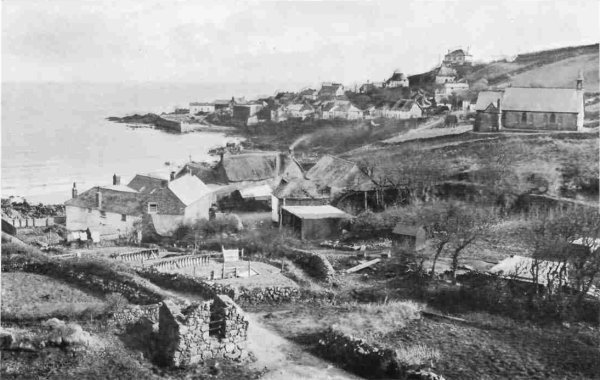
Immediately north of Land's End is the truly charming little Sennen Cove, with its church-town nearly a mile inland. Formerly its beach was haunted by pixies and mermaids; now, in the summer, it becomes quite fashionable with the presence of those who are lucky enough to get lodgings. There is quite a competition to obtain rooms at this quaint little fishing hamlet; those who love it best prefer it when it is left more completely to the gulls and the fisher-folk. Most of the fishing here is still done by the seine-net, and there is still "huing" from the cliffs to announce the arrival of the pilchards. Sennen can boast a new breakwater, and every scrap of harbourage is often badly needed. The church is dedicated to a saint who seems more real than some that we meet with in Cornwall. Senan or Senanus was an Irishman who came here some time in the sixth century. It is related of him that one day his mother was changing houses, and the youthful saint declined to help her; she was angry and poured some water over him. Even a saint may dislike house-moving or spring-cleaning. However, in this case the domestic articles very considerately moved of themselves. Another thing told of him is, that when being carried to burial he sat up on his bier and gave orders that his feast-day should be March the 8th, not the 1st. This foolish tale must have been invented later by some priest who wanted to change the festival. The church has a good tower built of massive granite blocks, and there is a fine granite cross in the new churchyard. Within, there is a curious mutilated alabaster figure, apparently a Virgin and Child, and there is an old mural painting. At the rock known as the Table Mên there is a tradition of a great battle between Arthur and some Danish invaders, and there is a conjecture of Danes having settled in this district. The wizard Merlin is said to have foretold another landing of Norsemen here, to precede the end of the world; perhaps he meant the Germans. In the past Sennen had a bad name for smuggling and piracy. Curving northward is the beautiful and partially sheltered Whitesand Bay, which has memories of some historic landings—Athelstan, Stephen, John, Perkin Warbeck; but the coast is very dangerous, and is rendered more so by off-lying rocks such as the Brisons. It is singular that Cornwall should begin and end with a Whitesand Bay. Inland rises the height of Chapel Carn Brea, which must be distinguished from the Carn Brea of Redruth; it reaches about 660 feet, but Bartinney, or Bartine, is still higher. Both are crowded with prehistoric remains, but Carn Brea is the more interesting in this respect, for its cairn, whose lower layer held the bones of some Stone Age chieftain, was crowned at the summit by a Christian oratory. It is a great pity that this chapel, probably one of the oldest religious structures in the kingdom, was not preserved. Above the Stone Age burial was a dolmen of the Bronze Age; and above this were layers that told of Romano-British civilisation. But the antiquities of this district really need a book to themselves. When we reach Cape Cornwall we are in the immediate neighbourhood of mining again, and the fine headland itself is crowned with an old mine-stack. Its formation gives Cape Cornwall the appearance of reaching even farther westward than Land's End, and the view from its summit is grandly impressive. This is the parish of St. Just-in-Penwith (so called to distinguish it from St. Just-in-Roseland). Mr. Hind thinks St. Just the dreariest town in Cornwall, and its best friends do not call it lovely; but there is a rather interesting Perpendicular church, with some earlier relics, and there is also a plân-an-guare, like the Planguary of Redruth—an old-world amphitheatre, first used for sports and later for miracle-plays. The name means "place of play." It is now used for religious and other meetings. The moorland country here is barren and windswept, with disfigurations from mining; and the dismal summit of Cam Kenidzhek is haunted with queer traditions. This is the "carn of the howling wind" or the "hooting cairn," covered with traces of the immemorial past and feared in old days as a special domain of evil spirits. About a mile westward is the old Botallack mine, perhaps the most famous in all Cornwall, which reached to the sea and considerably beyond; it was long closed, and the decayed buildings had quite a romantic appearance on the wild, bare cliffs, but the revival of Cornish minings has brought a new activity. The old workings run for about a third of a mile below the sea, and it is said that the pitmen were often terrified by the roar of the waves above their heads, dashing the loose boulders of rock. But the great Levant mine, a little over a mile northward, runs for about a mile beneath the sea, being worked for tin, copper, and arsenic. Once, not many years since, the sea actually broke into its workings. This is mining, indeed, in all its grimmest reality, and the arsenic-working in particular has a bad effect on the miners. But it earns dividends. Pages might be written about the old miners' superstitions, but even underground these things have died out; even the perils are now lessened by modern science. Yet at Wheal Owles, in 1892, eighteen men lost their lives through the flooding of the workings.
Just beyond Levant is Pendeen Village, with a new lighthouse on the coast. At Pendeen manor-house, now a farm, was born the eminent Cornish antiquary, Dr. Borlase, in 1695. For his age he was a tolerably enlightened archæologist, and his works on local antiquities have supplied the basis of much subsequent writing; but of course they present pitfalls for the unwary. He was Vicar of Ludgvan for fifty years. The curious fogou of Pendeen Vau was actually in the garden of his birthplace, so that he had an early stimulus to research. Pendeen has now its own church, which is of remarkable interest although quite recent. In plan and exterior it is modelled on Iona Cathedral, and was built by the Cornish missioner, Robert Aitken, who influenced his people so powerfully that the granite was both given and wrought free of cost. A castellated wall with a fine arched gateway surrounds the building, which proves that under the right impulse the people may still become church-builders—and will still attend church. Eastward of Pendeen is the church town of Morvah. This tract of coast from Land's End to St. Ives has perhaps been neglected by visitors and writers, only one spot, and that not the finest, Gurnard's Head, being really familiar. The stony barrenness of the inland country is compensated by a real grandeur of coast-line, invisible from the road and therefore often left unexplored. Morvah has traditions of mermaids, with some idea that its name may be a corruption of the Breton morverch; but we must probably seek some other derivation. Tonkin says the name simply means locus maritimus. Stories of mermaids are common enough, or rather were so, along this north shore, doubtless explained by the seals that were once frequent, and would be still if not shot off by the usual insensate "man with a gun." The small church is Perpendicular, with a pinnacled tower. In this parish is the magnificent Chûn or Chywoon castle, on a hill about 700 feet high. This western extremity of Cornwall was guarded by a line of hill forts, of which this Chûn, if not the most powerful, remains in best preservation. We cannot speak with decision as to the date of their earliest use, but this stronghold of Chûn was almost certainly utilised as late as the fifth or sixth centuries, and may have seen fighting during the days when Irish invaders, even if they came as travelling saints, were not always welcomed. The first and second vallum can be traced with their ditches, and there was doubtless an inner wall. The masonry is of different character from that cyclopean piling of boulders which was all the earlier men had known of building. Of such cyclopean style, though it is a small specimen, is the Chûn cromlech, standing near. In the near neighbourhood are the Mên Scryfa (the inscribed stone), the Mên-an-tol (the holed stone), the Nine Maidens, the Lanyon Quoit,[A] the huts of Bosporthennis, the Mulfra Quoit—all being monoliths, or other survivals of wonderful interest, with the strange fascination of their mystery. Cairns, barrows, sepulchral monuments, we can understand, for death and burial are ever with us; but what was the meaning of these circles and standing-stones—who built them, and for what purpose? They are interpreted astronomically now—the latest, perhaps the correct, theory. The earliest peoples who brought any culture to these shores came from the East, and we cannot tell what profundities of astrologic science they carried with them. It is generally acknowledged that when the rough Teutons came they encountered and checked a mental culture higher than their own. But we can only conjecture dimly, and leave the controversialists to wrangle.
On the moorland beyond Morvah rises the tor of Carn Galva, standing stern and solitary like a little patch of Dartmoor. On the coast is the grand sheer cliff of Bosigran, the western protection of Porthmeor Cove, with traces of prehistoric fortification; it is a noble bluff of granite, with a drop of 400 feet. Puffins nest in the crevices below. A little westward are the pinnacled rocks of Rosemergy, covered with lichens and in parts clad in ivy; the neighbouring turfy slopes are fragrant with heather and gorse. Little streams filter their way from the moorland to the coves, reaching the sea through hollows rich with ferns—there are still rare ferns to be found in the more inaccessible shelters. Just beyond is another Treryn Dinas, like that of the Logan near St. Levan; but this Treen is better known as the Gurnard's Head. It is a favourite show-place, winning perhaps more attention than it deserves in comparison with other places near it; but the rocky and turf-clad headland, with its traces of a far-distant past, is really very beautiful, reaching like a couchant beast into the waves that are sometimes of the purest blue, sometimes white with seething foam. There was an old chapel on the neck of the promontory, and near are remains of some rude granite huts. The popularity of the place has brought a modern hotel.
The cove of Porthglaze with its strange turret-like rocks, the coves of Pendour and Zennor—all these are beautiful, and cannot be seen from the road; the visitor must explore them by scrambling along the cliffs, crossing summits and gorges and gullies, not deterred by difficulties that to a careless or nervous climber might become dangers. Only so can this fine coast be fully known.
In its situation the village of Zennor is like some of the wild, stony parts of Ireland; but the cottages are too comfortable to be Irish. Close to it stretches the stone-strewn moorland. Everywhere we have proof of the abundance of stone, the scarcity of wood; hedges are of rough boulders and pebbles; stiles are the charming Cornish "gridirons"; there is a stream crossed by rugged little stone bridges. The church is of the thirteenth century, restored in 1890; of course there had been earlier restoration, for the tower is Perpendicular. The dedication is to St. Sinara or Senar, a virgin probably of Irish origin; but we know nothing about her, and little of the early building itself, except that in 1270 the Bishop of Exeter granted it to his college at Glassiney near Penryn, and the living seems to have been starved. Zennor, indeed, was formerly known as the place "where the cow ate the bell-rope," a sportive neighbourly reference to its poverty and infertility. But the most famous feature of the church is its carved mermaid. There are two good old bench-ends, now forming the sides of sedilia, and of these the mermaid is one, represented with comb, mirror, and fishy tail. The story tells that the men of Zennor were very fine singers in the old days, and one, a squire's son who sang in the choir, had so beautiful a voice that this mermaid came all the way up from the sea-beach to hear him, Sunday after Sunday. How she did it is not explained; but at last her importunity prevailed, and the youth went away with her. She had lured him to the
Where the winds are all asleep;
Where the spent lights quiver and gleam,
Where the salt weed sways in the stream."
The dial on the tower also bears the figure of a mermaid. There must have been some origin for such a legend; perhaps some youth was drowned off the coast, and it was imagined that a mermaid had beguiled him away. The same sea-lady appears to have been heard of later, for it is said that "a long time after, a vessel lying in Pendour Cove cast her anchor, and in some way barred the access to a mermaid's dwelling. She rose up from the sea and politely asked the captain to remove it. He landed at Zennor, and related his adventure, and those who heard it agreed that this must have been the lady who decoyed away the poor young man." But why poor? The connection may have been a happy one; the mermaid was evidently courteous in manners, though her representation on the Zennor bench-end is not exactly beautiful. Zennor Hill or Beacon rises to 750 feet in desolate grandeur, and on this high land, often haunted by foxes and badgers, is the great Zennor Quoit or cromlech, thought to be the finest in Britain. Its slab, 18 feet in length, has slipped from its rest. It is an immense titanic monument, whose story no one can tell us; yet in this district these things are common, and utterly disregarded by the countryfolk. They have forgotten even the tales of the giants who used to play "bob-buttons" with them. He who wanders among these undated relics and wild stony moorlands may easily go astray; the cairns and tors are very like each other, and paths are few. Sometimes also there are blinding mists or fierce winds heavy with rain; at other times a glamour of loveliness steals over the desolate wastes, sunsets wrap them in atmospheric glory, or dreamy noons brood over them with deep calm. Between Zennor and St. Ives is the parish of Towednack, where they tried to build a hedge around the cuckoo. It is just a symbol of our craving to keep the springtime ever with us; the hedge was not high enough, and the cuckoo flew out at the top. The name of the hamlet was formerly Towynnok, which evidently embodies a dedication to St. Winnoc—probably the same saint as we find at Landewednack. The low, sturdy little tower has no pinnacles; when the folk were building it the devil came each night and pulled them down. But this parish does not touch the sea at all. Off the coast are the rocks known as the Carracks, beyond which we pass Penynys and Hor Point, and so reach the "Island" of St. Ives.
CHAPTER XII
ST. IVES
Some years since, when the average man spoke of Cornwall he was thinking of St. Ives—and perhaps of Tintagel. These were the two places whose names had taken the public imagination, the one being typical of the Duchy's romance, the other of her everyday life. But in those days love of the picturesque had not quite overcome a dislike of fishy and other smells. Walter White frankly told his readers not to disenchant themselves by going into St. Ives; he recommended admiring it from a distance. The town's name was familiar in popular songs, and it was known as a prosperous fishing-port. Then the artists arrived, and—perhaps more important still—a much improved railway service. At the present day the reputation of St. Ives is assured, yet it is certainly less popular as a holiday resort than some other places in Cornwall; those who come here usually prefer the suburban district of Carbis Bay. Newquay has attained an easy supremacy in popularity; Bude is following in its wake; while South Cornwall has Looe and Fowey, the Lizard, Penzance, with numerous small coast-side hamlets for the delight of quieter guests. But St. Ives maintains its position as a typically Cornish town; its past is thoroughly interesting, and its records ample; it is a striking and in some respects fascinating link between the bygone and the present. Old St. Ives seems to derive entirely from the little headland known as The Island. It was just one of those places that the ancients loved to fortify, almost insular and easily defensible. The dry-stone defence known as the Two Edges was probably constructed by men of the Stone Age; it is certainly pre-Celtic. Other strongholds of the same date may be found at Gurnard's Head, at Trencrom, and at Bosigran, to name only a few. The Island may have been really insular when first fortified. There are remains of an old chapel of St. Nicholas on the point of the headland, and it is difficult to say whether this must be associated with the name of St. Ia; there is also an oratory of St. Leonard, known as "the Chapel," close to the stone pier. We may fairly conclude that both these are later than the cell of St. Ia, which was on the site of the present parish church. This saintly woman must on no account be connected with the dedications of the Cornish St. Ive (pronounced Eve) near Liskeard, or the St. Ives of Huntingdonshire. She appears to have reached Cornwall late in the fifth century, coming in the company of the Irish prince, Fingar, who renounced his kingdom in order to preach Christianity. Fingar is claimed as a convert of St. Patrick. St. Ia is said to have floated to the Island, anciently named Pendinas, on a miraculous leaf, by which is clearly meant a coracle of the kind still to be seen in parts of Wales. Her comrades went on to evangelise other parts of Cornwall, but she remained here, living in a beehive-hut of the style called "Picts' houses," and doing her best to soften the faith and manners of the rude inhabitants. It is said that she was martyred by a local king or chieftain, Tewdrig, or Theodoric. She resided here long enough to impress her name permanently on the locality, whose earliest Latin name that we can trace was Parochia Sancte Ye, while the Cornish name was Porthia. The existing church stands on the site of an oratory which was either her own foundation or was erected soon after her death by loving disciples. Till 1409 St. Ives, being only a small fishing hamlet, belonged ecclesiastically to Lelant; but at that date the people petitioned the Pope, through their lord of the manor, Champernowne, that they might have a separate church: "As it had pleased the Almighty God to increase the town inhabitants and to send down temporal blessings most plentifully among them, the people, to show their thankfulness for the same, did resolve to build a chapel in St. Ives, they having no house in the town wherein public prayers and Divine service was read, but were forced every Sunday and holy day to go to Lelant church, being three miles distant from St. Ives, to hear the same, and likewise to carry their children to Lelant to be baptized, their dead to be there buried, to go there to be married, and their women to be churched." In response to this appeal the Pope directed the Bishop of Exeter that the chapels both of St. Ives and Towednack should be made parochial, "with font and cemetery, but dependent on Lelant." The people set to work at once, bringing the necessary granite from Zennor by boat, roads being then quite unfit for transit of heavy burdens. Completed in 1426, the church consists of chancel, nave, and two aisles, with a tower 119 feet in height. The roofs are of decorated wagon-form, with figures of angels at the springings of the braces. The Trenwith aisle was added a little later. In the original church was an organ, very fine for those days; it was destroyed in 1648 by the Puritans. There are some very good bench-end carvings, not all in their original position, and there is a Trenwith brass with the figure of St. Michael ludicrously restored. Many other objects of interest may be noted, both within and without the church, including a fifteenth-century cross in the churchyard, thrown down by the Puritans and re-erected.
Historically, St. Ives has played no great part, but what may be called its domestic annals are singularly varied and full. The chief events that can be called historical are a landing of the French at Porthminster during the reign of Henry VI., and the anchoring of Perkin Warbeck in St. Ives Bay, in 1497, when he was proclaimed as Richard IV. St. Ives was also concerned in the Western Rebellion of 1549, when the Cornishmen rose on behalf of their ancient religion. There was a question of language also, as well as of faith, as we may see from the articles of complaint:—
"We will not receyue the new Servyce, because it is but lyke a Christmasse game, but we wyll have our olde Servyce of Mattens, masse, evensong and procession in Latten as it was before. And so we the Cornyshe men, whereof certen of us understa'de no Englysh, utterly refuse this newe Englysh.... We wyll have holy bread and holy water made every Sundaye; Palmes and ashes at the times accustomed; Images to be set up again in every church, and all other aunceint olde Ceremonyes used heretofore by our Mother the Holy Church. Item we wyll have everye preacher in his sermon and every Pryest at his masse, praye specially by name for the soules in purgatory as owre forefathers dyd."
This rising, which began in Devonshire, rapidly spread throughout Cornwall; it was, indeed, the fiercest and most serious of all the risings against an enforced Reformation. It ended in disaster; many Cornishmen were killed either in the field or by hanging afterwards; among whom was John Payne, mayor or portreeve of St. Ives. Of the religious aspect of the quarrel nothing need be said; but it is certain that the compulsory introduction of the English Bible and Prayer Book proved the death-blow of the Cornish language. It did not die at once, but it speedily began to languish, and two centuries later was practically extinct. During the Civil War St. Ives sided with the Parliament, and its church, therefore, does not contain the letter of thanks from King Charles that is so commonly seen in Cornish churches. The little town was always strong in local patriotism, and sturdily nursed its own interests as a fishing port; yet a study of its Borough Accounts proves that it could be generous at times, and these accounts are such delightful reading that a few extracts must be quoted. They begin with the year 1573; the quaintness of diction and the "indifferent spelling" add piquancy and remoteness to some of the entries.
Many of these have to do with expenses towards the keep of foundlings, burying of the dead by the parish, and other charities; thus, a very few years from the commencement, we have:—
"Pd. Eliz: Rodger to keepe a base childe founde by the p'rishe and for half of a pecke of blye, XVIIId.
"Pd. Alce caraway who releeveth certaine children of the parishe, VId.
"Pd. a poore man of Morestowe whose house was burnte and his wiefe distracted of her witts, XIId."
The charitable doings of these good St. Ives folk were evidently very numerous and very varied; but these entries are not all of almsgiving. Thus, in the same year as above, we have the following:—
"Easter Quarter. Impmis pd. for two dele boordes to make a newe seate to the vicar, IIId."
Also:—
"Item paid to the younge felow which is our clarke, IIs."
Many of the entries have to do with licensed beggars, or shipwrecked seamen, or the raising moneys for the deliverance of foreign captives; but the variety is endless and delightful. Thus, after reading of a shilling bestowed upon "a man of Irelande that had his barke stollen by pirats," we have the record of a similar sum paid "ffor a paire of breches ffor John the lasar." This John seems to have cost the parish sundry amounts for his breeches and jerkins; but in 1596 it would appear that St. Ives was quit of him, if it is he to whom the following refers:—
"Pd. to a cople of women that shrowded ye lazar John Nyclis: and ther breake faste yt tyme, VIs."
Immediately after this eightpence is given "to a pore lame sowldior hurted in the quenes servyce in yrland having a lisens." The town could make merry at times, as we find when sixpence was paid "for a pynte of Secke when our burgesse Mr. Harrys was chosen"—which is very moderate compared with Falstaff's payments for the same liquor. In 1626 we read that special harbour-dues were levied to pay for the repair of the "peere or Kay of St. Ives"; in which dues there were special charges for English vessels and somewhat higher for "Alients." The writer is of divided mind as to the spelling of pier, for he passes from "peere" to "peor." It is interesting to note that "All alients for roulinge on the sande te paye pr tonn IId."; which does not refer to any merry sport of rolling on the sands, as sometimes practised by exhilarated visitors, but to rolling of fish. It was doubtless a useful provision that "noe garbadge of ffishe or stinkinge ffishe should be cast above full sea marke att neape tide on the sande." What with the queer wordings and the defective punctuation, it is sometimes difficult to fathom the exact purport of entries. Thus, about the year 1629, we have mention of two shillings given "to a poore distressed scholler that came to our towne from Germanie the 27th of ffebruarie to seeke passadge home from Ireland." Query, where was the poor "scholler" going? In 1640 the famous silver wishing-cup was presented to the town by Sir Francis Basset, being about a foot in height; it was really drunk from in old corporation festivities, but the wine was latterly dipped from it in a ladle. It is inscribed as follows:—
Within the Borough of beloved Saint Ies,
It is desyred that this my cup of love
To every one a peacemaker may prove;
Then am I blest, to have given a legacie
So like my heart unto posteritie."
A little later we read of sixpence paid "to one that did whipp the mayde that would drowne herself"; from which it is clear that the town did not encourage suicide. Just below is, "Item, more to six distressed Bristoll men their vessell being taken att Sea, 4s. 6d." There are many such entries, of which St. Ives may well be proud.
But these accounts also bear record of less peaceful proceedings. Under the year 1681, after an entry of four shillings received from "ffower offendors for their breach of the Saboth," we have a chronicling of disturbance caused by St. Just men, and a fine on them "for their riotous assembling into the Borough." A little later is the item: "Pd constables to putt St. Just men to Lanceston, £6 9s. 6d."; also 5s. "paid Mr. Robinson to dress their wounds." It is pleasant to think that the St. Ives folk were such good Christians. In 1685 the borough paid some attention to the condition of its drum: "Pd Henry Anthony for new making the Towne drum 2s. 6d." Later, there is a payment to Henry Barber for beating the same. Immediately after there is much to-do about some sugar stolen by a man named Teage; sugar was a costly luxury in those days. One of the items is this: "Spent by Mr. Trentwith, Mr. Robinson, my self & Mr. May, at St. Earth, Gwynear, Camborne and other places to discover the Sugar stollen by Teage being out two dayes, £1 3s. 6d." It is amusing to notice how the writer's modesty held good until he had recorded the names of Trentwith and Robinson, after which it rebelled and insisted on taking precedence of Mr. May. This Teage business caused a deal of trouble, and many witnesses were carried to Launceston as evidence against him, at great expense; yet the borough did not scruple, shortly afterwards, to expend a shilling "for poynts to whip the boyes veiweinge the parish bounds," and another shilling for the drummer on that occasion. In 1681 there was trouble with the vicar who served the three parishes of St. Ives, Towednack, and Lelant, about the payment of tithes; the vicar seems to have been non-resident, and often attended to his pastoral duties at inconvenient times. In 1690 King William's victory at the Boyne cost the borough a pound in merry-making, to which we may add the following entry of 5s. 6d. "for a Tar Barrell and Syder." In the same year an itinerant beggar seems to have won alms from the authorities under a false ticket:—
"Given ffrancis Browne by consent who brought a Let pas by that name, but afterwards his name apeared to bee ffrancis Jackson 1s. 0d.
"Pd. the Cryer to whip him and for thongs 1s. 1d."
Under the year 1693 we are reminded of perils, now happily impossible, that then lurked around these shores. There is an entry of half-a-crown paid to William Thomas "for his labour to goe to ffalmouth to give an account that two ffrench privateers lay in our bay"; and a little later another half-crown was given "to ffower poore boyes that were taken by a ffrench privateer." The beginning of 1698 seems to have been especially devoted to charities; we have record of sums given to two distressed men and their children whose houses were burnt; to two poor Irishmen cast away at Zennor; to a poor traveller and his wife, a seaman who had lost his hand, a captain who had lost all his goods by wreck, and a poor disbanded soldier. Also, four shillings given to two "poore soldiers which came from Silly." It has generally been understood that Scillonians object to their name being spelt in this manner; yet we have a later entry of expense "examining the Silly Soldiers." One is tempted to quote much further from these alluring records, and they certainly assist us considerably in understanding the old-time ways of living, as we ramble about the tortuous byways, nooks and corners of St. Ives. In the letter the accounts are strictly local; in the spirit they may be taken as typical of almost any West Country town of that date, and they have the frequent touch of humanity that relieves bare figures from monotony.
In connection with the flourishing condition of Methodism at St. Ives, it is important to remember that John Wesley paid the town as many as twenty-seven visits, beginning in 1743 and ending in 1789. There was already a society of his followers here when he began his visits, but they were very unpopular with the majority of the townsfolk, who accused them of sympathy with the Pope and the Jacobites. Wesley's own reception was very mixed; he received some countenance and a good deal of mob violence. Not only the vicar and curate of St. Ives were against him, but he had a still more formidable opponent in Dr. Borlase, the antiquarian vicar of Ludgvan. When a parishioner tried to persuade Borlase that Wesley's preaching was doing good, he exclaimed, "Get along; you are a parcel of mad, crazy-headed fellows." Yet two years after his first visit Wesley was able to describe St. Ives as "the most still and honourable post (so are the times changed) which we have in Cornwall." But when he paid his fifth visit, in 1750, it is clear that opposition had not died out. He tells us that: "Having first sent to the mayor to inquire if it would be offensive to him, I preached in the evening not far from the market-place. There was a vast concourse of people, very few of the adult inhabitants of the town being wanting. I had gone through two-thirds of my discourse, to which the whole audience was deeply attentive, when Mr. S. sent his man to ride his horse to and fro through the midst of the congregation. Some of the chief men in the town bade me go on, and said no man should hinder me, but I judged it better to retire to the room." We may be sure it was no personal shrinking, but a regard for the public peace, that caused the preacher's decision. Twenty years later he wrote: "Here God has made all our enemies to be at peace with us, so that I might have preached in any part of the town. But I rather chose a meadow, where such as would might sit down, either on the grass or on the hedges—so the Cornish term their broad stone walls, which are usually covered with grass." Of his last visit he says that "well-nigh all the town attended, and with all possible seriousness. Surely forty years' labour has not been in vain here." The numberless meeting-houses and Bethels throughout Cornwall bear at least one form of testimony to the enduring fruits of that "forty years' labour."
There are other things besides Methodists at St. Ives; there are painters and pilchards. The colony of artists here is almost as famous as that of Newlyn, and there are at least sixty different studios. Pictures from St. Ives have won world-wide fame; in fact, artistically, Cornwall would have long since become stale were it not for its inexhaustible charm. The painters bring something of a Latin Quarter element with them, and are by no means limited to British in nationality. Mr. Stanhope Forbes says: "I remember finding in a house at St. Ives where I was calling, four painters of four different nationalities. In that town Zorn, the well-known Swedish artist, painted his first oil picture, which now hangs in the Luxembourg, and for it his palette was set by an equally celebrated American painter who at that time resided there."
The studios are specially thronged during the winter months, as the climate allows much open-air work; in the summer many of the painters fly to other hunting-fields, leaving Cornwall to the tourist. The Cornish have grown accustomed to the painters by this time, and cease to regard them with wondering curiosity; they are recognised as having distinct local uses. Many of the pictures now displayed in exhibitions bespeak a close intimacy between the painters and the fishermen. But the pilchards are of still more importance to the little huddled town where the fishers live; and these usually begin to arrive about August, when the huers have already taken up their position on the high places around, in order to signal the first sighting of the shoals. The huers are on watch from August till late October, and it is the method of taking by seine that renders their signalling of great importance. The exact position of the fish must be ascertained before the seine-nets are dropped to enclose them. The takes are sometimes enormous, but seasons greatly vary, as the fish are governed by laws of feeding whose operation we cannot easily trace. The average annual taking of pilchards in Cornwall is estimated at 20,000 hogsheads. Gulls in countless numbers hover above the fishing-boats, and swoop down for their share in the spoil; sometimes, however, scared away by the more powerful gannets, with whom they dare not dispute. At times the gulls are a distinct nuisance and something more to the fisherman; they will snatch fish from his very boat, and the constant loss must be very considerable; yet there is a superstitious idea that the gull is the fisherman's friend—an idea in which we might rejoice more if it led the men to be equally humane towards other living creatures. The same mercy is by no means shown to the gannet. But a more serious enemy of the men is the dogfish, who tear their nets; and the fishers are taking their revenge by trying to popularise this fish as an article of food, under the name of the "flake." Besides the prevalent fishing with seines, there is much drift-fishing from St. Ives, taking place at night; the boats being dotted about within and outside the bay, with their headlights showing like twinkling stars. The St. Ives men are not dependent on pilchards only, happily for them; in winter their seines take many mullet, which are mostly sent to Paris. The shore-seine used for these is comparatively small; it is coiled and passed round the school, and the two ends then drawn ashore. Here, as elsewhere, the men are usually parcelled into companies—a kind of limited share-company; they take turns in shooting the nets, and profits are shared. The control of affairs by husband and wife is a different sort of share-company; the wife is supreme mistress at home, but the man becomes "boss" as soon as he gets his sea-boots on. Many mackerel are often brought to St. Ives, and the men go still further afield after herring; but somehow the catch of the pilchard seems the most distinctively local feature, and the fish, once common much further east, is still an important actuality to all the Land's End fishing ports. The typical Cornishman has always been a fisher or a tin-miner; and both still flourish.
Picturesque and artistic St. Ives clusters narrowly about the harbour and on the neck of the Island; the more modern residences and lodging-houses stretch above Porthminster Beach, with a popular development at Carbis Bay. More inland suburbs are chiefly devoted to the mining that has suffered so many vicissitudes—flourishing, then decadent, and now flourishing again. One such centre is Halsetown, a mining settlement founded something less than a century ago by James Halse, of the old Cornwall Hals family; he was a solicitor and a mayor of St. Ives, intimately connected with the mines. But in this rather unattractive quarter we are less likely to think of Halse than we are of Sir Henry Irving, who spent his childhood here. The reputation of a great actor becomes very much a phantom affair after a few years; but as we still associate the name of Garrick with a brilliant period of the Georgian age, so the name of Irving must always be linked with the later brilliant period of the Victorian. To the younger generation of theatre-goers he is fast becoming like a half-mythical demigod—one of those whom the elder folk mention with regretful shakings of the head when newer favourites are lauded. The actor was not born in Cornwall, but in Somerset; his mother, however, was a Cornish woman named Behenna, and one of his aunts was Mrs. Penberthy, wife of Captain Isaac Penberthy, whose captaincy of course referred to his position as overseer of mines here at Halsetown. Hither Irving was brought in his fourth year, and his memories of Cornwall remained vivid to his dying day. "I recall Halsetown," he said, "as a village nestling between sloping hills, bare and desolate, disfigured by great heaps of slack from the mines, and with the Knill monument standing prominent as a landmark to the east. It was a wild and weird place, fascinating in its own peculiar beauty, and taking a more definite shape in my youthful imagination by reason of the fancies and legends of the people. The stories attaching to rock and well and hill were unending; every man and woman had folk-lore to tell us youngsters. We took to them naturally—they seem to fit in wisely with the solitudes, the expanses, the superstitious character of the Cornish people, and never clashed in our minds with the Scriptural teachings which were our daily portion at home. These legends and fairy stories have remained with me but vaguely—I was too young—but I remember the 'guise dancing,' when the villagers went about in masks, entering houses and frightening the children. We imitated this once, in breaking in on old Granny Dixon's sleep, fashioned out in horns and tails, and trying to frighten her into repentance for telling us stories of hell-fire and brimstone. The attempt was not too successful." Mrs. Penberthy was a Methodist and a teetotaler, of deeply religious instincts; yet the boy's life with his cousins was evidently free and uncramped. The uncle was strong, somewhat passionate, but lovable. If there was some sternness in the home atmosphere, there was also plenty of affection, and that is the most vital point. "Halsetown gave me a good physical start in life, at any rate," said the actor. "I attribute much of my endurance of fatigue, which is a necessary part of an actor's life, to the free and open and healthy years I lived at Halsetown, and to the simple food and regular routine ordered by my aunt. We rambled much over the desolate hills, or down to the rocks at the seashore. There was plenty of natural beauty to look for, and I suppose we looked for it. I know the sea had a potent attraction for me. I was a wiry youth, as I believe, when the time came for me to join a London school."
The Knill monument mentioned by Irving claims a little more attention. John Knill, born at Callington in 1733, after being articled to a Penzance solicitor, became collector of Customs at St. Ives, and in 1767 was chosen mayor. A few years later Government sent him to Jamaica to inspect the ports; he was private secretary to the Earl of Buckinghamshire, Lord-Lieutenant of Ireland; and in late life he became a practising solicitor at Gray's Inn, as well as magistrate for the county of Middlesex. He died in London, 1811. Long before this date he had erected his own mausoleum on Worvas Hill, near St. Ives, and to this his remains were brought. Among many legacies, his will directed that certain ceremonies should be observed once every five years, on the festival of St. James the Apostle; £10 to be spent "in a dinner for the mayor, collector of Customs, and clergyman, and two friends to be invited by each of them, making a party of nine persons, to dine at some tavern in the borough; £5 to be equally divided amongst ten girls, natives of the borough and daughters of seamen, fishermen or tinners, each of them not exceeding ten years of age, who shall, between ten and twelve o'clock of the forenoon of that day, dance for a quarter of an hour at least, on the ground adjoining the mausoleum, and after the dance sing the 100th Psalm of the old version, to the fine old tune to which the same was then sung in St. Ives Church; £1 to a fiddler who shall play to the girls while dancing and singing at the mausoleum, and also before them on their return home therefrom; £2 to two widows of seamen, fishermen or tinners of the borough, being sixty-four years old or upwards, who shall attend the dancing and singing of the girls, and walk before them immediately after the fiddler, and certify to the mayor, collector of Customs, and clergyman, that the ceremonies have been duly performed; £1 to be laid out in white ribbons for breast-knots for the girls and widows, and a cockade for the fiddler, to be worn by them respectively on that day and on the Sunday following." These observances have been duly performed, the last date being 1906, when many visitors attended to witness the proceedings.
A little eastward of Carbis Bay is Lelant, the mother-parish of St. Ives. Its full title is St. Uny Lelant, and the dedication is to the Irish Eoghain or Euinus, whom we find in Brittany as Uniac. There are other traces of him in Cornwall, as at Redruth and Sancreed; and it is probable that he arrived in Cornwall about the same time as St. Ia, but the fullest traditions of him relate to his Irish life. The word "Lelant" is explained as Lan-nans, the "valley-church"; in old books we still find the parish named as Lanant. The stronghold of Tewdrig, who murdered St. Ia and other saints, is supposed to have been on the coast here, its traces concealed by the sweeping sands that very nearly made an end of the village entirely, as they really did destroy its one-time harbour. A number of skeletons of prehistoric date were discovered when cutting for the railway to St. Ives, proving the early occupation of these coasts. Norden, writing more than three centuries since, says that Lelant was "sometyme a haven towne, but now of late decayed by reason of the sande which has choaked the harbour and buried much of the landes and houses; many devises they use to prevent the absorption of the churche." But the cultivation of the sand-rush, arundo arenaria, has done what the other "devises" failed to do; and the rushy towans have now provided an ideal golf-course, which prospers though the little town is somnolent. It is here that St. Ives visitors do most of their golfing, and the ground is described as "a natural seaside course, with charming views in all directions. The holes are rather short and tricky, and put a premium on local knowledge. Last, but not least, Lelant can boast a climate absolutely ideal for golf in winter." Lelant Church is interesting, but has lost its fine old bench-ends and screen. It is connected with the memory of a former vicar, Parson Polkinghorne, who was a renowned ghost-layer, a redoubtable fox-hunter, and a skilled hurler. His exorcising formula is said to have commenced with the words "in Nommy Dommy," and we are told it was in Latin throughout—as we may believe from this specimen. But the days of the exorcist are over now—there are no ghosts to lay, or only such as will not be laid.
There is a ferry at Lelant, taking the traveller across the Hayle creek to sandy Phillack, one of the mother-parishes of Hayle. This is the narrowest section of the Cornish peninsula, and from Hayle River to Mount's Bay is only about four miles across; a good road makes the journey from sea to sea. It is just a neck of land dividing north from south, and persons susceptible to climatic change say that the difference can be noticed when they get half-way across. Hayle, a little waterside town of less than two thousand inhabitants, is not particularly attractive. There is a charm in the endless sand-blown dunes that stretch on both sides of the estuary, but dismal weather can make them desolate, and wild weather converts them into a howling waste; while Hayle itself, with some small shipping and industry, is a place that the lover of beauty does not often care for. But it is not altogether to be despised, and it is conveniently situated on the main Great Western line. This Hayle district was once the great landing-place of saints from Ireland, who came here rather numerously about fifteen centuries since; those who came from Wales usually landed near Padstow or came to Cornwall by way of Devon. One such Irish saint was Gwythian, who built his oratory a few miles north of Hayle, and the remains of this rugged little church have lately been rescued from the sands, with a special service of commemoration held over it. The Irish saints brought their style of building with them, and such relics as those of St. Piran and St. Gwythian are exactly similar in style to the oldest memorials of the same nature in Ireland. The masonry was of the simplest—a mere laying of rough stones together without mortar. Some have supposed this oratory of St. Gwythian to be the earliest religious building surviving in Britain, but it is very difficult to say anything definite. If the little church really survived as the saint left it its claim would be a good one, but, like St. Piran's, it is more likely to be a century or two later. Visitors must not expect to learn much about the saints or about the monuments from the countryfolk, either here or anywhere else in Cornwall. With luck they may get a few quaint notions and superstitions out of the older people; but the younger folk are educated in a different manner now—universal school systems tend to uniformity and usually to a deadening of the imagination. For the legends and traditions of the country-side it is necessary to go to the guide-books, which are themselves often misleading. If a traveller were to go through Cornwall compiling a book that should contain solely what he saw and heard, it would be something quite different from the ordinary handbook, and those who only know the Duchy by reading about it would be chiefly struck by its omissions. The people, here as elsewhere, no longer care much for the traditions of their forefathers; and the delightful literary works that belong to topography are the result and the supply of a culture in which the ordinary men and women of the localities have small share. The visitor should carry the best literary guide he can procure with him, otherwise he is likely to learn little of the country's lore and its antiquities—unless now and then he applies to a clergyman or perhaps an intelligent schoolmaster. The days of oral tradition have passed for ever. We need not complain when we remember that written literature is a result of this decease.