
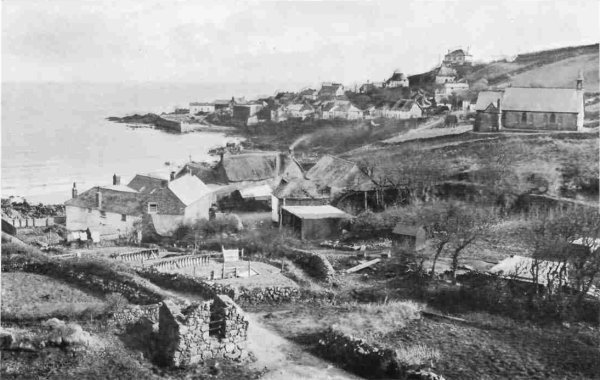
Penpoll Creek is reached by a delightful wild-flower lane leading from Crantock; it is the quickest way into Newquay. What may be called the main road goes inland, by Trevemper Bridge, a good four miles—sometimes to be chosen instead of taking the ford. The Gannel is only a small stream in itself, but here, at its sandy mouth, it broadens to a considerable width, and flows with rapid current. At Penpoll the road runs to meet the river on either side, and there is a narrow plank-bridge by which travellers can pass dryshod when the tide is low. But the banks of sand are very shallow, and are quickly flooded by the incoming water; this little bridge of planks is soon washed by the waves, and during some hours each day the Gannel cannot be forded. In broad daylight, when visitors from Newquay are passing and repassing, the spot may be cheerful enough; but at nightfall a dusky solemnity possesses it. There is the rumour of immemorial tradition in the air; it comes with the lap of the water and the low sob that breathes from the sands; it speaks in the cry of the birds as they wing their way restlessly from bank to bank. The countryfolk whisper that these birds are the souls of those who have been drowned at the ford—those who have dared to pass unwarily when the tide was pouring in with the force of the ocean behind it. The moment of safety had gone, but rather than drive many miles round to the bridge at Trevemper, they risked the passage, their horses became confused by the whirl of waters, and by the sands, that are always treacherous in a rising tide; the flow was too strong for swimming; the waves soon bubbled mockingly above the drowned heads of man and beast.
But there is another cry that suddenly resounds through the stillness, a long-drawn, mysterious utterance, passing drearily, difficult to locate, more difficult to name—one of those sounds by which Nature at times reaches to the dark places of our spirit and terrifies us with vague dread of the unknown. Is it the wail of an owl or other bird of the night? It pervades the air wildly and lingeringly. Those who come late to the ford and hear this sudden strange call draw rein and turn backward; it is better to drive the weary distance to the bridge than to brave a crossing when this warning is abroad. Those who are familiar with this country-side, with its dim lingerings of Celtic tradition, its strange borderland of myth and reality, know the meaning of the cry in their hearts, though, perhaps, they decline to give mention to it with their lips. They have been told in their childhood of a man who once lived in these parts, whose life was stained by many black deeds, and lightened by a single good one. He had been a smuggler, a wrecker, a pirate; his hand was red with blood, his soul dark with the soil of crime. One night a cottager lay dying, and was praying that a priest might be fetched to his bedside. Moved by a rare impulse of pity, the man of many sins set forth to cross the Gannel and to bring the priest from a religious house beyond. But the time for fording had passed; the river was running swiftly, and waves were leaping hungrily about the usual track of passage. Yet it meant a long delay to go round by the bridge, and the occasion was pressing. Merging all his virtue into one brave deed, the man plunged into the boiling torrent, and never reached the other side. In consideration of this last action the doom that would otherwise have been his was mitigated into a nobler penance. He is permitted to haunt the shores, and by his cries to warn passengers when the ford has become perilous. So does he save others and work out his own salvation.
Immediately beyond the Warren, with its old-world tumuli, is Fistral Bay, the eastern point of which is Towan Head, giving Newquay its finest promenade. Here, just beyond the golf-links, are two of the largest hotels, and beyond these is the lifeboat-house, with its slip for launching. Beneath are caverns and natural tunnels once devoted to smuggling; while a memorial of old Newquay's other industry exists in the quaint Huer's House, on the eastern point of the headland. It was from this look-out that the hue-and-cry was raised when the shoals of pilchards were sighted; a man being on watch here, to give signal to the fishing-boats. But the pilchards do not come so far eastward now; the house remains to remind Newquay, now in the day of its pride and fashion, that it was a humble lowly fishing village. Carew, three centuries since, spoke of "newe Kaye, a place in the north coast of Pydar Hundred, so called because in former times the neighbours attempted to supplie the defect of nature by art, in making there a kay for the rode of shipping."
There is usually some amount of charm about a harbour; but neither the harbour nor even the sea is visible from the streets of Newquay, except in rare glimpses. Modern Newquay seems to have striven to render itself uninteresting; Mr. Hind says that it is the ugliest though the most popular coast-town in Cornwall. Of course, this only applies to the town, not to its situation, its fine cliffs and broad sands; Newquay townsfolk might with a little foresight have made their leading street into a most attractive promenade by leaving one side open towards the sea. As it is, the streets are resorted to for shopping and business purposes, and for nothing else; they have nothing else to offer. Commonplace on this plateau above the cliffs, the coast becomes glorious below, eaten out as it is into grand caves and hollows, with alluring stretches of weeded beach and firm shell-sand. Fistral Beach and the bracing headlands have their own special charm; but the popular beach at Newquay is that which reaches towards St. Columb and Trevalgue Head. Visitors find particular delight in the Island, a mass of rock that is really insular at high water, and the numerous caves are a constant temptation to young and old explorers. There are barrows also above the Crigga Rocks, linking modern Newquay with a far-forgotten past; and at St. Columb Porth, generally called Porth for short, are traces of submerged forest. Trevalgue Head is practically an island, joined to the mainland by a narrow bridge; and in tempestuous weather this is a grand spot for noting the force and sublimity of Cornish seas. The Banqueting Hall and Cathedral Cavern are especially fine caves here. Of course, care must always be taken to watch the tides, or trouble may be expected. About a mile inland from the Porth is the village of St. Columb Minor, the mother-parish of Newquay; farther inland still is St. Columb Major, and both churches appear to be dedicated to a maiden Columba, who suffered martyrdom in Gaul. We must not think of the great Irish Columba here. The district has long been a chief centre of Cornwall's popular game of hurling, which still enjoys an annual revival, sometimes in the village itself, sometimes on the sands reaching towards Newquay. The ball used on these occasions is a little smaller than a cricket-ball, and has a coating of silver; it is inscribed with the verse—
Do your best;
In one of your parishes
I must rest."
The sides are not now confined to the parishes, but usually consist of "Married versus Single," or "Townsmen versus Countrymen." The ball is thrown up and hurled from hand to hand, no kicking being allowed; and the game is won by him who reaches the opponents' goal with it. From Carew's account of the game as formerly played, we may judge that a very extensive ground was used; he speaks of the players as taking "their way over hills, dales, hedges, ditches—yea, and thorou bushes, briers, mires, plashes, and rivers whatsoever—so as you shall sometimes see twenty or thirty lie tugging together in the water, scrambling and scratching for the ball. A play verily both rude and rough." A writer of half a century since gives this description: "A ball about the size of a cricket-ball, formed of cork or light wood and covered with silver, was hurled into the air, midway between the goals. Both parties immediately rushed towards it, each striving to seize and carry it to his own goal. In this contest, when any individual having possession of the ball found himself overpowered or outrun by his opponents, he hurled it to one of his own side, if near enough, or if not into some pool, ditch, furze, brake, garden, house, or other place of concealment, to prevent his adversaries getting hold of it before his own company could arrive." It is clear that hurling somewhat resembled football as anciently played in England and Scotland between parish and parish. In old times the ball was provided by the corporations of the different localities; we read in the St. Ives parish accounts for the year 1639: "Item for a Silver Bole that was brought to towne, 6s. 6d." On such balls was often inscribed the Cornish motto, Guare teag yu guare wheag—"Fair play is good play." A curious method of forming sides, in the past, was to set all the Toms, Williams, and Johns on one side, while their neighbours of other Christian names were ranged against them; from whence came the rhyme—
Take off all on the sands."
But even St. Ives seems now to have abandoned the old sport, and it is limited to these parishes of St. Columb. Cornwall now devotes itself, and very successfully, to our customary football.
The two Columb churches are both interesting, that of St. Columb Minor having the second highest tower in Cornwall. Porth Island is really a portion of the Glendorgal estate, the home of the late Sir Richard Tangye, who did so much for the preservation of local antiquities. Just beyond is Flory Island (Flory being clearly a corruption of Phillory), sometimes known as Black Humphrey's Isle; Black Humphrey was one of the pirate-smugglers whose tales are common around this coast.
Beyond the northern end of Watergate Bay we come to Mawgan Porth, and a mile beyond this are the famous Bedruthan Steps. Both places, but especially the Steps, afford a very favourite excursion from Newquay, seven miles distant; and whether the journey is performed on foot, or by cycle, motor-car or carriage, it is full of interest and beauty. It is best to come during the ebb of a spring tide, when the coves and caves may safely be explored; at other times there is grave peril. The caverns at Mawgan Porth are remarkably fine, and the grandly wild stretch of beach can hardly be spoken of with too great enthusiasm. The coast is as pitiless as it is beautiful, and many relics of wreckage are often washed ashore; after heavy storms the crags and caves are still searched for jetsam. It may be noted that those who do not wish to examine the caves, but who desire to see massive waves breaking on a magnificent coast-line, should come when the tide is nearing the full after prolonged westerly winds; they will see something that is even grander than high-arched dusky caverns and glimmering rock-tunnels. The beach at Bedruthan has nothing specially to distinguish it from those at Newquay and Porth, with the exception of the isolated masses of rock and boulder that in some sense cause it to resemble Kynance. Several of these have been given fanciful names—such names being always dear to the average tourist; one of these is the striking Queen Bess rock, and another is the Good Samaritan. This last is so named, not very aptly, because it proved the destruction of an East Indiaman, the Good Samaritan, many years since; but as it is an ill wind that blows no one any good, so it is certain that the wreck of this richly-cargoed vessel provided the womanfolk of the district with fine silks and satins for many years after. We can thus understand the point of the local saying, "It is time for a Good Samaritan to come." The coast-people's attitude towards wrecks has never been one of ingratitude—except when Preventive officers proved too wary. Diggory Island, a little to the north, has two natural arches, making a fine spectacle at floodtide.
Perhaps it is partly by reason of its contrast with the wild, stark coast that the far-famed Vale of Lanherne has won its reputation. It is a spot that has excited the enthusiasm of painters, versifiers, and guide-books; yet probably its chief charm is the surprise of its sylvan and pastoral character in a tract of country that is not notable for either. Counties farther east can show hundreds of such scenes; but the quiet rusticity and woodland features here come with a special touch of soothing and repose after the long, bare moorlands, sandy dunes, and stern, naked cliffs. There is also another attraction—the convent of Lanherne, once the manor-house of the Arundells. Mr. Baring-Gould says that "Lanherne lies in the loveliest vale in Cornwall"; Mr. Hind says, "the Vale of Lanherne did not rouse my enthusiasm." Most visitors agree with the Rector of Lew Trenchard. The mansion, now the convent, came into possession of the "great Arundells" in 1231 by marriage with a daughter of John de Lanherne. It was in the reign of Henry VII. that a later Arundell purchased Wardour Castle, in Wiltshire, and gifted it to his son Sir Thomas, who was married to a sister of Catherine Howard; and it is at Wardour that the family of Arundell still flourishes. The family remained Catholic through the Reformation, and the sanctuary lamp in Lanherne Chapel was never extinguished; so that English Catholics have a very special regard for this spot, where the light of their faith still burns brightly after so many centuries. The front of the old house dates from 1580; but many buildings have been added of late years for the accommodation of the nuns, whose seclusion is very strict. It came into possession of the Carmelites in 1794, when a party of nuns, driven from France by the Revolution, came to England, having in vain tried to find safety at Antwerp. They were given this mansion by Henry, eighth Lord Arundell of Wardour.
Here they have been ever since, the settlement having been much enriched and enlarged more recently. Their presence has drawn other Catholics to the spot, so that the district is quite mediæval in its spiritual atmosphere; besides which many visitors not of the faith come hither to worship in the beautiful chapel, and to try to obtain glimpses of the fair recluses. Having once taken the veil, these nuns never again leave the precincts. They attend the services in a gallery concealed by a grating; they take exercise in a high-walled garden; when they die they are buried in the convent cemetery. There cannot fail to be a touch of sadness in thinking of these ladies thus secluded from the "stir of existence," severed from the interests of their brothers and sisters, not even having the fair country-side and grand coast as a feast for their eyes, their lives spent in ceaseless prayer and liturgy. It is strange that such things should be, and we can only imagine the haven to be welcome to those who, in their declining years, crave perfect peace and retirement after the stress of uttermost sorrow or restless buffetings. There are paintings of Vandyke and Rubens in the chapel. Outside the door is an old cross, brought from Gwinear, which is supposed to be Anglo-Saxon; its inscriptions have never been deciphered. They are thought to be in both Saxon and Latin. There is a secret chamber in the older part of the convent, dating from those Elizabethan days when priests lurked about the Cornish country-side, nourishing their faith in the villagers, who were very slow to welcome the Reformation, and always seeking if possible to stir a rising against the new order. It is said that a priest was once successfully concealed here for eighteen months.
Many stirring things are told of the Arundells, who were dauntless Royalists. One is the siege of Wardour Castle in 1643, when it was heroically defended by Blanche, wife of Lord Arundell, who was with the King at Oxford. This lady, with a garrison of fifty, so stoutly resisted the Parliamentary attack that most honourable terms of capitulation were granted; but these terms were not kept. It was another Arundell, then a very old man, who defended Pendennis. The family had another house at Trerice, about three miles south-east of Newquay; and at the Restoration, when their confiscations were removed, the title of Lord Arundell of Trerice, now extinct, was created. Carew has some curious remarks about them. He says: "Their name is derived from Hirondelle, in French, a swallow, and out of France at the Conquest they came, and six swallows they gave in arms. The country people entitled them the Great Arundells; and greatest stroke, for love, living, and respect, in the country heretofore they bear. Their house of Lanhearn standeth in the parish called Mawgan. It is appurtenanced with a large scope of land which was employed in frank hospitality."
The next attraction at Mawgan is its church. Perpendicular in style but dating from the thirteenth century, its pinnacled tower is surrounded by beautiful Cornish elms, and close to the graveyard runs a prattling brook. The restoration by Butterfield was not all that might be desired, but it happily spared the carved bench-ends, the fine pulpit and the screen. There are also some good brasses and memorials of the Arundells. In the churchyard is a remarkable lantern-cross—not Celtic but mediæval; it is described by Blight as "the most elaborate of the kind in Cornwall. What is intended to be represented by this carving is not very evident; an angel seated on a block in a corner holds a serpent turning round a pillar, and with its head touching the face of a king. By the king's side is the figure of a queen kneeling before a lectern." There is also in the graveyard a curious monument, the stern of a boat, bearing the record of ten seamen who drifted ashore in their little vessel, frozen to death, at Beacon Cove in 1846. Before leaving Mawgan most visitors will take a ramble through the beautiful Carnanton woods, while some may remember that Carnanton was the residence of William Noye, Attorney-General to Charles I., who as member for St. Ives had signalised himself as a champion of parliamentary rights. Ministerial rank worked a wonderful change; so much so that Noye was actually the originator of the ship-money tax which played so large a share in embroiling the nation. Hals goes so far as to say that Noye "was blow-coal, incendiary, and stirrer-up of the Civil War"; and it was he who prosecuted the arrested members of the House of Commons. He had the reputation of a miser, so that, when he died, it was stated that his heart had shrivelled into the shape of a leather purse. It is rather a pitiful memory to attach to so delightful a district.
CHAPTER XV
THE PADSTOW DISTRICT
When we turn from the Mawgan district to make our way towards the Padstow estuary the grand, broken coast goes with us, ever presenting new aspects of varying beauty—coves of golden sand succeeded by gaunt, caverned headlands, with here and there a craggy islet lying among the tumbling breakers. The great plateau of the Bodmin Moors here touches the coast, bringing its profusion of prehistoric remains—though in that matter there is little of Cornwall that is not plentifully endowed. Immediately above Bedruthan there is one cliff-castle, and on Park Head, a little beyond, are the burial tumuli of some unknown people. We are now in the parish of St. Eval, whose church stands on high ground about two miles inland. It is said that Bristol merchants, in the eighteenth century, found this church so useful a landmark for their vessels that they rebuilt it at their own cost. Eval is a saint not easy to identify; there is an inscribed stone in Pembrokeshire giving the name Evali fili Dencui, so that he may have been a missionary from South Wales. North of Park Head are the Butter Coves, and the coves of Porthmear and Portcothan. They are magnificent in times of rough weather. In a quiet way Porthcothan is beginning to attract visitors, but the place is not very accessible, and has little but its loveliness to recommend it. There is, however, a remarkable fogou, or subterranean cavern, about 38 feet long and 6 feet in height, with a passage leading into another similar chamber. Fogou is the Cornish word for cave (sometimes corrupted into Hugo); but it usually signifies a cavern or passage of artificial construction, built at an early date for the concealment of persons or of property. There are good specimens at Cairn Uny, at Trelowarren, and at Trewoofe near Lamorna. In most of these passages only a few yards can now be traversed, as they have fallen into disuse, and unless repaired frequently the sides and roofs have a tendency to fall in. Sometimes they obviously connect with old hill-castles and strongholds, in which case their construction takes us beyond the reach of history; and generally their formation was assisted or suggested by nature. But their comparatively recent use by smugglers for the concealment of run goods makes it particularly difficult to speak with certainty as to their true antiquity; and the coves around Porthcothan saw the landing of many an illicit cargo. Stories of fugitive Royalists taking refuge in these fogous are common, and have doubtless a basis of fact. It is supposed that the entire length of the Porthcothan fogou must have been over 1,000 yards, one gallery leading to Trevethan, whence another communicated with the beach at Porthmear.
Passing other jagged points and creeks, we come to Constantine Bay, where the ordinary visitor may pardonably suppose he is on the steps of a Roman emperor, but the Constantine here recorded was a genuine Cornish saint. Perhaps his name was Cystennyn, Latinised after, as was a common custom. He was of the Cornish royal family, being son of Cador; and Geoffrey of Monmouth tells us, fabulously, that he succeeded Arthur as King of the British. He is chiefly remembered in literature by the abuse that Gildas heaped upon him, in those letters, written about 546, that are notable for imperfect accuracy, fervent religion, and virulent bad temper. Gildas calls Constantine the "tyrannical whelp of the unclean lioness of Damnonia"; and further asks, "Why standest thou astonished, O thou butcher of thine own soul? Why dost thou wilfully kindle against thyself the eternal fires of hell?" It is quite likely that Constantine had done some bad things and been no better than his neighbours; but it is supposed that he was converted in his old age, through the preaching of St. Petrock, whom we shall meet more intimately at Padstow. It is said that Constantine was hunting, and the stag that he was pursuing took refuge in Petrock's cell; the animal's recognition of the saint's holiness and appeal to his protection so touched his heart as to lead to a change of life. Another story refers his conversion to grief at the death of his wife. Mr. Baring-Gould tells us that: "So completely did he sever himself from the world, that it was supposed by some that he had been murdered by Conan, his successor. He retired to a cell on the sands in the parish of St. Merryn, near Padstow, where there was a well, and where he could be near Petrock, through whom he had been brought to the knowledge of himself." It is probable that he journeyed later to the creek of the Helford River, in South Cornwall, and founded the Constantine that we find there. It is doubtless on the site of his original cell that the old church of St. Constantine stands, overwhelmed and ruined by sand-storms long since, buried utterly for a time like that of St. Piran, and now again visible, a few broken and rugged walls among the towans. The sand that destroyed the church destroyed also the village, and the parish was merged in that of St. Merryn, whither the beautiful font was conveyed. This font and other portions of St. Merryn Church are of the well-known Cataclew stone, from the Cataclew quarries by Trevose Head. This stone was formerly put to very effective use in church-building, and it is pleasant to know that it has again come into popularity.
But the fact that has given greatest distinction to this spot, and that which does more than anything else to draw visitors, is the discovery, about ten years since, of a prehistoric burial-ground at Harlyn Bay. The Athenæum of that date announced to its readers that "a discovery of the highest importance to the study of the prehistoric races inhabiting England before the first Roman invasion has recently been made in a remote corner of Cornwall. On a sloping sandy hillside overlooking the picturesque white sand-bay of Harlyn excavations were being made by Mr. Reddie Mallett for sinking a well preparatory to building a house overlooking the sea. The spot selected for boring turned out to be exactly in the centre, not of a tumulus containing but two or three interments, but of a perfect cemetery, with three distinct layers of burials of men, women, and children. The drift sand that is so extensive in this part of Cornwall rose some 8 to 10 feet above the graves, but when the original hardly compressed sand was reached, the great slates with which the kists were carefully formed were often not more than 2 feet below this surface." Dr. Beddoe pronounced the remains to be neolithic, and the persons here interred were of a dolichocephalic or long-skulled race—sometimes known as the long barrow-builders, who generally buried their dead without cremation. There were some tiny kists for children, but a great number of the bodies had been buried uncoffined. The district had afforded earlier similar traces of pre-Roman interment, but nothing on so large a scale as this. Although a great deal of excavation has gone on since, and there is a small museum erected close by to contain the more striking finds, much more may yet be done and other secrets be revealed. It is not quite certain yet where the persons lived whose bones have thus been uncovered to the gaze of a late generation of sight-seers, but it is supposed that their habitations must have been near this site. They were, of course, in a higher state of civilisation than mere cave-dwellers, but their huts may have been of perishable wattle, or they may have come from some of the hut-circles of the Bodmin Moors. The remains, like those around St. Piran's, bespeak a somewhat dense population. As Harlyn Bay has become popular for picnic parties from Padstow and elsewhere, this old necropolis often resounds with laughter and merry-making; but in winter and in rough weather it is left to its own solemnity. A spirit of awe broods above it; we remember the words of Ezekiel: "The hand of the Lord was upon me, and carried me out in the Spirit of the Lord, and set me down in the midst of the valley which was full of bones."
Meeting the ocean westward of Harlyn is Trevose Head, with its lighthouse and coastguard station. The headland rises to nearly 250 feet, and its light is sorely needed, the coast, with its outlying masses of crag, being a deadly peril to navigation. The views to be obtained here are of exceptional grandeur, and the lighthouse-keepers, though far less lonely than on many similar stations, generally welcome a visit.
Padstow is situated on the western side of the Camel estuary, below the sandbank known as the Doom Bar (probably dune-bar). The gates of the river-mouth are the Stepper Point, with its white day-mark, and Pentire Point; the Doom Bar lies well within these, almost blocking the passage, which, with vessels of any draught, must be made on the Stepper side. The name Doom Bar is, of course, provocative of legend, and an appropriate one has been found. It is said that Padstow had once a safe and commodious harbour, whose mouth was haunted by a beautiful mermaid. The harbour was under her special protection, and she was consequently revered by the inhabitants. But one day a youth foolishly fired on her from the cliffs. With a cry of rage she plunged into the water, but reappeared for a moment to vow that henceforth the harbour should be ruined. An old Cornishman who told the story in the days when such traditions still passed current, used to add: "We have had commissions and I know not what about converting this place into a harbour of refuge. A harbour of refuge would be a great blessing, but not all the Government commissions in the world could keep the sand out, or make the harbour deep enough to swim a frigate, unless the parsons can find out the way to take up the merry-maid's curse." But there is another tradition attaching to the Bar. This is the country of Tregeagle—he lies buried at St. Breock, close to Wadebridge: "John Tregeagle, of Trevorder, Esqr., 1679." His story forms a curious mixture of the recent and the prehistoric. We see that a man named Tregeagle truly lived and died something more than two centuries ago; but the Tregeagle or Tergagle of legend belongs to folk-lore rather than to modern social life. Very old ideas and superstitions have in some manner become attached to a recent name; tradition has a knack of bringing forward its dates; stories of immemorial antiquity are related as though they were the experience of the narrator's father or grandfather, and are modernised to suit that supposition. Legend never sticks at absurdity or anachronism. From some versions of the story it would appear that Tregeagle could not have lived earlier than the seventeenth century, in actual accordance with the date on his tombstone; but in others certain of the early Cornish saints are introduced, carrying the history twelve centuries back or further still. It would seem that Tregeagle was a landowner in the neighbourhood of Bodmin, holding the Trevorder estate; but he won his chief notoriety as steward on the lands of the Robartes family, at Lanhydrock. There is still a room in the Lanhydrock mansion known as Tregeagle's. The man doubtless did many things of which morality cannot approve, but tradition has overdone itself in attributing to him every possible crime, including the murder of his wife, his children, and his sister. He was an unjust steward, grinding the tenants unmercifully, and enriching himself not only at their expense but at that of his employer. But he contrived to purchase the goodwill of the Church, and at his death it was only seemly that the clergy should do what they could for him. When the spirits of darkness came to claim the soul of the dying wretch they were successfully repelled by the priests with the powers of bell, book, and candle. The Church wrangled with the fiends above the breathless body, defeated them in heated theological controversy, dismissed them with contumely, and laid Tregeagle to rest with his fathers at St. Breock. He was not destined to repose there long. There was a heritage of trouble in connection with the Lanhydrock estate, and the defendant in one particular case sorely needed the witness of Tregeagle himself, to settle a disputed point. By some means he managed to procure it; the clergy provided a safe-conduct, and the figure of the dead Tregeagle was led into the witness-box. A thrill of horror passed through the court, but this spectral witness gave evidence faithfully, and gained a triumphant verdict for defendant. The trouble now was what to do with Tregeagle. The fiends were still waiting for him; defendant who had summoned him took no further interest in the matter; but the clergy felt that they still owed him a duty. They knew that the dead man's chance at the Day of Doom was not a good one, but in the meantime they would do what they could. It was decided to give him a perpetual penance, which might keep the evil spirits at a distance. He was led away to the shores of Dosmare Pool, on the desolate Bodmin Moors, and there set to drain the pool with a leaky limpet-shell. In those days Dosmare was supposed to be bottomless—a reputation which it has since destroyed by drying in hot summers. For long years Tregeagle toiled at his hopeless task. If he ceased from his labour for a moment he would be at the mercy of the devils.
One night, after many years of fruitless toil, there came a terrific storm, with thunder and earthquake. In sheer horror and despair Tregeagle fled. Immediately the demons were on his track, chasing him so closely that he could not stay to dip his limpet-shell in the foaming water. Feeling that they were upon him, he rose with a cry of anguish, and fled across the pool, thus gaining a temporary advantage, for spirits of evil cannot cross water. He made for the hermitage on Roche Rock, the yelling pursuers at his heels. Just as they were about to seize him he thrust his head within the small window of the hermit's chapel, and thus was safe. There was still a difficulty about his position. He could not get further into the church, nor does it appear that the hermit desired it; and he could not withdraw his head lest the fiends should seize him. He had to stay and listen to the good man's prayers and liturgies, which only added to the terrors of his guilty conscience, so that his remorseful screams were heard above all the psalms and prayings. The hermit found it a great affliction, for the population of the district was kept away by the unpleasantness of Tregeagle's presence. At last two other clergy came to his assistance, and Tregeagle was led away to the coast at Padstow. His new task was to make ropes of sand—one of the familiar penances of such traditions. He could not do it; it was worse than draining Dosmare. Night and day he rendered the place hideous with his frantic cries, and the Padstow folk did not like it at all. It was making the neighbourhood unbearable. At their earnest request another effort was made by the priests to dispose of poor Tregeagle. He was ruining the harbour by his attempts to make the ropes of sand; every rising sea scattered these ropes, however carefully formed, and the sand was accumulating in a bar of Doom. It is said that St. Petrock himself, the spiritual founder of Padstow, forged a chain of which every link was a prayer, and thus led away the unhappy ghost to Helston. In the estuary of the Hel River he spoiled the harbourage also, for a devil tripped him one day, when toiling across with a sack of sand, and the sand was spilt right across the mouth of the river. At last he was cast out from Helston also, and dismissed to Land's End, where he remains labouring to this day, endeavouring to sweep the sands from Porthcurno Cove into Nanjisal. Of course, it cannot be done; the full force of the Atlantic drives around Land's End, and the sands are driven backward again and again. But he is safe from the immediate attack of the fiends, and he is out of the way of the countryfolk. His cries are lost in the crash of the seas that dominate that desolate shore, and the fishermen have given up thinking about Tregeagle. The legends vary in telling his doom; some make the draining of Dosmare his last penance and some this task at the Land's End. But if an imaginative reason is desired to account for the formation of the Padstow Doom Bar, surely this tale will do as well as any other.
It will be seen that this chronicle of Tregeagle carries him back to the time of Petrock, the patron saint of Padstow, whose name is a corruption of Petrock's-stow. Little Petherick, sometimes called St. Petrock Minor, is thought to be a corruption of the same name. Petrock was a Celtic saint, probably a Welshman, who went to Ireland for his religious education; he crossed to Cornwall in a coracle, and landed in this estuary of the Camel. He founded an oratory here, and probably another at Little Petherick. It is also suggested that he established another cell at Place, the seat of the Prideaux, but it seems more likely that the chapel at Place was founded by St. Samson. After spending many years at Padstow the saint is said to have voyaged to the East, visiting India, and also going on a visionary journey to some Island of the Blest, after the manner of St. Brendan. After returning to Cornwall he removed to Bodmin and established the most important of his religious foundations. Like Padstow, Bodmin was formerly named Petrockstow, and this has caused endless confusion to the chroniclers as well as some quarrels between the two towns. Further, the saint evidently went into Devon; we trace his footsteps at Dartmouth, Exeter, Hollacombe, Anstey, and elsewhere. Bodmin can boast precedence of Padstow in certain respects, for it attained episcopal consequence, besides being the county town of Cornwall; but with regard to priority in connection with Petrock, it is clear Padstow has the first claim. At one time Padstow appears to have been called Lodenek or Lodernek, but in the thirteenth century it was certainly known as Aldestowe; in fact, the town has been troubled with a multiplicity of names, which is always a regrettable thing, for a person or a place. The town is about two miles within the estuary, and were it not for the sands that block its entrance, this would be truly a fine harbour; even so, it is the best that North Cornwall possesses. Two vessels sailed from here for the siege of Calais; and in the sixteenth century some sort of corporation was granted, but this seems to have been lost. At the present day it is a picturesque, quaint old town, in a beautiful and most interesting site, dominated by a weather-beaten old church. But Mr. Hind, though he finds much to admire, does not regard Padstow as in any sense typically Cornish. He says: "An air-voyager dropped from a flying-machine upon the roof of a Padstow house would never think that he was in Cornwall. If he walked out to Stepper Point, or strode some miles westward to Trevose Head, the first land sighted in old days by Canadian timber vessels trading to Padstow, the majestic sweep of coast, the jagged headlands and scattered rocks would certainly suggest Cornwall; but the estuary of the Camel from Wadebridge to Padstow, although beautiful, has no claim to the epithet wild. The panorama induces reflection, moves one to a mood of gentle melancholy; but it does not stimulate. Nowhere in Cornwall have I seen such sand—gold, grey and yellow, equally lovely at all tides. Looking across the river, the eye is soothed by these wastes of blown sand stretching inland from the sea to where the little hamlet called Rock rises from the shore." Sundries are imported at the docks, and there is some shipment of corn; but the ship-building, once notable, has greatly declined, and the town now does little but repairing. It is satisfactory to find that the sands of the Doom Bar have a certain value, as they contain much carbonate of lime, and they are carried inland for agricultural purposes. The church, which stands well above the town, has a good Early English tower, and a beautiful, finely carved catacleuse font; in the south porch the parish stocks are preserved. In the chancel, over the piscina, is an effigy sometimes mistaken for that of St. Anthony, but almost certainly the figure is St. Petrock himself, with his usual symbols, the staff and wolf, at his feet. There are modern monochrome pictures from drawings by Hofmann in front of the organ. It is natural to find monuments of the Prideaux family both within the church and without; in the churchyard also are two granite crosses, one much mutilated.
Prideaux Place, generally named Place, stands a little higher than the church, in a glorious situation; it is a finely designed Elizabethan mansion—Elizabethan in style if not exactly in date—erected by Sir Nicholas Prideaux about the year 1600. Its old staircase was brought thither when Stowe House, once the seat of the Grenvilles, was broken up. The Prideaux are a Cornish family of ancient note, whose names we often meet with in the Duchy's annals; but the most widely known was Humphrey Prideaux, born here in 1648, who at one time was Rector of St. Clement's, Oxford, and later became Dean of Norwich. He wrote a Life of Mahomet, and also a work in which he attempted to bridge over the interval between the Old and New Testaments—rather a ticklish job, one might imagine. There are a good many excellent pictures at the house—a Vandyck and many Opies; but the visitor, unless specially introduced, will have to be content with the outside of the beautiful manor-house.
Padstow has been associated from immemorial times with a special celebration of the May-Day festival, immediately deriving from the old folk-plays and mummings that were once universal. The special survival here is of the Hobby Horse, that once played so prominent a part in these boisterous masquerades, but such life as it still enjoys at Padstow is somewhat a galvanised existence, just as children still occasionally dress in poor tinsel and gaiety in order to collect a few coppers. Such exhibitions are melancholy rather than interesting—
Thro' which the spirit breathes no more?"
The horse is a wooden circle, with a dress of blackened sailcloth, a horse's head, and a prominent tail. Readers of Scott's Abbot will, of course, remember that the Hobby Horse was equally popular in Scotland. The Hobby Horse song, as rendered at Padstow, was probably only a variant of verses common elsewhere, but local and topical allusions were freely introduced, and stanzas were addressed to special personages. The performance is in a moribund condition, and it is certainly not worth while for a stranger to travel to Padstow on May-Day to see it. Very likely he would not see it; it is a thing that may be discontinued at any time. If we were devoting our attention to Cornwall as it used to be, much would come into this book which is now utterly obsolete, and would cause as great surprise to Cornish folk as to others.
If the tide serves, it is certainly worth while to go up to Wadebridge, if only for the sake of the grand old bridge, originally built of seventeen arches, in the year 1485, by Thomas Lovibond, Vicar of Egloshayle. The bridge has been widened since its erection, but is not otherwise much changed. There was a ferry here in the past, but it was perilous, and Lovibond could not rest till, with the assistance of his bishop, he had collected money for this beneficent work. There was a great difficulty in sinking foundations for the bridge, owing to the shifting sands, but, guided by a dream, Lovibond is said to have resorted to packs of wool—the same method reported by tradition of Bideford Bridge. The bridge is 320 feet long, and remains the best specimen of its class in England, as it retains its protecting angles for the use of pedestrians, which at Bideford have been removed. Lovibond was not only a bridge-builder; he also erected the fine tower of his church at Egloshayle (the mother-parish of Wadebridge). Egloshayle probably means the "church by the river" (eglos-hêl); its church is particularly interesting for its western doorway, its Norman font, and its Kestell monument, while there is some good carving in the roof of the south aisle. The church of St. Breock is distant nearly a mile from Wadebridge, on the western side of the river, and is perhaps still more delightful in its position; it is noteworthy for its monuments, which, however, have been much displaced. It is here that the remains of Tregeagle lie entombed; his spirit, if we may credit tradition, is otherwise engaged. St. Breock is supposed to have arrived in Cornwall, from Wales, earlier than Petrock. He was an old man, and, as Mr. Baring-Gould tells us, one day his companions "left him to sing psalms in his cart whilst they were engaged at a distance over some pressing business. When they returned they found a pack of wolves round the old man, but whether his sanctity, or toughness, kept them from eating him is left undecided." Surely it must have been his sanctity. His name attaches to the Breock Downs, a high-lying moorland rising to about 700 feet, thickly strewn with prehistoric remains. Wadebridge has suffered by the opening of the railway to Padstow, but it can boast that its rail to Bodmin was the second line to be opened in England. Many jests were current in reference to the speed of this early railway. Professor Shuttleworth, who was born at Egloshayle Vicarage, says: "I have often seen the train stop while people got out and gathered blackberries. But it is lovely country down around Egloshayle and Wadebridge, just as pretty and quiet as can be." Mr. Arthur Norway also has a very tender regard for the district, for a similar reason, and he has given some weird stories of local superstition. But it cannot be claimed that Wadebridge is on the coast, and we must retreat seaward.