
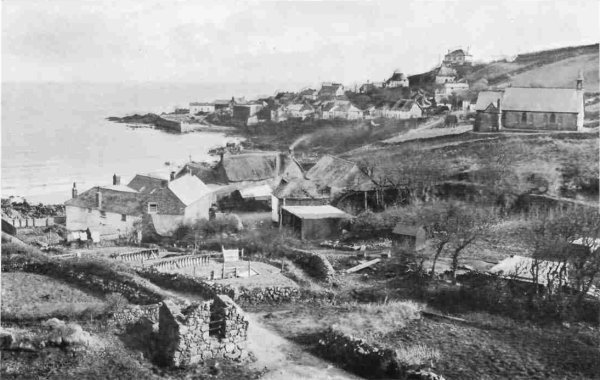
Readers of Baring-Gould's stirring novel, The Roar of the Sea, are sure to look eagerly for St. Enodoc's Church. It lies among the sand-dunes on the eastern bank of the estuary, and is now protected from the sands that once practically buried it by the growth of rush-grass and tamarisk hedges; even now it lies low within a deep trench, and we can easily picture its condition in days when the parson used to enter through the roof to perform service, so as to keep his tithes. Built in 1430, it was the successor of an earlier cell of the saint's. Its slightly crooked spire of slate is the sole landmark to guide a visitor. In the graveyard is a curious collection of stoups and water-bowls. It is about forty years now since the church was excavated from the sands that rose to its roof and restored to usefulness. Those familiar with Mr. Baring-Gould's book will remember that he places the home of Cruel Coppinger in this district, with his house at Pentire Glaze; but we shall find the true home of Coppinger further northward, near Morwenstow. Just within Hayle Bay is the little village of Polzeath, which in time may become a popular watering-place; it has a wonderful charm of position, and enough sand to satisfy anybody. The fine headland of Pentire reaches beyond, with its off-lying islet of Newland. Mr. Norway thinks that the stretch of coast visible from Pentire is the finest in all Cornwall, and he speaks with authority. On the west the view extends to Trevose, and embraces the whole of the beautiful Padstow harbour, together with an unlimited ocean of marvellous ever-changing colours. "On the east the prospect seems almost boundless. Port Isaac Bay lies just below, sweeping far back into the land, half hidden by the Eastern Horn of Pentire. Across the bay Tintagel lies directly opposite, eight miles away over the sea, every crevice and gully of its riven island clearly marked in the translucent air; and beyond it the eye follows leagues and leagues of iron cliffs towering far higher than any others in the west, and point after point of noble jagged promontories, past Boscastle, set back a little out of sight, past Bude and Cambeak, and rugged Morwenstow, till it rests at last on the dim line of Hartland Point, full 40 miles away as a bird would fly. It is idle to compare any other view in the West Country with this either in extent or grandeur, or in the immediate beauty of its surroundings. It is little known, and rarely visited by any but by shepherds. Yet it is more easy of access from Wadebridge than the Land's End or the Logan from Penzance; and there will be some to whom its very loneliness is an additional attraction. However this may be, those who leave Cornwall without visiting Pentire have missed its noblest scenery."
It is a large claim that Mr. Norway makes, but surely it is justified. The parts of Cornwall that are best known are naturally those that come within range of the more popular resorts—Newquay, Bude, Penzance, St. Ives, Falmouth—while eastern Cornwall is accessible from Plymouth. But this stretch of coast is near no popular centre, and, with the exception of Tintagel and Boscastle, it remains neglected. If Padstow or Polzeath, Portquin or Port Isaac, ever become more popular, visitors will flock to these grand cliffs and marvel that they never came here before. There is a remarkable triple entrenchment on the eastern Horn of Pentire, above its stark, rugged caverns; but those who came here and fortified this noble headland, in far-back days of which we can only dream, came not in search of the picturesque as we do, nor probably for the spiritual repose that we crave in this age of hurry. Even sterner necessities governed their existence. Cliff-camps of this nature cannot have been designed against any foe from the sea—even to-day it would be a perilous thing indeed to attempt a forcible landing at such places—they were more likely a last refuge from invading tribes that came overland from the south-east. The struggles witnessed here must almost certainly have been far earlier than the coming of Roman or Teuton; it was probably successive waves, or antagonist tribes, of Stone Age men that here contended and opposed each other. But the ditches and embankments have little to tell us; tradition is silent, the lonely barrows are dumb. Yet the blood of the peoples still flows within Cornish veins; and those characteristics that we vaguely speak of as Celtic often derive from a far earlier source.
The little island to the east of Pentire is the Mouls, and to the right is Portquin Bay. Port Isaac Bay, beyond Kelland Head and Varley Point, takes its name from the delightful little fishing village of Port Isaac, of which Port Gaverne may almost be considered as a suburb. Both are in the parish of St. Endellion, but Port Isaac has its own church, erected in Early English style in 1882. Its small pier is said to date from the time of Henry VIII., and before the railway a good deal of Delabole slate was shipped here. The fishing for pilchards is here done by trawlers, not by seines, as round Land's End. The name may probably be interpreted as porth izic, the "corn port," though certainly this is not a grain country. Very appropriately, it is said that fish are exhibited among the fruits and flowers at the Port Isaac annual harvest service. Some other West Country fishing-towns have introduced nets and oars at such services, but to bring in the actual fish seems peculiar to this place. The fish has always been a sacred symbol in Christian art, and it represents to fisher-folk what the fruits of the earth do to the field labourer. Both these little twin ports—Isaac and Gaverne—are entirely charming, and much to be commended to all who would know unspoiled Cornwall. Nestling within their tiny coves, they have a varied background of interesting country, pleasant little beaches, beautiful cliffs, and a glorious sea. There is one other resort to be visited before reaching Tintagel, and that is Trebarwith Strand, which similarly reaches the sea by a tiny cove, with the Gull Rock lying off shore as a target for storms. Trebarwith is likely to become fashionable. It has a fine stretch of sands, and provides some of the best bathing to be had in North Cornwall. Those who wish to be near Tintagel and yet close to the sea had better come to Trebarwith rather than to the Tintagel village itself.
CHAPTER XVI
TINTAGEL AND BOSCASTLE
When we come to the region that is specially sacred to traditions of King Arthur we find ourselves in the presence of wonderful natural charm and of considerable historic perplexity. Those who are content with the ordinary guide-books, and who have no conception of Arthur beyond what they may have gained from snatches of Tennyson, will not be troubled by this perplexity; they will take the crumbling walls on Tintagel heights to be the actual castle in which the Celtic prince was born, and any round table will suffice them as being that around which the king and his chieftains sat. But something a little better than this is desirable. We want Arthur to be something more than a mere ghost, something even more than the blameless hero of a beautiful Victorian poem. Yet if we go to the learned authorities the ghost becomes more ghostlike, the phantom becomes more dim; it is mainly destructive criticism that we meet with, and assertions that are largely negative. In spite of this, there must be something tangible behind so persistent a rumour as this tradition of Arthur. Wherever the Brythonic tribes extended, there we find traces of him. The Gaels know nothing of him. Finn, Oisin, Cuthullin, Cormac—such as these were the great Goidhelic heroes. But the British tradition reached from Armorica to the Forth, and carried Arthur with it. The Welsh claim him, the Bretons, the Cornish, the Lowland Scotch. Cornwall, with Tintagel as an asset of faith, claims his birth; Somerset, with Cadbury on the river Camel, claims Camelot; and Glastonbury boasts of his grave. Of these claims, that of Cornwall is the most powerfully supported; there is not only Tintagel, but Kelly Rounds, Damelioc, and Cardinham. One of the Welsh Triads speaks of the three chief palaces of Arthur as being Caerleon-on-the-Usk, Celliwig in Cornwall, and Penrhyn Rhionedd in the north. Celliwig may safely be identified with the partially effaced earthwork near St. Kew Station, known as Kelly Rounds (probably from the Cornish killi, meaning woods or groves), standing in what may be described as a Kelly district, for we have here in a cluster such names as Kelly Green, Kelly Farm, Bokelly, Kelly Brae, Calliwith. The Rounds have been cut across by a road, but there are distinct traces of two ramparted circles, with some remains of a sheltering earthwork to the west. Damelioc, a large and strong entrenchment with three concentric ramparts, lies about seven miles south-west of Tintagel; and it was here that Gorlois, Duke of Cornwall, took up his position after placing his wife Igerne for safety within Tintagel itself. The common story says that Uther, mad with love, overcame and slew Gorlois at Damelioc, and gained admission to Tintagel in his guise, thus becoming the father of Arthur. Of course, there is the other tradition that represents Arthur as of supernatural birth, washed to the shore by the waves, rescued by Merlin, and given to the world as a son of Uther. Cardinham, the other almost certain Arthurian locality in Cornwall, is about five miles east of Bodmin, and is identified with the Caradigan where Arthur sometimes held court. It is a large, lonely earthwork, in a field near a farmhouse. It must not be forgotten that the guide-books usually put forward Camelford as another most important Arthurian place, mentioning Slaughter Bridge as the scene of the king's last battle. There certainly was a battle here between Britons and Saxons, but this took place at least two centuries after Arthur's time; and though a spot named Arthur's Grave is shown to visitors, all definite connection between the king and Camelford must be surrendered. The last great battle, according to all authentic tradition, was fought against Picts, and what would Picts have been doing in Cornwall? The grave at Glastonbury, it must be owned with regret, is now generally understood to be a monkish fable. It is not pleasant for a West of England man to surrender either Camelford or Glastonbury, but truth must be faced, and the fact is almost certain that Arthur's last battle, and therefore his grave, must be sought in Scotland.
We may assume that Arthur was a Romanised Briton, born in the late fifth century at Tintagel; his name being possibly a Celtic form of the Latin Artorius. He became the champion of his race against encroaching Saxons, North-Country Picts, and wandering pagan hordes who fought for lust of bloodshed and pillage. Against these it is likely that Arthur sought to maintain a semi-Romanised, partially Christianised civilisation. He is credited with twelve great battles, in all of which he proved victorious; some of these were certainly in Somerset, and the last of his triumphs, that of Badon Hill, somewhere in Wessex. His rule thus established on a firm foundation, for many years Britain knew comparative peace and good government. The Round Table of which we hear so much is probably a symbolic addition of the bards, unless it means that in Arthur's time persons of good class began to sit decently together at tables. The thirteenth battle, in which he lost his life fighting against his nephew Mordred, has usually been given to the West of England—Malory and Tennyson both do so. But the traditions that became most popular sprang up in an age when the Cymry were forgetting the former wide extent of their tribal sway, and were limiting their racial pride to a part of the country that was still free from the Teuton. The fact that Arthur's last fight was with the Picts, and against Mordred, is almost conclusive as to its location. His sister, the mother of Mordred, had married Llew or Lot, of the Lothians, and there is reason to believe that the king was already familiar with this part of Scotland. The battle is always given as fought at Camlan, and this name has diverted later writers to the Camels of Cornwall and of Somerset. But the Celtic cam in place-names is quite common; it signifies crooked, and we find it in a number of river-names. Mordred had become a chieftain of the Picts, and he possibly resented any claims of suzerainty on the part of Arthur. The fight, whose date is stated as 542, was almost certainly waged at Camelon on the river Carron, near Falkirk. Arthur was defeated—it is likely that his forces were greatly outnumbered; and he died, either on the field or as an immediate result of a wound then received. Not many miles distant is an earthwork still known as Mordred's Castle; and at Carron, nearer still, there was formerly a mound or cairn known as Arthur's Oon (oven). All the picturesque detail in Tennyson's wonderful "Passing of Arthur" must be attributed to Cymric bards, to the genius of Malory, and to the poet's imagination; we must be content with the conclusion that Arthur was born but did not die in Cornwall.
In any case nothing of the present ruins at Tintagel existed in the time of Arthur. Geoffrey of Monmouth, who wrote about the year 1150, says of the stronghold that "it is situated upon the sea, and on every side surrounded by it; and there is but one entrance into it, and that through a straight rock, which three men shall be able to defend against the whole power of the kingdom." Even Gorlois, we remember, only gained admittance by stratagem. Tintagel, Dundagel, or Dundiogl, the Dunecheniv of Domesday, seems certainly to have belonged to Gorlois when Uther was Pendragon or Head-king of Britain; it would have been a cliff-castle such as that on Pentire Head. As years passed the rock probably became more insular, and when the Norman stronghold was built it was connected with the mainland by a drawbridge. From earliest times the castle attached to the Earls of Cornwall, one of whom protected David, Prince of Wales, during his revolt against Edward I. Later it was used as a kind of prison, a Mayor of London being confined within it. Elizabeth had some thought of restoring it, for it had already become ruinous; Leland says: "The residue of the buildings of the Castle be sore wetherbeten, and yn ruine; but it hath beene a large thinge." Its outworks extended to the mainland, but the great keep was on the isolated mass of rock. Here also are the remains of St. Juliet's chapel, with its altar-slab and stone benches. It is not easy to say much about the Juliot or Julitta to whom this chapel was dedicated; but the chapel is certainly that mentioned in the thirteenth-century High History of the Holy Grail. "They came into a very different land, scarce inhabited of any folk, and found a little castle in a combe. They came thitherward and saw that the enclosure of the castle was fallen down into an abysm, so that none might approach it on that side, but it had a right fair gateway and a door tall and wide, whereby they entered. They beheld a chapel that was fair and rich, and below was a great ancient hall." But the spirit of modernism now comes very near to this sacred spot of antiquity; on an opposite headland stands a commodious hotel, and the Tintagel golf-links come very close to the castle. A tiny port lies below, from which a little slate is sometimes shipped. The village, whose correct name of Trevena is being displaced by that of Tintagel, lies about a mile inland; it is clean and comfortable, but not remarkably picturesque except for the old gabled building that was once its post-office. Those who want the perpetual presence of the sea will not be contented with it. Its church, dedicated to SS. Marcelliana and Materiana (of whom the latter may be the Welsh Madron), stands at a distance, above the cliffs west of the castle; it is a stern, bare building, magnificently placed, so fully exposed to the force of Atlantic gales that the very tombstones have been buttressed. A portion of the walls, in their rude simplicity, appears to be Saxon, but many orders are represented here, from the late Norman chancel-arch to the Decorated south transept and Perpendicular screen. There is a rugged circular font, and what is supposed to be a Roman milestone. The vestry was formerly a Lady-chapel, possibly Saxon, with a thirteenth-century door and a curious mutilated altar. The south-transept window is to the memory of J. Douglas Cook, founder of the Saturday Review, who returned to his native Cornwall to die. In the churchyard are the graves of drowned seamen, British and foreign. It is a striking and solemnising little church, quite in harmony with a district of myth and sublimity. It is possible that some who come to Tintagel for the first time may be disappointed. If so, they have expected too much, or have expected the wrong thing. There is no gloss of false romance about the place; the ruins have not the hollow pretentious grandeur of some Norman castles; what we see is the unadorned, unveiled reality of a majestic coast, the low, stark walls of ruin on an immemorial site, the naked wind-beaten church on the heights, the sea breaking into gaunt caverns below. Sheep feed within the enclosure to which we scramble by a ragged path. Sentiment may resent the hotel and the golfers, but any jarring note can easily be ignored. Yet even Tennyson seems to have been disappointed at first; afterwards, the spirit of the place sank into him and prevailed. Perhaps old Hawker has described it best, in few pregnant words:—
They meet for solemn severance, knight and king,
Where gate and bulwark darken o'er the sea."
He gives us the words of Arthur, when the listeners "hush their hearts to hear the king":—
I yearn that men I know not, men unborn,
Shall find, amid these fields, King Arthur's fame.
Here let them say, by proud Dundagel's walls—
'They brought the Sangraal back at his command,
They touched these rugged rocks with hues of God,'
So shall my name have worship, and my land."
And after the king had spoken:—
The deep foundations shook beneath the sea."
And we have the grand final picture:—
Lay, a strong vassal at his master's gate,
And, like a drunken giant, sobb'd in sleep."
There was a time when Trevena, with Bossiney and Trevalga, formed a borough, and sent members to Parliament, of whom Francis Drake was one. It needed little apology to disfranchise such a small corporation as this, but the first Reform Bill had to deal with far greater anomalies. Bossiney has other attractions than such memories as this, having a delightful cove protected by the fine headland of Willapark. The fishing hamlet is close to an ancient burial-mound or barrow, from which election writs were once read and the local mayor proclaimed. From this cove we can pass upward into the glorious Rocky Valley, with its broken crags, its tangled foliage and rushing stream, its old mill. It is just a little like the gorge at Lynmouth, but wilder. This is the stream forming the famous cascade known as Knighton's (or St. Nectan's) Kieve. It is not very easy to find, and, here as at Tintagel, a key must be procured before its beauties can be examined. The Kieve is a basin of rock, into which the water has a fall of about 40 feet. St. Nectan is supposed to have been a brother of Morwenna, of Morwenstow; it is said he had an oratory here, and when he was dying he threw its silver bell into the waterfall. But Mr. Baring-Gould says that he died at Hartland. Following the usual guide-book convention, this would be the right moment for quoting Hawker's ballad, "The Sisters of Glen Nectan," but that piece is not one of his happiest efforts, and the legend is at least dubious. Those who journey afoot from Bossiney to Boscastle will find it almost impossible to keep to the coast, as the Rocky Valley forms an impediment, especially when its stream is in flood after heavy rains. But they can find a tolerable road to Trevalga, crossing the stream at the Long Bridge, and at Trevalga they will find an interesting little church. The shore here is broken into some small creeks of great beauty, but one chasm is so dark and sombre that it has won the name of Blackapit. There are dangers along these wild beaches; the poet Swinburne, when a boy, was almost cut off by the tide near Tintagel. From Blackapit we rise to Willapark Point and the church of Forrabury. The view from the Point is very fine, covering the ravine and haven of Boscastle on the east, and looking towards Tintagel on the west. Forrabury, the parish church of Boscastle, is dedicated to St. Symphorian, whoever that saint be (perhaps St. Veryan); and in situation it much resembles that of Tintagel. The pulpit and the woodwork of the altar date from the fifteenth century. There is a good granite cross in the churchyard. Here again there is a temptation, into which most writers fall, of quoting from Hawker, with his poem, "The Silent Tower of Bottreaux," in which he gives us a legend accounting for the fact that this church has only a single bell. But as he frankly confessed, in after life, that he had invented the story on the very slightest foundation, it is better to avoid quoting from the ballad, except solely for the melodious smoothness of its burden:—
Thus saith the ocean chime;
Storm, whirlwind, billow past,
Come to thy God at last."
Boscastle, taking its name from the old Norman family of Bottreaux (though there are many other place-names in Cornwall beginning with bos, which means abode or dwelling-place), is certainly the most romantic and picturesque haven in the Duchy, though there may be others that surpass it in actual beauty. The coast has a wild grandeur rather than loveliness, and in dismal or stormy weather there is a weird, solemn gloom. The little town lies sheltered at the head of a gorge in which two rivulets meet and form the haven. Old Leland in his graphic manner mentions one only of these brooks: "There cummith down a little broke from South-Est out of the Hilles thereby, and so renning by the West side of the Towne goith into Severn Se betwixt two hilles, and there maketh a pore Havenet, but of no certaine salvegarde." It is the river Valency of which he speaks, the more important of the streams that join just above the haven. This is a tiny land-locked harbour with stone piers, at which some coal, lime, and general merchandise are imported; the entrance is very difficult to make, and vessels that succeed in doing so have to be warped in by immense hawsers. Seeing this, and the small haven at Bude, one realises the wildness of this unsheltered coast, where such perilous places are called harbours. The village, though not large, is a long one, straggling down a hill and along the narrow ravine. Its activity is maintained by the daily arrival and departure of cars from Camelford, Bude, Otterham, and Tintagel, bringing many visitors in the summer season. Some come to stay, but most make only a fleeting call; Nature has placed grave obstacles in the way of Boscastle's ever becoming a fashionable watering-place. Its charm is unique and undeniable; but it appeals to the artist, the sturdy pedestrian and climber, the lover of solitude that at times is absolute desolation, rather than to the parent of a family. But the desolation, if that is not too stern a word to use, only applies to the coast; the Valency Valley is verdant and beautiful. It runs among furze and bracken by the riverside, and by this path we can reach the quiet, lovely vale in which Minster stands, so named from a former monastic establishment. Like the church at Tintagel, this of Minster is dedicated to St. Materiana, whom Mr. Baring-Gould identifies with the Welsh Madrun. The tower is of a single stage; there are good bench-ends and roof-carvings. A portion of the church having fallen in one Sunday, after morning service, it was rebuilt about forty years since. The priory was founded by William de Bottreaux in the reign of Richard I., but does not seem to have had a long existence. Minster is a large parish, but Forrabury is one of the smallest in Cornwall.
Pentargon, the bay and headland beyond the Boscastle golf-links, is sometimes interpreted as "Arthur's Head," but this is doubtful. The caves here, and those below Willapark, were once much haunted by seals; the coast being absolutely honeycombed by the constant fretting of the waves. At times, but rarely, the Cornish chough may be seen on the cliffs, recalling the old tradition that the spirit of Arthur lingers around his native rocks in this form—a tradition that was even familiar to Cervantes, though he knew the Welsh version of it, which makes Arthur a raven. Eastward past Beeny the cliffs gradually rise, till at High Cliff they reach the height of 700 feet; it needs some enthusiasm for a pedestrian to keep to the coast-line, though every mile has its grandeur. Beyond Cambeak lies the delightful Crackington Cove, which will some day become a watering-place; it stands at the mouth of a verdant valley with a stream like that of the Valency. It is in the parish of St. Genny's, whose church is dedicated to St. Genesius of Auvergne, of whom it is related that after being beheaded he walked about with his head under his arm. The saints of Cornwall are reported to have done some extraordinary things, but they do not usually descend to absurd actions of this nature; and there may be a shrewd suspicion that Genesius has no business here at all. William Braddon, a Parliamentary officer and member in the time of the Civil War, lived at Treworgye in this parish, and was buried in the church; some have supposed that he was vicar here. Pencannow Head, the north limit of Crackington Cove, rises sheer from the shore to the height of 400 feet. Dizzard Point is far less precipitous. A few miles further east the cliffs break to allow room for a fine stretch of sands at Widemouth Bay, and here we have another spot that is certain to develop into a pleasure-resort of the future. It cannot, of course, compare with the coast magnificence of the shore from Pentire to Boscastle, but it has what these wilder spots lack—a possibility of conventional settlement and expansion in the style of watering-place that the British public chiefly loves.
CHAPTER XVII
BUDE
We read in the memoir of Tennyson that in the year 1848 he felt a craving to make a lonely sojourn at Bude. "I hear," he said, "that there are larger waves there than on any other part of the British coast, and must go thither and be alone with God." So he came, with the subject of his Idylls simmering in his mind. He found the great rollers, the grand, open coast, the solitude; these are still there, to be found of all that seek. There may be some lessening of the solitude, but only in parts; Bude has not yet become widely popular; it is the haunt of those who love bracing air and quiet. It grows, but grows slowly; old friends may return to it without being tortured by too glaring a change.
The coast must indeed be destitute of harbours that can call Bude a haven; yet the name Bude Haven stands, as if in deadly irony. This whole north coast of Cornwall and Devon has little enough of refuge for seamen in distress; and if they endeavour to make Bude when seas are running high they are simply courting disaster; it were better to stay far out, if the cruel Atlantic will let them. Yet a rumour of history says that Agricola landed here. It is not impossible, though accredited history tells nothing of such a visit; seas are not always stormy, even on the shores of North Cornwall—there are days when the waters from St. Ives to Lundy are peaceful as a child asleep. But such slumbering is not their characteristic mood; there is generally a strong ocean swell, and when westerly winds chafe the tide its force and fury are tremendous. Hawker, who was familiar with every yard of the district, has a ballad to the purpose:—
Unto his hungry mate:
'Ho! gossip! for Bude Haven;
There be corpses six or eight.
Cawk, cawk! the crew and skipper
Are wallowing in the sea;
So there's a savoury supper
For my old dame and me.'
'I am fourscore years and ten;
Yet never in Bude Haven
Did I croak for rescued men.—
They will save the captain's girdle,
And shirt, if shirt there be;
But leave his blood to curdle
For my old dame and me.'"
The graveyards, the fields, the farmyards, will bear out this grim character; there are traces of shipwreck everywhere—memorials of drowned seamen in the burial-ground, figure-heads of shattered vessels placed here and there, beams and spars applied to unintended agricultural uses. One such figure-head is that of the Bencoolen, in the churchyard, reminding us of a vessel wrecked in 1862, when only six were saved from its crew of thirty-five. The Bencoolen was trading from Liverpool to Bombay. We may take Hawker's description of the disaster, recollecting, however, that he wrote in great excitement, and that he was a little unjust to the men of Bude. The wreck took place towards the end of October, after a hurricane that "lasted seven days and nights. On Tuesday at two o'clock afternoon a hull was seen off Bude wallowing in the billows. All rushed to the shore. At three she struck on the sand close to the breakwater—not 300 yards from the rocks. Manby's apparatus was brought down—a rocket fired and a rope carried over to the ship. The mate sprang to clutch it—missed—and fell into the sea, to be seen no more alive. 'Another rope!' was the cry. But from the mismanagement of those in charge there was no other there. They then saw the poor fellows constructing a raft and launching it. A call for the lifeboat, one of large cost, provided with all good gear, kept close by. She was run down to the water. A shout for men—none—a few of the Hovillers, pilotmen, got on board, but refused to put off—all Bude lining the cliffs and shore—Well, well—to abbreviate a horror, the raft was tossed over. About six were washed ashore with life in them, four corpses, and the rest were carried off to sea dead—26 corpses are somewhere in our water, and my men are watching for their coming on shore. The County gives 5s. for finding each corpse, and I give 5s. more. Therefore they are generally found and brought here to the vicarage, where the inquest and the attendant events nearly kill me.... Hordes of people picking up—salvors with carts and horses—and lookers on. It reminded me of old Holingshed's definition, 'a place called Bedes Haven (Bede, a grave).' When the masts went over the captain, married a fortnight before, rushed down into his cabin, drank a bottle of brandy, and was seen no more. The country rings with cries of shame on the dastards of Bude." A calmer eyewitness quite absolves the Bude men from all blame—to render more help had been impossible. The vessel was being steered skilfully to take the haven, but she was too large for its mouth. But, unjust or not, we must love Parson Hawker. He tells of his procedure when a corpse was reported: "I go out into the moonlight bareheaded, and when I come near I greet the nameless dead with the sentences 'I am the Resurrection and the Life,' &c. They lay down their burthen at my feet—I look upon the dead—tall—stout—well-grown—boots on, elastic, and socks—girded with a rope round the waist. I give him in charge to the sexton and his wife to cleanse, to arrange, to clothe the dead. I order a strong coffin, and the corpse is locked in for the night. I write a letter to the coroner and deliver it for transit to the police. And here the misery begins." To every corpse discovered Hawker gave burial in consecrated ground; it was not many years since the law had forbidden this. The few graphic words quoted give us an idea of his days spent on this lonely, pitiless coast—days which he varied by acts of beneficence to his parishioners, and by the writing of much beautiful poetry. Close to the mouth of this perilous haven is the low breakwater, built to connect an outlying mass of rock that was formerly insular with every tide. Carew (1602) speaks of this rock; he says: "We meete with Bude, an open sandie bay, in whose mouth riseth a little hill, by euerie sea-floud made an Iland, and thereon a decayed chapell: it spareth roade only to such small shipping as bring their tide with them, and leaveth them drie, when the ebb hath carried away the salt water." He tells how Arundel of Trerice had a house here named Efford, now the Bude vicarage; and how this gentleman "builded a salt-water mill athwart this bay, whose causey serveth, as a verie convenient bridge, to save the way-farers former trouble, let and daunger." The present church stands near, built by Sir Thomas Acland in 1835. The chapel on the islet, decayed even in Carew's time, was dedicated to St. Michael, its dedication being transferred to the present church; only a few faint traces of the old building can be seen. It was this same Sir Thomas Ackland who constructed the bathing-pool at the end of the breakwater, where it forms a very pleasant little swimming-bath. But in time of storm, rock and pool and breakwater are a mass of snowy, quivering foam; even in less tempestuous times it is fine to see the waves rush seething up the sides of the substantial little breakwater, with suggestiveness of what they can do in wilder hours.
It must be confessed that this corner by the haven is the most interesting portion of Bude, which some visitors have condemned as an unattractive place. Certainly the growth of lodging-houses has not added to its charm, as these houses have all the tameness, though doubtless also the convenience, of modern street-architecture. It is by the haven and on the banks of the now useless canal that there is anything of an old-world atmosphere. As compared with places like Polperro or Boscastle, Bude has a touch of the commonplace, but its coast is fine, and it is an excellent centre for a district of supreme attraction. Readers who care to see how it figures in modern fiction should turn to the Seaboard Parish of the late George Macdonald, in which Bude is the Kilkhaven of the story. Even here the novelist had to borrow another church for his setting; the present Bude Church is by no means that of the romance. The town is now reaching from the canal banks to the breezy Summerleaze Downs, and beyond; and of course the golfer is here in all his glory. But if we go a little more than a mile inland we find all that may be lacking in Bude at Stratton, which may or may not be named after an old "street" that passed this way from Devonshire. That street was almost certainly not Roman, even if the Romans used it. There is a little stream here called the Strat, which does not help us, for the stream may have been called after the town. Stratton shares with Stowe in the glorious memories of Sir Beville Grenville, his wife Grace, and his servant Anthony Payne; but Bideford has also its claim to long association with the Grenvilles—it was from Bideford that Sir Richard sailed the Revenge. Stowe, in the parish of Kilkhampton, a few miles north of Bude, is now a farm, showing very few traces of the Grenville manor-house, which was one of the finest and most extensive in the West. There were two houses, an earlier and a later, but both are now things of the past. At Stratton, however, there is still the Tree Inn, which seems to have been the business residence of Sir Beville, whither he came to settle matters with his tenants and followers; and it was here that his servant, Anthony Payne, was born. Payne, who stood seven foot four in his stockings, was devoted and loyal to his heart's core; it was he who, when Sir Beville fell fighting for King Charles at Lansdown, led the knight's son up the hill at the head of the gallant, irresistible Cornishmen. These Cornishmen had already proved their powers much nearer to Stratton. The battlefield known as Stamford Hill is close by; it was here that Sir Beville and Hopton defeated the Parliamentary forces under the Earl of Stamford and Chudleigh. The fight took place in 1643, and was one of those Royalist victories in the West that for a time made the cause of the King look very hopeful. The Cornish troops were outnumbered almost by two to one; they were tired and hungry, and they had the worst of the ground, for the Roundheads had entrenched themselves; yet they stormed the hill, routed the Parliament men, and took 1,700 prisoners. An old gun still lies there to mark the spot, and above is the inscription: "In this place an army of ye Rebels under ye command of ye Earl of Stamford received a signal over-throw by ye valour of Sir Bevill Grenville and ye Cornish Army." If there be ever glory attaching to battlefields, it may be found here. While the battle was raging Grace Grenville, the wife of Sir Beville, was waiting in anguish of heart at Stowe, only to be pacified when her husband himself came home at night to tell her of the issue. Yet scarce two months had flown when the sorrowful Payne wrote telling his beloved mistress the sore tidings of Lansdown, where the Cornishmen followed their slain master's son up the hill with tears in their eyes. "They did say they would kill a rebel for every hair of Sir Beville's beard. But I bade them remember their good master's word when he wiped his sword after Stamford fight; how he said, when their cry was 'stab and slay,' 'Halt, men; God will avenge.' I am coming down with the mournfullest burden that ever a poor servant did bear, to bring the great heart that is cold to Kilkhampton vault. Oh, my lady, how shall I ever brook your weeping face?"
Never was a sweeter communionship of husband and wife than that between Sir Beville and Lady Grace, thus brought to an earthly end; it gives a lovely touch of domestic affection to annals that are otherwise stern and bloody enough, with all their glory. There are some charming letters preserved, that passed between the two; showing the beautiful simplicity of their natures and the tone of their home life. "My dearest," wrote the knight from London, "I am exceedingly glad to hear from you, but doe desire you not to be so passionat for my absence. I vow you cannot more desire to have me at home than I desire to be there." And again: "Charge Postlett and Hooper that they keepe out the Piggs and all other things out of my new nursery, and the other orchard too. Let them use any means to keepe them safe, for my trees will all be spoild if they com in, which I would not for a world." And the lady, addressing "Sweet Mr. Grenvile," adds in a postscript to her letter: "If you please to bestowe a plaine black Gownd of any cheape stufe on me I will thank you, and some black shoes." She died about four years after her husband fell at Lansdown. These two lie buried at Kilkhampton, but Payne, the loyal servant, is somewhere within the noble church of Stratton; there is no monument to say where. The church is of excellent restored Perpendicular, with fine pinnacled tower. Within are a Norman font, a Jacobean pulpit, and the black marble tomb of Sir John Arundel (1561), whose former manor-house at Efford is now Bude Vicarage; there are brasses of the knight, his wives and their children. The fourteenth-century effigy of a knight in the north aisle is supposed to be that of Sir Ranulf de Blanchminster, who is commemorated in one of Hawker's ballads. It is fitting to think of the poet-parson in this spot; not only are we now approaching very near his own parish, but his father was Vicar of Stratton and lies buried in the church's chancel. Hawker was often asked to preach here, but he long declined, fearing that the associations would be too overwhelming for him. This proved to be the case when at last, in his old age, he preached at the church. Suddenly breaking in his sermon, he explained with faltering voice, "I stand amid the dust of those near and dear to me." It is little wonder that his listeners shared his emotion; and some touch of it may still come over those to whom the records of Hawker are very dear. The number of such lovers should have been much increased by the adequate biography that is now at the service of the public, prepared by the son-in-law of the poet; and Hawker is pre-eminently one of those whom we learn to love even more through his memoirs than by his writings. For his life was a life of noble deeds, not only of beautiful words.
CHAPTER XVIII
MORWENSTOW
There is a fine stretch of sands protecting the Bude shores, but the background of these sands is cliff. It was this sand that made one of the chief uses of the canal from Bude to Holsworthy, now superseded by the railway; containing a large proportion of lime, it is valuable for agricultural purposes. The sands have a further use now as a playground for visitors; very few watering-places become really popular without such a beach for the children and the bathers. But the true coast is, of course, the background of cliff, and this continues grandly rugged and broken to the Devon borders, and beyond. Little more than a mile north of Bude is Poughill, pronounced Puffill. The church, dedicated to St. Olaf, is one of the few Teutonic foundations in Cornwall; but, indeed, this northern corner of the neighbouring counties, with its "weeks" and "hams" and "worthies," must have been largely held by settlements of Saxons. The value of place-names in such matters is very great, though it must never be pressed too far. Poughill Church, with a good Perpendicular tower, is chiefly notable for its frescoes, somewhat glaringly restored; they resemble those of St. Breage, in the Helston district. Both figures represent St. Christopher bearing his sacred burden across the tide, and the details are in an advanced stage of symbolism. Far more pleasing, artistically, are the beautiful bench-ends of the early sixteenth century, with their various emblems of the Crucifixion, their armorial insignia, their symbols and initials. This church is peculiarly attractive, and its situation is delightful. From thence the road runs to Kilkhampton, whither recollections of the Grenvilles have already carried us. We are now getting into the heart of the Hawker district, but other associations are so numerous here that it seems impossible to deal with them all in anything like an adequate manner. The Perpendicular church of Kilkhampton chiefly dates from the Elizabethan days when one of the Grenvilles was rector here; but it embodies the beautiful Norman doorway from the church supposed to have been built in the eleventh century by another Grenville. Some other Norman traces are preserved—Rector Grenville was a judicious restorer. Of his date are the oak bench-ends, which are as good as Poughill's, and there is an elaborate screen. The monument of Sir Beville Grenville, erected long after his death by his grandson, is perhaps not quite what it ought to be—it is too dismal and conventional. It is very much in the spirit of the Calvinistic clergyman, James Hervey, who, when curate at Bideford, was so much impressed by Kilkhampton Church that it prompted his once famous Meditations among the Tombs. The work and others of its author's, such as Theron and Aspasio, may still be met with occasionally on old-fashioned bookshelves, or on the second-hand stalls; and they forcibly remind us of the style of second-rate reflection which, in a different dress, is still dear to the average sober-minded individual. But Hervey is not at all bad, of his sort, and our great-grandfathers thought him profound. Probably, however, he was dearer to their wives; it is chiefly women who support this kind of moralising. To Hervey Kilkhampton Church was "an ancient Pile, reared by Hands that ages ago moulded into Dust—the Body spacious, the Structure lofty, the whole magnificently plain." He was at Bideford in 1740. Much more lively in its nature was the connection with this parish of the notorious Cruel Coppinger, smuggler, wrecker, and desperado.