
He came from a foreign land;
He was brought to us by the salt water,
He was carried away by the wind."
Coppinger has become almost mythical, by reason of older traditions of pirate-smugglers being attributed to him. The Rev. S. Baring-Gould himself, in his book on the Vicar of Morwenstow, has located Coppinger in the Kilkhampton district; but his novel, In the Roar of the Sea, places its hero, somewhat humanised, at St. Enodoc. The truth is, there are similar traditions in several parts of the Cornish coast, and elsewhere. There was a floating mass of legend ready to be appropriated by any character that might seem to deserve it; and we may take Coppinger as a kind of generic title, the clustering of varying Cornish traditions of wrecking and piracy round one name. Such being the case, he may as well be placed at Kilkhampton as anywhere else. He is reported sometimes as a Dane, sometimes as an Irishman, who was thrown on the coast in a tempest, who leaped upon her horse's back behind a girl who had come to witness the wreck, and who ultimately married her. He proved to be one of the blackest villains Cornwall had ever known, but as he had a powerful gang of followers who aided him in all his misdoings, there must have been plenty as bad as he, though they might lack his gift of leadership and initiative. He is said to have chopped off a gauger's hand on the gunwale of a boat—rumour reported even worse things than this; and he once soundly horsewhipped the parson of Kilkhampton, who had offended him. There is also a story of his carrying a terrified tailor to "mend the devil's breeches." He departed as mysteriously as he came, after many years of vile outrage; he "who came with the water went with the wind." It is clear that a great deal of old-time folk-lore has gathered round this name, and probably no single man must be held answerable for all the wild doings related of Cruel Coppinger. In all such traditions Hawker is a most unsafe guide; he did not consciously "falsify the books," but he had misled many who came after, particularly the popular guide-books, by his looseness and his play of fancy. But he came to this district at a period when smuggling, if not actual wrecking and piracy, was at its height—not only in Cornwall, be it remembered, but in many other parts of the coast, such as Sussex and Kent. It was a time when the Cornish used to thank God for wrecks; and if they did not actually lure vessels to destruction on their cruel coasts, which it may be feared they did sometimes, they at least did nothing to avert the disasters which, to their mind, were sent by a merciful providence. There was even a proverb that it was unlucky to rescue a drowning man—widespread, for Scott mentions it in the "Pirate"; the bad luck which these coast-folk had in view being the fact that a rescued personage could claim his property that the sea had cast up.
Hawker was born in Norley Street, Plymouth, December 29, 1803; his grandfather and uncle were both clergy in Plymouth at the time. Thus, though he has won a world-wide fame as the Cornish poet, Hawker was really Devonian; in this borderland of the two counties there is practically no difference. In the same manner the Grenvilles were of Devonshire, yet Cornwall treasures their memories with justifiable pride. In after years Hawker used to say that, could his mother have foreseen how sorrowful his life would be, she would have given a gentle pressure to his throat in his first hour, and so have averted all his earthly trials. He grew to be a mischievous and daring lad. One of his pranks was to swim out to the crags at the mouth of Bude haven, and there pose as a mermaid; which he did to the prolonged bewilderment of the countryfolk. He was educated at Liskeard, Cheltenham, and Oxford; coming to Morwenstow in 1834 after having held the curacy of North Tamerton. He had already married a lady who was twenty years older than himself—a marriage of the deepest lasting affection. His second marriage, in his old age, was to a lady forty years his junior; but by this time the poet's spirit had been broken by solitude, grief, failure to win literary success, and by the terrible scenes of shipwreck and death that often distracted him. He died in 1875, having been received into the Romish Church a few hours before his death; and the remains were laid in Plymouth Cemetery. On his tombstone is a line from his own beautiful poem, "The Quest of the Sangraal"—
There is now an elaborate memorial window in Morwenstow Church, unveiled in 1904. The poet has not been forgotten in this land, nor is he likely to be. He has impressed himself so vividly on the district that was long his home, that we may now as justly speak of the Hawker country as we do of the Scott or the Wordsworth country. The work was accomplished even more by the man's personality than by his writings. If only these writings had been preserved he would not pass to posterity quite as fully as he merited; only a portion of the man would survive. But there was the tradition of the man himself, assisted by some inadequate memoirs; and now we have one of the most charming biographies of recent times to bring him before us. He was not only poet and essayist; he was cleric and mystic, preacher, prophet, symbolist, philanthropist—some may add reactionary. His life was permeated with Catholic doctrine and colour. When he passed, in his closing hours, to a sister communion, the step was a natural and easy one, however unnecessary some of us may think it to have been. He loved the Church of England devotedly and unfailingly; but he always looked upon her as the Old Church, rather than as a reformed body; and to his unquestioning mind a few extra dogmas would never have presented any difficulty. It was disbelief, doubt, that he abhorred. Like Sir Thomas Browne, he was greedy for more mysteries, more marvels, more sublimities for unhesitating acceptance. He was always in sympathy both with the Roman and the early Greek Churches, and sometimes in his own ritual he borrowed from both; yet he could fulminate hotly enough at times against the excesses of either. He loved deeply and hated strongly; but the love was permanent and real, the hatred transient and superficial.
He had a lifelong bitterness against Dissenters, and lived on the tenderest terms with many. His bark was very much worse than his bite. "I understand, Mr. Hawker," once said a Nonconformist lady to him, "that you have an objection to burying Dissenters?" "Madam," he replied, "I should be only too delighted to bury you all." But there was no real sting behind the words, and some of his dearest and kindest parishioners were not Churchmen. He spent his days in doing good deeds to man and beast, saving strangers from the devouring sea, or giving their bodies Christian burial; tutoring the rugged hearts of his people; and living himself, in spite of much sorrow, disappointment, loss, in a world of holy dream and vision, conversing in spirit with saints and angels. Hawker believed that his dear country was given over to doubt and laxity; and every affliction of war, misfortune, bad weather, he interpreted as the chastening hand of God. He would have had his world coloured entirely by faith and religious observance; stained as it were, like the glass of church windows, by sacred image and story. But practicalities pressed heavily upon him and almost broke his heart; his poetic impulse failed under sore discouragement; he did not proceed with his finest poem; those of his poems that became popular did so without the attachment of his name. Very much of this was due to his own procedure; yet the man had much hardship, neglect, and suffering, for which he could in no sense be held responsible. He was a true descendant of the early Cornish saints, born perhaps several centuries too late, and thrust upon a world where he had to turn to sea and wind and woodland for the mystic symbolism which was his life-breath, finding too little of it in the ways and words of Victorian England.
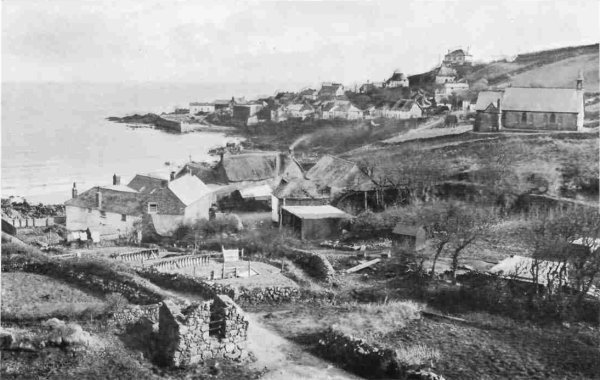
The present vicarage at Morwenstow was built by Hawker himself, there having been no vicar in residence for long years before his coming. It was here, in 1848, that Tennyson visited him, coming over from Bude, where he was staying at the Falcon Hotel. In stepping hastily from the garden to reach the sea, when he first arrived, the poet had fallen; there was no protecting rail there at that time. The injury proved so serious that he had to see a surgeon; and this surgeon happened to be Mr. John Dinham, Hawker's brother-in-law. Two days after the accident Tennyson drove over to Morwenstow with Dinham to see Hawker. His own note on the visit is brief and unsatisfying: "In a gig to Rev. S. Hawker, at Morwenstow, passing Comb Valley, fine view over sea, coldest manner of vicar till I told my name, then all heartiness. Walk on cliff with him; told of shipwreck." This is very meagre. Happily Hawker himself wrote down a more detailed account, and this was discovered among his brother's papers. It was headed with a cross, signifying that it recorded what Hawker deemed a mark of divine favour. "It was in the month of June, 1848, that my brother-in-law, John Dinham, arrived at Morwenstow with a very fine-looking man whom he had been called in to attend professionally at Bude for an injury in the knee from a fall.... I found my guest at his entrance a tall, swarthy, Spanish-looking man, with an eye like a sword. He sate down, and we conversed. I at once found myself with no common mind. All poetry in particular he seemed to use like household words.... Before we left the room he said, 'Do you know my name?' I said, 'No, I have not even a guess.' 'Do you wish to know it?' 'I don't much care—that which we call a rose, &c.' 'Well then,' said he, 'my name is Tennyson!' 'What!' said I, 'the Tennyson?' 'What do you mean by the Tennyson? I am Alfred Tennyson who wrote Locksley Hall, which you seem to know by heart.' So we grasped hands, and the Shepherd's heart was glad.... Then, seated on the brow of the cliff, with Dundagel full in view, he revealed to me the purpose of his journey to the West. He is about to conceive a poem—the hero King Arthur—the scenery in part the vanished Land of Lyonesse, between the mainland and the Scilly Isles.... Then evening fell. He arose to go; and I agreed to drive him on his way. He demanded a pipe, and produced a package of very common shag. By great good luck my sexton had about him his own short black dudheen, which accordingly the Minstrel filled and fired. Wild language occupied the way, until we shook farewell at Combe. 'This,' said Tennyson, 'has indeed been a day to be remembered.'" Hawker had a presentiment that they would never meet again, and they never did, though Tennyson visited Cornwall in later years. There was some slight correspondence, and an interchange of books; but the two drifted apart in spirit—perhaps they had never been very near. Tennyson's theology was that of Maurice, whom Hawker came to regard as an arch-enemy of Catholic truth. On one ground they both met in later life—when they chose the subject of the Holy Grail for poetic treatment; and on this ground the lesser poet beat the greater, as Tennyson himself frankly acknowledged. Yet both in their different ways lived near to the spirit that is typified by the Grail; but the one abode in solitude on his wild Cornish cliffs and the other lived in the blaze of popular fame, visited and loved by the greatest in the land. Who shall say that Hawker's life, after all, was not the nearest to his best ideals? Morwenstow vicarage is curious for its chimneys, which Hawker himself designed from church-towers in his neighbourhood and at Oxford. The church and vicarage stand in loneliness; there is no central village at Morwenstow, but the residences are scattered about the swelling downs and high-banked lanes. At the entrance to the graveyard is the lich-gate and mortuary, where many wrecked seamen were taken for burial. Such burials recall the unforgettable incident that occurred during the conveyance of one poor mangled body from the shore. "It was dark, and the party of bearers, with the Vicar at their head, were making their way slowly up the cliff by the light of torches and lanterns, when suddenly there arose from the sea three hearty British cheers. A vessel had neared the shore, and the crew, discovering by night-glasses what was taking place, had manned their yards to greet the fulfilment of duty to a brother mariner's remains." Morwenstow is really Morwenna-stow, Morwenna being a grand-daughter of Brychan, and thus belonging to a famous Welsh family of saints. The church is therefore a Celtic foundation, not Saxon as Hawker believed; he was always a little shaky in such details. In some maps and old local signposts the name is still written Moorwinstow, and was anciently Morestowe. Probably the earliest relic in the church itself is the font, which appears to belong to the tenth century; three typical Norman pillars support the northern arcade of the roof, and there is a very fine Norman door at the south porch. The Vicar loved to interpret the zigzag moulding as the "ripple of the lake of Gennesareth, the spirit breathing upon the waters of baptism"; he was doubtless more correct in reading a symbolic meaning into the carved vine that creeps from the chancel down the church. On the furze and bracken-clad slope above the cliffs, not far distant, is the hut that Hawker himself constructed, building it of wreckage; this was the sanctuary to which he loved to retreat for contemplation and literary work. It was here that he wrote his Sangraal poem, and the strong picture of its close might apply to this scene as forcibly as it does to its original.
In this parish is Tonacombe, a finely preserved specimen of the mediæval manor-house, its hall containing the old minstrels' gallery. This deeply interesting house has many memories of Charles Kingsley as well as of Hawker. Kingsley was a visitor here while writing his Westward Ho! and Tonacombe figures in that book as "Chapel." Hawker met Kingsley at this time, and introduced him to the Grenville localities. It is not likely that the two men got on well together; they were complete contrasts in nature and gifts. Hawker did not care greatly for Westward Ho! when it appeared, and thought its local colour defective. He rarely mentioned Kingsley in later life without a note of depreciation. He was far more in sympathy, intellectually and spiritually, with Kingsley's great antagonist, John Henry Newman. At Tonacombe are preserved a curious old lantern and walking-stick that formerly belonged to Hawker. The lantern "was made for Thomas Waddon of Tonacombe, who died in 1755. His brother Edward Waddon lived at Stanbury, and their sister Honor was the wife of the Rev. Oliver Rouse, Vicar of Morwenstow. The three families used to meet regularly at each other's houses for dice and cards. In the excess of their merriment the cronies would dash their glasses on the table, and the broken pieces were preserved as a record of the jest. In course of time there was a goodly collection of these fragments, and in order that their memorial should not perish the lantern was made of solid oak, square, with a pointed roof and little windows formed of the round bases of the broken glasses and other pieces cut in the shape of dice, hearts, clubs, diamonds, and spades. Thereafter, when the festive party broke up, those whose turn it was to walk homewards through the dark lanes had their way lighted before them by this emblem of their wit and humour." Stanbury, an old manor south of Tonacombe, claims some notice as the birthplace of John Stanbury (or Stanberry), confessor of Henry VI., who was appointed by that king to be first Provost of Eton. From being a Carmelite friar at Oxford he rose to be bishop, first of Bangor, finally of Hereford. He died in the Carmelite convent at Ludlow, 1474, and was buried at Hereford. Marsland-mouth, the northward boundary of Morwenstow parish, is also the boundary between Cornwall and Devon. Its utter loneliness and wildness are in complete contrast to the great southward boundary at the mouth of the Three Rivers. Here at Marsland Devon and Cornwall merge imperceptibly; the characteristics of the one are carried over into the other; in scenery, people, dialect, no change can be noted. This close community was emphasised, in Hawker's day, by the fact that for the last twenty-five years of his life he held charge of Welcombe parish as well as Morwenstow, Welcombe (most suitably named) being the first parish in Devon. In his old age, when Dr. Temple was appointed to the diocese of Exeter, the Vicar had some fear that he would be deprived of this additional cure, as Temple was expected to be no friend to Dr. Phillpotts' nominees; but, somewhat to his surprise, Hawker found that he got on fairly well with the new Bishop, though he detested his theological standpoints. Obviously, the name of Welcombe might be "Well-combe," there being a holy well of St. Nectan here; but that derivation does not seem to be correct. In the Exeter Domesday Book the parish is given as Walcomba, and probably the name signified Welsh-combe, marking the juncture when Saxonised West Devon passed into "West Wales." The church is three miles' distance from Morwenstow, and Hawker used to ride over every Sunday afternoon for service. On one occasion he forgot to bring his watch, and he needed some guide in timing his service so that he might return to officiate at Morwenstow in the evening. He asked the folk standing about the church porch if they could oblige him in this particular. "But time is of no great import at Welcombe, and no watch was to be had. At last, just as the service was beginning, an old woman hobbled up the aisle and handed to the Vicar a large and ancient timepiece. 'Her's only got one hand, your honour,' she said, 'but yu must just gi' a guess.'" Perhaps the name Welsh-combe (Welsh being taken in the old sense of "foreign") denoted some survival of earlier occupation here, some lingering neolithic remnant; the Welcombe folk are still distinguished by their dark hair and skins, and as being somewhat of a race apart. In Hawker's day they were very ignorant and superstitious, though sufficiently devout. They had "no farrier for their cattle, no medical man for themselves, no beer-house, no shop; a man who travels for a distant town (Stratton) supplies them with sugar by the ounce, or tea in smaller quantities still. Not a newspaper is taken in throughout the hamlet, although they are occasionally astonished and delighted by the arrival, from some almost forgotten friend in Canada, of an ancient copy of the Toronto Gazette. This publication they pore over to weariness, and on Sunday they will worry the clergyman with questions about Transatlantic places and names, of which he is obliged to confess himself utterly ignorant. An ancient dame once exhibited her prayer-book, very nearly worn out, printed in the reign of George II., and very much thumbed at the page from which she assiduously prayed for the welfare of Prince Frederick." He himself used to act as their postman. Perhaps it is misleading to say that Welcombe is only three miles from Morwenstow; visitors who try to find their way through the rambling narrow lanes will find it much nearer to five or six. But the loveliness of Marsland vale is a recompense, and a charming introduction to the beauties of North Devon.
On the Cornish side of Marsland-mouth is a secluded old farmhouse, which Hawker solemnly averred was haunted. It was once truly haunted by smugglers. Mr. Baring-Gould introduces it into his novel, The Gaverocks. Hawker once said to a visitor, "You must go and look at the old house there—there is a very curious old lady there you may see—come into my study and I will show you her picture—she died, at least her body did, some sixty years ago. I frequently see her and talk with her." This spot must not be quitted without recalling that Marsland-mouth is the home of Lucy Passmore, the white witch in Westward Ho! It was hither that Rose Salterne came to perform the love-charm that should reveal her lover. It can hardly be said that such superstitions have yet died out of the West Country, but it is the older people now that cherish these ideas, secretly and furtively. The youngsters are being taught differently in the Council Schools.
There are some fine headlands in this part of the coast, such as the two Sharpnose Points, but the finest of all is Hennacliff, which rises to about 450 feet, and drops sheer into the Atlantic waves. Even where there is a beach beneath these rugged cliffs, it is usually difficult to reach; in many parts the breakers dash full against the granite precipices, and there are often outlying reefs of cruel jagged crag. Noting the deadly features of the coast, we can understand how even Bude attained its name of Haven, however bitterly ironic that name may often have sounded. But it is a grand coast and mainland confronting the wild, unresting sea, and the traditional atmosphere of the district is wholly in keeping with its physical features. Rumours of bygone peoples float around us—of Saxon and Celt and of earlier people still; the legends that they fostered are repeated to us, the footsteps of old saints may be traced, together with secular records of pirate and smuggler. There are memories of glorious and gracious personages, as well as of those whose villainy at least was picturesque; there are sad memorials of shipwreck, death, and heartbreak. There are stretches of undulating upland, with fragrant turf, gorse, bracken; valleys almost too low for sunlight to enter, the wild and tortuous mouths of rapid streams, patches of meadow and pasture, with lonely cottages and isolated church-towns. Different from the southern coast in aspect, more desolate, less fertile, there is yet a special charm even in the desolation, a stimulating appeal in the solitude, and a marvellous purity in the bracing winds that blow, sometimes with ruthless violence, from a thousand leagues of ocean.
INDEX
Acland, Sir T., 358
Addison, 109
Aitken, Rev. R., 223
Anthony-in-Meneage, 110–11
Anthony-in-Roseland, 79
Antony, East, 27
Arthur, King, 335–46
Arundel family, 292–9
Atwell, Martin, 69
Austell, St., 66
Baring-Gould, Rev. S., 36, 51, 326, 365, 379
Bassets, 254–6
Bedruthan Steps, 293–4
Bencoolen, Wreck of the, 355
Besant, Sir W., 198
Bessie's Cove, 159
Beville, Sir J., 40
Bligh, Capt., 110
Bochym, 138
Bodinnick, 51
Bodmin, 319
Bodmin Moors, 301
Bodrigan, 73
Boleigh, 184
Bolster, 260–1
Bonaparte, Lucien, 180
Borrow, George, 180
Boscastle, 347–51
Bossiney, 346
Braddon, W., 352–3
Breock, St., 325–6
Brett, J., 178
Brutus, 17
Bude, 354–8
Burney, Fanny, 22
Byron, 81
Cadgwith, 118
Calais, Siege of, 60
Cambeak, 352
Camelford, 339
Cape Cornwall, 221
Carclaze Mine, 67
Cardinham, 339
Carhays, St. Michael, 76
Carminow, 143
Carnanton, 299
Carn Beacon, 78
Carn Brea, 256
Carn Galva, 225
Carn Kenidzhek, 222
Carter, "King of Prussia," 158
Cataclew Stone, 306
Chapel Carn Brea, 221
Choughs, 352
Chûn Castle, 224
Chysauster, 170
Cinque Ports, 60
Coleridge, Derwent, 147
Collins, Rev. J., 95
Columb Major and Minor, St., 288, 290
Constantine, St., 305–6
Cook, Capt., 92
Corineus, 17–18
Cornish language, 96, 124–5, 180, 236
Cornwall, Formation and appearance, 14–15
Cotehele, 24
Couch, Sir A. T. Quiller, 60
Coverack, 117
Crackington Cove, 352
Crantock, 277–82
Crantock Church, 280–1
Crowza Downs, 116
Cuby, St., 274
Cury, St., 138–9
Damelioc, 336
Davy, Sir Humphry, 173
Dingerrein, 77
Disraeli, B., 82
Dodman, 75
Dollar Hugo, 122
Doom Bar, 310–19
Drayton, 17
Dryden, 89
Dutch, 63
Fal, River, 100
Falmouth, 81–96
Finbar, St., 59
Flavel, 135
Flushing, 98
Forbes, Stanhope, 177
Forrabury, 347
Fowey, 54–65
Fyn and Joan, 38
Garrick, 22
Genny's, St., 352
George's, St. (Looe Isle), 37
Geraint, 77–9
Germoe, 153–4
Gerrans Bay, 77
Gilbert, 74
Gildas, 305
Glassiney College, 96
Glastonbury, 339
Godolphin Hill, 153
Godrevy Rock and Lighthouse, 253
Goethe, 135
Gogmagog, 17–8
Gorlois, 336
Gorran Haven, 74–5
Gotham, Men of, 75
Grade, 121
Grenville family, 40, 51, 199, 359, 364
Grenville, Sir Bevil, 40, 76, 359–62, 364
Grenville, Grace, 359–62
Gulf Stream, 207
Gulval, 175
Gunwalloe, 141
Gurnard's Head, 225
Gwythian, St., 251
Gyllyngvase, 86