
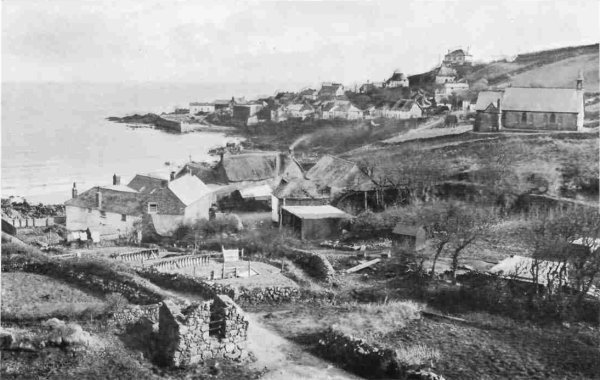
In this sense Looe, or rather the two Looes, are purely delightful. When we liken the place to Fowey or Dartmouth we must grant it the advantages of being closer to the sea; it stands actually at the mouth of its river, instead of retired within protecting sea-gates. To some extent it has to submit to the tender mercies of the tripper, for Plymouth steamboats are fond of bringing excursionists here; apart from these invasions, the spot is as peaceful as could be desired except by the veriest misanthropist. Approached by rail from Liskeard, the journey is made in leisurely backward and forward stages, the engine being reversed at times; so that passengers, who are requested not to get out till "the train is at rest," sometimes imagine themselves to be carried back to their point of departure. It is an amusing little line, but it serves its purpose; and indeed has a definite usefulness in reminding us that we have come away from bustle and hurry to a region of placid leisure and quietness. Arrived at the journey's end, one at first wonders how the people get in and out of their houses, so higgledy-piggledy do they appear to be piled one on top of the other; but the mystery may be solved by exploring the lanes and allies. Deliveries of produce are still often made by panniered donkeys, in quaint old-world fashion. There are two Looes, East and West, and two rivers of the same name which meet above the bridge. East Looe belongs to the parish of St. Martin's, and West Looe to that of Talland; both were granted a corporation in the time of Elizabeth, and each, before the Reform Bill, returned two representatives to Parliament. The credit of having sent twenty vessels and 315 men to the siege of Calais is given to East Looe, but it may be guessed that all the residents on the banks of the Looe rivers joined in this great patriotic effort. Those were the days of the town's fiercest activities, though its business as a port trading with the Continent endured till long afterwards; and the pilchard-fishery was once more important than it is now. Pilchards now for the most part keep further west. There is still much fishing done, and some small coastwise shipping gives occasional bustle to the rugged little banjo-shaped pier. There was anciently a great animosity between the two Looes, as was natural with such near neighbours; and the two still nourish a lurking contempt for each other, not always successfully concealed. They are at one, however, in their scorn for the pretensions of Fowey. An intense local patriotism, that really cannot tolerate outside claims, is a feature of many Western towns; a man from the next parish is almost as much a foreigner as if he came from "the shires." The two Looes have been brought to an enforced companionship, but they are not mutually conciliatory. East Looe can claim to be the business portion of the town, having the pier and the principal shops, while West Looe is more select and residential. The debate as to the greater antiquity may be left for the two to settle between themselves, but its harbour and pier must long have given East Looe the practical precedence. At the harbour some coal and limestone are imported, and there is a shipment of fish, bark, granite, and china-clay. East Looe boasts a further relic of its past in the ancient pillory preserved at the porch of its town hall. St. Martin's, the parish church, has a Norman door, and a font that appears to be of the same date; there is also a more modern church, St. Anne's, whose dedication recalls that of the chapel which formerly stood on the old fourteen-arch bridge, long since displaced. At West Looe the church of St. Nicholas was once used as a town hall and room for general entertainment, and very curious indeed were some of the amusements that used to come here. Mr. Baring-Gould tells us that when he first saw Looe it struck him as one of the oddest old-world places in England. There was a booth-theatre fitted up, and luring the folk to its dingy green canvas enclosure. "The repertoire comprised blood-curdling tragedies. I went in and saw 'The Midnight Assassin; or, The Dumb Witness.' Next evening was to be given 'The Vampire's Feast; or, The Rifled Tomb.' This tragedy was followed by Allingham's play, 'Fortune's Frolick,' adapted to the narrow capacities of the company. It was performed in broad Cornish, and interspersed with some rather good and I fancy original songs. But surely nowhere else but at Looe could such a reminiscence of the old strolling company-show of fifty or sixty years ago be seen." It is said that there are still queer things to be seen at the annual fair of May 6th, the West Looe "cattle and pleasure fair." But the contact with outside influences has had its natural effect; Looe is not quite what it once was; better approaches have been made, so that the visitor no longer drops sheer upon the roofs of the houses as he did once; the claims of local improvement and sanitation have done something to remove quaint and characteristic features. Yet there are still picturesque whitewashed houses with ragged gables and outside staircases; there are still curious old porches and delightful hanging-gardens where myrtle, hydrangea, and geranium can thrive all the year round. The shops still partake of the dual character that we find in quiet villages, so that the grocer is also the chemist and the butcher is the greengrocer. In one case the grocer has not only a chemist's store but also keeps a circulating library—a charming confusion of trades that enables the visitor to do his shopping within very limited range. The fishing done here, both professionally and as a sport, is fairly considerable; the Looe fishing-fleet often goes as far afield as the shores of Ireland, but when at home the men hang about the quay in the usual fashion of their kind, getting an occasional job with visitors, but more often enjoying that dreamy laziness for which they appear supremely qualified. They have the faculty of gazing long and intently at nothing, and of disputing for hours over subjects of scarcely greater tangibility; but their capabilities and efficiency must not be measured by their customary longshore attitude. Sometimes their wrangling almost equals that of the gulls that clamour in crowds about the small harbour, and that are always on the look-out for refuse thrown from the boats or from the quaysides. A special haunt of these gulls is the little Looe Island lying off West Looe, which is about a mile in circumference and 170 feet in height. This islet, also called St. George's Isle, because a chapel to St. George once stood here, is of great value to the river-mouth as a natural breakwater, and was once of further value as an inestimable aid in smuggling. Traces of the chapel may yet be seen on the summit of the isle, and human remains found here may possibly date from an early Christian settlement; but the prevailing memories of the island are by no means saintly. It was once occupied by a reprobate pair who certainly lived the "simple life" to perfection so far as locality was concerned, but whose simplicity may otherwise be doubted. These were a man named Fyn and his sister "Black Joan," who appear to have been born on the Mewstone, near Plymouth, and who were as wild as their companion seabirds. Their desperate cleverness assisted ably in the running of many an untaxed cargo; and even when a coastguard was placed on the island itself, his vigilance was quite insufficient to baffle them. The smugglers of Whitsand Bay well knew the uses of Looe island, and made frequent expeditions to it. The supposed fishermen of Cawsand did far more smuggling than they did in their avowed avocation, finding it more exciting and profitable; they were joined by many wild spirits from Plymouth, discharged navy men, loafers, and dare-devils. A special kind of galley was built to suit them, ostensibly intended for seine-fishing, but in reality adapted for high speed and easy handling; and these boats often made the journey to and from the French shores, in the face of terrible danger not only from Preventive forces, but from sea and rock. Very often the cargoes were not landed at all from these boats, but were sunk near shore, to be fetched as opportunity offered. Suspicion soon attached to these fleet Cawsand fishing-boats, and when they set forth on their apparently innocent purpose, the coastguard men were in a state of irritated expectancy; they knew too often that they were being fooled, yet their task of prevention was both difficult and perilous. The order used to be sent out that "a rocket and blue-light will be fired from the Ramehead when the galleys go afloat, as a signal to Polperro." Many of the smugglers' tricks reveal invention of a high order. After their own galleys had earned too much of a risky reputation, many having been taken in the act, their owners resorted to the device of chartering French vessels, with which, under certain limits, the revenue cruisers could not interfere. It may be guessed that unscrupulous confederates on Looe island were able to play an important part in such enterprises; so that Fyn and "Black Joan" enjoyed a life of constant excitement, and an unlimited supply of the best spirits. Not many years since the floor of a barn on the islet collapsed, and underneath was discovered a cellar for the storage of such spirits. It will be seen that St. George's Isle fully deserved its share in the evil repute that formerly attached to such islands as the haunt of desperadoes; Lundy, off the North Devon coast, is another instance. It was probably in remembrance of this isle and its chapel that the Looe ship was named the George, of which it is related that, many centuries since, it attacked and captured three French vessels single-handed. But of this, and of Looe's nobler memories generally, there is small record.
In place of such we have an interesting memorial of Looe's former use of the "cage," a companion instrument to the pillory. It is stated that "at East Looe Hannah Whit and Bessie Niles, two women of fluent tongue, having exerted their oratory on each other, at last thought it prudent to leave the matter in dispute to be settled by the Mayor. Away they posted to his worship. The first who arrived had scarce begun her tale when the other bounced in in full rage, and began hers likewise, and abuse commenced with redoubled vigour. His worship, Mr. John Chubb, ordered the constable to be called, and each of the combatants thought her antagonist was going to be punished, and each thought right. When the constable arrived, his worship pronounced the following command to him, 'Take these two women to the cage, and there keep them till they have settled their dispute.'" It is therefore clear that the name of John Chubb must be added to the roll of Looe heroes; and something may also be said for the constable—if he accomplished his mission safely.
There are many beautiful walks to be enjoyed from Looe, one being along the cliffs to Downderry; still more delightful is the walk along the banks of the West Looe River to Watergate, where the luxuriant foliage and the rich undergrowth of ferns are a perpetual joy. Such wooded loveliness is of a kind that we do not usually associate with Cornwall, though it is amply to be found in different parts of the Duchy; it is more like parts of the Lyn or the Wye than what is generally attributed to Cornwall. Another beautiful walk or row is up the east river to Sandplace. Talland also should certainly be visited; it is about two miles from West Looe, of which it is the mother-parish. The church, with its campanile tower, is most finely situated among wooded hills, and contains some beautiful workmanship. There is an altar-tomb of Sir John Beville, 1574; and there are bench-ends bearing Beville and Grenville arms. The families were connected, as we are reminded by the name of the noble Sir Beville Grenville. The transept was formerly known as the Killigarth Chapel; and Killigarth, close by, was formerly the Beville manor, noted in old days for its prodigal hospitality. The house has been destroyed, and a farm stands on the site, retaining the old name. A mile or two inland is Trelawne, another notable Cornish manor associated with one of the great old families. Parts of the house, which is in Pelynt parish, date from the fifteenth century, but a great deal of restoration has been done. The Trelawneys removed hither from Alternon in 1600. Mrs. Bray's novel, Trelawney of Trelawne, gives many particulars about the family and the locality; but this typical Cornish name is now chiefly recalled by the refrain of Hawker's "Song of the Western Men":—
Here's twenty thousand Cornishmen
Will know the reason why."
Hawker's song, which both Scott and Macaulay took to be a genuine old local ballad, was skilfully woven around those three lines and made to apply to the committal of the Seven Bishops, Sir Jonathan Trelawney, then Bishop of Bristol, being one of the Seven. The ballad had an enormous circulation and reputation, but, being issued anonymously, brought little renown to its author. The refrain is generally supposed, and was believed by Hawker himself, to belong to a popular ballad of the days when the bishops were committed; but it seems to have been earlier still, and to belong directly to this neighbourhood of West Looe. It has been revealed that an earlier Trelawney was imprisoned in the Tower in 1627, and there seemed a probability that his life would be taken. Being much beloved in the district of his home, some one was inspired to write the quatrain:—
And shall Trelawney die?
We've thirty thousand Cornish boys
Will know the reason why!"
This circulated rapidly through the Duchy, and reached London, where it is said to have procured the Cornishman's release. It is certain that John Trelawney was committed to the Tower in 1627 by the House of Commons, but was shortly released by order of the King and created a baronet. It is very probable, therefore, that this occasion was really the origin of the much-debated refrain, and that its use was revived by the committal of Bishop Trelawney, if not on other occasions and attached to other names as well. Hawker was not always sufficiently explicit as to the derivations of his poems, and he was guilty of one or two mystifications, some of which still survive in the popular guide-books (such as his story of the "Silent Bells of Bottreaux"); but he cannot be accused on this occasion, as he never asserted that his ballad was really ancient; and he certainly did fine service in embodying and perpetuating the stirring refrain. As Hawker states, he never claimed the chorus, but he did claim the ballad.
But after making all allowance for the beauties and varied associations of the Looes and of Talland, it must candidly be confessed that the great gem of the district is Polperro. From West Looe it is reached by way of Portlooe and Talland; there are daily excursions by brake from Looe in the season. Of course visitors can go by boat if they prefer; the distance is about four miles. The little port was once much more inaccessible than it is now; passengers literally dropped into it by a path part of which was cut into steps; no wheeled vehicle could possibly get down. The houses cluster at the mouth of a deep ravine that runs up to the village of Crumplehorn. Approaching the place by road, Mr. Norway says that "just at first one sees nothing of the town, but all at once it bursts upon the sight as the road runs round a bend, a striking huddled group of houses, cast so strangely into a heap as to produce the impression that they must have been built originally upon the hillside at comfortable distances apart; and that by some slipping of the rock foundations the houses have slid and slid until they can slide no further, but are brought to a standstill in the very bottom of the hollow.
"The confusion of the town is immense. It is a labyrinth of winding alley often ending in a cul-de-sac. But the downward sweep of the headlands is superb; and under the towering cliffs studded with bosses of golden furze lies a little pier and harbour with the sea-foam flying sharply round the jutting peaks of rock before a stiff south-wester, while the gulls wheel shrieking overhead, and out at sea a schooner is labouring heavily." Unfortunately, the cliffs, both here and at Talland, have lately been somewhat disfigured by huge scaffoldings erected by the Admiralty for speed tests; but it takes more than this to spoil Polperro. In spite of its appearance of having slipped, many of the houses look as if they were carved out of the very rock itself, and in some cases their steps actually are so carved. Polperro, part of which is in the parish of Talland and part in Lansallos, remains more lonely and primitive than Looe, for it is not touched by the railway, and its site offers little temptation to expansion. But it is becoming more and more sought after; artists have learned to love it and have introduced it to the art galleries; the inevitable sophistication must follow, just as Clovelly and Robin Hood's Bay have become sophisticated. But nothing can take from Polperro the loveliness of its position at the mouth of this seaward gorge, the beauty of the hills that surround it, the deep, restful blue of its seas. There are three piers protecting its safe little harbour, but even these are hardly enough in times of tempest, and heavy baulks of wood are let down into grooves, further to break the force of the waves. The sea has played a deadly part to Polperro folk in the past, and is ready to do so again. Old Jonathan Couch, the forefather of our present "Q," gives a striking picture of what Polperro used to be like in a storm during the days when he was doctor here, a century since:—"The noise of the wind as it roars up the coomb, the hoarse rumbling of the angry sea, the shouts of the fishermen engaged in securing their boats, and the screams of the women and children carrying the tidings of the latest disaster, are a peculiarly melancholy assemblage of sounds, especially when heard at midnight. All who can render assistance are out of their beds, helping the sailors and fishermen; lifting the boats out of reach of the sea, or taking the furniture of the ground-floors to a place of safety." Every fishing port round the coast knows what such a tempest means, and the horror, the hopeless and helpless desolation it arouses in the minds of the women at home, if it should overtake their men at sea. In these aspects, at least, our shores are still primitive; they still know the primal force of wind and waves: there is no sophisticating, no taming of these. But days are not all of storm and wreckage; there are many times here when the waves lap peacefully against the old stone piers, when the air is soft and delicious, and when the women at their doors, engaged in their everlasting task of knitting jerseys for their men, can chatter of the happiest subjects without dreaming of storm or shipwreck. This is the calmer mood in which visitors generally find Polperro.
Probably not many visitors will trouble to inquire into the derivation of the name of Polperro; they will be content to know that it is Cornish. There would be something to do indeed if tourists were to ask the meaning of every place-name they meet with, and if they depended on local replies their last state would certainly be worse than their first. But an intelligent inquiry into the origin of place-names is always delightful and useful. Pol, of course, is one of the recognised Cornish prefixes; it is simply pool, the Welsh pwll, a creek or inlet or "pill." The perro is supposed to be a corruption of Peter, and the whole name would thus mean Peter's Pool, so called from a chapel to St. Peter that once stood on Chapel Hill. An earlier name was Porthpeyre, which neither assists nor contradicts such a derivation. That St. Peter should be the patron of an old fishing town is only natural. Leland speaks of the place: "a fishar towne with a peere." There are some who say that you really have to walk sideways in Polperro, the streets are so narrow; but that is an exaggeration. Small as the place is, it afforded abundant material to Mr. Jonathan Couch, the country doctor who lived and died here (1788–1870), for his History of Polperro, which is a very charming book; and he further added to the reputation of the town by discovering certain ichthyolitic remains known as the "Polperro fossils." Happily he was a naturalist who recognised that the study of man is an important branch of all natural history; and geologic curiosities, interesting as they are, can hardly compete with the tales of old Polperro privateers and smugglers. Polperro built its own boats as it bred its own seamen, and both were excellent. That they were arrant smugglers was a characteristic of the times and of the locality; it is not for us to judge them. That they were men of piety is proved by the epitaph of that smuggler who prays for the pardon of the Preventive man who had shot him down:—
Was instantly struck dead.
Lord, pardon the offender who
My precious blood did shed."
They were able to show a clean pair of heels not only to the excisemen but also to the King's enemies; as was proved by the Polperro captain who escaped from right under the nose of two French frigates during our last war with "that sweet enemy, France."
Lansallos, one of the mother-parishes of Polperro, has a finely placed church, useful as a sea-mark. It seems to have been in this parish that a former resident had a very interesting duck-pond. It had all the appearance of being like other ponds, and the revenue officers, who sometimes dined here with their hospitable host, could see nothing in the least suspicious. But, when desired, this duck-pond could be made to swing round on a pivot, and underneath it was a most convenient recess which was an admirable storehouse for such things as it was not expedient for the Preventive men to see. The ingenuity fostered by smuggling was notorious, but surely few cleverer devices than this were ever conceived for the evasion of the King's revenue.
CHAPTER III
FOWEY
The traveller along the cliffs from Polperro to the Fowey estuary finds himself first in the parish of Lanteglos, known as Lanteglos-by-Fowey, to distinguish it from Lanteglos-by-Camelford. The accent, locally, is laid on the second syllable; and the name is a curious composite of Celtic and corrupted Latin. Taking the t as simply euphonious, we have the Celtic lan, first signifying an enclosure, then a sacred enclosure or consecrated ground, finally the church erected on such an enclosure; and eglos, a corruption of the Latin ecclesia, found elsewhere in Cornwall at Egloshayle and Egloskerry; the same word appearing usually in English place-names as Eccles, in Welsh as Eglwys, in Irish as Aglish or Eglish (Gaelic, eaglais). The llan or lan may generally be considered of earlier date than the eglwys or eglos. Lanteglos is a large parish, with which visitors chiefly become familiar by means of Polruan, a kind of suburb of Fowey across the river. To many persons the beauty and grandeur of the scenery will be more attractive than any antiquarian details, but there can be no harm in mentioning that the church of Lanteglos is dedicated to St. Wyllow, who is supposed to have had his cell here in the early days of Cornish saintdom, and to have been murdered by a relative who was probably an unrepentant pagan. The greater number of the parishioners live at Polruan, distant rather more than a mile; the church is surrounded by fields and lanes, whose luxuriant growth of bank and hedge suggest a rich humidity of soil. In summer there is a remarkable abundance of ragged-robins by the wayside, with honeysuckles and wild-roses clustering above them in glorious profusion; here and there rises the stately spire of a foxglove. Ferns of exquisite grace and loveliness dispute the right of existence with brambles and grasses and moss; and golden grain comes close to the churchyard wall. Standing as it does in such isolation, it is surprising to find that the church is a building of considerable size; but it is never rare to discover noble churches even in greater solitude than this—our forefathers did not measure the size of their churches in relation to the probable number of their congregations. Also, the fact that a church is out of sight does not always mean that it is out of mind; and when the fine, deep-sounding peal of Lanteglos bells rings for service on Sunday mornings, a good number of countryfolk wend their way through the lanes and meadows towards it. A rugged and time-worn Celtic cross keeps guard beside the porch, having, doubtless, stood here since the days when the first Christian missionaries found these monoliths of granite serving a pagan purpose, and transformed them with rough labour into the Christian symbol. There is another such cross standing on the hill about a mile distant, looking down on the little fishing harbour of Polruan, by which is also a holy well. It is not many years since Lanteglos Church was a disgrace to the country-side, by reason of the decay into which it had been allowed to fall; but that period of neglect is past, and a careful restoration has preserved the noble groining of the interior and the fine woodwork of the benches. The building, chiefly Decorated with Perpendicular tower, is specially notable for its admirable ribbed vaulting. The font is of earlier date, and near it are the parish stocks, once devoted to the confining of unruly legs. In the Lady Chapel, south of the chancel, where an abortive stairway points to the former existence of a rood-gallery, is a lovely altar, constructed mainly of pure alabaster, and the flooring before both altars is of highly polished marble. Here, too, are some fine old brasses to members of a family that has played its part in the nation's history; one member of which family, the duellist Mohun, is a prominent figure in Thackeray's Esmond. The Mohuns, coming from Dunster, settled at Hall House in this parish in the fourteenth century; it was doubtless in connection with them that the church once belonged to a Bridgwater foundation. But the Mohuns had removed to Boconnoc by the time that they achieved their greatest notoriety, in the person of Lord Charles, some of whose duels partook rather of the nature of assassination than of fair fight, the most notable being his slaying of the actor Mountford. It was in keeping with his life that Mohun should die in a combat of such fierceness that both the combatants, himself and the Duke of Hamilton, received mortal wounds. Hall House, near the Bodinnick side of the ferry from Fowey, is now a farm, embodying some remains of the old mansion. The Hall Walk above this eastern bank of the river gives a magnificent view of Fowey town and harbour. Fowey itself needs to be seen from such a spot to be fitly appreciated. The house was taken and held for the King by Sir Richard Grenville, and it is said that Charles, who was here in August, 1644, was nearly struck by a ball from across the river, Fowey being at that time in the hands of the Parliamentarian Essex.
Bodinnick is just a tiny hamlet, a small cascade of houses tumbling to the riverside, with its own stone slip to meet the ferry at its foot. The road to this ferry is so steep as to be almost precipitous, and the cottages abutting on its side are embowered in fragrant bloom. There is a runnel of water at the roadside, and in one place this water is collected in a round stone basin that looks immensely old; from this it trickles forth again with coolness and musical plash. Having reached this spot, we may as well pass over into Fowey by the ferry here instead of by that from Polruan. If we had already come from Fowey to Bodinnick we should find that the ferryman would carry us back without further payment; the outward fee included a return—not like the ferry of Charon which had no return for passengers. The oars dip peacefully into the water, breaking its surface of glistening light; a delicious coolness, that phantom fragrance of water to which we can give no name, steals upward soothingly and sweetly.
Fowey, whose position is strikingly like that of Dartmouth, is named from its river, which rises at Foy-Fenton on the Bodmin Moors and passes through Lostwithiel on its journey to the mouth. Mr. Baring-Gould derives its name, as that of the Fal, from the Celtic falbh, which means the "running or flowing," but the point is hardly clear. It is pleasant to turn from such disputations to the place itself, which has become famous in present-day romance as "Troy Town," the fanciful title bestowed by a gifted literary resident. The true street of this town may be said to be its river, where it is delightful to do one's business by water—much pleasanter than the narrow and somewhat dingy road that lies out of sight behind. Each garden has its boat moored at its foot, where the tide eternally whispers and gurgles and ripples. Sometimes the stream flows silently, though it may be with power; at other times it finds a voice by which the air is possessed and thrilled. The old stained walls, the rugged ladders by which the folk descend to their boats, are washed by the clear, pure waters; the shimmer of water enters the dwelling-rooms and is reflected on the ceilings, a fluctuating quiver of light, moved by every breeze that ruffles the surface of the stream. The small gardens are green to the edge of the walls that drop sheer to the river; these ladders and gardens are the true household gates. Here and there may be a small strip of quay, with the soil and grime of industry—perhaps the blackness of coal-dust; but the prevalent flavour is domestic. Higher up the river there may be more dissonance, where the steamboats are being laden with china-clay and stone; there is a clang of cranes, a rattle of machinery, a bustle out of unison with the placid water beneath, the dense woodland behind. Maritime doings seem to lose much of their beauty when they are dependent on steam—they cannot lose it all. For pure beauty we must go to the sailing-boat, whether it be the fisher's smack with red or tawny sail, the graceful yacht of pleasure, the schooner or barque of commerce. All these are represented in this lovely harbour within its protecting sea-gates; but none of them are represented intrusively; there is plenty of room, and there are delightful creeks running up into utter woodland solitude, like that one which is the pleasantest way of reaching Lanteglos Church.
One feature of this Fowey creek is its constant clamour of seagulls. From morning to night their voice can be heard, sometimes with a noise of wrangling and discordance, sometimes in single cries of bodeful complaint. Occasionally the din is such that it is difficult to hear a friend speaking; the birds cluster and hover and swoop above with fierce argument and angry parleying. They are so accustomed to human presences that, even if sometimes a nuisance, they are more often a joy. They are never molested; they have a sense of privilege—the good women of the houses will come out and talk to them as one might to a pet canary. Very often the house-wife throws broken food to them, and laughs at their scramble for it—the birds' queer difficulty in settling downward on the water, the wide sweeps they take to reach what lies beneath, the awkward dives and tumblings when they are near the surface. In full flight they are graceful and buoyant, with an easy command of their passage; but in descending thus to snatch something from the tide they often appear clumsy. When the object they want is close beneath, they do not seem able to reach it without fluttering and effort; whereas if they see anything from a distance they can swoop down upon it with the greatest ease. Sometimes one will gather some morsel from the water or exposed beach, and soar away with it; if observed, another, or perhaps two, will pursue him, trying to snatch the booty from him. A flying bird with his beak engaged in holding a treasure is very much at the mercy of his pursuers; his only resource is either to outstrip his covetous comrades, or else hastily to gobble the desired morsel in a manner that must rob it of some of its sweetness. These gulls are peculiarly fond of settling on the boats that are moored at the foot of the gardens; sometimes as many as fourteen or fifteen may be seen on one little rowing-boat, all sitting solemnly with their heads turned in one direction. A single bird will alight first, and others follow till the boat is occupied from stem to stern. Such of the boats as are in frequent use are seldom visited in this way; but the birds select those that are rarely used, and the owners of these boats do not always appreciate the selection. Some are covered with canvas as a defence, and a few are at times decorated with streamers of coloured rags, like those that we innocently place in our gardens in seed-time to scare the sparrows. The gulls soon recover from their alarm, if they ever feel any; and it is somewhat suggestive of irony to watch a gull calmly wiping his beak on a piece of rag intended to scare him away. Whether meant as insulting or not, such conduct does not provoke the inhabitants to severe reprisals; the gulls are an institution of the place, to be grumbled at sometimes but always to be tolerated. And all the grumbling is not on one side, as one may judge from the noise the birds sometimes make. At times the sharp cawing of black crows mingles with the croaking, and of course other birds have their say as well, in the bright mornings and dreamy eves. Out beyond the mouth of the harbour there are curlews and puffins on the lonely sea-washed crags; and in quiet weather there are more of the gulls seaward than up among the gardens. But they may certainly be regarded as the presiding genius of Fowey.
The village of Fowey—it calls itself a town—runs along in a single street on the westward bank of the river. At first sight this street is almost unattractive; it is narrow, with some awkward bends, and it gives no view of the water except an occasional peep through a low doorway. It runs to a considerable distance, and tries to increase its importance by changing its name at intervals; a few small alleys and by-roads strike off from it. One of its turnings is a sharp drop as well as a curve, perilous to all but the initiated. In some parts when a vehicle passes it is necessary to press very close indeed to the wall or in the kindly shelter of a doorway; the ample omnibus of the chief hotel spares little space for pedestrians. It may be with something of a malicious chuckle that one notices that this four-wheeled tyrant is often empty; but the malice is of evanescent nature, born of narrow escape. There are some shops, respectable if not imposing, and a goodly supply of inns; a fine church and a notable old Cornish manor-house. But all the time one has a sense that the real life of the place is the river behind these houses; even the leisurely little railway station does not seem of much consequence, though it acts as a feeder of the boats that busily ply here. Quite obviously this is no resort of mere pleasure, and it is all the more pleasurable for that; it has set itself to live sturdily, not troubling to attract the idler and the luxurious. Fowey is not altogether content to repose on its memories, though these are great. Generations of those who laboured on deep waters have nestled in these riverside homesteads, these nooks and corners and precipitous byways; they were lusty fighters and dauntless smugglers; they rose for their old faith, they fought loyally for their king, and they molested his enemies when he was at peace with them. In general they were a tough and independent lot, with a considerable scorn of those who live "in England"—that is to say, beyond the Tamar; and to this day an Englishman from the shires is very much of a foreigner with them. Even the man from a parish a few miles distant is looked at somewhat askance; after long years of residence they will still think him an outsider, and they repudiate with scorn the idea that any interlopers can understand them or their ways. They do not easily initiate strangers into the local mysteries or bestow the freedom of their township. Such an attitude may be out of date in this cosmopolitan age, but it is not unpleasant to strike against it; it coexists with the kindest of welcomes, the warmest of hospitalities. Yet it must be confessed that there are moods in which these Cornish folk are neither kind nor hospitable; their roughness is very rough, their parliamentary elections are often conducted in a spirit notorious for its violence. They are not all the gentle visionary dreamers that the Celts sometimes claim to be; indeed, there is much in their very physiognomy that proclaims them in large measure to be not true Celts at all, but men of still more aboriginal blood. Where then, it may be asked, shall we find the pure Celt? Yet it cannot matter greatly, except to those who set far too much store on matters of race. The weaving of ethnologic Britain would take more skill to unravel than the most learned can now attain to; it is a weft of many strands, strangely inter-knitted, and its result is infinite variety of personality. But it may be that here in Cornwall some of its earliest elements have lingered longer than in parts of the kingdom more exposed to invasion and immigration.
Both Plymouth and Falmouth may be spoken of as modern towns compared with Fowey. Its antiquity is proved by the dedication of its church to the Irish St. Finbar, who seems to have been a pupil of the Welsh Dewi, or St. David. Very many of Cornwall's saints came either from Ireland or Wales, and some from Brittany, to which the debt was repaid. Not much is known of Finbar, and that little is probably apocryphal. In 1336 the church was reconstructed and rededicated; Bishop Grandisson, who did this, may have thought that a more firmly established saint would be better, and he chose St. Nicholas, the patron of sailors and fishermen. A good part of the present building, including the north aisle, probably dates from that time; but the tower, a hundred feet high, is true Perpendicular. The groundwork has settled, causing a curious slope. The south-porch doorways appear to be late Norman. Among the monuments of the Treffrys is one erected by John Treffry during his own lifetime. Place House, the home of the Treffrys, stands close by, dominating the little town that presses around it. If its restoration had been conducted in better taste this fine old house might have been more beautiful than it is; its best features are the two exquisite fifteenth-century bay windows. The original hall and porch-room also survive, the latter being now known as the "Porphyry Room." Perhaps some visitors will take a deeper interest in the residence of Sir A. T. Quiller-Couch, the "Haven," standing pleasantly by the waterside, facing the mouth of the harbour. Thousands of readers have made the acquaintance of "Troy Town" through the romances of "Q"; and Mr. Couch is not only the writer of fiction that is often delightful, he is also a fine literary critic.
We do not know a great deal of Fowey in its earlier days, but its manor passed to Robert de Mortain at the Conquest. The town sent vessels to the Crusades, and in 1340 it shared with the port of Looe in sending a representative to a Council at Westminster. But the usual test by which historians now estimate the relative consequence of old English ports is the number of vessels contributed to the siege of Calais under Edward III., and by this test, which should not be pressed too hard, Fowey would appear to have been the chief port in the kingdom. She sent as many as forty-seven ships, the largest number of any, manned by 770 seamen. Next came Yarmouth, with fewer ships but more men; and Dartmouth was third. It is interesting to recall that to this memorable expedition Ilfracombe contributed six vessels, and Liverpool one. We may take it that the whole Fowey estuary shared in the manning and maintenance of this gallant squadron. The Fowey men had certainly the defect of their qualities, being proud and stiff-necked under the successes that attended them. It is reported that Fowey was made a member of the Cinque Ports, that very elastic "five"; but its comradeship in that association was clearly of a stormy and high-handed fashion. We read that certain Fowey men, passing near Rye and Winchelsea, "would vaile no bonnet," by which we may suppose is intended the customary salutation made in courtesy to a fellow-port.
Highly indignant, the men of Rye and Winchelsea sallied forth to teach the Foyens better respect, our seamen in those days being as willing to quarrel among each other as they were with the men of Normandy or Brittany. In the quaint words of the Cornish Hals, this contempt shown by the Fowey men, "by the better enabled seafarers reckoned intolerable, caused the Ripiers to make out with might and maine against them; howbeit with a more hardy onset than happy issue; for the Foy men gave them so rough entertainment as their welcome, that they were glad to depart without bidding farewell—the merit of which exploit afterwards entitled them Gallants of Fowey." Of course the Fowey men held their heads higher than ever after this, and even presumed to wear the arms of Rye and Winchelsea interwined with their own, in token of their supremacy. It was from such tough fibres that the British navy was built; those strenuous days of constant conflict and privateering were a grand tutorage for seamen, though not unexceptionable from a moral standpoint. But a town that behaved as Fowey did naturally had to suffer reprisals.
To quote again from Hals, we learn that certain Normans, with a commission from the King of France to "be revenged on the pirates of Fowey town, carried the design so secret that a small squadron of ships and many bands of marine soldiers was prepared and shipped without the Fowey men's knowledge. They put to sea out of the river Seine in July, 1457, and with a fair wind sailed thence across the British Channel and got sight of Fowey Harbour, where they lay off at sea till night, when they drew towards the shore and dropped anchor, and landed their marine soldiers and seamen, who at midnight approached the south-west end of Fowey town, where they killed all persons they met with, set fire to the houses and burnt one half thereof to the ground, to the consumption of a great part of the inhabitants' riches and treasures, a vast deal of which were gotten by their pyratical practices. In which massacre the women, children and weakest sort of people forsook the place and fled for safety into the hill country. But the stoutest men, under conduct of John Treffry Esquire, fortified themselves as well as they could in his then new built house of Place, where they stoutly opposed the assaults of the enemies, while the French soldiers plundered that part of the town which was unburnt without opposition in the dark." But the country-side was aroused, and men began to gather in such force that the French invaders found it prudent to depart with some haste, and with such of their spoil as they could hurriedly carry with them. They departed, says Hals, "with small honour and less profit." It was after this attack that the twin forts were built, at Polruan and Fowey, to protect the mouth of the river, and a chain was dropped at night between the two, as was the practice at Dartmouth.
It must have been on another occasion that the wife of Thomas Treffry, as Leland tells us, "repelled the French out of her house in her husband's absence." But the great days of Fowey were nearing their end. When Edward IV. made peace with France the town declined to countenance this termination of hostilities, and continued to wage war on its own account; perhaps it felt that there was much yet to be wiped off. "I am at peace with my brother of France," came the royal message; but the Fowey men were not at peace, and they said so. It is even stated that they slit the nose of the King's pursuivant, which almost made it appear that they were willing to be at war with the King of England also. Edward was not the man to be so trifled with, but the course he took was unkingly and despicable. He sent a party of men, who were clearly afraid to come nearer than Lostwithiel; and these, pretending to be harbouring some new designs against the French, invited the men of Fowey to come and take counsel with them. The Fowey men were then treacherously seized and their leader hanged; and the men of Dartmouth were fetched to take away the chain from Fowey Harbour and to snatch its ships. It may be that Dartmouth had some accounts to settle with its Cornish neighbour, but even these Devonians must have felt some grudging at such an act. This was the death-blow of Fowey's naval prosperity. She was now at the mercy of her foes, home or foreign. Yet she continued to bear herself bravely. Later, she erected St. Catherine's Fort as a defence; it is now a picturesque ruin. In the Civil War Fowey, like Cornwall generally, was loyal to her King, and though Essex took the town, it was soon retaken, with six thousand prisoners, and held for a year and a half longer. A few years later, (in 1666) the Dutch chased our Virginian fleet into Fowey Harbour, and dared to follow the vessels with the purpose of destroying them. But the Fowey forts had a word to say in the matter, and they made the place so hot for the great Dutch frigate of seventy guns, that it was glad enough to escape without finishing its errand. Such are the leading incidents in the history of this plucky little town, which formerly returned two members to Parliament. Relatively, its eminent position is entirely lost, but it has an eminence for loveliness of situation that can never be taken from it, and it can educate its sons in a glorious though chequered tradition. It has memories of occupation long before days of Cinque Port emulation. Close to Menabilly Park (Menabilly is the seat of the Rashleighs, a Cornish family of ancient repute) is a granite pillar known as the Longstone, bearing the inscription Cirusius hic jacit Cunomori filius, doubtless commemorating a Romanised Cornishman. At this manor-house, about two miles westward of Fowey, on a height above the sea, is a curious grotto built by a former Rashleigh to exemplify the mineral wealth of the Duchy. It is octagonal, and its sides are inlaid with native ores, fossils, shells, and stones. There is a further remarkable mineral collection at the house, with fine specimens of sulphuret of tin and copper, malachite, fluor, crystals, topaz, with some blocks of prehistoric tin. The coast here extends to Gribbin Head, and there is then a sharp bend inward to Par sands. Par is not particularly attractive, except for its pleasant bay; but the decay of its former mining activities is compensated for by its busy shipping of china-clays at the quays built by the late Mr. Treffry. Much of the china-clay goes to distant potteries, or is used for the whitening of cheap so-called linens; of course, much of this is despatched at the railway station which is the junction for Fowey. This is a British export which seems to be advancing by leaps and bounds; and this St. Austell district, with another active port at Charlestown, is practically its centre. It is said that, in this district alone, the royalties paid to ground landlords approach the figure of £90,000 per annum, and foreign companies are keenly endeavouring to establish a footing. But the presence of the powdery clay is not alluring except to those who profit by its output, and we may leave Par and Charlestown to their industrialism. Tywardreath (the "house or town-place on the sands") claims mention for the memory of its old Benedictine priory, now vanished. To pursue the Fowey River inland, past the charming Golant and St. Winnow, is a delightful excursion with a fitting termination in the beauties of Lostwithiel; but on the present occasion it takes us too far from the coast. The loveliness of this river resembles and equals that of the Fal and of the Dart.