
The Project Gutenberg eBook of The Court of Chancery: a satirical poem.
Title: The Court of Chancery: a satirical poem.
Author: Reginald James Blewitt
Release date: December 18, 2019 [eBook #60957]
Most recently updated: October 17, 2024
Language: English
Credits: Produced by Chuck Greif, deaurider and the Online
Distributed Proofreading Team at http://www.pgdp.net (This
file was produced from images generously made available
by The Internet Archive)
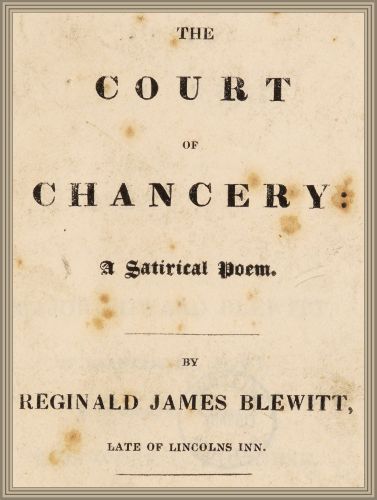
THE
C O U R T
OF
C H A N C E R Y:
A Satirical Poem.
—————
BY
REGINALD JAMES BLEWITT,
LATE OF LINCOLNS INN.
—————
When justice halts, and right begins to fail;
E’en then the boldest start from public sneers,
Afraid of shame, unknown to other fears;
More darkly sin, by satire kept in awe,
And shrink from ridicule, if not from law. Byron.
============
LONDON:
PRINTED AND PUBLISHED BY J. KAY, 1, WELBECK STREET,
CAVENDISH SQUARE.
1827.
TO
MAJOR EDWARD BLEWITT,
OF LLANTARNAM ABBEY,
In the County of Monmouth,
THIS WORK IS INSCRIBED,
WITH EVERY SENTIMENT OF FILIAL AFFECTION,
BY HIS SON,
THE AUTHOR.
PREFACE.
============
The great delay and ruinous expenses of a Chancery suit have become proverbial. Shame to the country, that suffers such a stain upon its system of equitable jurisprudence! I offer no apology for taking up the tomahawk of censure against this dire national enemy. Would that I could use the weapon more dexterously! It must, however, be sufficient satisfaction for me to have removed the scalp of concealment, without being too particular about the skill, with which it has been effected.
As a poet, I must throw myself upon the indulgence of the public. For the last ten years I have sacrificed every literary attainment to the study of the law; and am therefore in the situation of a miner, who, after years of cheerless labour underground, should be expected to display any great ingenuity in the pursuit of a more enlightened occupation.
The subject is dull, but not unfruitful. I have thrown into the work as much amusement as my poor abilities would furnish me with, but my principal objects have been truth and consistency.—I presume, therefore, to assert that I have always been honest in commendation, and never severe without reason.
I wish it to be distinctly understood that, in my character of a vicious attorney, I do not mean to represent the profession at large. There are in town and country many upright practitioners, of whose friendship I should feel proud. A lawyer, however, may be often dishonest without the fear of detection, and indeed almost without the consciousness of doing wrong. In his practice the boundaries between good and evil are very slight, and may be imperceptibly transgressed. There is little merit in one, whom the fear of punishment deters from the commission of crime; but not to practice knavery when it can be done with ease and infinity is at all events a negative virtue deserving of no slight consideration.
The idea of writing this poem first occurred to me in the Park of Fontainebleau, where I composed the greater part of it. During its progress I have had no opportunity of referring to any publication on the subject, and have, therefore, been compelled to draw very largely on my memory. This must be my excuse for any errors into which I may have fallen.
PREFACE TO THE NOTES.
============
The evils of the Court of Chancery have latterly been so much discussed, that I have thought it unnecessary to enter into long explanations upon the different objects of censure contained in the poem. The notes, therefore, contain only such observations as appeared absolutely necessary to make some of the verses more intelligible than could be effected in poetry, without a very tedious and dull circumlocution. The books of Chancery, practice and the report of the commissioners appointed to investigate the subject, will supply all deficiencies of this sort.
R. I. B.
THE COURT
O F C H A N C E R Y :
A Satirical Poem.