
Original
XIX. The Greedy Boy.
Sammy Smith would drink and eat
From morning unto night;
He fill'd his mouth so full of meat,
It was a shameful sight.
Sometimes he gave a book or toy,
For apple, cake, or plum;
And grudg'd if any other boy
Should taste a single crumb.
Indeed he ate and drank so fast,
And us'd to stuff and cram,
The name they call'd him by at last,
Was often Greedy Sam.
Original
XX. Disappointment.
Mamma shall we visit Miss Hammond to-day?
As seated at breakfast, exclaim'd little Ann:
The morning is fine, and the sun's very bright;
And I hope you will go, dear Mamma, if you can;
For I've felt so much pleasure to think of the play
I shall have at her house all the time that we stay,
That I've scarcely been able to sleep all the night.
So earnest was Ann in her wish to go out,
That when she was silent her looks seem'd to ask;
And to coax her mamma, then she climb'd on
her knee,
And kiss'd her and promis'd to learn all her task,
They went and Miss Ann was delighted no doubt,
Till she found Mr. Hammond confin'd by the gout,
And his daughter from home, that she wanted to
see.
Now homeward returning Ann said with a sigh,
Mamma, how unlucky our visit to-day;
I expected such pleasure to meet with Annette;
She is always so kind and good humour'd at play,
And I'm so disappointed I'm ready to cry.
Her mamma made a soothing and tender reply,
And taught her to bear what's in vain to regret.
Original
XXI. Drawing Teeth.
Miss Lucy Wright, though not so tall,
Was just the age of Sophy Ball;
But I have always understood,
Miss Sophy was not half so good;
For as they both had faded teeth,
Their teacher sent for Doctor Heath;
But Sophy made a dreadful rout,
And would not have hers taken out;
But Lucy Wright endured the pain,
Nor did she ever once complain,
Her teeth return'd quite sound and white,
Whilst Sophy's ach'd both day and night.
Original
XXII. Look at your Copy.
'|When Frances goes to school, to write,
I find, with great concern,
She never takes the least delight
To really strive to learn.
Some lines she makes are much too short,
And some she makes too long;
The copy's seldom where it ought,
Which makes her write quite wrong.
Such negligence I always see
With very great concern;
And think what pleasure there would be
To see her daily learn!
Original
XXIII. Envy, a Fable.
A Parrot that liv'd at a gentleman's house,
Could chatter and sometimes lie still as a
mouse.
He was hung at the door in a cage that was gay,
And treated with plenty one fine sunny day,
When the Cat, thro' mere envy, was thus heard
to say,
Pray, sir, do you live on these excellent things,
Because you're a bird, and have feathers and wings?
If a Cat is in want of a dinner that's nice,
She must hunt in the garret or cellar for mice.
The Parrot, observing the Cat in a rage,
Said, pray Mrs. Puss, are you fond of a cage;
Should you like to be kept in a prison like me,
And never permitted your neighbours to see?
Depriv'd of all means of assisting yourself,
Though numberless dainties in sight on the shelf?
Should you like to be fed at the will of a master,
And die of neglect or some cruel-disaster?
You cannot believe it more happy to be,
A parrot encaged, than a cat and quite free.
The cat was convinced that this reasoning was true,
And, ashamed of her envy, in silence withdrew.
Original
XXIV. The Letter.
When Sarah's papa was from home a great way,
She attempted to write him a letter one day!
First ruling the paper, an excellent plan;
In all proper order Miss Sarah began.
She said "She lamented sincerely to tell,
That her dearest mamma had been very unwell,
That the story was long, but that when he came
back,
He would hear of the shocking behaviour of Jack."
Though an error or two we by chance may detect,
It was better than treating papa with neglect;
For Sarah, when older, we know will learn better,
And write single I, with a capital letter.
Original
XXV. Honour.
As Dick and Bryan were at play
At trap, it came to pass,
Dick struck the ball so far away,
He broke a pane of glass.
Though much alarm'd, they did not run,
But walk'd up to the spot;
And offer'd for the damage done;
What money they had got.
When accidents like this arise,
Dear children! this rely on,
All honest, honourable boys
Will act like Dick and Bryan.
Original
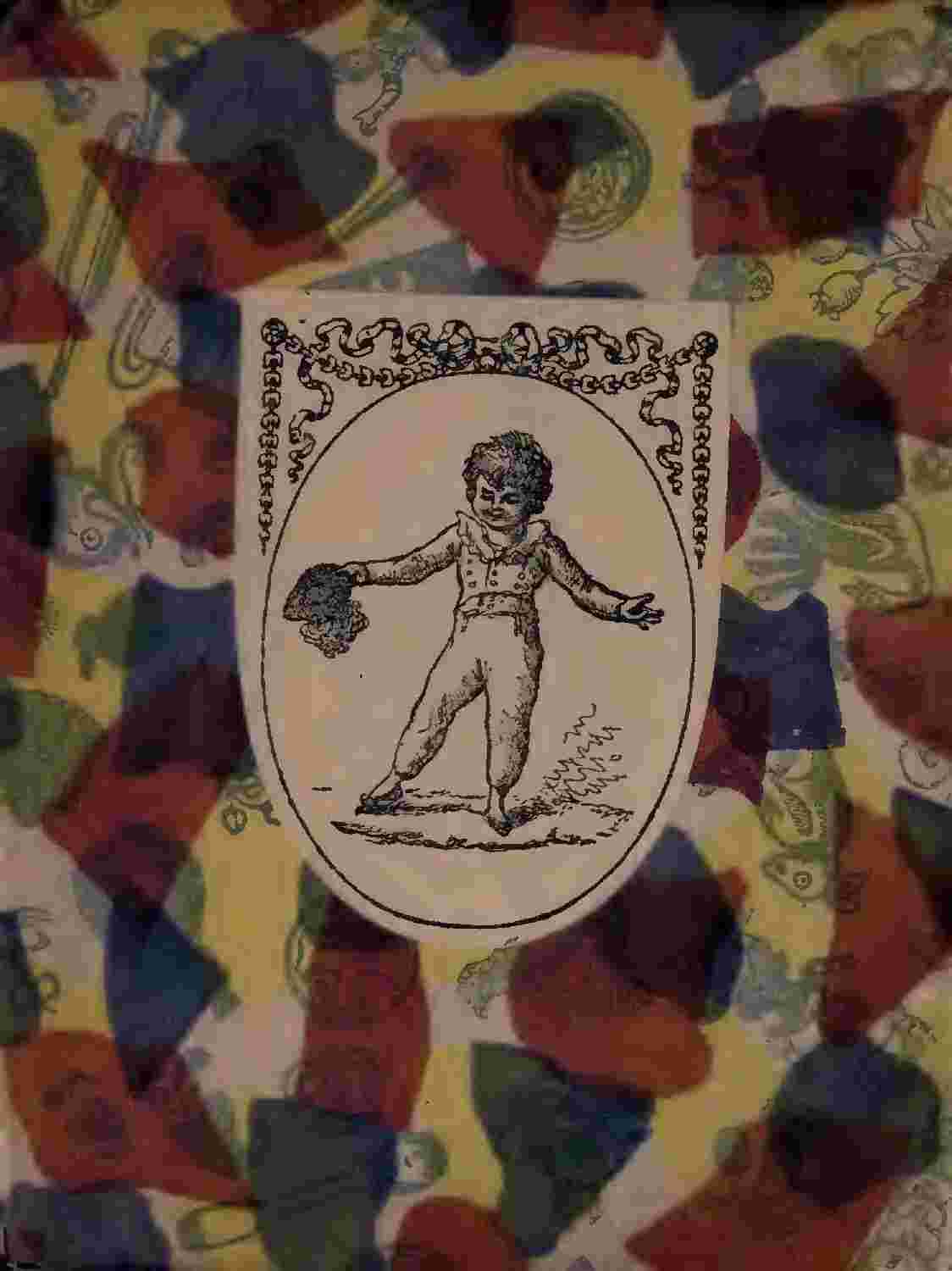
XXVI. Dancing.
O dear, I must wear my red slippers to-day,
And where are my gloves, and my parasol,
pray?
I'm always delighted when Friday is come,
For I like dancing better than staying at home.
But my mother says dancing was never design'd,
To be to positions and stepping confin'd,
But dancing should teach us in every place,
When standing or walking to do it with grace.
Original
XXVII. The Sensitive Figure.
Dear Uncle! whisper'd William Brown,
Pray will you give me half-a-crown,
I've seen a very curious toy,
I want to buy.
Charles Mansfield laid it on his hand,
And seemingly, at his command
It mov'd as though his voice were known,
And tumbled down.
His uncle said, to gain this prize,
You first must do your exercise:
When that's correct, you then shall buy
This curious toy.
Original
XXVIII. The Daisy.
Papa, said Eugene, is a daisy a book?
I thought it was only a flower;
Just now I ran down in the meadow, and look,
I have found one all wet with a shower.
A book would be spoil'd, you know, left in the
rain;
And could not be read for the dirt?
But a daisy all day in the wet may remain,
Without in the least being hurt.
You are right, said papa, with a smile, but you'll
find
The Daisy a book, my boy, too,
Containing short tales for the juvenile mind,
And adapted for children like you.
And call'd as it is by so humble a name,
This hint indirectly conveys;
Like the flow'ret it spreads, unambitious of fame,
Nor intrudes upon critical gaze.
Original
XXIX. Quarrelsome Children.
THE currants were ripe, and the gooseberries red,
And very few strawberries left on their bed:
Sweet blossoms and buds were beginning to shoot,
And some were decaying and changing to fruit.
When Charlotte and George in the garden were
seen,
To walk hand in hand where the gravel was clean,
How pleasing to see them good humoured and
merry;
Their cheeks had the bloom of the rose or the
cherry.
When a butterfly roving, that George chanc'd to
see,
Made these happy children at length disagree:.
For he, quite delighted, did all in his power
To catch it when perch'd on a beautiful flower;
And Charlotte his sister was angry at that,
And stopp'd little George, and ran off with his hat.
Quarrelsome Children.
(continued.)
To their mother at last in the parlour they ran,
And noisily speaking together began,
"George shan't catch the butterfly, I'm sure of
that."
"I will catch the butterfly; give me my hat!"
Such quarrelsome children, the mother replied,
I find it much better all day to divide:
Go, stand in that corner, and George do you stand
In another, and each hold a rod in your hand.
Though both had been naughty, 'tis proper to say,
They did not their mother's commands disobey:
They went to their corners and own'd before long,
For brother and sister to quarrel is wrong.
Original
XXX. The Hymn.
To thee, Almighty God! I raise
My heart and voice in prayer and praise;
I ask of thee, in humble prayer,
That thou wilt keep me in thy care.
I beg for grace, that I may shun,
All thou forbiddest to be done:
And ever doing what is right,
Be blest in thy protecting sight.
Almighty Lord! O let me prove
My adoration and my love,
By walking in thy holy way,
For ever more, O Lord! I pray.