
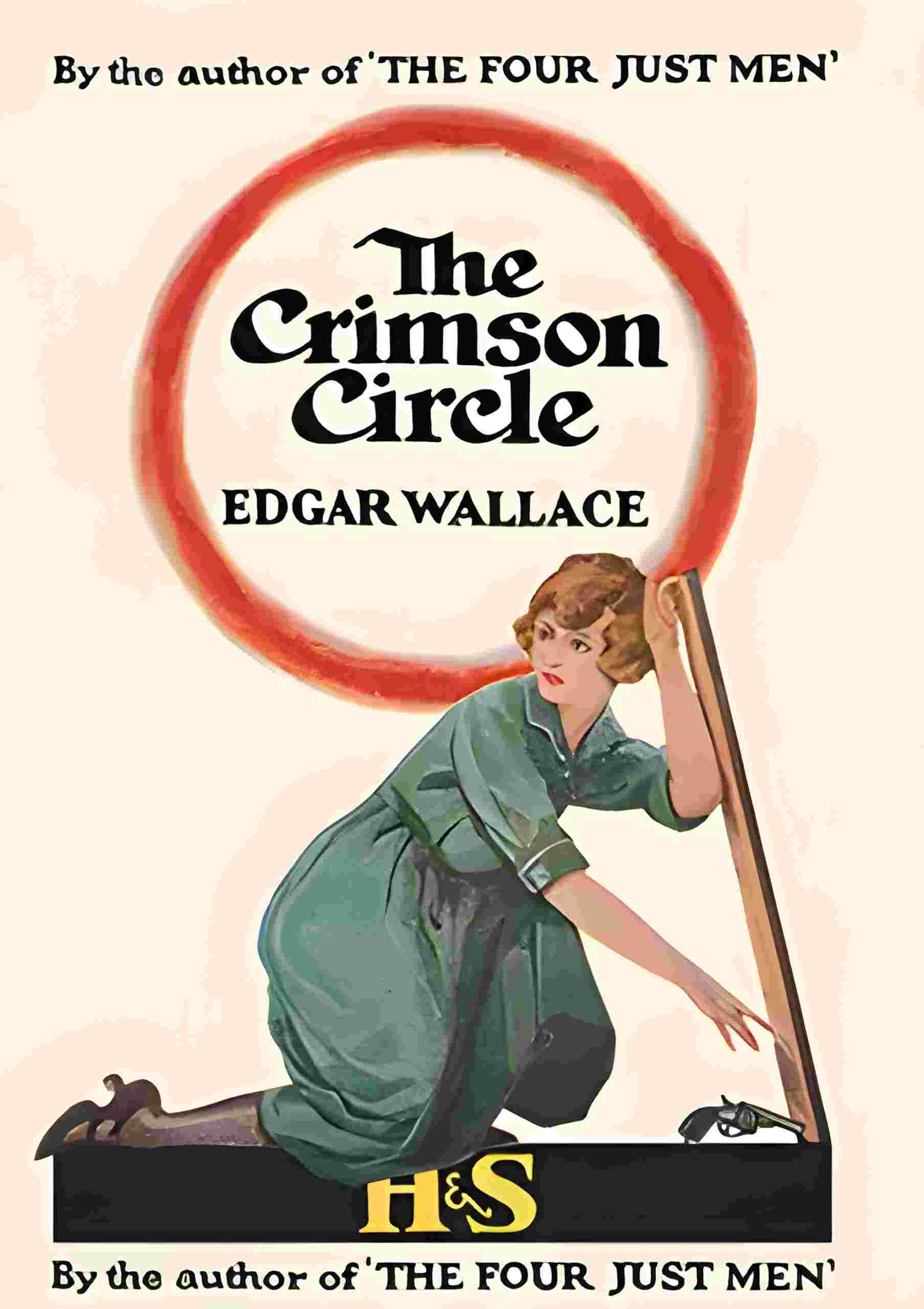
Chapter XXI.
River House
Thalia went straight back to the office and found Derrick Yale sitting in his room reading through a heap of unanswered correspondence.
“Is that the key? Thank you. Put it down there,” he said. “I am afraid you will have to answer most of these yourself. The majority of them are from foolish young people who wish to be trained as private detectives. You will find a form reply, and you can sign the answers yourself. And will you tell this lady,” he handed a letter across to her, “that I am so busy now that I cannot undertake any further commissions?”
He took up the key from the table and held it for a second on his hand.
“You saw Mr. Parr?”
She laughed.
“You’re almost terrifying, Mr. Yale. I did see Mr. Parr, but how did you know?”
He shook his head smilingly.
“It is really very simple, and I should take no credit for my gift,” he said, “any more than you take credit for your good looks and your predisposition to—shall I say ‘take things as you find them’?”
She did not answer at once, then:
“I am a reformed character.”
“I believe you will reform in time. You interest me,” said Yale, and then, after a pause, “immensely!” And with a jerk of his head he dismissed her.
She was in the midst of her work and her typewriter was clacking furiously when he appeared at the door of his room.
“Will you try to get Mr. Parr on the telephone?” he said. “You will find his number on the register.”
Mr. Parr was not in his office when she called, but half an hour later she reached him, and switched through the wire to the next room.
“Is that you, Parr?”
She heard his voice through the door, which was left ajar.
“I am going to Beardmore’s river property to make a search. I have an idea that Brabazon may be hiding there! … After lunch; all right. Will you be here at half-past two?”
Thalia Drummond listened and made a shorthand note on her blotting-pad.
At half-past two Parr called. She did not see him, for there was a direct entrance to Yale’s room from the corridor without, but she heard the rumble of his voice, and presently they went out.
She waited until their footsteps had died away, then she took a telegraph form, and addressing it to Johnson, 23, Mildred Street, City, she wrote:
“Derrick Yale has gone to search Beardmore’s riverside house.”
Thalia Drummond was nothing if not dutiful.
* * * *
The house stood upon a little wharf, and was a picture of desolation and neglect. The stone foundation of the wharf was in decay, the parapet broken, the yard a wilderness of weed; rank grasses and nettles formed almost an impenetrable barrier to their progress after they had opened the gate which led from the mean east-end street in which the wharfage was cited.
The house itself might at one time have been picturesque, but now, with its broken lower windows, its weather-stained woodwork and discoloured walls, it was a pitiable piece of architectural wreckage.
At one end was a big, gaunt, stone store, built flush with the wharf’s edge, and apparently communicating with the house. An air-raid during the war had demolished one corner of the wall, and robbed it of a few slates which remained, leaving the skeleton of rotting roof ribs nakedly bare to inspection.
“A cheerful place,” said Yale, as he opened the door. “It is not the sort of setting in which one could imagine the elegant Brabazon, is it?”
The passage-way was dusty. Cobwebs hung from the ceiling and the house was silent and lifeless. They made a rapid tour through the rooms, without, however, discovering any sign of the fugitive.
“There is a garret here,” said Yale, pointing to a flight of steps that led to a trap-door in the ceiling of the upper floor.
He ran up the steps, pushed open the flap and disappeared. Parr heard him walking along and presently he came down.
“Nothing there,” he said as he slammed the trap-door in its place.
“I never expected that you would find anything,” said Parr as he led the way out of the house.
They crossed the weed-grown path to the outer gate, and from a garret window a white-faced man watched them through the dusty glass; a man with a week’s growth of beard, whom even his most intimate friends would never have recognised as Mr. Brabazon, the well-known banker.
Chapter XXII.
The Messenger of The Circle
“You’re a fool, sir, and an idiot. I thought you were a clever detective, but you’re a fool!”
Mr. Froyant was in his most savage mood, and the neat stack of bank-notes which stood upon his desk supplied the reason.
The sight of so much good money going away from him was a cause of unspeakable anguish to the miserly Harvey, and if his eyes strayed away from that accumulation of wealth, they came back again almost instantly.
Derrick Yale was a difficult man to offend.
“Perhaps I am,” he said, “but I must run my own business in my own way, Mr. Froyant, and if I think that the girl can lead me to the Crimson Circle—as I do think—then I shall employ her.”
“Mark my words,” Froyant shook his fingers in the detective’s face, “that girl is with the gang. You will discover, my friend, that she is the messenger who will call for the money!”
“In which case she will be immediately arrested,” said the other. “Believe me, Mr. Froyant, I have no intention of losing sight of these notes, but if they are taken by the Crimson Circle, the responsibility must be mine not yours. My job is to save your life, and to divert the vengeance of the Circle from you to myself.”
“Quite right, quite right,” said Mr. Froyant hastily, “that is the proper way to look at it, Yale. I see that you are not as unintelligent as I thought. Have it your own way,” he said. He fingered the notes lovingly, and putting them into a long envelope, handed them, with every evidence of reluctance, to the detective, who slipped the package into his pocket.
“I suppose there is no news of Brabazon? The rascal has robbed me of over two thousand pounds, which I foolishly invested in one of Marl’s rotten concerns.”
“Did you know anything about Marl?” asked the detective, opening the door.
“I only know that he was a blackguard.”
“Did you know anything that isn’t as well known?” asked Yale patiently. “His beginnings, where he came from?”
“He came from France, I believe,” said Froyant. “I know very little about him. In fact, it was James Beardmore who introduced me. There was some story about his having been concerned in land swindles in France, and of having been imprisoned there, but I never take much notice of gossip. He was useful to me, and I made quite a considerable sum out of most of my investments with him.”
The other smiled. In those circumstances, he thought, the miser might very well forgive the erring Marl for his later losses.
When he got back to his office he found Parr waiting, with Jack Beardmore.
He had not expected a visit from the younger man, and guessed that the real attraction was Thalia Drummond, for whose absence he tactfully apologised.
“I’ve sent Miss Drummond home, Parr,” he said. “I don’t want a girl mixed up in the business of this afternoon. There may be a little rough-and-tumble work.”
He looked keenly at Jack Beardmore.
“For which I hope you are prepared.”
“I shall be disappointed if there isn’t,” said Jack cheerfully.
“What is your plan?” asked Parr.
“I am going into my room a few minutes before the messenger is due to arrive. I shall have both doors locked, that into the passage and that into this outer office. In the case of this door, I will leave the key on your side and ask you to lock me in. My object, of course, is to prevent a surprise. As soon as you hear a knock, and hear me rise and go to the door and unlock it, you will know that the visitor has arrived, and when the door closes again, I want you to station yourself outside in the corridor.”
Parr nodded.
“That seems simple,” he said. He walked to the window, looked out, and waved a handkerchief, and Yale smiled approvingly.
“I see you have taken the necessary precautions. How many men have you?”
“I think there are eighty,” said Mr. Parr calmly, “and they will practically surround the place.”
Yale nodded.
“We have to remember,” he said, “that the Crimson Circle may send a very ordinary district messenger, in which case, of course, he must be followed. I am determined that the money shall pass into the hands of the chief of the Crimson Circle himself—that is an essential.”
“I quite agree,” said Parr, “but I have an idea that the gentleman, or whoever he is, will not come himself. May I look at your office?”
He walked in and inspected the room. It was lighted by one window. In a corner was a cupboard, the door of which he opened. It was empty save for a hanging coat.
“If you don’t mind,” Inspector Parr was almost humble, “I want you to stay in the outer office. Thank you, I’ll close the door on you. I get rattled if I am overlooked.”
Laughingly Yale walked from the office, and Mr. Parr closed the door on him. He opened the second door, and looked out into the corridor. Presently they heard him close that also.
“You can come in,” he said, “I’ve seen all I want.”
The room was simply but comfortably furnished. There was a wide fireplace, in which, however, no fire burnt, although the day was chilly.
“I don’t expect him to get up the chimney,” said Yale, humorously, as he noticed the detective’s inspection, “I never have a fire in this office; I’m one of those hot-blooded mortals who are never really cold.”
Jack, a fascinated observer of the search, picked up the deadly little pistol that lay on the detective’s table, and examined it cautiously.
“Be careful, that trigger is a little sensitive,” said Yale.
He took from his pockets the envelope containing the notes, and laid them by the side of the weapon. Then he looked at his watch.
“Now I think that to be on the safe side we should go to the other office, and lock the door,” he said.
He accompanied his words by locking the door into the corridor.
“It is rather thrilling,” whispered Jack. He felt that a whisper was the fitting tone for that exciting moment.
“I hope it won’t be too thrilling,” said Yale.
They went to the outer office, and turned the key on him, and sat down—Jack unconsciously on Thalia Drummond’s chair, a fact which he realised with a start.
Was she of the Crimson Circle, he wondered? Parr had hinted as much. Jack set his teeth; he could not, and would not believe even the evidence of his own eyes, and his own common sense. So far from her influence waning, it was gathering strength. She was a being apart, and if she was guilty——
He looked up, and saw Parr’s eyes fixed upon him.
“I don’t pretend to be psychometrical,” said the detective slowly, “but I’ve an idea you’re thinking about Thalia Drummond.”
“I was,” admitted the young man. “Mr. Parr, do you think she is really as bad as she appears to be?”
“Do you mean, do I think that she stole Froyant’s Buddha, because if that’s what you mean, it is not a question of thinking, I am certain.”
Jack was silent. He could never hope to convince this stolid man of the girl’s innocence and anyway it was madness, he recognised, to think of her as innocent when she had confessed her fault.
“You had better keep quiet in there.” It was Yale’s voice, and Parr grunted a reply.
Thereafter they sat in dead silence. They heard him moving about the room, then he too was quiet, for the hour was approaching. Inspector Parr pulled his watch from his pocket, and laid it on the table; the hands pointed to half-past three. It was now that the messenger was due and he sat, his head strained forward, listening, but there was no sound of attack.
Presently there was a noise in Yale’s room, a queer bumping noise as though Yale had sat down heavily.
Parr jumped to his feet.
“What was that?”
“It is all right,” said Yale’s voice, “I stumbled over something. Be quiet.”
They sat for another five minutes, and then Parr called:
“Are you all right, Yale?”
There was no answer.
“Yale!” he called more loudly. “Do you hear me?”
There was no reply and springing to the door he snapped the lock, and rushed into the room, Jack at his heels.
What they saw might have paralysed even a more experienced officer than Inspector Parr.
Stretched upon the ground, his wrists fastened with handcuffs, his ankles strapped, and a towel over his face lay the prostrate figure of Derrick Yale. The window was open, and there was a strong scent of ether and chloroform. The package of money which had lain upon the table had disappeared. Three seconds later, an aged postman left the hall of the building, carrying his letter-bag on his shoulder, and the police who were watching the house, let him pass without question.
Chapter XXIII.
The Woman in the Cupboard
Parr bent down, and snatched the saturated towel from the detective’s face, and he opened his eyes, and stared around.
“What is it?” he asked thickly, but the inspector was busy unscrewing the handcuffs. Presently he threw them clanking to the floor, and lifted the man to his feet, as Jack, with trembling fingers, unbuckled the straps about Yale’s legs.
They led him to his chair, and he fell heavily into its depths, passing his hand across his forehead.
“What happened?” he asked.
“That’s what I’d like to know,” said Parr. “Which way did they go?”
The other shook his head.
“I don’t know, I can’t remember,” he said. “Is the door locked?”
Jack ran to the door. The key was turned from the inside. He could not have gone that way, but the window was open. That was the first thing Parr had seen when he entered the room.
He ran to the window, and looked out. There was a sheer fall of eighty feet, and no sign of a ladder or of any means by which Yale’s assailant could have escaped.
“I don’t know what happened,” said Yale, when he had partially recovered. “I was sitting in this chair when suddenly a cloth was pulled across my face, and two powerful hands gripped me with a strength which I shouldn’t have thought possible in any human being. Before I could struggle or cry out I must have lost consciousness.”
“Did you hear my call?” asked Parr.
The other man shook his head.
“But, Mr. Yale, we heard a noise and Mr. Parr asked if you were all right. You replied that you had only stumbled.”
“It was not me,” said Yale. “I remember nothing from the moment the cloth was put on my face until the moment you found me here.”
Inspector Parr was at the window. He pulled down the sash, and he pushed it up again, and then he looked on the window-sill, and when he turned there was a large smile on his face.
“That is the cleverest thing I’ve ever seen,” he said.
Something of Jack’s old antipathy to the stout detective returned.
“I don’t think it is particularly clever. They’ve half-killed Yale, and they’ve got away,” he said.
“I said it was clever, and it was clever,” said Mr. Parr stolidly, “and now I think I’ll go down, and interview the officers I left on duty in the hall.”
But the watching officers had nothing to say. Nobody had entered or left the building except the postman.
“Except the postman, eh?” said Parr thoughtfully. “Why, of course, the postman! All right, sergeant, you can dismiss your men.”
He went up in the elevator and rejoined Yale.
“The money’s gone all right,” he said. “I don’t know what we can do except report the matter to head-quarters.”
Yale was now nearly his normal self, and sat at his desk with his head resting on his hands.
“Well, I’m the culprit this time,” he said, “and they can’t blame you, Parr. I’m still trying to puzzle out how they got into that window, and how they reached me without making a sound.”
“Was your back to the window?”
Yale nodded.
“I never dreamt of the window. I sat so that I could see both doors.”
“Your back was also to the fireplace?”
“They couldn’t have come that way,” said the other, shaking his head. “No, this is the supreme mystery of my career; more astounding than the identity of the Crimson Circle,” he got up slowly, “I must report this to old man Froyant, and you had better come along and lend me your moral support,” he said. “He will be furious.”
They left the office together, Yale locking both doors and slipping the key into his pocket.
To say that Mr. Froyant was furious is to employ a very mild expression to describe his hectic frenzy.
“You told me, you practically promised me,” he stormed, “that the money would come back to me, and now you have come with a cock-and-bull story of being drugged. It is monstrous! Where were you, Parr?”
“I was on the premises,” said Mr. Parr, “and the story Mr. Yale has told is correct.”
Suddenly Froyant’s rage died down, so suddenly that the calmness of his voice was almost startling after its previous rancour.
“All right,” he said, “nothing can be done. The Crimson Circle have had their money, and that is the end of it. I’m much obliged to you, Yale. Please send your bill to me.”
And with these brusque instructions, he sent them to rejoin Jack, who was waiting in the street outside.
“Well, that beats the band,” said Parr. “I thought at one time he was going to have a fit, and then did you notice how his manner changed?”
Yale nodded slowly.
At the moment of Froyant’s change of manner a great idea was formed in his mind, a tremendous and startling doubt that was almost paralysing.
“And now,” said Parr good-humouredly, “as I have given you moral support, perhaps you will extend the same service to me. At police head-quarters I am not so much persona grata as you. Come along and see the Commissioner and tell him what happened.”
* * * * *
Derrick Yale’s office was silent and deserted. Ten minutes had passed since the drone of the elevator announced the departure of the three men. The silence was broken by a click, and slowly the doors in the big cupboard in the corner of Derrick Yale’s office were pushed open and Thalia Drummond came out. She closed the doors behind her and stood for a while contemplating the room, deep in thought. From her pocket she took a key, opened the door and, passing into the corridor, locked the door behind her.
She did not ring for the elevator. At the farther end of the passage was a flight of narrow stairs which communicated with the caretaker’s room, on the top floor, and which were used only by him. Down these she went. At the bottom was a door leading into the courtyard of a building. This, too, she unlocked and soon after had joined the throng of homeward bound clerks that thronged the pavement at this hour.
Chapter XXIV.
£10,000 Reward
“The Associated Merchants Bank are authorised to offer a reward of ten thousand pounds for information which will lead to the arrest and conviction of the leader of what is known as the Crimson Circle Gang. In conjunction with this reward the Secretary of State promises a free pardon to any member of the gang, other than one actually guilty of wilful murder, providing that the said member will furnish the information and evidence requisite to the conviction of the man or woman known as the Crimson Circle.”
On every hoarding, in every post office window, on every police station board, the announcement flared in blood-red print.
Derrick Yale, on his way to his office, saw the announcement and read it and passed on, wondering what effect this would have upon the minor members of the gang he had been engaged to hunt.
Thalia Drummond read it from the top of a bus, when that vehicle had pulled up close to a hoarding, to take on a passenger, and she smiled to herself. But the most remarkable effect of the poster was upon Harvey Froyant. It brought a colour to his face and a light to his eye which made him almost youthful. He, too, was on his way to the office when he read the announcement, but hurried back to his house and took from a drawer in his study a long list. They were the numbers of the bank-notes which the Crimson Circle had taken, and he had compiled them laboriously, almost lovingly.
With his own hands he now made another copy, a work that occupied him until late in the morning. When he had finished he wrote a letter, and enclosing the new list of notes, he addressed it, posting the letter himself, to a firm of lawyers which he knew specialised in the tracing of lost and stolen property.
Heggitts’ had rendered him good service before, and the next morning brought a representative of the firm, Mr. James Heggitt, the senior partner, a wizened little man with a chronic sniff.
The name of Heggitt was not one which was universally respected, nor did lawyers, when they met, speak of it with affection or regard. And yet it was one of the most prosperous firms of lawyers in the city. The majority of its clients were on or over the border-line which separates the lawful from the unlawful, but to the law-abiding also it was very useful, and was frequently consulted by more eminent firms whose clients wished to recover valuable goods which had been taken by the light-fingered gentry. In some mysterious way Heggitts’ could always place their finger upon a “gentleman” who had “heard” of the property which was lost, and, in the majority of cases, the missing article was restored.
“I got your note, Mr. Froyant,” said the little lawyer, “and I can tell you now that none of these notes are likely to go through the usual channels.” He paused and licked his lips, looking past Mr. Froyant. “The biggest ‘fence’ of all has gone, so I’m not doing him any injustice when I mention the fact.”
“Who was that?”
“Brabazon,” was the startling reply, and the other stared at him in astonishment.
“You don’t mean Brabazon of Brabazon’s Bank?”
“Yes, I do,” said Heggitt, nodding. “I should say he did a bigger business in stolen money than any other man in London. You see, it could pass through his bank without anybody being the wiser, and as he did a lot of business abroad and was constantly changing and re-changing money for export, he got away with it. We knew who was fencing it. At least, when I say we knew,” he corrected himself, “we had a shrewd suspicion. As officers of the court, we should, of course, have notified the authorities had we been certain. I thought it better to call to explain to you that it is going to be a very difficult job to trace this money. Most stolen notes are passed on race-courses, but quite a considerable number find their way abroad, where it is a much simpler matter to change them, and where they are ever so much more difficult to trace. You say it was the Crimson Circle who did it?”
“Do you know them?” asked Froyant quickly.
The lawyer shook his head.
“I have never had any dealings with them at all,” he said, “but, of course, I knew about them, and enough to know that they are clever people. It is likely that this man Brabazon has been doing their work, consciously or unconsciously. In that case they might find a difficulty in disposing of the stuff, for a bank-note ‘fence’ is one of the hardest to find. What am I to do when I track one of these notes and have discovered the person who passed it?”
“I want you to notify me at once,” said Froyant, “and nobody else. You understand that this is a matter on which my life may hang, and if by any chance the Crimson Circle get to know that I am trying to recover the money it will be a very serious thing for me.”
The lawyer agreed.
The Crimson Circle apparently interested him, for he lingered, and skilfully plied his employer with questions without Mr. Froyant realising that he was being pumped.
“They are something new in criminals,” he said. “In Italy, where the Black Hand thrives, the demand for money, followed by a threat of death, is quite a common occurrence, but I should not have thought it possible in this country. The most amazing thing of all is that the Crimson Circle holds together. I should imagine,” he said thoughtfully, “that there is only one man in it, and that he employs a very considerable number of people unknown to one another and each having his particular job to perform. Otherwise he would have been betrayed a long time ago. It is only the fact that the people serving him do not know him that makes it possible for him to carry on.”
He took up his hat.
“By the way, did you know Felix Marl? A client of ours is under charge of burgling his house. Mr. Barnet. You may not have heard of him.”
Mr. Froyant had not heard of “Flush” Barnet, but he knew Marl, and Marl interested him almost as much as the Crimson Circle interested the lawyer.
“I knew Marl. Why do you ask?”
The lawyer smiled.
“A strange character,” he said. “A remarkable character in many ways. He was a member of the gang engaged in frauds on French banks. I suppose you didn’t know that? His lawyer came to see me to-day. Apparently a Mrs. Marl has turned up to claim his property, and she has told the whole story. He and a man named Lightman made a fortune in France until they were caught. Marl would have been sent to the guillotine, only he turned State’s evidence. Lightman, I believe, went to the knife.”
“What a charming man Mr. Marl must have been!” said Mr. Froyant ironically.
The little lawyer smiled.
“What charming people we all are when our lives are laid bare!” he said, and Mr. Froyant resented the implied censure, for it was his boast that his life was a book. He might have added in truth a bank-book.
So Brabazon was a dealer in stolen notes and Marl a convicted murderer! Mr. Froyant wondered how Marl managed to escape from his term of imprisonment, which must have been a severe one, and he inwardly rejoiced that his business relationships with the deceased had not ended even more disastrously than they had.
He dressed and went to his club to dine, and his car was running into Pall Mall when a hoarding poster showed under the light of a lamp and reminded him of the unpleasant fact that he was a fifty-thousand pounds poorer man that night than he had been in the morning.
“Ten thousand reward!” he muttered. “Bah! Who is going to turn King’s evidence? I don’t suppose even Brabazon would dare.”
But he did not know Brabazon.
Chapter XXV.
The Tenant of River House
Mr. Brabazon sat in a chill upper room of River House, eating slowly a large portion of bread and cheese. He wore the dress suit he was wearing when the warning came to him, and he was a ludicrous figure in the smartly-fitting, but now soiled and dusty garb. His white shirt was grey with the grime of the house, he was collarless, and his general air of dissipation was heightened by the stubbly beard that decorated his face.
He finished his repast, opened the window carefully and threw out the remnants of bread, and passing through the trap-door, he descended the ladder and made his way to the big kitchen at the back of the house. He had neither soap nor towel, but he made some attempt to wash himself without their aid, utilising one of the two handkerchiefs he had brought with him to the house in his flight. With the exception of the clothes he stood up in, an overcoat and the soft felt hat he had seized when he made his escape, he was quite unequipped for this undesirable adventure.
The provisions which the mystery man had brought the night after he had reached his hiding place were almost exhausted (he had spent twenty-four hours without any food whatever, but in his agitation had not realised the fact until the stranger arrived carrying a basket of foodstuffs). As to his nerves, they were almost gone. A week spent in that hovel without communion with man, with the knowledge that the police were searching for him, and that a long term of imprisonment would automatically follow his capture, had played havoc with his placid features, and to the solitude had been added the terror of a search.
He had shrunk in a corner behind a door which opened to the inner room leading to the garret whilst the detective had explored the room. The memory of Derrick Yale’s visit was a nightmare.
He settled himself down in the old chair that he had found in the house, to spend yet another night. The man whose warning had sent him flying to cover must come soon, and must bring more food. Brabazon was dozing when he heard the sound of a key put into the lock below and jumped up. He tiptoed carefully to the trap-door and lifted it and then he heard the booming voice of the stranger.
“Come down,” it said, and he obeyed.
The previous interview had been in the passage where the darkness seemed thicker than anywhere else in the house. He had accustomed himself to the darkness and walked down the rickety stairs without mishap.
“Stay where you are,” said the voice. “I have brought you some food and clothing. You will find everything you need. You had better shave yourself and make yourself presentable.”
“Where am I going?” asked Brabazon.
“I have taken a berth for you on a steamer leaving Victoria Dock to-morrow for New Zealand. You will find your passport papers and ticket in the grip. Now listen. You are to leave your moustache, or what there is of it unshaven, and shave your eyebrows. They are the most conspicuous features of your face.”
Brabazon wondered when this man had seen him. Mechanically his hand stole up to his shaggy eyebrows and mentally he agreed with the mysterious visitor.
“I have not brought you any money,” the voice went on. “You have sixty thousand which you stole from Marl—you closed his account, forging his name to a cheque, believing that I would settle with him—as I did.”
“Who are you?” asked Brabazon.
“I am the Crimson Circle,” was the reply. “Why do you ask that question? You have met me before.”
“Yes, of course,” Brabazon muttered. “I think this place is driving me mad. When may I leave this house?”
“You may leave to-morrow. Wait until nightfall. Your ship leaves on the following morning, but you can get on board to-morrow night.”
“But they will be watching the ship,” pleaded Brabazon. “Don’t you think it is too dangerous?”
“There is no danger for you,” was the reply. “Give me your money.”
“My money?” gasped the banker, turning pale.
“Give me your money.” There was an ominous note in the voice that spoke in the darkness, and tremblingly Brabazon obeyed.
Two large packets of money passed into the gloved hand of the visitor, and then:
“Here, take this.”
“This” was a thinner wad of notes, and the sensitive fingers of the banker told him that they were new.
“You can change them when you get abroad,” said the man.
“Couldn’t I leave to-night?” Brabazon’s teeth were chattering now. “This place gives me the horrors.”
The Crimson Circle was evidently thinking, for it was some time before he spoke.
“If you wish,” he said, “but remember you are taking a risk. Now go upstairs.”
The order was sharp and peremptory, and meekly Brabazon obeyed.
He heard the door close, and peering through the dusty windows, he saw the dark shadow stalk along the path and disappear into the darkness. Presently he heard the gate click. The man was gone.
Brabazon groped for the bag which the other had left and, finding it, carried it to the kitchen. Here he could show a light without fear of detection, and he lit one of the scraps of candle he had discovered in his search of the house during the week.
The stranger had not exaggerated when he said that the bag contained all that Brabazon required. But the banker’s first thought was to examine the money which the other had put into his hand. They were notes of all series and all numbers. His own had been in a series, and yet they were new. He looked at them curiously. He knew that new bank-notes were not usually issued higgledy-piggledy, and then he guessed the reason. The Crimson Circle had blackmailed somebody and had asked that the notes should not be numbered consecutively. He put the money down and began to change.
It was a very smart Brabazon who stepped cautiously through the gates carrying his bag an hour later, and yet so remarkable was the change which the shaved eyebrows had made, that when, at eleven o’clock that night, he passed one of the many detective officers who were looking for him, he was unrecognised.
He had engaged a room in a small hotel near Euston Station, and went to bed. It was the first night of untroubled sleep he had enjoyed for over a week.
The next day he spent in his room, not caring to trust himself abroad in daylight, but in the evening, after a solitary meal served in his sitting-room, he went out to take the air. He was gaining in confidence, and was now satisfied that he could pass the scrutiny of the ship detective. He chose the less frequented streets and was passing near the Museum when he saw a bill newly pasted on the hoarding, and stopped to read it.
As he read, an idea took shape. Ten thousand pounds and a free pardon! It was by no means sure that he would escape in the morning; more likely was it that he would be detected, and at best what would his life be? The life of a hunted dog, for which even his money would not compensate him. Ten thousand pounds and freedom! And nobody knew about the money that he had tricked from Felix Marl’s estate. He would put that in a safe deposit in the morning, go straight to police head-quarters with information which he felt sure must lead to the Crimson Circle’s undoing.
“I’ll do it,” he said aloud.
“I think you’re very wise.”
The voice was at his elbow and he swung round.
A little, stocky man had walked noiselessly behind him in his rubber-soled shoes, and Brabazon recognised him instantly.
“Inspector Parr,” he gasped.
“That’s right,” said the inspector. “Now, Mr. Brabazon, will you come a little walk with me, or are you going to make trouble?”
As they went into the police-station, a woman came out, and the pallid Brabazon failed to recognise his former clerk. He stood in the steel pen whilst the story of his iniquities was told in the cold, official language of the warrant.
“You can save yourself a lot of trouble, Mr. Brabazon,” said Inspector Parr, “by telling me the truth. I know where you are staying—at Bright’s Hotel in the Euston Road. You arrived there late last night and your passage is booked in the name of Thomson to New Zealand by the Itinga, which is due to leave Victoria Dock to-morrow morning.”
“Good God!” said the startled Brabazon. “How did you know that?”
But here Inspector Parr did not inform him.
Brabazon did not intend lying. He told everything he knew. All that had happened from the moment he was called by telephone and told to make a get-away, until he was arrested.
“So you were in the house all the time?” said the inspector thoughtfully. “How did you come to escape Mr. Yale’s search?”
“Oh, was it Yale?” said Brabazon. “I thought it was you. There was an inner room—just a little storehouse, I think it was in the old times—I got behind the door and hid. He came almost to the door. I nearly died with fright.”
“So Yale was right again. You were there!” said the inspector speaking half to himself. “Now, what are you going to do about it, Brabazon?”
“I’m going to tell you all I know about the Crimson Circle, and I think I can give you information which will lead to his arrest. But you’ll have to be smart.”
He was recovering something of his old pomposity, Parr observed.
“I told you that he exchanged my notes for his, and his notes for mine. I’m sure he did that because he was afraid of the numbers being taken, but my notes were in a series—series E.19, and I can give you the number of every one of them,” he went on easily. “He wouldn’t change the stuff he got.”
“That was Froyant’s money, I think,” said the inspector. “Yes, go on.”
“He dare not change that, but he will change mine. Don’t you see what a chance this gives to you?”
The inspector was a little sceptical. Nevertheless, after Brabazon had been locked in the cell, he called up Froyant on the ’phone and told him as much of what had happened as was necessary for him to know.
“You’ve got the money?” said Froyant eagerly. “Come up to the house at once.”
“I’ll bring it up to the house with pleasure,” replied Parr, “but I feel I ought to warn you that this is not your money, although it is the actual cash that was transferred by you to the Crimson Circle.”
Later on, in Mr. Froyant’s presence, he explained the situation. That spare man made no attempt to hide his disappointment, for he seemed to think that in whatever circumstances the money was recovered, he was entitled to claim. After a while Inspector Parr got him into a more reasonable frame of mind. Froyant was talking quite calmly on the matter, when he suddenly broke off with the question:
“Have you the numbers of the notes which Brabazon handed to him?”
“They are easy to remember,” said Parr, “they belong to a series,” and he recited the numbers, Mr. Froyant making a rapid note on his desk-pad.
Chapter XXVI.
The Bottle of Chloroform
Thalia Drummond was writing a letter when her visitor arrived, and of the many people whom Thalia expected to call, Millie Macroy was the last. The girl looked ill and tired, but she was not so far from human that she could not stand and admire the dainty drawing-room into which Thalia showed her, her servant having gone home for the night.
“Why this is a palace, kid,” she said, and regarded Thalia with reluctant admiration. “You know how to do it all right, better than poor ‘Flush.’ ”
“And how is the elegant ‘Flush’?” asked Thalia coolly.
Millie Macroy’s face darkened.
“See here,” she said roughly, “I don’t want any kind of talk about ‘Flush’ in that tone, do you understand? He is where you ought to be. You were in it as well as him.”
“Don’t be silly. Take off your hat and sit down. Why, it’s like old times seeing you, Macroy.”
The girl grumbled something under her breath, but accepted the invitation.
“It is about ‘Flush’ I want to see you,” she said. “There’s some talk of framing a murder charge against him, but you know he didn’t commit any murder.”
“I know? Why should I know?” asked Thalia. “I didn’t even know that he was in the house until I read the newspapers in the morning—how wonderfully clever they are on the Press to get news so red-hot.”
Milly Macroy had not come to discuss the enterprise of the Press. She drove straight into her subject, which was, as Thalia had expected, “Flush” Barnet and his immediate prospects.
“Drummond, I’m not going to quarrel with you,” she said.
“I’m glad of that,” said Thalia. “I can’t exactly see what there is to quarrel about, anyway.”
“That may or may not be,” said Miss Macroy ironically. “The point is, what are you going to do for ‘Flush’? You know all these swells, and you’re working for that swine Yale,” she almost hissed. “It was Yale who put Parr up to the Marisburg Place job; Parr hadn’t got brains enough to think it out for himself. Were you working with Yale all the time?”
“Don’t make me laugh,” said Thalia scornfully. “It’s certainly true I am working for Yale, if writing his letters and tidying his desk is work. But what swells are you talking about? And what can I do for ‘Flush’ Barnet?”
“You can go to Inspector Parr and tell him the old, old story,” said Macroy. “I’ve got it all worked out; you can say that ‘Flush’ was sweet on you, saw you go into the house and followed, and couldn’t get out.”
“What about my young reputation?” asked the girl coolly. “No, Milly Macroy, you’ve got to think up something prettier and, anyway, I don’t think they’re making a charge for murder against him, from what Derrick Yale said this morning.”
She rose and walked slowly across the room, her hands clasped behind her.
“Besides, what interest have I in your young man? Why should I take the trouble of speaking for him?”
“I’ll tell you why.”
Miss Macroy rose, her hands on her hips, and glared at the girl.
“Because when the Brabazon case comes on, there’s nothing to prevent me going into the box and saying a few plain words about what you did in the way of quick money-getting when you were Brab’s secretary. Ah! That’s made you jump, miss!”
“When the Brabazon case comes on!” said the girl slowly. “Why? Have they caught Brabazon?”
“They pinched him to-night,” answered the girl triumphantly. “Parr did it: I was up at the police station making inquiries about some money that ‘Flush’ left over for me, when they brought him in.”
“Brabazon a prisoner,” said Thalia slowly. “Poor old Brab!”
Macroy was watching her through her half-closed lids. She had never liked Thalia Drummond, and now she hated her. She feared her too, for there was something sinister in her very coolness. Presently Thalia spoke.
“I’ll do what I can for ‘Flush’ Barnet,” she said. “Not because I’m scared of your going into the box—that’s the part of the police court where you’ll be least at home, Macroy—but because the poor little wretch was innocent of the murder.”
Miss Macroy swallowed something at this description of her lover.
“I’ll talk to Yale in the morning. I can’t be sure it will do any good, but I’ll get a heart-to-heart talk with him if he gives me a chance.”
“Thank you,” said Miss Macroy, a little more graciously, and proceeded to admire the flat in conventional language.
Thalia showed her from room to room.
“What’s this place?”
“The kitchen,” said Thalia, but made no attempt to open the door. The girl looked at her suspiciously.
“Have you got a friend?” she asked, and before Thalia could stop her she had opened the door and walked in.
The kitchen was a small one and empty. The electric light was burning, which suggested to Miss Macroy that the girl had left the kitchen to answer her knock.
Thalia could have smiled at the obvious disappointment on Milly Macroy’s face, but her inclination to amusement departed as Macroy walked to the sink and picked up a bottle.
“What is this?” said she, and read the label.
It was half-filled with a colourless liquid, and Miss Macroy did not attempt to take out the stopper. The label told her all she wanted to know.
“ ‘Chloroform and Ether,’ ” she read, looking at the girl. “Why have you been using chloroform?”
Only for a second was Thalia taken aback, and then she laughed.
“Well, do you know, Milly Macroy,” she drawled, “when I think of poor ‘Flush’ Barnet in Brixton Gaol, I just have to sniff something to put him out of my mind.”
Macroy banged down the bottle on the table with a snort.
“You’re a bad lot, Thalia Drummond, and one of these days they’ll be waking you at eight o’clock, and ask you if you have any message for your friends.”
“And I shall reply,” said Thalia sweetly, “bury me next to ‘Flush’ Barnet, the eminent crook.”
Miss Milly Macroy did not think of a suitable retort until she was in the Marylebone Road, and then it came to her with annoying force that, for all her interview, Thalia Drummond had promised nothing.
Chapter XXVII.
Mr. Parr’s Mother
Jack Beardmore had heard of Brabazon’s arrest, and went straight to police head-quarters to see Mr. Parr.
He found that excellent gentleman had gone home.
“If it is important, Mr. Beardmore,” said the police clerk on duty, “you will find him at home in his house at Stamford Avenue.”
Beyond his natural interest in the Crimson Circle and all that pertained thereto, Jack had no particular wish to see the inspector, and Derrick Yale had telephoned all that was known or could be told.
“Parr thinks this arrest may have an important development,” he said. “No, I haven’t seen Brabazon, but I accompany Parr to-morrow morning when he visits him.”
Yale, too, was apparently un-get-at-able; he had hinted that he had a theatre party that night, and Jack bent his steps homeward. He had sent his car away, for he felt he needed exercise to dissipate his energies, and as he crossed the gloomy park, taking a short cut to his house, he found himself wondering what sort of a home life a man like Parr could have. He had never spoken about his family, and his mode of living outside of the police head-quarters was almost as much of a mystery as that which he was trying to unravel.
Where was Stamford Avenue, he wondered. He had reached a deserted spot of the park, when he thought he heard footsteps behind him, and turned his head. He was not a nervous type, and ordinarily the sound of somebody walking in his rear would not have interested him sufficiently to make him turn. The path here skirted a dense thicket of rhododendrons. There was nobody in sight. Jack went on, quickening his pace.
He heard no more footsteps, but looking round he thought he saw a man walking on the grass by the side of the path. As Jack stopped he too halted. He was doubtful as to what he should do. To challenge the man might put him into an absurd position; there was no reason in the world why any good citizen should not walk in the park at night, or, for the matter of that, why they should not walk behind him anywhere at a respectable distance.
And then ahead of him he made out a slowly strolling figure, and heard the unmistakable “beat walk” of a policeman.
To his own amazement he felt relieved, and when he looked round, the figure that had followed him had disappeared. He tried to reconstruct his impression; whoever his tracker had been, he was smally made. At first Jack had thought it was a boy; perhaps some poor park beggar who was mustering up courage to approach him for the price of a night’s bed. It seemed absurd that he was glad to be out of the park, and to step into the well-lighted street, but it was the case.
He made an inquiry of a policeman.
“Stamford Avenue, sir? That bus you see over there will take you, or you can get there in a taxi in ten minutes.”
Jack stood for a long time before he called the taxi-cab. Mr. Parr would rightly resent this intrusion into his domestic privacy, and really he had no excuse to offer. But making up his mind of a sudden, he called a cab, and in a very short time was experiencing exactly the same doubts and misgivings before the door of Inspector Parr’s maisonette.
It was Parr himself who opened the door.
His face was naturally free from expression, and he neither showed surprise nor annoyance at the arrival of his late visitor.
“Come in, Mr. Beardmore,” he said. “I have just arrived, and am having supper. I suppose you’ve had your evening meal a long time ago.”
“Don’t let me interrupt you, Mr. Parr, only I was rather interested to hear that you had caught Brabazon, and I thought I’d come along.”
The inspector was showing him into the dining-room, when suddenly he stopped.
“Good Lord!” he said.
Jack could only wonder what had startled him.
“Do you mind waiting here?”
For the first time since Jack had known the police officer, Parr was embarrassed.
“I must first tell an old aunt of mine who is staying here who you are,” he said. “She’s not used to visitors. I’m a widower, you know, and my aunt keeps house for me.”
He entered the dining-room hurriedly, closing the door behind him, and Jack felt something of his host’s embarrassment.
A minute, two minutes passed. He heard a hurried movement in the room, and Parr opened the door.
“Come in, sir.” His red face was even a deeper red. “Sit you down, and please forgive me for keeping you waiting.”
The room in which he found himself was well and tastefully furnished. Jack was annoyed with himself for expecting anything else.
Mr. Parr’s aunt was a faded lady with an absent manner, and she seemed to cause Mr. Parr a considerable amount of anxiety. He scarcely took his eyes from her as she moved about the room, and she hardly spoke before he jumped in to interrupt her, always politely, but always very definitely.
The inspector’s supper was set upon a tray; he had just about finished when Jack had knocked at the door.
“I hope you’ll excuse our untidiness, Mr.—er——”
“Beardmore,” said Jack.
“She’ll never remember it,” murmured the inspector.
“I can’t keep the place as mother kept it,” she said.
“Of course not, of course not, auntie,” said Mr. Parr hurriedly. “A little absent,” he murmured. “Now what did you want to know, Mr. Beardmore?”
Jack laughingly excused himself for his call.
“The Crimson Circle is such a complicated business that I suspect every new agent to be the central figure,” he said. “Do you think that the arrest of Brabazon is going to help us?”
“I don’t know,” replied Parr slowly. “There is just a chance that Brabazon will be a very big help indeed. By the way, I’ve put one of my own men to look after him, and I have given instructions that the jailer is not to go into the cell under any circumstances.”
“You’re thinking of Sibly, the sailor, who was poisoned?”
Parr nodded.
“Don’t you think, Mr. Beardmore, that that was one of the greatest mysteries of all the mysterious Crimson Circle murders?”
He asked this question very soberly, but there was a little glint in his eye which Jack did not fail to notice.
“You’re laughing. Why? I think it was mysterious, don’t you?”
“Very,” said the inspector. “In some respects, and the poisoning of Sibly will, to my mind, be a much more important factor in the eventual capture of the Crimson Circle than is the arrest of our friend Brabazon.”
“I wish you wouldn’t talk about crime and criminals,” said his aunt fretfully; “really, John, you are very trying. It may have suited mother——”
“Yes, of course, auntie; I’m sorry,” said Parr hurriedly, and when she had left the room, Jack Beardmore’s curiosity got the better of his discretion.
“Mother seems to have been rather a paragon,” he smiled, and wondered if he had made a faux pas.
The answering laugh reassured him.
“Yes, rather a paragon; she is not staying with us just now.”
“Is she your mother, Mr. Parr?”
“No, my grandmother,” said Mr. Parr, and Jack looked at him in astonishment.
Chapter XXVIII.
A Shot in the Night
The inspector must have been nearly fifty, and he made a rapid calculation as to the age of this wonderful grandmother who took an interest in crime, and kept the house tidy.
“She must be a wonderful old lady,” he said, “and I suppose she’d even be interested in the Crimson Circle.”
“Interested!” Mr. Parr laughed. “If mother was on the track of that gang with the same authority as I have, they would be high and dry in Cannon Street police station to-night. As it is,” he paused, “they are not.”
All the time they were talking Jack was puzzling his head as to why, in spite of its order, the room gave him an impression of untidiness. But he was not left to his own thoughts for very long, for Mr. Parr was in an unusually communicative mood. He even went so far as to tell Jack some of the unpleasant things said to him by the Commissioner.
“Naturally police head-quarters are rather rattled by the continuance of these crimes,” he said. “We haven’t had anything like this for fifty years. In fact, I don’t think since the Ripper murders there has been such an orgy of destruction. It may interest you, too, Mr. Beardmore, to know that the Crimson Circle, whoever he is, is the first real organising criminal we have had to deal with for nearly fifty years. Criminal organisations are loose affairs, and as they depend for their safety upon that sense of honour which every thief is supposed to possess, but which I have never met with, the game doesn’t last very long. The Crimson Circle, however, is a man who obviously trusts nobody. He cannot be betrayed because nobody is in a position to betray him. Even the minor members of the gang cannot betray one another, because it is just as clear to me that they do not know one another by name or by sight.”
He went on to discuss interestingly cases in which he had been concerned, and it was nearly half-past eleven when Jack rose with a further apology.
“I’ll take you to the front door; your car is here, isn’t it?”
“No,” said Jack. “I came by taxi.”
“H’m,” said the inspector. “I thought I saw a car drawn up in front of the door. We are not a motor-car owning neighbourhood; probably it is a doctor’s machine.”
He opened the door, and, as he had said, a black car was drawn up at the kerb.
“I seem to have seen that before,” said the inspector, and took a step forward. As he did so a pencil of flame leapt from the dark interior of the car; there was a deafening report, and Inspector Parr fell into Jack’s arms and slid to the ground. A second later and the car was speeding up the street; it showed no light and vanished round the corner as the doors in the street began to open and to let out the alarmed residents.
A policeman came running along the pavement, and together they lifted the detective and carried him into the dining-room. Happily the aunt had gone to bed, and had apparently heard and noticed nothing.
Inspector Parr opened his eyes and blinked.
“That was a nasty one,” he said with a wince of pain. He felt gingerly in his waistcoat and brought out a flat piece of lead. “I’m glad he didn’t use an automatic,” he said, and then, seeing the blank amazement on Jack’s face, he grinned.
“The Crimson Circle gentleman is only one of three who wear a bullet-proof waistcoat,” he said. “I am the second, and—” he paused, “Thalia Drummond is the third, as I happen to know.”
He did not speak again for some time, and then he said to Jack:
“Will you telephone to Derrick Yale? I think he is going to be considerably startled.”
The prophecy understated the case.
Derrick Yale arrived half an hour after the shooting in such haste that his appearance suggested that he had dressed over his pyjama suit. He listened to Parr’s story, and then:
“I don’t want to be uncomplimentary, inspector,” he laughed, “but you’re the last person in the world I should have thought they would have wanted to shoot.”
“Thank you,” said Parr, who was gingerly fixing a lint pad over his bruised chest.
“I don’t mean that as uncomplimentary; I merely mean that such a definite challenge to the police is the last thing in the world I expected them to deliver.” He frowned heavily. “I don’t understand it,” he said as though speaking to himself. “I wonder why she wanted to know. I’m talking about Thalia Drummond. She asked me this morning what was your address,” he said. “I understand your name is not even in the telephone book or in the local directory.”
“What did you say?”
“I gave her some evasive answer, but I’ve just remembered that my private address book is accessible, and she could easily have discovered it without troubling to ask me. I wonder she didn’t.”
Jack gave a weary sigh.
“Really, Yale, you’re not suggesting that Miss Drummond fired that shot, are you? Because, if you are, it’s a ridiculous suggestion. Oh, I know what you’re going to say: she’s a bad lot and has been guilty of all sorts of miserable little crimes, but that doesn’t make her a murderess!”
“You’re quite right,” replied Yale after a pause. “I’m being unjust to the girl, and it doesn’t seem that I’m starting fair if I am sincere in my desire to give her a chance. I wanted to see you to-night, by the way, Parr.” He took from his pocket a card and laid it on the table before the inspector. “How does that strike you for nerve?”
“When did you get it?”
“It was waiting in the letter-box for me, but I didn’t see it, curiously enough, until I was rushing out to find a taxi to bring me here. Isn’t it colossal?”
The card bore a symbol familiar enough to the two men, but at the very sight of that Crimson Circle, Jack shuddered. Within the hoop was written:
“You are serving the losing side. Serve us instead and you shall be rewarded tenfold. Continue your present work, and you die on the fourth of next month.”
“That gives you about ten days,” said Parr seriously, and it might have been the pain he had suffered, or excitement, but he seemed suddenly to lose his colour. “Ten days,” he muttered.
“Of course, I take not the slightest notice of that threat,” said Derrick Yale cheerfully. “I must confess that after my unpleasant experience at the office I almost credit them with supernatural gifts.”
“Ten days,” repeated the detective. “Have you made any plans? Ordinarily, where would you be on the fourth of next month?”
“It is curious that you should ask that,” said Yale, “but I had arranged to go down to Deal for some fishing. A friend of mine has lent me a motor-launch, and I thought of spending the night in the Channel; in fact, I had arranged to go on that day.”
“You can make what arrangements you like, but you are not going alone,” said Parr emphatically. “And now you can all clear out. Thank your lucky stars that my aunt has not wakened, and that mother isn’t here!”
The last he said was intended for Jack, and Jack smiled understandingly.